Category: UNCATEGORIZED

14 Sep 2019

Startups Weekly: Part & Parcel plans plus-sized fashion empire

Hello and welcome back to Startups Weekly, a weekend newsletter that dives into the week’s noteworthy startups and venture capital news. Before I jump into today’s topic, let’s catch up a bit. Last week, I wrote about Stripe’s grand plans. Before that, I noted Peloton’s secret weapons

Remember, you can send me tips, suggestions and feedback to kate.clark@techcrunch.com or on Twitter @KateClarkTweets. If you don’t subscribe to Startups Weekly yet, you can do that here.

Startup spotlight

The best companies are built by people who have personally experienced the problem they’re attempting to solve. Lauren Jonas, the founder and chief executive officer of Part & Parcel, is intimately familiar with the struggles faced by the women she’s building for.

San Francisco-based Part & Parcel is a plus-sized clothing and shoe startup providing dimensional sizing to women across the U.S. The company operates a bit differently than your standard direct-to-consumer business by seeking to include the women who wear and evangelize the Part & Parcel designs by giving them a cut of their sales.

Here’s how it works: Ambassadors sign up to receive signature styles from Part & Parcel, which they then share and sell to women in their network. Ultimately, the sellers are eligible to receive up to 30% of the profit per sale. The out-of-the-box model, which might remind you somewhat of Mary Kay or Tupperware’s business strategy, is meant to encourage a sense of community and usher in a new era in which plus-sized women can facilitate other plus-sized women’s access to great clothes. 

190615 PartandParcel 00 16384

“I bought a brown men’s polyester suit and wore it to an interview,” Jonas, an early employee at Poshmark and the long-time author of the popular blog, ‘The Pear Shape,’ tells TechCrunch. “I was that kid wearing a men’s suit.”

Clothing tailored to plus-sized women has long been missing from the retail market. Increasingly, however, new brands are building thriving businesses by catering precisely to the historically forgotten demographic. Dia&Co., for example, raised another $70 million in venture capital funding last fall from Sequoia and USV. And Walmart recently acquired another brand in the space, ELOQUII, for an undisclosed amount. Part & Parcel, for its part, has raised $4 million in seed funding in a round led by Lightspeed Venture Partners’ Jeremy Liew.

The startup launched earlier this year in Anchorage, “a clothing desert,” and has since grown its network to include women in several other underserved markets. Given her own history struggling to find a fitted woman’s suit, Jonas launched her line with structured pieces, including suits and blouses — though the startup’s biggest success yet, she says, has been its boots, which come in three different calf width options.

“Seventy percent of women in this country are plus-sized,” Jonas said. “I’m bringing plus out of the dark corner of the department store.”

This week in VC

sex tech 1

Image: Bryce Durbin / TechCrunch

Must read

TechCrunch’s Megan Rose Dickey published a highly anticipated deep dive on the state of sex tech this week. The piece provides new data on funding in sex tech and wellness companies, analysis on sex tech startup’s battle for public advertising and responses from industry leaders on how we can destigmatize sex with technology. Here’s a short passage from the story:

Cindy Gallop sees a market opportunity in every type of business obstacle she encounters. That’s why All The Sky will also seek to invest in startups that tackle the infrastructural tools needed to fuel sextech, like payments, hosting providers and e-commerce sites.

“I want to fund the sextech ecosystem to maintain and sustain a portfolio for All the Skies, to create a bloody huge sextech ecosystem and three, to monopolistically build out the ecosystem to be a multi-trillion-dollar market,” Gallop says.

On my radar

I swung by Contrary Capital‘s Demo Day this week, in which a number of startups gave a 4- to 5-minute pitch. Next on my list is Alchemist‘s Demo Day in Menlo Park. The accelerator welcomes enterprise startups for a six-month program focused on early customer adoption, company development and mentorship.

Also on my radar is Females To The Front. The event began this week in Palm Springs and if I were based in SoCal, I would have swung by. Led by Amy Margolis, the event is said to be the largest gathering of female cannabis founders and funders to date. Here’s how the group describes the event: “Females to the Front Retreat will mix immersive and hands-on workshops, pitch training, investment deck preparation and business skill set education with investor meetings and plenty of shared meals, pool time, yoga, connections, rest and rejuvenation. Every workshop is built to directly engage attendees instead of powerpoint and panels. Be prepared to return home inspired, engaged and with so many more tools in your toolbox.”

For the record, I don’t advertise events in my newsletter just wanted to give props to this one because it’s a great development for the cannabis tech ecosystem.

33880884864 9f2f7a02dc k

Time to Disrupt

We are just weeks away from our flagship conference, TechCrunch Disrupt San Francisco. We have dozens of amazing speakers lined up. In addition to taking in the great line-up of speakers, ticket holders can roam around Startup Alley to catch the more than 1,000 companies showcasing their products and technologies. And, of course, you’ll get the opportunity to watch the Startup Battlefield competition live. Past competitors include Dropbox, Cloudflare and Mint… You never know which future unicorn will compete next.

You can take a look at the full agenda here. And if you still need convincing, here’s five reasons to attend this year’s conference from our COO himself.

And finally… #EquityPod

This week, the lovely Alex Wilhelm, editor-in-chief of Crunchbase News, and I gathered to discuss a number of topics including WeWork’s IPO and Uber’s attempts to bypass a new law meant to protect gig workers. Listen here.

13 Sep 2019

Cloudflare cofounder Michelle Zatlyn on the company’s successful IPO — and what’s next

Shares of Cloudflare rose 20% in its first day of trading today on the public market, opening trading at $18 after it priced its IPO at $15 a share on Thursday and holding steady through the day.

Put another way,  the performance of the nine-year-old company — which provides cloud-based network services to enterprises —  was relatively undramatic as these things go. That’s a good thing given that first-day “pops” often signal that a company has left money on the table. Indeed, Cloudflare had initially indicated that its shares would be priced between $10 and $12, before adjusting the price upward, which suggests its underwriters, led by Goldman Sachs, accurately gauged demand for the offering.

Of course, it was still a very big day for Cloudlfare’s 1,069 employees and especially for Cloudflare’s founders Matthew Prince, its CEO, and Michelle Zatlyn, its COO. We talked with Zatlyn today in the hours after the duo rang the opening bell to ask about the experience, and how the IPO impacts the company going forward.

Our chat has been edited lightly for length and clarity.

TC: Thanks for making time for us on a busy day.

MZ: Of course! [TechCrunch’s] Battlefield [competition, in which Cloudflare competed in 2011] is such an integral part of our funding story. Thank you for giving us the stage to launch our company.

TC: Did you get any sleep last night?

MZ: I was so exhausted that I got a great night’s sleep, This whole process has been so incredible, so special. I didn’t know what to expect, and it’s been way better than I could have imagined. There are 150 of our teammates, early employees, family members, board members, champions and other friends here with us [in New York at the NYSE]. We also live-streamed [our debut] to our offices around the world to so they could share this moment with us.

TC: How are you feeling about today? The stock is up 20 percent. There’s always banter afterward about whether a listing was priced right, whether any money was left on the table.

MZ: At this point, we’ve raised almost a billion dollars between today and all of the money we’ve raised from venture investors. We have a great team. We’re really happy. The markets are going to react how they react, but it’s part of our DNA to provide more value than we capture. We think that’s the way to build an enduring company.

TC: You have a liquid currency now. Do you imagine Cloudflare might become more acquisitive as a public company?

MZ: We’ve done some acquisitions on the smaller side and of course, we have a team that’s always looking at different opportunities. But we’re really engineering driven and we think we have many products and service left to build, so we’ll continue to invest in our products and in R&D development, as well as our customer relationships.

TC: Retaining employees is a challenge that some newly public companies worry about. How will you address this in the coming days and months as lock-up periods expire?

MZ: I’m so proud of where we are today and of our whole team, and we’re just getting started. [Matthew and I will] show up Monday morning and get back to work and so will our employees, because they want to make the company [an even greater business].

TC: The company went public with a dual-class structure that gives not just management but all employees 10 times the voting rights of the shares sold to the public. Why was this structure important to Cloudflare, and did it give investors pause?

MZ: There are more than 1,000 people around the world who are building the product and working with customers and we think it’s important for them to have that 10:1 structure, so it’s something we put in place a few years ago at the encouragement of some of our earlier investors.

TC: Were you modeling this after another company? Is there a precedent for it?

MZ: I don’t know of another one — there may be — but we weren’t inspired by another company. We just felt passionately that this being the right corporate structure and [I don’t think it was harder for us to tell the story of Cloudflare because of it]. Over the last two weeks, in talking with investors across the world, it wasn’t in the top 10 topics that came up, so I think we did a good job of describing it in our S-1.

TC: What was the roadshow like? What surprised you most?

MZ: Don’t get me wrong, there’s a ton of work involved from all kinds of people, in finance, on our legal teams. But roadshows have a bad rap in that people think they’re grueling and that, by the end, you’ll be exhausted. That was my expectation. But it was really fun. It was a huge privilege to represent Cloudflare to all these investors who were incredibly smart and well-prepared. We traveled all over and people told us ‘You look better than most teams.’

Michelle Zatlyn

TC: Where does on go for one of these roadshows?

MZ: You have the usual suspects; there’s a travel roadshow circuit, with some variations based on people’s vacation schedules, but New York, San Francisco, Boston, Chicago, Baltimore is common, Kansas City, Indianapolis, Toronto. You go in person to some places and in others, people dial in. But the whole thing gave me new insight into these pools of capital after venture capital. It was really interesting.

TC: Cloudflare said in a recent amendment to its S-1 that it was in touch with the U.S. Treasury’s Office of Foreign Assets Control back in May after determining that it products were used by individuals and entities that have been blacklisted by the U.S. Did this new revelation slow anything down?

MZ: There was no impact. Your group of advisors expands when you go through a public offerings and lawyers dot every i and cross every t, and you become a better company for it.

We deliver cybersecurity solutions that are made that broadly available to businesses, entrepreneurs, and nonprofits and that’s incredible but there are also some unsavory actors online and we’ve always been a transparent organization [about having to grapple with this].

TC: How will Cloudflare handle requests for service by embargoed and restricted entities going forward? As a public company, does that process change in any way?

MZ: We have a really good process today. I think people think that we let anyone use Cloudflare and that’s it. But if customers are breaking the law, we remove them from our network and that’s not new and we publish transparency reports on it.

Sometimes, [you’re confronting] things that aren’t illegal but they’re gross, and the question is whose job is it to take it offline. But I work with some of the smartest minds on this and we try to be very transparent about how we figure this out. The conversation is so much better than it was a few years ago, too, with policy makers and academics and the business community engaging on on this. People around the world are talking about where the lines can be drawn, but these are tricky, heady conversations. 

TC: They certainly put Cloudflare in a precarious spot sometimes, as when the company banned the internet forum 8chan earlier this year after it was learned that the site was used by a gunman to post an anti-immigration rant. Can we expect that Cloudflare will continue to make decisions like this on a case-by-case basis?

MZ: Freedom of speech is such a fundamental part of this nations. Citizens should want the lawmakers to decide what the law should be, and if lawmakers could do this, it would be much better. On the other side, these are new issues that are arising so we shouldn’t rush. Lots of opinions need to be weighed and conversations are much father along than they once were, but there’s still work to be done, and Cloudflare is one [participant] in a much broader conversation.

13 Sep 2019

Disney CEO Bob Iger resigns from Apple’s Board of Directors


Disney CEO Bob Iger has resigned from Apple’s Board of Directors, according to a just-published SEC filing.

Neither company has given any reason for the departure (the explanatory text of the SEC filing is literally just “On September 10, 2019, Bob Iger resigned from the Board of Directors of Apple Inc.”) — but with Disney and Apple both prepping to launch their own video streaming services (Disney+ and Apple TV+, respectively) in November, it may be that there’s starting to be too much overlap.

We’ve reached out to the companies for comment, and will update if we hear back.

Story developing…

13 Sep 2019

MoviePass will shut down on September 14th

MoviePass’ all-you-can-watch movie theater membership always seemed too good to be true. After multiple price hikes, business model changes, and temporary shutdowns, the company seems to be calling it quits.

MoviePass has issued an announcement letting customers know that the service will stop working as of September 14th — so, tomorrow — because “its efforts to recapitalize MoviePass™ have not been successful to date”.

For the past few months, MoviePass had existed in a weird sort of zombie state; some customers in some regions were still able to use it, but no new subscribers were being accepted.

The company says it’s exploring “all strategic and financial alternatives”, from a massive “reorganization” to a sale of the company and all of its assets. In the meantime, though, it sounds like the service is dead, effective pretty much immediately.

Story developing..

13 Sep 2019

How to work with top influencers and avoid ad blockers

We’ve aggregated the world’s best growth marketers into one community. Twice a month, we ask them to share their most effective growth tactics, and we compile them into this Growth Report.

This is how you’re going stay up-to-date on growth marketing tactics — with advice you can’t get elsewhere.

Our community consists of 600 startup founders paired with VP’s of growth from later-stage companies. We have 300 YC founders plus senior marketers from companies including Medium, Docker, Invision, Intuit, Pinterest, Discord, Webflow, Lambda School, Perfect Keto, Typeform, Modern Fertility, Segment, Udemy, Puma, Cameo, and Ritual.

You can participate in our community by joining Demand Curve’s marketing webinars, Slack group, or marketing training program.

Without further ado, onto the advice.

Editor’s note: This is the first of a new series of articles on startup growth tactics in 2019 for Extra Crunch. This first article has been unlocked for all TechCrunch readers.


Don’t abandon email unsubscribers. They’re still useful.

Based on insights from Matt Sornson of Clearbit.

You’ve launched a new feature and want to tell your audience about it. You can send an email to your newsletter subscribers, but how do you reach the 20%+ who unsubscribed? Most people mistakenly consider this audience to be a lost cause.

  • Create a custom audience of all newsletter unsubscribers on Facebook.
  • Run ads announcing the new feature to that audience.
  • Now you’ve reactivated people who at one point had an interest in your product — instead of forever ignoring them.

Tips for effectively working with influencers

Based on insights from Barron Caster of Rev.

  • Create a referral system for influencers: Influencers who sign up others get a % of their sales or signups. This makes a mini-pyramid structure and turns your influencers into a salesforce. Why is this important? Some influencers don’t actually sell products, but just sign up tons of other influencers. Find these people.
  • Get everything you can out of an engagement (e.g. permission to use them as a testimonial for emails, social proof, etc.).
  • Working with influencers is a relationship-building game:
    • Actually go to conferences to meet influencers.
    • Treat influencers like royalty. Surprise them with gifts like flowers/donuts. $100 to send a gift can pay hefty dividends if they like your brand more and share that with their followers.
    • Give influencers a tangible benefit to share with their followers. They care about their followers and want to beneficially incentivize them to click on their link and buy with them.

More tips for working with influencers

Based on insights from Cezar Grigore of Tremo Books.

  • Geo rollouts: Your ROI increases when a bunch of influencers in the same category / region share your product within an interval of 2-4 weeks. It gives the impression that everyone is talking about your product.
  • Initially focus on influencers with 10-150k audiences. They’re smaller and more willing to accept bartered deals. There are enough influencers in this range willing to work in exchange for a free product. Most may not be producing results, but some work well, bringing in 50-200 customers within 24 hours. As you build up your following and reputation for your brand, it becomes much easier to work with more influential people.
  • It’s harder to cut deals with bigger influencers (100k-2M). Only about 5-10% of bigger influencers are willing to work on an affiliate basis (e.g. $10/customer).

Overcoming ad blockers that screw up your conversion data

  • Ad blockers can block FB’s tracking libraries and underreport ad conversions (even by 50%). The trick? Consider using the static IMG FB pixel — not the JavaScript one — which ad blockers don’t appear to block. — C.
  • Here’s another ad block workaround: You can extract UTM tags from the URL then save them into LocalStorage using JavaScript. Next, send that stored data plus the user’s on-site conversion behavior to a custom backend that, inherently, will circumvent ad blockers. Just be diligent about ensuring your marketing links all have UTM tags. —Neal O’Grady of Demand Curve
  • Remember that the use of ad blockers varies heavily by audience and device type. Depending on who your audience is, ad blockers can either be a huge problem or a non-problem. —Neal O’Grady of Demand Curve
    • So, for example, few people on mobile have ad blockers. Not much of a problem there.
    • However, on desktop, up to ~75% of millennial gamers and techies may have it installed.
    • In contrast, on desktop, maybe only 25% of middle-aged Americans outside of tech hub cities may have it installed.
    • These are hand-wavy numbers. Google for specifics.
13 Sep 2019

This prosthetic arm combines manual control with machine learning

Prosthetic limbs are getting better every year, but the strength and precision they gain doesn’t always translate to easier or more effective use, since amputees have only a basic level of control over them. One promising avenue being investigated by Swiss researchers is having an AI take over where manual control leaves off.

To visualize the problem, imagine a person with their arm amputated above the elbow controlling a smart prosthetic limb. With sensors placed on their remaining muscles and other signals, they may fairly easily be able to lift their arm and direct it to a position where they can grab an object on a table.

But what happens next? The many muscles and tendons that would have controlled the fingers are gone, and with them the ability to sense exactly how the user wants to flex or extend their artificial digits. If all the user can do is signal a generic “grip” or “release,” that loses a huge amount of what a hand is actually good for.

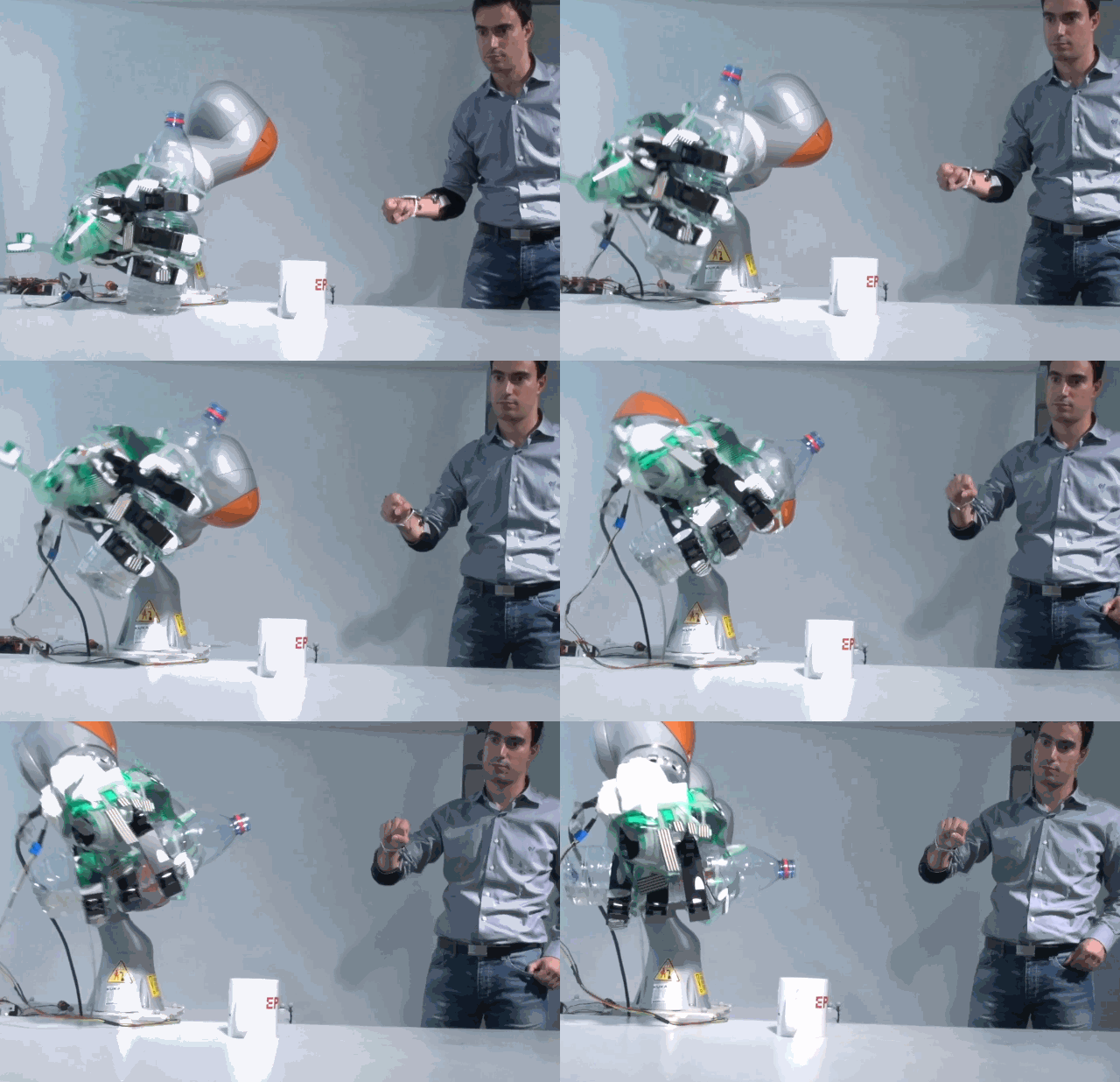
Here’s where researchers from École Polytechnique Fédérale de Lausanne (EPFL) take over. Being limited to telling the hand to grip or release isn’t a problem if the hand knows what to do next — sort of like how our natural hands “automatically” find the best grip for an object without our needing to think about it. Robotics researchers have been working on automatic detection of grip methods for a long time, and it’s a perfect match for this situation.

epfl roboarm

Prosthesis users train a machine learning model by having it observe their muscle signals while attempting various motions and grips as best they can without the actual hand to do it with. With that basic information the robotic hand knows what type of grasp it should be attempting, and by monitoring and maximizing the area of contact with the target object, the hand improvises the best grip for it in real time. It also provides drop resistance, being able to adjust its grip in less than half a second should it start to slip.

The result is that the object is grasped strongly but gently for as long as the user continues gripping it with, essentially, their will. When they’re done with the object, having taken a sip of coffee or moved a piece of fruit from a bowl to a plate, they “release” the object and the system senses this change in their muscles’ signals and does the same.

It’s reminiscent of another approach, by students in Microsoft’s Imagine Cup, in which the arm is equipped with a camera in the palm that gives it feedback on the object and how it ought to grip it.

It’s all still very experimental, and done with a third-party robotic arm and not particularly optimized software. But this “shared control” technique is promising and could very well be foundational to the next generation of smart prostheses. The team’s paper is published in the journal Nature Machine Intelligence.

13 Sep 2019

Amazon tests a one-tap review system for product feedback

Amazon is testing an easier way for people to leave product feedback with the launch of one-tap ratings. The change is meant to encourage those who don’t have the time, energy or interest in writing reviews to still share their opinion about the product, which benefits the larger Amazon community of shoppers who are reliant on ratings and reviews to make better purchasing decisions.

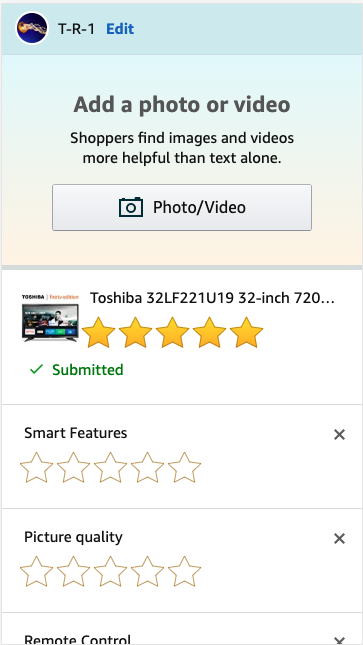
If you have access to the new experiment, you’ll be able to just tap once to leave your star rating on any item, without having to fill out additional fields like a review title and written review, as previously required.

You’ll also be able to access these one-tap ratings from a number of places, including the “Your Orders” page on Amazon where you can tap the “Write a Review” button; by going to a product page directly; or by responding to solicitations sent to you from Amazon or those that appear on the homepage when you log in.

The process of leaving a one-tap review is extremely simple — you just select the star rating and you’ll then see a green checkmark confirming the submission.

Only those one-tap ratings from Verified Purchases will contribute to the product’s overall star rating. You’re also able to expand on your feedback later on, if you choose, by adding a review, photos, or video.

amazon ratings test

The new feature could go a long way towards being able to collect feedback from a larger number of online consumers, as many don’t bother with writing reviews. It could also help balance out the ratings with feedback from real shoppers, as opposed to those who may have been incentivized or paid to leave reviews.

That’s against Amazon policy, of course, and is a practice the retailer has been cracking down on for years — including by outright banning incentivized reviews, by way of multiple lawsuits, fines, and through suspensions of seller accounts. But there are still services out there offering to boost a product’s Amazon reviews through less-than-official tactics. And there are products on Amazon that continue to have suspiciously positive reviews, ranging from weight loss pills to Bluetooth headphones.

Flooding those products with legit reviews from real customers could bring about a more accurate rating, even if Amazon isn’t able to fully flush the scammers from its review community.

The new ratings test is showing both online and in the mobile app worldwide. Not everyone will see the feature at this time as some customers will be in a control group.

Amazon confirmed the new feature is an experiment, not a public launch.

“We are testing a feature that allows customers to leave feedback easily while also helping shoppers get authentic customer ratings on products from a broader set of shoppers,” an Amazon spokesperson said.


13 Sep 2019

Despite tipping policy changes, DoorDash says back pay is not ‘at issue here’

When DoorDash announced changes in its tipping model last month, it was certainly a step in the right direction. Some workers, however, have said it’s not enough. In addition to wanting fair wages, they want back pay.

In light of DoorDash’s announcement, labor group Working Washington said a key question remained: “Will they pay workers backpay for the customer tips the company has been misappropriating since 2017?”

“There’s no ‘back pay’ at issue here because every cent of every tip on DoorDash has always gone and will always go to Dashers,” a DoorDash spokesperson told TechCrunch via email in response to a question about whether or not DoorDash would back pay its delivery workers.

When Instacart changed its tipping practices earlier this year, it also retroactively compensated shoppers when tips were included in the payment minimums. DoorDash, however, does not see the need for back pay.

“An independent third-party research firm has confirmed that Dashers were paid as was explained on our website and in our app: Dashers received a minimum base bay from DoorDash, plus 100% of customer tips, plus additional pay for some orders to reach the guaranteed minimum,” the spokesperson said. “A reminder that under our old model, DoorDash would boost pay if a customer left little or no tip. Although boost pay was intended to help Dashers, we recognize that it also had the unintended effect of making some customers feel like their tips didn’t matter. Under our new model, every dollar a customer tips will be an extra dollar in their Dasher’s pocket.”

Additionally, DoorDash says it will increase the amount it pays on average through base pay and bonuses. Ideally, that will increase overall earnings for Dashers.

“This commitment is incredibly important to us, which is why we’ll be working with that same independent third party to ensure that Dasher earnings under this new model increase,” the spokesperson said.

As DoorDash previously announced, the new payment policies will go into effect this month following feedback from its tests. Since the announcement, however, DoorDash has put $30 million toward a campaign committee to establish a 2020 ballot initiative that would enable companies to provide workers benefits, establish wage commitments and guarantees, offer flexibility and establish that drivers are not employees. Lyft and Uber have also each put $30 million into the initiative. Meanwhile, gig worker protections bill AB5 passed.

AB5 would help to ensure gig economy workers are entitled to minimum wage, workers’ compensation and other benefits by requiring employers to apply the ABC test. The bill, first introduced in December 2018, aims to codify the ruling established in Dynamex Operations West, Inc. v Superior Court of Los Angeles. In that case, the court applied the ABC test and decided Dynamex wrongfully classified its workers as independent contractors.

According to the ABC test, in order for a hiring entity to legally classify a worker as an independent contractor, it must prove the worker is free from the control and direction of the hiring entity, performs work outside the scope of the entity’s business and is regularly engaged in an “independently established trade, occupation, or business of the same nature as the work performed.”

The bill has yet to be signed into law, but Governor Gavin Newsom is expected to do so. Moving forward, we can surely expect DoorDash to continue advocating for its independent worker model. We can also expect organizers from Working Washington to keep advocating for better wages and protections.

13 Sep 2019

Daily Crunch: AR startup Daqri is shutting down

The Daily Crunch is TechCrunch’s roundup of our biggest and most important stories. If you’d like to get this delivered to your inbox every day at around 9am Pacific, you can subscribe here.

1. Another high-flying, heavily funded AR headset startup is shutting down

In an email obtained by TechCrunch, Daqri — which built enterprise-grade AR headsets — told its customers that it’s pursuing an asset sale and will be shutting down its cloud and smart-glasses hardware platforms by the end of September.

Daqri is the latest heavily funded, enterprise-focused augmented reality startup to struggle or shut down recently, with Osterhout Design Group unloading its AR glasses patents earlier this year and Meta selling its assets after it ran out of cash.

2. Apple introduces a ‘grace period’ for lapsed App Store subscriptions

Previously, any lapse in payment could cut off the customer from an app’s subscription-based features. Now, Apple says developers will have the option to offer a “grace period,” giving Apple more time to collect payment.

3. SmileDirectClub makes its debut on the public market

Teeth-straightening company SmileDirectClub rang the opening bell at Nasdaq yesterday, marking its first day of trading as a public company.

4. Element AI raises $151M on a $600-700M valuation to help companies build and run AI solutions

Element AI has built an artificial intelligence systems integrator of sorts, designed to help other companies develop and implement AI solutions.

5. Walmart’s Vudu adds Family Play feature so viewers can skip sex, violence and substance abuse

Vudu viewers can turn filters on and off for sex/nudity, violence, substance abuse and language. In the first three instances, Vudu will skip the relevant scenes, and in the case of strong language, it will mute the dialog.

6. Sidewalk Labs spins out urban data-gathering tool Replica into a company

The Replica tool grew out of Model Lab, a project started two years ago to investigate modeling as a way to address urban problems — specifically the fact that public agencies don’t have all the information needed to understand the connections between transportation and land use.

7. How the Valley can get philanthropy right with former Hewlett Foundation president Paul Brest

When he was named president of the William & Flora Hewlett Foundation, Brest applied the rigor of a legal scholar, not just to his own institution’s practices, but to those of the philanthropy field at large. (Extra Crunch membership required.)

13 Sep 2019

JUMP pulled its bikes from a number of markets in the last few months

Uber -owned JUMP pulled its bikes and scooters from a handful of markets over the last few months. The latest city affected is San Diego, where JUMP’s bikes and scooters will no longer be available as of September 19, with the exception of two naval bases in the city.

“We understand this may have a huge impact on your day-to-day commuting and we regret the fact that we can no longer provide this service to you,” JUMP wrote in an email to its San Diego customers.

The decision was in light of San Diego councilperson Barbara Bry calling for a moratorium on scooters in the city until it could figure out a fiscally responsible and thoughtful plan.

“We agree with local elected officials in San Diego who’ve said current micromobility regulations foster an unsustainable operating environment, which is why we’re ending our operations as of today,” an Uber spokesperson told TechCrunch. “We look forward to working with the city to develop more sensible regulations.”

Earlier this week, JUMP removed its bikes from Providence following acts of vandalism and misuse. This month, JUMP is also removing its bikes from Atlanta after operating in the city for just nine months. Its scooters, however, will remain.

“We are winding down our current JUMP e-bike operations in Atlanta,” an Uber spokesperson told TechCrunch. “We will continue to offer JUMP scooters and look forward to continuing conversations with city leaders on how we can work together to expand transportation options.”

That decision came after Atlanta halted its permitting process for dockless vehicles and implemented a nighttime curfew for them. Meanwhile, JUMP also pulled its bikes from Dallas, San Antonio with no real explanation. In Staten Island, regulatory hurdles forced JUMP to remove its bikes. Since June, JUMP has pulled its bikes from at least six markets.

“Our goal is to make JUMP electric bikes and scooters a sustainable part of the transportation ecosystem,” an Uber spokesperson told TechCrunch. “We currently have JUMP products in over 25 cities worldwide and we make operational decisions on a case by case basis.”

It’s likely those case-by-case decisions are at least partially fueled by unit economics — looking at everything from ridership to vandalism to theft.

Meanwhile, San Francisco seems to remain a solid market for JUMP bikes. In August, JUMP hit one million rides in San Francisco since launching in January 2018 with a total fleet size of 500 bikes. Earlier this year, JUMP touted its high utilization rates in the city compared to docked bike providers.

Uber’s JUMP, of course, is not the only company facing issues with its micromobility operations. In July, Lyft had to pull its e-bikes from San Francisco following apparent battery fires. Then, in August, a Lime bike caught on fire in Seattle. On the positive side for Uber, at least there have not been any reports of its bikes or scooters catching on fire.

This is all to say micromobility is not an easy business. Between regulatory hurdles, potential vandalism and faulty batteries, there are a number of factors that can stand in the way of success.