Category: UNCATEGORIZED

27 Aug 2019

Uber and Lyft drivers are not letting up on the fight for AB-5 and a union

A number Uber and Lyft drivers are protesting outside of Uber’s San Francisco headquarters to demand the passage of Assembly Bill 5 and the right to unionize. This is part of a three-day caravan across California organized by Gig Workers Rising and Mobile Workers Alliance.

“The journey is inspired by the United Farm Workers 1966 pilgrimage from Delano to Sacramento, led by Cesar Chavez,” MWA wrote on its blog. “Like gig workers in California, farm workers were thought to be impossible to organize and their exploitation was taken as a given by the public at large. The UFW proved the doubters wrong and we will too.”

The aim of the caravan is to rally drivers throughout California to advocate for their collective rights and make it clear to legislators they want AB-5 to pass. AB-5 seeks to codify the ruling established in Dynamex Operations West, Inc. v Superior Court of Los Angeles. In that case, the court applied the ABC test and decided Dynamex wrongfully classified its workers as independent contractors based on the presumption that “a worker who performs services for a hirer is an employee for purposes of claims for wages and benefits…”

4161F81F 7DC6 4649 AD06 367947018560

Those who work as 1099 contractors can set their own schedules, and decide when, where and how much they want to work. For employers, bringing on 1099 contractors means they can avoid paying payroll taxes, overtime pay, benefits and workers’ compensation.

According to the ABC test, in order for a hiring entity to legally classify a worker as an independent contractor, it must prove the worker is free from the control and direction of the hiring entity, performs work outside the scope of the entity’s business and is regularly engaged in an “independently established trade, occupation, or business of the same nature as the work performed.”

In short, AB-5, which has already passed in the California State Assembly, would ensure gig economy workers are entitled to minimum wage, workers’ compensation and other benefits.

160CF4EE 43D6 475A 9166 373CAEA3C098

Today represents the third protest at Uber’s HQ since May, when drivers protested ahead of Uber’s IPO. Their demands have remained consistent, asking for better wages, benefits, transparent policies, a voice and the right to form a union.

But neither Lyft nor Uber wants AB-5 pass. Uber says drivers tell the company what they value most is the flexibility to work whenever, wherever and for whomever they want.

“We believe that independent, on-demand workers should not have to sacrifice security to enjoy that flexibility,” an Uber spokesperson told TechCrunch. “That’s why we’ve been working with stakeholders to find a path forward that provides a minimum earnings guarantee for drivers; a robust package of portable benefits they can access no matter which rideshare company they drive for; and meaningful representation that gives them a say on matters affecting their lives and livelihood.”

Similarly, Lyft says it’s advocating for an approach that is in line with the interests of its drivers, which would entail flexibility and benefits.

“That’s why we’ve been working with lawmakers and labor leaders on a different solution, so drivers can continue to control where, when, and how long they drive, while also having some basic protections like a minimum earnings floor, a system of worker-directed portable benefits, and representation,” the spokesperson said.

It’s worth noting that Gig Workers Rising and Mobile Workers Alliance do not represent all drivers. Lyft has shared thousands of messages it says drivers have sent to legislators demanding they protect their flexibility. However, as driver and protest organizer Annette Rivero previously told TechCrunch’s Greg Epstein, “AB5 doesn’t take away anybody’s flexibility, it’s the companies that take away the flexibility. Because I know that that’s something that everyone’s stuck on right now, and it’s a lie. There’s no truth to it.”

Developing…
27 Aug 2019

Kitty Hawk CEO Sebastian Thrun is coming to Disrupt SF

Sebastian Thrun can’t be described easily.

He’s a serial entrepreneur and educator, a computer scientist and inventor. He helped bring self-driving cars out of academia through X, the Google moonshot factory he founded. (That little project is now known as Waymo.) Thrun went on to co-found Udacity, the $1 billion online education startup where he is executive chairman.

Now, Thrun is pushing the “future of transportation” idea beyond self-driving cars. As CEO of Kitty Hawk Corporation, Thrun is working on bringing two aircraft to market — the one-person Flyer and a two-person autonomous taxi called Cora. Boeing and Kitty Hawk recently formed a strategic partnership with Boeing on Cora and more broadly on urban air mobility, particularly around safety and how autonomous and piloted vehicles will co-exist.

We’re excited to announce that Thrun will be joining us onstage at TechCrunch Disrupt SF to give a behind the scenes look at Kitty Hawk and what the future of flight might look like.

Disrupt SF runs October 2 to October 4 at the Moscone Center in San Francisco. Tickets are available here.

Thrun’s visits to Disrupt SF always deliver something new. Who can forget the puppy? This year, we’re focused on flying cars, what they’ll look like, and how Kitty Hawk, which is backed by Google’s Larry Page, will deliver on this promise of the future. 

Did you know Extra Crunch annual members get 20% off all TechCrunch event tickets? Head over here to get your annual pass, and then email extracrunch@techcrunch.com to get your 20% off discount. Please note that it can take up to 24 hours to issue the discount code.

27 Aug 2019

How to move from VP of Sales to CRO with leading exec recruiter David Ives

It wasn’t so long ago that sales meant just showing up with a deck and a smile. These days, it seems that sales leaders almost need a PhD in statistics just to get through the typical day managing a sales funnel. From SQLs and MQLs to NDRR and managing overall retention, the roles of VP of Sales and Chief Revenue Officers (CROs) are evolving rapidly in tandem with the best practices of SaaS startups.

Few people know this world better than David Ives, who is a partner at True Search, one of the top executive recruiting firms in the country where he co-leads the go-to-market practice. David has led countless CRO and VP of Sales searches, and in the process, has learned not just what CEOs and boards are looking for, but also the kinds of skills that candidates need to shine in these important career inflection points.

In our conversation, we talk about the evolving nature of the sales org, how leaders can best position themselves for future advancement, what companies are looking for today in new executive sales hires, and compensation changes in the industry.

This interview has been extensively edited and condensed for clarity

Introduction and background

Danny: Why don’t we start with your background — how did you get into recruiting?

David: So my background was definitely unique. I started as an enterprise sales rep of the truest form selling subscription-based data analytics and systems into capital markets, so into investment banks, trading desks, hedge funds, asset managers, portfolio managers — you name it. Then I drifted purposely, intentionally away from capital markets and did about four different growth technology companies. I landed at NewsCred, and it was a neat time — it was really the birth of the startup landscape with the whole Flatiron district in New York.

Later, I was looking for my next CRO opportunity and was networking with some of the investor folks that I knew. I had a friend of mine who was a talent partner at a private equity firm who said to me, “I’ve always thought that you’d be really good at this and we’re starting to push for our search firms to have operators.” I went and met with Brad and Joe [founders of True], and three weeks later I was in the seat.

Danny: That’s great. And what do you do at True?

David: Well, we moved to a specialization model right when I got here. I don’t know if I was the test case or not, but I didn’t know search, so my skillset was that I knew the role. I run our go-to-market practice with another partner, and we have probably 40, 45 people in that group. We focus exclusively on sales, marketing, customer success, we’ll do biz dev. I probably skew more to CRO than anything else, but I do CMO and VP of marketing as well, and then I do a handful of business development, chief client officers, and VPs of customer success a year. That’s my mix basically.

What is the skillset of a modern CRO?

Danny: You’ve been in the sales leadership space for a long time, and you’ve been in the recruiting space for a couple of years. What are some of the changes that you’re seeing today in terms of candidates, skills, and experiences?

David: I think a big change has been from what I call a backend pipeline manager to what I would call a full funnel manager.

27 Aug 2019

Apple releases first beta of iOS 13.1, indicating iOS 13 is nearly done

Surprise, Apple didn’t release yet another beta version of iOS 13. The company released the first developer beta of iOS and iPadOS 13.1 instead.

This is a curious move as Apple doesn’t usually share beta versions of .1 updates before the release of major updates. What’s even more surprising is that Apple released new beta versions for watchOS 6.0 and tvOS 13.0 today.

Chances are that iOS 13.0 is pretty much done by this point. Usually, Apple releases major versions of iOS a few days after announcing the new iPhone — the press event will likely take place at some point in early September. The company might release iOS 13.0 a bit earlier than expected this year.

Apple removed some minor features in iOS 13 in early beta versions of iOS 13. As MacRumors spotted, many of those features are now back in the beta version of iOS 13.1. Those features include Shortcuts automations and the ability to share your ETA in Apple Maps.

It’s clear that Apple is trying to make iOS 13.0 as stable as possible, even if it means releasing some features a bit later this fall.

27 Aug 2019

Lucid’s drone is built to clean the outside of your house or office

Building exteriors tend to get gross. Dirt clings to the walls. Windows get filmy. Spiderwebs amass. If you live in a particularly humid area, mold and mildew can start to make exterior walls look like a science experiment.

On taller buildings, scrubbing it all off generally means bringing a bucket truck, scaffolding, or suspension gear and having a crew hang from the side of the building. It’s a lot of prep work, with a lot of potential for falls and injuries. Lucid, a new company out of North Carolina, has a different approach: drones.

Rather than pressure washing, their drone “soft washes” the building — be it a house, an office, or the campus library — by spraying a cleaning solution that the company says is biodegradable and works on surfaces like brick and limestone. The operator rolls up to a site, unfolds the drone, powers it up, then plugs it into a tank sitting in the back of their work truck. A hose tether runs from the tank to the drone at all times, feeding the low-pressure sprayer while keeping the bulk of the weight down on the ground. The operator handles the drone via remote control.

The drone is currently battery-powered; in the future, Lucid plans to work tethered power into the design. The company tells me the drone is currently designed/tested to clean buildings up to 120 feet tall. That’s around 11 or 12 stories, depending on the building’s design.

While their early tests were done with off-the-shelf drones, Lucid tells me it’s now custom building its own; they need to be able to carry the weight of the tether, fly slowly for finer controls and easier operation, and stay light enough (under 55 lbs) that it fits within the FAA’s small unmanned aircraft guidelines. The company tells me that their drone weighs around 25-30lbs, depending on payload requirements.

Lucid co-founder Andrew Ashur says they originally set out to be the service provider, hiring operators and cleaning the buildings themselves. When they began testing the concept and other companies started reaching out, the team realized that they might be better off selling the drone itself. They’re now starting to rent the drones out to companies for $3,000 per month, which includes support, training, and maintenance (because, as any hobbyist drone pilot could tell you, things break.)

Lucid is part of Y Combinator’s Summer 2019 batch. As of YC Demo Day last week, the company noted that it had signed contracts worth around $33,000 per month in recurring revenue.

Ashur tells me that while they’re considering a nationwide rollout, their focus right now is on the Southeastern United States — it’s where they started, and where mold and mildew issues are common.

27 Aug 2019

Daily Crunch: Smartphone sales decline again

The Daily Crunch is TechCrunch’s roundup of our biggest and most important stories. If you’d like to get this delivered to your inbox every day at around 9am Pacific, you can subscribe here.

1. Smartphone sales declined again in Q2, surprising no one

After years of growth, the smartphone market’s recent slide has continued in the second quarter of 2019, according to Gartner.

It’s not a huge decline — 1.7% year over year — but this could turn into an ongoing problem for manufacturers. And the biggest hit is coming at the high end of the market, as higher prices combine with longer refresh cycles and fewer compelling features.

2. Yelp will let users personalize their homepage and search results

If you’re a vegetarian, or if you’re a parent who’s usually looking for kid-friendly restaurants, you no longer have to reenter that information every time you do a search. Instead, you can enter it once and Yelp will prioritize those results moving forward.

3. Ron Johnson’s e-commerce startup Enjoy raises $150M, expands in U.K.

Through partnerships with other companies, including AT&T, Sonos, Google and now EE, Enjoy creates an online mobile store where customers can shop for devices and receive same-day delivery. They can also opt to have an Enjoy expert deliver the item and help them get set up, free of charge.

Fairphone main Google

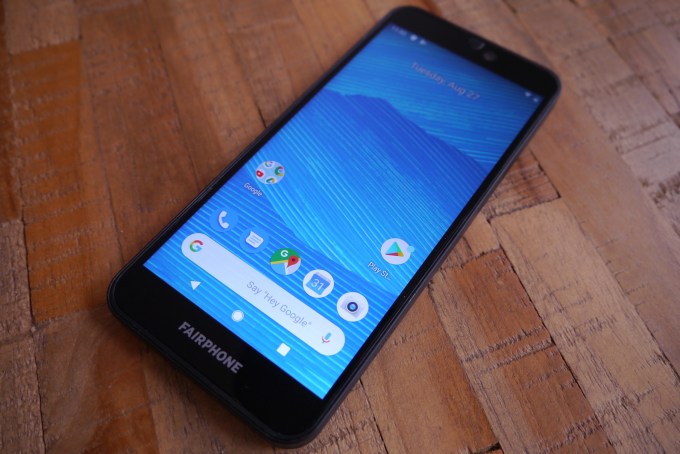
Fairphone 3 running Android 9 out of the box

4. Can Fairphone 3 scale ethical consumer electronics?

Fairphone, the Dutch social enterprise that’s on a mission to rethink the waste and exploitation that underpins the business of consumer electronics, announced its third smartphone today.

5. Facebook is working with HackerOne on a bug bounty program for its Libra cryptocurrency

Facebook is moving ahead with its cryptocurrency project, even as government regulators have called for the company to suspend it while they assess its legality.

6. The BBC is developing a voice assistant, code named ‘Beeb’

Why is a publicly funded broadcaster ploughing money into developing a voice assistant? A BBC spokesperson said the intent is to “experiment with new programmes, features and experiences without someone else’s permission to build it in a certain way.”

7. How to use Amazon and advertising to build a D2C startup

In-depth tips from VMG Ignite, a consultancy that’s worked with dozens of direct-to-consumer startups trying to both find product-market fit and achieve scale through Amazon and online advertising. (Extra Crunch membership required.)

27 Aug 2019

Through crowdsourcing, Cerberus Interactive wants to take location based gaming to the masses

Sami Khan began his work in the startup world by marketing mobile-based investment services like Acorns.

Now the marketer who helped grow that business to a nearly $1 billion valuation is turning his attention to location based gaming in the hopes that he can take on leading contender, Niantic, with a faster, more flexible, and fan driven approach to game development with his new startup, Cerberus Interactive.

Khan’s pitch is that he’s taking the skills he’d honed building up services like Acorns or the browser extension for bargain hunters, Honey, to game development to make games more viral from their inception.

The biggest thing is how do you de-risk what is perceived as a hit driven industry?” Khan asks. “Games are closer to digital apps than back in the days of the console and companies should ship it like an ecommerce concept… If adoption of the game is going to be the decision factor of whether a game fails or succeeds…why isn’t the adoption fo the game tested before the title is built or while the game is being conceived?”

So for his first foray into gaming, Khan is combining a crowd-sourced approach to the development of the game and applying it to what many people think is gaming’s next big frontier —  the location based game phenomenon that hit its stride with Niantic’s Pokemon GO.

Right now in location based games you have the behemoth which is Niantic,” says Khan. “Right now the gaming industry looks at location based games as its own sub genre. But when we look at location based games, we believe that location based games have an aspect that it is a game mechanic within other games.” 

The first game that Cerberus is developing is a base building simulator akin to a title like “Age of Empires” but based on real-world locations. “Simulation games or casual games with location built in will have a bonus or an advantage over the stationary games that we play today,” says Khan.

The “Atlas Empires” title that Cerberus is currently developing is being made in concert with the gamers who might want to play it. So far, an undisclosed number of customers are already paying to have a say in certain aspects of the game’s development — kind of like a premiere tier within a crowdfunding campaign.

Khan, a New Orleans native who splits his time between Los Angeles and Austin, has enlisted some marquee investors in his bid to challenge both the traditional ways in which games have been developed and the current industry leader.

Strategic investor MobilityWare has signed on to back the company along with individual investors like Steve Huffman, the co-founder and chief executive of Reddit, and Blake Chandler, the chief business officer of the runaway social network hit, TikTok.

Khan traces his love of games to his time visiting his cousins in Bangladesh and playing “Prince of Persia” on an early Toshiba laptop. “I remember sitting around the computer, watching my oldest cousin play because my dad didn’t want any of the kids touching the laptop,” Khan says.

So far the beta version of “Atlas Empires” has had 50,000 downloads and has about 1,000 daily players, Khan says. The commercial version of the game is expected to go live in the first quarter of 2020, says Khan.


27 Aug 2019

Anthony Levandowski, former Google engineer at center of Waymo-Uber case charged with stealing trade secrets

Anthony Levandowski, the former Google engineer and serial entrepreneur who was at the center of a trade secrets lawsuit between Uber and Waymo, has been indicted by a federal grand jury on theft of trade secrets.

The indictment, which is posted below, charges Levandowski with 33 counts of theft and attempted theft of trade secrets while working at Google, where he was an engineer and one of the founding members of the group that worked on Google’s self-driving car project. He is scheduled to be arraigned on the charges on August 27 at 1:30 p.m. before U.S. Magistrate Judge Nathanael M. Cousins.

If convicted, Levandowski faces a maximum sentence of 10 years and a fine of $250,000, plus restitution, for each violation.

TechCrunch has reached out to Pronto AI, Levandowksi’s new startup, for comment. We will update the story once the company, Levandowksi or his attorneys respond.

The charges stem from Levandowski’s time at Google’s self-driving project, where he led its light detecting and ranging (lidar) engineering team, according to the indictment. The indictment alleges that in the months before his departure, Levandowski downloaded from secure Google repositories numerous engineering, manufacturing, and business files related to Google’s custom lidar and self-driving car technology. Levandowski worked on the project from 2009 until he resigned from Google without notice on January 27, 2016.

Levandowski left Google and started Otto, a self-driving trucking company that was then bought by Uber. Waymo later sued Uber for trade secret theft.

Waymo alleged in the suit, which went to trial, that Levandowski stole trade secrets, which were then used by Uber.  The case went to trial, but was settled in February 2018. Under the settlement, Uber has agreed to not incorporate Waymo’s confidential information into their hardware and software. Uber also agreed to pay a financial settlement which included 0.34% of Uber equity, per its Series G-1 round $72 billion valuation. That calculated at the time to about  $244.8 million in Uber equity.

“We have always believed competition should be fueled by innovation, and we appreciate the work of the U.S. Attorney’s Office and the FBI on this case,” a A Waymo spokesperson said in a statement provided to TechCrunch.

The prosecution is being handled by the Office of the U.S. Attorney, Northern District of California’s new Corporate Fraud Strike Force and is the result of an investigation by the FBI.

“All of us have the right to change jobs,” said U.S. Attorney David L. Anderson, “none of us has the right to fill our pockets on the way out the door.  Theft is not innovation.”

This is a developing story.

Levandowski Indictment by TechCrunch on Scribd

27 Aug 2019

Hulu redesigns its iOS app for better discovery

At this year’s CES event, Hulu announced plans to trial an updated version of its user interface that would do away with the confusing landing page called “Lineup.” At the time, the company said it was considering both  “Hulu Picks” option or an “Unwatched in My Stuff” screen as a replacement for “Lineup.” Today, Hulu’s new interface is rolling out across iOS devices, the company says.

The Hulu interface launched in 2017 was not always well-liked — something Hulu had acknowledged after a complaint became the most upvoted item on Hulu’s customer feedback forums a couple of years ago. Users felt the interface was too difficult to navigate and the layout was confusing, among other things.

Some of Hulu’s challenges were around the fact that it was trying to merge an on-demand library with a live TV service, while also finding room to promote its original content.

But some of its other design choices were just odd — like its decision to make a single piece of content the main focus for many of its screens, for example. Meanwhile, its landing page “Lineup” never really made sense, either. Its name hinted at some form personalization, but instead, it was more often filled with suggestions of what Hulu was promoting, like “The Handmaid’s Tale.”

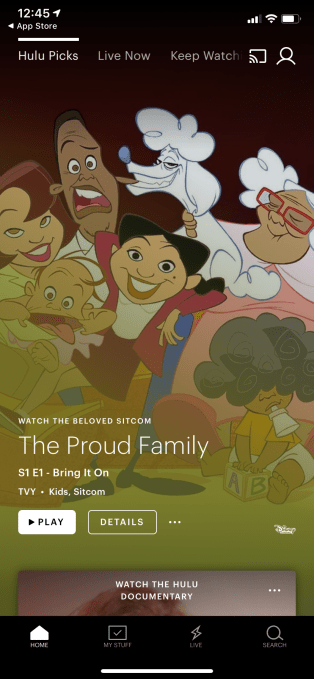
The updated iOS interface ditches “Lineup,” and replaces it with “Hulu Picks.” This is more clearly a collection of things to watch that’s curated by Hulu staff, rather than algorithmically derived by user viewing behavior.

Image from iOS 7

However, the other landing page Hulu had been considering, “Unwatched in My Stuff,” is still available, just a few swipes over.

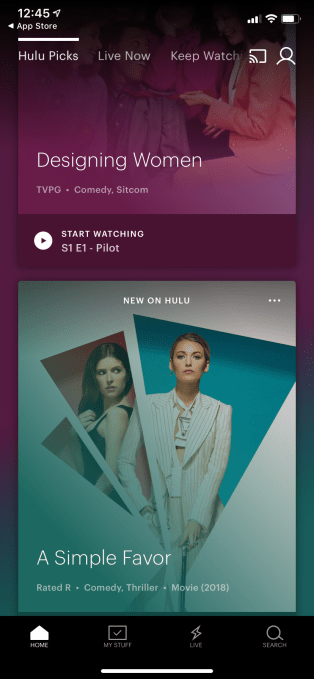
While Hulu still gives a single piece of content the focus on its main screens on the iPhone, it’s now easier to see there’s more content available if you swipe down, as the top of the next item’s card is peeking up from the bottom of the screen.

On iPhone, this means you can see two items at a time. On iPad, you can see two rows totaling 6 cards on the app’s main screen when in landscape mode.

Image from iOS 8

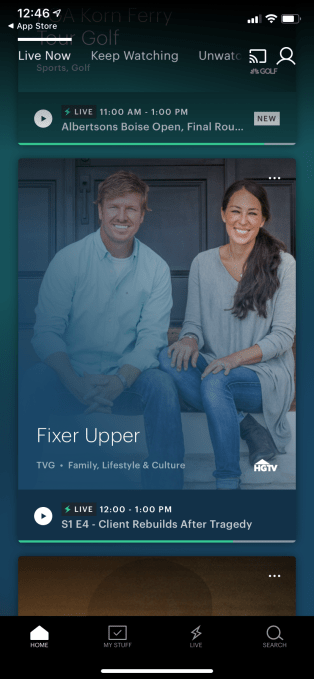
This same format applies not only to “Hulu Picks,” but also to neighboring screens like “Live Now,” “Unwatched in My Stuff,” “My Channels,” and the genre-based sections like “Sports,” “News,” “TV,” “Movies,” “Kids,” “Hulu Originals,” and others. Ony the “Keep Watching” screen retains the more traditional thumbnails.

This seems like a small change, but it goes a long way to increase the discoverability of Hulu content, as it reduces how many times you have to swipe to see more suggestions.

Image from iOS 6

Other changes touted at CES like adding expanded metadata next to content (genre, rating, year) or the ability to mark content as “unwatched” haven’t made an appearance. (Plenty of items still lack a rating). The 14-day live TV guide mentioned at CES isn’t available on iOS, either.

Hulu didn’t publicly announce the launch of the iOS redesign, but did confirm it’s rolling out now, only to iOS. They said other devices will get the update “soon.”

27 Aug 2019

SAP covers hot topics at TechCrunch’s Sept. 5 Enterprise show in SF

You can’t talk enterprise software without talking SAP, one of the giants in a $500 billion industry. And not only will SAP’s CEO Bill McDermott share insights at TC Sessions: Enterprise 2019 on September 5, but the company will also sponsor two breakout sessions.

The editors will sit down with McDermott and talk about SAP’s quick growth due, in part, to several $1B+ acquisitions. We’re also curious to hear about his approach to acquisitions and his strategy for growing the company in a quickly changing market. No doubt he’ll weigh in on the state of enterprise software in general, too.

Now about those breakout sessions. They run in parallel to our Main Stage set and we have a total of two do-not-miss presentations for you to enjoy. On September 5, you’ll enjoy 3 breakout sessions – 2 from SAP and one from Pricefx. You can check out the agenda for TC Sessions: Enterprise, but we want to shine the light on the sponsored sessions to give you a sense of the quality content you can expect.

  • Innovating for a Super-Human Future 
    Martin Wezowski (SAP)
    We talk about change, but what are the mechanics and the dynamics behind it? And how fast is it? The noted futurist will discuss what it means to be an innovator is transforming faster than before, and this transformation is deeply rooted in the challenges and promises between cutting edge tech and humanism. The symbiosis between human creativity & empathy and machine intelligence opens new worlds for our imagination in a time when “now” has never been so temporary, and helps us answer the question: “What is human, and what is work in a superhuman future?” (Sponsored by SAP)
  • Pricing From Day One
    Madhavan Ramanujam (Simon Kucher and Partners, Gabriel Smith) and Darius Jakubik (Pricefx) A key ingredient distinguishing top performing companies is clear focus on price. To maximize revenue and profits, pricing should be a C level / boardroom consideration. To optimize pricing, you should think about price when determining which products and features to bring to market; put the people, process and technology in place to optimize it; and maintain flexibility to adjust strategy and tactics to respond to changing markets. By doing so, companies unlock the single greatest profit lever that exists. (Sponsored by Pricefx)
  • Cracking the Code: From Startup to Scaleup in Enterprise Software 
    Ram Jambunathan (SAP.iO), Lonnie Rae Kurlander (Medal), Caitlin MacGregor (Plum) and Dimitri Sirota (BigID) The startup journey is hard. Data shows that 70% of upstart tech companies fail, while only 1% of these startups will go on to gain unicorn status. Success in enterprise software often requires deep industry experience, strong networks, brutally efficient execution, and a bit of luck. This panel brings together three successful SAP.iO Fund-backed enterprise startups for an open discussion on lessons learned, challenges of scaling, and why the right strategic investors or partners can be beneficial even at early-stages. (Sponsored by SAP)

TC Sessions: Enterprise 2019 takes place in San Francisco on September 5. It’s a jam-packed day (agenda here) filled with interviews, panel discussions and breakouts — from some of the top minds in enterprise software. Buy your ticket today and remember: you receive a free Expo-only pass to TechCrunch Disrupt SF 2019 for every ticket you buy.