Category: UNCATEGORIZED

23 Aug 2019

India exempts startups from long-standing ‘angel tax’

India today addressed a long-standing challenge that has been affecting the country’s booming startup ecosystem. As part of a raft of measures to boost overall economic growth from a five-year low, Finance Minister Nirmala Sitharaman said New Delhi is exempting startups from Section 56(2) — a provision more popularly known as an “angel tax” in the local income tax laws — that required startups to pay a certain tax if they received an investment at a rate higher than their “fair market valuation.”

Local tax authority in India does not recognize the discounted cash flow method that many investors use to value early-stage startups, and instead value the company for what it is worth currently, which as you can imagine, is very little. Investors assess a startup’s value based on what it could eventually become in the future.

Prior to today’s announcement, the government levied a 30% tax on affected startups. Sitharaman said any startup that is registered with the Department of Industrial Policy & Promotion, a government body, will be exempted from the angel tax. Those not registered will remain subjected to it, she said in a press conference Friday.

More than 24,000 startups are currently registered with the Department of Industrial Policy & Promotion. The law was originally introduced amid concerns that wealthy people could invest in bogus startups as a way to launder money.

“Angel tax was there to stop shell companies from creating capital from nowhere,” Piyush Goyal, a minister for commerce and industry as well as railways, said in a statement Friday.

The angel tax, which was introduced in 2012, impacted only the local investors, becoming a roadblock for many citizens from funding early-stage startups. The announcement today comes weeks after the Narendra Modi government said it would address this issue.

Many prominent investors, startup founders, analysts and other industry executives have long publicly criticized the angel tax, telling the government that it is severely hurting the health of the local ecosystem.

Anand Mahindra, chairman of Mahindra Group, said last year that the angel tax needs “immediate attention or else all chances of building a rival to Silicon Valley in India will be lost.”

Sreejith Moolayil, a founder of health food startup True Elements, said the existence of an angel tax would leave many entrepreneurs like him with no choice but to shut down their companies.

Late last year, India’s tax department sent a flurry of notices to startups demanding them to pay the angel tax on funds they received from individual investors. The notices sparked an uproar, with many calling it “harassment.”

“Hope this will address the concerns of DPIIT registered startups. The proposed cell should look into concerns of all startups including those who are already under notice,” said Ashish Aggarwal, who oversees Public Policy at industry body Nasscom, of today’s announcement.

The government will also set up a dedicated cell to address other tax problems that startups face, Sitharaman said. “A startup having any income-tax issue can approach the cell for quick resolution,” the ministry said in a statement.

Jayanth Kolla, founder and chief analyst at research firm Convergence Catalyst, told TechCrunch earlier that the angel tax was the primary reason early-stage startups in the nation were struggling to raise money from investors.

Even as Indian tech startups raised a record $10.5 billion in 2018, early-stage startups saw a decline in the number of deals they participated in and the amount of capital they received. Early-stage startups participated in 304 deals in 2018 and raised $916 million in funds last year, down from $988 million they raised from 380 rounds in 2017 and $1.096 billion they raised from 430 deals the year before, research firm Venture Intelligence told TechCrunch.

Sitharaman also announced the country was scrapping a recently introduced additional levy on foreign funds. The government would revoke the surcharge, which increased tax on foreign companies investing in India to over 40%, she said. She also promised to pay out all pending tax refunds owed to small and medium enterprises within 30 days. Companies have long complained that the tax authority takes too much time to refund the money owed to them.

23 Aug 2019

The 2020 Chevy Bolt EV now has a 259-mile range thanks to some cell chemistry tinkering

The 2020 Chevy Bolt EV now has 259 miles of range, a 9% increase from previous year models of the electric hatchback, according to the EPA.

To get there, the company focused on cell chemistry, not the battery pack. The GM brand did not add more battery cells or change the battery pack or the way it is integrated into the vehicle structure, a spokesperson confirmed.

Instead, Chevrolet’s battery engineering team made what the company described as “impactful changes to the cell chemistry.” The changes to the cell chemistry allowed the team to improve the energy of the cell electrodes, and ultimately enabled them to squeeze more range out of the battery.

The increase pushes the 2020 Chevy Bolt ahead of the Kia Niro and the standard range plus variant of the Tesla Model 3, with 239 and 240 miles of range respectively. Other versions of the Model 3, the long range and performance, have a much longer 310-mile range. It’s also just one mile better than the 258-mile range Hyundai Kona EV. Nissan Leaf Plus, the laggard in the group, can travel 226 miles on a single charge.

That might not seem like much. But in this small, yet growing pool of electric vehicle models, jumping from 238 to 259 miles  could help Chevrolet sell more Bolt EVs next year. It could also cannibalize sales this year.

The electric vehicle has never been a top seller for the GM brand, particularly compared to its top-selling SUVs and trucks. It has beat out some of its other Chevy models and sales are high enough for the company to stick with the compact hatchback for now.

GM delivered 23,297 Chevy Bolt EVs in 2017, the first model year of the electric vehicle. But the following year, deliveries fell 22% to 18,019. Sales have rebounded in the first half of the year.

The 2020 model year, which will be offered in two new exterior colors, is expected to arrive in dealerships later this year. The base price of the electric vehicle is $37,495, which includes destination and freight charges. Tax, title, license and dealer fees are excluded.

23 Aug 2019

Verified Expert Growth Marketing Agency: Torch

CEO Jeremy OBriant never intended to create Torch, an agile growth marketing agency based in San Francisco. He started his career as a CPA, but after leading a growth team at Sidecar and running growth projects on his own, forming Torch was the most obvious thing to do. He now leads a team that implements “agile growth,” an iterative approach that involves setting clear goals and running smaller experiments over the course of monthly sprints. Learn more about their approach to growth, their ideal client, and more.

“Torch offers custom solutions to whatever you need. They are fast and deliver on what they promise. They are also scrappy and willing to try stuff to solve unique needs.” Head of Product in SF

Torch’s approach to growth

We aim to be the thought leaders of Agile Growth. We didn’t invent the term, but we are certainly becoming the leading voice of the process in the growth marketing world. Agile simply means being able to move quickly and with ease. We start with clearly defined business goals and prioritize growth tactics based on the impact, cost, and efficiency. Then collaborate with growth teams to execute a handful of items in recurring growth sprints, typically on a monthly cadence.”

On their ideal client

“Our ideal partner has product-market fit, is redefining their category, and is ready to scale in a sustainable way. We are very strategic in the types of businesses we work with and steer clear of doing narrow prescriptive tactics. We love to collaborate with partners that are open to taking a fresh strategic look at their entire growth stack and embrace the agile approach to discover the right strategy for their unique situation.”

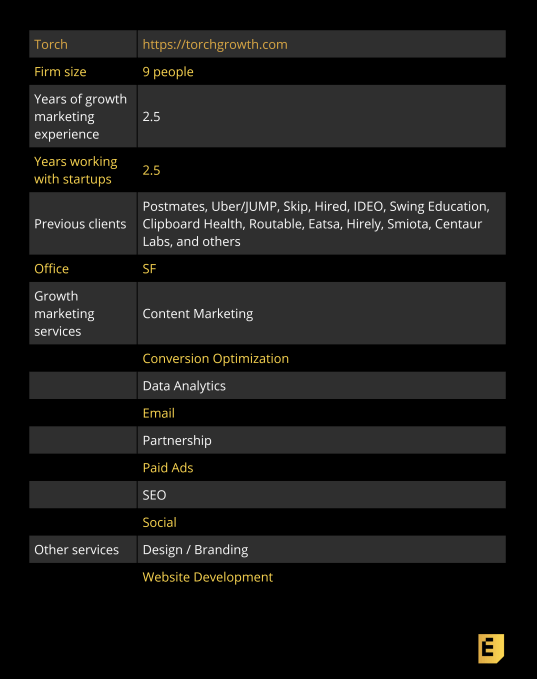
designer fast facts 37

Below, you’ll find the rest of the founder reviews, the full interview, and more details like pricing and fee structures. This profile is part of our ongoing series covering startup growth marketing agencies with whom founders love to work, based on this survey and our own research. The survey is open indefinitely, so please fill it out if you haven’t already. 

Interview with Torch CEO Jeremy OBriant

Jeremy OBriant

Yvonne Leow: Tell me about your background and how you became a growth marketer. 

Jeremy OBriant: People are often surprised when I tell them I started my career as a CPA. I ended up working in the trenches on several M&A deals and heard lots of founding stories from entrepreneurs.

23 Aug 2019

Facebook really doesn’t want you to read these emails

Oh hey y’all, it’s Friday! It’s August! Which means it’s a great day for Facebook to drop a little news it would prefer you don’t notice. News that you won’t find a link to on the homepage of Facebook’s Newsroom — which is replete with colorfully illustrated items it does want you to read (like the puffed up claim that “Now You Can See and Control the Data That Apps and Websites Share With Facebook”.)

The blog post Facebook would really prefer you didn’t notice is tucked away in a News sub-section of this website — where it’s been confusingly entitled: Document Holds the Potential for Confusion. And has an unenticing grey image of a document icon to further put you off — just in case you happened to stumble on it after all. It’s almost as if Facebook is saying ‘definitely don’t click here‘…

ca update grey

So what is Facebook trying to bury in the horse latitudes of summer?

An internal email chain, starting September 2015, which shows a glimpse of what Facebook’s own staff knew about the activity of Cambridge Analytica prior to The Guardian‘s December 2015 scoop — when the newspaper broke the story that the controversial (and now defunct) data analytics firm, then working for Ted Cruz’s presidential campaign, had harvested data on millions of Facebook users without their knowledge and/or consent, and was using psychological insights gleaned from the data to target voters.

Facebook founder Mark Zuckerberg’s official timeline of events about what he knew when vis-a-via the Cambridge Analytica story has always been that his knowledge of the matter dates to December 2015 — when the Guardian published its story.

But the email thread Facebook is now releasing shows internal concerns being raised almost two months earlier.

This chimes with previous (more partial) releases of internal correspondence pertaining to Cambridge Analytica  — which have also come out as a result of legal actions (and which we’ve reported on previously here and here).

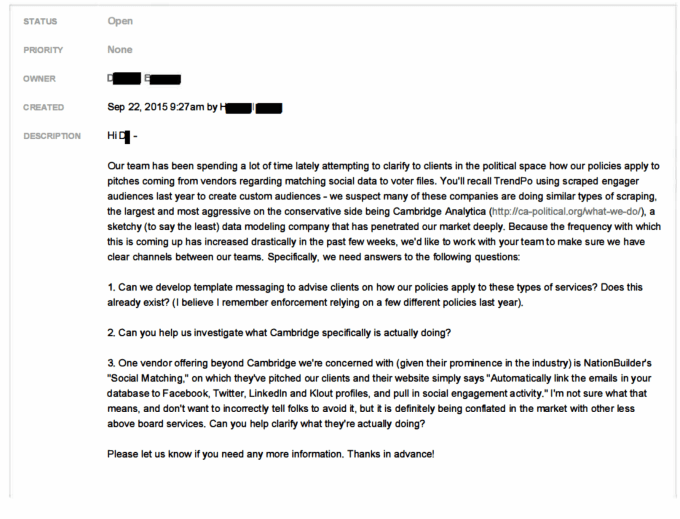
If you click to download the latest release, which Facebook suggests it ‘agreed’ with the District of Columbia Attorney General to “jointly make public”, you’ll find a redacted thread of emails in which Facebook staffers raise a number of platform policy violation concerns related to the “political partner space”, writing September 29, 2915, that “many companies seem to be on the edge- possibly over”.

Cambridge Analytica is first identified by name — when it’s described by a Facebook employee as “a sketchy (to say the least) data modelling company that has penetrated our market deeply” — on September 22, 2015, per this email thread. It is one of many companies the staffer writes are suspected of scraping user data — but is also described as “the largest and most aggressive on the conservative side”.

Screenshot 2019 08 23 at 16.34.15

On September 30, 2015, a Facebook staffer responds to this, asking for App IDs and app names for the apps engaging in scraping user data — before writing: “My hunch is that these apps’ data-scraping is likely non-compliant”.

“It would be very difficult to engage in data-scraping activity as you described while still being compliant with FPPs [Facebook Platform Policies],” this person adds.

Cambridge Analytica gets another direct mention (“the Cambridge app”) on the same day. A different Facebook staffer then chips in with a view that “it’s very likely these companies are not in violation of any of our terms” — before asking for “concrete examples” and warning against calling them to ask questions unless “red flags” have been confirmed.

On October 13, a Facebook employee chips back into the thread with the view that “there are likely a few data policy violations here”.

The email thread goes on to discuss concerns related to additional political partners and agencies using Facebook’s platform at that point, including ForAmerica, Creative Response Concepts, NationBuilder and Strategic Media 21. Which perhaps explains Facebook’s lack of focus on CA — if potentially “sketchy” political activity was apparently widespread.

On December 11 another Facebook staffer writes to ask for an expedited review of Cambridge Analytica — saying it’s “unfortunately… now a PR issue”, i.e. as a result of the Guardian publishing its article.

The same day a Facebook employee emails to say Cambridge Analytica “is hi pri at this point”, adding: “We need to sort this out ASAP” — a month and a half after the initial concern was raised.

Also on December 11 a staffer writes that they had not heard of GSR, the Cambridge-based developer CA hired to extract Facebook user data, before the Guardian article named it. But other Facebook staffers chip in to reveal personal knowledge of the psychographic profiling techniques deployed by Cambridge Analytica and GSR’s Dr Aleksandr Kogan, with one writing that Kogan was their postdoc supervisor at Cambridge University.

Another says they are friends with Michal Kosinsky, the lead author of a personality modelling paper that underpins the technique used by CA to try to manipulate voters — which they described as “solid science”.

A different staffer also flags the possibility that Facebook has worked with Kogan — ironically enough “on research on the Protect & Care team” — citing the “Wait, What thread” and another email, neither of which appear to have been released by Facebook in this ‘Exhibit 1’ bundle.

So we can only speculate on whether Facebook’s decision — around September 2015 — to hire Kogan’s GSR co-founder, Joseph Chancellor, appears as a discussion item in the ‘Wait, What’ thread…

Putting its own spin on the release of these internal emails in a blog post, Facebook sticks to its prior line that “unconfirmed reports of scraping” and “policy violations by Aleksandr Kogan” are two separate issues, writing:

We believe this document has the potential to confuse two different events surrounding our knowledge of Cambridge Analytica. There is no substantively new information in this document and the issues have been previously reported. As we have said many times, including last week to a British parliamentary committee, these are two distinct issues. One involved unconfirmed reports of scraping — accessing or collecting public data from our products using automated means — and the other involved policy violations by Aleksandr Kogan, an app developer who sold user data to Cambridge Analytica. This document proves the issues are separate; conflating them has the potential to mislead people.

It has previously also referred to the internal concerns raised about CA as “rumors”.

“Facebook was not aware that Kogan sold data to Cambridge Analytica until December 2015. That is a fact that we have testified to under oath, that we have described to our core regulators, and that we stand by today,” it adds now.

It also claims that after an engineer responded to concerns that CA was scraping data and looked into it they were not able to find any such evidence. “Even if such a report had been confirmed, such incidents would not naturally indicate the scale of the misconduct that Kogan had engaged in,” Facebook adds.

The company has sought to dismiss the privacy litigation brought against it by the District of Columbia which is related to the Cambridge Analytica scandal — but has been unsuccessful in derailing the case thus far.

The DC complaint alleges that Facebook allowed third-party developers to access consumers’ personal data, including information on their online behavior, in order to offer apps on its platform, and that it failed to effectively oversee and enforce its platform policies by not taking reasonable steps to protect consumer data and privacy. It also alleges Facebook failed to inform users of the CA breach.

Facebook has also failed to block another similar lawsuit that’s been filed in Washington, DC by Attorney General Karl Racine — which has alleged lax oversight and misleading privacy standards.

23 Aug 2019

Nonprofits and NGOs: Exhibit at TechCrunch Disrupt SF 2019

Nonprofit groups and NGOs are now invited to apply for exhibit space in Startup Alley at TechCrunch Disrupt SF on Friday, October 4th.

Founded in 2014, TechCrunch Include leverages our extensive network to support underserved and underrepresented groups in tech. Two years ago, we began to invite nonprofit and NGO groups to exhibit at the conference, as well as provide tickets for the event. This year, TechCrunch will host 10 nonprofits or NGOs at the Moscone Center at Startup Alley inside Disrupt SF.

TechCrunch Disrupt’s Startup Alley is the heart of the conference show floor. Filled with early-stage startups, Startup Alley is the prime location to connect with startups, network with investors and engage with more than 100 corporate partners at the show. Participation in the Alley will give nonprofits and NGOs a unique opportunity to engage with the brightest tech talent, entrepreneurs and prominent investors from around the globe. Not to mention hundreds of press in attendance!

Nonprofits and NGOs are eligible if they support an underrepresented or underserved community in tech, have registered 501c3 or an equivalent status for at least three years and did not participate at a TC Disrupt in 2018. Organizations that are selected will be asked to engage with their communities regarding the conference after selection. Preference will be given to local organizations.

Applications are open now til Wednesday September 4th. Groups will be notified of their participation status September 6th. If you have additional questions, please email startupalley@techcrunch.com.

Apply now!

23 Aug 2019

Japan’s ispace now aims for a lunar landing in 2021, and a Moon rover deployment in 2023

One of the private companies aiming to deliver a commercial lunar lander to the Moon has adjusted the timing for its planned mission, which isn’t all that surprising given the enormity of the task. Japanese startup ispace is now targeting 2021 for their first lunar landing, and 2023 for a second lunar mission that will also include deploying a rover on the Moon’s surface.

The company’s ‘HAKUTO-R’ program was originally planned to to include a mission in 2020 that would involve sending a lunar orbital vehicle for demonstration purposes without any payloads, but that part of the plan has been scrapped in favor of focusing all efforts on delivering actual payloads for commercial customers by 2021 instead.

This updated focus, the company says, is due mostly to the speeding up of the global market for private launch services and payload delivery, including for things like NASA’s Commercial Lunar Payload Services program, wherein the agency is looking for a growing number of private contractors to support its own needs in terms of getting stuff to the Moon.

ispace itself isn’t on the list of 9 companies selected in round one of NASA’s program, but the Japanese company is supporting American non-profit Draper in its efforts, which was one fo the chosen. The Draper/ispace team-up happened after ispace’s initial commitment to its 2020 orbital demo, so its change in priorities makes sense given the new tie-up.

HAKUTO-R will use SpaceX’s Falcon 9 for its first missions, and the company has also signed partnerships with JAXA, Japan’s space agency, as well as new corporate partners including Suzuki, Sumitomo Corporation, Shogakukan, and Citizen Watch.

23 Aug 2019

Target’s same-day pickup and delivery services growing at double the rate of 2018

Target’s investment in same-day pickup and delivery options is paying off. The company, which today offers same-day in-store pickup, drive-up, and same-day delivery through its acquisition of Shipt, said this week that these services combined have more than doubled their sales in the last year. In addition, they accounted for more than a third of Target’s digital sales, up from about 20% last year.

“These options offer speed, convenience and reliability and as a result, they are quickly becoming the preferred fulfillment choices for our guests,” said Target CEO Brian Cornell, speaking to investors about Target’s Q2 earnings. “And most importantly, because these options leverage our store infrastructure, technology, and teams, same-day fulfillment delivers outstanding financial performance as well,” he added. 

What’s notable about the same-day sales is that they’re bringing in guests to Target, who had never before placed digital orders with the retailer.

Roughly 1 in 5 customers placing a same-day order in the second quarter were placing an order with Target for the first time.

And once Target customers become familiar with the process, they seem to return in short order. During Q2, more than three-quarters of the same-day orders were placed by guests who had used same-day fulfillment in the past three months.

Target’s ability to grow its same-day sales in this fashion was the result of investment in infrastructure, technology, and even its brick-and-mortar stores themselves.

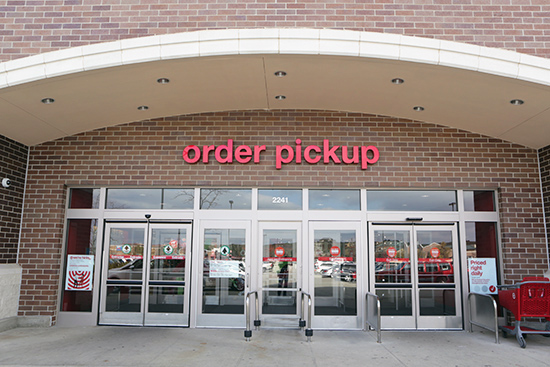
Glenview Order Pickup Entrance Exterior

On the technology front, Target says its pickup and delivery services benefitted from increased order picking efficiency. Instead of using a first-in, first-out (FIFO) system, new algorithms are being used to prioritize the sequence of order picking that helps direct store employees on which work to do first as well as the best box size for packing orders.

The technology also helps to optimize the path for order picking to minimize the number of steps between the sales floor and back room.

Target claims that since the beginning of last year, these improvements have led to an over 30% increase in order picking for drive-up and pickup services. Its ship-from-store capability also improved over 30% during that time.

Meanwhile, the retailer’s $7+ billion remodeling project announced in 2017 was focused more than just updating the stores’ look-and-feel and merchandising displays. The new format stores also include changes designed to cater to online shoppers who come inside the store for their order pickups, by adding more space for things like Order Pickup.

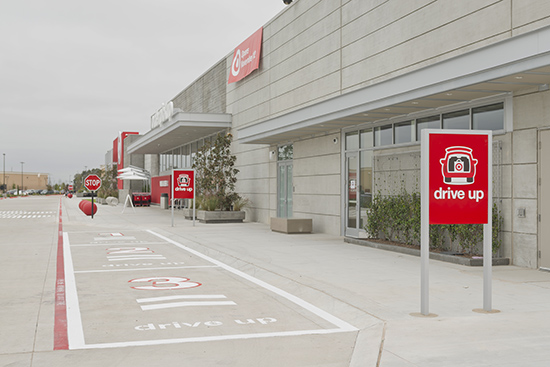
Outside, space is added for Drive Up customers who shop online then later drive to the store for curbside service.

This summer, Target passed its 500th store remodel, and says it’s on-track to remodel 1,000 stores by the end of 2020. It also plans to open up more small-format stores — about a third of the size of a traditional Target, or on average, 40,000 sq ft — in big cities, suburbs, and college campuses.

Target says it plans on opening 30 more small-format stores per year, as it has done last year and the year prior. It said on Friday it had opened its 100th small-format store.

Richmond Drive Up

All the changes to make Target’s stores more of home for order fulfillment has helped the retailer reduce costs, as well, the company pointed out this week on its Q2 earnings.

Target says, as it’s shifted away from upstream distribution centers for order fulfillment to its stores, costs went down by more than 40%. And costs related to same-day services went down by 90%. Target today has 1,855 U.S. stores, which is how it’s able to make this store-centric strategy work.

Many traditional big-box retailers are struggling under the weight of competition from Amazon — Macy’s, Kohl’s and J.C. Penney’s all released disappointing earnings this week, for example.

Target’s earnings, however, beat every estimate this week, sending shares to a record high.

The company reported $18.42 billion in revenue, above the $18.34 billion expected. Profits were up 17% to $938 million ($1.82 a share) compared with $799 million ($1.49 a share), a year ago.

Second-quarter comparable sales grew 3.4 percent, with same-day fulfillment accounts for nearly 1.5 percentage points of that. Over the past two years, comparable sales have grown 10%, Target said.


23 Aug 2019

Sphero has acquired LittleBits

Sphero and Little Bits have long been kindred spirits in the world of entertaining STEM toys, and soon they’ll be one and the same. Sphero this morning announced plans to buy the New York-based electronic building block company.

Founded in 2010 and 2011 respectively, Sphero (nee Orbotix) and Little Bits took separate approaches, but ultimately ended up in similar spaces. Sphero first brought to life a smartphone controlled 3D printed ball that debuted at CES in 2011. That same year, Ayah Bdeir’s electronics kit side project became a serious business under the LittleBits banner.

Both companies were alumni of Disney’s accelerator. Sphero leveraged that connection in the break out Star Wars: The Force Awakens toy, a remote control BB-8. Ultimately, however, it flew too close to the sun with its licensed products, creating an R2-D2, Lightning McQueen and talking Spider-Man toys. Early last year, the Colorado-based company ended the Disney deal, laid off dozen and announced that it was moving full time into educational toys.

After several of its own Marvel and Star Wars licensing deals under the Disney IP banner, LittleBits faced similar difficulties earlier this year. In a statement to TechCrunch, the site noted that it, too, would be experiencing layoffs as it shifted its focus to K-12. “As you can imagine, the education market’s needs are vastly different than that of retail,” the company said at the time. Given this, we had to re-shape our internal structure, which ultimately led to a reduction in staff.”

Per Crunchbase, LittleBits and Sphero have raised $62.3 million and $120.3 million respectively. LittleBits notably made its own acquisition almost exactly a year ago, bringing DIY.org under its banner to add a subscription-based education element to the company’s offerings. Two months prior, Sphero purchased fellow Colorado startup, Specdrums and has since begun to offer the company’s music educational products under its banner.

image001

“We’re thrilled to bring littleBits into the fold here at Sphero,” CEO Paul Berberian told TechCrunch ahead of the acquisition. “Teachers need proven solutions that enhance learning for their students, and kids want technology that allows them to have epic experiences. Now, Sphero is better poised to introduce the best coding tools and hands-on STEAM tools like littleBits to even more classrooms around the world.”

The deal will help Sphero expand its office footprint into New York. Bdeir, however, will be moving on to other projects after nearly a decade at the helm of LittleBits.

“When I studied engineering, it was top down, test-based,” she said in a statement offered to the press. “I hated it and wanted to quit every semester. Then I got exposed to the pedagogy of learning through play and my life changed; no one could peel me away from learning, inventing, creating. Together, littleBits and Sphero are now bringing this experience to kids everywhere.”

No word on how many LittleBits employees will remain under the Sphero banner, though the aforementioned layoffs have certainly decreased the likelihood of redundancy between the two companies. With LittleBits under its wing, Sphero now holds 140 patents in the fields of robotics, electronics, software and IOT. It remains to be seen how or if the lines will work together, or whether they’ll remain independent under the Sphero banner much as Specdrums has thus far.

Between the two brands, however, there’s some solid classroom outreach and goodwill here. And both despite and because of its own struggles, Sphero makes sense as a home for the company. Both have experienced solid growth into beloved brands in a similar timeframe, even while getting ground through the sometimes unforgiving startup grind. Hardware is hard, and both Sphero and LittleBits have the war wounds to prove it.

Terms for the deal have not been disclosed.

23 Aug 2019

The myth of “stage agnostic” investing

Hello and welcome back to Equity, TechCrunch’s venture capital-focused podcast, where we unpack the numbers behind the headlines.

This week we were helmed by Kate Clark, Alex Wilhelm, and yet another extra special guest. Unusual Ventures co-founder and partner John Vironis joined us to talk soil investing (yes, it’s a thing), seed investing, growth investing and all the somewhat meaningless funding stages.

Vrionis was a longtime investor at Lightspeed Venture Partners and has made big bets on a number of companies, including AppDynamics, Heptio, and Mulesoft.

It was a great episode that kicked off with some conversation around DoorDash, the food delivery company that continues to make headlines week after week. We’d like to stop talking about the company, but it intrudes regularly into our notes.

This time DoorDash bought a few companies, purchases that appear set to allow the firm to boost its investment and research into self-driving delivery robots. (Kate saw one in the wild recently!)

Next we went deep into the subject of seed. John, of course, has been a seed investor for years and has lots to say on the topic. Mostly, we discussed Kate’s latest piece on mega-funds making an increasing number of deals at the earliest stage. John doesn’t think “stage-agnostic” investing makes any sense. You need experts at each stage making bets on a specific type of company. In his words, ‘a heart surgeon wouldn’t deliver your baby, right.”

Then we moved onto one of our favorite subjects, namely direct listings, the IPO market, and if money is too often left on the table. The question takes on extra import when we see results like Dynatrace’s IPO, which rose around 50 percent its first day. It seems likely that we’ll see other companies pursue the sort of direct listings that Spotify and Slack managed.

That segued us brilliantly into our final topic: Airbnb and its financial health. The firm, we reckon, is a good candidate for a direct listing itself. We talked over its numbers, and if we were to sum our perspectives, we’d say that Airbnb is about as impressive as we expected.

All that and we had fun, as usual.

Equity drops every Friday at 6:00 am PT, so subscribe to us on Apple PodcastsOvercastSpotify, Pocket Casts, Downcast and all the casts.

23 Aug 2019

Ping Identity files for $100M IPO

Some eight months after it was reported that Ping Identity’s owners Vista Equity had hired bankers to explore a public listing, today Ping Identity took the plunge: the Colorado-based online ID management company Ping Identity has filed an S-1 form indicating that it plans to raise up to $100 million in an IPO.

The company was acquired by Vista in 2016 for about $600 million, and while the initial S-1 filing doesn’t have an indication of price range, the company is said to be looking at a valuation of between $2 billion and $3 billion in this listing.

The area of identity and access management has become a cornerstone of enterprise IT, with companies looking for efficient and secure ways to centralise how their employees, their customers, their partners and various connected devices can be authenticated across their cloud and on-premise applications.

Ping has been one of the bigger companies building services in this area, competing with the likes of Okta, OneLogin, AuthO, aCisco, nd dozens more off-the-shelf and custom-built solutions.

The company offers its services on an SaaS basis, covering services like secure sign-on, multi-factor authentication, API access security, personalised and unified profile directories, data governance and AI-based security policies.

The company has been on a steady growth curve, reporting revenues of $112,898 million in the first six months of 2019, versus $99,450 in the same period a year before. It’s not profitable but its net loss has been shrinking in recent years, with a net loss of just $3.1 million in the first six months of this year versus $5.8 million a year before (notably in 2017 overall it was profitable with a net income of $19 million. It seems that the change is due to acquisitions and investing for growth).

More to come.