Category: UNCATEGORIZED

22 Aug 2019

Oracle directors give blessing to shareholder lawsuit against Larry Ellison and Safra Catz

Three years after closing a $9.3 billion deal to acquire Netsuite, several Oracle board members have written an extraordinary letter to the Delaware Court, approving a shareholder lawsuit against company executives Larry Ellison and Safra Catz over the 2016 deal. Reuters broke this story.

According Reuters’ Alison Frankel, three board members including former U.S. Defense Secretary Leon Panetta, sent a letter on August 15th to Sam Glasscock III, Vice Chancellory for the Court of the Chancellor in Georgetown, Delaware, approving the suit as members of a special Board of Directors entity known as the Special Litigation Committee.

The lawsuit is what is called in legal parlance, a derivative suit. According to the site Justia, this type of suit is filed in cases like this. “Since shareholders are generally allowed to file a lawsuit in the event that a corporation has refused to file one on its own behalf, many derivative suits are brought against a particular officer or director of the corporation for breach of contract or breach of fiduciary duty,” the Justia site explained.

The letter went onto say there was an attempt to settle this suit, which was originally launched in 2017, through negotiation outside of court, but when that attempt failed, the directors wrote this letter to the court stating that the suit should be allowed to proceed.

As Frankel wrote in her article, the lawsuit, which was originally filed by Firemen’s fund could be worth billions:

One of the lead lawyers for the Firemen’s fund, Joel Friedlander of Friedlander & Gorris, said at a hearing in June that shareholders believe the breach-of-duty claims against Oracle and NetSuite executives are worth billions of dollars. So in last week’s letter, Oracle’s board effectively unleashed plaintiffs’ lawyers to seek ten-figure damages against its own members, Frankel wrote

It’s worth pointing out, as we reported at the time of the Netsuite acquisition, that Larry Ellison was involved in setting up Netsuite in the late 1990s and was a major shareholder at the time of the deal.

Oracle was struggling to find its cloud footing in 2016, and it was believed that by buying an established SaaS player like Netsuite, it could begin to build out its cloud business much faster than trying to develop something like it internally. A June Synergy Research SaaS marketshare report, while admitting the market was fragmented, still showed Oracle was far behind the pack in spite of that deal three years ago.
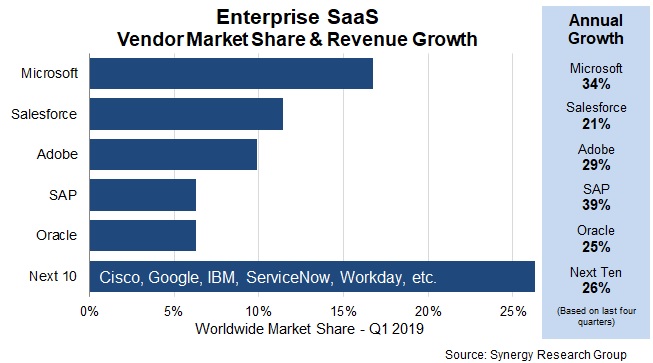
SaaS Q119 1

While there have been bigger deals in tech M&A history, including Salesforce’s acquisition of Tableau for $15.7 billion earlier this year, it’s still stands with some of the largest.

We reached out to Oracle regarding this story, but it declined to comment.


22 Aug 2019

VMware acquires Carbon Black for $2.1B and Pivotal for $2.7 billion

VMware today announced that it is acquiring Carbon Black, a publicly traded security company that focuses on securing modern cloud-native workloads. The price of the acquisition is about $2.1 billion.

In addition, VMware also confirmed the acquisition of Pivotal, which will have a value of about $2.7 billion. VMware’s revenue for the last quarter was $2.44 billion. That’s a big day for VMware.

“Building on another solid quarter, we are thrilled about announcing our intent to acquire Pivotal and Carbon Black,” said VMware CEO Pat Gelsinger in today’s announcement. “These acquisitions address two critical technology VMware, Inc. priorities of all businesses today — building modern, enterprise-grade applications and protecting enterprise workloads and clients. With these actions we meaningfully accelerate our subscription and SaaS offerings and expand our ability to enable our customers’ digital transformation.”

Indeed, these are two very different companies, but both Carbon Black and Pivotal focus on modern workloads. Pivotal focuses on building modern applications, thanks to its Cloud Foundry heritage and recently added support for Kubernetes, while Carbon Black provides the security features necessary to secure modern applications and infrastructures.

The two moves follow the company’s acquisition of Bitnami earlier this year, completing this triquetra of acquisitions that all aim to bring VMware’s technology into a future where VMs are only part of the equation.

Carbon Black was founded in 2002 and went public in early 2018. At the time of the IPO, it’s valuation was about $1.25 billion. Its stock traded as low as under $13 earlier this year, but it has since recovered to over $21. VMware will pay $26 per share in cash for the company and expects the deal to close by the end of January 2020.

“Today marks an exciting milestone for Carbon Black, VMware and the entire cybersecurity industry,” said Patrick Morley, CEO, Carbon Black, in the announcement. “We now have the opportunity to seamlessly integrate Carbon Black’s cloud-native endpoint protection platform into all of VMware’s control points. This type of bold move is exactly what the IT and security industries have been looking to see for a very long time. We look forward to working with the VMware team to continue delivering a modern security cloud platform to customers around the world. Additionally, we’re pleased that today’s transaction provides Carbon Black’s shareholders with immediate and substantial value.”

Updating…

22 Aug 2019

FCC approves $4.9B in funding for rural broadband improvements

The FCC has just approved nearly five billion dollars in subsidies for rural broadband operators to be paid out over the next ten years. Recipients of this windfall will have to “maintain, improve, and expand” their broadband infrastructure, especially in underserved areas.

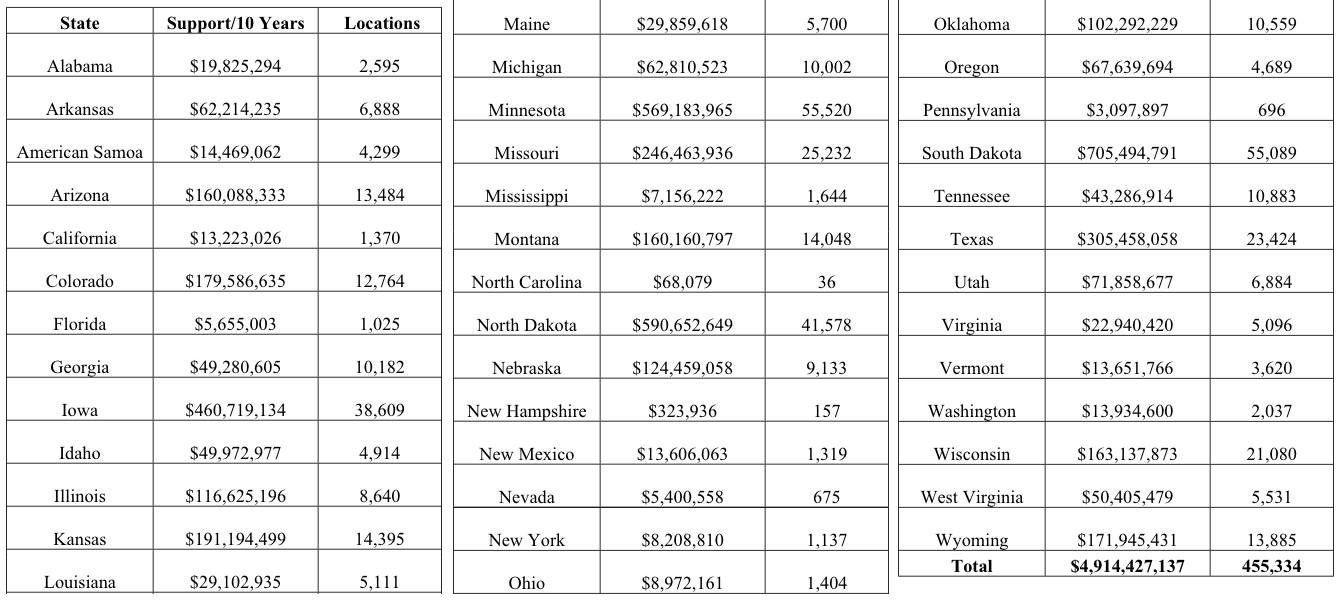
Carriers in 39 states, American Samoa, and many tribal lands will receive varying amounts of funding depending on the number of people they serve, the cost of providing that service, and so on. Naturally states with more people in rural areas receive more cash — you can see how your state made out in the chart below.

To be clear, this isn’t some spontaneous cash drop by the FCC; it has to decide how to distribute the funds it receives from fees and such, and one of the major efforts underway these days is improving rural broadband. But the specifics of how to disburse billions over a decade, who qualifies, how to verify their qualification and compliance with the terms — it’s a complex process and must be negotiated and approved, as this program eventually was.

It’s different, by the way, than CAF II and other funds, which are also directed at rural broadband but different methods, for example working directly with municipalities or contractors. I’ve asked the FCC for a bit more detail and will update if I hear back.

Rural carriers often have higher costs for deployment and maintenance, and have to pass that cost on to their subscribers. Considering rural broadband often has lower speed and reliability than urban connection, these poor folks end up paying more for less. The fund is meant to defray those costs, both for carrier and subscriber. If Uncle Sam is paying half the bill to roll out new fiber, that means the bottom line for Joe Six-Megabit goes down a bit too (ideally). Sure, it’s kind of trickle-down economics, but it doesn’t have to trickle far.

North and South Dakota are getting the lion’s share of the fund, with a combined $1.3 billion headed their way, and some 96,000 homes and businesses to be served. That’s an average of about $13,000 per site over ten years, or $114 per month per site. Sounds reasonable when you work it out that way — this isn’t just a subsidy but an investment.

Iowa, Minnesota, and Texas all are getting quite a bit as well, but don’t be jealous if you’re in, say, California, which is only getting $13 million over a decade to serve 1,300 new sites. There’s plenty of internet money swirling around California — it’s places that have more land than cash that the FCC needs to help out.

Here’s the full list of amounts and locations:

fcc states

22 Aug 2019

HP CEO steps down, citing ‘family health matter’

HP announced this afternoon that Dion Weisler is stepping down as President and CEO. The executive cited a “family health matter” in his decision, noting that he will be returning home to Australia.

The company already has a successor lined up, as its President of Imaging, Printing and Solutions, Enrique Lores, got unanimous approval from its board of directors. Lores will be assuming the top spot on November 1.

Developing….

22 Aug 2019

Frontier technologies are moving closer to the center of venture investment

As the technologies that were once considered science fiction become the purview of science, the venture capital firms that were once investing at the industry’s fringes are now finding themselves at the heart of the technology industry.

Investing in the commercialization of technologies like genetic engineering, quantum computing, digital avatars, augmented reality, new human-computer interfaces, machine learning, autonomous vehicles, robots, and space travel that were once considered “frontier” investments are now front-and-center priorities for many venture capital firms and the limited partners that back them.

Earlier this month, Lux Capital raised $1.1 billion across two funds that invest in just these kinds of companies. “[Limited partners] are now more interested in frontier tech than ever before,” said Bilal Zuberi, a partner with the firm.

He sees a few factors encouraging limited partners (the investors who provide financing for venture capital funds) to invest in the firms that are financing companies developing technologies that were once considered outside of the mainstream.

22 Aug 2019

Hulu and Amazon Prime Video chip away at Netflix’s dominance

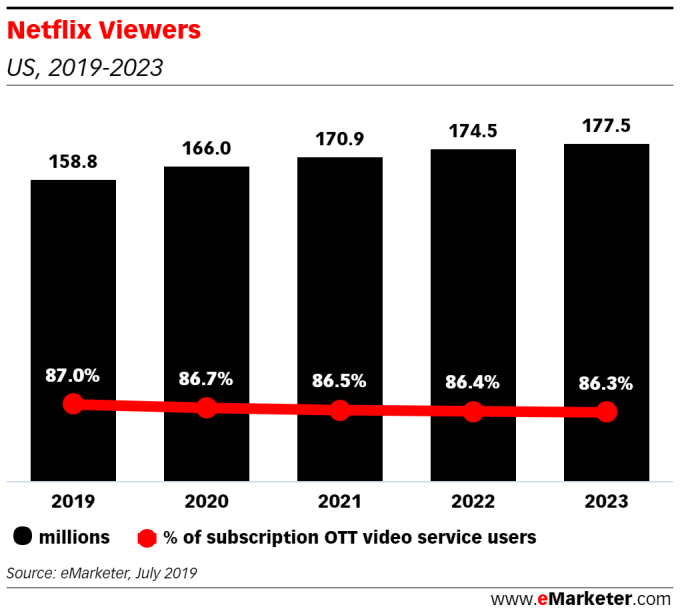
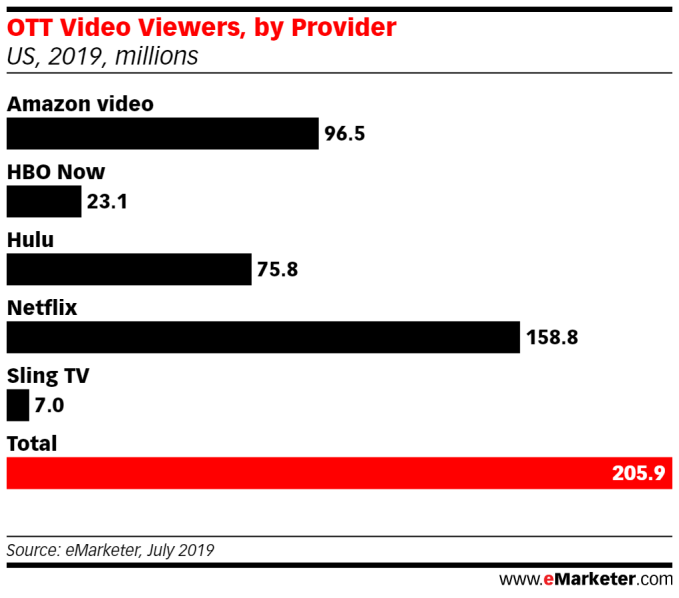
Netflix is still the No. 1 subscription streaming service in the U.S., according to a new report from eMarketer, but rivals including Amazon Prime Video and Hulu are starting to cut into its market share. The analyst firm forecasts 182.5 million U.S. consumers will subscribe to over-the-top streaming services this year, or 53.3% of the population. Netflix is still the too choice here, with 158.8 million viewers in 2019 and it is continuing to grow. However, its share of the U.S. over-the-top subscription market will decline even as its total subscriber numbers climb, the report said.

Though Netflix announced in Q2 the first drop in U.S. users in nearly a decade, eMarketer says Netflix will see strong growth throughout the rest of the year — up 7.6% over 2018. This will be driven by the new seasons of popular series like Orange is the New Black and Stranger Things, as well as Academy Award-winning director Martin Scorsese’s new movie, The Irishman.

But Netflix is no longer the only option for streaming video these days. Back in 2014, it had 90% of the market. In 2019, its share will have shrunk to 87%.

1 1

This decline in market share is attributed to the rise of rival services, like Hulu and Prime Video.

Hulu, for example, is estimated to reach 75.8 million U.S. viewers this year, or 41.5% of subscription service users. The number of viewers will also increase by 17.5% in 2019, but this is a drop from 2018’s big growth spurt of 49.6%

Prime Video, meanwhile will remain the second-largest subscription over-the-top video provider in the U.S. in 2019, the report says, with 96.5 million viewers. That’s up 8.8% over last year.

The firm estimates Prime Video will reach a third of the U.S. population by 2021.

2

Netflix market share dominance is about to face new threats as well, most notably from the Disney-Hulu-ESPN bundle, which is priced the same as a standard U.S. Netflix subscription.

“Netflix has faced years of strong competition for viewers, coming from streaming video platforms, pay-TV services, and even video games,” said eMarketer forecasting analyst Eric Haggstrom. “While there is no true ‘Netflix killer’ on the market, Disney’s upcoming bundle with Disney+, Hulu and ESPN+ probably comes closest. Netflix’s answer has been to stick to what has made it the market leader—outspending the competition on both licensed and original content, offering customers a competitive price,” he added.

Disney isn’t the only one with a new streaming service in the works, though.

Apple TV+ is poised to launch later this year, and is said to be spending $6 billion on content — far more than the $1 billion that had been reported. It’s also said to be considering a competitive $9.99 per month price point.

NBCUniversal and AT&T WarnerMedia are also poised to enter the market, the latter with HBO Max. And following the CBS-Viacom merger, the combined company is looking to beef up its own platforms, CBS All Access and the ad-supported Pluto TV, with the newly acquired content.

“The market for streaming video has been driven by an explosion in high-end original content and low subscription costs relative to traditional pay TV,” Haggstrom noted. “A strong consumer appetite for new shows and movies has driven viewer growth for services like Netflix, Hulu and Amazon Prime Video, as well as the broader market.”

22 Aug 2019

Watch YC CEO Michael Seibel chat startups, prices, and tech’s center of gravity

This week, nearly 200 startups convened at Y Combinator Demo Day to pitch venture capitalists, angels and other folks looking to spend some money.

YC chief executive officer Michael Seibel took some time out of his busy schedule to join us on a special episode of Equity, TechCrunch’s venture-capital-focused podcast. Given that we had Seibel to chat with, Kate and Alex decided to drop the regular format and riff interview-style about what the accelerator program is up to.

We discussed the new startup batch (roundups here, here, and here), recent changes to the program, rising deal prices, SAFEs versus convertible notes and the future of technology in San Francisco. Regarding price, here’s what Seibel had to say:

“It’s a competitive market where investors are bidding against each other. So if you see pricing go up you have to ask yourself the question, ‘where is the money supply coming from?’ The big trend over the last six years has been institutional investors moving from just kind of Series A funds and growth funds down to the seed level. When you looked at Demo Day when I was going through the first time it was full of angels – people investing off their own personal balance sheet. And if you look at the room today it’s full of funds. The reality is that, as the pool of capital increases in the seed world, the seed investors are competing against each other and one of the easier ways for investors to compete is to bid up price.”

But, Seibel continued, YC doesn’t necessarily consider the situation a net-positive, because companies that raise such huge rounds can spend money as though they had reached the fabled “product-market fit,” when in reality they have not. They just have money, which can feel the same but is not.

Ultimately, the thing that’s going to kill you, Seibel says, isn’t fundraising or who you raised from. The thing that’s going to kill you, he says, is that you didn’t build something your customers wanted.

Watch a clip from the interview here:

To hear more from Seibel and watch four more video clips discussing YC, the new class, and the startup game in San Francisco and beyond, become an Extra Crunch member. You can learn more and try it for free. 

22 Aug 2019

Pew: mobile and social media users in emerging markets have more diverse social networks

The latest study from Pew Research Center takes a look at the impact mobile technology, including the use of smartphones and social media, is having on the diversity of people’s social network in emerging markets. For the purpose of the study, Pew surveyed mobile users in eleven key markets: Mexico, Venezuela, Colombia, South Africa, Kenya, India, Vietnam, the Philippines, Tunisia, Jordan, and Lebanon. It found that users in these markets had broader social networks than those without smartphones and social media.

In the U.S., we’ve been concerned with social media’s ability to create “filter bubbles” — meaning how we surround ourselves online with people who hold the same opinions as us, which is then reinforced by social media’s engagement-focused algorithms. This leads us to believe, sometimes in error, that what we think is the most correct and most popular view.

According to Pew’s study, emerging markets are experiencing a somewhat different phenomenon.

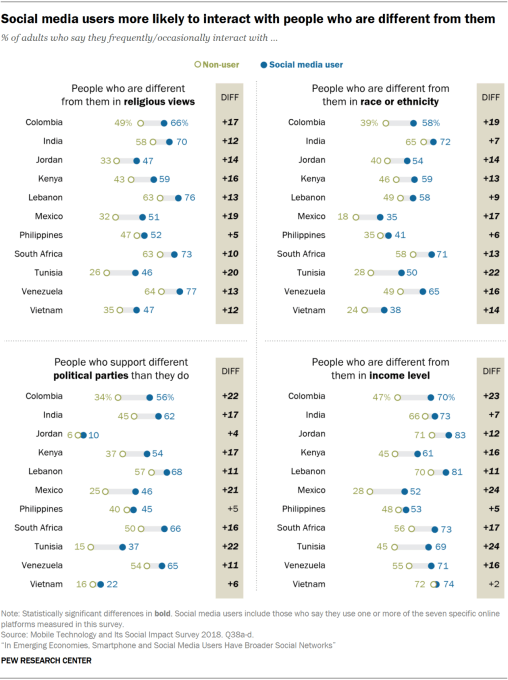
Instead of isolation, the study found that smartphone users in these markets, and particularly those who also used social media, were more regularly exposed to people with different racial and ethnic backgrounds, different religious preferences, different political parties, and different income levels, compared to those without a smartphone.

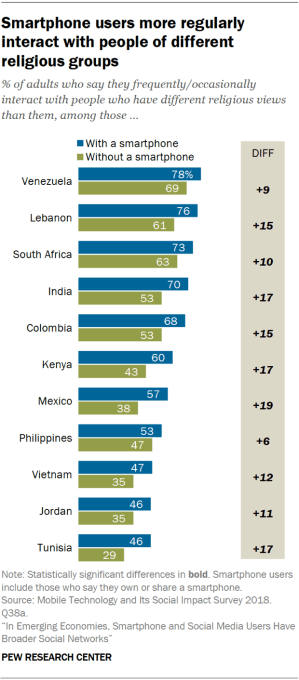
In Mexico, for example, 57% of smartphone owners regularly interacted with people of other religions, while only 38% of those without a smartphone did. And more than half (54%) interact with people who supported different political parties. They were also 24% more like to interact with people of different income levels, and 17% more likely to interact with people of different ethnic or racial backgrounds.

PI PG 2019.08.22 Social Networks Emerging Economies 0 01

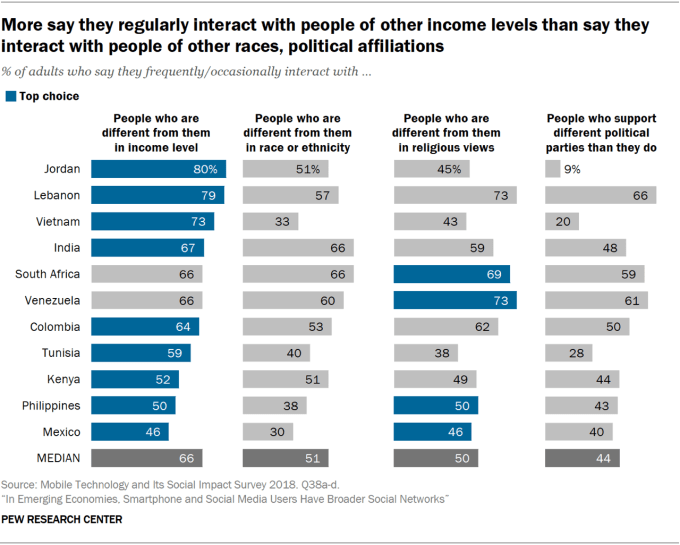
These sorts of trends help up across the nations studied, Pew noted, with a median of 66% saying they interacted with people with different income levels, 51% saying they interacted with a those of different race or ethnicity, 50% saying they interacted with those having different religious views, and a median 44% saying they interacted with those who supported a different political party.

PI PG 2019.08.22 Social Networks Emerging Economies 2 03 1

The use of social media and messaging apps was found to be a huge contributor here, as it made people more likely to encounter people different from them, the study also said.

PI PG 2019.08.22 Social Networks Emerging Economies 2 04

The report, however, isn’t claiming that smartphone and the related social media use are the cause of this increase in diversity in these people’s lives. There may be other reasons for that. Smartphone owners, in general, may have more resources and money — they own a smartphone, after all — and this alone could help expose them to a more diverse group of people.

That said, smartphones are helping people stay connected to distant family and friends, and build out online networks of people they don’t ever see in person.

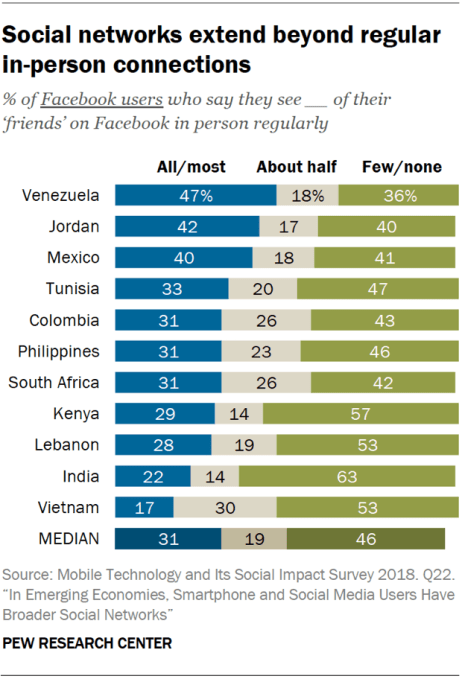
More than half of people in most of the surveyed countries said that only see half — or fewer — of the people they call or text in person. 93% said they keep in touch with far-flung contacts. And a median of 46% said they see their few or none of Facebook friends regularly.

PI PG 2019.08.22 Social Networks Emerging Economies 2 01

All this connecting isn’t seen as being fully positive, however.

An earlier Pew report found that users in these 11 countries believe the internet and social media are making people more divided in their opinions and only sometimes more accepting of different views. Exposure to diversity and acceptance of it are different things.

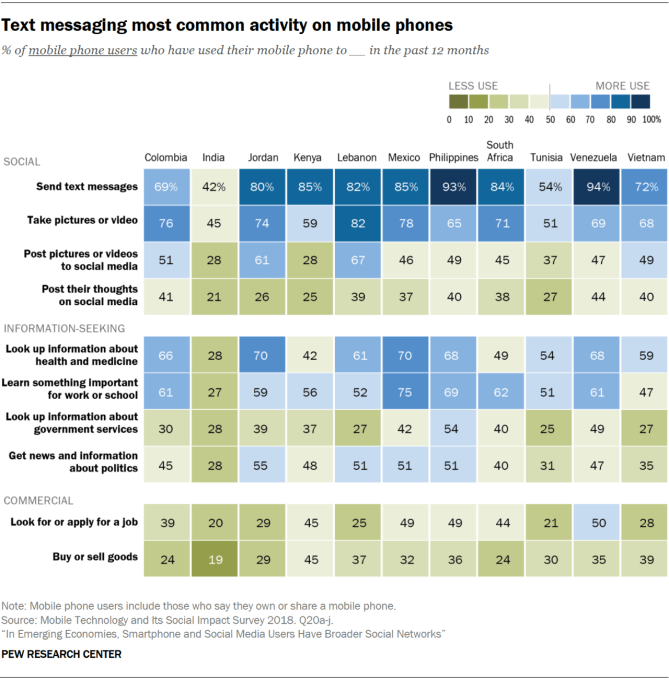
The new report also gets into how smartphones are used. For example, a median of 82% said they texted, 69% took photos or videos, 61% looked up health information, 47% looked up news and political information, and 37% looked up information about government resources.

PI PG 2019.08.22 Social Networks Emerging Economies 0 03

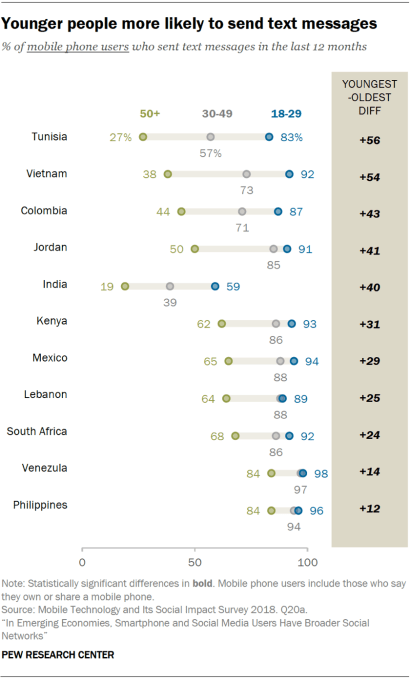
It also examined smartphones’ impact on digital divides, noting that people with access to these devices and social media, as well as younger people, those with higher levels of education and men, were gaining more benefits than others.

PI PG 2019.08.22 Social Networks Emerging Economies 0 04

The study is based on in-person interviews conducted by D3 Systems, Inc. and the results are based on national samples, notes Pew.

The full report is available here, with deeper dives on activities and data by individual countries.

22 Aug 2019

Amazon is acquiring 49% stake in India’s Future Coupons

Amazon, which has invested over $6 billion in India’s growing internet market, just invested a little more to expand its foothold in the the world’s second largest internet market. The U.S. e-commerce giant has acquired a 49% stake in Future Coupons, a group entity owned by India’s second largest retail chain Future Group, the latter said in a regulatory filing Thursday evening (local time).

In a statement to TechCrunch, an Amazon spokesperson said, “Amazon has agreed to invest in Future Coupons Limited, which is engaged in developing innovative value-added payment products and solutions such as corporate gift cards, loyalty cards, and reward cards primarily for corporate and institutional customers. This investment will enhance Amazon’s existing portfolio of investments in the payments landscape in India.”

“Pursuant to these agreements, Amazon has agreed to make an equity investment in Future Coupons Limited for acquiring a 49% stake comprising both, voting and non-voting shares. As part of the agreement, Amazon has been granted a call option,” Future Retail said in a filing (PDF) to the local stock exchange.

As part of the agreement, Amazon has the option to “acquire all or part of the Promoters’ shareholding in it Future Retail Limited” bwteeen the third and tenth year in “certain circumstances, subject to applicable law.” Future Coupons owns about 7.3% stake in Future Retail, according to past regulatory filings.

Financial terms of the deal were not disclosed.

“The Promoters have also agreed to certain share transfer restrictions on their shares in the Company for same tenure, including restrictions to not transfer shares to specified persons, a right of first offer in favour of Amazon, all of which are subject to mutually agreed exceptions (such as liquidity allowances and affiliate transfers). The transaction contemplated above is subject to obtaining applicable regulatory approvals and customary closing conditions,” Future Retail added.

Future Retail can’t directly sell stake in Amazon, so it is routing it through one of its entities. Future Retail runs over 2,000 stores, including “Big Bazaar” retail stores, across 400 cities in India.

This is a developing story. More to follow…

22 Aug 2019

Tumblr’s next step forward with Automattic CEO Matt Mullenweg

After months of rumors, Verizon finally sold off Tumblr for a reported $3 million — a fraction of what Yahoo paid for the once might blogging service back in 2013.

The media conglomerate (which also owns TechCrunch) was clearly never quite sure what to do with the property after gobbling it up as part of its 2016 Yahoo acquisition. All parties has since come to the conclusion that Tumblr simply wasn’t a good fit under either the Verizon or Yahoo umbrella, amounting to a $1.1 billion mistake.

For Tumblr, however, the story may still have a happy ending. By all accounts, its new home at Automattic is far better fit. The service joins a portfolio that includes popular blogging service WordPress.com, spam filtering service Akismet and long-form storytelling platform, Longreads.

In an interview, this week, Automattic founder and CEO Matt Mullenweg discussed Tumblr’s history and the impact of the poorly received adult content restrictions. He also shed some light on where Tumblr goes from here, including a potential increased focused on multimedia such as podcasting.

Brian Heater: I’m curious how [your meetings with Tumblr staff] went. What’s the feeling on the team right now? What are the concerns? How are people feeling about the transition?