Category: UNCATEGORIZED

20 Aug 2019

The American AI Initiative: A good first step, of many

The path to general AI — and possibly superintelligence — is being paved before our eyes. And with the proliferation of an AI-driven society, the social and economic value of such technology is also on the rise. In turn, harnessing and leveraging such technology needs to extend beyond the interests of venture capitalists, investment groups and entrepreneurs — and also be a priority on a geopolitical scale.

When the global economy starts to feel the shift ushered in with mass-adoption of AI, the United States needs to be leading the charge as opposed to chasing the pack.

If the U.S. is to compete on a global level, they’ll face an arms race of sorts from a litany of nations that are already doubling-down on the massive advantages that come with national AI proficiency. In fact, 18 different countries have launched national AI strategies, with government funding ranging from $20 million to almost $2 billion.

A first step in the right direction was taken by the Trump administration recently when the president signed an executive order launching the American AI Initiative. This policy will funnel federal funding and resources toward AI-specific research while also implementing U.S.-led international AI standards. Additionally, the program will call for new research into increasing AI literacy in American workers.

Unfortunately, there are no specifics around what exactly this new program actually looks like in practice, and there is no additional research being dedicated toward AI development. There are no timelines for implementation of these initiatives, only a vague goal of roughly six-ish months before a detailed plan is rolled out. Jason Furman, a Harvard professor who helped draft the Obama administration’s report on AI, said that the plan had “all the right elements” but was also “aspirational with no details and is not self-executing.”

How can the private sector build on what the federal government has put in place?

Yet, the importance of government involvement in AI R&D cannot be overstated. If we remain on the path we’re on, one where large technology companies and VC firms are funding the bulk of AI research, the country would only see pockets of growth around the largest technology companies and the regions of the country would continue to stagnate. We would not be able to work on major moonshot projects and collectively pool our resources for the greater good across all regions of the U.S. All innovations would be tightly controlled by technology companies and adoption rates would not move up and actually make a difference in the way we utilize AI. This would result in a marginal talent pool, and new developments would be those of technology innovators — not problem-solvers. Everything would be driven by its contribution to business and not its contribution to society at-large.

So, government involvement matters, yet the administration can’t be solely responsible for catalyzing the change needed by the American workforce — it falls on us as well. So that begs the question…

How can the private sector build on what the federal government has put in place?

The program focuses on five key pillars: Research and development, infrastructure, governance, workforce and international engagement. Like Furman said, those concepts are well and good, but they remain vague and still clearly undefined. But, even if the administration’s program isn’t hitting the ground running, that doesn’t mean that you and I can’t push the ball in the right direction. So, how can we as a workforce help execute on the program? What do we need to do to enact the ideals that the federal government is focused on in AI?

Focus on building AI-literacy in American workers

Until the American workforce itself is concerned with being AI-first, we will see challenges in implementation, adoption and deployment, and AI literacy will be largely confined to the areas in which it’s already being heavily used (automation, customer service, insights, engagement, etc.).

Additionally, these industries aren’t even using AI to actually solve problems or improve society, they are largely using it as an autopilot. And if AI is being used simply to automate processes for tech companies, then we’re missing out on the opportunity to use it to its full advantage to solve actual sociological issues around hunger, poverty and healthcare.

And the focus needs to extend beyond the workforce and into the classroom. All STEM programs in American schools need AI-based coursework. Universities need AI-based programs and intelligence labs, such as MIT, for example, where roughly 25% of faculty conduct research on intelligence in labs like the MIT-IBM Watson AI Lab, the Robust Robotics Group and the Laboratory for Information and Decision Systems (LIDS).

Our academic institutions and research centers would continue to strive as centers of excellence around the world, meaning that the best and brightest minds would continue to be attracted and would keep our talent pool stocked. Our universities would increase enrollment for AI/digital experts, as those roles would be the golden mature standard.

Startups need to swarm and work closely with federal AI strategy

While I hate to use cliches, this is a “teamwork makes the dream work” situation. Aligning the startup community with government strategy would allow innovation and social good to walk hand-in-hand when it comes to AI development.

The importance of government involvement in AI R&D cannot be overstated.

This would lead in new space technologies, create new innovation for society in food, energy and health, and create a lifestyle that balances efficiency and leisure. It also would allow American corporations to go after dispersion and breakthrough innovation. From a government perspective, this means continuing to provide open and structured data sets for the public to use while still protecting the sensitive information that keeps our citizens safe. Providing these data sets is the first step, but making others aware through education campaigns is also important

Make AI all-inclusive

Much the same way that IT experts, coders and web/app developers had to learn to work side-by-side with business owners, marketers and production-level employees across the business ecosystem over the last two-and-a-half decades, we must bridge the “gap” between AI experts, technologists and leading technology companies and solutions owners, general SMBs and corporate America to develop an inclusive and universally understandable AI strategy.

The advancement of machine learning models, specifically deep learning, relies on the ingestion of data — structured or unstructured. The sharing of this data, from people involved in day-to-day problems and solutions to technologists who are concerned with the big picture, is the key to developing innovative and inclusive AI solutions. A better AI future built on diverse data sets requires both parties to work collaboratively.

Data is officially the most valuable commodity on earth and the countries that win the race to harness and use it to its maximum value and efficiency are going to position themselves favorably around the globe. And if America is to win the race, it will take the buy-in of the collective public, private and government entities in our country. If we are to move past improving our viewing patterns on Netflix and start solving the brass-tax issues in our country’s society, it will come as a result of the convergence of government, society and business.

20 Aug 2019

DoorDash acquires autonomous driving startup Scotty Labs

DoorDash has been on an acquisition tear of late with Scotty Labs as its latest target. Terms of the deal were not disclosed, but this comes after DoorDash acquired Caviar in a deal worth $410 million.

Scotty Labs, a tele-operations company that is working on technology to enable people to remotely control self-driving cars, raised a $6 million seed round from Gradient Ventures with participation from Horizon Ventures and Hemi Ventures last March. The startup had previously worked with Voyage for its self-driving cars in retirement communities.

“Our core belief at Scotty has always been that Autonomy + Remote Assistance is the future,” Scotty CEO Tobenna Arodiogbu wrote on Medium. “We have intentionally always considered ourselves to be the anti-hype company and focused intensely on developing core infrastructure and algorithms to ensure the safe deployment of autonomous vehicles.”

Meanwhile, DoorDash quietly brought on the two co-founders from Lvl5, another company that had built tech to create high solution maps for autonomous driving using crowdsourced imagery and computer vision to merge and process the images. In April, Lvl5 announced it was shutting down after the acquisition.

Details of how Scotty Labs and Lvl5 will fit into DoorDash’s business are nonexistent, but you could imagine DoorDash using Scotty’s technologies to remotely control delivery robots or other types of autonomous vehicles.

“We’ll share more updates in the near future but for now, we’re really excited to be part of the amazing DoorDash family and looking forward to building something magical together,” Scotty Labs co-founder Tobenna Arodiogbu wrote on Medium.

From what we understand, the Lvl5 deal was more of an acquihire and did not include any of the maps that were built using the company’s technology. Instead, startup Mapillary obtained that trove of hundreds of millions of images.

DoorDash would not comment on what the new hires are working on, but through its robot pilots and partnership with GM, the startup has made no secret of its interest in exploring autonomous technology, specifically looking at how it can improve the cost and efficiency of deliveries, and it would make sense that it would also want to have in-house expertise to own and manage those projects

DoorDash has experimented with delivery robots before. In 2017, DoorDash partnered with both Starship Technologies and Marble to test food delivery via robot. More recently, DoorDash announced a partnership with GM’s Cruise to test self-driving food delivery cars. DoorDash is also beefing up its in-house team of autonomous and navigation specialists.

This investment in autonomous through its acquisition of Scotty Labs and acquihire of the team from Lvl5 comes at a time when DoorDash says it is revamping its policies around driver wages.

The enthusiasm and potential of autonomous had led to startups creating literally dozens of interesting products that focus on different aspects of this field. But it will take a village to get this tech off the ground, which means that consolidation is inevitable.

DoorDash — operating on the principle of economies of scale — has been pretty aggressive in positioning itself as one of those consolidators. We have heard it tried to merge with Postmates. It bought Caviar this summer. And it has raised an absolute ton of money. In May, DoorDash raised a $400 million round valuing it at $12.6 billion. Meanwhile, DoorDash’s main competitor, Postmates, is gearing up to go public this quarter.

As technology becomes a key way for the crowded arena of delivery startups to differentiate themselves, investing in its own autonomous tech R&D — by way of picking up some of these disparate startups that may have struggled to survive on their own — is one way for DoorDash to build out that tech cred.

20 Aug 2019

Researchers look into keeping autonomous vehicles from becoming mobile vomitoriums

If you’re like me, and I’m just going to assume most of you are, motion sickness is a serious consideration on any car trip where you’re not driving. So what are we supposed to do in self-driving vehicles? Researchers are finally looking into this question with an experiment designed to see just what makes people like us so sick.

The study, at the University of Michigan, was undertaken because the researchers realized that if millions of people can’t read or do work in autonomous vehicles, that massively reduces the draw of using them in the first place. And it turns out there has been almost no investigation of why certain people get motion sickness in this context, what makes it better or worse, and so on.

“Very few studies have been conducted in cars; instead, a lot of the work has been done for sea and air transportation modes, performed in driving simulators or on motion platforms,” explained lead investigator for the project, Monica Jones, in a university news release. “A lot of scales that exist in the literature are based on nausea. If we design to a vomiting response, we have really missed the mark on autonomous vehicles.”

Basically the cars should be designed around making people actually comfortable, not stopping just short of losing their lunch. What does that even consist of? That’s what these initial experiments are meant to explore.

The team collected 52 people from a variety of demographics and had them sit in the car while it navigated the university’s Mcity Test Facility, a sort of mock urban environment meant for exactly this kind of work. The drive involved the usual turns, stops, and accelerations you would experience being driven around a city, and participants were asked to perform some basic tasks on an iPad and answer questions posed by a researcher in the car. I can tell you I’m feeling queasy just thinking about taking part.

They were observed for indications of discomfort and were told to report any such feelings — and of course let the researchers know if they needed to stop. Sensors watched for changes in temperature or perspiration, among other things.

The early findings (PDF) are not exactly surprising, but they’re a start. It may not be front page news that people using a gadget while in a self-driving car tended to feel more sick. But no one has ever actually studied this, so if we’re going to treat it seriously one way or the other, it needs to be directly observed. And indeed there were other factors that cropped up as well. Younger people reported higher motion sickness levels, for instance. Why? When?

“Passenger responses are complicated and have many dimensions,” said Jones. And to measure those responses the team built up a database of thousands of measurements and observations that extend beyond a simple “misery scale,” but include context and other types of pain or discomfort.

This is just the beginning of what is sure to be a longer-term study of how to make self-driving vehicles as inclusive — and popular — as possible. Certainly if they get to the bottom of it, I (and all of you out there like me) will be much more likely to use an AV for my daily commute.

20 Aug 2019

MoviePass exposed thousands of unencrypted customer card numbers

Movie ticket subscription service MoviePass has exposed tens of thousands of customer card numbers and personal credit cards because a critical server was not protected with a password.

Mossab Hussein, a security researcher at Dubai-based cybersecurity firm SpiderSilk, found an exposed database on one of the company’s many subdomains. The database was massive, containing 161 million records at the time of writing and growing in real-time. Many of the records were normal computer-generated logging messages used to ensure the running of the service — but many also included sensitive user information, such as MoviePass customer card numbers.

These MoviePass customer cards are like normal debit cards: they’re issued by Mastercard and store a cash balance, which users who sign up to the subscription service can use to pay to watch a catalog of movies. For a monthly subscription fee, MoviePass uses the debit card to load the full cost of the movie, which the customer then uses to pay for the movie at the cinema.

We reviewed a sample of 1,000 records and removed the duplicates. A little over half contained unique MoviePass debit card numbers. Each customer card record had the MoviePass debit card number and its expiry date, the card’s balance, when it was activated.

The database had more than 58,000 records containing card data — and was growing by the minute.

We also found records containing customers’ personal credit card numbers and their expiry date — which included billing information, including names, and postal addresses. Among the records we reviewed, we found records with enough information to make fraudulent card purchases.

Some records, however, contained card numbers that had been masked except for the last four digits.

The database also contained email address and some password data related to failed login attempts. We found hundreds of records containing the user’s email address and presumably incorrectly typed password — which was logged — in the database. We verified this by attempting log into the app with an email address and password that didn’t exist but only we knew. Our dummy email address and password appeared in the database almost immediately.

None of the records in the database were encrypted.

Hussain contacted MoviePass chief executive Mitch Lowe by email — which TechCrunch has seen — over the weekend but did not hear back. It was only after TechCrunch reached out Tuesday when MoviePass took the database offline.

It’s understood that the database may have been exposed for months, according to data collected by cyberthreat intelligence firm RiskIQ, which first detected the system in late June.

We asked MoviePass several questions — including why the initial email disclosing the security lapse was ignored, for how long the server was exposed, and its plans to disclose the incident to customers and state regulators. When reached, a spokesperson did not comment by our deadline.

MoviePass has been on a rollercoaster since it hit mainstream audiences last year. The company quickly grew its customer base from 1.5 million to 2 million customers in less than a month. But MoviePass took a tumble after critics said it grew too fast, forcing the company to cease operating briefly after the company briefly ran out of money. The company later said it was profitable, but then suspended service, supposedly to work on its mobile app. It now says it has “restored [service] to a substantial number of our current subscribers.”

Leaked internal data from April said its customer numbers went from three million subscribers to about 225,000. And just this month MoviePass reportedly changed user passwords to hobble access for customers who use the service extensively.

Hussain said the company was negligent in leaving data unencrypted in an exposed, accessible database.

“We keep on seeing companies of all sizes using dangerous methods to maintain and process private user data,” Hussain told TechCrunch. “In the case of MoviePass, we are questioning the reason why would internal technical teams ever be allowed to see such critical data in plaintext — let alone the fact that the dataset was exposed for public access by anyone,” he said.

The security researcher said he found the exposed database using his company-built web mapping tools, which peeks into non-password protected databases that are connected to the internet, and identifies the owner. The information is privately disclosed to companies, often in exchange for a bug bounty.

Hussain has a history of finding exposed databases. In recent months he found one of Samsung’s development labs exposed on the internet. He also found an exposed backend database belonging to Blind, an anonymity-driven workplace social network, exposing private user data.

Read more:

20 Aug 2019

Waxed canvas bags from Waterfield, Manhattan Portage, Saddleback and more

It’s finally Bag Week again! the most wonderful week of the year at TechCrunch. Just in time for back to school, we’re bringing you reviews of bags of all varieties: from backpacks to rollers to messengers to fanny packs.

This year, like last year, I decided to focus on a specific niche in the bag community: waxed canvas. Last year I reviewed a handful of bags from Ona, Filson, and other purveyors of fine waxed goods. But there are many more to choose from, so I’ve collected a second handful and used them all for long enough to get a sense of their strengths and weaknesses.

Waxed canvas is a wonderful material. The natural fibers infused with wax provide water resistance, structure, protection, and a great look that only gets better with time as you use it. It’s my favorite material and it should be yours too. Only trouble is it can be expensive. But keep in mind that these bags are the kind that you take with you for a decade or two.

For this post I focused on laptop bags, but later in the festivities I’ll have a couple more waxed bags more in the “messenger” style, so keep your eyes peeled.

Waterfield Bolt – $269

Pros:

  • Solid medium-weight material and construction
  • Good padding and leather protective layer
  • Surprising amount of space and pockets

Cons:

  • Somehow lacks panache
  • Leather thongs instead of metal zipper pulls not for everyone

Store link

Of all the bags I’ve looked at for this roundup, this one is perhaps the most straightforward, in that it isn’t convertible, super-heavy, super-light, blue, or anything like that. It’s just a solid all-purpose laptop bag made of waxed canvas and leather, and as such makes for a sort of baseline with which to compare everything else.

[gallery ids="1839091,1839097,1839088,1839093,1839096,1839095,1839094,1839092,1839090,1839087"]

The Bolt’s canvas isn’t as thick as that on other Waterfield bags, since it’s lined and padded on the inside. It still has a nice finish, though, and the leather base and trim are similarly high-quality. The strap is, like the other bags from the company, nylon, where I would prefer canvas, but the grippy leather shoulder pad included is among the most practical and comfortable I’ve used.

Where the Bolt excels is not in sheer space, since it’s rather a compact bag (you can choose a larger size if you prefer), but in feeling that space is used well. There are snap pockets in the front and a larger zip one as well for quick access, all protected by a small flap but still easy to get at. On the back is a flap pocket and luggage strap so it can sit safely atop your roller bag.

And opening up the main compartment through its weather-proof zipper, the bag accordions open pleasantly to reveal laptop, tablet, notebook, and other slots all easily accessible. I even like the color in there!

I only wish it inspired a little more love. It’s not a bad-looking bag by any means, but it feels very pedestrian — few stylistic choices seem to have been made. It’s practical but not individual. To some that won’t matter — this is a solid bag. But it lacks a certain je ne sais quois that the company has to spare in its other bags.

Waterfield Outback Solo – $159

Pros:

  • Great material and construction
  • Compact but not microscopic

Cons:

  • Awkward to carry without strap
  • Not a lot of room in there (by design, but still)

Store link

Sometimes you’re just going out with a tablet or laptop and book, and don’t feel like taking a whole messenger style bag or briefcase. This little guy is sort of halfway between a laptop sleeve and a bag, and if you don’t mind its purselike nature it’s a perfect companion for those more minimal trips.

The laptop compartment is snug and well-padded. The outside has a slip pocket with some nooks for pens and the like, big enough to fit a 8.5×11″ notebook or not-too-thick book. Just don’t try putting groceries or anything in there.

[gallery ids="1839103,1839102,1839101,1839100,1839099,1839098"]

Closure is a magnetic snap that feels secure enough but I’d just as soon have something a little more physical. I’d like to mention that the closure strap looks a little sloppy in the photos above, but it’s really not like that in general use and will wear in nicely. And although it feels great to carry this light little guy with the shoulder strap (which stows away decently well), carrying it like a sleeve or clutch isn’t so hot — a small handle or strap would make this much better.

I’d recommend this to anyone who has a larger bag for trips but doesn’t want to pack and unpack it every time they want to step out to the coffee shop. This would work well as a sub-bag or laptop sleeve if you have lots of room in the big one.

Joshu+Vela Zip Briefcase – $198

Pros:

  • Excellent lighter material that will age well
  • Straightforward style and solid straps
  • Great giant brass zippers

Cons:

  • Which side’s the front?
  • Unstructured interior can make stowage and retrieval annoying

Store link

Coming from a shop more known for totes and lightweight, fashionable gear for everyday urban living, this one is heavy duty for them but light compared with some others in this roundup. Its style is subtle and straightforward, but high quality.

The material is a lighter weight and color canvas with a crispy feel that will very quickly show patterns of use as, for example, one front pocket is habitually used for a book or keys. Empty it is possibly the lightest waxed bag I’ve used, which of course makes it good for anyone trying to stay minimal. The simple leather straps are sturdy and comfortable, though their springy, upright nature does mean they occasionally interfere with access.

[gallery ids="1839045,1839054,1839046,1839053,1839052,1839051,1839050,1839044,1839049,1839048,1839047"]

I love the huge brass zipper and pulls, though I could do without the leather bits (you can remove them). I didn’t like the plain natural canvas strap at first but it, like other aspects of the bag, has grown on me.

The simplicity of the design is good, but it also leads to some problems. Unless you look closely it can be hard to tell which side is the front — only the zipper flap and small label hint at it. Something to secure or differentiate the front or rear pockets, even as simple as removing the divider in the back, would be welcome.

Inside has three divisions, but the billowing, unstructured canvas plus the limited zip-top entrance can make stowage and retrieval a little awkward, more so than a flap-top bag anyway. A tighter compartment for a laptop or tablet would be great in here rather than having it swim in a big undifferentiated section. There’s also no padding, so I’d recommend keeping your device in its own case (this also helps it fill out the space).

Manhattan Portage Cortelyou – $365

Pros:

  • Classy messenger/briefcase crossover style
  • Lovely blue color
  • Great handle, closure, and straps

Cons:

  • Not particularly waxy or robust
  • Steel and brass? Sacrilege
  • Interior material not for everyone (also has a tacky watermark)

Store link

Waxed canvas is normally tan or brown, but that’s just tradition. I like the forest green of the Croots bag from last year or the Saddleback one below, but the rich navy blue of this Manhattan Portage Token bag is also excellent. The material is very light, with a fine weave and barely any wax. That means it probably won’t show the characteristic scuffs and patterns that give this type of bag its personality. (You can always wax it yourself.)

This bag, with its half-flap and top handle, straddles the line between laptop bag and briefcase. It’s not particularly thick but has lots of room for big documents, laptops, and other long items. Its structure means it’ll stay relatively svelte even when full — this won’t get lumpy.

[gallery ids="1839062,1839056,1839058,1839061,1839059,1839063,1839060,1839055,1839057"]

The leather straps and trim are a nice chocolate color and complement the blue well. It’s not heavy or stiff, and the shoulder strap in particular is very pliable — though so long I had to knot it to keep the extra out of the way (fortunately it looks cool that way). The snap closure can be a little tricky to get right by feel, but attaches solidly. The handle, which folds flat but pops up when you need it, is genius — probably the best handle of all the bags in this roundup, though not quite as robust as the Saddleback (but what is?).

The interior isn’t as to my liking. The red nylon watermarked with a branded pattern seems sort of gauche compared to the refined outside, and at the same time it feels like this choice of material should have allowed for more small pockets. It should help keep things dry, though, which is good considering the thinness of the waxed canvas layer.

Manhattan Portage Saratoga

Pros:

  • Convertible style makes it a good companion for conventions, business trips, etc
  • Plenty of handles and exterior pockets

Cons:

  • Not the best of both worlds (but not the worst either)
  • Straps make it feel bulky and lumpy if not stowed carefully

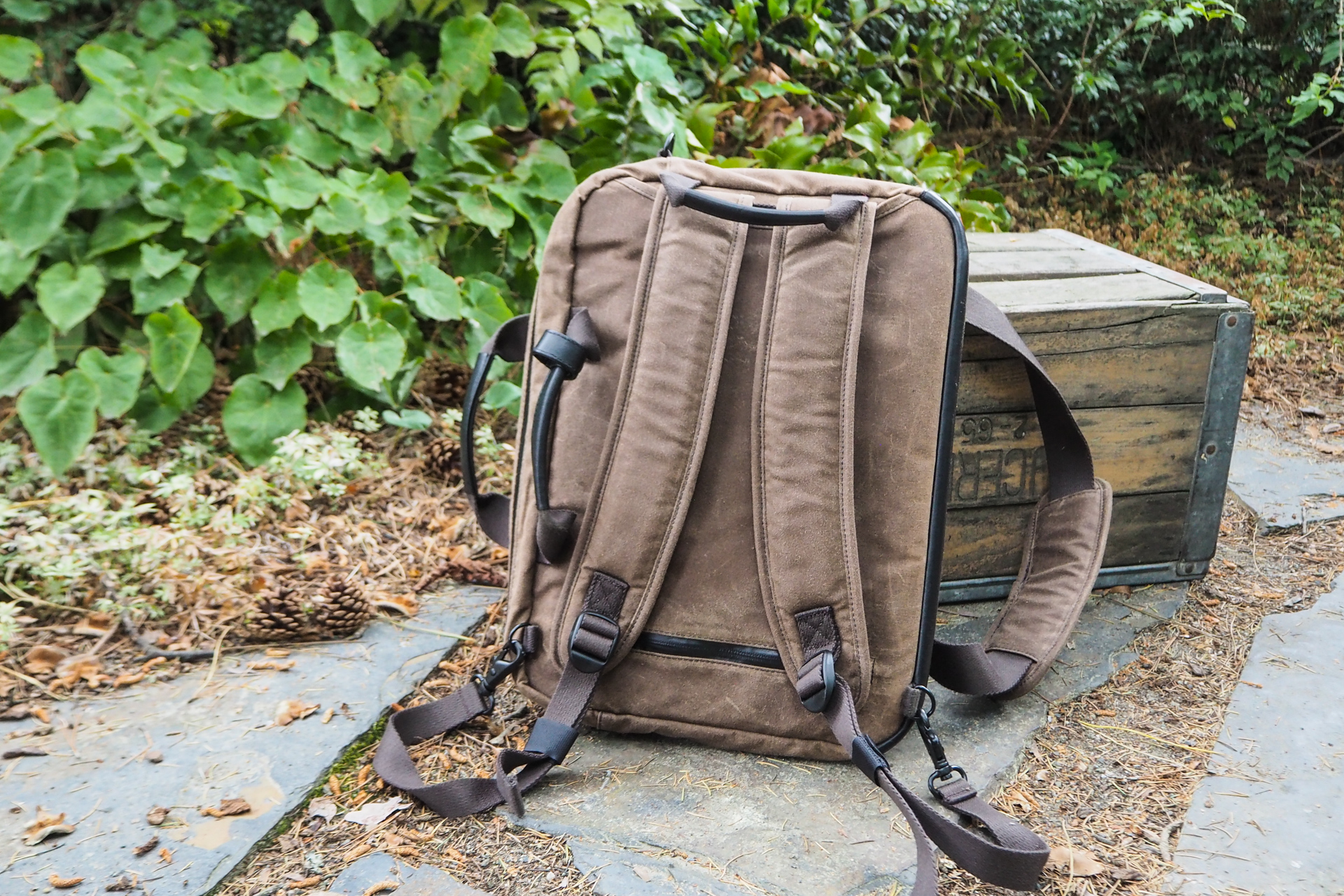
When I’m at CES or some other big show where I do a lot of walking but need to carry my basic loadout everywhere, I often wish I could transform my laptop bag into a backpack or vice versa. The Saratoga accomplishes this, and while it ends up compromising both forms as a result, it also fundamentally scratches an important itch.

The material is a soft-feeling canvas that doesn’t feel very rugged but is showing a nice wear pattern already. The weather-sealed zippers are good news for anyone who wants to take this out in the rain, but there are just too many of them. Six on the exterior, five visible on the front side! This thing jingles like a festive little elf.

[gallery ids="1839068,1839067,1839066,1839065,1839069"]

The back of the bag is a large pocket in which the pack straps sit, providing extra padding while they’re in there.  You pull them out and clip them onto some unobtrusive little D-rings, and boom, it’s a backpack. Doing the reverse is a little harder, as you need to make sure the straps don’t bunch up in their pouch.

I would have much preferred a more elegant pocket solution, not least because some of the pockets don’t make much sense while in one or the other configuration. And the leather bottom, while great in briefcase mode, makes it seem a little lopsided in backpack mode. Obviously these are drawbacks inherent to the switchable design, which brings its own benefits, but they’re worth considering. I might have liked a single big pocket on the front that can be opened from the side or top, and sub-pockets within.

The interior, while it’s the same watermarked red nylon as the one above, is populated with tons of little pockets and useful stashes that helpfully all close independently, meaning there’s no need to re-pack when you’re going from one mode to the other.

(I can’t seem to find this for sale any more – but keep your eyes open if you like it.)

Manhattan Portage Hewes – $265

Pros:

  • Pockets! So many pockets!!

Cons:

  • Maybe too many pockets

Store link

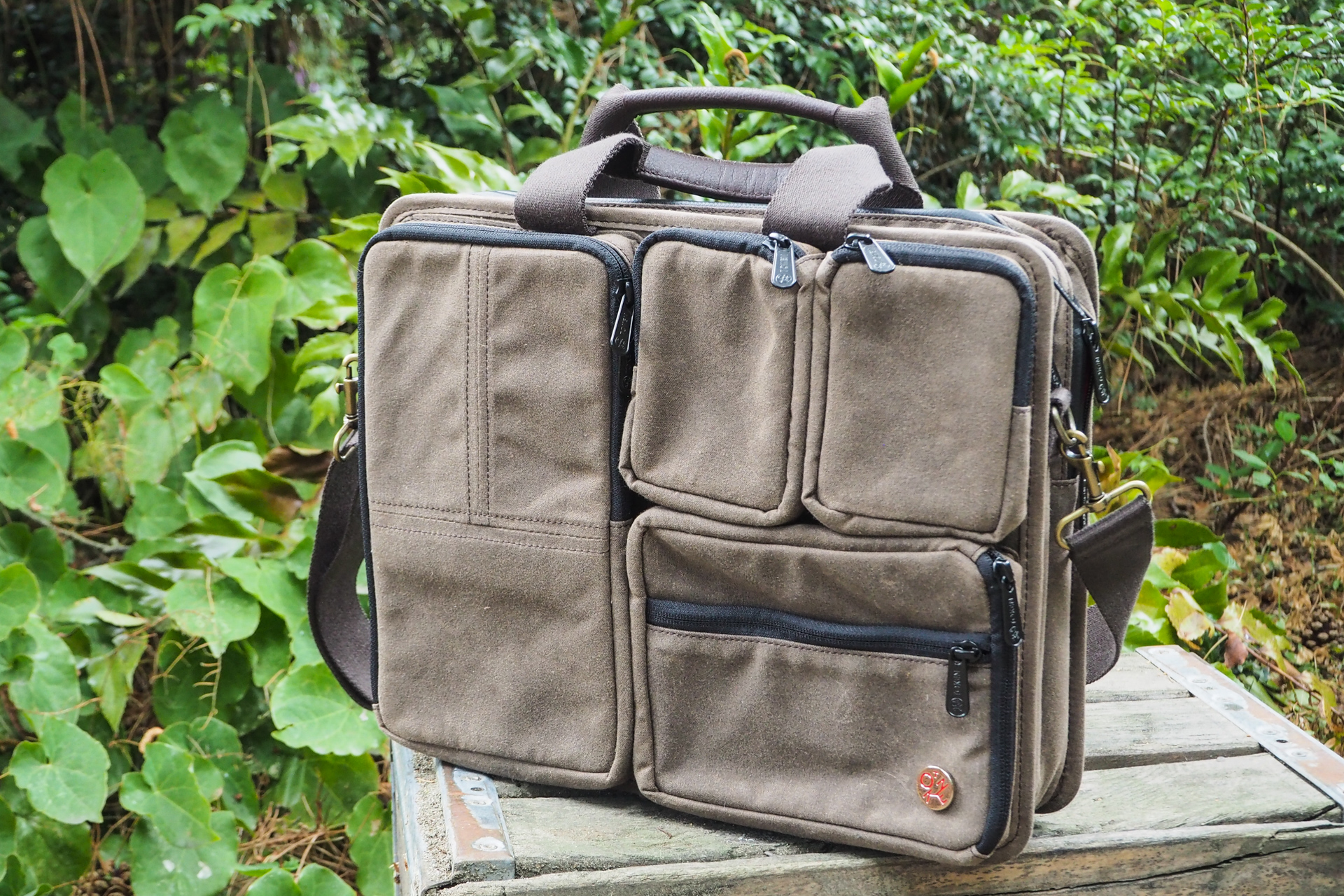
I’ll just say right off the bat that this one isn’t for me — I prefer a plainer exterior, and this thing does not have that. On the other hand, for the organized gadget fiend, this might be a fantastic match.

[gallery ids="1839072,1839075,1839074,1839073,1839070,1839071,1839076"]

The front side is just pocket after pocket. There are two big enough for a small phone, another good for a notebook, pens, or a power adapter, an a third with a removable divider that could hold all manner of things small and large. Nothing too bulky will fit in them, but any number of audio recorders, lens filters, earbuds, and so on will go in there.

Then there are two totally separate full-size compartments, one with more organizing space inside and both with plenty of padding. The simple strap is easy to release and stashes inside nicely.

Saddleback Leather Co Canvas Messenger – $439

Devin Coldewey / TechCrunch

Pros:

  • Built like a waxed tank
  • Seriously, this thing is a beast
  • Spacious and handsome

Cons:

  • Also heavy as a tank
  • Very basic pockets and interior
  • Price reflects its “for life” nature

Store link

This bag came with a label on it sporting the company’s motto: “They’ll fight over it when you’re dead.” And I’m inclined to believe it. This is definitely by far the heaviest-duty waxed canvas bag I’ve had the pleasure of reviewing, which may or may not make it to your taste.

The olive-colored canvas is very thick and stiff, and waxed all the way through, not just in a layer on the outside. The stitching is industrial-grade and probably uses half a mile of thread. Quarter-inch-thick leather plates stiff as a board protect the back and bottom of the bag, and another serves to connect with the handle. The strap is a kind of folded-over canvas that feels even tougher than the leather. On top is a unique and practical thick leather handle that folds flat if necessary but feels very robust.

[gallery ids="1839078,1839081,1839083,1839082,1839084,1839086,1839085,1839080,1839079,1839077"]

The muscular materials and construction, however, preclude the inclusion of fine details like small pockets and pen sheaths. Instead there are two major exterior pockets that simply fold over themselves to close up, being held shut by the flap; there’s also room between them and the main compartment. Smaller side pockets under the massy strap hardware are good spots for flashlights but pens may disappear to the bottom.

This thing is also heavy as hell. Empty, it weighs as much as another bag with a light load. For some that weight will be reassuring but for others it’s just too much.

Inside the main compartment is plenty of room but little organization; there’s a single flap that will hold a laptop in place (my 13-inch MacBook Pro fits perfectly), and beyond that it’s just a big empty space. This is the only briefcase-style bag that rivals Filson’s (in my last roundup) for overnight capability. This one is definitely going to get your stuff waxy for the first few trips, though.

That’s all for today, but keep an eye out for more waxed canvas bags later in Bag Week as well!

20 Aug 2019

Netflix aims to retain subscribers with launch of a feature to track new releases

Hoping to keep viewers engaged with its content, Netflix today announced the launch of a new section called “Latest” in its TV app, designed to highlight the streaming service’s recent and upcoming releases. The addition isn’t just another row or two within the main Netflix homepage. Instead, the “Latest” section gets its own dedicated area in the Netflix TV app, which is accessible from the left-hand sidebar navigation.

Here, it’s found beneath the “Home” button and above the links to the dedicated “Movies” and “TV Shows” pages.

The section will be personalized to the end user, based on their viewing history, the company says.

At the top of “Latest” is a row that showcases new content that arrived this week, which is then followed by two rows showing content that’s due to arrive this week and the next.

Users can also click on these future releases and set alerts to remind them when the TV show or movie they’re interested in watching has arrived.

Netflix says the feature is now globally available on its TV app, which means you’ll only find it on streaming devices like the Fire TV, Apple TV or Roku, for instance, or on other smart TV or game console platforms. However, the company tells TechCrunch it already has a similar feature for Android users and is currently testing the “Latest” section on iOS.

The company first spoke to Variety about the addition, adding that the personalized suggestions update several times per day.

Netflix director of product innovation Cameron Johnson told the outlet the experience was similar, in a way, to movie trailers, as it’s also designed to get people interested in upcoming releases.

However, the launch comes at a time when people will soon be considering the value they receive from their Netflix subscription. The company recently posted a disappointing quarter where it announced it lost U.S. subscribers for the first time since 2011 and broadly missed estimates of 5 million subscriber additions, by adding just 2.7 million new subscribers globally.

The streamer blamed its light content slate for the declines. While it did claim a couple of bright spots in Q2, like the dark comedy Dead to Me and the limited series When They See Us, a good bit of Netflix’s original content is becoming formulaic and copycat-ish.

It’s now doing its own version of Project Runway, and has a slate of shows that are obviously inspired by (if not precisely copied from) popular reality TV hits like Million Dollar Listing, Say Yes to the Dress, Cupcake Wars, Top Chef, The Bachelor, Real Housewives, and others. It manages to snag beloved stars, but then puts them into mediocre fare. It underwhelms with its by-the-numbers original films.

That said, Netflix deserves credit for how far it has come since its early days as a mail-order movie service. Today, its multi-billion dollar investments in original content has led to the streamer being best known for its own breakout hits, like Orange is the New Black or House of Cards, for example.

But as its sheds its catalog content in favor of shifting its audience to in-house productions, its image has changed as well. It’s no longer thought of a one-stop-shop for anything you want to watch combined with a rich slate of quality originals. And now it’s poised to lose some of its most popular licensed content — Friends and The Office — as the traditional media license holders move into the streaming market.

Variety had reported in July that content from NBCU, Disney/Fox and Warner Bros. accounts for 60%-65% of Netflix’s viewing hours.

Now Netflix is facing competition from Disney+, which will undercut Netflix’s pricing at $6.99 per month and be offered in a $12.99 per month bundle that also includes Hulu and ESPN+. That’s the same price as Netflix’s standard U.S. plan.

More than ever, Netflix needs to keep its viewers locked in, and one of the best ways to do this is to remind them there are new movies and shows they will want to watch.

Image credit: Netflix

20 Aug 2019

Independent report on Facebook bias catalogues mild complaints from conservatives

An independent investigator has issued a preliminary report on its work determining the existence and/or extent of bias against conservatives on Facebook . It’s refreshingly light reading — the complaints are less “Facebook is a den of liberals” and more “we need more transparency on ad policies.”

The report was undertaken in May of last year, when Facebook retained Covington and Burling, led by former Republican Senator Jon Kyl, to look into the allegations loudly being made at the time that there was some kind of anti-conservative bias on the social network.

“We know we need to take these concerns seriously,” wrote VP of global affairs and communications Nick Clegg. Of course, Facebook says it takes everything seriously, so it’s hard to be sure sometimes.

Covington and Burling’s approach was to interview more than a hundred individuals and organizations that fall under the broad umbrella of “conservative” about their concerns. These would be sorted, summarized, and presented to Facebook leadership.

By far the biggest concern wasn’t anything like “they’re censoring us” or “they’re pushing an agenda.” These views, which are often over-amplified, don’t seem to reflect what everyday folks and businesses are having trouble with on the platform.

Instead, the largest concern is transparency. The people interviewed were mainly concerned that the policies behind content moderation, ad approval, fact-checking, and so on were inadequately explained. In the absence of good explanations, these people understandably supplied their own, usually along the lines that they were being targeted inordinately in comparison with those left of them politically.

It’s worth noting here that no evidence that this was or wasn’t the case was sought or presented. The surveys were about concerns people had, and did not extend to anything like “provide the logs where you can see this happened,” or anything like that. What was gathered was strictly anecdotal.

In a way this feels irresponsible, in that anyone could voice their concern about a problem that may very well not exist, or that may not be universally agreed is a problem. For instance some groups complained that their anti-abortion ads featuring premature babies were being removed. Maybe Facebook feels that images of bloody, screaming children will not increase time on site.

hatespeech

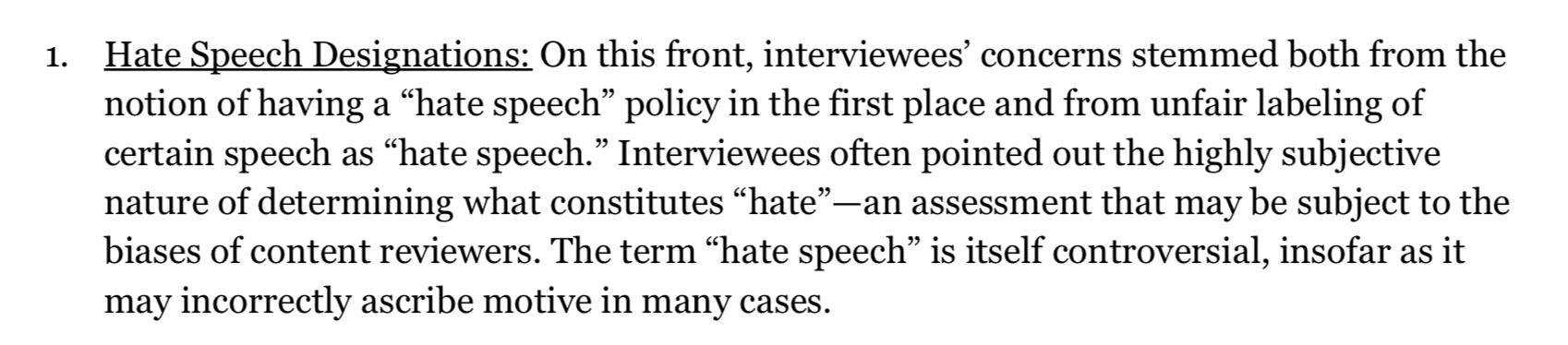
Unfortunately hate speech is real and here to stay. But it is valid to take issue with the subjectivity of how it may be determined as such.

But at the same time, the intent was not to quantify and solve bias, necessarily, but to understand how people perceived bias in day-to-day use of the site in the first place.

As you may have perceived, the concerns of conservatives in fact mirror the concerns of liberals: that Facebook is applying unknown and unknowable processes to the selection and display of content on the platform, and that our ability to question or challenge these processes is limited. These are nonpartisan issues.

Facebook’s response since the report was commissioned (in other words, over the last year and a half) has been to generally provide more information whenever it has stepped in to touch a post, ad, or other user data. It now tells people why certain posts are being shown, it has better documented news feed ranking (though not too well, lest someone take advantage), and it has created a better system for making content removal decisions, as well as a better appeal process.

So it says, anyway, but we can hardly take the company at its word that it has increased diversity, improved tools, and so forth. The investigation by Covington and Burling continues and these are but the preliminary results. Clegg writes that “This is the first stage of an ongoing process and Senator Kyl and his team will report again in a few months’ time.”

You can read the full interim report below:

Facebook – Covington Interim Report 1 by TechCrunch on Scribd

20 Aug 2019

NASA confirms mission to Jupiter’s moon Europa to explore its icy oceans

NASA has confirmed a mission to Europa, one of the Moons of Jupiter, will indeed happen. The mission was initially explored starting in 2017, with the space agency looking for reports on how it might proceed, and now NASA has said it will go ahead and move to the key stop of finalizing mission design, which will then lead to actually building the spacecraft that will make the trip, and the science payload it’ll carry on board.

The goal of the mission, which is codenamed ‘Europa Clipper,’ is to find out whether the icy natural satellite orbiting Jupiter could sustain life, and also explore whether it might be colonizable or habitable. Plus, we’ll definitely learn a lot more about Europa with an up-close-and-personal exploration.

Europa is the one of 79 known moons orbiting the gas giant, and is the six-largest in the entire solar system. It’s a bit smaller than our own, and has a crust that is composed primarily of water ice. Some scientists believe that it could have a water ocean just underneath that ice curst, however, and that if said ocean exists, it might be among the likelier places in our solar system to find life.

NASA’s goal for this mission is to launch it as early as 2023, though it’ll need its SLS launch system to be ready to make that happen. The extended timeline allows for a launch-ready state by 2025, which seems a bit more realistic given the current state of affairs.

20 Aug 2019

NASA confirms mission to Jupiter’s moon Europa to explore its icy oceans

NASA has confirmed a mission to Europa, one of the Moons of Jupiter, will indeed happen. The mission was initially explored starting in 2017, with the space agency looking for reports on how it might proceed, and now NASA has said it will go ahead and move to the key stop of finalizing mission design, which will then lead to actually building the spacecraft that will make the trip, and the science payload it’ll carry on board.

The goal of the mission, which is codenamed ‘Europa Clipper,’ is to find out whether the icy natural satellite orbiting Jupiter could sustain life, and also explore whether it might be colonizable or habitable. Plus, we’ll definitely learn a lot more about Europa with an up-close-and-personal exploration.

Europa is the one of 79 known moons orbiting the gas giant, and is the six-largest in the entire solar system. It’s a bit smaller than our own, and has a crust that is composed primarily of water ice. Some scientists believe that it could have a water ocean just underneath that ice curst, however, and that if said ocean exists, it might be among the likelier places in our solar system to find life.

NASA’s goal for this mission is to launch it as early as 2023, though it’ll need its SLS launch system to be ready to make that happen. The extended timeline allows for a launch-ready state by 2025, which seems a bit more realistic given the current state of affairs.

20 Aug 2019

Fitbit cofounders James Park and Eric Friedman are coming to Disrupt SF

Ten years ago, a hardware startup launched a fitness device on stage at TechCrunch 50. The $99 gadget combined a pedometer with a diet monitoring system, designed to help wearers meet their fitness goals.

Of course, a lot has changed for Fitbit in the intervening decade. The company has since become synonymous with fitness trackers in the U.S. In 2015, it filed for a $358 million IPO.

After several years of defining the wearables category, things have gotten a bit rockier, however, as the company contends with increased competition from the premium Apple Watch and low cost trackers from companies like Xiaomi.

Through acquisitions like Pebble and Vector, the company has improved its fortunes by building its own smartwatch line. Fitbit has also begun to transition into the healthcare industry through partnerships wit companies like Blue Cross Blue Shield.

Fitbit’s cofounders James Park and Eric Friedman will join us on stage to discuss their process for growing a hardware startup and navigating often fickle industry trends.

Disrupt SF runs October 2 to October 4 at the Moscone Center in San Francisco. Tickets are available here.

Did you know Extra Crunch annual members get 20% off all TechCrunch event tickets? Head over here to get your annual pass, and then email extracrunch@techcrunch.com to get your 20% off discount. Please note that it can take up to 24 hours to issue the discount code.