Category: UNCATEGORIZED

15 Aug 2019

US legislator, David Cicilline, joins international push to interrogate platform power

US legislator David Cicilline will be joining the next meeting of the International Grand Committee on Disinformation and ‘Fake News’, it has been announced. The meeting will be held in Dublin on November 7.

Chair of the committee, the Irish Fine Gael politician Hildegarde Naughton, announced Cicilline’s inclusion today.

The congressman — who is chairman of the US House Judiciary Committee’s Antitrust, Commercial, and Administrative Law Subcommittee — will attend as an “ex officio member” which will allow him to question witnesses, she added.

Exactly who the witnesses in front of the grand committee will be is tbc. But the inclusion of a US legislator in the ranks of a non-US committee that’s been seeking answers about reining in online disinformation will certainly make any invitations that get extended to senior executives at US-based tech giants much harder to ignore.

Naughton points out that the addition of American legislators also means the International Grand Committee represents ~730 million citizens — and “their right to online privacy and security”.

“The Dublin meeting will be really significant in that it will be the first time that US legislators will participate,” she said in a statement. “As all the major social media/tech giants were founded and are headquartered in the United States it is very welcome that Congressman Cicilline has agreed to participate. His own Committee is presently conducting investigations into Facebook, Google, Amazon and Apple and so his attendance will greatly enhance our deliberations.”

“Greater regulation of social media and tech giants is fast becoming a priority for many countries throughout the world,” she added. “The International Grand Committee is a gathering of international parliamentarians who have a particular responsibility in this area. We will coordinate actions to tackle online election interference, ‘fake news’, and harmful online communications, amongst other issues while at the same time respecting freedom of speech.”

The international committee met for its first session in London last November — when it was forced to empty-chair Facebook founder Mark Zuckerberg who had declined to attend in person, sending UK policy VP Richard Allan in his stead.

Lawmakers from nine countries spent several hours taking Allan to task over Facebook’s lack of accountability for problems generated by the content it distributes and amplifies, raising myriad examples of ongoing failure to tackle the democracy-denting, society-damaging disinformation — from election interference to hate speech whipping up genocide.

A second meeting of the grand committee was held earlier this year in Canada — taking place over three days in May.

Again Zuckerberg failed to show. Facebook COO Sheryl Sandberg also gave international legislators zero facetime, with the company opting to send local head of policy, Kevin Chan, and global head of policy, Neil Potts, as stand ins.

Lawmakers were not amused. Canadian MPs voted to serve Zuckerberg and Sandberg with an open summons — meaning they’ll be required to appear before it the next time they step foot in the country.

Parliamentarians in the UK also issued a summons for Zuckerberg last year after repeat snubs to testify to the Digital, Culture, Media and Sport committee’s enquiry into fake news — a decision that essentially gave birth to the international grand committee, as legislators in multiple jurisdictions united around a common cause of trying to find ways to hold social media giants to accounts.

While it’s not clear who the grand committee will invite to the next session, Facebook’s founder seems highly unlikely to have dropped off their list. And this time Zuckerberg and Sandberg may find it harder to turn down an invite to Dublin, given the committee’s ranks will include a homegrown lawmaker.

In a statement on joining the next meeting, Cicilline said: “We are living in a critical moment for privacy rights and competition online, both in the United States and around the world.  As people become increasingly connected by what seem to be free technology platforms, many remain unaware of the costs they are actually paying.

“The Internet has also become concentrated, less open, and growingly hostile to innovation. This is a problem that transcends borders, and it requires multinational cooperation to craft solutions that foster competition and safeguard privacy online. I look forward to joining the International Grand Committee as part of its historic effort to identify problems in digital markets and chart a path forward that leads to a better online experience for everyone.”

Multiple tech giants (including Facebook) have their international headquarters in Ireland — making the committee’s choice of location for their next meeting a strategic one. Should any tech CEOs thus choose to snub an invite to testify to the committee they might find themselves being served with an open summons to testify by Irish parliamentarians — and not being able to set foot in a country where their international HQ is located would be more than a reputational irritant.

Ireland’s privacy regulator is also sitting on a stack of open investigations against tech giants — again with Facebook and Facebook owned companies producing the fattest file (some 11 investigations). But there are plenty of privacy and security concerns to go around, with the DPC’s current case file also touching tech giants including Apple, Google, LinkedIn and Twitter.

15 Aug 2019

How Facebook does IT

If you have ever worked at any sizable company, the word “IT” probably doesn’t conjure up many warm feelings. If you’re working for an old, traditional enterprise company, you probably don’t expect anything else, though. If you’re working for a modern tech company, though, chances are your expectations are a bit higher. And once you’re at the scale of a company like Facebook, a lot of the third-party services that work for smaller companies simply don’t work anymore.

To discuss how Facebook thinks about its IT strategy and why it now builds most of its IT tools in-house, I sat down with the company’s CIO, Atish Banerjea, at its Menlo Park headquarter.

Before joining Facebook in 2016 to head up what it now calls its “Enterprise Engineering” organization, Banerjea was the CIO or CTO at companies like NBCUniversal, Dex One and Pearson.

“If you think about Facebook 10 years ago, we were very much a traditional IT shop at that point,” he told me. “We were responsible for just core IT services, responsible for compliance and responsible for change management. But basically, if you think about the trajectory of the company, were probably about 2,000 employees around the end of 2010. But at the end of last year, we were close to 37,000 employees.”

Traditionally, IT organizations rely on third-party tools and software, but as Facebook grew to this current size, many third-party solutions simply weren’t able to scale with it. At that point, the team decided to take matters into its own hands and go from being a traditional IT organization to one that could build tools in-house. Today, the company is pretty much self-sufficient when it comes to running its IT operations, but getting to this point took a while.

“We had to pretty much reinvent ourselves into a true engineering product organization and went to a full ‘build’ mindset,” said Banerjea. That’s not something every organization is obviously able to do, but, as Banerjea joked, one of the reasons why this works at Facebook “is because we can — we have that benefit of the talent pool that is here at Facebook.”
IMG 20190702 125344

The company then took this talent and basically replicated the kind of team it would help on the customer side to build out its IT tools, with engineers, designers, product managers, content strategies, people and research. “We also made the decision at that point that we will hold the same bar and we will hold the same standards so that the products we create internally will be as world-class as the products we’re rolling out externally.”

One of the tools that wasn’t up to Facebook’s scaling challenges was video conferencing. The company was using a third-party tool for that, but that just wasn’t working anymore. In 2018, Facebook was consuming about 20 million conference minutes per month. In 2019, the company is now at 40 million per month.

Besides the obvious scaling challenge, Facebook is also doing this to be able to offer its employees custom software that fits their workflows. It’s one thing to adapt existing third-party tools, after all, and another to build custom tools to support a company’s business processes.

Banerjea told me that creating this new structure was a relatively easy sell inside the company. Every transformation comes with its own challenges, though. For Facebook’s Enterprise  Engineering team, that included having to recruit new skill sets into the organization. The first few months of this process were painful, Banerjea admitted, as the company had to up-level the skills of many existing employees and shed a significant number of contractors. “There are certain areas where we really felt that we had to have Facebook DNA in order to make sure that we were actually building things the right way,” he explained.

Facebook’s structure creates an additional challenge for the team. When you’re joining Facebook as a new employee, you have plenty of teams to choose from, after all, and if you have the choice of working on Instagram or WhatsApp or the core Facebook app — all of which touch millions of people — working on internal tools with fewer than 40,000 users doesn’t sound all that exciting.

“When young kids who come straight from college and they come into Facebook, they don’t know any better. So they think this is how the world is,” Banerjea said. “But when we have experienced people come in who have worked at other companies, the first thing I hear is ‘oh my goodness, we’ve never seen internal tools of this caliber before.’ The way we recruit, the way we do performance management, the way we do learning and development — every facet of how that employee works has been touched in terms of their life cycle here.”

Event Center 02

Facebook first started building these internal tools around 2012, though it wasn’t until Banerjea joined in 2016 that it rebranded the organization and set up today’s structure. He also noted that some of those original tools were good, but not up to the caliber employees would expect from the company.

“The really big change that we went through was up-leveling our building skills to really become at the same caliber as if we were to build those products for an external customer. We want to have the same experience for people internally.”

The company went as far as replacing and rebuilding the commercial Enterprise Resource Planning (ERP) system it had been using for years. If there’s one thing that big companies rely on, it’s their ERP systems, given they often handle everything from finance and HR to supply chain management and manufacturing. That’s basically what all of their backend tools rely on (and what companies like SAP, Oracle and others charge a lot of money for). “In that 2016/2017 time frame, we realized that that was not a very good strategy,” Banerjea said. In Facebook’s case, the old ERP handled the inventory management for its data centers, among many other things. When that old system went down, the company couldn’t ship parts to its data centers.

“So what we started doing was we started peeling off all the business logic from our backend ERP and we started rewriting it ourselves on our own platform,” he explained. “Today, for our ERP, the backend is just the database, but all the business logic, all of the functionality is actually all custom written by us on our own platform. So we’ve completely rewritten our ERP, so to speak.”

In practice, all of this means that ideally, Facebook’s employees face far less friction when they join the company, for example, or when they need to replace a broken laptop, get a new phone to test features or simply order a new screen for their desk.

One classic use case is onboarding, where new employees get their company laptop, mobile phones and access to all of their systems, for example. At Facebook, that’s also the start of a six-week bootcamp that gets new engineers up to speed with how things work at Facebook. Back in 2016, when new classes tended to still have less than 200 new employees, that was still mostly a manual task. Today, with far more incoming employees, the Enterprise Engineering team has automated most of that — and that includes managing the supply chain that ensures the laptops and phones for these new employees are actually available.

But the team also built the backend that powers the company’s more traditional IT help desks, where employees can walk up and get their issues fixed (and passwords reset).
Event Center 10

To talk more about how Facebook handles the logistics of that, I sat down with Koshambi Shah, who heads up the company’s Enterprise Supply Chain organization, which pretty much handles every piece of hardware and software the company delivers and deploys to its employees around the world (and that global nature of the company brings its own challenges and additional complexity). The team, which has fewer than 30 people, is made up of employees with experience in manufacturing, retail and consumer supply chains.

Typically, enterprises offer their employees a minimal set of choices when it comes to the laptops and phones they issue to their employees, and the operating systems that can run on them tend to be limited. Facebook’s engineers have to be able to test new features on a wide range of devices and operating systems. There are, after all, still users on the iPhone 4s or BlackBerry that the company wants to support. To do this, Shah’s organization actually makes thousands of SKUs available to employees and is able to deliver 98% of them within three days or less. It’s not just sending a laptop via FedEx, though. “We do the budgeting, the financial planning, the forecasting, the supply/demand balancing,” Shah said. “We do the asset management. We make sure the asset — what is needed, when it’s needed, where it’s needed — is there consistently.”

In many large companies, every asset request is double guessed. Facebook, on the other hand, places a lot of trust in its employees, it seems. There’s a self-service portal, the Enterprise Store, that allows employees to easily request phones, laptops, chargers (which get lost a lot) and other accessories as needed, without having to wait for approval (though if you request a laptop every week, somebody will surely want to have a word with you). Everything is obviously tracked in detail, but the overall experience is closer to shopping at an online retailer than using an enterprise asset management system. The Enterprise Store will tell you where a device is available, for example, so you can pick it up yourself (but you can always have it delivered to your desk, too, because this is, after all, a Silicon Valley company).
A73A6581

For accessories, Facebook also offers self-service vending machines, and employees can walk up to the help desk.

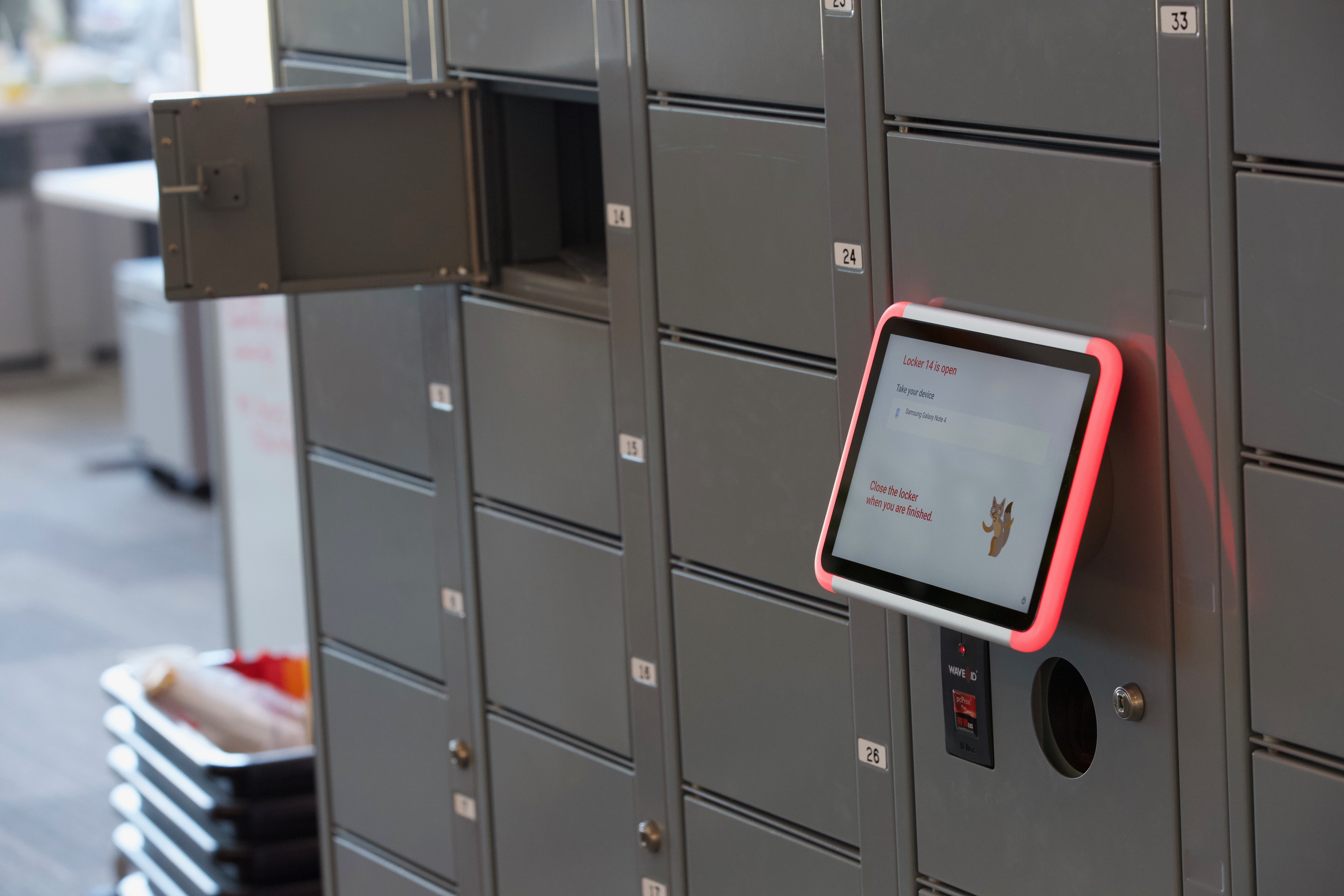
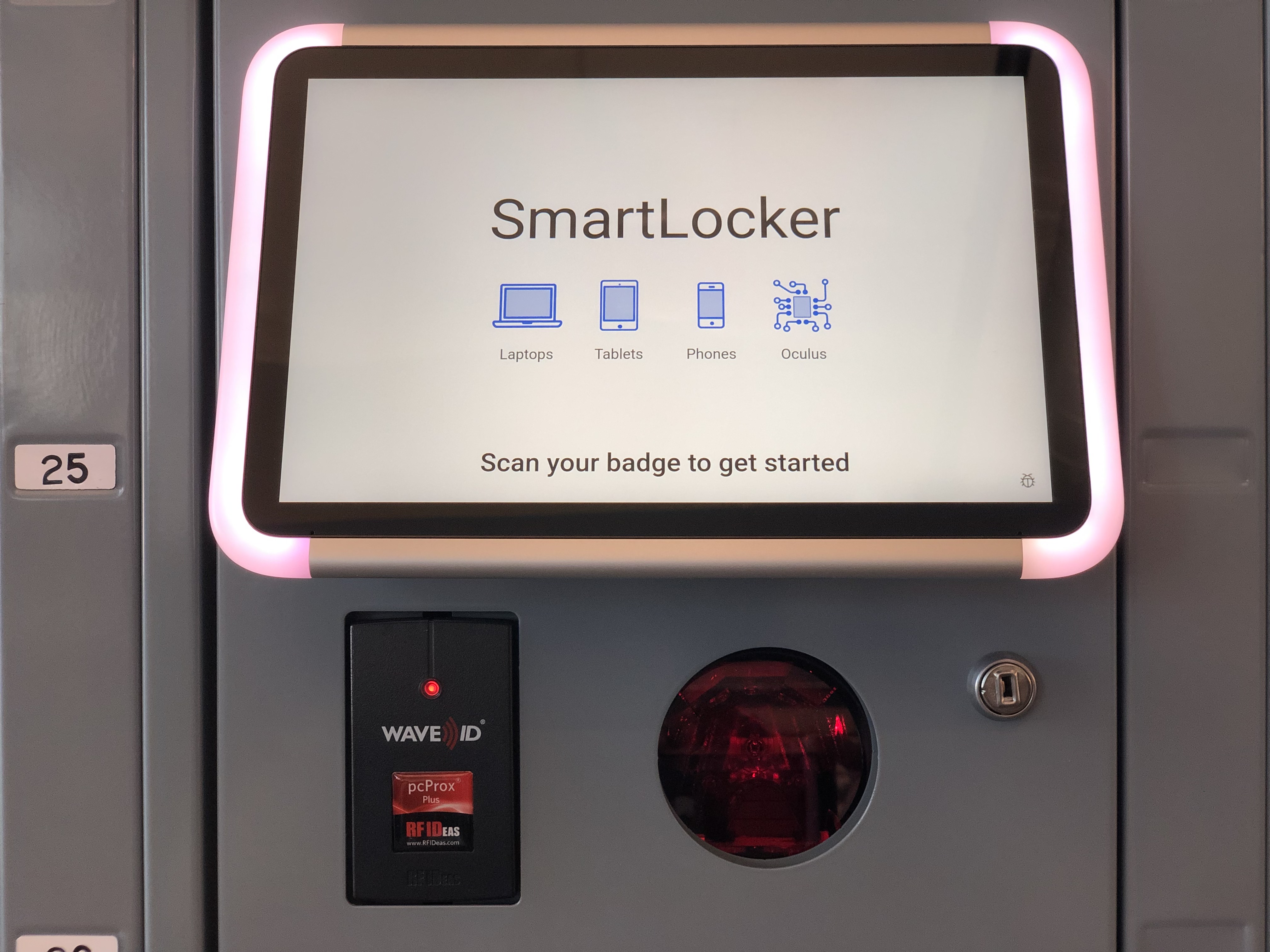
The company also recently introduced an Amazon Locker-style setup that allows employees to check out devices as needed. At these smart lockers, employees simply have to scan their badge, choose a device and, once the appropriate door has opened, pick up the phone, tablet, laptop or VR devices they were looking for and move on. Once they are done with it, they can come back and check the device back in. No questions asked. “We trust that people make the right decision for the good of the company,” Shah said. For laptops and other accessories, the company does show the employee the price of those items, though, so it’s clear how much a certain request costs the company. “We empower you with the data for you to make the best decision for your company.”

Talking about cost, Shah told me the Supply Chain organization tracks a number of metrics. One of those is obviously cost. “We do give back about 4% year-over-year, that’s our commitment back to the businesses in terms of the efficiencies we build for every user we support. So we measure ourselves in terms of cost per supported user. And we give back 4% on an annualized basis in the efficiencies.”

Unsurprisingly, the company has by now gathered enough data about employee requests (Shah said the team fulfills about half a million transactions per year) that it can use machine learning to understand trends and be proactive about replacing devices, for example.
IMG 8238

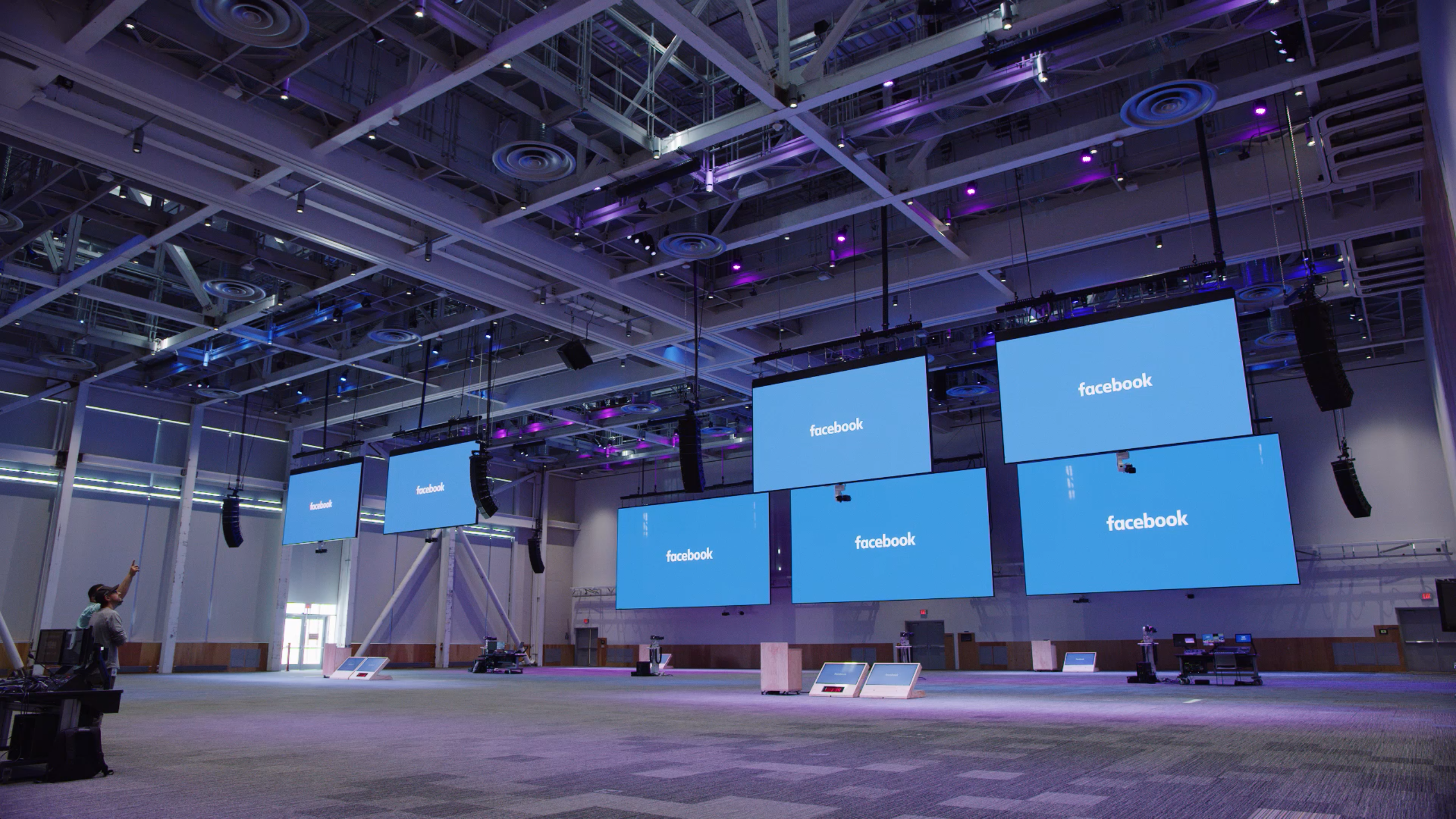
Facebooks’ Enterprise Engineering group doesn’t just support internal customers, though. Another interesting aspect to Facebook’s Enterprise Engineering group is that it also runs the company’s internal and external events, including the likes of F8, the company’s annual developer conference. To do this, the company built out conference rooms that can seat thousands of people, with all of the logistics that go with that.

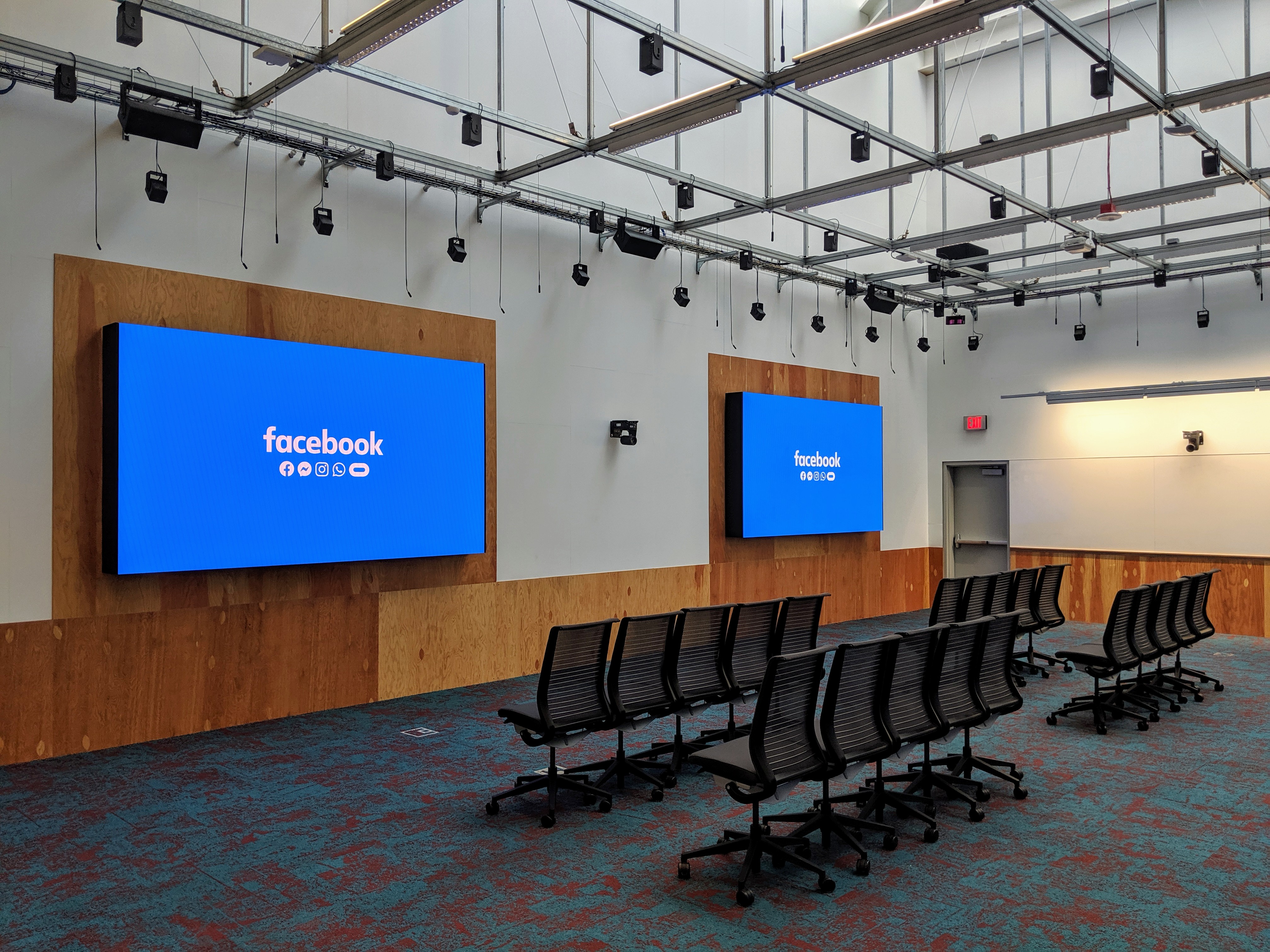
The company also showed me one of its newest meeting rooms where there are dozens of microphones and speakers hanging from the ceiling that make it easier for everybody in the room to participate in a meeting and be heard by everybody else. That’s part of what the organization’s “New Builds” team is responsible for, and something that’s possible because the company also takes a very hands-on approach to building and managing its offices.

Facebook also runs a number of small studios in its Menlo Park and New York offices, where both employees and the occasional external VIP can host Facebook Live videos.

Event Center 56

Indeed, live video, it seems, is one of the cornerstones of how Facebook employees collaborate and help employees who work from home. Typically, you’d just use the camera on your laptop or maybe a webcam connected to your desktop to do so. But because Facebook actually produces its own camera system with the consumer-oriented Portal, Banerjea’s team decided to use that.

“What we have done is we have actually re-engineered the Portal,” he told me. “We have connected with all of our video conferencing systems in the rooms. So if I have a Portal at home, I can dial into my video conferencing platform and have a conference call just like I’m sitting in any other conference room here in Facebook. And all that software, all the engineering on the portal, that has been done by our teams — some in partnership with our production teams, but a lot of it has been done with Enterprise Engineering.”

Unsurprisingly, there are also groups that manage some of the core infrastructure and security for the company’s internal tools and networks. All of those tools run in the same data centers as Facebook’s consumer-facing applications, though they are obviously sandboxed and isolated from them.

It’s one thing to build all of these tools for internal use, but now, the company is also starting to think about how it can bring some of these tools it built for internal use to some of its external customers. You may not think of Facebook as an enterprise company, but with its Workplace collaboration tool, it has an enterprise service that it sells externally, too. Last year, for the first time, Workplace added a new feature that was incubated inside of Enterprise Engineering. That feature was a version of Facebook’s public Safety Check that the Enterprise Engineering team had originally adapted to the company’s own internal use.

“Many of these things that we are building for Facebook, because we are now very close partners with our Workplace team — they are in the enterprise software business and we are the enterprise software group for Facebook — and many [features] we are building for Facebook are of interest to Workplace customers.”

As Workplace hit the market, Banerjea ended up talking to the CIOs of potential users, including the likes of Delta Air Lines, about how Facebook itself used Workplace internally. But as companies started to adopt Workplace, they realized that they needed integrations with existing third-party services like ERP platforms and Salesforce. Those companies then asked Facebook if it could build those integrations or work with partners to make them available. But at the same time, those customers got exposed to some of the tools that Facebook itself was building internally.

“Safety Check was the first one,” Banerjea said. “We are actually working on three more products this year.” He wouldn’t say what these are, of course, but there is clearly a pipeline of tools that Facebook has built for internal use that it is now looking to commercialize. That’s pretty unusual for any IT organization, which, after all, tends to only focus on internal customers. I don’t expect Facebook to pivot to an enterprise software company anytime soon, but initiatives like this are clearly important to the company and, in some ways, to the morale of the team.

This creates a bit of friction, too, though, given that the Enterprise Engineering group’s mission is to build internal tools for Facebook. “We are now figuring out the deployment model,” Banerjea said. Who, for example, is going to support the external tools the team built? Is it the Enterprise Engineering group or the Workplace team?

Chances are then, that Facebook will bring some of the tools it built for internal use to more enterprises in the long run. That definitely puts a different spin on the idea of the consumerization of enterprise tech. Clearly, not every company operates at the scale of Facebook and needs to build its own tools — and even some companies that could benefit from it don’t have the resources to do so. For Facebook, though, that move seems to have paid off and the tools I saw while talking to the team definitely looked more user-friendly than any off-the-shelf enterprise tools I’ve seen at other large companies.


15 Aug 2019

What will Tumblr become under the ownership of tech’s only Goldilocks founder?

This week, Automattic revealed it has signed all the paperwork to acquire Tumblr from Verizon, including its full staff of 200. Tumblr has undergone quite a journey since its headline-grabbing acquisition by Marissa Mayer’s Yahoo in 2013 for $1.1 billion, but after six years of neglect, its latest move is its first real start since it stopped being an independent company. Now, it’s in the hands of Matt Mullenweg, the only founder of a major tech company who has repeatedly demonstrated a talent for measured responses, moderation and a willingness to forego reckless explosive growth in favor of getting things ‘just right.’

There’s never been a better acquisition for all parties involved, or at least one in which every party should walk away feeling they got exactly what they needed out of the deal. Yes, that’s in spite of the reported $3 million-ish asking price.

Verizon Media acquired Tumblr through a deal made to buy Yahoo, under a previous media unit strategy and leadership team. Verizon Media has no stake in the company, and so headlines talking about the bath it apparently took relative to the original $1.1 billion acquisition price are either willfully ignorant or just plain dumb.

Six years after another company made that bad deal for a company it clearly didn’t have the right business focus to correctly operate, Verizon made a good one to recoup some money.

Aligned leadership and complementary offerings drive a win-win

15 Aug 2019

Alibaba cloud biz is on a run rate over $4B

Alibaba announced its earnings today, and the Chinese ecommerce giant got a nice lift from its cloud business, which grew 66 percent to more than $1.1 billion, or a run rate surpassing $4 billion.

It’s not exactly on par with Amazon, which reported cloud revenue of $8.381 billion last quarter, more than double Alibaba’s yearly run rate, but it’s been a steady rise for the company, which really began taking the cloud seriously as a side business in 2015.

At that time, Alibaba Cloud’s president Simon Hu boasted to Reuters that his company would overtake Amazon in four years. It is not even close to doing that, but it has done well to get to over a billion a quarter in just four years.

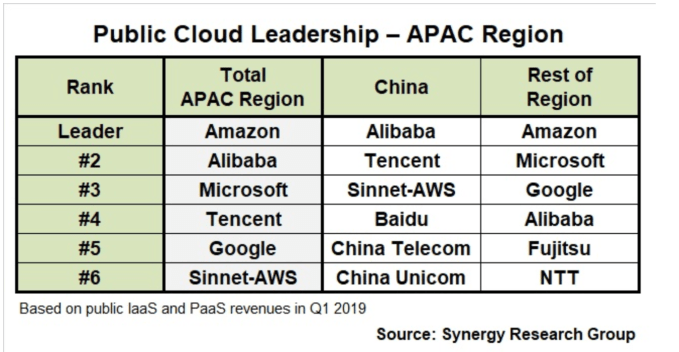
In fact, in its most recent data for the Asia-Pacific region, Synergy Research, a firm that closely tracks the public cloud market found that Amazon was still number one overall in the region. Alibaba was first in China, but fourth in the region outside of China with the market’s Big 3 — Amazon, Microsoft and Google — coming in ahead of it. These numbers were based on Q1 data before today’s numbers were known, but they provide a sense of where the market is in the region.

Screenshot 2019 08 15 11.17.26

The company was busy last quarter adding over 300 new products and features in the period ending June 30th (and reported today). That included changes and updates to core cloud
offerings, security, data intelligence and AI applications, according to the company.

While the cloud business still isn’t a serious threat to the industry’s Big Three, especially outside its core Asia-Pacific market, it’s still growing steadily and accounted for almost 7 percent of Alibaba’s total of $16.74 billion in revenue for the quarter — and that’s not bad at all.

15 Aug 2019

YouTube’s new AR feature lets you virtually try on makeup while watching videos

Earlier this summer, YouTube announced its plans for a new AR feature for virtual makeup try-on that works directly in the YouTube app. Today, the first official campaign to use the “Beauty Try-On” feature has now launched, allowing viewers to try on and shop lipsticks from MAC Cosmetics from YouTube creator Roxette Arisa’s makeup tutorial video.

Makeup tutorials are hugely popular on YouTube, so an integration where you can try on the suggested looks yourself makes a ton of sense. While a lipstick try-on feature isn’t exactly groundbreaking — plenty of social media apps offer a similar filter these days — it could lead to more complex AR makeup integrations further down the road.

The new AR feature only works when you’re watching the video from a mobile device, and the YouTube app is updated to the latest version.

Famebit MAC Shortened

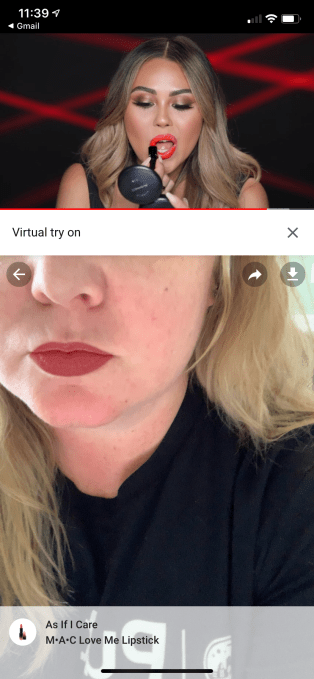
Then, when watching the video, you’ll see a button that says “try it on” which will launch the camera in a split-screen view. The video will continue to play as you scroll through the various lipstick shades below, applying the different colors to see which one works best. Unlike some of the filters in social apps like Instagram and Snapchat, the colors are evenly aligned with your lips and not bleeding out the edges. The result is a very natural look.

Image from iOS 1MAC Cosmetics will work with creators through YouTube’s branded content division, Famebit. The program connects brands with YouTube influencers who then market their products as paid sponsorships.


MAC is the first partner for this AR feature, but more will likely follow.

Prior to launch, YouTube tested the AR Beauty Try-On with several beauty brands, and found that 30% of viewers chose to active the experience in the YouTube iOS.

Those who did were fairly engaged, spending more than 80 seconds trying on virtual lipstick shades.

Google is not the first company to offer virtual makeup try-on experiences. Beyond social media apps, there are also AR beauty apps like YouCam MakeupSephora’s Virtual ArtistUlta’s GLAMLab and others. L’Oréal also offers Live Try-On on its website, and had partnered with Facebook last year to bring virtual makeup to the site. In addition, Target’s online Beauty Studio offers virtual makeup across a number of brands and products.

YouTube’s implementation, however, is different because it’s not just a fun consumer product — it’s an AR-powered ad campaign.

Though some may scoff at the idea of virtual makeup, this market is massive. Millions watch makeup tutorials on YouTube every day, and the site has become the dominant source for referral traffic for beauty brands. In 2018, beauty-related content generated more than 169 billion views on the video platform.

You can watch the YouTube video here, or engage with the AR feature from the mobile YouTube app.

If you don’t see your face immediately after pressing the “try on” button, you probably need to update the YouTube app.

15 Aug 2019

Elon Musk: Spotify is “coming” to Tesla vehicles in North America

Tesla owners in the U.S. and Canada may finally get that free Spotify Premium integration they’ve been asking for.

Tesla CEO Elon Musk tweeted late Wednesday night that Spotify premium integration is “coming.” Musk, who has promised Spotify to owners in North America before, did not provide a timeline. In other words, the music streaming service could be integrated next week or a six months from now.

But still, it’s a moment of celebration for many Tesla owners who have complained about Slacker Radio, the streaming music service integrated into all vehicles in the U.S. and Canada. Owners in Europe, Australia and Hong Kong have had Spotify Premium in their vehicles since late 2015.

Slacker Radio, which launched in 2007, has customizable radio stations based on the listener’s personal music tastes. The free and subscription-based service also tried to differentiate itself from the likes on Spotify and Pandora by using DJs to curate programs and at one time, even sold a portable music player. Despite its efforts, Slacker has been overshadowed by Spotify, which had 232 million monthly active users and 108 million paying subscribers at the end of June 2019.

Slacker was acquired in 2017 for $50 million in cash and stock by the LiveXLive, an entertainment and streaming service that focused on live music performances.

Last year, LiveXLive announced a partnership with Dash Radio, a digital radio broadcasting platform with more than 80 original live stations. Under the deal, Dash channels will be available across Slacker Radio a move meant to bring more live radio on the streaming service.

15 Aug 2019

Fitz Frames, with $2.5M in seed funding, wants your kid to have custom glasses

Fitz Frames is today launching out of beta to offer affordable, custom-made glasses for families, and in particular, for children.

The company, which has raised $2.5 million in seed funding, was founded by Heidi Hertel is led by her and co-CEO Gabriel Schlumberger. The company declined to disclose its investors, but shared that it was a mix of angel and institutional investors.

Hertel started the company after taking her children through the process of buying glasses with little to no success.

Hertel cites two main problems with buying glasses for children: 1) There isn’t much selection around style for kids, and 2) Glasses are made for kids and adults with little variation in size for kids who are in-between.

Here’s how it works:

With a Rx from a doctor or without, kids and parents hop on the Fitz Frames app to go through a virtual try-on. While the user is going through a virtual try-on to find the right pair of glasses, the Fitz Frames app is doing a full measurement of the face using thousands of data points, including ear-height, nose shape, etc. to make sure that the end-result is a comfortable, well-fitting pair of glasses.

From there, Fitz Frames sends the measurements to their manufacturing set-up in Youngstown, Ohio, where the frames are made from polyamide powder which is 3D-printed using selective laser sintering.

Not only does the polyamide allow for a more durable, flexible frame, but the manufacturing process as a whole allows Fitz to turn around frames quickly. The goal, according to Hertel, is to turn around a pair of glasses in a week or less.

Fitz Frames are also made with no-screw hinges, opting instead for arms that pop right out of the socket and pop back in. This means repairing a pair of Fitz Frames is far easier and doesn’t require sewing hands and tiny screwdrivers.

Kids can also have their name or favorite number or address etched into the arm of the glasses.

Fitz Frames cost $95, but the company is also offering a subscription plan for parents. The idea is that kids lose and break their glasses all the time, and that small children shouldn’t have to feel responsible for something worth hundreds of dollars.

“Glasses shouldn’t have to be so precious,” said Hertel.

The subscription, which costs $185/year, includes two pairs of glasses. From there, subscribers can get unlimited frames (but not lenses, or shipping) throughout the year. In other words, your kids can lose their glasses as often as they’d like as long as you’re cool paying for the third, fourth, and so on lenses.

Fitz Frames isn’t alone. A company called Pair Eyewear is also tackling kids glasses with an approach that focuses on easily changing the style through clip-on top-frames. Warby Parker also recently got into kids’ frames.

Not unlike Warby, Fitz is also working alongside non-profits to make glasses more accessible. The company has a partnership with Vision to Learn, which provides eye exams and glasses to kids in low-income communities, as well as a pilot program with Loving Eyes, an org that provides custom-fit eyeglasses for children with craniofacial anomalies who can’t wear conventional glasses.

Fitz Frames also has plans to launch a pop-up in the Hamptons this fall.

15 Aug 2019

The Google Assistant now lets you annoy your family members with assignable reminders

Do you sometimes have to nag your significant other to take out the trash on Monday night? Now, you can do so in a more passive-aggressive way by sending them a reminder through the Google Assistant instead of in person.

“Hey Google, remind Alex to take out the trash at 8pm,” is all it takes. Your family members (or roommates that you’ve added to your Google family group) will then get a notification on their phones and/or Assistant-powered Smart Displays.

“Assignable reminders on the Google Assistant help families and housemates better collaborate and stay organized while at home or on the go,” explains Google. “This means you can now create reminders for your partner or roommate to do things like pick up the groceries, pay a recurring bill, walk the dog—or send them a note of encouragement when they need it the most (‘Hey Google, remind Mary that she will do great on tomorrow’s exam.’)”

I’m pretty sure Mary would prefer a bit of human contact with that encouragement, but sometimes the Google Assistant is all you have.

AR Hub

Technically, for all of this to work, you need to have the person you are sending the reminder to in your contacts list and in your Google Family group. You also need to set up Voice Match for them for this to work on a smart display or speaker. Parents can set up accounts for children under 13 through Family Link.

This new feature will become available in English on phones, speakers and Smart Displays in the U.S., U.K. and Australia. Like with all Google reminders, you can set times and locations for your messages to pop up.

Mercifully, you can block people from sending you reminders, too, thanks to a new toggle in the Assistant Settings menu.

AR Mobile

15 Aug 2019

Spotify will reportedly test a price hike for its premium service in some markets

Spotify is set to test a price increase for its family plan, upping the cost by around 13 percent in some Scandinavian markets, Bloomberg reports. The price increase is designed as a limited test to figure out whether it might be able to roll out higher pricing for its service globally. The report notes that the higher prices might not be made permanent or roll out anywhere else, depending on the result of the limited test.

The music streaming company has good reason to give higher prices a shot: It’s consistently a money losing company, despite having the largest user base of any music streaming service around. That’s more important now that the company is a publicly listed entity, and as it seeks to move towards profitability as a result.

In video streaming, Netflix has managed to consistently increase prices and retain subscribers over the years as it shifted from seeking growth to driving more revenue. But Netflix’s offering is currently more or less unique in the market, and its costs to consumers still far undercut the alternative – a traditional cable or satellite TV subscription. Spotify is acting in a very different environment, with competitive services on offer with very similar value propositions from companies including Apple, Google and Amazon who all use these primarily as complements to other businesses, rather than as money-making enterprise in themselves.

15 Aug 2019

What security pros need to know from Black Hat & Def Con 2019

Black Hat and Def Con came and went as quickly as it ever does. The week-long pair of back-to-back conferences, referred to as “hacker summer camp,” draws in the security crowd from across the world onto Las Vegas, where startups tout their technologies as hackers and researchers reveal their findings.

This year we saw ordinary-looking charging cables that can hack your computer, we found out that cloud backups are easily exposed, robocall blocking apps aren’t as privacy-focused as you might think, and your corporate VPN and office printer are targets for hackers (and if they fail there they’ll just ship a hardware exploit to your mailroom.) Even students can easily hack their own school systems.

The obvious takeaways might be to never plug anything into your computer and that all your data is already ‘pwned’.

But what does that all mean to the average security professional, let alone the CISO at the top of the corporate chain? Between the villages and the many speaker tracks — not to mention the darting between hotels — it’s tough to know exactly what we should take away from the shows.

We spoke to four security experts who were there and asked them what their primary takeaways were for security decision-makers.

Internet of Things is a risk factor