Category: UNCATEGORIZED

13 Aug 2019

Xiaomi tops Indian smartphone market for eighth straight quarter

Xiaomi has now been the top smartphone maker in India for eight straight quarters, becoming a constant headache for Samsung in the key overseas market that continues to show strong appetite for handsets as their shipment slows, or drops pretty much everywhere else in the world.

The Chinese electronics giant shipped 10.4 million handsets in the quarter that ended in June this year and assumed 28.3% of the market, research firm IDC reported Tuesday. Its closest rival, Samsung, which once held the tentpole position in India, shipped 9.3 million handsets in the nation during the same period and settled with 25.3% market share.

Overall, 36.9 million handsets were shipped in India during the second quarter of this year, up 9.9% from the same period last year and up 14.8% since the quarter before, IDC reported. This was the highest volume of handsets that has ever shipped during the second quarter in India, the research firm said.

As smartphone shipments slow or decline in most of the world, India has emerged as an outlier that continues to show strong momentum as tens of millions of people purchase their first handset in the country each quarter.

Research firm Counterpoint told TechCrunch that there are about 450 million smartphone users in India, up from about 350 million late last year and 300 million in late 2017. This growth has made India, home to more than 1.3 billion people, the fastest and second largest smartphone market worldwide with unmatched room for further growth.

Globally, smartphone shipments declined by 2.3% year-over-year in Q2 2019, IDC said.

Chinese phone makers Vivo and Oppo, both of which spent lavishly in marketing during the recent local favorite cricket season in India, also expanded their base in the country. Vivo had 15.1% of the local market share, up from 12.6% in Q2 2018, while Oppo’s share grew from 7.6% to 9.7% during the same period. The market share of Realme, which has gained following after it started to replicate some of Xiaomi’s early model, also shot up, moving from 1.2% in Q2 2018 to 7.7% in Q2 2019.
GettyImages 1128860832

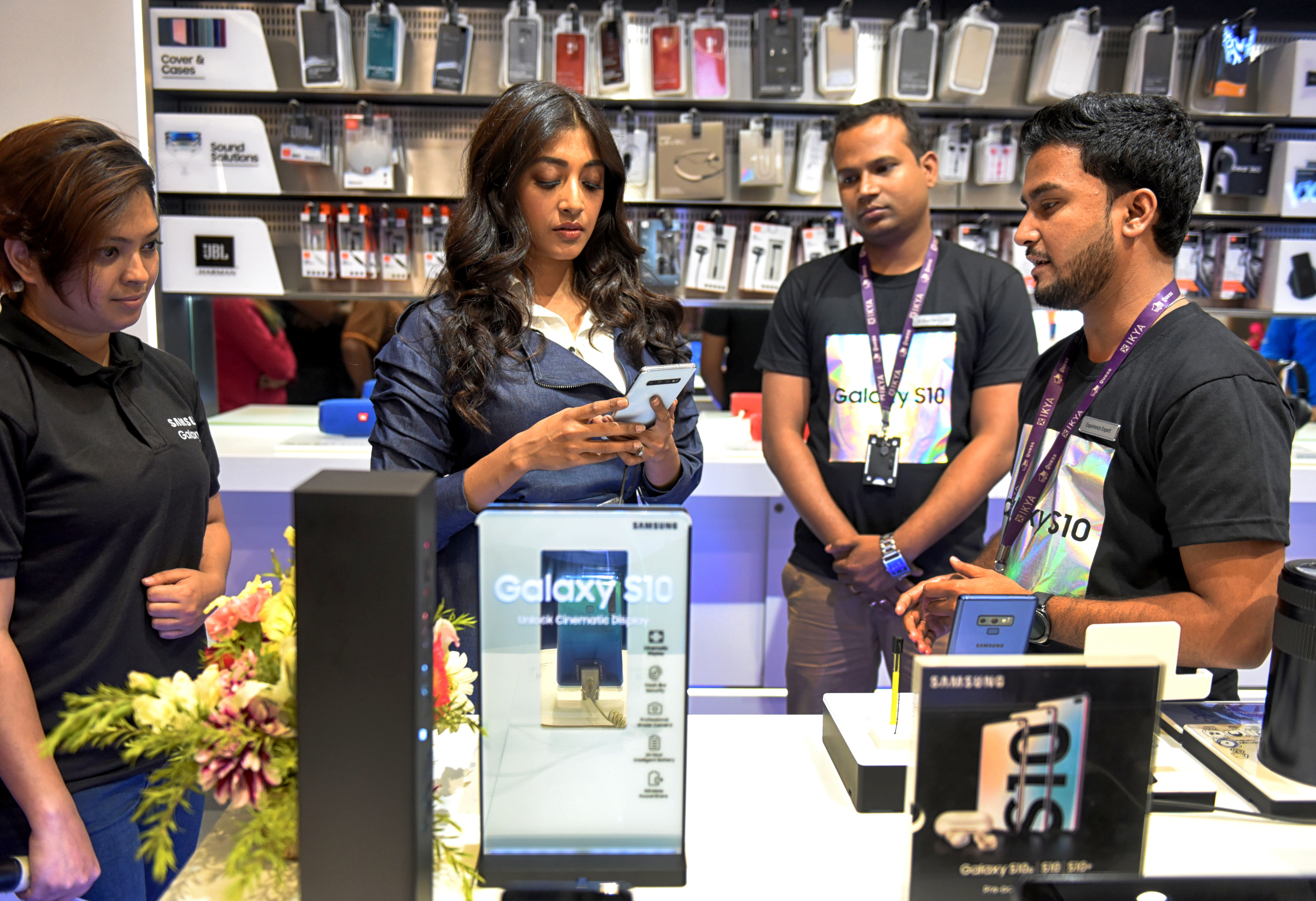
Samsung showroom demonstrator seen showing the features of new S10 Smartphone during the launching ceremony. (Photo by Avishek Das/SOPA Images/LightRocket via Getty Images)

The key to gaining market share in India has remained unchanged over the years: Increasingly bulk up the specs in handsets and sell them for low prices. The average selling price of a handset during the Q2 was $159 in the quarter that ended in June this year. 78% of the 36.9 million phones that shipped in India sported a sticker price below $200, IDC said.

That’s not to say that phones priced above $200 don’t have any takers in India. Per IDC, the fastest growing smartphone segment in the nation was priced between $200 to $300, witnessing a 105.2% growth over the same period last year.

Smartphones priced between $400 and $600 were the second-fastest growing segment in the country, witnessing a 16.1% growth since the same period last year. Chinese phone maker OnePlus assumed 63.6% of this premium segment, followed by Apple (which has less than 2% of the market share), and Samsung.

Feature phones that have maintained a crucial position in India’s handsets market continue to maintain their significant footprint, though their popularity is beginning to wane. 32.4 million feature phones shipped in India during Q2 this year, down 26.3% since the same period last year.

For Xiaomi, which shipped 32.3 million smartphones globally in Q2 2019, India has become its biggest market, the company said. Xiaomi entered the Indian market five years ago, and for the first two years, relied mostly on selling handsets online to cut overhead costs. But the company has since established and expanded its presence in the brick and mortar market, which continues to account for much of the sales in the country.

Earlier this month, the Chinese phone maker said it has set up its 2,000th Mi Home store in India. It is on track to have presence in 10,000 physical stores in the country by end of the year, and expects to see half of its sales come from the offline market by that time frame.

Samsung has stepped up its game in India in last two years, too. The company, which opened the world’s largest phone factory in the country last year, has ramped up productions of Galaxy A series of smartphones that are aimed at budget conscious customers and conceptualized a similar series that includes Galaxy M10, M20, and M30 smartphone models for the Indian market. The Galaxy A series handsets drove much of the growth for the company, IDC said.

Even as it lags behind Xiaomi, Samsung shipped more handsets in Q2 2019 compared to Q2 2018 (9.3 million vs 8 million) and its market share grew from 23.9% to 25.3% during the same period.

“The vendor was also offering attractive channel schemes to clear the stocks of Galaxy J series. Galaxy M series (exclusive online till the end of 2Q19) saw price reductions which helped retain the 13.5% market share in the online channel in 2Q19 for Samsung,” IDC said.

But the South Korean giant continues to have a tough time surpassing Xiaomi, which continues to abide by its 5% profit margin (Xiaomi says it only makes 5% profit on any hardware it sells). Xiaomi has also expanded its local production efforts in India and created more than 10,000 jobs in the country, more than 90% of whom have been granted to women.

13 Aug 2019

Facebook contractors said to have collected and transcribed users’ audio without permission

Reset the counter on “number of days since the last Facebook privacy scandal.”

Facebook has become the latest tech giant to face scrutiny over its handling of users’ data, following a report that said the social media giant collected audio data and recordings from its users and transcribed it using third-party contractors.

The report came from Bloomberg, citing the contractors who requested anonymity for fear of losing their jobs.

According to the report, it’s not known where the audio came from or why it was transcribed, but that Facebook users’ conversations were often matched against to see if they were properly interpreted by the company’s artificial intelligence.

There are several ways that Facebook collects voice and audio data, including from its mobile devices, its Messenger voice and video service, and through its smart speaker. But the social media giant’s privacy policy makes no clear mention of voice data. Bloomberg also noted that contractors felt their work was “unethical” because Facebook “hasn’t disclosed to users that third parties may review their audio.”

Facebook has since stopped the practice.

We’ve asked Facebook several questions, including how the audio was collected, for what reason it was transcribed, and why users weren’t explicitly told of the third-party transcription, but did not immediately hear back.

Facebook becomes the latest tech company to face questions about its use of third-party contractors and staff to review user audio.

Amazon saw the initial round of flak for allowing contractors to manually review Alexa recordings without express user permission, forcing the company to add an opt-out to its Echo devices. Google also faced the heat for allowing human review of audio data, along with Apple which used contractors to listen to seemingly private Siri recordings. Microsoft also listened to some Skype calls made through the company’s app translation feature.

It’s been over a year since Facebook last had a chief security officer in the wake of Alex Stamos’ departure.

Read more:

13 Aug 2019

Daily Crunch: Verizon is selling Tumblr

The Daily Crunch is TechCrunch’s roundup of our biggest and most important stories. If you’d like to get this delivered to your inbox every day at around 9am Pacific, you can subscribe here.

1. Verizon is selling Tumblr to WordPress.com parent, Automattic

It’s been six years since Yahoo acquired the popular blogging platform for more than $1 billion. Since then, Yahoo was acquired in turn by Verizon, and now Verizon is selling Tumblr for what’s been variously reported as a “nominal” price and “well below $20 million.”

While it may be simplistic to peg the service’s declining value to any single decision, last year’s move to ban pornography has certainly proved disastrous. At least on the surface, Automattic and WordPress seem like they might be a better fit.

2. Snap introduces Spectacles 3, with two HD cameras and 3D effects on Snapchat

Snap isn’t giving up on its Spectacles hardware yet.

3. Postmates to drop IPO filing next month

Despite previous reports indicating the on-demand delivery company is seeking an M&A exit, sources close to the matter say Postmates is on track to complete an initial public offering this year.

disrupt sf

4. Announcing the Disrupt SF 2019 agenda

We’ve got a little something for everyone: Space chats with Lockheed Martin’s Marillyn Hewson and Blue Origin’s Bob Smith, a word from Snap CEO Evan Spiegel, a fireside chat with two of 2019’s big VC winners, Ann Miura-Ko and Theresia Gouw, as well as a rare chance to sit down with GV’s David Krane.

5. MasterClass founder launches Outlier, offering online courses for college credit

The classes cost $400 each and feature content specifically shot for online consumption (rather than your standard classroom lectures), with dynamically generated problem sets. And they come with credit from the University of Pittsburgh.

6. Singularity 6 raises $16.5M from Andreessen Horowitz to create a ‘virtual society’

The startup’s ex-Riot Games co-founders claim they’re less focused on building a button-mashing competitive shooter and more on creating a “virtual society,” where users can develop relationships with in-game characters powered by “complex AI.”

7. How lawyers help bring your acquisition deal to fruition

Attorneys can act as project managers, working with company executives and boards of directors, guiding them through the lengthy transaction process — and of course, advising them on the legal side of the equation. (Extra Crunch membership required.)

13 Aug 2019

CBS and Viacom are merging into a combined company called ViacomCBS

In a widely-anticipated move, CBS and Viacom have agreed to reunite.

The two media giants split back in 2006, although the Redstone family maintained control through National Amusements, a privately-held holding company. Now they’re coming back together in an all-stock merger, creating a new entity with the straightforward-but-ungainly name ViacomCBS.

The move is, in some ways, a concession to a turbulent media environment driving large-scale M&A, with AT&T buying Time Warner and Disney acquiring most of Fox — both deals seen as consolidation in preparation for a streaming-centric future. Similarly, once this deal is done, ViacomCBS is expected to make more acquisitions of its own.

It’s also a victory for Shari Redstone, who’s been pushing for the merger over the opposition of some CBS executives — when CBS CEO Leslie Moonves’ resigned last year in a scandal over sexual harassment allegations, he also paved the way for this merger.

Viacom CEO Bob Bakish will become CEO of the combined organization, while Joe Ianniello will continue to serve as chief executive at CBS, and Redstone becomes chair of the combined company’s board of directors.

My father once said ‘content is king,’ and never has that been more true than today,” Redstone said in a statement. “Through CBS and Viacom’s shared passion for premium content and innovation, we will establish a world-class, multiplatform media organization that is well-positioned for growth in a rapidly transforming industry.”

Brands owned by ViacomCBS include CBS (obviously), Showtime, Nickelodeon, MTV, BET, Comedy Central and Paramount Network, as well as the film studio Paramount Pictures.

In their announcement, the companies note that the merger creates a joint content library that includes more than 140,000 TV episodes and 3,600 films, and “reunites fan-favorite franchises such as Star Trek and Mission: Impossible” (which were previously split between Paramount on the film side and CBS on the TV side). They also say that this will allow them to “accelerate” their direct-to-consumer strategy, which includes offerings like CBS All Access, Showtime and Pluto TV.

The deal is expected to close by the end of 2019.

13 Aug 2019

DirecTV Now’s rebranding to ‘AT&T TV NOW’ is officially rolling out

AT&T’s live TV streaming service, DirecTV Now, is getting a new name. The company in July announced that the service would soon be rebranded to AT&T TV NOW at some point later in the summer. The company today confirmed that change is officially rolling out.

The company teased the rebrand’s launch on its Twitter account this afternoon, but didn’t clarify what it meant by “whole new look.” Many assumed the tweet referred to the fact that DirecTV Now brand — which still remains across all app platforms and social accounts — will finally be removed.

A company spokesperson confirmed the tweet was related to AT&T’s prior announcement of the name change.

That being said, the AT&T DirecTV Now apps haven’t yet been updated in the app stores, so this is the first news that the name change is imminent. (The spokesperson could not speak to the exact timing of the rebrand’s arrival).

AT&T had previously explained that DirecTV Now customers would see the rebranding go live around the same time that the new AT&T TV service began its pilot testing.

The latter is the company’s new home TV service that doesn’t require a satellite. Instead, it offers live TV and on-demand titles over a broadband connection, plus a cloud DVR, and access to thousands of streaming apps like Netflix and Pandora, as well as a voice remote powered by Google Assistant.

Screen Shot 2019 08 13 at 2.29.47 PMBoth AT&T TV NOW and AT&T TV will utilize the same AT&T TV app on mobile devices and on their TV’s big screen. There will be no change for current DirecTV NOW subscribers beyond needing to re-accept the terms of service to continue streaming.


The DirecTV Now app will update automatically to become the AT&T NOW app when the changes go live, the company said.

DirecTV Now rebranding isn’t the only change to AT&T’s streaming plans in recent months.

The company also rolled out price hikes and new bundles for DirecTV Now customers, punted on its original plans for a multi-tiered WarnerMedia streaming service, and last month announced its new HBO Max service would instead launch in spring 2020 for slightly more than the HBO NOW subscription of $14.99/month.

The new name for AT&T’s live television streaming service comes at an opportune time, as the DirecTV Now brand has been in the headlines due to a nearly three-week-long blackout of CBS stations while the companies negotiated a new carriage agreement.

That deal had impacted 6.6 million people across DirecTV Now, Direct TV, and AT&T’s U-Verse in several major cities including New York, Chicago, and LA. A new agreement was reached last week, just ahead of the anticipated announcement of a CBS-Viacom merger. (Announced today!)


13 Aug 2019

The secret of content marketing: Avoid high bounce rates

Advice on content marketing always talks about getting people to your blog.

But, what about once they’re there — how do you get them to then buy from you?

That’s the conversion half of content marketing, and that’s what I’ll cover: converting your readers into paying customers.

First, they read. Then, they buy.

When visitors arrive on your blog, three things should happen:

  1. First, they must start reading — instead of bouncing.
  2. Next, keep should keep reading until at least halfway through.
  3. Finally, they should be enticed to read more or convert: sign up, subscribe, purchase, etc.

Demand Curve’s data shows that when readers complete this full chain of events — as opposed to skipping step #2 — they’re more likely to ultimately buy from you.

Why? People trust your brand more after they’ve consumed your content and deemed you to be high quality and authoritative.

We’ve optimized tens of millions of blog impressions, and we have three novel insights to share in this post. Each will hopefully help compel readers to stick around and buy.

Let’s conquer high bounce rates — the bane of content marketers.

Entice visitors to start reading

First, some obvious advice: Getting visitors to read begins with having a strong intro.

A good intro buys goodwill with readers so they keep reading — and tolerate your boring parts.

There are three components to a good intro:

  1. Have a hook. Read about hooks here.
  2. Skip self-evident fluff. Read about succinctness here.
  3. Tease your subtopics to reassure visitors they landed in the right place.

The web’s biggest blogs include tables of contents at the top of their posts to reassure readers. It not only benefits SEO, it also improves read-through rates.

GettyImages 913560720

Image via Getty Images / z_wei

Keep them reading once they’ve started

Once visitors begin reading, you have three tactics to retain them:

  1. Drop-off optimization.
  2. A/B testing.
  3. Exit rate analysis.

This is how we’ll improve our read-through and conversion rates.

Drop-off optimization

Sometimes, when I write a post on Julian.com, I find few people actually finish reading it. They get halfway through then bounce.

I discover this by looking at my scroll-depth maps using Hotjar.com. These show me how far down a page an average reader gets. Then I pair that data with the average time spent on the page, which I get from Google Analytics.

Whenever I notice poor read completion rates, I spend ten minutes optimizing my content:

  1. I refer to the heatmaps to see which sections caused people to stop reading.
  2. Then I rewrite those offending sections to be more enticing.

This routinely achieves 1.5-2x boosts in read-through rates, which can lead to a similar boost in conversion.

You see, I never just publish a blog post then move on.

I treat my posts the same way I treat every other marketing asset: I measure and iterate.

For some reason, even professional content marketers publish their posts then simply move on. That’s crazy. Not spending 10 minutes optimizing can be the difference between people devouring your post or not being able to get halfway through.

Specifically, here’s the process for rewriting a post’s drop-off points to get readers to continue reading.

How to perform drop-off optimization

Screenshot 2019 08 06 20.34.53

Image via Julian Shapiro / Julian.com

First, record a scroll heatmap of your blog post. Any heatmap tool will do. I use Hotjar.com.

Next, whenever you see, say, 80% of readers getting midway into your post but only a fraction then make it to the end, you know you have a problem in the back half of your post: it’s verbose, uninsightful, or off-topic.

Your job is to find these drop-off points then rewrite the offending content using four techniques:

  • Brevity: Make the section more concise: Cut the filler and switch to a bullet list like the one you’re reading now. Or, delete the section altogether if it’s not interesting.
  • Inject insights: Perhaps your content is self-evident and boring. Rewrite it with novel and surprising thoughts.
  • Make headlines enticing: Make the next section’s headline more enticing. Perhaps readers bounce because they see that the next section’s title is boring or irrelevant. For example, instead of titling your next section “Wrapping up,” re-write it into something more eyebrow-raising like, “What you still don’t know.”
  • Cliffhangers: End sections with a statement like “Everything I just told you is true, but there’s a big exception.” Then withhold the exception until the next section. Keep them reading.

Once you’ve ironed out drop-off points, perhaps 35% of your readers finish the post instead of 15%. This reliably works, and it’s the highest-leverage way to achieve conversion improvements on your posts.

This is so self-evident yet no one does it for some reason.

And we’re only just starting. There’s another, more effective technique for optimizing your content: A/B testing paragraphs. Whereas drop-off optimization irons out the kinks in your article, A/B testing is how you take your read-through rates to a new tier.

Before we begin, follow along

As we explore the tactics below, you’re welcome to visit two blogs that incorporate these techniques:

If you need a primer on SEO before continuing, see my other TechCrunch article on the topic here and this orientation here.

A/B testing content

13 Aug 2019

The ClockworkPi GameShell is a super fun DIY spin on portable gaming

Portable consoles are hardly new, and thanks to the Switch, they’re basically the most popular gaming devices in the world. But ClockworkPi’s GameShell is something totally unique, and entirely refreshing when it comes to gaming on the go. This clever DIY console kit provides everything you need to assemble your own pocket gaming machine at home, running Linux-based open-source software and using an open-source hardware design that welcomes future customization.

The GameShell is the result of a successfully Kickstarter campaign, which began shipping to its backers last year and is now available to buy either direct from the company, or from Amazon. The $159.99 ($139.99 as of this writing on sale) includes everything you need to build the console, like the Clockwork Pi quad-core Cortex A7 motherboard with integrated Wi-Fi, Bluetooth, 1GB of DDR3 RAM, but it comes unassembled.

GameShell Clockwork Pi 3

You won’t have to get out the soldering iron – the circuit boards come with all components attached. But you will be assembling screen, keypad, CPU, battery and speaker modules, connecting them with included cables, and then installing them in the slick, GameBoy-esque plastic shell. This might seem like an intimidating task, depending on your level of technical expertise: I know I found myself a bit apprehensive when I opened the various boxes and laid out all the parts in front of me.

But the included instructions, which are just illustrations, like those provided by Lego or Ikea, are super easy to follow and break down the task into very manageable tasks for people of all skill levels. All told, I had mine put together in under an hour, and even though I did get in there with my teeth at one point (to remove a bit of plastic nubbin when assembling the optional Lightkey component, which adds extra function keys to the console), I never once felt overwhelmed or defeated. The time-lapse below chronicles my enter assembly process, start to finish.

What you get when you’re done is a fully functional portable gaming device, which runs Clockwork OS, a Linux-based open-source OS developed by the company. It includes Cave Storyone of the most celebrated indie games of the past couple of decades, and a number of built-in emulators (use of emulators is ethically and legally questionable, but it does provide an easy way to play some of those NES and SNES games you already own with more portability).

There’s a very active community around the GameShell that includes a number of indie games to play on the console, and tips and tricks for modifications and optimal use. It’s also designed to be a STEM educational resource, providing a great way for kids to see what’s actually happening behind the faceplate of the electronics they use everyday, and even getting started coding themselves to build software to run on the console. Loading software is easy, thanks to an included microSD storage card and the ability to easily connect via WiFi to move over software from Windows and Mac computers.

[gallery ids="1868132,1868139,1868138,1868137,1868136,1868135,1868133"]

Everything about the GameShell is programable, and it features micro HDMI out, a built-in music player and Bluetooth support for headphone connection. It’s at once instantly accessible for people with very limited tech chops, and infinitely expandable and hackable for those who do want to go deeper and dig around with what else it has to offer.

Swappable face and backplates, plus open 3D models of each hardware component, mean that community-developed hardware add-ons and modifications are totally possible, too. The modular nature of the device means it can probably get even more powerful in future too, with higher capacity battery modules and improved development boards.

I’ve definitely seen and used devices like the GameShell before, but few manage to be as accessible, powerful and customizable all at once. The GameShell is also fast, has great sound and an excellent display, and it seems to be very durable with decent battery life of around three hours or slightly ore of continuous use depending on things like whether you’re using WiFi and screen brightness.

13 Aug 2019

Aluminum packaging is coming for your water as Coca-Cola’s Dasani brand takes the plunge

Coca Cola’s Dasani brand is the latest company pitching bottled water to go the aluminum can route.

It’s part of a broader rejiggering of the water brand’s plans to use mostly recycled material for their water bottles by 2030.

The company is debuting a hybrid bottle that’s made from half renewable and recycled PET plastic in addition to new PET plastic. Consumers can expect those bottles to hit store shelves by mid-2020, according to the company.

Coca-Cola is also going to be rolling out more Dasani PureFill water dispensers (fancy water fountains) for its corporate installations as an expansion of its Coca-Cola Freestyle mix and match soda dispensing products, the company said.

Finally, and most interestingly (at least to this reporter), Coke is going to introduce aluminum cans across the northeastern U.S. in the fall. A national expansion and a rollout of new aluminum bottles is planned for 2020, according to the company.

“Designing our packages to reduce the amount of raw materials used and incorporating recycled and renewable content in our bottles to help drive a circular economy for our packaging is an important part of our commitment to doing business the right way,” said Sneha Shah, Group Director, Packaging Innovation, Coca-Cola North America. “We are working diligently to continually reduce our overall environmental footprint through smarter package design, procurement of recycled and renewable materials while continuing to deliver exceptional consumer experiences.”

Coke’s moves follow similar announcements from the competition.

Earlier this year, Pepsi’s Aquafina brand announced the introduction of aluminum cans for its own water distribution business.

All of these companies are responding to concerns about the profusion of plastics in the environment and increasing consumer concerns about what this proliferation of plastic waste may mean for human life and health.

Researchers recently discovered plastic microfibers in rainwater in the Rocky Mountains, and plastics are also showing up in the food supply (primarily in fish). It’s unclear what impact these plastics may have on people, but perhaps the best recourse is not to have to find out?

There’s another reason that both Coke and Pepsi are beginning to roll out aluminum packaging for their water. Competition.

The brains behind Vitacoco recently launched a new water brand called Ever and Ever, which the company claims is taking significant market share from Dasani and Aquafina in the places where it’s being sold.

And aluminum is better for the environment.  “Because the majority of aluminum is made from recycling… emissions on a recycled aluminum product are much lower than a PET,” says Michael Kirban, the chief executive of VitaCoco. 

The company launched its own foray into the aluminum-packaged water category after working with Lonely Whale, a non-profit that focuses on ocean environmental issues.

“We’re in mostly tetrapack and mostly in cans and in certain instances in plastic bottles,” said Kirban. “We brought them in last year to talk about how we could offset our own impact. The idea came about with them as they were launching a campaign against plastic water bottles.”

Then there’s Liquid Death, the company whose over $1 million financing from the venture investment studio Science launched a thousand sneers on Twitter before eventually being embraced.

If anything, the moves by Coke and Pepsi (along with Liquid Death, Ever and Ever and other brands) shows that corporations are finally taking at least some small steps to try to reduce the environmental impact of their packaging and logistics decisions.

It’s worth noting that there are other ways to ensure that potable water is available universally without having to pay for additional packaging — paying money to upgrade water infrastructure so everyone in the U.S. has access to clean, delicious drinking water. Tap water could be good enough, if cities and states were willing to adhere to already established laws around water quality.

13 Aug 2019

Facebook is losing its last Oculus co-founder

Facebook spent billions on Oculus in 2014, and in the years since the organization has been absorbed deeper into Facebook while the startup’s co-founders have stepped back in prominence. Today, the final Oculus co-founder remaining at Facebook, Nate Mitchell, announced he was leaving the company in an internal memo sent to employees.

The news was first reported by Alex Heath at The Information. Mitchell confirmed the news soon after on Twitter.

We’ve reached out to Facebook for comment.

In a note on Reddit, Mitchell said he was leaving the company and would be “taking time to travel, be with family, and recharge.”

Mitchell was Oculus’s head of product management for virtual reality.

Mitchell’s role has shifted several times in the past few years at the company as the VR organization underwent a number of leadership shakeups. Late last year, the company’s former CEO Brendan Iribe left the company following disagreements with the team on the future of Oculus’s high-end products. The company’s central co-founder Palmer Luckey had a much more high-profile departure from the company, following an odd, convoluted scandal that involved him paying for a billboard for an anti-Clinton political group aligned with Reddit’s r/The_Donald community.

13 Aug 2019

Domino’s launches e-bike delivery to compete with UberEats, DoorDash

Domino’s will start using custom electric bikes for pizza delivery through a partnership with Rad Power Bikes, as it aims to become more competitive with on-demand apps like DoorDash, GrubHub and UberEats.

Hundreds of e-bikes will be deployed across corporate-owned stores later this year in Baltimore, Houston, Miami and Salt Lake City, the company said Tuesday.

The e-bike announcement comes as Domino’s, which specializes in pizza, faces increasing competition from on-demand delivery apps like UberEats that offer customers far more choice. Domino’s could never offer enough menu options to compete with DoorDash or UberEats. But it can compete on service and delivery times.

The e-bikes are part of that plan. The company has also partnered with companies like Ford to test pizza delivery using autonomous vehicles. Earlier this summer, it launched a new pilot for self-driving pizza delivery in Houston in partnership with Nuro. Domino’s will use Nuro’s R2 vehicle, its second generation autonomous electric test car, which will go into service later this year.

The e-bikes supplied by Rad Power Bikes are equipped with small integrated motors to assist with pedaling and can run for 25 to 40 miles depending on the user, before needing a recharge, according to the company. The bikes are equipped with lights in the front and back, reflective materials for driver safety, and have a top assisted speed of 20 miles per hour.

Importantly, the e-bikes have been customized to hold pizza, drinks and sides. One e-bike can hold up to 12 large pizzas.

The company tested the e-bikes and discovered that service and delivery times improved, Tom Curtis, Domino’s executive vice president of corporate operations said in the announcement. The e-bikes also opened up the labor pool for the company, allowing it to tap into candidates who might not have a car or driver’s license.

Some franchisee owners were already using e-bikes and found they are essential in hilly urban areas.

“While delivery on a traditional bike solved many of our traffic and parking issues, the hills in Seattle were tough on even our best cyclists,” Greg Keller, Seattle Domino’s franchisee said a press release announcing the e-bike program. “E-bikes were a game-changer for us, and we’ve been delivering with them for three years now. We have been able to save money, provide better service, increase hiring and maintain a happy workforce.”