Category: UNCATEGORIZED

02 Aug 2019

The evolving airspace ecosystem

Imagine a world where drones deliver emergency medical supplies to people in need. Or shuttle commuters from place to place avoiding ground traffic and breaking down the geographical divide between cities and suburbs.

Autonomous drones could spray pesticides on crops, monitor construction sites, or film adventure seekers skiing down mountains.

Potential drone applications are limited only by our imaginations… and our ability to operate them safely.

Right now the FAA is working together with the tech industry to build new rules of engagement to ensure that these unmanned aerial vehicles avoid a collision without the eyes of human pilots.

These regulatory hurdles are the last obstacle to letting the market for autonomous drones soar.

The current airspace ecosystem

Aircraft, from Cessna 152s to Airbus 380s, are the most common vehicles that populate and cruise the airspace. And they all require a pilot’s eyes to operate.

In the case of commercial aircraft, they also require a Mode C Transponder, which determines the aircraft’s altitude. All commercial and most private aircraft also have to communicate with Air Traffic Control (ATC), people on the ground who logistically coordinate which aircraft taxi, take off, and land at airports.

This is a system with three layers of protection and vigilance to avoid horrific and often fatal crashes: ATC, Mode C, and the pilot’s eyes. With unmanned aircraft, this universally accepted system for keeping the National Airspace System safe will have to change.

pasted image 0

Digitizing the airspace for drones flown by artificial intelligence

Objects that don’t have humans on board can’t use eyes to avoid collision, or communicate and listen to ATC. As a substitute for humans and eyes, these vehicles must rely on several new systems, largely using artificial intelligence. And these systems will require that the current ecosystem operate digitally in real time.

In the very near future, Unmanned Traffic Management (UTM) hopes to seamlessly integrate with today’s version of ATC. 

GettyImages 649629414

Image courtesy of Getty Images

UTM strives for the digital sharing of each user’s planned flight details with the goal for each user (e.g. “pilot”) to have the same situational awareness of the airspace. That way, as drones navigate the skies they will know whether or not they’re impeding any other traffic in the sky. Companies like Airmap and Unifly are working on such systems. While UTM is a great idea, it’s hard to standardize such a system because it will be nearly impossible to convince or require 100 percent of manned pilots to use it. There will always be non-cooperative aircraft, just like there will always be automobile drivers who do not wear their seat belts even though the benefits of doing so are obvious and compelling.

Therefore, we will need to aggregate other layers of safety on top of UTM to ensure our airspace is safe. Specifically, the Mode C Transponder will be updated to an Automatic Dependent Surveillance-Broadcast (ADS-B) sensor. This enhanced sensor transmits aircraft-to-aircraft and provides significant additional real-time precision to help both pilots and controllers achieve shared situational awareness.

As the last critical layer of safety and redundancy, if for whatever reason a manned aircraft pilot doesn’t enter her flight path in the UTM system or the aircraft doesn’t have a working ADS-B sensor, both common scenarios, the drone needs to have an equivalent to the pilot’s eyes to avoid another flying object.

Bessemer portfolio company, Iris Automation has developed a system that provides drones with eyes in the sky. The system uses a small module with a camera that feeds into a real-time, onboard computer vision and deep learning algorithm to detect, track, classify, and if needed, avoid, other objects in the airspace to keep the drone safe throughout its flight.

At present, Iris is the only company with an FAA beyond visual line-of-sight (BVLOS) waiver and is the only certified detect and avoid (DAA) system in the market. The BVLOS system doesn’t require a visual observer on the ground and the entire system fits into the palm of your hand, weighing only 350 grams.

The wild blue yonder of drone ubiquity

One day drones will ubiquitously operate in our airspace preventing disasters and making our lives safer, easier, and better. They’ll put out fires, deliver late night take out, and inspect our infrastructures such as bridges, railways, and pipelines.

In order for all this to happen, it will be necessary for pilots, drone users, manufacturers, and the FAA to embrace and use this new digital technology and ecosystem. When they do, the virtually endless possibilities associated with drone technology can be realized in a way that will make the skies even safer.


02 Aug 2019

What to expect from Samsung’s Galaxy Note event

Samsung’s never been particularly good at keeping things under wraps. That’s no doubt, at least in part, by design. The company loves priming the rumor pump ahead of product announcements, and like clockwork, we’ve already seen plenty of what we expect is planned for next Wednesday’s Unpacked event in Brooklyn.

Earlier this week, Samsung announced the Galaxy Tab S6, its latest shot against the iPad Pro. Doing low-key product announcements ahead of events has become a bit of a thing of late. Apple and Google both did it earlier this year. Among other things, it’s a way of letting the world know that you’ve got more stuff to announce than a single event could possibly hold.

It seems like Samsung’s got a fair amount lined up for Wednesday, but the big show at Barclays is really about one thing:

The Galaxy Note 10

Screen Shot 2019 08 02 at 1.05.42 PM

Duh, right?

If there’s one thing Samsung likes more than devices, it’s a lot of devices. Following on the heels of a bunch of new Galaxy S devices, the company is expected to release between two and three new models.

The big news here is the expected addition of a Plus or Pro model. For whatever percentage of the population that’s been holding off on buying a Note over concerns that the screen just isn’t large enough, the new model is a expected to support a 6.8-inch display compared to the standard Note’s 6.3 (both AMOLED). That’s definite tablet territory, but Samsung’s made great strides on the body-to-screen ratio front, so it may not be the size and weight of a manhole cover.

A third model, which is more wishful thinking than full-on rumor for now, has the company releasing a 5G model. It makes sense from a strategy standpoint. Samsung released an everything-and-the-kitchen-sink version of the S10 with 5G last month, and the company clearly prides itself at being one of the first to bring the tech to market — even though carriers haven’t really caught up.

Rumors point to a triple-lens camera this time out, including a 16-megapixel ultra-wide on board, while the Pro/Plus is getting a depth-sensing time of flight sensor. Internally, we expect the addition of the Snapdragon 855 Plus. The Note would be among the first to sport the newly souped-up chip announced by Qualcomm a couple of weeks back.

Charging is expected to be sped up to support the beefy 3,600mAh/4,300mAh batteries, and 8/12GB of RAM are expected on the standard and Plus models, along with 25GB of storage.

Oh yeah, and then there’s that dongle.

Galaxy Watch Active 2

Screen Shot 2019 08 02 at 1.07.25 PM

It’s been less than half a year since Samsung showed off the original Galaxy Watch Active, but the company is rumored to already be ready for part two. Available in both 40 and 44mm versions, the watches are said to bring ECG detection and fall monitoring, following recent additions for the Apple Watch. Rumors also point to the removal of the spinning physical bezel in favor of a touch version.

Etc.

DSCF5301 1

More information on the Galaxy Fold seems like a no-brainer. We got a rough time frame of September a couple of weeks back. I’d anticipate something more specific on the long-awaited and much-delayed foldable, along with some more information on those fixes.

Similarly MIA is the Galaxy Home, which was announced this time last year. We still don’t have a specific date on the company’s HomePod competitor, in spite of rumors that the company was already working on a cheaper version. Or maybe Samsung would rather sweep the Bixby delivery device under the carpet altogether?

All will be revealed on Wednesday, August 7, starting at 1PM ET/11AM PT.

02 Aug 2019

Journalist behind Cambridge Analytica story launches crowd-funder after libel threat

There have been millions of words written about the story of how Cambridge Analytica (CA) was employed by the Trump campaign to affect the 2016 US election and the UK’s Brexit referendum via the use of millions of Facebook profiles it had illegally bought, not least our recent review and analysis of the recent Netflix documentary about that saga. The controversy became so big that Facebook’s CEO, Mark Zuckerberg, was dragged before Congress and multiple legal investigations are still ongoing.

A major player in that movie and the ongoing story was, and still is, Pulitzer-nominated Carole Cadwalladr, the freelance Guardian newspaper journalist who was the first to tease apart the mess of threads liking CA, Trump and Brexit.

Cadwalladr recently made a highly regarded TED Talk which went viral on the subject, and which repeated evidence published by the UK’s Parliament about a series of “covert meetings” businessman Aaron Banks, a major Brexit campaigner and funder, had with the Russian government. The talk, “Facebook’s role in Brexit and its threat to democracy,” has been viewed more than two million times.

Cadwalladr’s reporting on the funding of the Brexit campaign and alleged links between Nigel Farage, Donald Trump’s 2016 presidential campaign, and Russian influence on the 2016 US election led to Banks – an ally of Donald Trump – becoming the subject of a serious criminal investigation by the National Crime Agency (the UK equivalent of the FBI).

Banks has now launched defamation proceedings against Cadwalladr over the allegations about his financial and political links, but, in particular, for that one remark about meetings with Russians, quoted in the Netflix documentary. Moreover, he is lodging a personal case against her, rather than suing the outlets that published her work, or TED, which hosted a speech at the heart of his case, and which would normally have the resources to fight a legal battle.

In order to support her journalism while she fights this libel case, and to increase resources for her investigation, Cadwalladr has now launched a GoFundMe campaign as she faces the possibility of a million-pound libel bill.

While her legal team are confident that the case is “entirely without merit”, Cadwalladr (a freelance, not staff, reporter) could be bankrupted by Banks’ legal costs, which are expected to rise into seven figures.

The result could mean that she is tied up in litigation for months in a move that press freedom organizations have called an “abuse of law” to “silence a journalist” .

“Arron Banks is not suing TED or the Guardian and Observer, though it is the extensive investigations that we have published and that have helped trigger several serious criminal investigations that has prompted this lawsuit,” she said in a statement.

“Instead, he has chosen to go after me as an individual in a clear attempt to intimidate and harass me. It’s extremely concerning that a millionaire can use the law in this way. This isn’t just an attack on me, it’s an attack on journalism.”

Fellow journalists and press freedom campaigners have spoken out in support of Cadwalladr in an open letter to the former Foreign Secretary, Jeremy Hunt. The letter identifies Banks’s claim as an example of “strategic litigation against public participation” (“SLAPP”) lawsuits, “a means of intimidating and silencing journalists working in the public interest”.

Banks’ spokesman, Leave.EU communications director Andy Wigmore, has said Banks’ lawsuit was about preventing Cadwalladr from continuing “to make assertions which are factually far-fetched and just not true”.

02 Aug 2019

A closer look at China’s smartphone market

In February 2013, China surpassed the United States to become the world’s largest smartphone market. More than half a decade on, it still proves an elusive target for international sellers. A glance at reports from the past several shows reveals the top spots dominated by homegrown names: Huawei, Vivo, Oppo, Xiaomi.

Combined, the big four made up roughly 84 percent of the nearly 100 million smartphones shipped last quarter, per new numbers from Canalys. Even international giants like Apple and Samsung have trouble cracking double-digit market share. Of the two, Apple has generally done better, with around six percent of the market — around six times Samsung’s share.

But Apple’s struggles have been very visible nonetheless, as the company has invested a good deal of its own future success into the China market. At the beginning of the year, the company took the rare action of lowering its guidance for Q1, citing China as the primary driver.

“While we anticipated some challenges in key emerging markets, we did not foresee the magnitude of the economic deceleration, particularly in Greater China,” Tim Cook said in a letter to shareholders at the time. “In fact, most of our revenue shortfall to our guidance, and over 100 percent of our year-over-year worldwide revenue decline, occurred in Greater China across iPhone, Mac and iPad.”

When it came time to report, things were disappointing as expected. The company’s revenue in the area dropped nearly $5 billion, year over year. On the tail of two rough quarters, things picked up a bit for Apple in the country. This week, Tim Cook noted “great improvement” in Greater China.

02 Aug 2019

A closer look at China’s smartphone market

In February 2013, China surpassed the United States to become the world’s largest smartphone market. More than half a decade on, it still proves an elusive target for international sellers. A glance at reports from the past several shows reveals the top spots dominated by homegrown names: Huawei, Vivo, Oppo, Xiaomi.

Combined, the big four made up roughly 84 percent of the nearly 100 million smartphones shipped last quarter, per new numbers from Canalys. Even international giants like Apple and Samsung have trouble cracking double-digit market share. Of the two, Apple has generally done better, with around six percent of the market — around six times Samsung’s share.

But Apple’s struggles have been very visible nonetheless, as the company has invested a good deal of its own future success into the China market. At the beginning of the year, the company took the rare action of lowering its guidance for Q1, citing China as the primary driver.

“While we anticipated some challenges in key emerging markets, we did not foresee the magnitude of the economic deceleration, particularly in Greater China,” Tim Cook said in a letter to shareholders at the time. “In fact, most of our revenue shortfall to our guidance, and over 100 percent of our year-over-year worldwide revenue decline, occurred in Greater China across iPhone, Mac and iPad.”

When it came time to report, things were disappointing as expected. The company’s revenue in the area dropped nearly $5 billion, year over year. On the tail of two rough quarters, things picked up a bit for Apple in the country. This week, Tim Cook noted “great improvement” in Greater China.

02 Aug 2019

Digitizing construction sites with Scaled Robotics

Approximately 20% of construction costs are wrapped up in fixing errors. Barcelona-based Scaled Robotics wants to minimize the rework by automating progress monitoring with autonomous mobile robots. 

Leveraging lidar and autonomous vehicle technology (similar to what’s used by Google cars to map the world), Scaled Robotics built a WALL-E doppelgänger to navigate and build maps of construction sites by fusing images, video and data captured by its robots.

[gallery type="slideshow" columns="1" ids="1863476,1863475,1863474,1863473"]

The company was born out of frustration, “of not having the tools to build what we designed in the office,” says co-founder Stuart Maggs, whose background is in construction and architecture. “You spend a lot of time in the office, creating this vision of what you wanted, that you thought was right, but ultimately, it came down to a guy in the field with just a tape measure and a piece of chalk that will put things pretty much however he felt on that day.” 

Their robots have been deployed in various construction sites around the world, including Dura Vermeer in the Netherlands and Kia in the U.K. Maggs says he found it surprisingly easy to convince the construction industry of the robot’s value — arguing there’s a real need for what it delivers: High-resolution comparison of the digital model to the on-the-ground build site that helps build managers keep close track of progress and spot problems before they can scale into costly expenses. The bot is a multifaceted tool for efficiency, he adds. 

In the beginning, workers on site were a bit hesitant, but after numerous jokes and picture-taking, Maggs, said in closing, “they just accept it as another tool on the construction site.”

02 Aug 2019

Digitizing construction sites with Scaled Robotics

Approximately 20% of construction costs are wrapped up in fixing errors. Barcelona-based Scaled Robotics wants to minimize the rework by automating progress monitoring with autonomous mobile robots. 

Leveraging lidar and autonomous vehicle technology (similar to what’s used by Google cars to map the world), Scaled Robotics built a WALL-E doppelgänger to navigate and build maps of construction sites by fusing images, video and data captured by its robots.

[gallery type="slideshow" columns="1" ids="1863476,1863475,1863474,1863473"]

The company was born out of frustration, “of not having the tools to build what we designed in the office,” says co-founder Stuart Maggs, whose background is in construction and architecture. “You spend a lot of time in the office, creating this vision of what you wanted, that you thought was right, but ultimately, it came down to a guy in the field with just a tape measure and a piece of chalk that will put things pretty much however he felt on that day.” 

Their robots have been deployed in various construction sites around the world, including Dura Vermeer in the Netherlands and Kia in the U.K. Maggs says he found it surprisingly easy to convince the construction industry of the robot’s value — arguing there’s a real need for what it delivers: High-resolution comparison of the digital model to the on-the-ground build site that helps build managers keep close track of progress and spot problems before they can scale into costly expenses. The bot is a multifaceted tool for efficiency, he adds. 

In the beginning, workers on site were a bit hesitant, but after numerous jokes and picture-taking, Maggs, said in closing, “they just accept it as another tool on the construction site.”

02 Aug 2019

Google to auction slots on Android default search ‘choice screen’ in Europe next year, rivals cry ‘pay-to-play’ foul

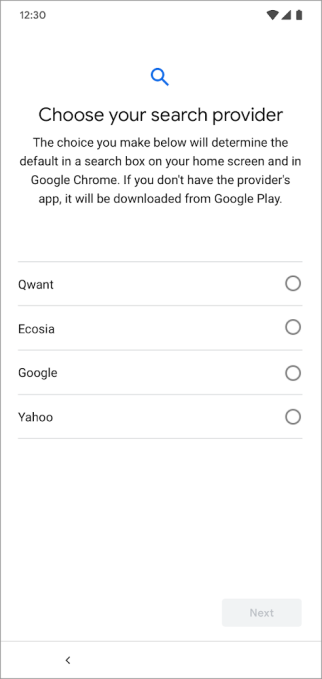
Starting early next year Google will present Android users in Europe with a search engine choice screen when handsets bundle its own search service by default.

In a blog post announcing the latest change to flow from the European Union’s record-breaking $5B antitrust enforcement against Android last year, when the Commission found Google had imposed illegal restrictions on OEMs and carriers using its dominant smartphone platform, it says new Android phones will be shown the choice screen once during set-up (or again after any factory reset).

The screen will display a selection of three rival search engines alongside its own.

OEMs will still be able to offer Android devices in Europe that bundle a non-Google search engine by default (though per Google’s reworked licensing terms they have to pay it to do so). In those instances Google said the choice screen will not be displayed.

Google says rival search engines will be selected for display on the default choice screen, per market, via a fixed-price sealed bid annual auction — with any winners (and/or eligible search providers) being displayed in a random order alongside its own.

Search engines that win the auction will secure one of three open slots on the choice screen, with Google’s own search engine always occupying one of the four total slots.

“In each country auction, search providers will state the price that they are willing to pay each time a user selects them from the choice screen in the given country,” it writes. “Each country will have a minimum bid threshold. The three highest bidders that meet or exceed the bid threshold for a given country will appear in the choice screen for that country.”

android choice screen

If there aren’t enough bids to surface three winners per auction then Google says it will randomly select from a pool of eligible search providers which it is also inviting to apply to participate in the choice screen. (Eligibility criteria can be found here.)

“Next year, we’ll introduce a new way for Android users to select a search provider to power a search box on their home screen and as the default in Chrome (if installed),” it writes. “Search providers can apply to be part of the new choice screen, which will appear when someone is setting up a new Android smartphone or tablet in Europe.”

“As always, people can continue to customize and personalize their devices at any time after set up. This includes selecting which apps to download, changing how apps are arranged on the screen, and switching the default search provider in apps like Google Chrome,” it adds.

Google’s blog post makes no mention of whether the choice screen will be pushed to the installed base of Android devices. But a spokeswoman told us the implementation requires technical changes that means it can only be supported on new devices.

Default selections on dominant platform are of course hugely important for gaining or sustaining marketshare. And it’s only since competition authorities dialled up their scrutiny that the company has started to make some shifts in how it bundles its own services in dominant products such as Android and Chrome.

Earlier this year Google quietly added rival pro-privacy search engine DuckDuckGo as one of the default choices offered by its Chrome browser, for example.

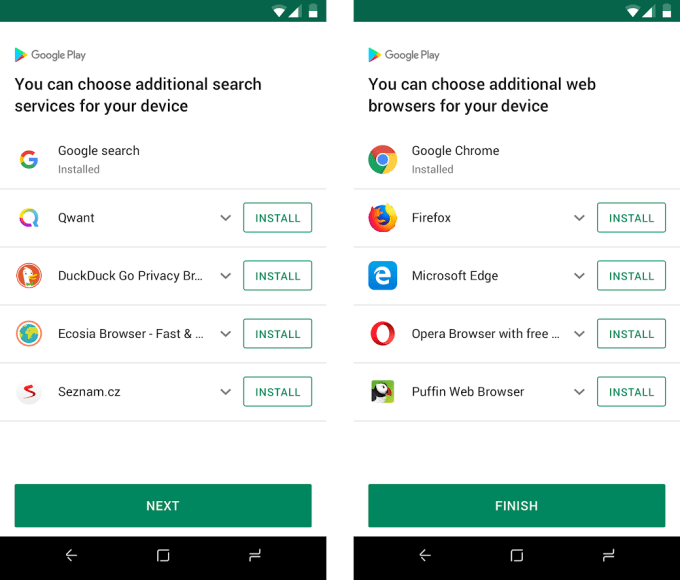
In April it also began rolling out choice screens to both new and existing Android users in Europe — offering a prompt to download additional search apps and browsers.

In the latter case, each screen shows five apps in total, including whatever search and browser is already installed. Apps not already installed are included based on their market popularity and shown in a random order.

android choice app screen.max 1000x1000

French pro-privacy search engine, Qwant, told us that since the rollout of the app service choice screen to Android devices the share of Qwant users using its search engine on mobile has leapt up from around 2% to more than a quarter (26%) of its total userbase.

Qwant co-founder and CEO Eric Léandri said the app choice screen shows that competing against Google on search is possible — but only “thanks to the European Commission” stepping in and forcing the unbundling.

However he raised serious concerns about the sealed bid auction structure that Google has announced for the default search choice — pointing out that many of the bidders for the slots will also be using Google advertising and technology; while the sealed structure of the auction means no-one outside Google will know what prices are being submitted as bids, making it impossible for rivals to know whether the selections Google makes are fair.

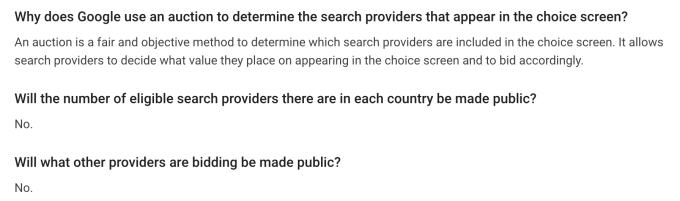
Even Google’s own FAQ swings abruptly from claims of the auction it has devised being “a fair and objective method” for determining which search providers get slots, to a flat “no” and “no” on any transparency on bid amounts or the number of providers it deems eligible per market…

Screenshot 2019 08 02 at 16.51.50

“Even if Google is Google some people can choose something else if they have the choice. But now that Google knows it, it wants to stop the process,” Léandri told TechCrunch.

“It is not up to Google to now charge its competitors for its faulty behavior and the amount of the fine, through an auction system that will benefit neither European consumers nor free competition, which should not be distorted by such process,” Qwant added in an emailed press statement. “The proposed bidding process would be open to so-called search engines that derive their results and revenues from Google, thereby creating an unacceptable distortion and a high risk of manipulation, inequity or disloyalty of the auction.”

“The decision of the European Commission must benefit European consumers by ensuring the conditions of a freedom of choice based on the intrinsic merits of each engine and the expectations of citizens, especially regarding the protection of their personal data, and not on their ability to fund Google or to be financed by it,” it also said.

In a further complaint, Léandri said Google is requiring bidders in the choice screen auction to sign an NDA in order to participate — which Qwant argues would throw a legal obstacle in the way of it being able to participate, considering it is a complainant in the EU’s antitrust case (ongoing because Google is appealing).

“Qwant cannot accept that the auction process is subject to a non-disclosure agreement as imposed by Google while its complaint is still pending,” it writes. “Such a confidentiality agreement has no other possible justification than the desire to silence its competitors on the anomalies they would see. This, again, is an unacceptable abuse of its dominant position.”

We’ve reached out to the Commission with questions about Google’s choice screen auction.

DuckDuckGo founder, Gabriel Weinberg, has also been quick to point to flaws in the auction structure — writing on Twitter: “A ‘ballot box’ screen could be an excellent way to increase meaningful consumer choice if designed properly. Unfortunately, Google’s announcement today will not meaningfully deliver consumer choice.

“A pay-to-play auction with only 4 slots means consumers won’t get all the choices they deserve, and Google will profit at the expense of the competition. We encourage regulators to work with directly with Google, us, and others to ensure the best system for consumers.”

02 Aug 2019

Following Ninja’s news, Mixer pops to top of the App Store’s free charts

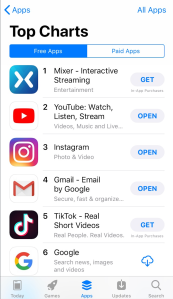
Yesterday, Tyler “Ninja” Blevins announced that he’s leaving Twitch, moving his streaming career over to Microsoft’s Mixer platform. This morning, Mixer has shot to the top of the App Store’s free app charts.

Microsoft acquired Mixer in 2016, back when it was called Beam, and has been trying to grow the platform since. However, Mixer has had a tough go of it with competition from the industry leader, Twitch, as well as other tech giants like Google (YouTube) and Facebook.

In fact, Mixer represented just three percent of game streaming viewership hours in the last quarter, according to StreamElements.

Microsoft had this to say about Ninja’s move:

We’re thrilled to welcome Ninja and his community to Mixer. Mixer is a place that was formed around being positive and welcoming from day one, and we look forward to the energy Ninja and his community will bring.

mixerNinja announced the news with a video, which didn’t offer much by way of reasons for the move. It’s highly likely that Microsoft paid a pretty penny for it, though that hasn’t been officially confirmed.

In less than 24 hours, his new Mixer channel has picked up more than 250K followers, and Mixer has risen to the top of the App Store charts.

It’s early days for the switch, but it’s still a long way to go to get back to the 14 million followers Ninja enjoyed on Twitch.

02 Aug 2019

Texas joins growing list of AGs looking to block T-Mobile/Sprint merger

Late last week, the DOJ green lit T-Mobile and Sprint’s $26 billion deal to become nation’s number three carrier. The deal isn’t officially official just yet, with some prominent opposition facing the merger. A growing list of attorneys general have sued to block the merger, and other big name just came on board.

With the addition of Texas Attorney General Ken Paxton, the number moves to 15, including the District of Columbia. California, Colorado, Connecticut, the District of Columbia, Maryland, Michigan, Mississippi, New York, Virginia and Wisconsin filed the initial suit in June and were soon joined by Hawaii, Massachusetts, Minnesota and Nevada.

Notably, Paxton is one of only two Republicans on the list — probably not surprising as many conservative lawmakers have suggested that a merger of the third and forth largest carriers might actually promote competition. Trump appointed DOJ antitrust chief Makan Delrahim agreed with carrier suggestions that a merger would help a larger T-Mobile accelerate 5G growth.

Paxton disagreed with the sentiments.

“After careful evaluation of the proposed merger and the settlement, we do not anticipate that the proposed new entrant will replace the competitive role of Sprint anytime soon,” Paxton said in a statement provided to TechCrunch. “It is the Attorney General’s responsibility to preserve free market competition, which has proven to result in lower prices and better quality for consumers. The bargain struck by the U.S. Department of Justice is not in the best interest of working Texans, who need affordable mobile wireless telecommunication services that are fit to match the speed and technological innovation demands of Texas’ growing economy.”

T-Mobile has also come under scrutiny for intense lobbying, including $195,000 spent at Trump’s D.C. hotel since last April.