Category: UNCATEGORIZED

30 Jul 2019

How the new ‘Lion King’ came to life

When I was told that I’d be visiting the production of Disney’s new version of the “Lion King,” I had a hazy idea of what to expect — sets recreating the iconic landscapes of the animated film, maybe some actors in costumes or motion capture suits.

Instead, if you’ve seen the movie (which came out on July 19) you probably aren’t surprised to hear that there wasn’t a single set or costume in sight. After all, even though the film looks like a live action remake of “The Lion King,” every shot except for the first was created on a computer.

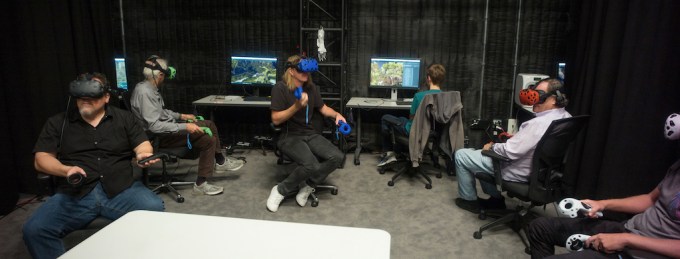
So what I visited in 2017 was a nondescript Los Angeles warehouse filled with computers. In the main room, almost everything was black — black padding on the walls, black VR headsets, black dolly tracks for the camera.

Director Jon Favreau explained to visiting journalists that the plan was to create a virtual Serengeti in the Unity game engine, and then apply live action filmmaking techniques to create the film, the “Lion King” team described this as a “virtual production process.”

It started with a research trip to Kenya, with copious reference photos taken of the landscape and animals. Then the art department got to work creating sets — the aforementioned virtual Serengeti — which can be “filmed” by moving a real camera around the space (and the need for real-world camera equipment like dolly tracks). Those shots are then edited together and handed over to the effects team at MPC to create the images you see in the final film.
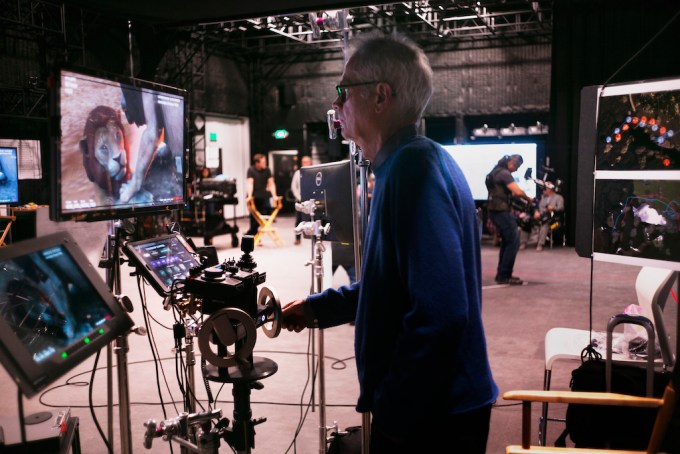
TLK Caleb OnTheWheels StdyCamInBG L1002485

THE LION KING – (Pictured) Caleb Deschanel. Photo by: Michael Legato.
© Disney Enterprises, Inc. All Rights Reserved.

“If you go back to ‘Avatar,’ ‘Avatar’ solved the problem of how do you film a movie that usually gets created with computer graphics, so we put computer graphics into the cinematographer’s monitor so that they could use more traditional equipment to see the movie” said virtual production supervisor Ben Grossman. “Fast forward to ‘Lion King’ and what we’re doing is we’re putting the filmmakers inside the monitor. So now, they can put on a VR Headset and be in Africa or on the Empire State Building or on the surface of the Moon, so that they can walk around and see and feel the filmmaking process … as though they were there.”

That doesn’t just involve VR and computer animation, Grossman added. There’s also significant use of artificial intelligence in the virtual sets and characters. For example, the filmmakers could create a 3D model of a lion, and then teach the AI so that the lion can act hungry, or cold, or as if it’s looking for food: “We start telling the computer things like that and then it starts to associate behaviors with motivations and intents.”

Ultimately, Grossman suggested that this could lead to a situation where filmmaking is less about traditional “filmmaking or storytelling,” and more about “world-building”: “You create a world where characters have personalities and they have motivations to do different things and then essentially, you can throw them all out there like a simulation and then you can put real people in there and see what happens.”

And while the technology side sounds quite sophisticated, everyone emphasized that the goal was to give the filmmakers the tools they needed to feel like they were making a live action film.

The Lion King

In fact, director of photography Caleb Deschanel (whose career has been focused on live action, with credits like “The Passion of the Christ” and “The Right Stuff”) described himself as “the Luddite in this group,” whose goal was to “try to make it feel as film-y as possible.”

“I remember reading about Brad Bird … who had directed a lot of animation, obviously, and then when he was directing live action, he got very frustrated ’cause he couldn’t do all these sort of crazy things,” Deschanel said. “And we’re going in the opposite direction and taking the tools of normal filmmaking and bringing them into our world, and using that as a method to create a reality.”

He acknowledged that working with the technology has been a learning process — so much so that he spoke wistfully about starting over again once they’d finished the movie, so that he could apply all the lessons he’d learned.

“I mean, when we did the canyon chase with the wildebeests early on, and we were filming and I was struggling with getting light where I wanted it,” he said. “And then, weeks later, I discovered: Well, if you don’t like the light there, we can take these mountains, we can just drop them down and get the sun coming through where you want it.”

All of this speaks to the extraordinary amount of thought and technology that went into making a movie in a new way. But it also dances around the most basic question: Why remake “The Lion King” at all?
TLK Leg 0735 CR

THE LION KING – (L-R) Jon Favreau, Caleb Deschanel, James Chinlund, Robert Legato and Andy Jones. Photo by: Michael Legato.
© Disney Enterprises, Inc. All Rights Reserved.

Favreau’s answer was that he wanted to take the story and themes that were so powerful in the original film (and in the subsequent Broadway musical), and then “create something that feels like a completely different medium than either of those two.”

The box office receipts offer another answer, with “The Lion King” on-track to become perhaps the highest grossing movie of the summer and one of the biggest hits of the year.

Critics haven’t been quite as impressed, complaining that the “realistic” approach hampers the emotional expressiveness of the animals (not to mention the imagination and energy of the musical numbers). It seems that many of them found themselves asking: Why go to all the effort to take such a fantastical story and then to tell it in a photo-real way?

Back during the set visit, VFX Rob Legato said studio heads were asking something similar, namely: “Why would you go through the great expense to have everything under your control and then take your control away on purpose?”

The point, Legato argued, is to be true to “the artist’s idea” of creating a movie that “looks like a film” but could never be shot in real life. And his hope is that when audiences watch the new “Lion King,” they don’t see visual effects — similar to how most people don’t watch “The Godfather” and think “great sets, great costumes, interesting light.” Instead, “You just watch the film. You don’t really pick apart one of the disciplines, you just enjoy it.”

He added, “My viewpoint is, it’s not a visual effect anymore, if it’s just moviemaking.”
30 Jul 2019

LG’s smartphone sales dropped another 21%

Let’s start with the good news. LG actually had a pretty good quarter (on the strength of appliance sales). The LG Home Appliance & Air Solution division made $5.23 billion for Q2. Anyone who’s been following the company for the past several years can guess where the bad news comes.

Smartphone sales dipped 21.3% year over year for the South Korean company. The culprits are as you’d expect: an overall slowing of the smartphone market, coupled with aggressive undercutting from Chinese manufacturers. Huawei seems to lead the pack on that front, with a big increase in sales, in spite of a confluence of external factors.

The smartphone unit saw an operating loss of $268.4 million, in spite of a 6.8% increase in sales from the quarter prior. LG chalks up the loss to higher marketing on new models and April’s move from Seoul to Vietnam for smartphone production for longer-term cost cutting.

In spite of this, the company says it’s still bullish about smartphone sales for Q3. “The introduction of competitive mass-tier smartphones and growing demand for 5G products are expected to contribute to improved performance in the third quarter,” it writes in an earnings release.

LG is, of course, among the first companies to release a 5G handset, with the V50 ThinQ. The next-gen wireless technology is expected to increase stagnating global smartphone sales, though much of that will depend on the speed with which carriers are able to roll it out. It seems unlikely that 5G in and of itself will be a quick or even longer-term fix for a struggling category.

30 Jul 2019

Ford acquires mobile robotics company Quantum Signal to help with self-driving

Ford has acquired a small robotics company based in Michigan called Quantum Signal, which has produced mobile robots for a number of clients, including the U.S. military. The company’s speciality has been building remote control software for robotic vehicles, specifically, and its also responsible for a very highly-regarded simulated testing and development environment for autonomous and remotely-controlled robotic systems.

All of the above is useful not only when developing military robots, but also when setting out to build and deploy self-driving cars – hence Ford’s interest in acquiring Quantum Signal. Ford said in a blog post that while others might’ve been sleeping on Quantum Signal and the work its done, it has been following the company closely, and will employ its experience in developing real-time simulation and algorithms related to autonomous vehicle control systems to help build out Ford’s self-driving vehicles, transportation-as-a-service platform, and both hardware and software related to both.

Reading between the lines here, it sounds like Ford’s main interest was in picking up some experienced talent working on autonomy, and very specific challenges that are needed to develop road-worth self-driving vehicles, including perception systems and virtual testing environments. Ford does however explicitly lay out a desire to “preserve” Quantum’s own “unique culture” as it brings the company on board, pointing out that that’s the course it took with similar acquisition SAIPS (an Israeli computer vision and machine learning company) when it brought that team onboard in 2016.

SAIPS has now more than doubled its team to 30 people, and relocated to a new headquarters in Tel Aviv, with a specific focus among its latest higher on bringing in specialists in reinforcement learning. Ford has also invested in Argo AI, taking a majority stake in the startup initially in 2017 and then re-upping with a joint investment with Volkswagen in July of this year in a deal that makes both major equal shareholders. It’s Ford is happy to both acquire and partner in its pursuit of self-driving tech development, and this probably won’t be the last similar deal we see made en route to actually deploying autonomous vehicles on roads for any major automaker.

30 Jul 2019

DigitalOcean gets a new CEO and CFO

DigitalOcean, the cloud infrastructure service that made a name for itself by focusing on low-cost hosting options in its early days, today announced that it has appointed former SendGrid COO and CFO Yancey Spruill as its new CEO and former EnerNOC CFO Bill Sorenson as its new CFO. Spruill will replace Mark Templeton, who only joined the company a little more than a year ago and who had announced his decision to step down for personal reasons in May of this year.

DigitalOcean is a brand I’ve followed and admired for a while — the leadership team has done a tremendous job building out the products, services and, most importantly, a community, that puts developer needs first,” said Spruill in today’s announcement. “We have a multi-billion dollar revenue opportunity in front of us and I’m looking forward to working closely with our strong leadership team to build upon the current strategy to drive DigitalOcean to the company’s full potential.”

Spruill das have a lot of experience, given that he was in CxO positions at SendGrid through both its IPO in 2017 and its sales to Twilio in 2019. He also previously held the CFO role at DigitalGlobe, which he also guided to an IPO.

In his announcement, Spruill notes that he expects DigitalOcean to focus on its core business, which currently has about 500,000 users (though it’s unclear how many of those are active, paying users). “My aspiration is for us to continue to provide everything you love about DO now, but to also enhance our offerings in a way that is meaningful, strategic and most helpful for you over time,” he writes.

Spruill’s history as CFO includes its fair share of IPOs and sales, but so does Sorenson’s. As CFO at EnerNOC, he guided that company to a sale to investor Enel Group. Before that, he led business intelligence firm Qlikto an IPO.

It’s not unusual for incoming CEOs and CFO’s to have this kind of experience, but it does make you wonder what DigitalOcean’s future holds in store. The company isn’t as hyped as it once was and while it still offers one of the best user experiences for developers, it remains a relatively small player in the overall cloud game. That’s a growing market, but the large companies — the ones that bring in the majority of revenue — are looking to Amazon, Microsoft and Google for their cloud infrastructure. Even a small piece of the overall cloud pie can be quite lucrative, but I think DigitalOcean’s ambitions go beyond that.

30 Jul 2019

DigitalOcean gets a new CEO and CFO

DigitalOcean, the cloud infrastructure service that made a name for itself by focusing on low-cost hosting options in its early days, today announced that it has appointed former SendGrid COO and CFO Yancey Spruill as its new CEO and former EnerNOC CFO Bill Sorenson as its new CFO. Spruill will replace Mark Templeton, who only joined the company a little more than a year ago and who had announced his decision to step down for personal reasons in May of this year.

DigitalOcean is a brand I’ve followed and admired for a while — the leadership team has done a tremendous job building out the products, services and, most importantly, a community, that puts developer needs first,” said Spruill in today’s announcement. “We have a multi-billion dollar revenue opportunity in front of us and I’m looking forward to working closely with our strong leadership team to build upon the current strategy to drive DigitalOcean to the company’s full potential.”

Spruill das have a lot of experience, given that he was in CxO positions at SendGrid through both its IPO in 2017 and its sales to Twilio in 2019. He also previously held the CFO role at DigitalGlobe, which he also guided to an IPO.

In his announcement, Spruill notes that he expects DigitalOcean to focus on its core business, which currently has about 500,000 users (though it’s unclear how many of those are active, paying users). “My aspiration is for us to continue to provide everything you love about DO now, but to also enhance our offerings in a way that is meaningful, strategic and most helpful for you over time,” he writes.

Spruill’s history as CFO includes its fair share of IPOs and sales, but so does Sorenson’s. As CFO at EnerNOC, he guided that company to a sale to investor Enel Group. Before that, he led business intelligence firm Qlikto an IPO.

It’s not unusual for incoming CEOs and CFO’s to have this kind of experience, but it does make you wonder what DigitalOcean’s future holds in store. The company isn’t as hyped as it once was and while it still offers one of the best user experiences for developers, it remains a relatively small player in the overall cloud game. That’s a growing market, but the large companies — the ones that bring in the majority of revenue — are looking to Amazon, Microsoft and Google for their cloud infrastructure. Even a small piece of the overall cloud pie can be quite lucrative, but I think DigitalOcean’s ambitions go beyond that.

30 Jul 2019

Special offer: discounted hotels and flights for Disrupt SF 2019

Disrupt San Francisco 2019 takes place on October 2-4, and we’re working every angle to make it financially accessible to as many people as possible. It starts with early-bird pricing on four types of passes for different needs and budgets. Plus, we offer discounts for students, nonprofit organizations, government employees and military personnel.

But did you know you can score discounted rates on flights and hotels for your Disrupt adventure? Yup. United Airlines offers Disrupt SF attendees discounted fares on flights to San Francisco International Airport or San Jose International Airport. Head on over to United.com and book your flight under “Advanced Search” using offer code ZFWZ101320. It’s an easy way to save.

Whether it’s just you or your entire team, you can reserve discounted hotel rooms through room blocks TechCrunch has secured at multiple hotels throughout the City by the Bay. Many of the hotels also offer special perks, including free Wi-Fi and gym access, when you book through this website. Your extras may vary depending on which hotel you choose. The supply of rooms is limited, so get booking!

Once you have your Disrupt pass and your travel reservations well in hand, you can start strategizing to make the most of your time at Disrupt SF — three short days packed with early-startup programming across four stages.

Whether on the Main stage, the Extra Crunch stage, on a panel or during a fireside chat, Disrupt speakers represent an impressive range of expertise. We’re talking up-and-coming boundary-pushers to the top players in the startup world — iconic technologists, investors and founders.

Witness the glory that is Startup Battlefield, TechCrunch’s epic pitch competition. Watch as the world’s most innovative startups launch and compete for the Disrupt Cup, investor and media love and, of course, $100,000.

Explore and network your way through Startup Alley, where you’ll find more than 1,200 startups and sponsors displaying products, platforms and services spanning the tech spectrum. While you’re there, be sure to visit the TC Top Picks, our hand-picked cadre of outstanding startups.

Want a tool that cuts through the crowds to help you meet the people who can help move your business forward? Then use CrunchMatch, the free business match-making service. It makes networking easier than ever.

Grab your discounts, people, and join us at Disrupt San Francisco 2019 on October 2-4. Buy your early-bird passes today, and then book your discounted flights and hotel rooms before they all disappear.

Is your company interested in sponsoring or exhibiting at Disrupt San Francisco 2019? Contact our sponsorship sales team by filling out this form.

30 Jul 2019

Daily Crunch: Capital One discloses enormous data breach

The Daily Crunch is TechCrunch’s roundup of our biggest and most important stories. If you’d like to get this delivered to your inbox every day at around 9am Pacific, you can subscribe here.

1. Capital One hacked, over 100 million customers affected

Another day, another data breach. This time, the company involved is Capital One, which says the breach affects roughly 100 million individuals in the U.S., and 6 million in Canada.

The data leaked potentially includes “names, addresses, ZIP codes/postal codes, phone numbers, email addresses, dates of birth, and self-reported income,” as well as information like “credit scores, credit limits, balances, payment history, contact information.”

2. What Huawei didn’t say in its ‘robust’ half-year results

The media has largely bought into Huawei’s “strong” half-year results today, but there’s a major catch in the report: the company’s quarter-by-quarter smartphone growth was zero.

3. Real estate platform Compass raises another $370M on a $6.4B valuation en route to an IPO

The platform is not just a marketplace to connect buyers to real estate agents to sellers, but an engine that helps figure out pricing, timing for sales and how to stage homes to get the best prices and most sales.

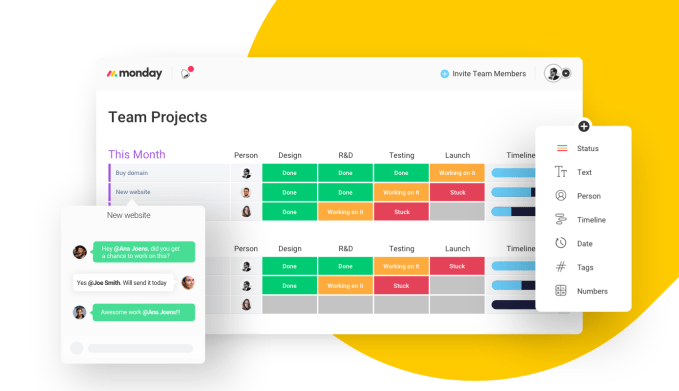
4. Monday.com raises $150M more, now at $1.9B valuation, for workplace collaboration tools

The big bump is in part due to the company’s rapid expansion; it now has 80,000 organizations as customers, up from a mere 35,000 a year ago.

5. The Museum of Future Experiences offers a spooky, surreal take on VR

The experience isn’t easy to describe, but afterwards, I felt equal parts amused, excited and unsettled, and I knew this wasn’t like any other VR I’d seen.

6. Techstars nabs $42M to expand its global presence

Techstars is both a fund deploying capital to early-stage upstarts and an operating business nearing $100 million in annual revenue. Its latest equity investment will fuel the latter.

7. Facebook and YouTube’s moderation failure is an opportunity to deplatform the platforms

While the major platforms reap the bitter harvest of years of ignoring the issue, startups can pick up where they left off. (Extra Crunch membership required.)

30 Jul 2019

The dreaded 10x, or, how to handle exceptional employees

The “10x engineer.” Shudder. Wince. I have rarely seen my Twitter feed unite against an idea so loudly, or in such harmony.

I refer of course to the thread last month by Accel India’s Shekhar Kirani, explaining “If you have a 10x engineer as part of your first few engineers, you increase the odds of your startup success significantly” and then going on to address, in his opinion, “How do you spot a 10x engineer?”

The resulting scorn was tsunami-like. The very concept of a 10x engineer seems so… five years ago. Since then, the Valley has largely come to the collective conclusion that 1) there is no such thing as a 10x engineer 2) even if there were, you wouldn’t want to hire one, because they play so poorly with others.

The anti-10x squad raises many important and valid — frankly, obvious and inarguable — points. Go down that Twitter thread and you’ll find that 10x engineers are identified as: people who eschew meetings, work alone, rarely look at documentation, don’t write much themselves, are poor mentors, and view process, meetings, or training as reasons to abandon their employer. In short, they are unbelievably terrible team members.

Is software a field like the arts, or sports, in which exceptional performers can exist? Sure. Absolutely. Software is Extremistan, not Mediocristan, as Nassim Taleb puts it.

30 Jul 2019

Google’s new version of Android Auto focuses on Assistant

Google is starting to roll out an updated version of its in-car platform Android Auto that aims to make it easier and safer for drivers to use.

The version, which was first revealed during Google I/O 2019, has a dark theme, new fonts and color accents, more opportunities to communicate with Google’s virtual assistant and the ability to fit wider display screens that are becoming more common in vehicles.

Android Auto, which launched in 2015, is not an operating system. It’s a secondary interface — or HMI layer — that sits on top of an operating system and brings the look and feel of a smartphone to the vehicle’s central screen. Rival Apple introduced its own in-car platform, Apple CarPlay, that same year.

Automakers, once hesitant to integrate Android Auto or Apple CarPlay into vehicles have come around. Today, Android Auto is available in more than 500 car models from 50 different brands, according to Android Auto product manager Rod Lopez.

Car owners with Android Auto support will start to see the new design over the next few weeks. However, updates will not be made to the standalone version of Android Auto, a smartphone app that gave users access to the platform even if their car wasn’t compatible to Android Auto. Google says it plans to “evolve” the standalone phone app from Android Auto to the Assistant’s new driving mode in the future.

Meanwhile, the in-car version features some important changes, notably more opportunities for drivers to use their voice — and not their hands — to interact with Android Auto. Users will notice the Google Assistant badge on Android Auto, that when tapped will provide information about their calendar, read the weather report or news.

3Android Auto Google Assistant Badge

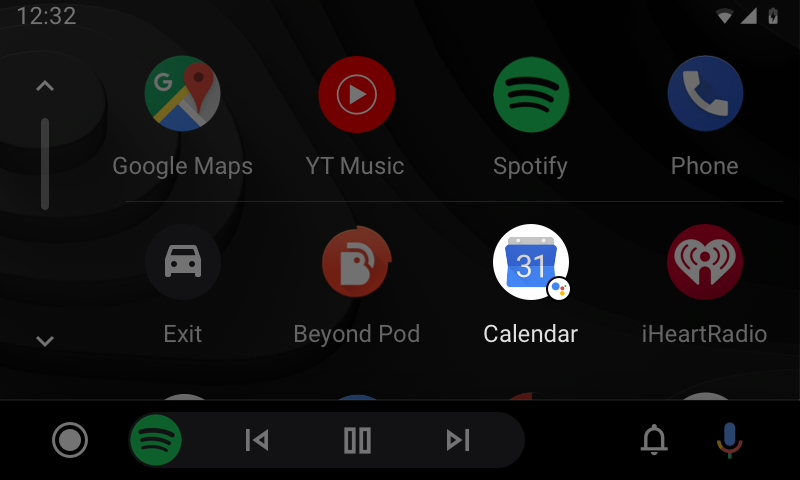
Other new features include a new app launcher designed to let users access their favorite apps with fewer taps. A button on the bottom left of the screen launches this feature. Once deployed, users will see app icons with the most commonly used ones featured in the top row.

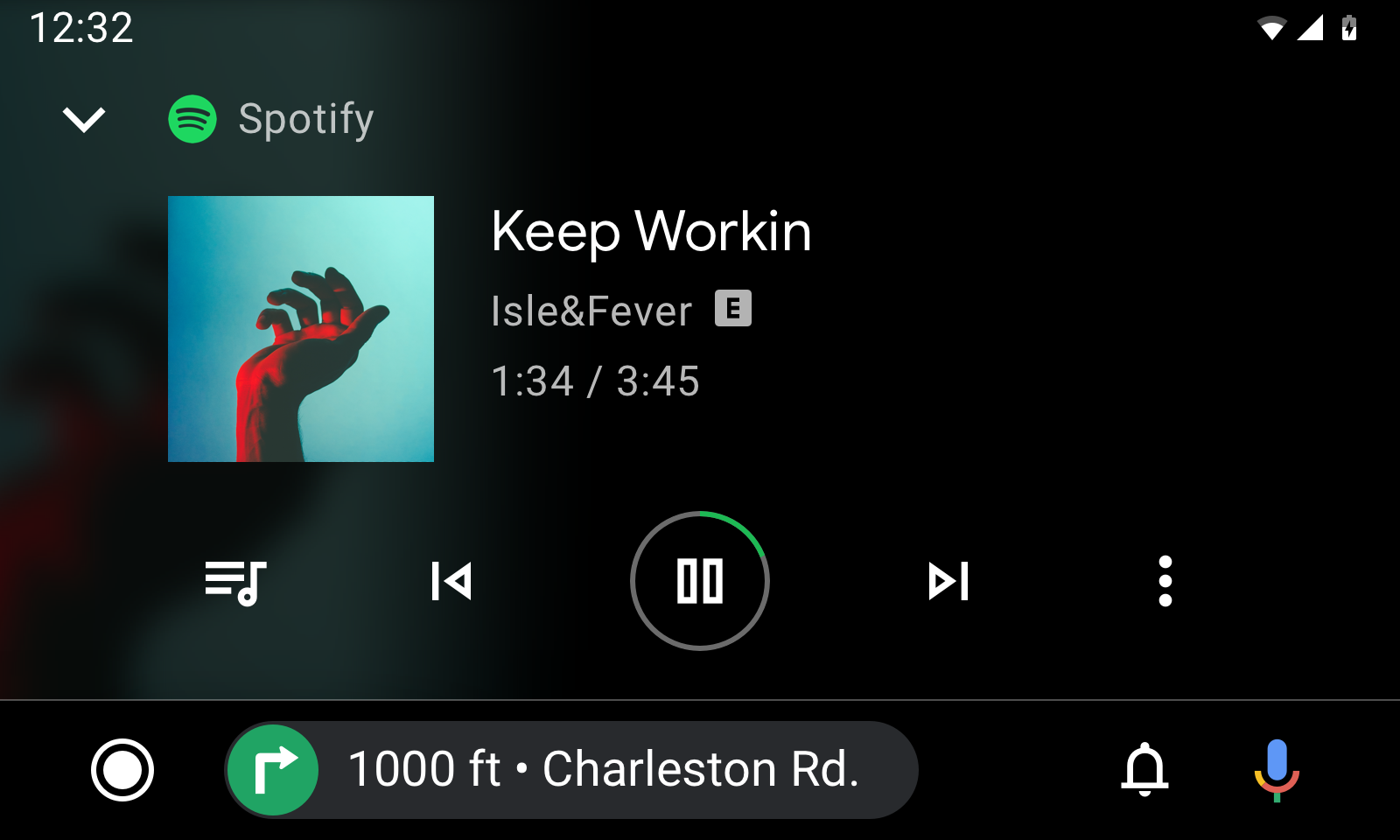
Android Auto has also improved its navigation, which is perhaps the most commonly used feature within the platform. Now, the navigation bar sits at the bottom of the display and allows users to manage multiple apps. This improvement means users won’t miss an exit or street while they’re listening to Spotify .

4Android Auto Media

The navigation feature also pops up as soon as the driver connects with Android Auto. If a route is already queued up on a phone, Android Auto will automatically populate the directions.

This latest version also has a new notification button — located on the bottom right corner — houses recent calls, messages and alerts. Drivers can tap the mic button or say ” “Hey Google” to have the Google Assistant help make calls, send messages and read notifications.

Google has also developed an operating system called Android Automotive OS that’s modeled after its open-source mobile operating system that runs on Linux. Instead of running smartphones and tablets, Google modified it so it could be used in cars. Polestar, Volvo’s standalone performance electric car brand, is going to produce a new vehicle, the Polestar  2, that has an infotainment system powered by Android Automotive OS.

30 Jul 2019

CrowdLobby wants to democratize political lobbying

Lobbying, whether we like it or not, is an effective way to enact political change. But it’s historically only been available to special interest groups and corporations with hoards of cash on hand. CrowdLobby, a non-partisan organization that launched this month, hopes to change that.

Last year, corporations and special interest firms spent $3.5 billion on lobbying, according to The Center for Responsive Politics. Through CrowdLobby, the aim is to help everyday people crowdfund to hire lobbyists of their own.

“Lobbyists do have a huge effect on current legislative processes,” CrowdLobby co-founder and CEO Heidi Drauschak (pictured above on right), a lawyer with experience in the lobbying industry, told TechCrunch. “Until we can totally change the whole structure, we have to play the game. It’s not that the game is a horrible game, but it’s just that not everyone gets a chance to play.”

CrowdLobby works by featuring campaigns around issues that its community has deemed to be important. From there, anyone can contribute to the campaign — which generally seeks $50,000. The team landed on that amount after having conversations with lobbyists regarding what it would take to make a change on a state level. CrowdLobby only charges you if the campaign hits its target.

“If enough funds are raised around a specific issue, we facilitate that aggregation and the hiring of the lobbyist itself,” Drauschak said.

In order to make money, CrowdLobby charges a processing fee. The startup is still experimenting with what to charge but currently has a 25% processing fee in place. That’s undoubtedly higher than processing fees to which people are generally accustomed, but Drauschak stressed that CrowdLobby is a two-sided marketplace that facilitates the entire lobbying process. That means aggregating the funds, figuring out which lobbyist to hire and then engaging in ongoing communications with the lobbyist.

“We want to give people the exact same benefits that someone who normally hires a lobbyist would get,” Drauschak said.

CrowdLobby officially launched this month with three featured campaigns focused on education, cannabis decriminalization and autism in the state of Virginia, which is where the company is headquartered.

crowdlobby campaigns

“The community can determine if a campaign goes live,” CrowdLobby co-founder and COO Sam Biggio (pictured above on left) told TechCrunch. “We try to stay out of that process as much as possible and be the objective tool for whatever the people want.”

Currently, CrowdLobby is working with a handful of lobbyists. But the ideal number of lobbyists depends on how many campaigns CrowdLobby has going on at any given time. Right now, the goal is to build a team of lobbyists that demonstrates the credibility of the platform, Drauschak said.

CrowdLobby plans to offer campaigns in additional states by next year, at the latest, as well as get some additional campaigns off the ground. CrowdLobby does not have traditional venture funding, but raised $35,000 in a Kickstarter campaign and is currently participating in the Lighthouse Labs accelerator in Richmond, Virginia, where they received additional funding.

“Anything political is always going to be dicey,” Drauschak said. “But we’ve been setting ourselves up to take [the venture funding] route when we’re ready.”