Category: UNCATEGORIZED

23 Jul 2019

AWS launches a new tool to help you optimize your EC2 resources

Here is a small but potentially handy update if you’re an AWS EC2 user. The company today launched a new feature called “EC2 Resource Optimization Recommendations,” which does exactly what the name promises. It’s not flashy, it’s not especially exciting, but it may just save you and your company a good amount of money (and maybe that’ll get you that raise you’ve been hoping for).

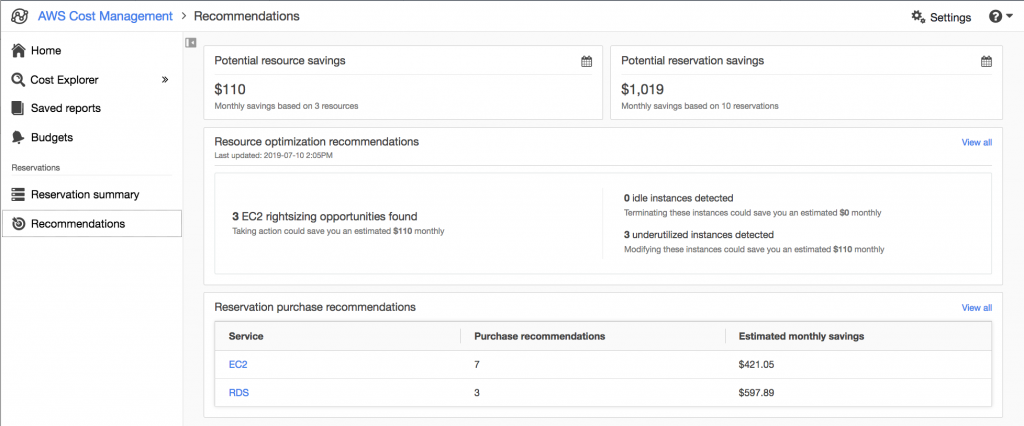
The resource optimization tool will look at your EC2 usage and give you personalized recommendations to find idle and underutilized instances. To do this, it looks at your usage history, CloudWatch metrics and your existing reservations.

Screen Shot 2019 07 10 at 11.20.43 AM 1024x426

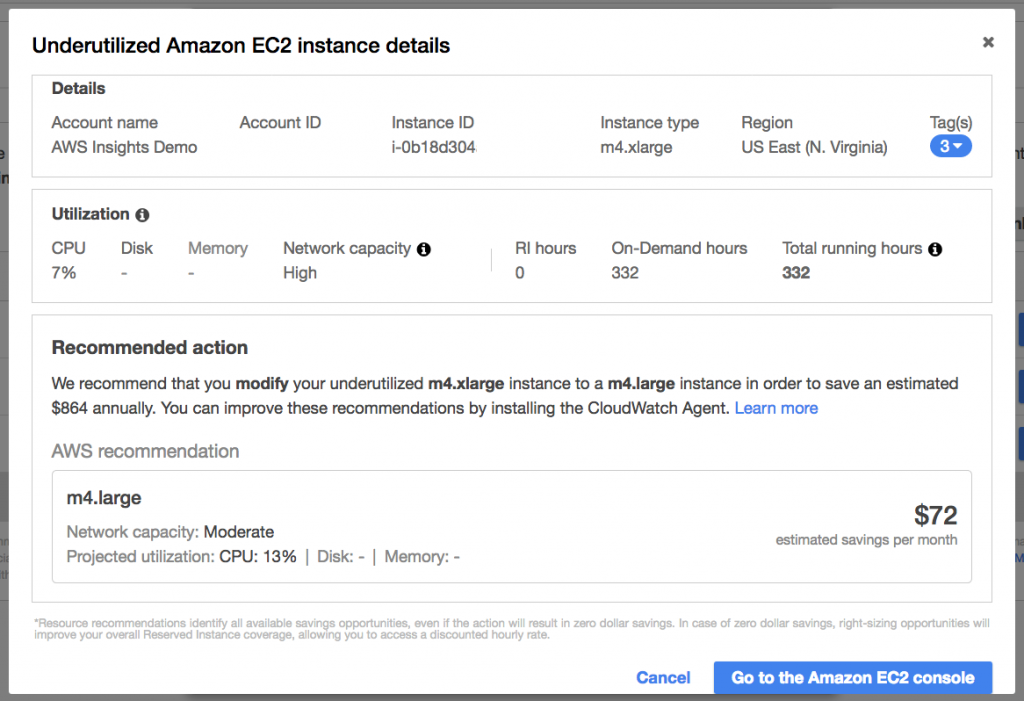
When it finds an idle instance, that is, one that has lower than 1% maximum CPU utilization, the tool will recommend that you shut it down. No surprises there. When it finds underutilized instances, it’ll present you with three different sizes that you can move to that’ll likely fit your usage patterns better than your current plan.

One caveat: this feature currently works for all standard EC2 instances, but it’s not available for GPU-based instances yet.

This new feature is now available to all AWS users. You can find it in the AWS Cost Management suite, where it’ll join the rest of AWS’ tools for keeping an eye on your budget and how you’re spending it. Nobody has ever accused AWS of having a straightforward pricing structure, so any little thing helps to make managing all of these resources a bit easier.

Screen Shot 2019 07 10 at 11.27.06 AM 1 1024x701


23 Jul 2019

Google’s Nest adds to its partnerships focused on the power grid with new Leap agreement

Google’s smart home device business, Nest, is increasing its ties to the utility industry by adding another partner to bring its smart thermostats into homes to reduce energy consumption and provide that unused power back to utilities in times of peak power demand.

Last year the company inked an agreement with OhmConnect and it has now signed another deal with the startup Leap. While the OhmConnect deal helped Nest manage end customer sign-ups, in its deal with Leap, sign-ups are handled through Nest’s Rush Hour Rewards program and Leap provides the exchange through which reduced power is provided to the utility.

The agreement will be another way for Leap to provide power to Pacific Gas & Electric under its existing 45 megawatt contract with the utility.

“Google Nest is an excellent partner to have as we continue our efforts to deliver much-needed flexible capacity in California – their decision to join the Leap Exchange is a wonderful example of using today’s increasingly smart and responsive appliances as assets that benefit the grid as a whole,” said Thomas Folker, CEO of Leap, in a statement.

According to Folker every consumer has about one kilowatt of load they can reduce over the course of a year. It’s about a $50 value per year and Folker’s Leap is installing the Nest home hub for free (a $120 value), Folker said.

It’s a way for consumers to get the Nest Hub (listening device, smart thermostat and internet of things control device) into their homes for free, while Leap handles selling the load onto the grid.

The company has about 2,500 Nest devices already enrolled in the program for about 2.5 megawatts of the 45 megawatts the company has promised to PG&E.

Ultimately, Leap thinks it can take this partnership on the road to other areas where the company’s operating including Texas and Southern California.

Nest has also done work directly with consumers in Southern California including projects with Southern California Edison, SDG&E’s programs and a load reduction deal for 50 megawatts with Southern California Edison.

23 Jul 2019

UPS forms a new subsidiary for drone delivery and seeks FAA approval to fly

UPS has big plans for drone delivery, and it’s taking two key steps to put them into action. First, it’s building its own dedicated subsidiary focused entirely on drone delivery called UPS Flight Forward, and it’s seeking FAA approval to operate its drones over populated areas, during nighttime hours and when not within view of a human operator, all of which are currently required for general commercial drone operation.

UPS will seek to gain the same certification that Alphabet’s Wing received back in April, which is a status that others including Uber Eats and Amazon Air have applied for but not yet received, as noted by The Verge.

One of the biggest shipping companies in the world, UPS basically needs to have some kind of play in the drone delivery field, whether or not that actually ends up being the future of last-mile logistics. Amazon, as mentioned, is seeking similar approval, and has been very aggressive in terms of their marketing and promotion of their drone delivery efforts.

Earlier this year, UPS partnered with drone startup Matternet to pilot medical sample deliveries in North Carolina, and the company demonstrated drones delivering packages from trucks back in 2017 in Florida, although the tests actually didn’t go as smoothly as UPS probably would’ve liked.

It’s nectar exactly how long it will take UPS to get approval, but the carrier seems confident it’ll be before year’s end, at which time we might see more in terms of actual commercial delivery service by drone rolling out.

23 Jul 2019

TD Ameritrade is bringing customers’ financial portfolios into the car

TD Ameritrade has integrated with in-vehicle software platforms Apple CarPlay, Android Auto and Amazon’s Echo Auto to give customers the ability to check their stock portfolio or get the latest financial news while sitting behind the wheel.

TD Ameritrade launched the suite of in-vehicle experiences this week, the latest move by the company to place investors just a voice command or click away from a stock price or other financial information.

TD Ameritrade Chief Information Officer Vijay Sankaran called this a “natural next step” and another way the company is “using complex technology to weave investing seamlessly into our daily lives.”

For now, customers won’t be able to make trades within the vehicle. Although that might be another “natural next step,” considering the trajectory of TD Ameritrade. Customers already can trade over the phone, via a desktop computer or mobile app and more recently through Amazon Alexa-enabled devices.

Instead, the features will depend on which in-vehicle software platform a customer is using. For those with Apple CarPlay, customers can keep track of real-time market news with a new TDAN Radio app from the TD Ameritrade Network. The network will broadcast news live via audio streaming optimized for CarPlay.

Drivers using the Android Auto and Echo Auto platforms have the option to use voice commands to unlock market performance summaries and sector updates, hear real-time quotes, check account balances and portfolio performance.

“In a connected world like ours, we have to meet investors where they are, whether at home, in the office, or on the go,” Sunayna Tuteja, head of strategic partnerships and emerging technologies at TD Ameritrade said in a statement. “In-vehicle technology offers a new type of connectivity that further breaks down barriers to accessing financial education and markets.”

23 Jul 2019

Healthcare startups struggle to navigate a business world that’s set up for them to fail

Digital health startups seem to be struggling to the point of failure. Many insights into why have addressed how technology’s traditional model of quickly putting out a minimum viable product then finding useful applications and business models isn’t working. The model might work in the general technology startup space, but it rarely goes well in the complex world of healthcare. Dr. Paul Yock, a cardiologist and founder of the Byers Center for Biodesign at Stanford University, built his brainchild program on one philosophy to help healthcare startups: need-based innovation.

Need-based innovation is a process in which problems are identified and sorted based on impact and opportunity. Once the top problem has been selected, solutions and commercialization are approached.

While I completely agree with need-based innovation, our healthcare system is set up to discourage all forms of  innovation right now. We also must tackle changing the ecosystem that healthcare startups need to navigate. As a physician-innovator, I have experienced how institutional policies, hierarchical and administrator-driven systems and pilot program dynamics are creating a stunted ecosystem that is not reaching its full potential.

When approaching any stakeholder a health startup usually works with — an advisor, a healthcare system, a pilot site — the wheel often needs to be reinvented. The entrepreneur is faced with a time-consuming and costly disadvantage that frequently forces them to enter deals that hurt them. The deals also counter-intuitively hurt the stakeholder that they are bringing on board because the technologies and companies on which they are counting are set up to fail. There needs to be a clear set of rules for everyone to play by to accelerate growth, with the philosophy that “a rising tide lifts all boats.”

These are the most crushing challenges of the current ecosystem that need a hard look and innovation themselves before healthcare startups can deliver.

Challenge 1: Institutional policies and hierarchical systems stunt innovation

Many healthcare startups are born during a founder’s time at a healthcare or educational institution. The institution promises to foster the innovation and make the nuances of the legal landscape easier. However, institutional innovation policies are not optimized to foster innovation, but rather to maximize ownership and financial returns. Most policies will require all filed patents to run through a “Tech Transfer Office,” which is assumed to provide value by performing Freedom to Operate searches and helping file for provisional patents.

Unfortunately, in today’s world of software, patents are somewhat less valuable and relevant than they once were. If any IP is filed, the institution will claim ownership and will consider licensing it to the inventor for a royalty agreement. Sometimes, if the institution does not believe in the ability of the inventor to carry the IP forward to commercialization, they will even cut them out entirely from the agreement.

An additional approach that is becoming more common within innovation policies is an equity stake in any companies started by an institutional employee, regardless of the existence of IP or whether the institution was interested in it. All of the above scenarios obviously take more from the healthcare startup than they give before an innovator even has time to blink.

Challenge 2: Healthcare doesn’t understand early-stage tech companies

Why are these policies designed this way? Part of the problem stems from stakeholders confusing medical technology with biotechnology (aka pharma). The innovation pathway within biotech is very well-defined, with established business models, established precedent and understandable risk profiles. It is quite common for drug discovery to start in the academic setting. Investors, boards and executive teams are accustomed to this model and can plan accordingly. Licensing patents and collecting a royalty on biotech sales is a market norm.

When it comes to early-stage technology companies, their challenges and early development are drastically different. The two critical resources an early-stage company has are cash and time. The goal is to unlock additional capital with product-market fit, and these companies need maximum flexibility to be able to move quickly to find it. Unfortunately, investors see the healthcare space as complex and high risk, which is true. So these startups face fundraising challenges for the space they are in, as well as unnecessary additional hurdles from the home institutions, increasing the likelihood of scaring away already skittish investors.

Challenge 3: Pilots are set up to hurt more than help

Startups are often completely dependent on partnerships or deals with larger healthcare organizations in order to grow and survive. These deals often start with a pilot. Unfortunately, the dynamic between giant healthcare institutions and tiny idealistic startups for pilots is not actually set up to be mutually beneficial.

In this scenario, healthcare systems have nothing to lose, orders of magnitude more resources and seemingly infinite amounts of time. Their incentive is to differentiate and “own” unique technologies so their competitors cannot get their hands on them. This is where startups often and understandably can make a big mistake — they believe the partner brings more value to the table than they do. For example, just having a pilot, even if it’s unpaid, with a major institution seems like it could help win over investors or additional customers. This leads to a spiral of events that frequently ends in sending startups into a trajectory toward failure (aka death by pilots).

We need innovators and administrators to come together and agree on common standards and rules to make the process more efficient, fair and effective.

Due to the lack of urgency and the intense bureaucracy, the sales cycle is long, sometimes one to two years, often lasting longer than startups have cash left to burn. Second, as mentioned, the pilot is frequently unpaid, or I have seen situations where an institution will even charge a startup for a pilot, leading to less cash and equity, which is already in short supply. Finally, onerous terms are often instituted, in which companies agree to unnecessary exclusivity or impossible goals. This doesn’t even take into consideration the challenges around deployment with HIPAA, security concerns and data sharing.

The ultimate result is that healthcare institutions that want to add value to their system by improving outcomes and decreasing costs will often doom the very technologies they believe are worthwhile. This dynamic is so well-established that many investors, even those well-versed in healthcare, will refuse to invest in institutional-oriented technology companies. My company, Osso VR, has had representatives of hospital systems approach us saying, “Don’t work with us. It will kill your company.”

Promising opportunities ahead

What if innovation policies were designed so that instead of focusing on what they can take from their spin-out companies, they focus on what value they can add? Stanford’s StartX accelerator program has a model where they commit to investing in 10% of any round a company raises after they leave the program, but it’s up to the company to choose whether or not they want StartX to participate. Unsurprisingly, almost all companies take advantage of the investment offer. These incentives help companies succeed and allow StartX to share in that success.

We need innovators and administrators to come together and agree on common standards and rules to make the process more efficient, fair and effective. One example we might follow is from Y Combinator. Raising money used to be expensive due to the amount of confusing legal documents required and corresponding legal fees. The time and expense could sometimes cause a deal to fall through, or a company would run out of money.

Its SAFE note investment document solves accounting difficulties and challenges around early-stage investment. This document has been validated by founders and investors, allowing entrepreneurs to raise money with little to no legal fees and a turnaround time of a day or two. Organizations like the American Medical Association, AdvaMed and the Consumer Technology Association have the buy-in, validation and potential to start tackling these processes. Standards could be set for protected innovation time, structured innovation positions and fellowships for organizational employees, and deal templates and best practices to shorten sales cycles and avoid onerous terms.

These problems are large, endemic and complex, but I am optimistic we can begin to work together to solve them to maximize our common interest: increasing the value of global healthcare.


23 Jul 2019

Snap’s 2019 comeback continues with heavy user growth in Q2

After a tumultuous public debut, the state of Snap is improving and Wall Street is responding.

The social media messaging company is up nearly 12% after-hours following a beat on Q2 earnings, announcing 388 million in revenue versus the Zack’s Consensus Estimate of $358.5 million, and a loss of $0.06 EPS versus an expected $0.10 loss. The financial were better than expected, but the real surprise was the healthy user growth.

Snap said they had hit 203 million daily active users (up 8% year-over-year), while that had only been expected to reach 191.7 million. The company announced they had 190 million DAUs last quarter and despite the year-over-year decrease, the stock had a strong rebound as investor expressed a renewed faith in the company’s ability to bring new users onto the platform.

In guidance for the next quarter, Snap is expecting revenue of $410 million and $435 million.

In its earning release, the company specifically highlighted how its Android app redesign had driven further engagement on that platform, saying they saw a “10% increase in the retention rate of people who open Snapchat for the first time.”

“The growth in our community, engagement, and revenue is the result of several transitions we completed over the past 18 months,” CEO Evan Spiegel said in a statement. “We look forward to building on our momentum and making significant ongoing progress in each of these areas.”

The company’s share price has nearly tripled since 2019’s start, though it still has a long way before it reaches its 2017 debut price.

We’ll have more details from the call starting at 2pm PT.

23 Jul 2019

How Axis went from concept to shipping its Gear smart blinds hardware

Axis is selling its first product, the Axis Gear, on Amazon and direct from its own website, but that’s a relatively recent development for the four-year old company. The idea for Gear, which is a $249.00 ($179.00 as of this writing thanks to a sale) aftermarket conversion gadget to turn almost any cord-pull blinds into automated smart blinds, actually came to co-founder and CEO Trung Pham in 2014, but development didn’t begin until early next year, and the maxim that ‘hardware is hard’ once again proved more than valid.

Pham, whose background is actually in business but who always had a penchant for tech and gadgets, originally set out to scratch his own itch and arrived upon the idea for his company as a result. He was actually in the market for smart blades when he moved into his first condo in Toronto, but after all the budget got eaten up on essentials like a couch, a bed and a TV, there wasn’t much left in the bank for luxuries like smart shades – especially after he actually found out how much they cost.

“Even though I was a techie, and I wanted automated shades, I couldn’t afford it,” Pham told me in an interview. “I went to the designer and got quoted for some really nice Hunter Douglas. And they quoted me just over $1,000 bucks a window with the motorization option. So I opted just for manual shades. A couple of months later, when it’s really hot and sunny, I’m just really noticing the heat so I go back to the designer and ask him ‘Hey can I actually get my shades motorized now, I have a little bit more money, I just want to do my living room.’ And that’s when I learned that once you have your shades installed, you actually can’t motorize them, you have to replace them with brand new shades.”

With his finance background, Pham saw an opportunity in the market that was ignored by the big legacy players, and potentially relatively easy to address with tech that wasn’t all that difficult to develop, including a relatively simple motor and the kind of wireless connectivity that’s much more readily available thanks to the smartphone component supply chain. And the market demand was there, Pham says – especially with younger homeowners spending more on their property purchases (or just renting) and having less to spare on expensive upgrades like motorized shades.

AXIS Gear 1The Axis solution is relatively affordable (though its regular asking price of $249 per unit can add up depending on how many windows you’re looking to retrofit) and also doesn’t require you to replace your entire existing shades or blinds, so long as you have the type that the Gear is compatible with (which includes quite a lot of commonly available shades). There are a couple of power options, including an AC adapter for a regular outlet, or a solar bar with back-up from AA batteries in case there’s no outlet handy.

Pham explained how in early investor meetings, he would cite Dyson as an inspiration, because that company took something that was standard and considered central to their very staid industry and just removed it altogether – specifically referring to their bagless design. He sees Axis as taking a similar approach in the smart blind market, which has too much to gain from maintaining its status quo to tackle Axis’ approach to the market. Plus, Pham notes, Axis has six patents filed and three granted for its specific technical approach.

“We want to own the idea of smart shades to the end consumer,” he told me. “And that’s where the focus really is. It’s a big opportunity, because you’re not just buying one doorbell or one thermostat – you’re buying multiple units. We have customers that buy one or two right away, come back and buy more, and we have customers that buy 20 right away. So our ability to sell volume to each household is very beneficial for us as a business.”

Which isn’t to say Axis isn’t interested in larger-scale commercial deployment – Pham says that there are “a lot of [commercial] players and hotels testing it,” and notes that they also “did a project in the U.S. with one of the largest developers in the country.” So far, however, the company is laser-focused on its consumer product and looking at commercial opportunities as they come inbound, with plans in future to tackle the harder work of building a proper commercial sales team. But it could afford Axis a lot of future opportunity, especially because their product can help building managers get compliant with measures like the Americans with Disabilities Act to outfit properties with the requisite amount of unites featuring motorized shades.

To date, Axis has been funded entirely via angel investors, along with family and friends, and through a crowdfunding project on Indiegogo which secured its first orders. Pham says revenue and sales, along with year-over-year growth, have all been strong so far, and that they’ve managed to ship “quite a few units so far” though he declined to share specifics. The startup is about to close a small bridge round and then will be looking to pin down its Series A funding after that, as it looks to expand its product line – with a focus on greater window coverings style compatibility as top priority.


23 Jul 2019

Using Spotify and Netflix payments to build your credit score? Grow Credit has a service for that.

Can subscriptions and everyday payments be used to help build or rebuild a credit score? The Los Angeles-based Grow Credit thinks so.

The service, which launched earlier this month, is one of the slew of new ideas coming from businesses that are angling to help build up credit scores for folks who can’t (or won’t) get a credit card, or who are rebuilding their credit.

The company is the latest evolution of a credit-based approach to financial services from the LA-based serial entrepreneur, Joe Bayen.

Bayen’s last startup was Lenny, a credit monitoring and lending service that was aimed at helping people better manage their payments to avoid damaging their credit scores.

Bayen scrapped the Lenny business model after realizing that he’d have a hard time finding a debt financing partner. So Bayen resolved to be more of a sourcing partner for new customers rather than developing a credit and lending business hmimself.

Hatch Bank, the new business arm for FirstTrust Bank, is acting as the lender of record for Grow Credit’s secured Mastercard credit business.

Bayen has always been focused on helping the under-banked make better decisions and in-between Grow Credit and Lenny there was still another business model that Bayen wanted to try.

it would have been a platform called LennyBike, which would have been a subscription service for customers to get access to a bicycle for $30 a month and those payments would then count toward building credit.

However, it’s a much simpler proposition to get people to use their existing subscription services as a credit building device than trying to get folks to pay for something new… thus, Grow Credit was born. (It also didn’t help that Bird raised $300 million and Line another $250 million around the time that Lenny Bike was trying to get to market.)

The company uses a virtual Mastercard that allows for consumers to pay for online subscriptions only. “We have been able to transform a healthy, positive, habit, which is making subscription payments, and we have turned that into a credit building opportunity,” says Bayen.

It’s a pretty elegant way to solve a problem that’s a real barrier to entry for a large number of financial services. Credit scores can impact mortgages, the ability to receive small business loans and a host of other services that are ways to boost economic opportunity.

The company has even brought on board experienced executives like Nick Roberts, the former chief marketing officer of Acorns to help get their messaging out.

There are two main competitors to a service like Grow Credit in the market for providing opportunities to build up a credit score, Roberts says. One is forced savings programs, the other is using fixed limit credit cards with massive fees. A host of new services that would use reporting utility, rental, mobile phone payments and other monthly expenditures toward credit scoring have yet to gain traction.

Grow Credit offers 0% APR financing for its service but has two tiers. A free tier for an unlimited $25 revolving credit line and a subscription service which charges $4.99 for a 12-month service offering periodic credit limit increases of up to $300. Both the free and subscription versions offer free FICO scores and automatic subscription detection.

The company makes money by giving subscription services the chance to upsell customers using the credit lines. ClassPass has already signed on as a partner, according to Bayen.

“This is establishing a small dollar loan and a line of credit,” says Roberts. “People on debit cards and stored value cards that are out there… they’re  using debit cards so the money is immediately debited from their account. What we’re doing is paying the bill and establishing the line of credit and getting paid back at the end of the month.”

The idea of using more data sources and alternative data to how credit bureaus determine credit scores is one that’s already resonating with a few Democratic contenders for the Presidential nomination.

Senator Kamala Harris has called for amending the Fair Credit Reporting Act to require credit agencies to include rent payments, cellphone bills and things like utility payments in their credit score calculations.

Roughly 26 million people are invisible to credit ratings and another 19 million have files that are unscorable, according to the Consumer Financial Protection Bureau . These are people who lack enough bank or credit-uninon accounts to have a credit score — and they’re a group that’s more likely to include African American and Latinx consumers.

Roughly 15% of African American and Latinx consumers are unable to receive a credit rating, according to data from the Consumer Financial Protection Bureau, as cited by MarketWatch.

“Expanding the calculation of credit scores to include payments made on rent, phone bills, and other utilities will increase access to credit for those with a limited or ‘invisible’ credit history or poor credit scores,” according to the Harris website.


23 Jul 2019

Starbucks will soon expand its delivery service via Uber Eats

Starbucks is gearing up to bring its on-demand delivery service, in partnership with Uber Eats, throughout the nation early next year. Starbucks first partnered with Uber Eats in 2018 with a pilot in Miami and expanded to cover 11 markets.

“We are driven to create new and unique digital experiences that are meaningful, valuable and convenient for our customers,” Starbucks Group President and COO Roz Brewer said in a statement. “Partnering with Uber Eats helps us take another step towards bringing Starbucks to
customers wherever they are.”

Currently, Starbucks delivers via Uber Eats in Miami, Seattle, Boston, Chicago, New York, Washington, D.C., San Francisco, Los Angeles, Orange County, Houston and Dallas. The partnership enables customers to place orders via the Uber Eats app, and track those orders in real-time.

“Our customers are huge Starbucks fans and love being able to get their favorite items delivered with Uber Eats speed,” UberEverything VP Jason Droege said in a statement. “We’re excited to expand our partnership across the United States to make ordering their favorite coffee and breakfast sandwich as easy as requesting a ride.”

Before its partnership with Uber Eats, Starbucks partnered with Posmates to tackle the same task back in 2015. However, that relatively small test in Seattle did not turn into a long-term partnership. Just yesterday, Uber announced that it’s testing a new monthly subscription that includes unlimited free deliveries via Eats, further creeping into Postmates’ territory.

23 Jul 2019

Buy a demo table at TC Sessions: Enterprise 2019

Early-stage enterprise startup founders listen up. That sound you hear is opportunity knocking. Answer the call, open the door and join us for TC Sessions: Enterprise on September 5 in San Francisco. Our day-long conference not only explores the promises and challenges of this $500 billion market, it also provides an opportunity for unparalleled exposure.

How’s that? Buy a Startup Demo Package and showcase your genius to more than 1,000 of the most influential enterprise founders, investors, movers and shakers. This event features the enterprise software world’s heaviest hitters. People like SAP CEO Bill McDermott; Aaron Levie, Box co-founder, chairman and CEO; and George Brady, executive VP in charge of technology operations at Capital One.

Demo tables are reserved for startups with less than $3 million, cost $2,000 and include four tickets to the event. We have a limited number of demo tables available, so don’t wait to introduce your startup to this very targeted audience.

The entire day is a full-on deep dive into the big challenges, hot topics and potential promise facing enterprise companies today. Forget the hype. TechCrunch editors will interview founders and leaders — established and emerging — on topics ranging from intelligent marketing automation and the cloud to machine learning and AI. You’ll hear from VCs about where they’re directing their enterprise investments.

Speaking of investors and hot topics, Jocelyn Goldfein, a managing director at Zetta Venture Partners, will join TechCrunch editors and other panelists for a discussion about the growing role of AI in enterprise software.

Check out our growing (and amazing, if we do say so ourselves) roster of speakers.

Our early-bird pricing is still in play, which means tickets cost $249 and students pay only $75. Plus, for every TC Sessions: Enterprise ticket you buy, we’ll register you for a complimentary Expo Only pass to TechCrunch Disrupt SF on October 2-4.

TC Sessions: Enterprise takes place September 5 at San Francisco’s Yerba Buena Center for the Arts. Buy a Startup Demo Package, open the door to opportunity and place your early-stage enterprise startup directly in the path of influential enterprise software founders, investors and technologists.

Looking for sponsorship opportunities? Contact our TechCrunch team to learn about the benefits associated with sponsoring TC Sessions: Enterprise 2019.