Category: UNCATEGORIZED

23 Jul 2019

LG says smart TVs will gain AirPlay 2 and HomeKit support next week

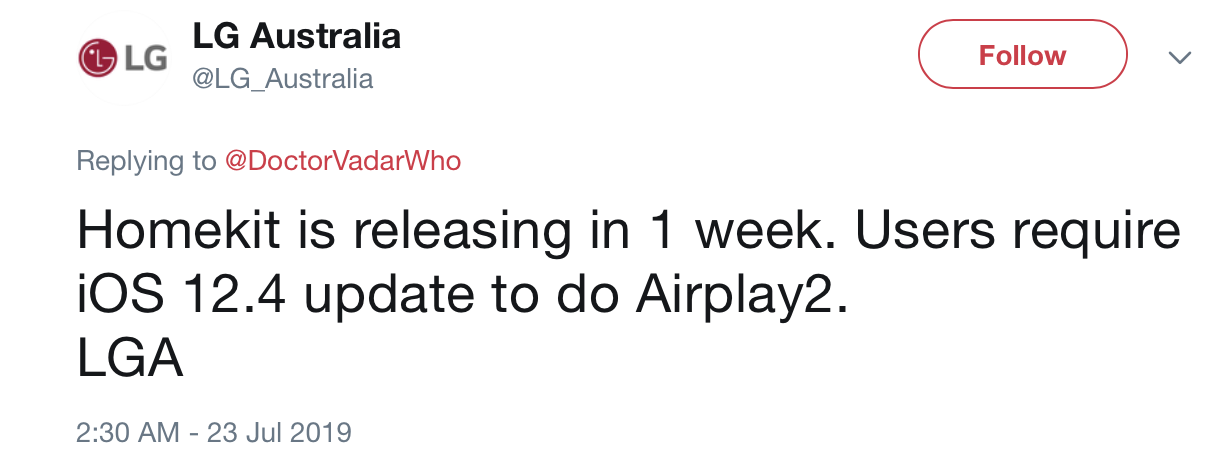
In addition to Samsung and Vizio, LG announced earlier this year that it would be adding support for Apple’s ecosystem to its TV operating system. According to a tweet from LG’s Australian account, the webOS update that adds support for HomeKit and AirPlay 2 will be released next week.

If you have an iPhone, iPad or Mac, you’ll be able to send video content to your TV using the AirPlay icon in your favorite video app. Unfortunately, some apps restrict AirPlay usage. So you’ll be able to beam YouTube or Amazon Prime Video content, but not Netflix shows for instance.

AirPlay is also useful if you want to show some photos on the big screen. And you can mirror your screen to a TV in case you want to use an LG TV for your PowerPoint presentation in your office.

LG TVs should also support AirPlay audio, which means that you can send audio to multiple AirPlay 2 devices at once (including your LG TV) and manage your multi-speaker setup from your iOS device.

When it comes to HomeKit support, you’ll be able to add your TV to the Home app and turn it on and off from there. Of course, it means that you can create automation in order to turn off the TV when you leave your home, or turn on the TV when you open the Hulu app on your iPad.

Thanks to HomeKit support, you can also create custom actions. For instance, you could say “Hey Siri, turn on the TV” and have Siri turn on the TV and dim your Philips Hue lights. You can also control the HDMI input from your Apple devices.

Unfortunately, LG said that AirPlay 2 and HomeKit support would only be added to 2019 smart TVs. Let’s see if that limit still stands when the company rolls out its software update.

Screen Shot 2019 07 23 at 3.38.42 PM

23 Jul 2019

Inventables raises $11.5M for its desktop milling technology

Inventables announced this morning that it has raised an $11.5 million Series C. The round, led by Cue Ball, alongside True Ventures, Greycroft, Pipeline Capital and Draper Associates, brings the Chicago-based startup’s total funding cup to 21 million, per Crunchbase.

The company specializes in desktop 3D carving — or subtractive manufacturing (not to be confused with the additive variety you get with 3D printers). While Inventables has produced its own proprietary machines, including the X Carve and the no longer available Carvey, this round is all about its software offerings.

Inventables says most of the funding this round will go into Easel, the company’s web-based design platform. Among other things, the company is working to make the technology compatible with more third-party machines.

“We are excited to see thousands of American businesses using our products for production,” founder and CEO Zach Kaplan said in a release tied to the news. This investment enables Inventables to enhance the functionality and compatibility of our Easel software, helping our business customers produce products faster and more profitably.”

The move is also clearly an attempt to transform the platform into a serious business product — though Inventables has apparently had little trouble attracting users. The company says it’s currently on track for four million carving projects this year using its services.

23 Jul 2019

TwelveSouth’s StayGo is the last USB-C dock you’ll ever need

The TwelveSouth StayGo is a new USB-C dock from a company that makes a ton of great and unique Mac and iOS device accessories. True to the company’s track record, it offers a slightly different take on a popular accessory category – and ends up excelling as a result.

The StayGo’s unique twist is an short USB-C to USB-C cable that slots right into a dedicated compartment on the dock, offering portable connectivity without any awkward stubby permanently attached cord. It also avoid the problem that direct USB-C dock connectors have, where they stick out and can potentially get damaged in your bag or scratch other stuff. There’s a second, 3-foot long cable included in the box, too, which you can conveniently just plug into your Mac at home if you switch between a desktop and a MacBook, or a Mac and an iPad.

It seems like a pretty simple thing, but having these two cables instead of just one, and the stowable short cable, make this far more convenient for anyone who travels or who does any out-of-home work at all. I’ve used a ton of these things, and StayGo is my clear favorite after having used it on a couple of trips over a month or so of testing.

I haven’t even talked about the ports yet – TwelveSouth nailed the right mix there, too, with three high-speed USB 3.0 ports, an Ethernet port, a USB-C connector (with pass-through charging at up to 85W), a 4K 30Hz HDMI port and both SD and microSD slots (which support UHS-I transfer speeds, and which can both operate simultaneously). That’s just about everything a traveler or working photographer today needs, and nothing they don’t – all in a space-saving design that never makes you choose between it and other gear when you’re packing even the smallest bag.

[gallery ids="1858916,1858915,1858914,1858913,1858912,1858911,1858910"]

In terms of performance, so far it’s been rock solid. There’s nothing worse than random unmounting of memory cards when you’re trying to transfer photos from a shoot, and the StayGo is definitely able to deliver solid, uninterrupted performance there. If I had any complaints, it’s that video output isn’t 60Hz, but that’s not really a necessary requirement for something that I’ll be using primarily to supplement my external monitor needs when I’m on the road instead of a dedicated video connection for a video editing setup, for instance.

The StayGo can get a bit warm when operating, but it’s never been actually hot, and the aluminum case construction helps ensure it can shed excess temp quickly.

At $79.99, it may be a bit more expensive than some of the hubs you can pick up on Amazon, but in terms of reliability, specs, port load out and its interesting approach to blending portability and at-home convenience, TwelveSouth is more than justified in setting that price point for the StayGo.

23 Jul 2019

Fetch Robotics raises $46 million to expand warehouse automation internationally

Placed against our sci-fi expectations, robotics have large fallen short — with one notable exception. In 2019, automation is a mainstay in  factories and warehouses. There the technology has been proven out in the field, and VCs are happy to invest millions.

This morning Fetch Robotics announced a $46 million Series C raise. The round, led by Fort Ross Ventures, brings the San Jose-based warehouse automation company’s total funding up to $94 million. New investors CEAS Investments, Redwood Technologies, TransLink Capital and Zebra Ventures joined the round, along with existing investors O’Reilly AlphaTech Ventures, Shasta Ventures, Softbank Capital and Sway Ventures.

Fetch says the money will be used to help expand operations globally for the largely U.S.-based operation. It will also be using funds to increase production for consumer demand and, naturally, additional research and development.

“Customers have responded enthusiastically to our unique Cloud Robotics solution, and we’re responding by securing the funds we need to continue growing and enhancing our offerings,” CEO Melonee Wise said in a release tied to the news. “The competitive pressures for excellence in logistics have never been greater. Our Autonomous Mobile Robots and cloud platform enables our customers to meet their customers’ demands while meeting their own financial objectives.”

The warehouse automation space has been booming in the past several years, and Fetch has been at the forefront. Founded in 2014 by Wise, an alumnus of Bay Area robotics pioneer Willow Garage, the company specializes in autonomous modular robotics designed to automate tedious warehouse tasks. We visited the company’s South Bay offices last year to get a fuller picture of what it has been working on.

These days the company is one of the primarily alternatives to in-house automation plays like Amazon Robotics.

23 Jul 2019

Mixhalo raises $10.7M to bring better sound quality to live events

Mixhalo — the startup co-founded by Incubus guitarist Mike Einziger and his wife, violinist Ann Marie Simpson-Einziger — has raised $10.7 million in Series A funding.

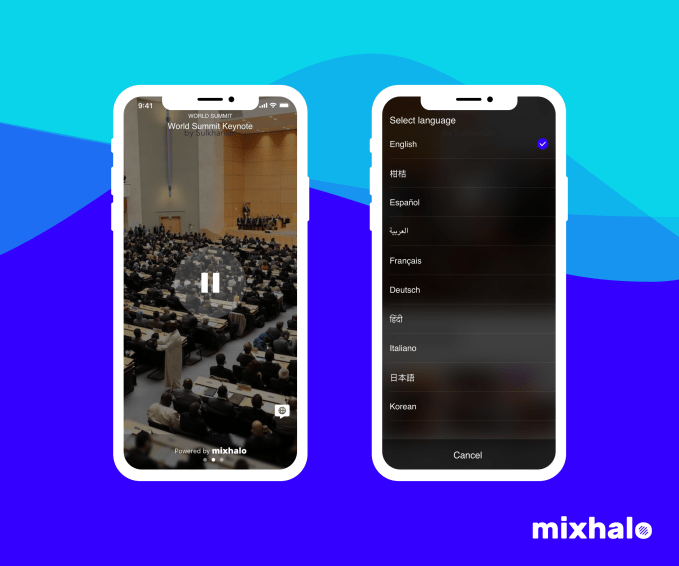
The company’s initial goal was to bring better sound quality to concerts. Instead of hearing music blasted out of speakers, users can connect their smartphone to a network (the startup creates its own wireless channel that doesn’t rely on the venue’s potentially overloaded WiFi or cell networks). Then, through their earbuds, they’ll hear the same sound mix that the musicians receive through their in-ear monitors.

Mixhalo launched two years ago at our Disrupt NY conference, where Incubus and investor Pharrell Williams took the stage to play a couple songs. The sound arrived loud and clear through my iPhone earbuds, and the experience didn’t feel too different form a normal concert.

Since then, Mixhalo has also been used at Y Combinator Demo Day and deployed on tours by Charlie Puth, Incubus and Metallica, as well as Aerosmith’s current Las Vegas residency.

And at the beginning of this year, Marc Ruxin joined as CEO. Ruxin formerly led the music discovery startup TastemakerX (which was acquired by Rdio), so this is clearly an area that interests him, but he told me that he actually wasn’t eager to return into the music business. However, he was wowed by Mixhalo’s sound quality, and as he talked to Einziger (who serves as the startup’s chief creative officer), he became convinced that the technology could be used at a wide range of events and venues — conferences, sports, museums, megachurches and more.

Plus, unlike other music startups, Ruxin said the business model here seemed appealingly straightforward: “We sell enterprise software to event organizers.”

mixhalo press 2up dark interpretation

When I’ve described the idea to friends, there’s usually some skepticism about whether concertgoers really care that much about sound, and concern about whether putting headphones on diminishes the social experience at these events.

However, Ruxin said Mixhalo offers a number of benefits beyond sound quality — there’s the ability for each listener to control their own volume, and an opportunity to create unique experiences, like offering multiple mixes for a single concert, or watching one band at a festival (or one presenter at Demo Day) while listening to another via Mixhalo.

He also argued that people don’t realize how bad most concert audio is, until Mixhalo gives the chance to experience something better.

“We’re definitely solving a problem in music that people don’t realize they have,” he said, comparing it to watching an old TV and thinking it was fine, until you had the chance to watch in HD: “Now, sports that’s not in HD looks crappy.”

As for the effect on the social experience, Ruxin said the idea isn’t to turn the whole event into a silent disco. Instead, Mixhalo aims to to allow the audience members to choose the experience they want. And that can change from song to song — he recalled seeing some fans listen to Mixhalo for most of a concert, then take their headphones off to sing along with the hits. Others did the opposite, wanting to get the best sound quality on their favorite songs.

Ruxin said he’s primarily focused on music and sports for now, but he’s also open to working with partners outside those areas, because the technology can be installed in, say, a Broadway musical with “no technical tweaks.”

The funding was led by Foundry Group, with participation from Sapphire Sport, Founders Fund, Defy Partners, Cowboy Ventures, Red Light Management, Another Planet Entertainment, Rick Farman and Rich Goodstone of Superfly and Charlie Walker of C3. Mixhalo has now raised a total of $15 million.

23 Jul 2019

AG Barr says consumers should accept security risks of encryption backdoors

U.S. attorney general William Barr has said consumers should accept the risks that encryption backdoors pose to their personal cybersecurity to ensure law enforcement can access encrypted communications.

In a speech Tuesday in New York, the U.S. attorney general parroted much of the same rhetoric from his predecessors and other senior staff at the Justice Department, calling on tech companies to do more to assist federal authorities gain access to devices with a lawful order.

Encrypted messaging has taken off in recent years, making its way to Apple products, Facebook, Instagram, and WhatsApp, a response from Silicon Valley in response to the abuse of access by the intelligence services in the wake of the Edward Snowden revelations in 2013. But law enforcement says encryption thwarts their access to communications they claim they need to prosecute criminals.

The government calls this “going dark” because they cannot see into encrypted communications, remains a key talking point by the authorities. Security experts have long said there is no secure way to create “backdoor” access to encrypted communications for law enforcement without potentially allowing malicious hackers to also gain access to people’s private communications.

In remarks, Barr said the “significance of the risk should be assessed based on its practical effect on consumer cybersecurity, as well as its relation to the net risks that offering the product poses for society.”

He suggested that the “residual risk of vulnerability resulting from incorporating a lawful access mechanism is materially greater than those already in the unmodified product.”

“Some argue that, to achieve at best a slight incremental improvement in security, it is worth imposing a massive cost on society in the form of degraded safety,” he said.

The risk, he said, was acceptable because “we are talking about consumer products and services such as messaging, smart phones, e-mail, and voice and data applications,” and “not talking about protecting the nation’s nuclear launch codes.”

The attorney general said it was “untenable” that devices offer uncrackable encryption while offering zero access to law enforcement.

Barr is the latest in a stream of attorney generals to decry an inability by law enforcement to access encrypted communications, despite pushback from the tech companies.

The U.S. is far from alone in calling on tech companies to give law enforcement access.

Earlier this year U.K. authorities proposed a new backdoor mechanism, the so-called “ghost protocol,” which would give law enforcement access to encrypted communications as though they were part of a private conversation. Apple, Google, Microsoft and WhatsApp rejected the proposal.

The FBI inadvertently undermined its “going dark” argument last year when it admitted the number of encrypted device it claimed it couldn’t gain access to was overestimated by thousands.

FBI director Christopher Wray said the number of devices it couldn’t gain access to was less than a quarter of the claimed 7,800 phones and tablets.

Barr did not rule out pushing legislation to force tech companies to build backdoors.

23 Jul 2019

Freshly elected as UK’s next PM, Boris Johnson pledges full fiber broadband bonanza

Get ready for a British Trump: The UK will shortly have a new prime minister after the Conservative Party membership overwhelmingly voted to elect Boris Johnson as their new party leader, passing over his sole rival for the post, Jeremy Hunt.

Johnson received 92,135 votes, a full 45,497 more than Hunt.

He replaces Theresa May who announced she would step down in May after failing to achieve backing from parliament for her EU withdrawal deal — the second PM to be topped by Brexit in just under three years.

Whether Johnson can outlast even May’s brief tenure very much remains to be seen.

The former journalist and ex major of London has made a political success story of clowning around in public, cracking often self-depreciating jokes which encourage a perception of joviality and good humor, while simultaneously pressing his personal ambition behind the scenes and ruthlessly gunning for the highest office in the land — which was his motivation for switching to back Brexit in the first place.

The clown mask enables the political manoeuvering, as it were.

How the usual Johnson ‘circus’ will translate into firm policy positions is something of an open question at this stage, though early indications suggest he’s intending an infrastructure spending spree — to feed the popularity contest that has, after all, swept him to power.

Albeit how any such public spending bonanza will be funded is anyone’s guess at this stage. One of his few leadership pledges was an income tax cut for high earners — which would rather shrink the Treasury’s coffers by billions than expand it…

He has also implied he might withhold the UK’s exit payment to the EU — a multi-billion sum that’s intended to cover the country’s existing commitments as it leaves the bloc.

But if you’re simultaneously hoping to ink a trade deal with the very same neighbors you’re denying payment to that would seem a rather self-defeating and short-term strategy, both at home and abroad.

Giving his Conservative leadership acceptance speech this afternoon there was little of policy substance on show from Johnson. In his usual showman style, he preferred to stroke sitting Tory egos with a confection of positive projections and feel-good sentiments — principally about ‘getting brexit done’ (though nothing on how he will actually get it done).

He also dropped a few enthusiastic words vis-a-vis infrastructure, education and broadband — going longest on the latter by claiming that “fantastic full fiber broadband” would be “sprouting in every household”, before falling back on the safe and fuzzy ground of non-specific cheerleading of party and country.

On the surface the fiber broadband pledge looks like a rinse and repeat of an existing government policy — announced in last year’s digital strategy — to put all UK households in reach of fibre to the premise (FTTP) by 2033.

Though the government had not committed to paying the estimated £30BN to fund a full rollout, focusing on regulatory tweaks to encourage the market to cover the majority of the country, targeting public cash at the tricky last fifth.

But penning his regular column in the Telegraph newspaper last month, Johnson dubbed the 2033 target “laughably unambitious“, writing that: “If we want to unite our country and our society, we should commit now to delivering full fibre to every home in the land not in the mid 2030s — but in five years at the outside.”

So a Boris Johnson-led Tory government’s full fibre target is, seemingly, being brought forward to 2025.

If he really intends for the public purse to bankroll universal FTTP within a five year time-scale it would certainly be transformative — with many rural regions still lagging urban Britain’s high speed access to Internet services, as a result of the business case for a rapid upgrade of these digital slow-lanes not stacking up.

Johnson is also right to identify the digital divide as increasingly problematic given the onward march of commercial technology. (And, indeed, increasingly problematic as more government services get pushed online — which risks widening the inequality gap, though he didn’t really dwell on that.)

However there’s no doubt that pressing fast forward on universal FTTP will entail a much larger bill than the government had budgeted for.

Last year’s Future Telecoms Infrastructure Review suggested an additional £3BN to £5BN in public funding would be needed to support commercial investment in the final ~10% of areas that would otherwise be overlooked, per the 2033 timeline. It’s anyone’s guess how much more public money will be needed to accelerate the whole broadband project to meet a universal access goal almost a decade quicker, per Johnson’s plan.

Though, as noted above, a full rollout has been costed at £30BN.

Assuming that ceiling wouldn’t need to be raised as a result of increased deployment velocity, the cost of Johnson’s faster fiber ambition could therefore scale spending on this particular infrastructure project 6x more than current government plans. Hence the pressing question of where the public funds will come from?

How much the Johnson push for ‘rural first’ fibre might cost UK consumers is another matter.

He talks in his newspaper column about “stimulating the private sector to get it done”. And if that stimulation includes government agreeing to industry demands to lengthen or even hyper-extend market review periods in order to encourage the private sector to get digging and fast, then it could result in UK consumers being on the hook twice: First by shelling out to lay the fiber in the first place, and then getting price-gouged to use the fibre-powered Internet services they’ve helped pay for.

Of course ‘fiber for all’ makes a great soundbite for PM Johnson to make a play for hearts and minds.

But, as with everything soon set to cross his desk, the devil is in the detail. And, well, clowns aren’t renowned for their grasp of those kinds of things.


23 Jul 2019

Arrcus snags $30M Series B as it tries to disrupt networking biz

Arrcus has a bold notion to try and take on the biggest names in networking by building a better networking management system. Today it was rewarded with a $30 million Series B investment led by Lightspeed Venture Partners.

Existing investors General Catalyst and Clear Ventures also participated. The company previously raised a seed and Series A totaling $19 million, bringing the total raised to date to $49 million, according to numbers provided by the company.

Founder and CEO Devesh Garg says the company wanted to create a product that would transform the networking industry, which has traditionally been controlled by a few companies. “The idea basically is to give you the best-in-class [networking] software with the most flexible consumption model at the lowest overall total cost of ownership. So you really as an end customer have the choice to choose best-in-class solutions,” Garg told TechCrunch.

This involves building a networking operating system called ArcOS to run the networking environment. For now, that means working with manufacturers of white box solutions and offering some combination of hardware and software, depending on what the customer requires. Garg says that players at the top of the market like Cisco, Arista and Juniper tend to keep their technical specifications to themselves, making it impossible to integrate ArcOS with those companies at this time, but he sees room for a company like Arrcus.

“Fundamentally, this is a very large marketplace that’s controlled by two or three incumbents, And when you have lack of competition you get all of the traditional bad behavior that comes along with that including muted innovation, rigidity in terms of the solutions that are provided, and these legacy procurement models, where there’s not much flexibility with artificially high pricing,” he explained.

The company hopes to fundamentally change the current system with its solutions, taking advantage of unbranded hardware which offers a similar experience, but can run the Arrcus software. “Think of them as white box manufacturers of switches and routers. Oftentimes, they come from Taiwan, where they’re unbranded, but it’s effectively the same components that are used in the same systems that are used by the [incumbents],” he said.

The approach seems to be working as the company has grown to 50 employees since it launched in 2016. Garg says that expects to double that number in the next 6-9 months with the new funding. Currently the company has double-digit paying customers and over 20 in various stages of proofs of concepts, he said.

23 Jul 2019

Freedom Robotics raises $6.6M to take the hassle out of founding a robotics startup

After years — decades even — of promises, the robotics industry is finally beginning to realize its potential. Nowhere is this phenomenon clearer than in the world of warehouse automation. Freedom Robotics, a new Bay Area-based startup, came out of stealth this week with plans to help ease the barrier of entry for companies to control and monitor large and small scale robotics fleets alike.

Today, the company announced that it has raised a sizable $6.6 million seed round led by Initialized Capital. The round also finds a handful of high profile investors joining, including, notably, Toyota AI Ventures and Pagerduty founder Andrew Miklas. They join founders of Twitch, Lookout Mobile Security and Xobni.

Freedom’s offering is designed for out-of-the-box operation, with businesses able to customize the offering using its API. The offering minimizes the technical expertise require to implement its offering, promising that users can get started, “with just one line of code.”

Freedom Robotics Team Standing

Co-founder and CEO Josh Wilson tells TechCrunch Freedom Robotics was founded to help companies get their robots to market, adding he sees the company as an AWS-type product for robotics. Freedom Robotics is targeting robotic teams within large companies and likewise, with small companies building robotic solutions. Instead of building the infrastructure around robotic products, Freedom Robotics offers a simple, turn-key solution that addresses items most robotic teams face.

“In 20 years 50% of all jobs worldwide, which represents $2.2 Trillion in wages within the US alone, will be replaced by robotics and automation,” the company notes in its announcement. “Our Funding round enables us to build the team and technology that will be the core infrastructure to power the next generation of robotics companies.”

Interested parties can sign up for early access on Freedom’s site.

23 Jul 2019

India’s Haptik acquires Los Angeles startup Convrg in international expansion push

Mumbai-based Haptik, which operates a conversational AI platform, has already won several high profile clients in India. Now the five-year-old firm, with newly found significant capital in the bank, is attempting to replicate its success in international markets.

On Tuesday, Haptik announced it has acquired Convrg, a Los Angeles-based startup that develops chatbots, to serve customers in North America. The acquisition is part of Haptik’s broader strategy to both expand its technology expertise and team and business overseas, Aakrit Vaish, cofounder and CEO of Haptik, told TechCrunch in an interview.

Founded in 2017, Convrg has made a name for itself by developing several popular chatbots and voice products. Its clients today include Reddit, The GRAMMYs, Aveda, Shopify, Sephora, and Proactiv. The startup had raised only a “small seed round” prior to today’s announcement, Vaish said, declining to reveal any financial details.

Convrg recently hired Timothy Carey, an industry veteran, who now serves as Haptik’s General Manager for the region. Convrg’s cofounders — Audrey Wu, Liz Snower and Amit Gupta — will report to Carey, who until recently held a similar position at IPSoft, another AI-driven firm.

Haptik, which sold majority stake to telecom operator Reliance Jio in a $100 million deal earlier this year, currently offers a chatbot platform. Many players including Coca Cola, Oyo, Samsung, Tata Group, and KFC use Haptik’s chatbots in their customer support services.

The firm has about 90% of its clients in India today, something it intends to change in the coming quarters. “60% of all software is bought in the U.S., so for us that market is critically important,” he said.

“We have done some business in the U.S. in the past, but now we really want to focus on expanding there,” he said. “For that, we need team and dedicated operation there. You can’t expand in the U.S. sitting in India, or on a plane.”

Vaish is already in talks with a handful of other startups and is open to more acquisitions, he said.

Other than that, the firm is currently exploring and developing voice bots as it expands its offerings. Voice bots would help it find more clients, such as those who handle customer services through phones, for instance.

When asked about what he thinks of major giants such as Google and Amazon also expanding into these fields, Vaish said these companies are largely making solutions for users — and not businesses. Besides, the chatbot space is so nascent currently that any effort from any giant helps educate the market, he said.