Category: UNCATEGORIZED

22 Jul 2019

Microsoft invests $1 billion in OpenAI in new multiyear partnership

Microsoft is making a $1 billion bet on OpenAI, the company formed by notable founders including Elon Musk and Sam Altman three years ago with the aim of doing research and development work to steer the growth of artificial intelligence towards the ‘friendlier’ end of the spectrum, in order to help mitigate what Musk sees as a potential existential threat from AI if it isn’t developed responsibly while it grows in capability.

On Monday, Microsoft and OpenAI announced a multiyear “exclusive computing partnership” that will include the two companies building new AI supercomputing technologies for Microsoft’s Azure cloud platform, and OpenAI will also port its existing services to work on Azure. Microsoft will also now be “OpenAI’s preferred partner” when it comes to the commercialization of new AI technologies it develops in future.

All the talk of ‘exclusivity’ and ‘preference’ in this announcement is particularly interesting because one of OpenAI’s founding principles was to “freely collaborate” among other AI researchers, and make both its work and patents available to others. But there are some caveats, including that there is OpenAI Inc. the non-profit organization, and its for-profit corporate subsidiary OpenAI LP, and that its current charter includes a provision that it may reduce its public publishing of its work as it moves forward out of “safety and security concerns.”

The goal of this partnership for Microsoft seems to be to provide it an edge in building out a broad-scale Azure AI platform, and ensure its supercomputing technologies are involved in the development of artificial general intelligence. OpenAI benefits because Microsoft will be party to its principles around developing advances in AGI safely and with humanity’s interest in mind – and there’s the $1 billion, too.

At its launch, OpenAI noted that it had $1 billion committed from Musk, Altman and co-founder and CTO Greg Brockman, as well as Reid Hoffman, Jessica Livingston, Peter Thiel, Amazon Web Services (this makes the Azure angle here particularly interesting), Infosys and YC Research, though it did not anticipate spending that much in the ensuing few years.

22 Jul 2019

FTC hits Equifax with fine of up to $700M for 2017 data breach

As part of a settlement with federal authorities over a data breach in 2017 that affected 147 million Americans, credit agency Equifax will pay up to $700 million in fines.

The Federal Trade Commission said in a statement Monday that Equifax has agreed to initially pay at least $575 million in fines as part of the settlement with the federal government and states over its “failure to take reasonable steps to secure its network” that led to the breach.

Hackers stole credit files on millions of Americans, but also British and Canadian nationals, including Social Security numbers, dates of birth, and thousands of payment card records in the May 2017 breach.

The company came under fire by congressional committees and security experts alike after it was found that Equifax had not properly rolled out publicly released patches on its network months prior to the data breach.

Former chief executive Richard Smith, who retired in the wake of the scandal, blamed the lack of patching on a single employee.

A House Oversight Committee said the breach was “entirely preventable.”

This marks the largest fine ever issued by the FTC following the $148 million fine handed to Uber following its own data breach. However, the fine amounts to as much as 20% of the company’s 2018 revenue.

U.K. authorities already issued its maximum penalty of £500,000 — about $624,000 — under its since-replaced legislation. Under the new GDPR rules which had not come into effect at the time of the Equifax breach, the credit rating agency would’ve been liable for fines of up to 4% of its global annual turnover.

As part of the settlement, the company will also have to improve its data security going forward, said Joe Simons, FTC chairman, including designating staff to oversee its information security program.

Equifax will also have to undergo third-party assessments every two years.

A year after the breach was disclosed, the company came under fire for facing few — if any — consequences as a result of exposing its customers’ data.

“This settlement requires that the company take steps to improve its data security going forward, and will ensure that consumers harmed by this breach can receive help protecting themselves from identity theft and fraud,” said Simons.

An Equifax spokesperson did not immediately respond to a request for comment.

22 Jul 2019

Meet 500 Startups’ 25th batch of startups

It’s that time of year again. When startup founders fret for weeks on end as the long-awaited Demo Day approaches. Investors pore through lists of startups participating in various accelerator programs and have their associates ping dozens of founders for coffee meetings.

Demo Day season is upon us. Soon Y Combinator’s latest cohort of startups will pitch to investors for two days, beginning August 19, and 500 Startups, another San Francisco-based accelerator program for early-stage companies, will host its own Demo Day on August 22.

We’ll report live from YC’s Demo Day next month. For now, here’s a closer look at all the startups finishing out 500 Startups’ latest program. As a reminder, through its four-month seed program, the 500 Startups seed fund invests $150,000 in participating companies in exchange for 6% equity. The companies below include a mix of fintech, digital health, edtech and e-commerce businesses, 33% of which 500 Startups says are women-led and 40% have Black or Latinx founders.

  • Alluva: Rewards individual users for their blockchain and crypto price predictions.
  • AMPAworks: An inventory management tool focused on hospitals. The startup uses computer vision AI to track and manage inventory in real time.
  • BeatDapp: Helps music labels and artists track their songs to collect royalties by providing real-time audit reports of streaming-play counts.
  • BlackCart: A try-before-you-buy app for fashion e-commerce stores.
  • Blue Studios: The Peloton of STEM education focused on teaching 1 billion kids STEM skills.
  • Blue Wire: A sports podcasting network.
  • Bytez: Helps developers and data scientists work faster.
  • Chemtech: An AI-product for manufacturing plant automatization.
  • Crash: A tool to help people launch their career.
  • Curie: A camera-based AI shopping assistant.
  • Dispatchr: Helps electric utilities prevent wildfires, catastrophes and crippling outages.
  • Docket: A system of record and workflow management SaaS for legal teams.
  • EINO: An AI platform that produces predictive and historical insights on localized population movement and their intention in urban areas for enterprise business users.
  • EZFarming: A marketplace that helps farmers finance their business and sell their produce.
  • FitzyTV: An internet TV platform designed to help consumers watch and record all their streaming TV channels across multiple services.
  • Gentem: A tool that provides instant claims reimbursements for physicians.
  • Glyph: A digitally knit shoe company.
  • Hearo Live: Turns passive media into a powerful, live social experience for games, sports, streaming and more.
  • Heartex: Helps companies quickly build AI products and features.
  • HYVE: Helps users navigate their social media universe by allowing them to follow more people.
  • InnerTrends: A data science service for SaaS that uncovers insights in customer onboarding, retention and engagement without the need for data scientists.
  • KIKI: The first app that pays you for having fun. A social marketplace where you can meet people, and buy and share experiences with them.
  • Lucidact Health: An AI assistant for nurses and case managers to help them know what to do faster and eliminate errors.
  • Nanno: The first on-demand childcare app that lets parents book vetted sitters nationwide.
  • Nanogrid: Building advanced cost calculation technology that enables home energy companies to ensure their customers get the most value out of their products.
  • NewoldStamp: An email signatures platform that turns every employee’s email into a marketing tool.
  • Renaissance: Allows users to earn loyalty points by listening to music.
  • Resonado: Reimagining audio systems for businesses with patented Flat Core Speaker technology.
  • RestAR: 3D capturing and product visualization for e-commerce using AI with any mobile device.
  • Rovilus: Developing safe and reliable battery packs for industrial vehicles and light electric aircraft.
  • Send4: Enables retailers to offer a seamless post-purchase experience to their customers.
  • Sharebee: A vertically integrated marketplace where anyone can book moving and storage in a couple of minutes for half of the traditional price.
  • Tradespace: A global IP marketplace for companies to buy, sell, license and invest in technology.
  • Visionful: Connects smart cities and autonomous vehicles leveraging AI and computer vision to provide full automation for parking and traffic monitoring.
  • Voogy: An IP to domain name database that allows companies to track and discover the anonymous web visitors that do not convert into their sales funnel.
22 Jul 2019

Airbnb introduces new search tools for business travelers

As more companies turn to Airbnb for Work to arrange work trips, the vacation rentals, homes and experiences business is making things easier for business travelers.

The company already provides thousands of listings catered to business travelers, complete with flexible access, personal kitchens for home-cooked meals and/or on-site laundry. Now, customers can easily locate those listings with Airbnb’s new search capabilities for business trips.

Airbnb’s work trip toggle, available globally as of today, allows guests to customize their search results for work travel and make more informed booking decisions by immediately filtering out vacation homes and other less convenient offerings. Airbnb is relying partly on social recommendations to ensure the correct listings — which includes entire homes, Airbnb Plus homes and boutique hotels — are showcased, including listings that have positive ratings from business travelers specifically.

Airbnb for Work launched in 2014 and has quickly grown to account for a large chunk of the company’s overall bookings. Last year, to account for the popularity of the service, Airbnb expanded its work arm to include Airbnb Experiences tailored for teams and more. Today, 500,000 companies are using Airbnb for Work to help manage their business travel.

Airbnb’s latest product tweak shows how personalized the platform can become — and is becoming — as it accumulates data from its massive trove of customers. The company, which counts 6 million listings in more than 100,000 cities, is doubling down on customization, M&A and more as it prepares for an initial public offering expected soon.

22 Jul 2019

Adobe brings Alexa integration to its XD prototyping tool

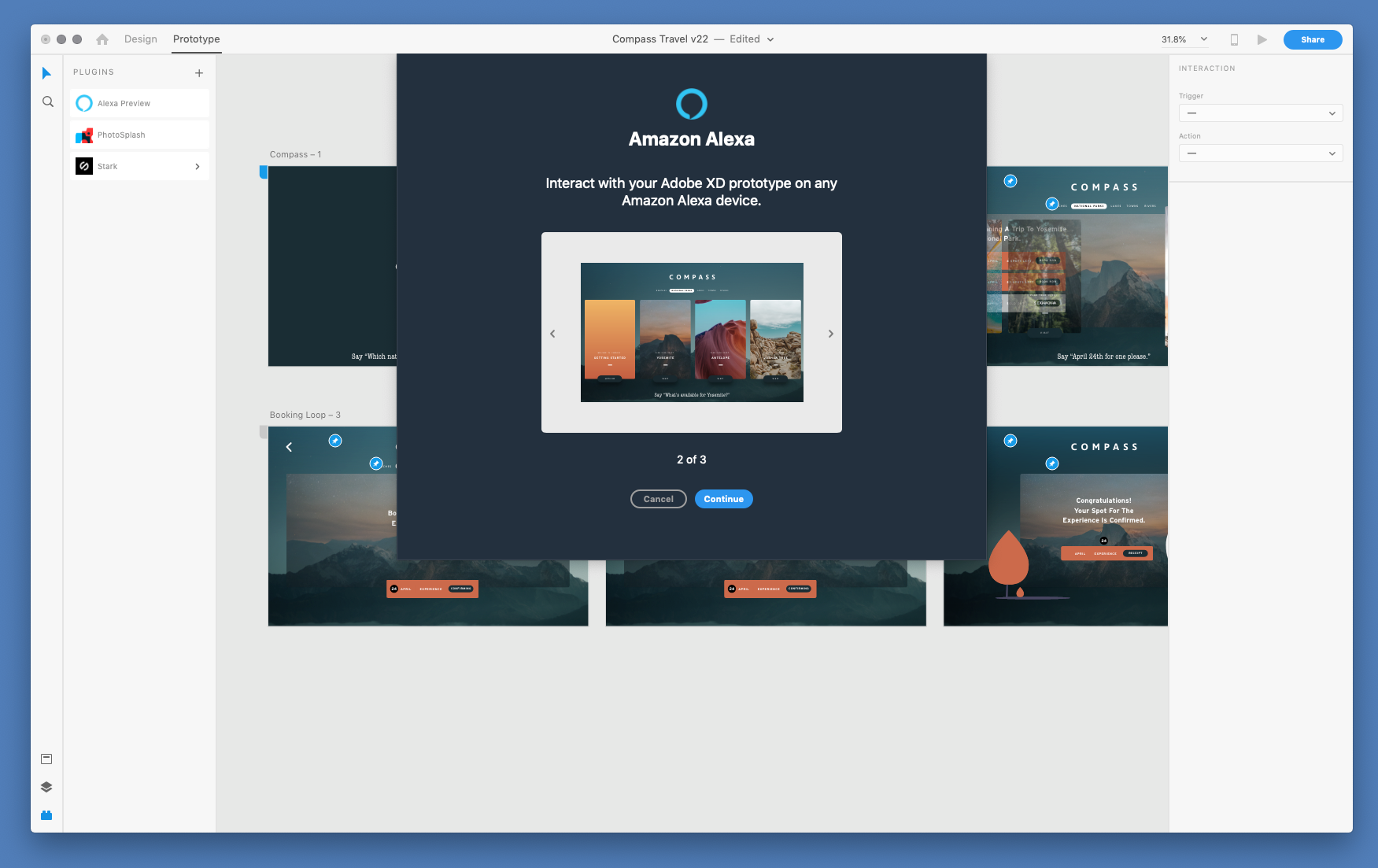
Adobe XD, the company’s increasingly popular prototyping and design tool, is getting support for testing Amazon Alexa voice experiences on devices like the Echo Dot and the Echo Show. This work builds upon XD’s existing voice prototyping tools, which the company announced last October, and also includes Adobe’s first Alexa skill, which is unsurprisingly the XD skill that lets you test those prototypes.

Adobe’s latest voice tech survey shows that users are indeed interested in using voice tech, but at its core, XD was always a tool for building web and mobile experiences. Over the course of the last few months, Adobe has made several investments into building voice apps as well. The same designers and developers who have long been tasked with building regular apps are now often being asked with building voice apps as well. So it makes sense to use the same tool they are already familiar with for testing these new kinds of apps, too.

The integration includes the Alex skill, as well as the Alexa XD plugin that makes it easy to export voice prototypes to Alexa and then preview them. “Experiencing your prototypes on real devices can help your clients or stakeholders better understand and experience your vision,” writes Mark Webster, Adobe’s director of product for voice UI and UX. “Plus, by having voice prototypes readily available on an Alexa-enabled device, you can have more design-focused conversations about your Alexa skills and iterate without having to go through full product development cycles.”

In its earliest iteration, XD’s voice support was relatively rudimentary and only let you trigger speech playback when it understood a specific word. That’s great for a demo and to get some of the basic functionality down, but it’s not exactly a substitute for testing a skill on a real device.

Chances are, we’ll see support for testing with other voice assistants in the future, too. For now, though, XD only works Alexa.

XD Amazon Alexa Plugin 01

22 Jul 2019

Box lands big financial services company with Morgan Stanley digital vault win

For many years, the argument went that it would be hard to get large enterprises to move to the cloud, then that it would be impossible to get regulated industries like healthcare and financial services. Yet in recent years, Box and other cloud companies have shown that’s just not true, crafting solutions for even the most regulated industries. Today, Box announced a new partnership with Morgan Stanley on a digital vault.

The new tool takes advantage of Box’s storage and collaboration strengths to enable customers to store key life documents like wills, deeds and tax documents digitally in an encrypted Box storage repository on the Morgan Stanley wealth management platform.

The solution relies on the Box API to upload documents. Either Morgan Stanley or the client can add documents to the vault, and both parties receive a notification when new documents are added. It also includes the ability to comment, so the client and financial advisor can communicate about the documents if there are any questions or issues.

Naureen Hassan, chief digital officer at Morgan Stanley Wealth Management says that the company chose Box because of security on the back end and ease of use on the front. “Box was selected because it provides the comprehensive capabilities needed to deliver a rich client experience and meet the strict security standards for cloud based solutions,” she said.

Box CEO Aaron Levie saw the deal in digital transformation terms. Companies like Morgan Stanley, regardless of their business vertical, need to transform and provide better customer experiences online.

“In financial services today, companies need to reimagine how they connect and engage with their customers and how they empower their people. It’s a race to transform critical processes like loan origination and wealth management with digital technology. Many of these workflows center on content, and Morgan Stanley is a great example of how cloud content management from Box enables seamless new digital experiences,” Levie explained.

22 Jul 2019

Cyber threats from the U.S. and Russia are now focusing on civilian infrastructure

Cyber-confrontation between the U.S. and Russia is increasingly turning to critical civilian infrastructure, particularly power grids, judging from recent press reports. The typically furtive conflict went public last month, when The New York Times reported U.S. Cyber Command’s shift to a more offensive and aggressive approach in targeting Russia’s electric power grid.

The report drew skepticism from some experts and a denial from the administration, but the revelation led Moscow to warn that such activity presented a “direct challenge” that demanded a response.  WIRED magazine the same day published an article detailing growing cyber-reconnaissance on U.S. grids by sophisticated malware emanating from a Russian research institution, the same malware that abruptly halted operations at a Saudi Arabian oil refinery in 2017 during what WIRED called “one of the most reckless cyberattacks in history.”

Although both sides have been targeting each other’s infrastructure since at least 2012, according to the Times article, the aggression and scope of these operations now seems unprecedented.

Washington and Moscow share several similarities related to cyber-deterrence. Both, for instance, view the other as a highly capable adversary. U.S. officials fret about Moscow’s ability to wield its authoritarian power to corral Russian academia, the private sector, and criminal networks to boost its cyber-capacity while insulating state-backed hackers from direct attribution.

Moscow sees an unwavering cyber-omnipotence in the U.S., capable of crafting uniquely sophisticated malware like the ‘Stuxnet’ virus, all while using digital operations to orchestrate regional upheaval, such as the Arab Spring in 2011. At least some officials on both sides, apparently, view civilian infrastructure as an appropriate and perhaps necessary lever to deter the other.

Image courtesy of TechCrunch/Bryce Durbin

Whatever their similarities in cyber-targeting, Moscow and Washington faced different paths in developing capabilities and policies for cyberwarfare, due in large part to the two sides’ vastly different interpretations of global events and the amount of resources at their disposal.

A gulf in both the will to use cyber-operations and the capacity to launch them separated the two for almost 20 years. While the U.S. military built up the latter, the issue of when and where the U.S. should use cyber-operations failed to keep pace with new capabilities. Inversely, Russia’s capacity, particularly within its military, was outpaced by its will to use cyber-operations against perceived adversaries.

Nonetheless, events since 2016 reflect a convergence of the two factors. While the U.S. has displayed a growing willingness to launch operations against Russia, Moscow has somewhat bolstered its military cyber-capacity by expanding recruiting initiatives and malware development.

The danger in both sides’ cyber-deterrence, however, lies not so much in their converging will and capacity as much as it is rooted in mutual misunderstanding. The Kremlin’s cyber-authorities, for instance, hold an almost immutable view that the U.S. seeks to undermine Russia’s global position at every turn along the digital front, pointing to U.S. cyber-operations behind global incidents that are unfavorable to Moscow’s foreign policy goals. A declared expansion in targeting Russian power grids could ensure that future disruptions, which can occur spontaneously, are seen by Moscow as an unmistakable act of U.S. cyber-aggression.

In Washington, it seems too little effort is dedicated to understanding the complexity of Russia’s view of cyber-warfare and deterrence. The notion that Russia’s 2016 effort to affect the U.S. presidential election was a “Cyber” or “Political” Pearl Harbor is an appropriate comparison only in the sense that U.S. officials were blindsided by Moscow’s distinct approach to cyberwarfare: an almost seamless blend of psychological and technical operations that differs from most Western concepts.

Russian military operators conducted what should be considered a more aggressive cyber-campaign a year before their presidential election-meddling, when they posed as ‘CyberCaliphate,’ an online branch of ISIS, and attacked U.S. media outlets and threatened the safety of U.S. military spouses.

For their part, the Russians made a different historical comparison to their 2016 activity. Andrey Krutskikh, the Kremlin’s bombastic point-man on cyber-diplomacy issues, likened Russia’s development of cyber-capabilities that year to the Soviet Union’s first successful atomic bomb test in 1949.

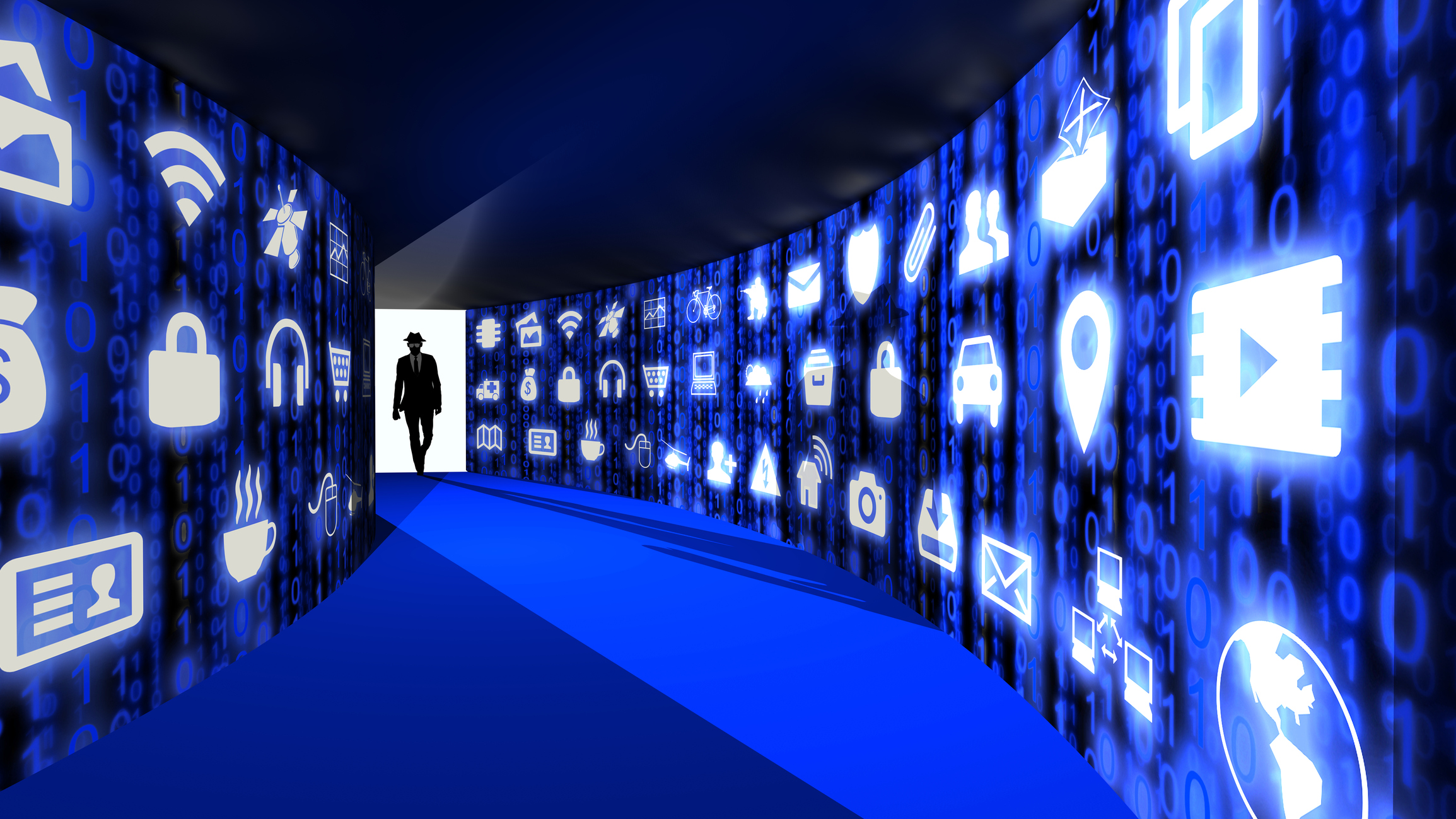
A silhouette of a hacker with a black hat in a suit enters a hallway with walls textured with blue internet of things icons 3D illustration cybersecurity concept

Image courtesy of Getty Images/BeeBright

Western analysts, fixated on untangling the now-defunct concept of the ‘Gerasimov Doctrine,’ devoted far less attention to the Russian military’s actual cyber-experts, who starting in 2008 wrote a series of articles about the consequences of Washington’s perceived militarization of cyberspace, including a mid-2016 finale that discussed Russia’s need to pursue cyber-peace with the U.S. by demonstrating an equal ‘information potential’.

Despite Cyber Command’s new authorities, Moscow’s hackers are comparatively unfettered by legal or normative boundaries and have a far wider menu of means and methods in competing with the U.S. short of all-out war. Russian military hackers, for example, have gone after everything from the Orthodox Church to U.S. think tanks, and they launched what the Trump administration called the most costly cyber-attack in history.

In the awkward space between war and peace, Russian cyber-operations certainly benefit from the highly permissive, extralegal mandate granted by an authoritarian state, one that Washington would likely be loath (with good reason) to replicate out of frustration.

By no means should the Kremlin’s activity go unanswered. But a leap from disabling internet access for Russia’s ‘Troll Farm’ to threatening to blackout swaths of Russia could jeopardize the few fragile norms existing in this bilateral cyber-competition, perhaps leading to expanded targeting of nuclear facilities.

The U.S. is arriving late to a showdown that many officials in Russian defense circles saw coming a long time ago, when U.S. policymakers were understandably preoccupied with the exigencies of counterterrorism and counterinsurgency.

Washington could follow Moscow’s lead in realizing that this is a long-term struggle that requires innovative and thoughtful solutions as opposed to reflexive ones. Increasing the diplomatic costs of Russian cyber-aggression, shoring-up cyber-defenses, or even fostering military-to-military or working-level diplomatic channels to discuss cyber redlines, however discretely and unofficially, could present better choices than apparently gambling with the safety of civilians that both sides’ forces are sworn to protect.

22 Jul 2019

With Chandrayaan-2 launch, India’s ISRO shoots for the Moon on a shoe-string budget

India took a giant leap in its space program on Monday after its space agency launched a spacecraft that is scheduled to touch down on the Moon in September.

The Indian Space Research Organization (ISRO), which is India’s equivalent of NASA, confirmed the successful launch of the spacecraft as it inches closer to become only the fourth nation — after the United States, China, and the Soviet Union — to land a spacecraft on the Moon. Chandrayaan-2 aims to land on a plain surface that covers the ground between two of the Moon’s craters, Simpelius N and Manzinus C.

The spacecraft was originally scheduled to launch from the Satish Dhawan Space Centre, Sriharikota in Andhra Pradesh on July 15, but ISRO postponed it less than 20 minutes ahead of the deadline citing a “technical glitch.” ISRO said it resolved the issue last week.

Everything about India’s homegrown lunar mission — dubbed Chandrayaan-2 (Sanskrit for “moon vehicle”) — is a technological marvel.  The spacecraft — which is sitting atop of the country’s most powerful rocket to date, a Geosynchronous Satellite Launch Vehicle called Mark III — is carrying an orbiter, a lunar lander called Vikram and six-wheeled rover Pragyan (Sanskrit for “wisdom”). In early September, the lander, which is named after Vikram Sarabhai, the father of ISRO, is scheduled to detach from the orbiter. Until then, Chandrayaan-2 will embark on a slow journey to the Moon, staying in an elliptical orbit.

The mission’s budget is just $141, significantly lower than those of other countries, and less than half of the recently released blockbuster “Avengers: Endgame.” The orbiter is designed to operate for at least one year, but lander and rover are expected to operate for just a couple of weeks.

03gslvmkiii m1vehiclemountedonmobilelaunchpedestalmovingtowardsthesecondlaunchpad

The spacecraft that was launched today/ Image: ISRO

The Chandrayaan-2 mission is aimed at analyzing minerals on the south pole of the Moon, a region that has not been closely studied yet. So the Chandrayaan-2 lander is equipped with a suite of instruments, including spectrometer and cameras, among others to map the lunar surface, look for water, and measure moonquakes and temperature of the soil.

In a statement released earlier this month, ISRO said the Chandrayaan-2 will “boldly go where no country has ever gone before.”

As the name suggests, Chandrayaan is not India’s first lunar mission. In 2008, the nation sent orbiter Chandrayaan-1 that played an instrumental role in helping confirm the presence of water ice in the lunar craters. In 2013, ISRO also launched an orbiter to Mars in its maiden $74 million interplanetary mission — a fraction of the $671 million NASA spent for a Mars mission in the same year. In 2017, ISRO also deployed a record 104 satellites into the space in just 18 minutes. 

ISRO has come a long way and specialized in low-cost space launches since the early 1960s, when components of rockets were transported by bicycles and assembled by hand in the country.

Last month, ISRO unveiled its intentions to have its own space station in the future and conduct separate missions to study the Sun and Venus. It will begin working on its space station following its first manned mission to space, called Gaganyaan (which means “space vehicle” in Sanskrit), in 2022 — just in time to commemorate 75 years of the country’s independence from Britain. The government has sanctioned Rs 10,000 crores ($1.5 billion) for the Gaganyaan mission.

“While navigation, communication and Earth observation are going to be the bread and butter for us, it is missions such as Chandrayaan, Mangalyaan (Sanskrit for “Mars vehicle”) and Gaganyaan that excite the youth, unite the nation and also pave a technological seed for the future,” said Dr. Kailasavadivoo Sivan, chairman of Indian Space Research Organization (ISRO) at the time.

22 Jul 2019

Sennder raises $70M on $300M valuation to take on the freight forwarding industry

Logistics and the movement of freight from point A to B (and C and beyond) is one of the more antiquated, and less-understood aspects of the world of commerce. But one look at Amazon and how it has grown its empire on the strength of its logistics prowess (and another glance or two at the companies that have fallen down on supply and shipment costs and issues), and you can see just how much of a cornerstone it is for a business to get right. Today, a Berlin-based startup called Sennder is announcing a significant round of funding to take on that antiquated logistics market with an updated, digital platform. It has raised a Series C of $70 million, with a valuation that we understand is in the region of $300 million.

The funding — led by Lakestar with participation from Accel, Next47, H14, HV Holtzbrinck Ventures, Project A and Scania Growth Capital — is notable in that it’s the second round that Sennder has raised this year alone. (It announced a Series B of $30 million this past spring.) That underscores the current surge of investor and market interest in logistics, which is estimated to be a $400 billion market in Europe alone.

Other big funding rounds in the market have included others that compete directly with Sennder in the area of freight forwarding, such as Flexport out of the US bagging an investment from Softbank at a $3.2 billion valuation; Zencargo out of the UK raising $20 million; and FreightHub raising $30 million. In the wider market of logistics, Bringg has raised $25 million and NEXT raising $97 million.

That speaks to a very crowded market, which is where Sennder’s specialization comes into play. Its focus specifically is on one part of the market called the “full truck load” (FTL) market, which is aimed at organising, logging and optimising the cargo that lorry drivers are packing up onto their pallets, with a specific focus on smaller and mid-size trucking companies.

It’s an area that is estimated to be valued at $120 billion in Europe alone. As with other startups in logistics, the aim is to bring cloud-based communications and better record keeping, along with more efficient logistical mapping organization to an industry that has been operating largely by way of faxed or shipped invoices and even in some cases, handshakes.

In the case of Sennder, that includes not just better communication between truckers, those shipping the goods, and those receiving them, but GPS tracking to help with arrivals estimates and invoicing between truckers and shippers. Given its emphasis on small and medium trucking companies, it often works directly with the owners of the trucks themselves.

“We have pooled our knowledge and experience gathered in our previous roles to improve operational excellence in this highly complex market. Our relentless focus on product and industry pain points has helped us to deliver an impressive portfolio of global, highly satisfied enterprise clients,” said David Nothacker, who co-founded the company with Nicolaus Schefenacker and Julius Koehler, in a statement. “We believe that sennder is leading the way for the industry on digitisation, reliability and customer service.”


22 Jul 2019

Visa invests in India-based B2B payments platform PayMate’s $25M round

PayMate, a Mumbai-based startup that helps businesses automate and digitize their payments, is raising $25 million in a new round, its founder said, as it looks to expand its presence within India and in international markets.

In an interview with TechCrunch, Ajay Adiseshann, founder and CEO of PayMate, said the startup has already raised a substantial amount of the $25 million it is eyeing in its Series D. These funds came from Recruit Strategic Partners, Brand Capital, Visa, and existing investor Mayfair 101. Adiseshann said he expects the round to close in 60 days.

The 13-year-old startup, which had raised $18 million prior to Series D, began its journey as a consumer-facing payments service. But it quickly shifted its attention to opportunities in business-to-business payments market, Adiseshann said.

PayMate today develops and offers cloud-based solutions for SME and enterprise customers to help them manage invoices and payments from vendors and customers. It also works with Visa and issuing banks to offers crediting financial option to customers.

Last year, PayMate acquired Z2P Technologies, a startup that offers lending technologies, to bring lending stack on its platform. It looks at transactional data on its platform to score SMEs and offer them credits from third-party lenders. PayMate also serves as a discounting marketplace, allowing large enterprises to electronically negotiate offers with SMEs.

In India, and same is true of some other markets, small and medium businesses often struggle to secure financing options from major banks. “India is a very collateral-based in financing. On our platform, we have the visibility of their transactional data,” he said. This helps establish transparency and trust between all the stakeholders.

The startup has over 35,000 business customers that use its platform to process more than $5 billion in payments each year. It began operations in UAE earlier this year and will use the new capital to expand in Africa and parts of Europe, Adiseshann said.