
Category: UNCATEGORIZED

19 Jul 2019

Powering the brains of tomorrow’s intelligent machines

Sense and compute are the electronic eyes and ears that will be the ultimate power behind automating menial work and encouraging humans to cultivate their creativity. 

These new capabilities for machines will depend on the best and brightest talent and investors who are building and financing companies aiming to deliver the AI chips destined to be the neurons and synapses of robotic brains.

Like any other herculean task, this one is expected to come with big rewards.  And it will bring with it big promises, outrageous claims, and suspect results. Right now, it’s still the Wild West when it comes to measuring AI chips up against each other.

Remember laptop shopping before Apple made it easy? Cores, buses, gigabytes and GHz have given way to “Pro” and “Air.” Not so for AI chips.

Roboticists are struggling to make heads and tails out of the claims made by AI chip companies.  Every passing day without autonomous cars puts more lives at risk of human drivers. Factories want humans to be more productive while out of harm’s way. Amazon wants to get as close as possible to Star Trek’s replicator by getting products to consumers faster.

A key component of that is the AI chips that will power them.  A talented engineer making a bet on her career to build AI chips, an investor looking to underwrite the best AI chip company, and AV developers seeking the best AI chips, need objective measures to make important decisions that can have huge consequences. 

A metric that gets thrown around frequently is TOPS, or trillions of operations per second, to measure performance.  TOPS/W, or trillions of operations per second per Watt, is used to measure energy efficiency. These metrics are as ambiguous as they sound. 

What are the operations being performed on? What’s an operation? Under what circumstances are these operations being performed? How does the timing by which you schedule these operations impact the function you are trying to perform?  Is your chip equipped with the expensive memory it needs to maintain performance when running “real-world” models? Phrased differently, do these chips actually deliver these performance numbers in the intended application?

Image via Getty Images / antoniokhr

What’s an operation?

The core mathematical function performed in training and running neural networks is a convolution, which is simply a sum of multiplications. A multiplication itself is a bunch of summations (or accumulation), so are all the summations being lumped together as one “operation,” or does each summation count as an operation? This little detail can result in difference of 2x or more in a TOPS calculation. For the purpose of this discussion, we’ll use a complete multiply and accumulate (or MAC), as “two operations.” 

What are the conditions?

Is this chip operating full-bore at close to a volt or is it sipping electrons at half a volt? Will there be sophisticated cooling or is it expected to bake in the sun? Running chips hot, and tricking electrons into them, slows them down.  Conversely, operating at modest temperature while being generous with power, allows you to extract better performance out of a given design. Furthermore, does the energy measurement include loading up and preparing for an operation? As you will see below, overhead from “prep” can be as costly as performing the operation itself.

What’s the utilization?

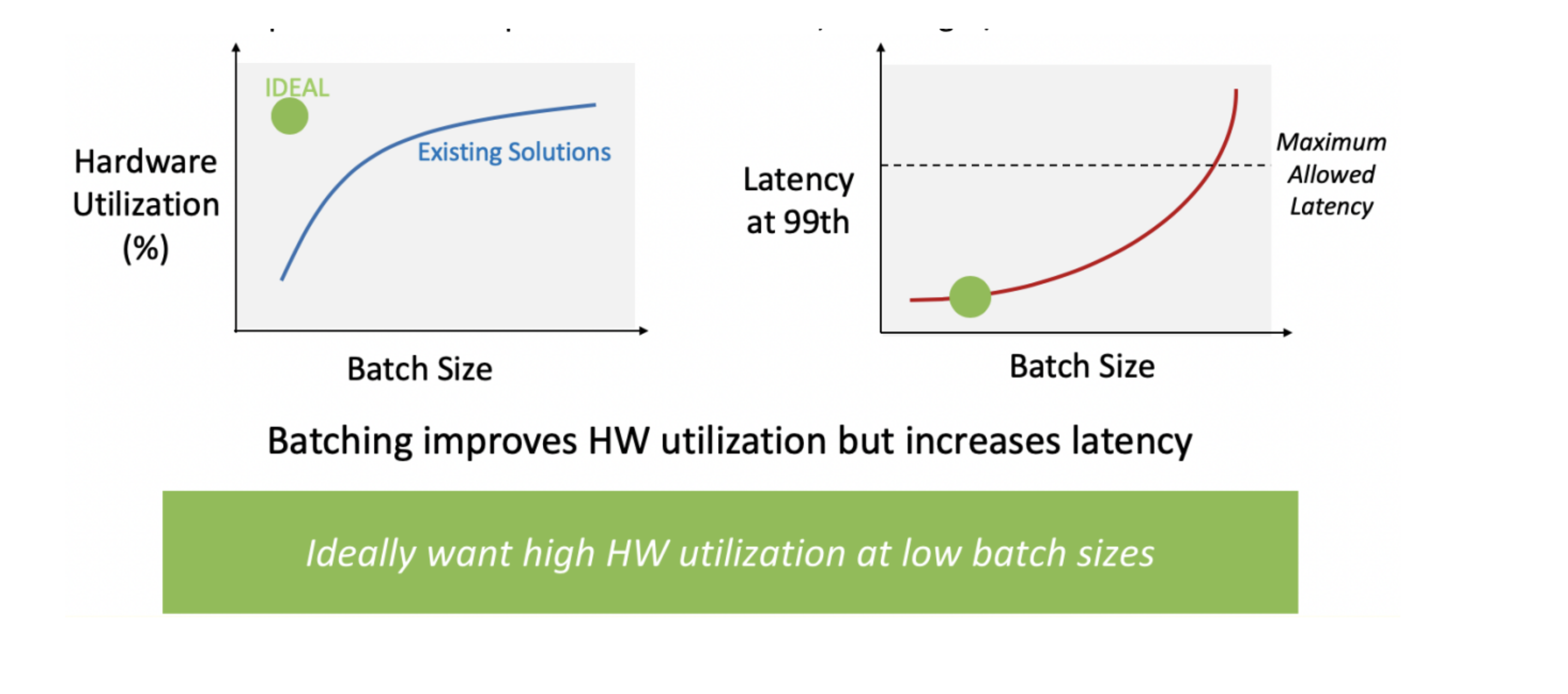
Here is where it gets confusing.  Just because a chip is rated at a certain number of TOPS, it doesn’t necessarily mean that when you give it a real-world problem, it can actually deliver the equivalent of the TOPS advertised.  Why? It’s not just about TOPS. It has to do with fetching the weights, or values against which operations are performed, out of memory and setting up the system to perform the calculation. This is a function of what the chip is being used for. Usually, this “setup” takes more time than the process itself.  The workaround is simple: fetch the weights and set up the system for a bunch of calculations, then do a bunch of calculations. Problem with that is that you’re sitting around while everything is being fetched, and then you’re going through the calculations.  

Flex Logix (my firm Lux Capital is an investor) compares the Nvidia Tesla T4’s actual delivered TOPS performance vs. the 130 TOPS it advertises on its website. They use ResNet-50, a common framework used in computer vision: it requires 3.5 billion MACs (equivalent to two operations, per above explanation of a MAC) for a modest 224×224 pixel image. That’s 7 billion operations per image.  The Tesla T4 is rated at 3,920 images/second, so multiply that by the required 7 billion operations per image, and you’re at 27,440 billion operations per second, or 27 TOPS, well shy of the advertised 130 TOPS.  
Screen Shot 2019 07 19 at 6.13.46 AM

Batching is a technique where data and weights are loaded into the processor for several computation cycles.  This allows you to make the most of compute capacity, BUT at the expense of added cycles to load up the weights and perform the computations.  Therefore if your hardware can do 100 TOPS, memory and throughput constraints can lead you to only getting a fraction of the nameplate TOPS performance.

Where did the TOPS go? Scheduling, also known as batching, of the setup and loading up the weights followed by the actual number crunching takes us down to a fraction of the speed the core can perform. Some chipmakers overcome this problem by putting a bunch of fast, expensive SRAM on chip, rather than slow, but cheap off-chip DRAM.  But chips with a ton of SRAM, like those from Graphcore and Cerebras, are big and expensive, and more conducive to datacenters.  

There are, however, interesting solutions that some chip companies are pursuing:

Compilers:

Traditional compilers translate instructions into machine code to run on a processor.  With modern multi-core processors, multi-threading has become commonplace, but “scheduling” on a many-core processor is far simpler than the batching we describe above.  Many AI chip companies are relying on generic compilers from Google and Facebook, which will result in many chips companies offering products that perform about the same in real-world conditions. 

Chip companies that build proprietary, advanced compilers specific to their hardware, and offer powerful tools to developers for a variety of applications to make the most of their silicon and Watts will certainly have a distinct edge. Applications will range from driverless cars to factory inspection to manufacturing robotics to logistics automation to household robots to security cameras.  

New compute paradigms:

Simply jamming a bunch of memory close to a bunch of compute results in big chips that sap up a bunch of power.  Digital design is one of tradeoffs, so how can you have your lunch and eat it too? Get creative. Mythic (my firm Lux is an investor) is performing the multiply and accumulates inside of embedded flash memory using analog computation. This empowers them to get superior speed and energy performance on older technology nodes.  Other companies are doing fancy analog and photonics to escape from the grips of Moore’s Law.

Ultimately, if you’re doing conventional digital design, you’re limited by a single physical constraint: the speed at which charge travels through a transistor at a given process node. Everything else is optimization for a given application.  Want to be good at multiple applications? Think outside the VLSI box!

19 Jul 2019

Parrot’s getting out of the low-end drone business

Parrot announced the AR.Drone back at CES 2010, three years before DJI’s Phantom 1. It was a seemingly odd move by a company best known for making bluetooth speakers and headsets, but over the years it’s continued to release fairly novel takes on the growing category.

Two years back, the French company announced its intentions to shift product away from consumer focused device. Since then, it’s been slowly scaling things back, this week confirming a Wirecutter report that it’s leaving the toys behind.

No doubt seeing an insurmountable challenge from China’s DJI, the company is shuttering all drone lines but Anafi. While the line closely resembles DJI’s Mavic products, Parrot has begun to position the foldable quadcopter at enterprise uses. As we noted in April, the addition of a Flir thermal camera finds the company targeting construction workers and firefighters.

The move comes as the consumer and hobbyist market continues to grow, but those numbers have been utterly dominated by DJI’s offerings in recent years. Of course, DJI has also been tackling the B2B space, both with souped up versions of the Mavic line and higher payload devices like the Matrice and Inspire.

Those products can perform a wide range of different tasks, from pesticide spraying to search and rescue.

19 Jul 2019

Mylk Guys wants to be the online vegan grocery store that non-vegans can love

Gaurav Maken, the chief executive officer of the online vegan grocery store, Mylk Guys, doesn’t think of his company as a place to just buy food. For him, it’s a testing ground and platform for all of the new food products he expects to be developed as startup entrepreneurs and established food companies start tackling the plant-based and alternative meat market in earnest.

The company has raised $2.5 million in support of that vision from investors including Khosla Ventures, Pear Ventures, and Fifty Years.

“Today we’re an online grocery store,” says Maken. “We are also a place for cultured meats and any genetically engineered food that allows us to scale our food production and allows us to keep feeding people.”

Screen Shot 2019 07 19 at 8.37.42 AM

Maken isn’t wedded to plant-based products and envisions a virtual store stocked with products that create more sustainable consumption options for its customers. In fact, 40% of the company’s customers are not vegan, according to Maken. 

“We don’t only think about vegans. We think about sustainable food systems,” says Maken. “Our audience is an educated consumer who wants to have less of an impact from their diet… They’re just folks trying to do better with their eating habits.”

Right now, the company sells around 1300 products through its site. And the pitch that Maken makes to suppliers is that they can access the data around their customers (unlike other online retailers whose name rhymes with shmamazon).

“We provide analytics and a way for brands to unlock the data coming from their customers,” Maken says. “Our focus is how can we get you a personalized staple that works for you.” 

The company’s top sellers are vegan cheeses like Sparrow Camembert, lines of vegan jerkies, and the Beyond Burger, Maken said.

“You can build brands that are successful that are $1 million brands or $5 million brands and the reason why you haven’t is because they haven’t had the platform to provide national distribution to be successful,” says Maken.  

Mylk Guys launched in 2018 and went through the Y Combinator accelerator program. Now, with its new capital, the company is focusing on expanding its sales and marketing on the East Coast. Opening a new warehouse for distribution and reaching out to the vegan community on the Eastern Seaboard.

The model for selling more sustainable foods directly to the consumer has at least one precedent. Los Angeles-based Thrive Market raised $111 million in a 2016 round of funding for its online sustainable product-focused grocery store.

As recent reports indicate, the sustainable food business is only growing. Citing reports from Ecovia Intelligence, the publication Environmental Leader reported that organic food sales topped $100 billion for the first time in 2018.

19 Jul 2019

Twitter tests a new way to label replies

Twitter is testing a new way to make conversation threads easier to follow, with the launch of a new test that labels notable replies with special icons. If the original poster replies somewhere in the thread, their tweet will have a small microphone icon next to their profile picture. Other tweets may be labeled, as well — including those from users who were mentioned in the original tweet and replies from people you’re already following on Twitter.

These will be labeled with the at symbol (@) and a small person icon with a checkmark by it, respectively.

The new test is the latest in a series of experiments Twitter has been running focused on making its product easier to use, particularly when conversations around a tweet become lengthy.

At the beginning of this year, the company first began a test where it labeled the original poster in a conversation thread as the “Original Tweeter.” That may have been a bit too confusing for some, because a few months later, Twitter changed it to “Author.” It then also added two other labels, for people who were mentioned in the original tweet, and those replies from people you’re following.

These, however, were text labels — meaning they took up valuable screen space on small mobile devices. They also cluttered up the already text-heavy interface with more distracting text to read.

The new icons don’t have that problem. But they’re also small and light gray and white in color, which makes them hard to see. In addition, their meaning isn’t necessarily clear to anyone who doesn’t hang around online forums like Reddit, for example, where it’s common to use a microphone to showcase the original poster’s follow-up comments.

It’s also unclear why Twitter thinks users are clamoring to see this information. Highlighting the original poster is fine, I guess, but the other labels seem extraneous.

While this is a minor change, it’s one of many things Twitter is tweaking in the hopes of making its service simpler and more approachable. It’s also running an experimental prototype app called twttr where it’s trying out new ideas around threaded conversations, like using color-coded replies or branching lines to connect tweets and their responses.

A lot of these changes feel a little unnecessary. Twitter isn’t as difficult to understand as the company believes it is.

At the end of the day, it’s a way to publish a public status update and reply to those others have posted. That’s its core value proposition — not live streaming video, not its clickable newsreels it calls “Moments,” and not its article bookmarking tools. Those are useful and fun additions, sure, but optional.

Instead, Twitter’s challenges around user growth aren’t because the service is overly complex, but because a public platform like this is rife for issues around online bullying and abuse, disinformation and propaganda, hate speech, spambots, and everything else that an unmoderated forum would face.

Twitter tests are live now, but not be showing for all users.

19 Jul 2019

Twitter to attempt to address conversation gaps caused by hidden tweets

Twitter’s self-service tools when it comes to blocking content you don’t want to see, as well as a growing tendency for users to delete a lot of the content they post, is making some of the conversations on the platform look like Swiss cheese. The company says it will introduce added “context” on content that’s unavailable in conversations in the next few weeks, however, to help make these gaps at least less mystifying.

There are any number of reasons why tweets in a conversation you stumble upon might not be viewable, including that a poster has a private account, that the tweet was taken down due to a policy violation, that it was deleted after the fact or that specific keywords are muted by a user and present in those posts.

Twitter’s support account notes that the fix will involve providing “more context” alongside the notice that tweets in the conversation are “unavailable,” which, especially when presented in high volume, doesn’t really offer much help to a confused user.

Last year, Twitter introduced a new process for adding additional context and transparency to why an individual tweet was deleted, and it generally seems interested in making sure that conversations on the platform are both easy to follow, and easy to access and understand for users who may not be as familiar with Twitter’s behind-the-scenes machinations.

19 Jul 2019

Huawei’s new OS is for industrial use, not Android replacement

Seems Hongmeng isn’t the Android replacement it’s been pitched as, after all. The initial story certainly tracked, as Huawei has been preparing for the very real possibility of life after Google, but the Chinese hardware giant says the operating system is primarily focused on industrial use.

The latest report arrives courtesy of Chinese state news agency, Xinhua, which notes that the OS has been in development for far longer than the Trump-led Huawei ban has been in effect. Hongmeng is a relatively simple operating system compared to the likes of Android, according to SVP, Catherine Chen. The news echoes another recent report that Huawei had initially developed the software for use on IoT devices.

None of this means that Huawei isn’t working on a full mobile operating system, of course. Or that the sees of this new OS couldn’t be adapted to do more.

And given the recent news, such a move would be a pretty good use of the company’s vast resources. After all, it’s no doubt seen the writing on the wall for some time. While no one anticipated that such a ban would arrive so suddenly, questions about the company have been floated in security circles for years now.

New restrictions from the Trump administration barred Huawei from working with American companies like Google, but temporary reprieves have allowed the smartphone maker to employ Android services — at least temporarily. Questions about the company’s health are still very much up in the air, however, as the ban ramps back up.

19 Jul 2019

China’s Tiangong-2 space station is officially no more

Chinese space station’s Tiangong-2 has officially ended its mission, and the orbital research facility’s entire existence. The platform de-orbited and burned up as planned at just after 9 AM ET on Friday, coming down over the South Pacific Ocean, as confirmed by the official Chinese space agency.

The station weighed around 9 U.S. tons at the time it re-entered the Earth’s atmosphere, but even so it was small enough that it almost entirely burned up in the process. Tiangong-2 was relatively small for a space station (when measured against the ISS), consisting of just a research module with enough space on board for only two astronauts on board.

After about 1,000 days in space, Tiangong-2 had exceeded its planned lifespan, and China’s space agency planned this de-orbit – in contrast to Tiangong-1’s de-orbit last year, which was not planned (though ultimately not a risk to anyone on the ground, either). Both of these, and the forthcoming Tiangong-3, are intended as temporary orbital stations designed for testing key technologies in pursuit of the ‘real’ Chinese space station – which is set to begin its mission life in 2020 with the launch of the Tianhe-1 core module.

19 Jul 2019

After Baidu tie-up, BMW taps Tencent for autonomous driving in China

China is BMW’s largest market, and the German automaker knows in order to capture the country’s demanding consumers, its future models must support robust autonomous driving capability.

But to build it itself in China is hardly possible. The success of autonomous driving relies in part on high-definition mapping, a process that requires an expansive collection of geographic information. By law, foreign entities can’t host China-based data without local partnerships. Apple noticeably works with a Chinese firm to store user emails, text messages and other forms of digital footprint in the country.

That appears to be one of the catalysts for BMW’s new partnership with Tencent. The Chinese tech giant, which is best known for WeChat and runs an expanding cloud computing business, said on Friday it’s setting up a data computing and storage platform for the German premium carmaker. Reuters reported that the pair plans to launch the computing center by the end of this year in Tianjin, a port city near Beijing.

The tie-up came months after BMW’s earlier data expansion in the world’s largest passenger car market. In February, Here — a Google Maps alternative partly owned by BWM — joined forces with Chinese navigation service Navinfo which would help Here collect data locally. It’s perhaps by no coincidence that Navinfo and Tencent both bought small shares in Here three years ago.

As BMW gets more familiar with China’s road conditions, there’s no reason why it won’t apply those data to its freshly minted ride-hailing venture.

Teaming up with BMW can be a big win for Tencent, which has been placing more focus on enterprise-facing endeavors as its main gaming business copes with regulatory pressure. In the world of transportation, “Tencent is committed to assisting automotive companies in the digital transformation,” said Dowson Tong, the company’s president of Cloud and Smart Industry, in a statement.

Another relationship

BMW has previously sought after another Chinese tech leader to automate its vehicles. It has been working with Baidu, the country’s largest search engine provider with a growing list of artificial intelligence initiatives, on automated driving since 2014.

Last October, the duo ramped up their alliance after the German automaker joined Baidu’s autonomous driving open platform Apollo . The deal carried larger diplomatic significance as it came about during Chinese Premier Li Keqiang’s visit in Germany to meet with Chancellor Angela Merkel. Baidu president Zhang Yaqin said at the time the deal was meant to “accelerate the development of autonomous driving technologies that align with the Chinese market.”

BMW’s relationship with Tencent, on the other hand, has previously played out on other fronts including joint research into autonomous driving security and testing that involved Tencent’s noted Keen Security Lab.

Baidu and Tencent don’t compete directly for their core businesses, but both are making a big push into the future of mobility, whether the effort pertains to in-car entertainment or self-driving. It’s not uncommon for tech rivals in China to target the same partner. A spokeswoman for BMW told TechCrunch that “there is no overlap in the collaboration” and the German firm is “cooperating with different top-notch Chinese companies in different fields.”

Indeed, the setup with Tencent seems more comprehensive at first glance. The Chinese company is providing “IT architecture, tools and platforms supporting the entire process of [BMW’s] automated driving research and development,” according to the spokeswoman. When it comes to Baidu, she cited an example of the pair working on a self-driving safety white paper that also involved ten other partners.

That might be a roundabout way of saying that the Baidu alliance is looser. It’s worth pointing out that BMW isn’t unique to Apollo, which bills itself as the “Android for autonomous cars” and now counts more than 100 auto partners from across the world.

A large network helps generate conversations and potential leads down the road, but keeping it this way could compromise the depth of “collaboration” — a word that’s too often co-opted by publicists. As Cao Xudong, founder of Chinese autonomous driving unicorn Momenta, told TechCrunch earlier, collaboration in the auto sector “demands deep, resource-intensive collaboration, so less [fewer partnerships] is believed to be more.”

What about the other heavyweight Alibaba, which also wants to own the future of driving? The Chinese e-commerce and cloud computing company has become pally with state-owned carmaker SAIC, with which it has set up a joint venture called Banma to create autonomous driving solutions. This existing marriage means BMW will unlikely tap Alibaba for automation, an employee at a major Chinese self-driving startup suggested to me.

19 Jul 2019

Virgin Orbit signs agreement to launch small satellites for the UK’s Royal Air Force

Virgin Orbit, the small satellite launch company backed by billionaire Richard Branson, has signed an initial agreement to develop small satellite launch capabilities for the UK’s Royal Air Force (RAF). The deal, which is part of the RAF’s Artemis project, will see Virgin Orbit aim to launch hardware provided by Guildford, UK-based Surrey Satellites in a demo mission.

This is in keeping with Virgin Orbit’s stated hope to bring spacecraft launch capabilities to the UK. The closest the UK has come is when it launched a British satellite aboard a British rocket in 1971 – but that took off from a launchpad in Australia. Virgin Orbit announced a deal to build a new Spaceport from which its modified 747 launch aircraft will take-off in Cornwall, with a target open date of early next decade.

Virgin Orbit’s method for launching doesn’t involve terrestrial rockets at all, which helps a lot with the cost of infrastructure (since you basically just need a traditional airfield). Basically, a smaller rocket is attached to the wing of a modified Boeing 747, which then separates at a high cruising altitude and blasts the rest of the relatively short way to low-Earth orbit carrying light payloads.

The method doesn’t work to get big, heavy satellites into space (which, somewhat ironically in this case, are the kind typically sent up by government and military agencies). But it’s perfect for sending smaller satellites, which have become popular because of their cost benefits in terms of both construction and launch price.

19 Jul 2019

Can you really predict the next generation of unicorns?

Hello and welcome back to Equity, TechCrunch’s venture capital-focused podcast, where we unpack the numbers behind the headlines.

It’s a good week here at Equity HQ because our two co-hosts are both back at the same time! Kate Clark and Alex Wilhelm, after each of them taking some time off, led the show today, digging into a wealth of news and happenings.

Here’s a quick rundown of what happened on the show this week!

  • Postmates is still working on its IPO! Despite some reports indicating that the popular on-demand delivery company was talking to rival players about a possible sale, the company’s CEO said this week that his firm is still looking to go public. (It’s also picking up money this year, and talent.) Selfishly we love this, as we want to read its S-1 and see its numbers, something that wouldn’t happen if it wound up subsumed into a larger company. Say, Uber for example.
  • DouYu priced its IPO at the low-end of its range, but the offering did add lots of new capital to its coffers. Not every IPO raises its range and prices above the heightened interval, DouYu reminds us. But the company’s debut is yet another China-based unicorn going public on the U.S. markets, so we had no choice but to pay attention to the streaming and esports-themed company. Recall that Huya, a similar company, went public previously (more here).
  • CrowdStrike’s first earnings report was a success. The cybersecurity business focused on endpoint protection posted revenues of $96.1 million on GAAP net losses of $26 million in the first quarter of fiscal year 2020. The company, if you remember, completed a $612 million NASDAQ initial public offering in June.
  • The next unicorn list contains some obvious companies (Rothy’s, Next Trucking, etc.) and some surprise entries (Lattice?).
  • 100 Thieves has lots of new money, and esports is cool. That’s a quick summary, but in detail, the firm added a $35 million Series B to its accounts less than a year after it raised a $25 million Series A. When a firm raises an extra round that quickly, it usually means things are going well.
  • Patreon raised a big new round. You’re all familiar with Patreon, a platform that supports creators. Can a pivot toward SaaS accelerate its path toward a billion-dollar valuation? We think so.
  • Substack, a plucky favorite of the journalist scene, has fresh capital! Because both Alex and Kate are authors of their very own newsletters (yes, they have a podcast too, sorry), they had plenty of thoughts about this one.

Next week Kate and Alex are back and we may even have a special guest back with us. So make sure you are subscribed, and we’ll be right back in just seven days.

Equity drops every Friday at 6:00 am PT, so subscribe to us on Apple PodcastsOvercast, Pocket Casts, Downcast and all the casts.