Category: UNCATEGORIZED

16 Jul 2019

How to watch Elon Musk’s Neuralink brain control interface startup presentation live

One of Elon Musk’s stealthier endeavors is set to become a lot less stealthy tonight, with a presentation set for 8 PM PT (11 PM ET) streaming live from its website in which we’ll learn a lot more about Neuralink, the company Musk founded in 2017 to work on brain control interfaces (BCIs) and essentially part of his larger strategy to help mitigate the risks of AI and enhance its potential benefits.

Here’s what we do know about Neuralink already: It’s initial goal, at least as of two years ago, was to figure out how brain interfaces could be helpful in alleviating the symptoms of chronic medical conditions, including epilepsy. This goal will involve the development of “ultra high bandwidth brain-machine interfaces to connect humans and computers,” which is the only formal description Neuralink provides of its overall mission on its own website.

In a post on Wait Buy Why back when the company first broke cover, we got a lot more in-depth background about what problem Musk wants to solve and why. Summarized, Neuralink’s mission is very much on trend with Musk’s other ventures, in that it hopes to help humans avoid something he perceives as an existential threat in order that we may survive, thrive, and I guess come up with other potential existential threats for him to also then solve.

Ultimately, Neuralink seems to be aiming well beyond its initial exploration of medical technology, which was really just a way to potentially get testing faster with a practical application that’s easier to work with in terms of rules and regulators. Musk’s goal, per the Wait But Why explainer, is actually to eliminate the “compression” that happens when we translate our thoughts into language, and then into input via keyboard, mouse, etc. before actually transmitting it to a computer. Taking away the need to compress and then decompress the signal, in other words, will make communication between people and computers much faster, lossless, and very high bandwidth.

This has an existential angle because this is a key step, Musk believes, in ensuring that humanity can keep up with the increasingly advanced AI it’s developing. So to avoid a doomsday scenario where the robots take over, basically Musk proposes more or less mind-melding with the robots instead.

That was a lot to digest two years ago – it’s wild to think about what Neuralink may have done in the interim to work towards or modify this goal. Luckily, we won’t have to wait with much longer. That stream kicks off at 8 PM PT (11 PM ET) and will be carried live on Neuralink.com. We’ll update this post if there’s a direct stream, too.

16 Jul 2019

Voyant Photonics raises $4.3M to fit lidar on the head of a pin

Lidar is a critical method by which robots and autonomous vehicles sense the world around them, but the lasers and sensors generally take up a considerable amount of space. Not so with Voyant Photonics, which has created a lidar system that you really could conceivably balance on the head of a pin.

Before getting into the science, it’s worth noting why this is important. Lidar is most often used as a way for a car to sense things at a medium distance — far away, radar can outperform it, and up close ultrasonics and other methods are more compact. But from a few feet to a couple hundred feed out, lidar is very useful.

Unfortunately even the most compact lidar solutions today are still, roughly, the size of a hand, and the ones ready for use in production vehicles are still larger. A very small lidar unit that could be hidden on every corner of a car, or even inside the cabin. It could provide rich positional data about everything in and around the car with little power and no need to disrupt the existing lines and design. (And that’s not getting into the many, many other industries that could use this.)

Lidar began with the idea of, essentially, a single laser being swept across a scene multiple times per second, its reflection carefully measured to track the distances of objects. But mechanically steered lasers are bulky, slow, and prone to failure, so newer companies are attempting other techniques like illuminating the whole scene at once (flash lidar) or steering the beam with complex electronic surfaces (metamaterials) instead.

One discipline that seems primed to join in the fun is silicon photonics, which is essentially the manipulation of light on a chip for various purposes — for instance, to replace electricity in logic gates to provide ultra-fast, low-heat processing. Voyant, however, has pioneered a technique to apply silicon photonics to lidar.

In the past, attempts in chip-based photonics to send out a coherent laser-like beam from a surface of lightguides (elements used to steer light around or emit it) have been limited by a low field of view and power because the light tends to interfere with itself at close quarters.

Voyant’s version of these “optical phased arrays” sidesteps that problem by carefully altering the phase of the light traveling through the chip. The result is a strong beam of non-visible light that can be played over a wide swathe of the environment at high speed with no moving parts at all — yet it emerges from a chip dwarfed by a fingertip.

LIDAR Fingertip Crop

“This is an enabling technology because it’s so small,” said Voyant co-founder Steven Miller. “We’re talking cubic centimeter volumes. There’s a lot of electronics that can’t accommodate a lidar the size of a softball — think about drones and things that are weight sensitive, or robotics, where it needs to be on the tip of its arm.”

Lest you think this is just a couple yahoos who think they’ve one-upped years of research, Miller and co-founder Chris Phare came out of the Lipson Nanophotonics Group at Columbia University.

“This lab basically invented silicon photonics,” said Phare. “We’re all deeply ingrained with the physics and devices-level stuff. So we were able to step back and look at lidar, and see what we needed to fix and make better to make this a reality.”

The advances they’ve made frankly lie outside my area of expertise so I won’t attempt to characterize them too closely, except that it solves the interference issues and uses a frequency modulated continuous wave technique, which lets it measure velocity as well as distance (Blackmore does this as well). At any rate their unique approach to moving and emitting light from the chip lets them create a device that is not only compact, but combines transmitter and receiver in one piece, and has good performance — not just good for its size, they claim, but good.

“It’s a misconception that small lidars need to be low-performance,” explained Phare. “The silicon photonic architecture we use lets us build a very sensitive receiver on-chip that would be difficult to assemble in traditional optics. So we’re able to fit a high-performance lidar into that tiny package without any additional or exotic components. We think we can achieve specs comparable to lidars out there, but just make them that much smaller.”
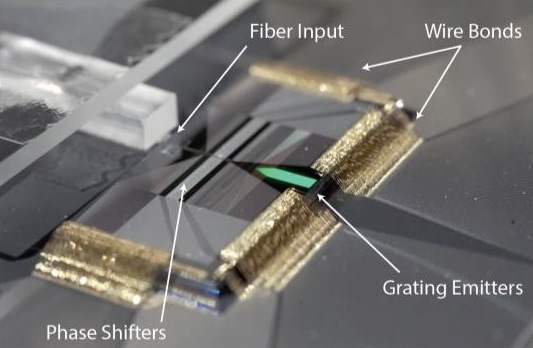
photonics testbed

The chip-based lidar in its test bed.

It’s even able to be manufactured in a normal fashion like other photonics chips. That’s a huge plus when you’re trying to move from research to product development.

With this first round of funding, the team plans to expand the team and get this tech out of the lab and into the hands of engineers and developers. The exact specs, dimensions, power requirements and so on are all very different depending on the application and industry, so Voyant can make decisions based on feedback from people in other fields.

In addition to automotive (“It’s such a big application that no one can make lidar and not look at that space,” Miller said), the team is in talks with numerous potential partners.

Although being at this stage while others are raising 9-figure rounds might seem daunting, Voyant has the advantage that it has created something totally different from what’s out there, a product that can safely exist alongside popular big lidars from companies like Innoviz and Luminar.

“We’re definitely talking to big players in a lot of these places, drones and robotics, perhaps augmented reality. We’re trying to suss out exactly where this is most interesting to people,” said Phare. “We see the evolution here being something like bringing room size computers down to chips.”

The $4.3 million raised by Voyant comes from Contour Venture Partners, LDV Capital, and DARPA, which naturally would be interested in something like this.


16 Jul 2019

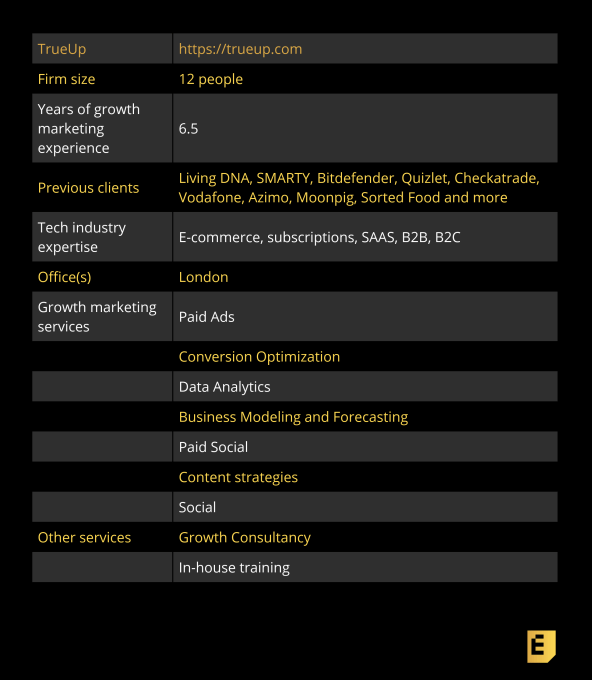
Verified Expert Growth Marketing Agency: TrueUp

It was the perfect storm when CEO and Founder Liam Reynolds finally decided to start TrueUp, a data-driven growth marketing agency/consultancy based in London. After decades of working for large creative advertising agencies, Liam quit his job right around the beginning of Silicon Valley’s growth hacking trend and plunged headfirst into running growth for early-stage startups.

TrueUp has since evolved from a one-man shop into an award-winning agency with a team of dedicated data, paid marketing and conversion specialists. Learn more about how they collaborate with clients and help them develop short- and long-term growth frameworks.

TrueUp’s approach to growth marketing:

“Rather than just saying ‘Look at these amazing results we’ve achieved,’ we would say, ‘Look, these are your growth opportunities, this is the process you need and here’s the framework unlock your true potential,’ We would build business models around this to show the opportunity in numbers, revenue and ROI.

Our approach to growth is anchored in delivering the right message to the right target audience in the right channel at the right time. It sounds simple but we’re amazed at how wrong people get this.

So we’ve created our own bespoke methodologies and frameworks to really explore and identify these hidden killer messages that drive action. We’ve built our own tools that allow us to do a lot of high-tempo, high-intensity testing.

It’s quite common that we have 500 to 600 tests running concurrently on Facebook for any given client. We’re continuously testing, learning, iterating, improving. As a result we’ve achieved some amazing results for our clients.”

Advice to founders:

“We approached True Up to help us establish and scale a UK paid marketing function. The team was highly professional from their initial pitch through the end of the project.” Maninder Saini, SF, International Operations Manager, Quizlet, Inc.

“For earlier stage startups, it’s to focus on achieving product-market fit and having awesome user experiences before worrying about growth. We worked with and mentored a lot of startups that immediately jump to, “Look I need to get X number of customers in X months.” However their products/services are often seriously lacking. This creates very weak foundations for growth. So their efforts would be better spent on creating products that genuinely meet a customer need. Once they’ve achieved product-market fit, it’s to communicate benefits not features. There’s always at least one killer message that cuts through but more often than not it’s hidden and not what the founders think it is. So a structured test program to explore this is also very much needed!”

designer fast facts 31

Below, you’ll find the rest of the founder reviews, the full interview, and more details like pricing and fee structures. This profile is part of our ongoing series covering startup growth marketing agencies with whom founders love to work, based on this survey and our own research. The survey is open indefinitely, so please fill it out if you haven’t already. 


Interview with TrueUp CEO & Founder Liam Reynolds

Liam photo

Yvonne Leow: Tell me about how you got into growth marketing and why you decided to start TrueUp.

Liam Reynolds: I started my career at a data marketing company called Dunnhumby. They were famous for managing the data science and intelligence behind TESCO’s Club Card, a very large loyalty program in the UK.

16 Jul 2019

Qualtrics’ Julie Larson-Green will talk customer experience at TC Sessions: Enterprise

We’re less than two months out from our first TC Sessions: Enterprise event, which is happening in San Francisco on September 5, and did you know our buy 1 get 1 free sale ends today too! Among the many enterprise and startup executives that’ll join us for the event is Qualtrics’ Julie Larson-Green. If that name sounds familiar to you, that’s most likely because you remember her from her 25 years at Microsoft. After a successful career in Redmond, Larson-Green left Microsoft in 2017 to become the Chief Experience Officer at SAP’s Qualtrics.

In that role, she’s perfect for our panel about — you guessed it — customer experience management.

Larson-Green joined Microsoft as a program manager for Visual C++ back in 1993. After moving up the ladder inside the company, she oversaw the launch of Windows 7 and became the co-lead of Microsoft’s hardare, games, music and entertainment division in 2013. At the time, she was seen as a potential replacement for then-CEO Steve Ballmer.

Later, during a period of reshuffling at the company in the wake of the Nokia acquisition, became the Chief Experience Officer of Microsoft’s My Life and Work group.

Larson-Green joined Qualtrics before it was acquired by SAP for $8 billion in cash. Qualtrics offers a number of products that range from customer experience tools to brand tracking and ad testing services, as well as employee research products for gathering feedback about managers, for example. At the core of its product is an analytics engine that helps businesses make sense of their employee and customer data, which in turn should help them optimize their customer experience scores and reduce employee attrition rates.


Our buy one get one free ticket deal ends today! Book a ticket for just $249 and you can bring a buddy for free. Book here before this deal ends.

We’re still selling startup demo tables, and each package comes with 4 tickets. Learn more here.

16 Jul 2019

China startup deals shrink as fundraising for investors plummets

Chinese startups continue to weather tough times as private investors, caught in a cash crunch, are concentrating money into fewer deals.

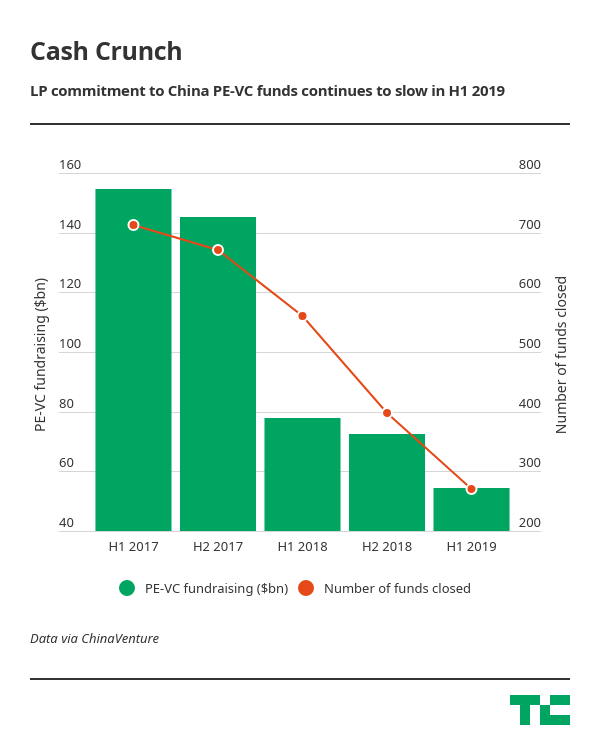
China’s deal-making activity for startups in the six months ended June halved from a year ago to 1910, according to data from consulting firm ChinaVenture’s research arm. The amount invested in domestic startups during the first half of 2019 plummeted 54% to $23.2 billion.

The slide in startup investment comes as the money behind the money shrinks amid a cooling economy in China that is exacerbated by a trade war with the U.S. Fundraising for investors was already showing signs of slowdown a year earlier. In the first half of this year, private equity and venture capital firms in China secured 30% less than what they had raised over the same period a year ago, amounting to a total of $54.44 billion. 271 funds managed to raise, down 52%.

vc funding china

That money from limited partners is also flowing to a small rank of investors. 12 institutions accounted for 57% of all the capital landed by VCs and PEs in the period. Investment coffers that have gotten a big boost include the likes of TPG Capital, Warburg Pincus, DCG Capital, Legend Capital, and Source Code Capital.

Healthcare was the most backed sector during the six months, although proptech startups scored the biggest average deal size. Some of the highest funded companies from the period were artificial intelligence chip maker Horizon Robotics, shared housing upstart Danke and China’s Starbucks challenger Luckin.

16 Jul 2019

Highlights from Facebook’s Libra Senate hearing

Facebook will only build its own Calibra cryptocurrency wallet into Messenger and Whatsapp, and will refuse to embed competing wallets, the head of Calibra David Marcus told the Senate Banking Committee today. Calibra will be interoperable so users can send money back and forth with other wallets, and Marcus committed to data portability so users can switch entirely to a competitor. But solely embedding Facebook’s own wallet into its leading messaging apps could give the company a sizable advantage over banks, PayPal, Coinbase, or any other potential wallet developer.

Other highlights from the “Examining Facebook’s Proposed Digital Currency and Data Privacy Considerations” hearing included Marcus saying:

  • The US should “absolutely” lead the world in rule-making for cryptocurrencies
  • “Yes” Libra will comply with all US regulations and not launch until the US lawmakers’ concerns have been answered
  • “You will not have to trust Facebook” because it’s only one of 28 current and potentially 100 or more Libra Association members and it won’t have special privileges
  • “Yes I would” accept his compensation from Facebook in the form of Libra as a show of trust in the currency
  • It is “not the intention at all” for Calibra to sell or directly monetize user data directly, though if it offered additional financial services in partnership with other financial organizations it would ask consent to use their data specifically for those purposes.
  • Facebook’s core revenue model around Libra is that more online commerce will lead businesses to spend more on Facebook ads

But Marcus also didn’t clearly answer some critical questions about Libra and Calibra.

Chairman Crapo asked if Facebook would collect data about transactions made with Calibra that are made on Facebook, such as when users buy products from businesses they discover through Facebook. Marcus instead merely noted that Facebook would still let users pay with credit cards and other mediums as well as Calibra. That means that even though Facebook might not know how much money is in someone’s Calibra wallet or their other transactions, it might know how much the paid and for what if that transaction happens over their social networks.

Senator Tillis asked how much Facebook has invested in the formation of Libra. TechCrunch has also asked specifically how much Facebook has invested in the Libra Investment Token that will earn it a share of interest earned from the fiat currencies in the Libra Reserve. Marcus said Facebook and Calibra hadn’t determined exactly how much it would invest in the project. Marcus also didn’t clearly answer Senator Toomey’s question of why they Libra Association is considered a not-for-profit organization if it will pay out interest to members.

The hearing is ongoing and we’ll continue to update this article with more highlights

16 Jul 2019

Echo Dot and Fire TV Stick are again Prime Day’s best selling devices (so far!)

Amazon Prime members again snapped up loss leaders like the Echo Dot and Fire TV Stick with Alexa Remote on the first day of Amazon Prime Day 2019, which has now been stretched out to a 48-hour sale. This is the third year in a row that the entry-level Alexa smart speaker, the Echo Dot, has been a Prime Day bestseller. The Fire TV Stick was a top seller last year, too, and sold well in years past — including in 2016, when it emerged at the overall best-selling device globally on Prime Day.

Amazon never provides hard numbers on Prime Day sales, but claims “millions” of these devices — the Echo Dot and Fire TV Stick combined — were sold on Monday to customers worldwide during the first day of Prime Day 2019.

Last year, Amazon claimed customers bought “millions” of Fire TV Stick devices alone, for comparison’s sake.

The retailer also said this morning that U.S. shoppers saved “millions” on Prime Day sales on Monday. This includes other bestsellers like the Instant Pot DUO Plus 60 6 Qt, LifeStraw Personal Water Filter, and Crest 3D White Professional Effects Whitening Strips. The Instant Pot and LifeStraw filter were also two of the non-Amazon top sellers last Prime Day, which says something about the consistency of this sales event as it enters its fifth year.

Though Amazon didn’t officially list the Echo Dot in its round-up of July 15 Prime Day sales, the smart speaker had already been discounted to its then lowest price ever of $24.99 (half off list) before Prime Day even started. As the event kicked off, it dropped again to $22.

echo show 5

Today, Amazon is keeping the Echo Dot at $22 but is sold out of Charcoal, leaving only the lighter sandstone color available for purchase.

Other notable Day 2 Prime Day deals include:

A $49.99 Echo Show 5 (the smaller, more compact revamp of the Alexa speaker with a screen); savings of up to $140 on Fire TV Edition smart TVs; the $14.99 Fire TV Stick with Alexa Remote; a $59.99 Fire 7 Kids Edition tablet (or 2 for $99.98); and the $139 Ring Video Doorbell 2.

A list of the announced Prime Day, day 2 deals are below:

Amazon Devices:

  • $27.99 off Echo Dot, $22
  • $40 off the all-new Echo Show 5, $49.99
  • $25 off Fire TV Stick with Alexa Voice Remote, $14.99
  • Save up to $140 on Fire TV Edition Smart TVs
  • $20 off the all-new Fire 7 tablet, just $29.99, or get two for $49.98—a $50 savings
  • $40 off all-new Fire 7 Kids Edition tablet, just $59.99, or get two for $99.98—a $100 savings
  • $60 off Ring Video Doorbell 2, $139
  • Save up to $200 on eero WiFi systems
  • Save up to $50 on Kindle Paperwhite, plus get a $5 eBook credit and three months free Kindle Unlimited

Amazon Brands and Exclusives:

  • Save up to 50% on kids and baby styles from Simple Joys by Carter’s, LOOK by crewcuts, Spotted Zebra, and Amazon Essentials
  • Save up to 30% on furniture and décor from Rivet, Stone & Beam, and Ravenna Home

Electronics:

  • Save up to 25% on select Canon Mirrorless and DSLR cameras
  • Save up to 30% of select Sony and Samsung TVs

Apparel:

  • Save up to 40% off Ray-Ban sunglasses
  • Up to 50% off Dockers clothing and more
  • Deep discounts on Champion hoodies and Herschel Little America backpacks

Smart Home:

  • Save up to 50% off select Sony LED Smart TVs
  • Save up to 30% on Tile
  • Save up to 30% on iRobot Robotic Vacuums

Home, Kitchen & Furniture:

  • Save up to 30% on Blue Pure Air Purifier
  • Save on select Winix Air Purifiers
  • Save on Hoover ONEPWR vacuums
  • Save on Philips XXL Air Fryer
  • Save 30% on Keurig K-Café Single-Serve Coffee Maker
  • Save 30% on Crock Pot 6qt Slow Cooker
  • Save up to 30% on Brother Sewing Machines
  • Save on Philips Smoke-less Indoor BBQ Grill
  • Save up to 35% on Dash Egg Cookers

Toys & Games:

  • Save 30% on games from What Do You Meme?
  • Save up to 40% on select toys and games including favorites from LEGO and Melissa & Doug

Video Games:

  • Save up to 50% on Astro A40 TR headset

Tools & Home Improvement:

  • Save up to 30% on CRAFTSMAN power tools

Lawn & Garden:

  • Save up to 35% on Greenworks yard equipment

Sports & Outdoors:

  • Save up to 20% on Skywalker 15’ Jump and Dunk trampolines
  • Save 20% on Bushnell Trophy trail camera
  • Save 20% on Marvel Spiderman kids bikes

Automotive:

  • Save up to 30% on Pennzoil Motor Oil
  • Save up to 30% on NOCO Jump Starters and Battery Chargers


16 Jul 2019

Quirk wants to make cognitive behavioral therapy more accessible

Quirk, a YC-backed company, is looking to bring cognitive behavioral therapy (CBT) to more people suffering from anxiety or depression.

CBT aims to lessen or stop harmful behavior by changing the way people think, stopping them from falling into established patterns of negatively distorting their reality to justify or account for unhelpful habits.

“CBT has 40 years of research behind it,” says CEO and founder Evan Conrad. “I’ve had severe panic attacks my whole life and saw different therapists who tried what I now know is CBT. I assumed it was a pseudo science. It wasn’t until 10 months ago that I re-discovered CBT on my own and learned about its efficacy. It’s the gold standard.”

The app helps users practice one of the most common exercises in CBT: the triple-column technique.

Here’s how it works:

Users jump into the app whenever they have anxiety or a depressive thought to record it. They then identify any distortions that apply to that thought, such as Catastrophizing, Magnification of the Negative, Fortune Telling, or Over-Generalization, among others. From there, the user can challenge the thought with reasons why that thought might have been illogical to begin with. Finally, the user replaces the thought with something more reasonable.

For example, if I was worried about not getting a response to a text, I might believe (irrationally) that it has something to do with how that person feels about me, rather than the more obvious explanation: they’re just busy.

The hope of CBT is that identifying thought distortions, and manually replacing them with beliefs grounded in reality retrains the brain to experience the world in a realistic way and relieves patients from their depression and/or anxiety.

Conrad says that he went from having two anxiety attacks a week to two every six months.

The problem that Quirk is trying to solve is two-fold. First, people may not know the benefits or the empirical data supporting CBT. Secondly, the process of manually recording this on pen and paper can be more tedious and feel less private out in a public space.

Quirk’s attempt to solve these problems is to make CBT accessible to more people and to make the process of doing CBT slightly more private.

We asked Conrad about the potential negative affects of practicing CBT without the oversight of a mental health professional.

“As for self-administered CBT, we’ve run this by a number of therapists and all of them have said it’s generally a net-benefit,” Conrad said via email. “What would be harmful is if someone with a severe condition decided that they should use Quirk instead of seeing a therapist. But in practice we’ve seen the opposite effect. People who would have otherwise done nothing about their condition use Quirk as ‘first step’ towards therapy or will use Quirk when they would otherwise have no option (either because their isn’t a treatment in their country/area or because they can’t afford it).”

Dr. Daniel A. Fridberg, a practicing CBT psychiatrist from the University of Chicago, says that the triple-column technique is a great CBT exercise, but that it’s just part of the whole package of Cognitive Behavioral Therapy. He also said that the only way to know if a product like this can do harm is through a study, but that CBT itself is an evidence-based psychotherapy and has been proven effective.

“CBT is an effective, time-limited, reasonably cost-effective psychotherapy for things like depression, anxiety, substance abuse, etc,” said Dr. Fridberg. “The problem is that finding a good CBT therapist who delivers evidence-based treatment isn’t always easy in smaller communities where there isn’t easy access to a research hub. In some respects, an app that is packaged in an attractive way, gets people’s attention and promotes CBT as effective is a good thing.”

Dr. Fridberg also stated that anyone suffering from an issue that’s disrupting their day-to-day functioning should seek professional help.

Conrad says that he hopes Quirk can be a jumping off point for folks suffering from anxiety and depression, with the app suggesting that those suffering seek professional help in conjunction with using the app. He also shared that Quirk hopes to be able to connect users to professionals in their area as soon as they have the scale to do so.

Quirk costs $4/month for users.

16 Jul 2019

Aavgo security lapse exposed hotel bookings

A security lapse at a hotel management startup has exposed hotel bookings and guests’ personal information.

The security lapse was resolved Monday after TechCrunch reached out to Aavgo, a hospitality tech company based in San Francisco, which secured a server it had left online without a password.

The server was open for three weeks — long enough for security researcher Daniel Brown to find the database.

He shared his findings exclusively with TechCrunch, then published them.

Aavgo bills itself as a way for hotels to organize their operations by using several connected apps — one for use by guests using tablets installed in their hotel rooms for entertainment, ordering room service and checking out, and another for staff to communicate with each other, file maintenance tickets and manage housekeeping.

Several large hotel chains, including Holiday Inn Express and Zenique Hotels, use Aavgo’s technology in their properties.

The database contained daily updating logs of the back-end computer system. Although most of the records were logs of computer commands critical to the running of the system, we found within personal booking data — including names, email addresses, phone numbers, room types, prices, the location of the hotel and the room and the dates and times of check-in and check-out.

There was no financial information in the database beyond the credit card issuer.

The database also contained room service orders, guest complaints, invoices and other sensitive information used for accessing the Aavgo system, the researcher said.

Many of the records were related to its corporate hotelier customers.

One of those customers included Guestline, a property management company for hoteliers, which uses Aavgo as the underlying technology for its property management system. Guestline says it facilities 6.3 million bookings a year.

When reached, Guestline’s data protection officer James Padkin said data protection is of “paramount importance” and the company has “ceased our very limited trial of the AavGo housekeeping app.”

After the company failed to respond to the researcher’s initial email, Aavgo shut down the database a few hours after TechCrunch made contact with its chief executive, Mrunal Desai.

“We had no data breach; however, we did find a vulnerability,” said Desai. He said data on 300 hotel rooms was exposed. Brown said based on his review of the data, however, that the number is likely higher. Desai added that the company has “already started informing our customers about this vulnerability.”

Midway during our correspondence, Desai copied the company’s outside counsel, a Texas-based law firm, which threatened “immediate legal action” ahead of publishing this report.

Aavgo becomes the latest hospitality company embroiled in a hotel-related security incident in recent years.

In 2017, hotel booking service Sabre confirmed a seven-months long data breach of its SynXis reservation system, affecting more than 36,000 hotels globally and millions of credit cards.

A year later, Marriott-owned Starwood admitted a breach that affected up to 383 million hotel guests around the world. Earlier this month U.K. authorities said they would fine the company $123 million for the breach under the new GDPR regime, which affected about 30 million customers in the European Union.

Read more:

16 Jul 2019

Apply to TC Top Picks before the deadline & exhibit free at Disrupt SF 2019

Does your company have what it takes to be part of an elite cadre of early-stage startups and exhibit for free at Disrupt San Francisco 2019? There’s only one way to know for sure, but time is running out. Apply to be a TC Top Pick now — before the application window closes for good at 5:00 p.m. (PT) on July 19.

Why should you apply? For starters, it doesn’t cost anything, and all TC Top Picks receive a free Startup Alley Exhibition Package good for one full day of exhibiting in Startup Alley, the heart of every Disrupt. It’s the intersection of tech present and tech future — where more than 1,200 pre-Series A startups and sponsors exhibit their products, platforms and services. It’s a breeding ground of opportunity, and you never know who you might meet and where that connection might lead.

TechCrunch editors vet all applications and choose up to five startups in each of these (and only these) tech categories: AI/Machine Learning, Biotech/Healthtech, Blockchain, Fintech, Mobility, Privacy/Security, Retail/E-commerce, Robotics/IoT/Hardware, SaaS and Social Impact/Education.

TC Top Picks also receive three Founder passes and plenty of other perks, starting with the VIP treatment. You’ll exhibit in a dedicated space within Startup Alley, and we promote the Top Pick startups in our pre-conference marketing. Everyone wants to see who made the cut, including journalists covering the show and investors looking to add to their portfolios.

In a classic “but wait, there’s more” moment, a TechCrunch editor conducts a live interview with each Top Pick on the Showcase Stage in Startup Alley. We record the interviews for posterity and promote them across our social media platforms. That’s the kind of marketing tool that keeps on giving.

Take a page from DiaMonTech’s playbook. The company, the maker of a non-invasive glucose monitoring device, earned a Top Pick designation for Disrupt Berlin 2018. Markus Teuber, head of strategic partnerships, had this to say about the Top Pick experience.

“Exhibiting as a TC Top Pick helped us build credibility right away, and it still pays off during pitches as an anchor point for further discussion. The interview and media coverage helped us generate awareness for our groundbreaking approach, and it also helped us identify leads and build substantial cooperation agreements.”

Pro Tip: Every startup that exhibits in Startup Alley has a shot to win a Wild Card entry to Startup Battlefield. Yet another great reason to apply to be a TC Top Pick.

Disrupt San Francisco 2019 takes place October 2-4. Don’t miss out on this opportunity to place your startup in the Disrupt spotlight. Apply to be a TC Top Pick before the deadline clocks out precisely at 5:00 p.m. (PT) on July 19. Show us what you’ve got!

Is your company interested in sponsoring or exhibiting at Disrupt San Francisco 2019? Contact our sponsorship sales team by filling out this form.