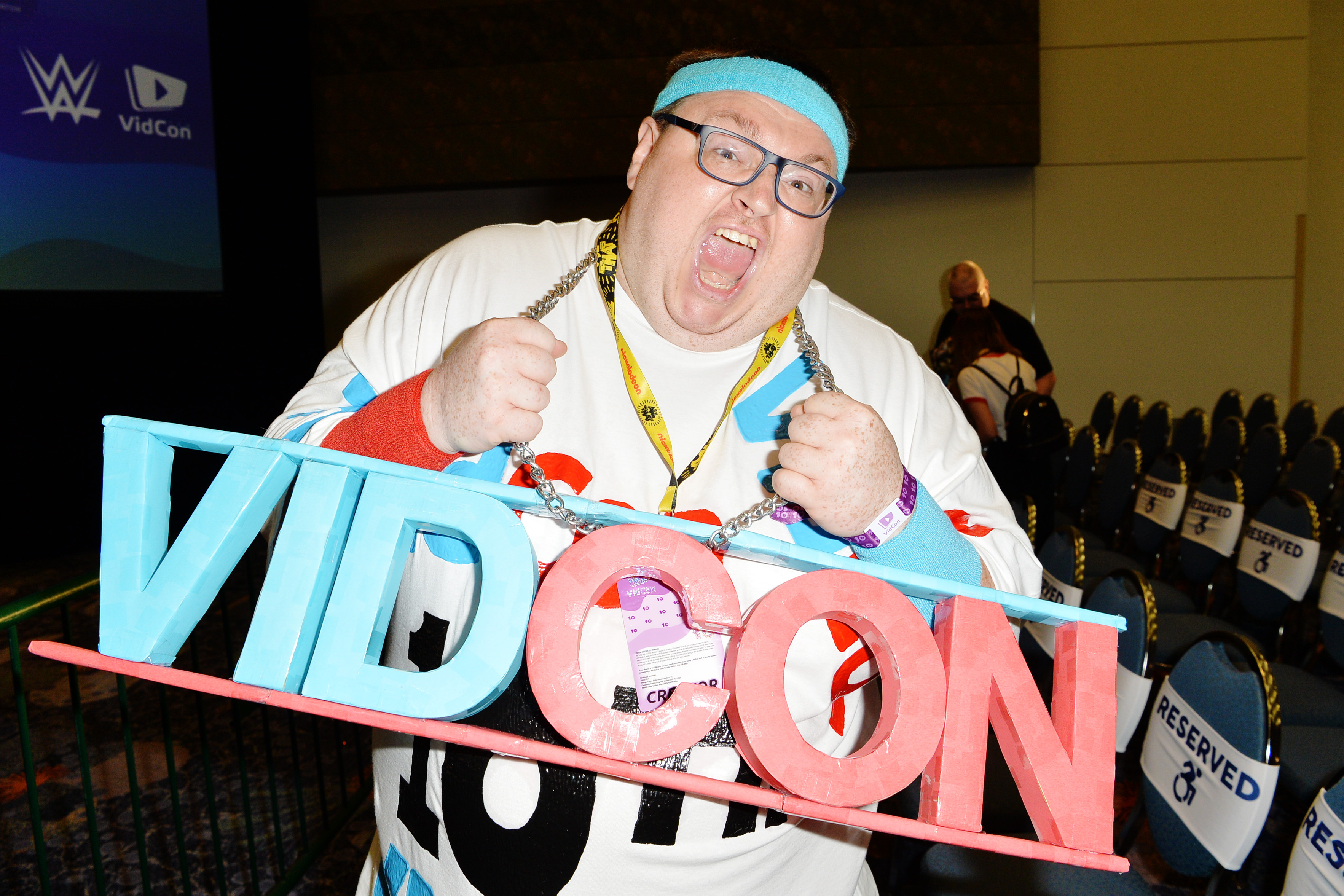
VidCon, the annual summit in Anaheim, CA for social media stars and their fans to meet each other drew over 75,000 attendees over last week and this past weekend. A small subset of those where entertainment and tech executives convening to share best practices and strike deals.
Of the wide range of topics discussed in the industry-only sessions and casual conversation, five trends stuck out to me as takeaways for Extra Crunch members: the prominence of TikTok, the strong presence of Chinese tech companies in general, the contemplation of deep fakes, curiosity around virtual influencers, and the widespread interest in developing consumer product startups around top content creators.
Newer platforms take center stage
Photo by Jerod Harris/Getty Images
TikTok, the Chinese social video app (owned by Bytedance) that exploded onto the US market this past year, was the biggest conversation topic. Executives and talent managers were curious to see where it will go over the next year more than they were convinced that it is changing the industry in any fundamental way.
TikTok influencers were a major presence on the stages and taking selfies with fans on the conference floor. I overheard tweens saying “there are so many TikTokers here” throughout the conference. Meanwhile, TikTok’s US GM Vanessa Pappas held a session where she argued the app’s focus on building community among people who don’t already know each other (rather than being centered on your existing friendships) is a fundamental differentiator.
Kathleen Grace, CEO of production company New Form, noted that Tik Tok’s emphasis on visuals and music instead of spoken or written word makes it distinctly democratic in convening users across countries on equal footing.
Esports was also a big presence across the conference floor with teens lined up to compete at numerous simultaneous competitions. Twitch’s Mike Aragon and Jana Werner outlined Twitch’s expansion in content verticals adjacent to gaming like anime, sports, news, and “creative content’ as the first chapter in expanding the format of interactive live-streams across all verticals. They also emphasized the diversity of revenue streams Twitch enables creators to leverage: ads, tipping, monthly patronage, Twitch Prime, and Bounty Board (which connects brands and live streamers).
The Daily Crunch is TechCrunch’s roundup of our biggest and most important stories. If you’d like to get this delivered to your inbox every day at around 9am Pacific, you can subscribe here.
While Uber is still predominantly white and Asian, the company has made notable headway in the representation of black and Latinx people among its employees.
As for those goals, Uber says that in the next three years, it aims to increase the percentage of women at levels L5 and higher (i.e. manager and above) to 35%, and increase the percentage of underrepresented employees at levels L4 and higher to 14%.
With Waze, you can find out the amount you’ll need to pay — sourced from its community of user-drivers, rather than direct from the official toll road operators.
Amperity says that in 2018, its annual recurring revenue grew 355% year-over-year. Although the startup only launched in 2016, it’s already signed up an impressive roster of customers, like Starbucks, Gap Inc., TGI Fridays and Planet Fitness.
Jon Evans looks at the “techlash,” arguing that people are particularly angry at the tech industry because they view it as the last engine of power that actually might change.
The real issue, according to Mahmee co-founder Melissa Hanna, is that “the data is fragmented.” She says this is why she built a network to get new moms the support they need — from their community, other moms and medical providers.
The deal, which was announced in October, was expected to take a year to clear all of the regulatory hurdles, but U.S. and EU regulators moved surprisingly quickly. For IBM, the future starts now. (Extra Crunch membership required.)
On Equity, the team offers an overview of the last two quarters of IPOs. Meanwhile, Original Content reviews the underwhelming Netflix thriller “Point Blank.”
A report from Adobe’s analytics arm predicts Amazon’s Prime Day 2019 sales event, which began today, to have another sizable impact on the U.S. e-commerce market. The company expects a revenue lift for top retailers — those with over $1 billion in online sales — to reach 79% this year, up from the 60% lift they sale during Prime Day 2018. And it says that Prime Day will become the third time outside the holiday season that U.S. e-commerce spending will top $2 billion, as it previously did on Labor Day 2018 and Memorial Day 2019.
“We attribute this growth in sales to the fact that the big e-commerce competitors have become better at reaping the benefits of this artificial holiday,” said Taylor Schreiner, principal analyst at Adobe Digital Insights (ADI). “After all, they’ve now had almost five years of practice in converting Prime Day traffic.”
The $2 billion figure includes Amazon, Adobe says, but is limited to U.S. e-commerce sales.
However, Prime Day itself now runs across a number of international markets, including for the first time, the United Arab Emirates, alongside the U.K., Spain, Singapore, Netherlands, Mexico, Luxembourg, Japan, Italy, India, Germany, France, China, Canada, Belgium, Austria, and Australia.
Top Amazon rivals like Walmart, Target, eBay, Best Buy and others, are running their own sales today, as are many e-commerce retailers. In fact, an earlier report from RetailMeNot predicted that, this year, 250 retailers will compete with Amazon on Prime Day. That’s up from 194 last year and up from just 7 on the first Prime Day in 2015.
eBay, in particular, went a little dirty with its counter sale, calling it a “Crash Sale” — a reference to how Amazon.com tanked on Prime Day 2018.
But that branding has paid off — according to the latest from website monitoring firm Catchpoint, Amazon has not had stability issues as of yet. The firm has been tracking Amazon’s desktop and mobile websites since 3 AM ET today, and as of 10 AM ET reports no problems. It even found that the average website load times are just as fast as last week when there was no sale.
That either speaks to big improvements to site stability to address last year’s issues, or perhaps a decline in consumer interest in Prime Day 2019 — perhaps because one of Prime Day 2018’s top-sellers, the Echo Dot, had a huge price cut before Prime Day began to $24.99. (Now it’s $22 for Prime Day.) We won’t know until the reports roll in later in the day, and after the sales event wraps.
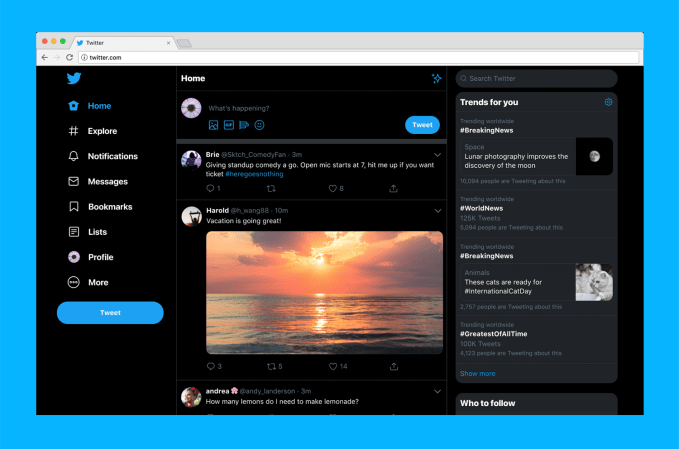
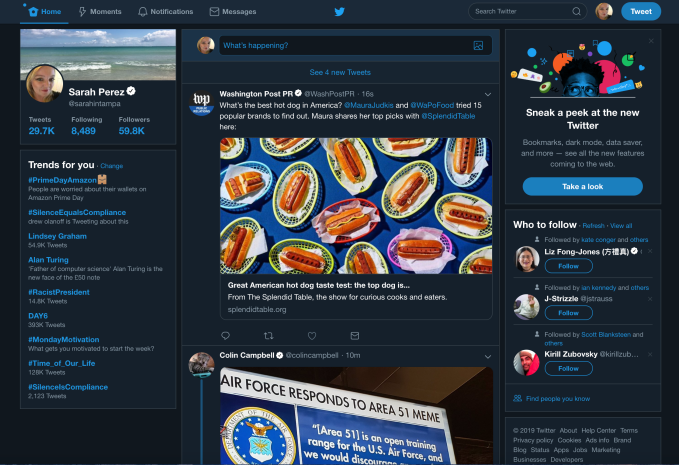
Twitter’s website is getting a major overhaul. The company has been testing a new version of its desktop website since the beginning of the year, and today the final product is rolling out to the public. The upgraded experience simplifies navigation with a new — and fairly large — left-hand sidebar that directs you to all of Twitter’s key sections, including Notifications, Direct Messages, Explore, Bookmarks, Lists, and more. The site also features an expanded, more inbox-like Direct Messages screen where you can view and respond to conversations in one place; plus easy profile switching, support for more themes, advanced search, and other features.
The popular dark modes, Dim and the very black Lights Out mode, are now supported along with more ways to personalize Twitter through different themes and color options.
But the most noticeable change is the organization and layout of the Twitter home screen itself.
Below: the old Twitter.com
Below: the new Twitter.com
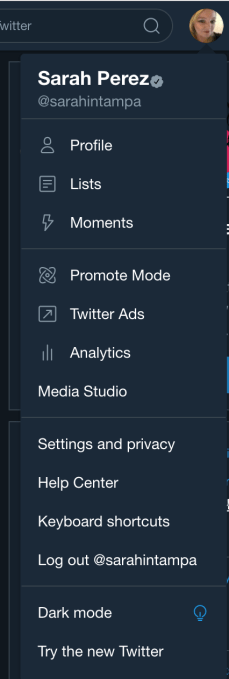
The update is designed to make it easier to move around Twitter. Before, you’d have to click on your Profile icon to access features like Lists, Themes, Settings, and other options. Meanwhile, getting to Moments was available both in this Profile dropdown menu and in the main Twitter navigation at the top of the screen, next to Notifications and Messages.
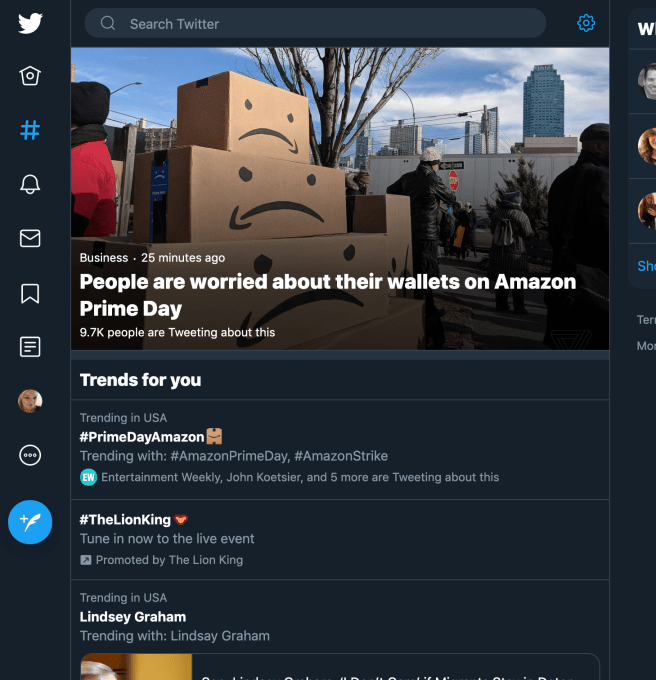
Now, Moments is being downgraded to the “More” menu in the redesign — as seen in a test running earlier this summer — and Explore instead gets the top billing. As on mobile, Explore will direct users to more live videos and personalized local moments, says Twitter. This is also where you’ll find Top Trends, while Personalized Trends will be featured on the right-hand sidebar on the home screen. (See above).
With the update, the new navigation menu includes: Home, Explore, Notifications, Messages, Bookmarks, Lists, Profile, and then More — the latter, a menu where you’ll find things like Moments, Twitter’s ad tools, Settings, and other features.
The new Compose feature has been slightly tweaked as well, with options to include a photo, GIF, poll or emoji now all in the bottom left — with the emoji button now swapping in for the location button, following Twitter’s decision to make sharing precise location less of a priority, given its lack of use.
Though the new home screen is arguably better-organized, the navigation text itself and the amount of screen real estate it takes up is overly large.
This detracts somewhat from the main content — the tweets themselves — because your eye is naturally drawn to the oversize navigation labels at first, not the posts flowing in the timeline. This can also be a jarring change to get used to for longtime Twitter.com users. (Good thing there’s a new Mac desktop app on the way.)
If you really can’t stand the navigation labels’ size, you can make the webpage smaller which then hides the text labels of the navigation items, leaving only their icons. This, unfortunately, isn’t all that useful if you like to keep Twitter open in a tab alongside all your other tabs. It works better if you pop out Twitter.com into its own window.
The navigation changes were likely a design choice Twitter made, in part, to simplify the use of its product by more casual users and newcomers.
The company has struggled with user growth throughout its history, even changing how it reports metrics to paint a better picture of its business. Now, you’d have to be almost completely web illiterate to not find your way around the new Twitter.com. But only time will tell what effect this has on growing its user base.
Not all the changes will be as controversial as the new layout, though.
For example, the now double-paned Direct Message section is more welcome as it makes using Messages feel more like the real inbox it often is — with the message list on the left and conversations on the right.
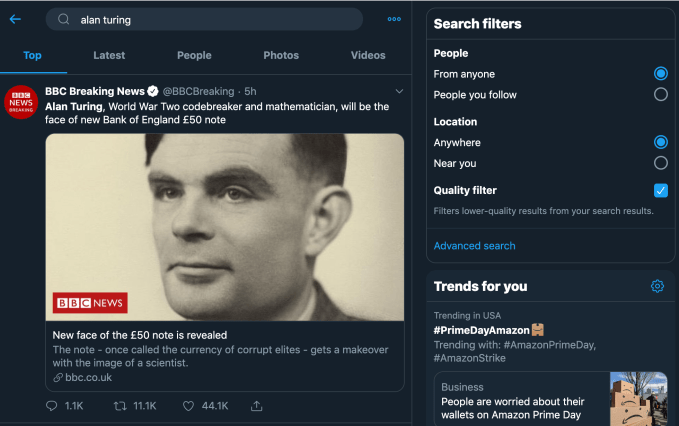
Search got an update, as well, which puts tabs for moving between “Top,” “Latest,” “People,” “Photos,” and “Videos” at the top of the screen, with Advanced Search Filters to the right.
And for those with multiple Twitter accounts, you can now switch between them from the main navigation. That’s helpful.
Twitter’s tests of the updated design had been rolling out to more people throughout the year — it even tried two different versions for a time. Throughout this process, the company incorporated some of the user feedback it received. For example, the changes to the Messaging screen and the high priority given to Bookmarks were among the requests Twitter addressed.
But generally speaking, Twitter was aiming to deliver a more consistent, seamless experience across both the phone and the web platforms with this update, a company spokesperson told us.
There’s some bad news for old school Twitter.com users — as of this public launch of the redesign, there’s no option for going back to the legacy experience, as there was during the testing period.
Twitter says the upgraded look will begin rolling out globally starting today.
The first mid-engine Chevrolet Corvette will have a familiar name. The 2020 Chevrolet Corvette will debut as a “Stingray” when it’s revealed July 18.
If that sounds familiar, it is. Numerous Corvette model years have been dubbed Stingray, beginning in 1963 with the second generation of the sports car.
The 2020 Chevrolet Corvette will debut as a Stingray on July 18, 2019.
The Stingray nameplate ran until 1976. GM’s Chevrolet brand brought the name back in 2014 with the seventh generation Corvette. Chevrolet announced Monday that “Stingray name will live on.”
For weeks now, Chevrolet has been trickling out news and other teasers about its eighth generation Corvette. Earlier this month, the brand showed off the steering wheel of the next generation Corvette.
The leathered-wrapped steering wheel has the Corvette crossed flags logo as the centerpiece with two spokes. Controls are integrated into the wheel. The steering wheel has a squared-off shape with a rather large opening, which suggests that designers wanted to provide a proper view to a large digital cluster.
Brave Care is an urgent care facility for pediatric care that costs, on average, about 80% less than a pediatric ER visit. Darius Monsef and his co-founder came up with the idea shortly after a fateful week for the Monsef family, during which their four-year-old dove off a bike ramp and their one-year-old started having breathing problems.
For both visits, he went to a pediatric urgent care facility where his kids were thoughtfully and patiently treated by Dr. Corey A. Fish. Monsef and Fish went to coffee a couple of weeks later, and Fish revealed he wanted to build out more pediatric urgent cares but needed a business partner.
The duo brought on a COO, Maryam Taheri, and a CTO, Asa Miller, and Brave Care was born.
It’s no surprise that parents are quick to pull the trigger on an emergency room visit when their kid is hurt or injured. But ER visits are incredibly expensive, leaving caring parents in a punishing situation.
The idea behind Brave Care is to provide a service that fits in between a child’s regular doctor and the emergency room.
“We don’t want the treatment of an injury or illness to be more traumatic than how you got it,” said Monsef.
Brave Care is built specifically for children, meaning that the waiting rooms are kid-friendly and the medical instruments are kid-sized and not intimidating. Plus, Brave Care goes the extra step to make sure little patients aren’t afraid, whether that means numbing gels for injections or offering medicine in liquid form.
For now, Brave only has one location, in the Portland area, but the vision is to expand the brand to many locations across the country. Brave also wants to introduce a triage tool to help parents at home who are making difficult decisions about what to do with a sick or injured kid.
“One thing parents often do is they try to Google for whatever symptom or problem their kid is having,” said Monsef. “And searching for a problem is pretty awful because search engines are trained to return the most interesting result, and I don’t want that. That’s terrifying. What I want is to reasonably narrow down the area of the problem so I can find a better answer.”
He went on to explain that sometimes it can be very difficult to search a symptom without the right terminology. For example, how do you describe a certain type of cough?
In the near future, Brave Care wants to introduce a self-guided triage tool for parents looking to understand the basics of the issue so they can make informed decisions on where they need to go, what they need to do and how urgently they need to do it.
[gallery ids="1855579,1855580"]
The triage product is currently in development and will launch soon.
Eventually, Monsef sees the opportunity to introduce an asynchronous telemedicine product, which would combine in a HIPAA-compliant messaging system the data collected from the self-serve triage tool with pictures and videos provided by the parent.
That said, Monsef believes that fully remote telemedicine leads to overprescription of antibiotics and says Brave Care will stay away from remote-only care in the short term.
“Without the right device in a consumer’s hand, there isn’t much we can do remotely,” said Monsef. “We can’t look in the ear or throat, or listen to the heart. But as consumers get more of these devices, we can improve remote care for kids.”
For now, however, Brave Care is simply focused on providing the best possible care to patients in its Portland facility.
Brave Care is in the current Y Combinator class and has raised a total of $1.45 million in funding.
Welcome to this transcribed edition of The Operators. TechCrunch is beginning to publish podcasts from industry experts, with transcriptions available for Extra Crunch members so you can read the conversation wherever you are.
The Operators highlights the experts building the products and companies that drive the tech industry. Speaking from experience at companies like Airbnb, Brex, Docsend, Edmodo, Facebook, Google, Lyft, Mint, Slack, Uber, WeWork, etc., these experts share insider tips on how to break into fields like design and enterprise sales. They also share best practices for entrepreneurs to hire and manage experts in fields outside their own.
This week’s edition features Gülay Birand, UX Lead and Product Design Manager at Facebook, and Tim Rechin, Head of Design at Edmodo, the leading education technology company. Gülay and Tim share their experiences and explain design, UI/UX, how to build a career in these fields, and how entrepreneurs should think about them.
Gülay and Tim bring experience from other great companies including Google, Amazon, Mint, and SAP. Having seen and grown in their disciplines from a variety of companies and customer types, they share deep insight from across tech.
Neil Devani and Tim Hsia created The Operators after seeing and hearing too many heady, philosophical podcasts about the future of the world and the tech industry, and not enough attention on the practical day-to-day work that makes it all happen.
Tim is the CEO & Founder of Media Mobilize, a media company and ad network, and a Venture Partner at Digital Garage. Tim is an early-stage investor in Workflow (acquired by Apple), Lime, FabFitFun, Oh My Green, Morning Brew, Girls Night In, The Hustle, Bright Cellars, and others.
Neil is an early-stage investor based in San Francisco with a focus on companies solving serious problems, including Andela, Clearbit, Recursion Pharmaceuticals, Vicarious Surgical, and Kudi.
If you’re interested in becoming a designer, doing UI/UX research, furthering your career in that field, or starting a company and don’t know when to hire or how to manage this discipline, you can’t miss this episode!
The show:
The Operators highlights the experts building the products and companies that drive the tech industry. Speaking from experience at companies like Airbnb, Brex, Docsend, Edmodo, Facebook, Google, Lyft, Mint, Slack, Uber, WeWork, etc., these experts share insider tips on how to break into fields like design and enterprise sales. They also share best practices for entrepreneurs to hire and manage experts in fields outside their own.
In this episode:
In Episode 3, we’re talking about design and UI/UX. Neil interviews Gülay Birand, UX Lead and Product Design Manager at Facebook, and Tim Rechin, Head of Design at Edmodo.
Neil Devani: Hello and welcome to The Operators, where we talk to the people building the companies of today and tomorrow. We publish every other Monday and you can find us online at Operators.co.
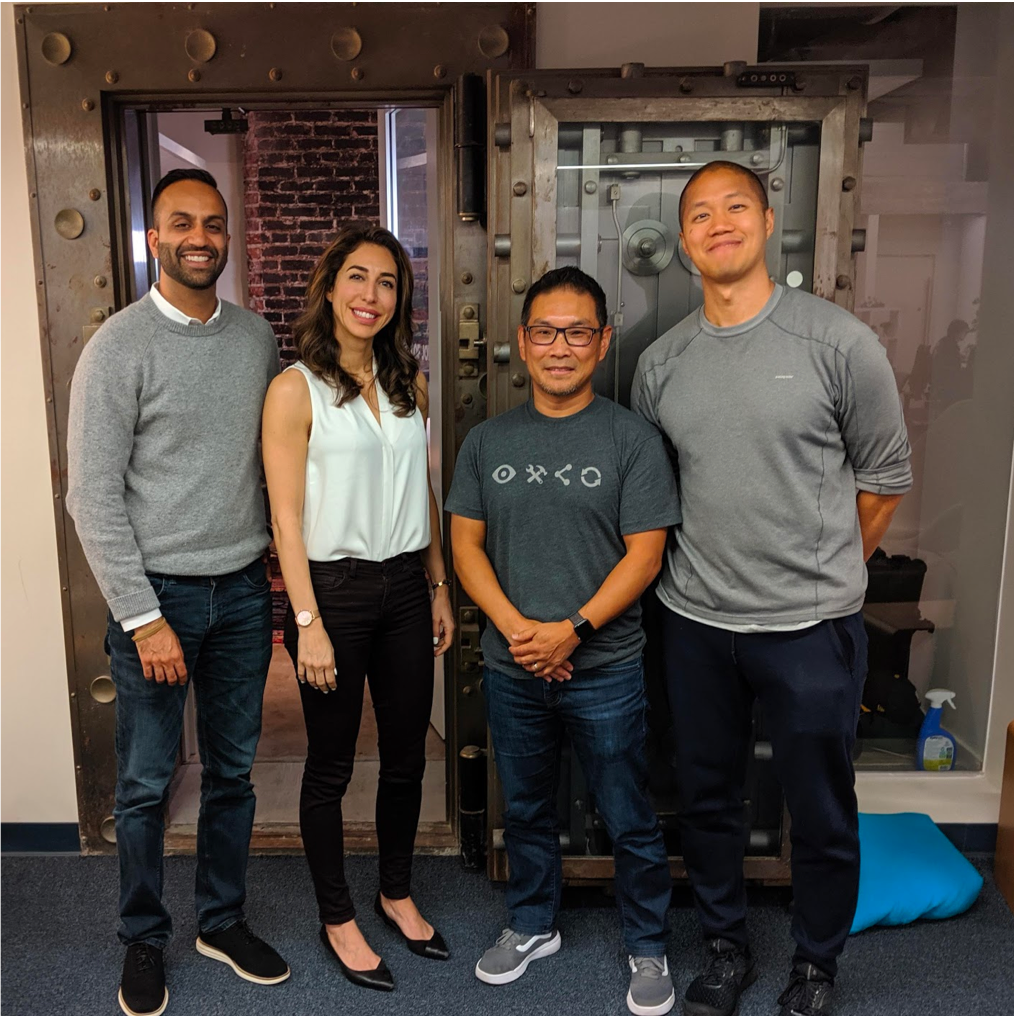
Today’s episode is very special, we are talking to two UI/UX experts who have designed and researched products that have been touched by billions of people. I’m your host, Neil Devani and we’re coming to you today from the Vault of Joi here at Digital Garage in downtown San Francisco.
Joining me is Tim Rechin, Head of Design at Edmodo, the leading classroom and education community with 100 million users globally. Also joining us is Gülay Birand, a UX lead and product design manager at Facebook.
Gülay works on the newsfeed product used by billions of people every day. Thank you for joining us, if you could tell us more about yourselves and your work it would be great to hear more.
Gülay Birand: Thank you, my name is Gülay Birand. I’m a product design manager at Facebook . I’ve been at Facebook for about three months. Prior to that I was at Google for about 8 years, and I led a horizontal team on Google Cloud Platform for about four years, leading growth and engagement, support, and product excellence initiatives.
Prior to that I did a bit of a tour to Google, so I worked on search, identity, a couple of other areas like mobile ads, and before that I was at T-Mobile where I was building mass market and franchise home experiences, mainly on Android. And prior to that I was at Amazon leading experiences for the very first Kindle, so that was a lot of fun.
Devani: And Tim tell us more about yourself and how you got here.
Tim Rechin: Yeah, so I’m currently at Edmodo, leading up design and that’s really across the entire platform that serves our teachers, students and parents in the US and globally. And before Edmodo, I was at Facebook, and I was on the Feed Ads team and responsible for the lead ads product that we launched that year. Before that I was at Mint, so doing personal finance and some of you may be using Mint.
Devani: I’m definitely using Mint, its great, I love it.
Rechin: And then before that SAP, Yahoo, eBay, and then Elance very early on which is now Upwork.
Devani: Very cool, all companies that I’ve used, products that I enjoy, thank you for helping create them.
Birand: Thank you.
Devani: So it’d be great if you could tell folks more about what you do every day. Who are the folks in your company that you are interacting with, what are your responsibilities, what does it mean to do the job that you do?
Rechin: That’s a good question, it’s a bit mixed. Just for some context, Edmodo is a company a little over 100 people and so our product teams are in the 6-7 product managers range. I lead a team of 3 designers. So my day to day is really getting to work and really trying to figure out what’s going on, so this year is a particularly busy year as we get ready for back to school.
And so we have a lot of concurrent projects going, so one of the things I like to do when I get in is level set, kind of see how my day is and I’ll go check in with the different teams. That’s part of the work I do, working with the different product teams and the strategy.
So like I said, we are working on lots of different projects, so it’s really just keeping everyone aligned and making sure that designers are delivering things on time, that any issues or gaps are being filled and we can go answer those questions that are coming from product managers and designers. In some cases too, there is a project that is about to be kicked off, so everything is not clean, phased, there are always these things that kind of pop up.
So I will find myself in meetings in talking about strategy to figure out how to kick off those projects or what our go-to-market is for back to school.
The head of Facebook’s blockchain subsidiary Calibra David Marcus released his prepared testimony before congress for tomorrow and Wednesday, explaining that “The Libra Association expects that it will be licensed, regulated, and subject to supervisory oversight. Because the Association is headquartered in Geneva, it will be supervised by the Swiss Financial Markets Supervisory Authority (FINMA). We have had preliminary discussions with FINMA and expect to engage with them on an appropriate regulatory framework for the Libra Association. The Association also intends to register with FinCEN as a money services business.”
Every startupper we’ve ever met loves a great deal, and so do we. That’s why we’re celebrating Prime day with a 48-hour flash sale on tickets to TC Sessions: Enterprise 2019, which takes place September 5 at the Yerba Buena Center for the Arts in San Francisco.
We’re talking a classic BOGO — buy-one-get-one — deal that starts today and ends tomorrow, July 16, at 11:59 p.m. (PT). Buy one early-bird ticket ($249) and you get a second ticket for free. But this BOGO goes bye-bye in just 48 hours, so don’t wait. Buy your TC Sessions: Enterprise tickets now and save.
Get ready to join more than 1,000 attendees for a day-long, intensive experience exploring the enterprise colossus — a tech category that generates hundreds of new startups, along with a steady stream of multibillion-dollar acquisitions, every year.
What can you expect at TC Sessions: Enterprise? For starters, you’ll hear TechCrunch editors interview enterprise software leaders, including tech titans, rising founders and boundary-breaking VCs.
One such titan, George Brady — Capital One’s executive VP in charge of tech operations — will join us to discuss how the financial institution left legacy hardware and software behind to embrace the cloud. Quite a journey in such a highly regulated industry.
Our growing speaker roster features other enterprise heavy-hitters, including Aaron Levie, Box co-founder and CEO; Aparna Sinha, Google’s director of product management for Kubernetes and Anthos; Jim Clarke, Intel’s director of quantum hardware; and Scott Farquhar, co-founder and co-CEO of Atlassian.
Looking for in-depth information on technical enterprise topics? You’ll find them in our workshops and breakout sessions. Check out the exhibiting early-stage enterprise startups focused on disrupting, well, everything. Enjoy receptions and world-class networking with other founders, investors and technologists actively building the next generation of enterprise services.
TC Sessions: Enterprise 2019 takes place September 5, and we pack a lot of value into a single day. Double your ROI and take advantage of our 48-hour BOGO sale. Buy your ticket before July 16 at 11:59 p.m. (PT) and get another ticket free. That’s two tickets for one early-bird price. And if that’s not enough value, get this: we’ll register you for a free Expo-only pass to Disrupt SF 2019 for every TC Sessions: Enterprise ticket you purchase (mic drop).
Interested in sponsoring TC Sessions: Enterprise? Fill out this form and a member of our sales team will contact you.
When Chinese internet companies seek initial public offerings, they tend to look to the United States where rules for profitability are less strict. SMZDM, an online shopping guide that few people outside China have heard of, has joined a small rank of internet startups that are trading on public markets in mainland China.
SMZDM, short for Shen Me Zhi De Mai or “what’s worth buying” in Chinese, saw its shares soar nearly 44% on its first day of trading in Shenzhen. After pricing its IPO at 28.42 yuan ($4.13) and opening the day at 34.1 yuan, SMZDM closed at 40.92 yuan. This values the company at about 2.18 billion yuan ($320 million).
The company is raising 330 million yuan from the public offering and plans to spend the money on upgrading its big data capabilities so it can deliver more personalized content and services to users.
Before applying for an A-share listing on China’s main bourses, firms generally need a three-year track record of profitability, though the country has made progress to smooth the way for loss-making, high-potential tech firms. SMZDM clocked (in Chinese) net income of 19.35 million yuan ($2.81 million), 35.16 million yuan and 86.24 million yuan in 2015, 2016 and 2017. Its revenue climbed from 97.29 million in 2015 to 367 million yuan in 2017.
Since its founding nine years ago, SMZDM has only raised from one institutional investor, China Growth Capital. Why sell shares to the public when the company was already earning good money?
“For an internet startup to keep attracting talents, it needs to have a transparent corporate structure and an employee stock ownership plan,” Wu Haiyan, managing partner at China Growth Capital, told TechCrunch in an interview. “Of course, going public is another way to raise capital.”
SMZDM began life as founder Sui Guodong’s blog where he reviewed a range of gadgets as a pastime. Over time, the WordPress site blossomed into a public platform where people share guides to purchasing products of all sorts — from baby milk formula to Nikon’s latest lens — and where to get the best deal. When a transaction happens on its partnering marketplaces, SMZDM gets a commission.
The model means shopping guides like SMZDM rely overwhelmingly on shopping portals for success and are susceptible to the changes at the e-commerce behemoths. Indeed, over 85% of SMZDM’s commission and marketing revenues in 2018 came from Alibaba, JD.com, Amazon and its other major clients.
For now, at least, Alibaba and the like seem to show enough interest in third-party product review sites. As Wu argued, “the heart of e-commerce portals is to drive sales instead of building a community for giving and receiving unbiased feedback,” which is SMZDM’s value proposition. The key performance index of an online community, she added, is the level of user interaction and amount of content they generate.
That’s why both Alibaba and Tencent — which has backed e-commerce companies JD.com, Pinduoduo and Mogu — threw money at Xiaohongshu (“The Little Red Book” in Chinese), a part marketplace, part social media platform for learning lifestyle trends.
While shoppers on Xiaohongshu are predominantly female as is the case with most Chinese e-commerce services, over half of SMZDM’s users are male, a result largely attributable to its abundant content about hardware and home appliances.
That library of product reviews, Wu argues, is what sets SMZDM apart from its competitors.
“Building any community takes time and capital alone can’t help it grow,” the investor observed. “People stay for high-quality content and interaction with like-minded users. When a community starts to have its own vibe, people will stick around.”


 Below: the new Twitter.com