Category: UNCATEGORIZED

12 Jul 2019

City Pantry, the UK corporate catering marketplace, has been acquired by Just Eat for £16M

City Pantry, the office catering marketplace that lets you order in food for staff, company events and meetings, has been acquired by takeout marketplace and delivery giant Just Eat.

The price is described as an initial cash offering of £16 million, with a possible further payout due if City Pantry achieves agreed operational and financial targets over the next three years.

The premise of the acquisition is to enable consumer-focused Just Eat to further expand into the U.K. corporate catering market by leveraging City Pantry’s brand, technology and sector knowledge. City Pantry claims over 1,000 monthly corporate customers.

Founded by Stuart Sunderland in 2013, City Pantry set out to improve the catering options available to companies in London. Its marketplace connects local caterers to businesses who need quality food delivered to their offices or to cover events, meetings and regular team meals.

When the startup first launched, Sunderland viewed its main competitors as traditional corporate caterers, sandwich retailers, pizza delivery places, and to a lesser extent, the newer breed of restaurant delivery companies such as Just Eat, Deliveroo and Uber’s UberEATs. However, as mindshare of these services has grown, it is likely that consumer and corporate catering has increasingly encroached on one another.

In this context, Just Eat’s acquisition of City Pantry makes a lot of sense for what is a relatively low price to gain a stronger foothold in the corporate market. Given that publicly-listed Just Eat is coming under increasing pressure from Deliveroo and UberEATs, it is also smart to demonstrate continuing momentum to the public markets. Small incremental acquisitions like this are a tried and tested way of doing so.

City Pantry is thought to have last raised funding in early 2018: a £4 million round led by Octopus Investments, with participating from Newable Private Investing. The startup’s other backers included Angel CoFund, and The London Co Investment fund (both of which are part-funded by U.K. tax-payer money), and various angels. City Pantry was also a graduate of retail startup accelerator TrueStart.

In a statement issued to TechCrunch, Tim Mills, Investment Director of the Angel CoFund, comments:

“This deal is credit to founder Stuart Sunderland and his team for recognising a need for quality of choice in the corporate catering market and building a marketplace that has been adopted by restaurants and corporates alike. The team has successfully grown the business in the U.K. and demonstrated the commercial opportunity in the B2B market, which is what has made it such an attractive investment for Just Eat. The acquisition is a great opportunity for the company to continue to scale beyond the U.K., with Just Eat opening up new markets for the business. City Pantry has achieved a lot in the past four years and delivered a good return for investors, I look forward to seeing the team reach new heights with Just Eat.”

Adds Peter Duffy, Interim CEO of Just Eat, in a statement:

“Working with City Pantry to accelerate its mission to improve and modernise the workplace dining experience is a great opportunity for Just Eat. It’s the right time for us to enter the corporate market and expand our offering.
“City Pantry has a well-established business, fantastic expertise and an entrepreneurial spirit that matches our own. We look forward to bringing the company into the Just Eat family and working with them to grow in the UK and internationally in this exciting and dynamic market.”

12 Jul 2019

Kencko chugs down $3.4M to help you get more fruit and vegetables in your diet

Kencko, a company that wants to help people eat more fruit and vegetables in their daily life, is entering feast mode after it announced a $3.4 million seed round for growth and product development.

We profiled the company last year, but — for those who missed it — Kencko develops plant-based snacks to help people eat healthy without having to suffer the pain of eating horrible tasting food or other extreme eating. That’s to say that its fruit drinks, the company’s first product, include the pulp and vitamins absent in pressed juice but come in a convenient sachet that has been flash-frozen and slow-dried to retain all the goodness. The company says that each packet, which is 20g and mixes with water, contains two of the five-a-day recommendation for fruit and vegetable servings.

Right now, Kencko — which means health in Japanese — is selling the fruit drink with six different flavor options. Founder and CEO Tomás Froes said the plan is to add as many as half a dozen new options before this year is out. Also coming are two new products that, like the drinks, are made from 100% organic fruits and vegetables to, again, make it easy and tasty to eat healthily.

Beyond products, Kencko is also using the new capital to develop its direct-to-consumer strategy. A big focus of that is its mobile app which is currently in beta with early customers but will get a full launch this year, according to Froes.

Kencko products are sold in units but also as a subscription, and that bundle will include a personal nutritionist — from Kencko’s in-house team — who will use data collected in the app to help customers personalize their diet and approach to health. Further down the line, that may include face-to-face appointments in parts of the U.S. and remote-based sessions, added Froes — who runs the 25-person company with co-founder and CBD Ricardo Vice Santos.

Kencko is focused on the U.S. and Canada but it is available worldwide. Customers can buy the fruit drink through a $16 three-day-trial pack, or more committed packages of 20 and 60 sachets, which cost $60 and $150, respectively.

Froes became a vegan after being diagnosed with acute gastritis. He was inspired to start the company in 2017 after a 90% fruit and vegetable diet cleared the condition without medicine — a doctor had previously told him that he would need to be treated with a cocktail of pills for the rest of his life.

kencko box20

Now, with plant-based brands like Impossible Foods and Beyond Meat booming and increased media coverage of the science and sustainability of food, Froes believes interest in healthy diet options has never been higher.

“There is demand for more transparency and knowledge on ingredients,” he explained in an interview. “The past few years have sparked a completely new revolution around food.”

The investment came from NextView Ventures, LocalGlobe, Kairos Ventures, Techstars, Max Ventures and other unnamed backers. Kencko took part in Techstar’s London accelerator last year.

12 Jul 2019

AI smokes 5 poker champs at a time in no-limit Hold’em with ‘ruthless consistency’

The machines have proven their superiority in one-on-one games like chess and go, and even poker — but in complex multiplayer versions of the card game humans have retained their edge… until now. An evolution of the last AI agent to flummox poker pros individually is now decisively beating them in championship-style 6-person game.

As documented in a paper published in the journal Science today, the CMU/Facebook collaboration they call Pluribus reliably beats five professional poker players in the same game, or one pro pitted against five independent copies of itself. It’s a major leap forward in capability for the machines, and amazingly is also far more efficient than previous agents as well.

One-on-one poker is a weird game, and not a simple one, but the zero-sum nature of it (whatever you lose, the other player gets) makes it susceptible to certain strategies in which computer able to calculate out far enough can put itself at an advantage. But add four more players into the mix and things get real complex, real fast.

With six players, the possibilities for hands, bets, and possible outcomes are so numerous that it is effectively impossible to account for all of them, especially in a minute or less. It’d be like trying to exhaustively document every grain of sand on a beach between waves.

Yet over 10,000 hands played with champions, Pluribus managed to win money at a steady rate, exposing no weaknesses or habits that its opponents could take advantage of. What’s the secret? Consistent randomness.

Even computers have regrets

Pluribus was trained, like many game-playing AI agents these days, not by studying how humans play but by playing against itself. At the beginning this is probably like watching kids, or for that matter me, play poker — constant mistakes, but at least the AI and the kids learn from them.

The training program used something called Monte Carlo counterfactual regret minimization. Sounds like when you have whiskey for breakfast after losing your shirt at the casino, and in a way it is — machine learning style.

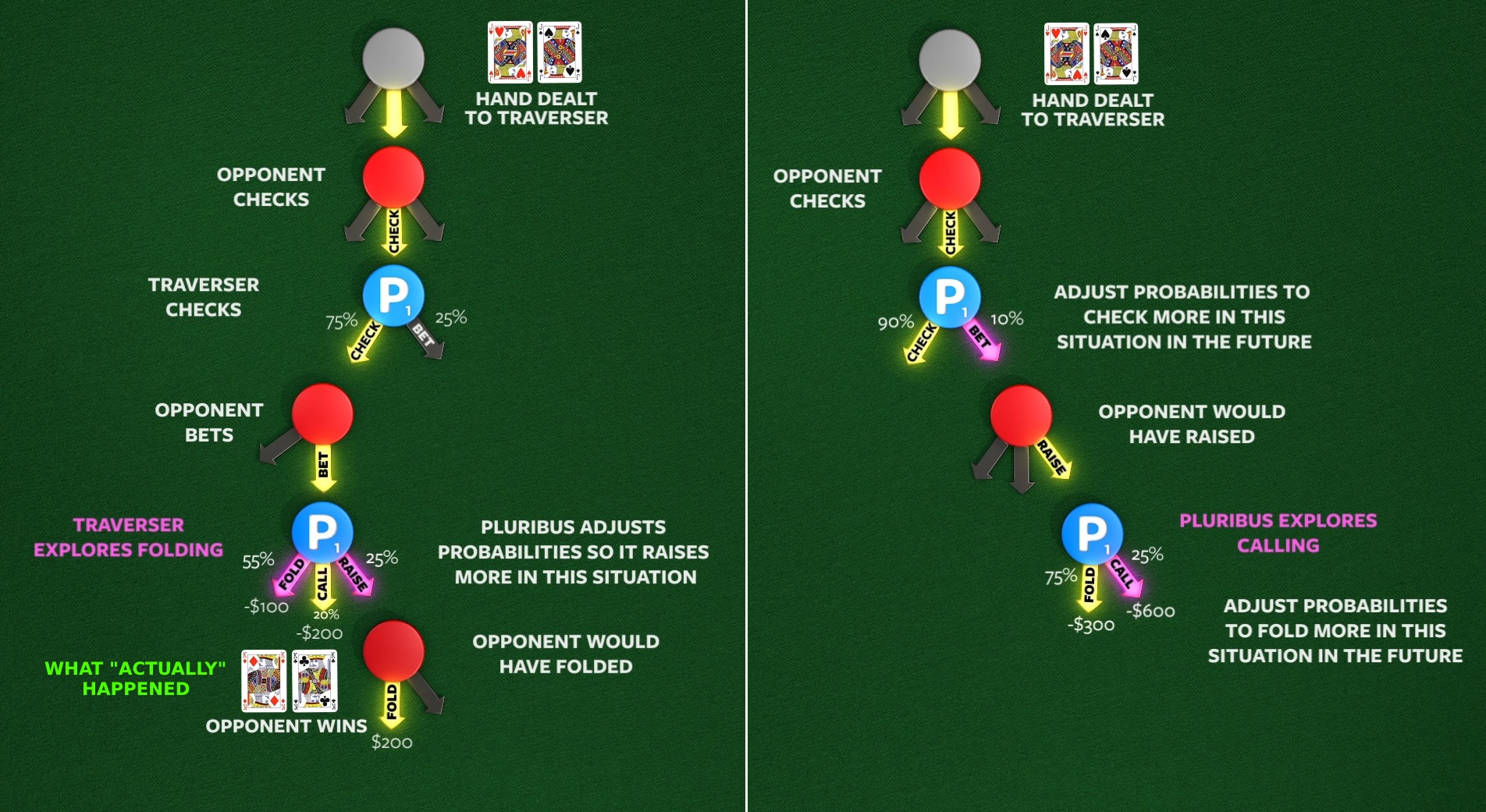
Regret minimization just means that when the system would finish a hand (against itself, remember), it would then play that hand out again in different ways, exploring what might have happened had it checked here instead of raised, folded instead of called, and so on. (Since it didn’t really happen, it’s counterfactual.)

A Monte Carlo tree is a way of organizing and evaluating lots of possibilities, akin to climbing a tree of them branch by branch and noting the quality of each leaf you find, then picking the best one once you think you’ve climbed enough.

If you do it ahead of time (this is done in chess, for instance) you’re looking for the best move to choose from. But if you combine it with the regret function, you’re looking through a catalog of possible ways the game could have gone and observing which would have had the best outcome.

So Monte Carlo counterfactual regret minimization is just a way of systematically investigating what might have happened if the computer had acted differently, and adjusting its model of how to play accordingly.
traverserj

The game originall played out as you see on the left, with a loss. But the engine explores other avenues where it might have done better.

Of course the number of games is nigh-infinite if you want to consider what would happen if you had bet $101 rather than $100, or you would have won that big hand if you’d had an eight kicker instead of a seven. Therein also lies nigh-infinite regret, the kind that keeps you in bed in your hotel room until past lunch.

The truth is these minor changes matter so seldom that the possibility can basically be ignored entirely. It will never really matter that you bet an extra buck — so any bet within, say, 70 and 130 can be considered exactly the same by the computer. Same with cards — whether the jack is a heart or a spade doesn’t matter except in very specific (and usually obvious) situations, so 99.999 percent of the time the hands can be considered equivalent.

This “abstraction” of gameplay sequences and “bucketing” of possibilities greatly reduces the possibilities Pluribus has to consider. It also helps keep the calculation load low; Pluribus was trained on a relatively ordinary 64-core server rack over about a week, while other models might take processor-years in high-power clusters. It even runs on a (admittedly beefy) rig with two CPUs and 128 gigs of RAM.

Random like a fox

The training produces what the team calls a “blueprint” for how to play that’s fundamentally strong and would probably beat plenty of players. But a weakness of AI models is that they develop tendencies that can be detected and exploited.

In Facebook’s writeup of Pluribus, it provides the example of two computers playing rock-paper-scissors. One picks randomly while the other always picks rock. Theoretically they’d both win the same amount of games. But if the computer tried the all-rock strategy on a human, it would start losing with a quickness and never stop.

As a simple example in poker, maybe a particular series of bets always makes the computer go all in regardless of its hand. If a player can spot that series, they can take the computer to town any time they like. Finding and preventing ruts like these is important to creating a game-playing agent that can beat resourceful and observant humans.

To do this Pluribus does a couple things. First, it has modified versions of its blueprint to put into play should the game lean towards folding, calling, or raising. Different strategies for different games mean it’s less predictable, and it can switch in a minute should the bet patterns change and the hand go from a calling to a bluffing one.

It also engages in a short but comprehensive introspective search looking at how it would play if it had every other hand, from a big nothing up to a straight flush, and how it would bet. It then picks its bet in the context of all those, careful to do so in such a way that it doesn’t point to any one in particular. Given the same hand and same play again, Pluribus wouldn’t choose the same bet, but rather vary it to remain unpredictable.

These strategies contribute to the “consistent randomness” I alluded to earlier, and which were a part of the model’s ability to slowly but reliably put some of the best players in the world.

The human’s lament

There are too many hands to point to a particular one or ten that indicate the power Pluribus was bringing to bear on the game. Poker is a game of skill, luck, and determination, and one where winners emerge after only dozens or hundreds of hands.

And here it must be said that the experimental setup is not entirely reflective of an ordinary 6-person poker game. Unlike a real game, chip counts are not maintained as an ongoing total — for every hand, each player was given 10,000 chips to use as they pleased, and win or lose they were given 10,000 in the next hand as well.
interface

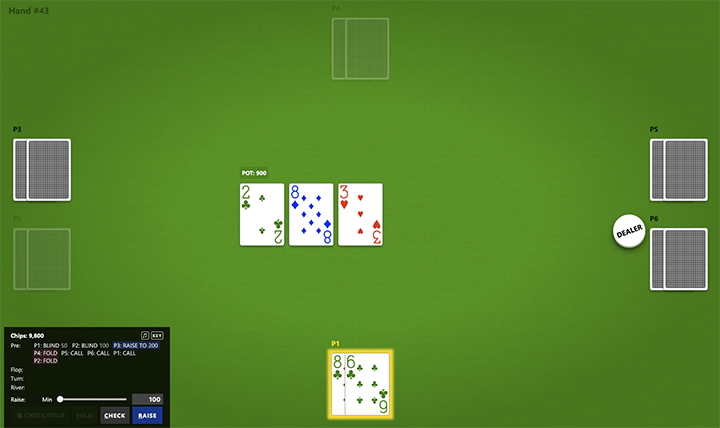
The interface used to play poker with Pluribus. Fancy!

Obviously this rather limits the long-term strategies possible, and indeed “the bot was not looking for weaknesses in its opponents that it could exploit,” said Facebook AI research scientist Noam Brown. Truly Pluribus was living in the moment the way few humans can.

But simply because it was not basing its play on long-term observations of opponents’ individual habits or styles does not mean that its strategy was shallow. On the contrary, it is arguably more impressive, and casts the game in a different light, that a winning strategy exists that does not rely on behavioral cues or exploitation of individual weaknesses.

The pros who had their lunch money taken by the implacable Pluribus were good sports, however. They praised the system’s high level play, its validation of existing techniques, and inventive use of new ones. Here’s a selection of laments from the fallen humans:

I was one of the earliest players to test the bot so I got to see its earlier versions. The bot went from being a beatable mediocre player to competing with the best players in the world in a few weeks. Its major strength is its ability to use mixed strategies. That’s the same thing that humans try to do. It’s a matter of execution for humans — to do this in a perfectly random way and to do so consistently. It was also satisfying to see that a lot of the strategies the bot employs are things that we do already in poker at the highest level. To have your strategies more or less confirmed as correct by a supercomputer is a good feeling. -Darren Elias

It was incredibly fascinating getting to play against the poker bot and seeing some of the strategies it chose. There were several plays that humans simply are not making at all, especially relating to its bet sizing. -Michael ‘Gags’ Gagliano

Whenever playing the bot, I feel like I pick up something new to incorporate into my game. As humans I think we tend to oversimplify the game for ourselves, making strategies easier to adopt and remember. The bot doesn’t take any of these short cuts and has an immensely complicated/balanced game tree for every decision. -Jimmy Chou

In a game that will, more often than not, reward you when you exhibit mental discipline, focus, and consistency, and certainly punish you when you lack any of the three, competing for hours on end against an AI bot that obviously doesn’t have to worry about these shortcomings is a grueling task. The technicalities and deep intricacies of the AI bot’s poker ability was remarkable, but what I underestimated was its most transparent strength – its relentless consistency. -Sean Ruane

Beating humans at poker is just the start. As good a player as it is, Pluribus is more importantly a demonstration that an AI agent can achieve superhuman performance at something as complicated as 6-player poker.

“Many real-world interactions, such as financial markets, auctions, and traffic navigation, can similarly be modeled as multi-agent interactions with limited communication and collusion among participants,” writes Facebook in its blog.

Yes, and war.

12 Jul 2019

Hayabusa2 lands on an asteroid and sends back amazing pictures to prove it

Japan’s Hayabusa2 mission to the asteroid Ryugu is an ambitious one to begin with, and the team recently made the decision to up the stakes with a second touchdown on the space rock’s surface. Not only did all go as planned, but we now have the best shots of an asteroid’s surface ever to be sent back to Earth.

Hayabusa2 is a very, very cool mission. The basic idea is this:

  1. Fly to nearby asteroid
  2. Land and sample the surface
  3. Blast a crater into it with a space gun
  4. Land and sample the crater
  5. Send the resulting samples back to Earth

Fabulous, right? And the intrepid spacecraft has just completed step 4 earlier today, touching down and snapping some amazing pictures while it did its science. This one was taken at the very moment it hit the surface:

hayabusa ryugu 1There was no guarantee this would happen, the JAXA team running the Hayabusa2 mission noted in a recent blog post. Any number of things could have resulted in a second touchdown being either too risky or not worth the trouble. Fortunately they concluded that the risk was acceptable and that this would be an important feat in more ways than one.
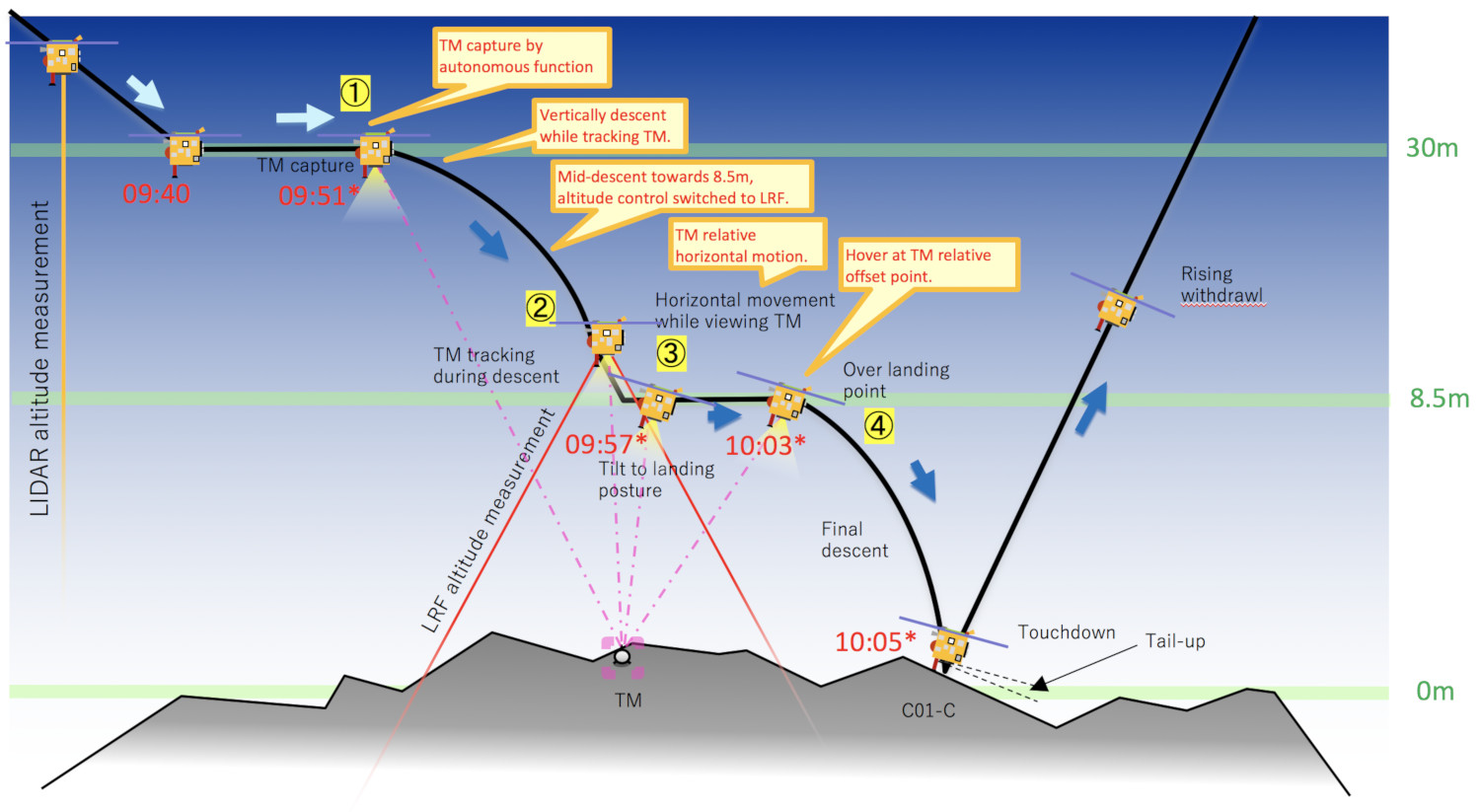
The previous sample was taken from the undisturbed surface of Ryugu, more or less as it’s been for many years. But then came the space gun — a 2-kilogram copper bullet propelled by a shaped explosion to some 4,400 miles per hour. It made a crater, all right! The probe flew clear around to the other side of the asteroid so it wouldn’t be hit by any debris.

What was exposed is a surface that has never been sampled before by human or robot hands — the soft underbelly of an asteroid. It could tell us much, which is why the team decided to go for it. That and it’s just fundamentally awesome and historic.

hayabusa ryugu 2In a brief update, JAXA provided a handful of pictures of the successful touchdown: 4 seconds before, the moment of impact, and 4 seconds after. It doesn’t stay for long, more bounces off the surface than “lands.” I assembled those into the gif you see above. A couple other shots show the area before the craft descended.

There isn’t much more information than this for now, as a more detailed breakdown will follow, the Hayabusa2 mission site explains. For now just savor the look on the team’s faces after this amazing feat:

hya

12 Jul 2019

Steam Labs lets you peek into Valve’s experimental projects

Like most companies, much of what Valve (the company behind the hugely popular Steam game store) tinkers with behind the scenes never sees the light of day. Concepts are born, torn apart and rebuilt, and sometimes tossed away without anyone outside the company ever seeing a hint of it.

Seems Valve is trying to change that, giving users an opportunity to provide feedback on potential new features before they’re fully baked. The company has just debuted a new project it calls “Steam Labs”, which will give super-early adopters an early peek at concepts that may or may not eventually make it into Valve’s Steam game store.

You can find the new Labs page right here.

The first three “experiments” are all focused around helping users find new games:

  1. Micro Trailers: Six second looping video trailers that start playing when you hover over a game’s in-store graphic
  2. Interactive Recommender: Since the Steam client is used to launch most games you purchase through the Steam store, Valve has a good idea of what you’re playing, and for how long. This experiment takes that data and uses it to find other games you might like based on which ones you’ve played the most. Want something no ones ever heard of? You can filter out the popular stuff, limiting results to just the lesser knowns.
  3. Automatic Show: An automatically generated “shopping channel”-style show of sorts, highlighting footage of the latest releases. In time, they hope to have auto-generated narration that tells you a bit about what you’re seeing; for now, though, it’s mostly just game footage over music.

Valve is quick to point out that all of these experiments are just that — there’s no promising that any of the stuff that hits the Labs will make it all the way to the official client. They also say that even “Steam Labs is itself an experiment”, which will probably change and evolve a bunch over time. If you particularly like/dislike a feature, Valve’s also put up a forum for user comments and suggestions.

Now if someone at Valve could go ahead and classify Half Life 3 as a Steam experiment and give us a look into what the hell is going on there, that’d be great.

12 Jul 2019

The Great Hack was one of the wildest movies I saw at Sundance

The trailer is out for Netflix doc The Great Hack, an early cut of which was screened at Sundance this year. I saw that cut during the fest and it was one of the wildest of a second wave of films trying to make sense of what the hell happened with Facebook and the election. A year ago, the tone was different. It was more shock and awe and impressionist art pieces. The Great Hack is part of a new breed that is making a serious attempt to put things into a narrative that normals can understand.

The film anchors itself mostly on two figures, Parsons School of Design Professor David Caroll and ex-Cambridge Analytica employee and ostensible whistleblower Brittany Kaiser, with a cast of other touchstone figures like Guardian journalist Carole Cadwalladr.

One of the major weaknesses of this kind of story is that it is likely best told in minutes of product meetings and repo commits, rather than attached to human narrative. But that’s not how most humans think and the past ten years have proven that even the people charged with protecting users from these systems have very little idea about how they actually work or how vulnerable they were and continue to be to manipulation. So The Great Hack takes an earnest stab at laying out the basics of how Facebook and other online platforms were manipulated and compromised in order to fuel Cambridge Analytica’s manipulation machine and, by extension, election campaigns and other public sentiment scenarios.

The version I saw did its best to connect these topics with tissue that (mostly, but not always) feels like it is linking the events with human counterparts involved. It does paint some of the journalists and figures in the piece with a bit of a golden brush, and never goes much further than ambivalence when featuring Kaiser, who was by her own admission, right alongside Cambridge Analytica CEO Alexander Nix, (who plays the villain of the piece (IRL as well as in the doc)) through CA’s most controversial period.

But, if you’ve been following the whole saga and reading news obsessively, not much in here is going to feel like brand new information. It is likely, though that there will be plenty that is new to a broader Netflix audience. If they were able to fix some of the pacing issues and land some of the ‘revelations’ with more punch in the final version I think it may have legs.

The doc hits Netflix on July 24th. You should check it out for yourself.


12 Jul 2019

You can now register for the Minecraft Earth closed beta

Take the real-world exploration of Pokémon GO and mash it up with the building elements of Minecraft, and you get Minecraft Earth.

While there’s no launch date for the game, Mojang has been saying for a while now that a closed Beta would go live sometime “this summer”. If you’re looking to get in there early, good news: they just opened up registration.

You can find the Beta registration page here.

Alas, since it’s a closed Beta, registering doesn’t guarantee you access — but in its FAQ about the Beta, the team notes that they’re planning to open it up to “hundreds of thousands of players” eventually, so your odds of getting in probably aren’t too bad. You’ll need to be over the age of 18, have a device running iOS 10/Android 7 or newer, and a Microsoft or Xbox Live account to get registered.

TechCrunch’s Devin Coldewey got a super early look at the game back in May — you can find his thoughts on it right over here.

Mojang also released a video teaser this afternoon, wrapping up much of what the game will offer in just under 3 minutes:

11 Jul 2019

YouTube is giving creators more ways to make money

YouTube is rolling out more ways for its creators to engage fans and generate revenue, the company announced today the VidCon event in Anaheim, California. Last year, YouTube used the event to launch new products like channel memberships, merchandise shelves, premieres, and more. This time around, it’s expanding several of those existing options with new features, while also introducing new products like Super Stickers and Learning Playlists — the latter which aims to promote the educational use of YouTube.

Super Stickers, meanwhile, is meant to complement the existing monetization tool, Super Chat.

Launched in January 2017, Super Chat lets fans pay to make their message stand out during a YouTuber’s live stream or Premiere. Today, YouTube says Super Chat is now the number one revenue stream across nearly 20,000 channels — a 65% year-over-year increase.

Over 90,000 channels have used Super Chat to date, with some earning more than $400 per minute, thanks to the feature.

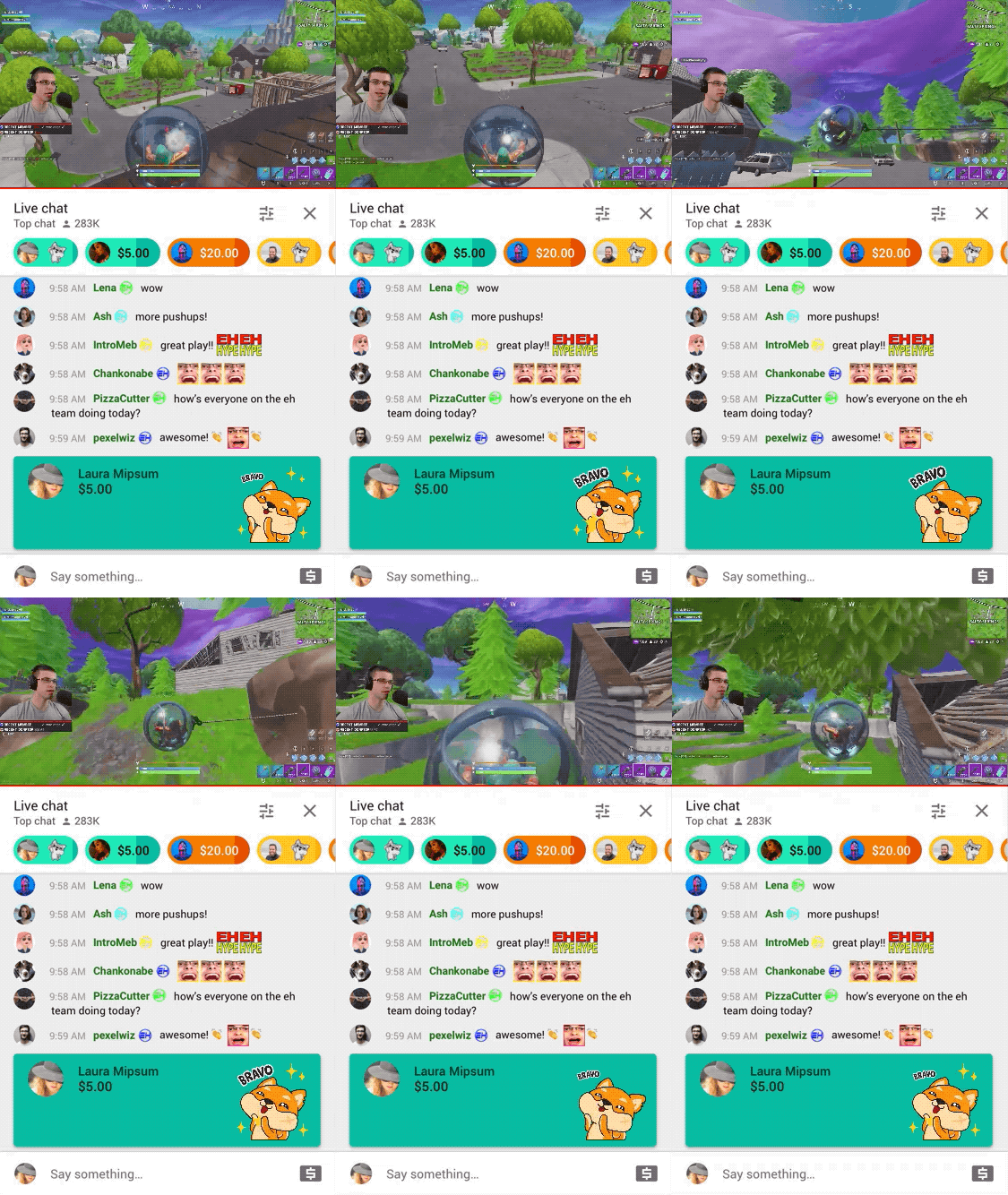
Given Super Chat’s traction, YouTube is introducing Super Stickers, which will launch in the next few months. Fans will be able to purchase these new, animated stickers during live streams and Premieres in order to show creators how much they like their content.

super stickers

The idea for Super Stickers seems to be inspired by gaming site Twitch’s Bits emotes and cheermotes, which also bring animated stickers into chat as a way of supporting video creators. However, YouTube’s Super Stickers will have a different look-and-feel, and will be offered across different languages and categories — including gaming, fashion and beauty, sports, music, food, and more.

At last year’s VidCon, YouTube also introduced Channel Memberships — an expansion of YouTube Gaming’s previous Twitch-like “Sponsorship” model, where fans pay a subscription to gain access to special features associated with a favorite channel.

At present, fans can opt to pay the $4.99 Channel Membership subscription to get unique badges, new emojis and other special perks like access to exclusive live streams, extra videos, or shoutouts. Today, YouTube is introducing a much-requested change to memberships: levels.

With levels, creators can set up to five different price points for memberships, each with their own set of perks. The feature has already been tested by select YouTubers, including the Fine Brothers Entertainment on their REACT channel. Their channel membership revenue increased by 6x after they rolled out two more expensive pricing tiers, YouTube said.

In addition, YouTube is expanding its Merch shelf feature that also launched last year at VidCon. Its debut partner Teespring helped creators to sell merchandise like t-shirts, hats, phone cases, and more. YouTube took a small commission on the sales, but said the majority went to the creator — along with the money made from the merch sales themselves.

Today, the Merch shelf is gaining several more partners, like Crowdmade, DFTBA, Fanjoy, Represent, and Rooster Teeth.

YouTube says “thousands” of channels have more than doubled their revenue thanks to the Merch shelf, Super Chat, and Channel Memberships, since launch.

Beyond the monetization features, YouTube also took time to speak about the educational and inspirational use cases on its site.

LearningPlaylistOverview desktop 1

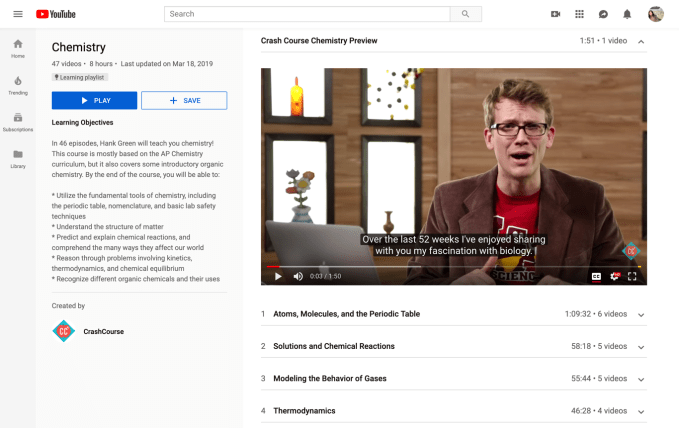
To make it easier for people to use YouTube to learn something new, the company is debuting a new feature called Learning Playlists, which offers more structure than is available with playlists today. The feature allows educational video creators to divide videos into chapters around key concepts, going from more basic to more advanced. And it hides recommendations from the Watch page — a first for YouTube.

Initially, only a handful of trusted partners get to test this feature, including Khan Academy, TED-Ed, The Coding Train, and Crash Course, to name a few.

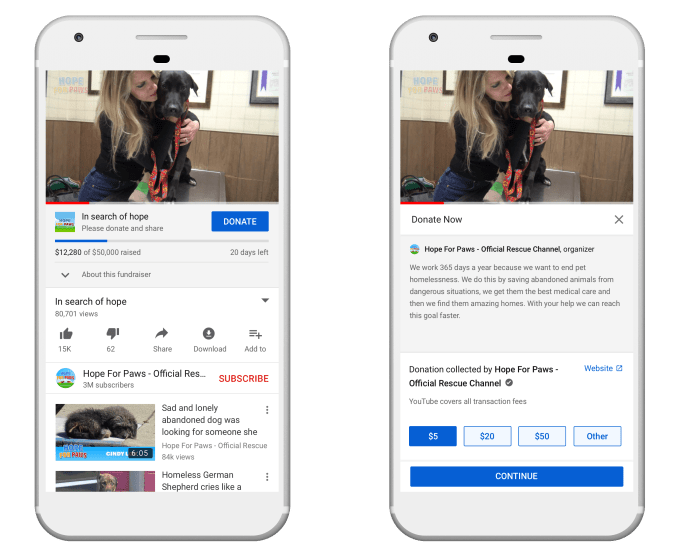
Finally, the site’s fundraising tool, YouTube Giving, is preparing to exit beta after a year of testing. The feature will launch in the months ahead and become available to thousands of U.S. creators. Once live, fans can click a Donate button to give to the nonprofit the creator wants to support.

Giving cropped Final2

Ahead of today’s VidCon keynote from YouTube Chief Product Officer Neal Mohan, the company had announced some well-received changes to the site’s copyright infringement tools.

It said copyright owners now have to specify the timestamp in the video their content appears, while creators will be able to use an updated version of YouTube Creator Studio to easily remove the portion of the content associated with the claim.


This helps to address situations where the Manual Claiming system was being used (or some would say abused) to claim very short — even only one second long — pieces of content, or incidental content — like when a creator walks past a store that’s playing music, for example. The company had said in April it was looking to address this.

The new system lets creators easily mute the sound when the claimed song plays, replace the song with free-to-use tracks, or quickly trim out the infringing content, instead of taking their video down.

Creators generally welcome the changes and new features that help them better engage fans and make money (or at least, not lose money).

That being said, YouTube is still under scrutiny for its bigger missteps and other practices like the gaming of its recommendation system and its role in creating a pedophilia wormhole; its alleged COPPA violations, which the FTC was alerted to; its ability to radicalize viewers as they’re pointed to ever more extreme content; its contribution to a world where parents exploit their kids for cash; and issues around how it policies “free speech” and hate speech, among other things.

In the grand scheme of things, YouTube has a lot on its plate beyond a few stickers and new ways to sell swag. But these are the sorts of tools that lock in creators to the YouTube platform, even amid threats from other large tech companies like Facebook, Instagram, and now Snapchat, which just announced new creator shows.

11 Jul 2019

There’s a tennis game hidden in Google right now. Here’s how to find it

Google loves a good Easter egg. From cutesie Douglas Adams references to the search results for “askew” being just a liiiiittle bit crooked, there’s all sorts of stuff hiding in the search engine if you know the right thing to type or the right buttons to push.

The latest addition is in honor of the Wimbledon tennis tournament, which wraps up this weekend. If you know where to look, Google has hidden a fun little pong-style tennis game within its results page.

It’s not too hard to find, but it’s just tucked away enough that most people probably won’t stumble upon it accidentally.

Here’s how to find it:

  1. Do a Google search for “wimbledon scores“.
  2. tennis 1

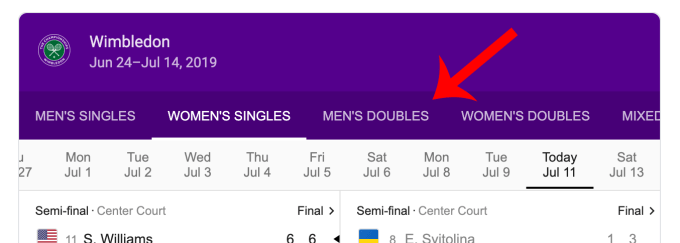
  3. See that purple box that pops up? See the nav bar that says “Men’s Singles”, “Women’s Singles”, etc? Grab that, and drag it all the way to the left to scroll to the end.
  4. tennis 2

  5. At the very end is a little tennis ball icon. Tap that, and the game should fire right up.

tennis 3

Once you’ve got it up, it’s pretty much Pong minus the paddles. Move to serve, then try to get your player in front of the ball to rally it back and forth. I’m not sure if it’s possible to actually get the ball past the computer player — I haven’t seen it happen. But just successfully returning the ball will get you a point. Once you miss a return, it’s game over.

It’ll work on both mobile or desktop, but I’ve found it’s a helluva lot easier to play on the latter.

11 Jul 2019

Twitter will start testing its ‘hide replies’ feature next week, in Canada

Twitter users are getting more control over which comments are visible in the conversations they start.

The company has been testing and talking about this feature since earlier this year, but starting next week, Twitter will actually roll it out to users in Canada.

As you can see in the GIF below, when you’re looking at replies to your tweets, you’ll be able select any of them and hit the “hide reply” option. However, as the name implies, these posts won’t be fully removed from Twitter, just hidden from the default view — everyone will still be able to tap on a gray icon to view hidden replies.

Here’s how Twitter’s Michelle Yasmeen Haq and Brittany Forks explain the feature:

Everyday, people start important conversations on Twitter, from #MeToo and #BlackLivesMatter, to discussions around #NBAFinals or their favorite television shows. These conversations bring people together to debate, learn, and laugh. That said we know that distracting, irrelevant, and offensive replies can derail the discussions that people want to have. We believe people should have some control over the conversations they start.

Twitter Hide Replies

As my colleague Sarah Perez noted previously, the current implementation is open to at least two criticisms — one, that it could allow users to hide critical viewpoints or fact-checking of their tweets (maybe quote-tweeting will be the better strategy moving forward), and two, that it still forces people to wade through potentially trollish or hateful content in order to hide replies.

Haq and Forks emphasize that Twitter is still looking for ways to improve the feature: “By testing in one country we want to get feedback and better understand how this tool can improve before it’s available globally.”

And yes, the timing of the news is a little awkward, coming right after Twitter went down for about an hour.