Category: UNCATEGORIZED

08 Jul 2019

Twitter and Facebook reportedly not invited to White House ‘social media summit’

On Thursday, the White House’s social media will reportedly host a who’s who of conservative media pundits. PragerU and Turning Point USA’s Charlie Kirk have apparently received invites to the event. There will, however, be some key names missing from the invite list — including, notably, the social media companies themselves.

Trump’s White House is hosting what it calls “a robust conversation on the opportunities and challenges of today’s online environment” this week. But according to a new report from CNN, neither Facebook nor Twitter qualify as “digital leaders,” as neither platform has received an invite.

The White House hasn’t released an invite list for the event — nor is it commenting on this latest report. Those sites will almost certainly be in the crosshairs, however, as Trump and fellow conservatives discuss their perceived biases. The President recently accused comes of “fighting” him in a recent interview with Fox News’ Tucker Carlson, stating that “what they’re doing is wrong and possibly illegal.”

In recent years, conservatives have accused Twitter, Facebook and Google of “shadow banning” and other perceived slights. Earlier this month, Twitter — which has been the subject of criticism from liberals and conservatives alike — announced a new “abusive behavior” notice aimed at public officials who violate the company’s speech policies.

08 Jul 2019

NASA’s giant mobile Artemis Moon launcher hits the pad for final testing

NASA is in final preparation stages for its Artemis 1 moon mission, which will be the first in its Artemis series of missions which intend to return an American man to the Moon, and bring an American woman to the surface of Earth’s natural satellite for the first time. The 335-ft tall mobile launch tower that will send Artemis 1’s Orion capsule to lunar orbit atop a Space Launch System rocket is now on the pad for its last round fo testing before the real thing.

NASA’s Artemis 1 mission will fly the Orion crew capsule to space, where it’ll spend three weeks, including a six-day lunar orbit. The capsule will be fully equipped with all life support systems it would need to actually support a crew onboard, but there won’t be anyone actually on it for this one since the intent is to prove the safety and effective operation of the system prior to Artemis 2, an intended crewed launch to follow Artemis 1 a few years down the road.

Artemis 1 will take off from Launch Pad 39A at Kennedy Space Center in Florida, with an intended launch timeframe of June 2020. The enter launch system has already undergone a lot of testing, both on-site at the towering Vehicle Assembly Building (VAB) where rocket parts are put together at Kennedy, and prior to that as each component has been built. But this final crucial round of testing will be the last on the pad before the rocket actually launches.

Tue ultimate goal of the current stage of the Artemis program is to land astronauts on the lunar surface, which will happen with the third Artemis mission in 2023 if all goes to current plans. Artemis missions thereafter will aim to establish a more permanent presence for humans in space, including ultimately the establishment of a lunar outpost.

08 Jul 2019

Elon Musk teases possible late July Starship presentation following engine test

Elon Musk was fielding a number of questions from fans on Twitter on Sunday, and revealed that the current target for a full presentation of Starship, SpaceX’s next-generation reusable rocket and a key piece of the company’s plan to reach Mars, could come as soon as “late July.”

The SpaceX CEO also noted that the company’s most recent test of one of its Raptor rocket engines (officially test ‘SN6’) was “overall successful,” despite an abort, since the whole purpose of the test was to test the outward limits of the new engine’s tolerances on fueling mixture ratios.

SpaceX’s official Starship presentation should take place “a few weeks after Hopper hovers,” according to Musk, which refers to the test StarHopper (or ‘Hopper’ for short) quick duration flights, which won’t be fully launches but will instead engage the engines to help prove their viability for eventual launch.  StarHopper completed a tethered hop test back in April, but the next step is to do this untethered, which is closer to reality than ever after last night’s test addressed a key issue with Raptor engine vibration at a specific operating frequency.

Once Hopper is through testing, presumably SpaceX will move on from using the scaled down prototype, which is only designed for testing in low altitudes, to a full-scale test rocket build, but we’ll hear the company’s plans in much more detail whenever this official Starship presentation really does take place.

08 Jul 2019

Uber rival Bolt has closed another tranche of funding at a $1B+ valuation

Uber and Lyft going public may have put closer public scrutiny on the economics of ridesharing, but it hasn’t had a chilling effect on the level of competition in the space. In the latest development, TechCrunch has learned and confirmed that Bolt, the Estonian ride-sharing, scooter and food delivery company that operates across Europe — most recently opening for business in London — and a number of emerging markets, has completed the first tranche of its latest round of funding. The equity injection bumps up the valuation of the company to over $1 billion, money that Bolt plans to use to fuel its international growth.

“We have closed a new funding round, aimed at supporting our recent launch in London and further expansion plans in 2019,” a spokesperson said in a short statement statement to TechCrunch.

The spokesperson would not elaborate on the size of the round, but technically, this would be a Series C. To date, Bolt has raised $185 million with its last big investment valuing it at $1 billion.

We understand that backers in this latest funding include Nordic Ninjas — a new fund out of Sweden backed by a number of Japanese LPs to invest in Northern European startups (Bolt is based out of Tallinn) — as well as Naya Capital (founded by hedge fund investor Masroor Siddiqui), Creandum and G Squared.

We are still trying to see if we can get further investor names and more details on the numbers. Previous investors in Bolt have included Didi (and by association Softbank and Uber), Daimler, Korelya Capital and Spring Capital, although we understand Spring is not in this round.

Bolt has been talking about this funding for a little while now — CEO and founder Markus Villig admitted to me, when asked, four months ago that more funding was on the cards — but according to a short note in PitchBook and a memo sent out to TMT investors (TMT is a shareholder in Bolt), the investment actually only closed this month.

It appears that this is not the final close — there is more dealmaking going on — but so far, the investor list provides some interesting indicators about Bolt.

G Squared has been behind a number of growth rounds for a range of fast-growing and large tech startups, including Pinterest, SoFi, Airbnb, Coursera, Spotify, Postmates and Instacart. It’s also backed some of the biggest names specifically in the category of transportation, including Lyft, Uber, Fair, Getaround, Turo, and Auto1. Its involvement speaks to big sums of money, and confidence in a strong growth story, hedging bets (or suggesting collaborations?) by potentially having stakes simultaneously in would-be competitors.

Nordic Ninjas, meanwhile, includes Honda as a shareholder. Added to Daimler, the owner of Mercedes who invested in Bolt last year when it was still called Taxify, this gives an interesting strategic twist to the investment.

And, it could also give Bolt a springboard to consider how to enter the Japanese market, to mark its first move into East Asia, to complement a footprint that includes a mix of developed and emerging markets in Western Europe, countries in the Arabic world, Africa, Eastern Europe, Western Asia and Australia.

Japan is notable for being one of the only developed countries to have, up to now, prohibited ridesharing businesses — that is, where private owners of vehicles work either individually or in networks to provide paid transportation services to other individuals.

That has led to a couple of different outcomes. First, the likes of Uber must partner with established taxi companies in the country to get entry into the market, rather than follow their usual course of business. And second, established taxi companies in Japan, who own and operate their own fleets, have become the most popular operators of ride-hailing apps in what is a fairly fragmented market.

It’s also a challenge to get operating licenses in the country. Didi, the Chinese ride hailing giant that is also an investor in Bolt, last year launched its own app in the Japan. Didi works with some 10 fleets and provides the logistics and ordering layer on top of those third-party services. Bolt operates a partnership program modelled on the same idea, which helps it build up quickly in the emerging markets where it has gained a lot of ground quickly.

Notably, much of Bolt’s growth seems to have been carefully carved out without much overlap with the likes of Didi and Uber (London, the biggest ride-hailing market in Europe, being a key exception). But as it continues to capitalise and grow, it will be interesting to see how and if that pattern will change.

We’ll update this story as we learn more.

08 Jul 2019

UK’s ICO fines British Airways a record £183M over GDPR breach that leaked data from 500,000 users

The UK’s Information Commissioner is starting off the week with a GDPR bang: this morning, it announced that it has fined British Airways £183.39 million ($230 million) in connection with a data breach that took place last year that affected a whopping 500,000 customers browsing and booking tickets online. In an investigation, the ICO said that it found “that a variety of information was compromised by poor security arrangements at [BA], including log in, payment card, and travel booking details as well name and address information.”

The fine — 1.5% of BA’s total revenues for the year that ended December 31, 2018 — is the highest-ever that the ICO has levelled at a company over a data breach (previous “record holder” Facebook was fined a mere £500,000 last year by comparison). And it is significant for another reason: it shows that data breaches can be not just just a public relations liability, destroying consumer trust in the organization, but a financial liability, too.

Indeed, the degree to which companies are going to be held accountable for these kinds of breaches is also going to be a lot more transparent going forward: the ICO’s announcement is part of a new directive to disclose the details of its fines and investigations to the public.

“People’s personal data is just that – personal,” said Information Commissioner Elizabeth Denham in a statement. “When an organisation fails to protect it from loss, damage or theft it is more than an inconvenience. That’s why the law is clear – when you are entrusted with personal data you must look after it. Those that don’t will face scrutiny from my office to check they have taken appropriate steps to protect fundamental privacy rights.”

The ICO said in a statement this morning that the fine is related to infringements of the General Data Protection Regulation (GDPR), which went into effect last year prior to the breach. More specifically, the incident involved malware on BA.com that diverted user traffic to a fraudulent site, where customer details were subsequently harvested by the malicious hackers.

BA notified the ICO of the incident in September, but the incident was believed to have first started in June. Since then, the ICO said that British Airways “has cooperated with the ICO investigation and has made improvements to its security arrangements since these events came to light.” It should be pointed out that even before this breach, there were other examples of the company treating data protection lightly. (Now, it seems BA has learned its lesson the hard way.)

BA might now choose to try to appeal the fine if it chooses. We have contacted BA and its parent company IAG for a response and will update this article when it responds.

While there are a lot of question marks over how the UK will interface with the rest of Europe over regulatory cases such as this one after it leaves the EU, for now it’s working in concert with the bigger rest. The ICO says it has been “lead supervisory authority on behalf of other EU Member State data protection authorities” in this case, liaising with other regulators in the process. This also means that these authorities where its residents were also affected by the breach will also have a chance to provide input on the ruling before it is completely final.

08 Jul 2019

DigitalBridge raises £3M for its ‘guided design tool’ for kitchens and bathrooms

DigitalBridge, the Manchester, U.K.-based startup using technology to help solve the “imagination gap” when planning home renovations, has picked up £3 million in new backing.

The round is led by Maven Capital Partners via two funds it manages: £1.5 million from Maven’s Venture Capital Trusts (VCTs) and £1.5 million from the NPIF Maven Equity Finance, a regional development fund managed by Maven as part of the U.K. government’s Northern Powerhouse Investment Fund.

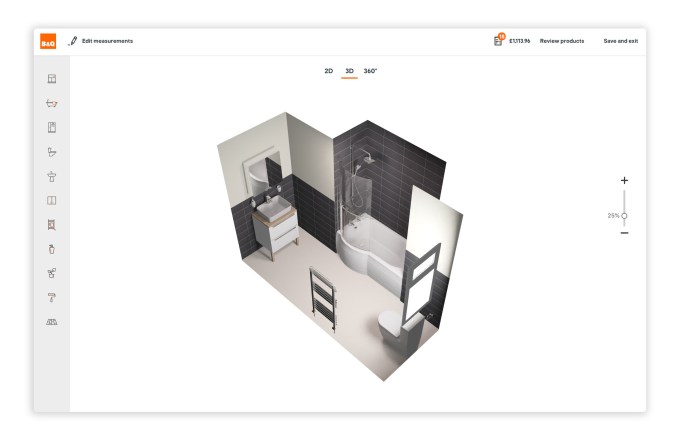
Working with Kingfisher Plc (owners of B&Q and Castorama) for the last couple of years, DigitalBridge has pivoted from its original AR-based home decor planning app to a new product it’s calling a ‘guided design tool’ for kitchens and bathrooms. That’s because, DigitalBridge founder David Levine tells me, home decor visualisation is only a nice-to-have whereas it’s a “must-have” for bathrooms and kitchens.

“Bathrooms and kitchens are much more complex rooms governed by complex design rules,” he explains. “We felt there was a big gap for a guided design tool which actively guides consumers through the entire journey of designing, visualising and buying whilst simplifying the inherent complexity of these rooms”.

There was, perhaps, another factor at play, too: the creation of AR development kits by Apple and Google have made it “really simple” for retailers to build their own home decor and furniture AR solutions, as well as seeing new competitors enter the space.

“Unlike most tools on the market today, DigitalBridge is utterly focused on the consumer and obsessed with creating simple and compelling experiences that enable that consumer to build their dream bathroom or kitchen irrespective of their design experience,” adds Levine. “Crucially, our core skillsets of AI and computer vision are absolutely pivotal to reducing that complexity”.

TechCrunch 01 3dViewer

The DigitalBridge solution resides on a retailer’s website or app — it is already live with B&Q in the U.K. — and guides you through the entire process of creating your new bathroom or kitchen. The the draw for retailers is that by enabling customers to easily design and visualise their new bathroom or kitchen, DigitalBridge can reduce sales cycles, increase conversion rates and average basket sizes, and “drive more engaged customers into store”.

“By using our technology, consumers are now able to visit the B&Q website and design the dream bathroom that will work for them, their family and budget, all without the need for professional assistance,” explains Levine. “Within minutes, they are guided through the process of entering their floor plan, designing the perfect bathroom and bringing it to life in immersive 3D. Once they’re happy with the design, they can buy directly online or go into a store to complete the purchase”.

Meanwhile, with regards to today’s newly disclosed funding round, Jeremy Thompson, Investment Director at Maven, says that DigitalBridge has developed a market-leading AI product which solves a genuine problem for retailers” by helping them engage with customers online. “We are genuinely excited to work with them and support their next stage of growth, as they look to accelerate deployment of the existing product, develop new products and enter new markets, including the U.S.,” he adds.

08 Jul 2019

Wind Mobility raises additional $50M and unveils new e-scooter hardware designed for rentals

Wind Mobility, the Berlin and Barcelona-based micro-mobility startup that operates e-scooter rentals in Europe, Israel and Asia, is disclosing $50 million in Series A funding. The new round is backed by existing investors. The company last raised $22 million in funding eight months ago from Chinese Source Code Capital and Europe’s HV Holtzbrinck Ventures, after it pivoted away from bike rentals to focus on e-scooters.

Coinciding with the new funding, Wind is unveiling its “third generation” e-scooters, which it says have been designed “from the ground up” for micro-mobility sharing. Eight months in development, the new hardware claims to be significantly more durable and best-in-class for battery life with the ability to drive 65-80km between charges.

The battery is hot swappable, too, meaning that it should be more efficient to run the Wind e-scooter service. That’s because not only can more scooters remain in circulation at any given time, potentially increasing revenue per scooter, but there’s a reduction in the cost of collecting dead batteries for re-charging as they are de-coupled from the scooter itself.

Wind also claims its new scooter has the highest waterproofing with IP67 standard, and that its increased durability should see it last over 12 months when used in the tough sharing environment. That in turn puts the startup on a better unit economic footing since flimsy hardware that needs to be replaced frequently has been a fiscal drag for e-scooter companies using off-the-shelf e-scooters designed primarily for single ownership and not for commercial use.

In the last few months a number of other micro-mobility companies have announced upgrades to their hardware, including European competitors Voi and Tier, although Wind Mobility co-founder and CEO Eric Wang has long talked up the importance of hardware as a differentiator, something he echoed again in a call late last week.

Specifically, Wang argued that it is still “Day One” in the e-scooter rental race and even though Wind hasn’t been as aggressive in its roll out and has deployed less scooters than Lime, Voi and Tier in Europe, he says there is still everything to play for. He said it was a conscious decision not to put too many scooters on the streets until the hardware was good enough to set the company on a path to profitability. Even with the 3rd generation scooter being deployed immediately, the company plans to stagger the launch so that it can gather sufficient data on how the new hardware is performing before hitting the accelerator so to speak.

The early signs look promising, however (in a video Wang sent me via WhatsApp the new Wind scooter survives being plunged into a pond and can be seen driving off after retrival from the water), although the Wind CEO cautions other companies and industry commentators not to underestimate how difficult hardware is. He argues that the detailed design decisions that Wind has made and the resulting improvements aren’t easily replicated any time soon and that there are “no shortcuts” in hardware. This has seen Wind set up its own R&D center in China in order to work as closely with the supply chain as possible.

Meanwhile, I’m told Wind now offers its services in 20 plus cities including operations in Germany, France, Spain, Israel, Austria, Portugal, Demark, Korea and Japan. The company currently employs over 120 people worldwide.

08 Jul 2019

Elon Musk: Tesla will ‘most likely’ begin computer chip upgrades this year

Tesla CEO Elon Musk said the company will “most likely” begin upgrading older electric vehicles with its new custom chip later this year — a lofty task that will involve retrofitting hundreds of thousands of Model S, X and 3s.

Musk tweeted Sunday night that the upgrades will begin most likely at the end of the fourth quarter.

Musk didn’t provide other details. He has previously said the upgrade would be free for owners who purchased the full self-driving feature, a software package that costs $6,000.

Tesla offers two different advanced driver assistance packages to customers: Autopilot and Full Self-Driving or FSD. Autopilot is ADAS that offers a combination of adaptive cruise control and lane steering and is now a standard feature on new cars. FSD includes Summon as well as Navigate on Autopilot, an active guidance system that navigates a car from a highway on-ramp to off-ramp, including interchanges and making lane changes.

While Tesla charges for the FSD software package, the vehicles are not fully autonomous. Musk has promised that the advanced driver assistance capabilities on Tesla vehicles will continue to improve until eventually reaching that full automation high-water mark.

The custom chip unveiled in April has been couched as a necessary hardware upgrade to reach that goal. Since March, new Model X and S vehicles have come equipped with the chip. The Model 3 followed a month later.

The custom chip was a milestone for the company. However, it still faces the considerable challenge of upgrading thousands of so-called “Hardware 2” vehicles, not to mention the continuous development of the software.

Tesla started producing electric vehicles with a more robust suite of sensors, radar, and cameras — called Hardware 2— in October 2016 under the premise and the promise that it had the hardware needed to eventually drive autonomously without human intervention. At that time, the company also began selling the upgraded full self-driving package that Musk said would eventually reach that ambitious target.

08 Jul 2019

Soldo scores $61M Series B for its ‘spend management’ platform for businesses

Soldo, the U.K. fintech that offers a multi-user spending account for businesses, has closed $61 million in Series B funding.

Leading the round is Battery Ventures and Dawn Capital, with participation from previous backers Accel and Connect Ventures. In addition, a small portion is debt financing from Silicon Valley Bank. It brings total raised by the London-based startup to $82 million.

Founded by Carlo Gualandri, who previously helped create Italy’s first online bank, Soldo offers a multi-user spending account for businesses of all sizes — from SMEs to much larger enterprises — that need to deploy and manage expenses across an entire organisation.

It enables departmental and employee spending to be managed in real time by combining a Soldo account, central dashboard, apps for iOS and Android and virtual wallets or physical “pre-paid” MasterCards that can be handed out to employees, departments and even external consultants or contractors.

In addition, Soldo offers granular spending controls that are at the heart of its tech stack. This allows for different expense criteria for each employee, contractor or spending department, with permissions set and all spending trackable centrally. It also lets users capture receipt data, while the whole system integrates with commonly used business accounting packages such as Xero, Quickbooks, Concur, Expensify, NetSuite, Zucchetti and SAP

Asked what the biggest challenge for Soldo has been over the last 12 months, Gualandri says “educating the market,” something that he doesn’t see changing any time soon.

“When you don’t know that a solution exists, you don’t even call it a “problem” but you consider it just a ‘fact of life’,” he says. “Spend management is a new category that replaces many old and outdated processes. [It] allows companies to distribute access to money with control, enabling flatter and more agile organisations. It will take time for the market to fully realise its transformational power”.

To that end, Gualandri says the most gratifying thing over the last year has been the results achieved within the companies that have started adopting Soldo. “We have been recognised by thousands of companies from small to very large as an innovative and reliable provider of financial services,” he tells me. “No small achievement in the traditionally more conservative world of business”.

Soldo isn’t profitable yet, but Gualandri says it could be within one or two years if that was the goal. However, this would mean choosing “slower, more organic growth” and given there is a very large market in front of Soldo it “would not be the right choice”. The majority of companies in Europe are still using “reimbursable expenses, spreadsheets and manual processes to manage the expense management cycle” and Soldo’s competition largely remains the status quo way of doing things (although Denmark’s Pleo, for example, operates in a similar space).

“We are a company with a fixed cost base and good unit economics so the break-even point is dependent on how much we invest and grow the fixed cost base (because most of our investment is people) and the volume of customers and spend managed by our system,” he says. “So by deciding to invest in product and sales we are in effect targeting a larger revenue and profit base but later on”.

Meanwhile, Soldo’s Series B round will be used to further grow in the U.K., where it claims a “leadership position,” and in Italy and Ireland. The company also plans to enter new European markets and double its workforce over the next 12 months. Gualandri says Soldo will continue to invest in its product, too, in order to tackle additional spend management “pain points”.

“Travel expenses is the most common need but procurement, purchasing goods and services, subscriptions, mobility expenses, employees benefits are all areas that can be innovated and are an expression of the concept of company spend management,” he says.

Meanwhile, Soldo recently secured an e-money licence from Ireland’s central bank in addition to the license it holds in the U.K. so that it can continue trading within the European single market post-Brexit and in the event of “no-deal”. “It’s crazy to think we’ve been forced to work for a year and a half on a hugely complex project, mostly duplicating something that we had already, to prepare our business for something that may or may not happen,” Gualandri told TechCrunch at the time of announcing its newly acquired Irish license.

07 Jul 2019

Fish replacement may be the next big wave in alternative protein development

Fish make up 16% of animal protein consumed globally, and demand is set to rise, according to the United Nations’ Food and Agriculture Organization, largely thanks to rising disposable incomes.

But overfishing is hugely problematic – and it’s not sustainable to continue with the way things are. Fish populations are being decimated – including the Pacific bluefin tuna, which is now at four percent of its original size. Industrial fisheries are using large machinery to trawl oceans, which traps and kills many other animals, including whales and dolphins.

In China alone, where demand for seafood dwarfs any other country, demand is rapidly growing. This is partly due to the African Swine Fever outbreak hitting pig farms affecting pork, and causing people to turn to other sources of protein. In addition, the country’s huge long-distance fishing industry continues to expand, depleting fisheries and causing conflicts.

But most of the fish we eat will be farm-raised by 2030. Poorly managed fish farms can cause chemical contamination of water and promote bacteria and diseases that end up in wild ecosystems. Farmed salmon poses a huge risk to the environment when it mixes with wild populations, as this can disturb important ecosystems.

Fish is a hugely important source of protein as we face a growing population and the challenges of food insecurity. But supplying fish sustainably, without depleting natural resources and harming the aquatic environment, is a continuous challenge. Fish is contaminated with plastics, mercury and antibiotics. And fish farming isn’t doing much to tackle food insecurity, as it isn’t reaching the places where it’s most needed.

There is also a long and ongoing debate about fish welfare, and whether fish species are sentient and can feel pain when they’re fished and killed. But research is putting this debate to rest and showing that a number of species demonstrate having long-term memory, social bonding and parenting skills, use tools, learn traditions and cooperate with other species. Most experts agree that fish also have the ability to experience emotions, including pain and fear.

GettyImages 1140243144

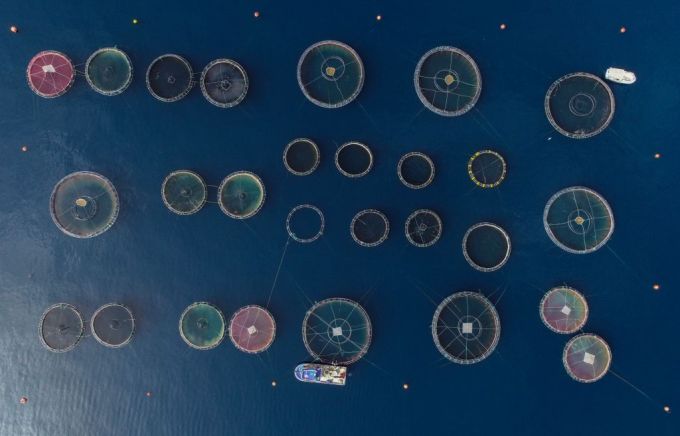
IZMIR, TURKEY – APRIL 25 : An aerial view of fish farm, raising a new breed ‘Egeli’ fish, in Izmir’s Karaburun district, Turkey on April 25, 2019. ‘Egeli’ fish, cross breeding of sea bream and dentex, are expected to be put on sale in a year. (Photo by Mahmut Serdar Alakus/Anadolu Agency/Getty Images)

But while fish farms in some countries must follow humane slaughter guidelines, there are no standards for wild fishing. And these guidelines are a far cry from their name. The traditional method for killing farmed fish is letting them asphyxiate in air or on ice, which is a prolonged and distressing processes, and is sometimes followed by a stun. The fish are often crowded into one small space, living in poor conditions and often starving. Overcrowded fish are more prone to disease, stress and aggression, which can cause them to lash out at each other and cause injuries. The pens can be a breeding ground for sea lice and disease, and parasites. And there are so man fish subject to this that we’ve lost count. Estimates suggest up to 120 billion farmed fish are slaughtered for food every year.

Although plant-based alternatives for red meat – like the Impossible Burger and Beyond Burger – and poultry – like The Imposter Burger – have been on the rise, when it comes to fish – we’ve fallen behind. Fish is as much a part of our diets as meat from land animals, so it only makes sense for there to be plant-based seafood options available for those who want to cut back on conventional products.

But the tide is starting to change, and we’re now seeing a promising focus on plant-based fish substitutes. Impossible Foods says plant-based fish alternatives are a ‘high priority’ for the start-up, while other companies are developing a number of fish products that are getting closer to mimicking the real thing. Good Catch offer plant-based tuna, Ocean Hugger Foods have developed a plant-based raw tuna, and New Wave Foods have come up with plant-based shrimp – while restaurants are starting to offer plant-based sushi.

There are also innovations with cell-based meat. Start-up Wild Type has developed lab-grown salmon by taking stem cells from salmon and grown them in lab conditions. The company is hoping to get its price down and start selling to consumers. Singapore-based Shiok Meats is developing cell-based crustaceans, including shrimp, crab and lobster, Blue Nalu is growing cell-based seafood and Finless Foods is focusing on growing bluefin tuna in the lab. The start-up says it was the first to produce a cell-based fish in 2017, and hopes to bring its fish to high-end restaurants this year. It also has the added benefit of being mercury-free.

There’s much work to be done around making fishing more humane and sustainable, but this must go alongside efforts to dampen demand. Plant- and cell-based meat companies continue to encourage and support those looking to reduce their red meat and poultry intake – and now there’s growing attention on doing the same for fish. We must make sure there are alternatives available to catch people who have woken up to the damage caused by our growing demand for fish.