Category: UNCATEGORIZED

03 Jul 2019

Google Pay gets more deeply integrated with Chrome

Google Chrome users will now have an easier way to pay while online shopping, says Google, thanks to an update that lets you access the payment information you’ve saved to your Google Account. Previously, you could sync this payment information between browsers on different platforms by turning on the Google sync option. Now, the company says you’ll be able to access autofill for payments just by signing into your Google Account while on the desktop — even if Chrome sync is disabled.

The feature takes advantage of Google Pay, which has been recently expanding to more sites across the web, following last year’s rebranding from “Android Pay” to reflect its more cross-platform nature. For example, only two weeks ago, Google announced that Google Pay’s integration with PayPal would expand to online merchants who accept Google Pay on their website or in their app.

With this new option, Chome users on a desktop browser will now offer you the ability to select a saved payment card from your Google Account when you’re checking out. You’ll have to enter your card’s CVC number to complete the transaction, and then will be emailed a receipt from Google Pay with more information following the purchase.

You can also manage your credit and debit cards associated with your Google Account under your Account settings (Payments & Subscriptions –> Payment methods), the company notes.

Screen Shot 2019 07 03 at 10.00.54 AM

Using this feature won’t automatically turn on Chrome sync. You’d still have to do that manually, if you want to sync other information in between your devices, like bookmarks, history, open tabs, passwords, autofill, and other settings.

Google also points out that you may not have to think about signing into your Google Account in order to take advantage of the new payment option — you’re automatically signed in to your account when you sign in to another Google service, like Gmail. However, you can sign out of your Google Account in Chrome, if you prefer or turn off “Allow Chrome sign-in” altogether.


03 Jul 2019

IP strategy: How should startups decide whether to file patents

Deciding what to patent can be a confusing process but by creating a formal process it is something that every startup can manage.

Intellectual property (IP) is one of the most valuable assets of a startup and patents are often chief among IP in terms of value. Patents allow the startup to prevent competitors from using their technology, which is a powerful feature that can grant unique advantages in the marketplace.

From a business perspective, patents can help with driving investment and acquisitions, provide protection during partnerships and business deals, and help defend itself against patent lawsuits by others.

However, startups also often have a hard time determining when and what to patent. Innovative startups are inventing new things on a regular basis, and there is a danger of slipping into a haphazard approach of patenting whatever happens to be available rather than systematically analyzing the business needs of the company and protecting the IP that moves the needle the most.

Moreover, startups must balance the need to protect IP with other areas of the business: Patents are complex documents that require an investment of time and resources to obtain. They often require specialized legal counsel to write and a lengthy examination process at the U.S. Patent & Trademark Office (USPTO).

This article is a how-to guide for startups to make the decision on when and what to patent with a mature approach to IP strategy.

Table of Contents

Creating a regular IP harvesting process

Index 02

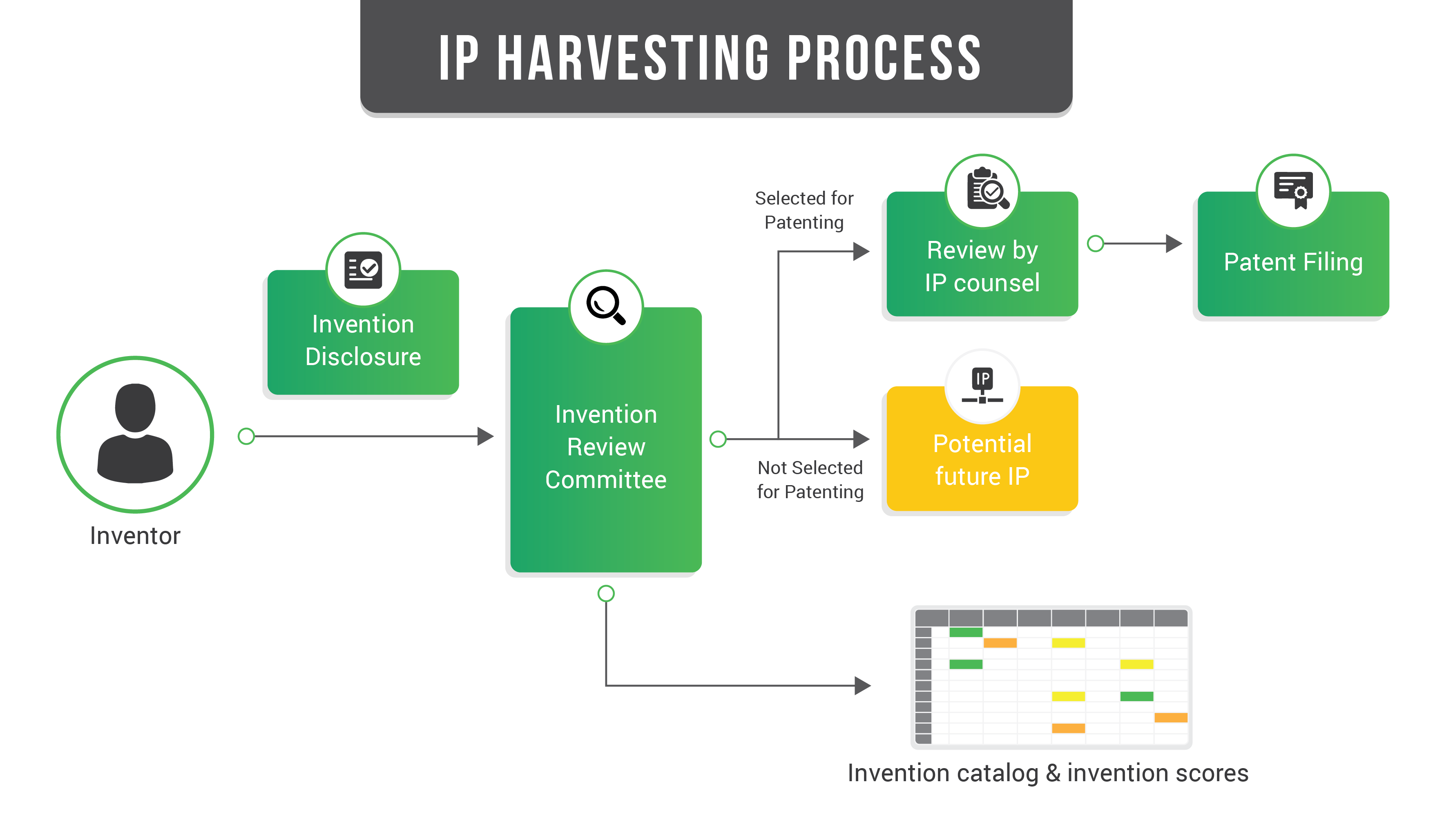
In order to make a decision about what to patent, a startup must first know what IP it has. For very small teams, it may be possible for everyone to have a shared idea of the IP. However, once teams grow beyond a few people, it is no longer possible to have complete visibility into what everyone on the team is doing and potentially inventing. Therefore, a regular IP harvesting process must be put in place to ensure proper reporting of IP to the executive level.

Most startups are best served with a simple IP harvesting process involving just three steps: (1) disclosure (2) invention review and (3) patent filing. In the disclosure stage, employees who are in IP creation roles must be trained to disclose ideas that are potentially protectable IP.

03 Jul 2019

New approach to state drone laws balances privacy and innovation

An influential group of attorneys called the Uniform Law Commission (ULC) will meet in Anchorage in July to debate and vote on model state legislation concerning drones. Thankfully, the ULC has made a great deal of progress since it first considered a one-sided, unworkable, 200-foot “line in the sky” approach last year. The current ULC proposal appropriately balances the rights of property owners with the needs of drone operators to access airspace.

The ULC’s proposal recognizes the same capabilities that make drones transformative for search and rescue, inspection and logistics, can – when misused – challenge the quiet enjoyment of property. If enacted by a state, the law would allow judges to weigh how many times and for how long the drone flew over the property, how low it was flying, why it was flying over the property, whether anyone saw the drone, and the time of day during which the flight occurred, when determining whether a drone has caused “substantial interference” with a property owner’s use and enjoyment of their land.

By giving courts the power to weigh each case on its own merits, the “Tort Law Relating to Drones Act” will allow drone flights for commercial purposes – such as package or medical supply delivery – to continue without fear of frivolous lawsuits or a complicated and conflicting patchwork of airspace restrictions.

According to the Federal Aviation Administration (FAA), more than 400,000 drones are registered to operate for commercial purposes in the United States. Drones may have to fly over property to deliver medical supplies to a nearby hospital or assess damage after a storm. First responders, too, may need to use drones to provide situational awareness during hostage situations or to help firefighters detect hot spots and search for people in burning buildings.

Working together, the ULC and U.S. drone industry have made significant strides to take into account the views of stakeholders, including the FAA and the U.S. Department of Transportation, which have likewise cautioned against drawing an arbitrary flight ceiling. Federal control over our airspace has been a bedrock principle of aviation safety for more than 70 years and is one of the reasons our nation’s aviation safety record is the envy of the rest of the world.

The ULC and the U.S. drone industry share the same goals when it comes to the regulatory framework for drones: uniformity and moving our nation forward. The ULC’s proposal for uniform state drone laws will maintain federal control of the skies while providing recourse for property owners whose property is interfered with by careless, reckless, or unlawful activity. It is a commonsense compromise that protects property owners on the ground while also allowing safe, responsible drone operations to take flight.

We appreciate the progress the ULC has made in collaboration with all the relevant stakeholders, and in particular its recent decision to reject an eleventh-hour proposal that would have reinstated certain altitude restrictions. We urge the full ULC to pass the proposal in its current form at its upcoming annual meeting in Anchorage, and to reject any last-minute attempts to amend it further. The current version strikes a reasonable balance between the concerns of property owners and the rights of drone operators.

Uniformity and reasonableness in the law are goals that, working together, we can accomplish.

03 Jul 2019

Europe moves closer to making VTOL air taxis a reality

The European Union Air Safety Agency (EASA), the regulatory body that provides the rules of the skies needed for commercial airlines and other air travel providers to operate, has released new certification guidelines that set the stage for commercial operation of both hybrid and electric vertical take-off and landing (VTOL) craft. This is a key step towards actually making it possible to operate an air mobility service from a technical perspective, but also from a regulatory one (at least in Europe) as well.

The EASA’s new special conditions add two new certification categories, including one ‘basic’ and one ‘enhanced,’ both applying to ‘small-category’ craft which are classified as aircraft that carry nine or fewer people and weight 7,000 lbs or less when fully loaded. Basic certification requires only that the aircraft in question are able to perform a controlled emergency landing, as defined by the safety rules set out by the EASA in terms of protection of passengers and others; enhanced certification means that the aircraft is able to also fly and land safely on a continuous basis, and for any aircraft intending to operate commercially, both certifications are required.

This isn’t yet the full regulatory framework necessary for true, full-scale commercial operation – it’s a step before that, and the EASA says that “the experience gained through the application of the VTOL special condition will feed into the Rulemaking process,” so basically as they see how companies work with these conditions they’ll adapt what becomes the final governing rules. But it’s still a step on the path towards on-demand aerial taxi service, which is good news for anyone working on making air mobility a reality.

03 Jul 2019

KKR confirms it has acquired Canadian software company Corel, reportedly for over $1B

Yesterday we broke the news that Corel — the company behind WordPerfect, Corel Draw, and a number of other apps, as well as the new owner of Parallels — had itself gotten acquired by KKR. Today, the news is confirmed and official: KKR today announced that it has closed the deal, purchasing Corel from private equity firm Vector Capital.

The terms of the acquisition are not being disclosed, but when the first rumors of a deal started to emerge a couple of months ago, the price being reported was over $1 billion.

Corel may not be the first name you think of in the world of apps and software today. Founded in the 1980s as one of the first big software companies to capitalize on the first wave of personal computer ownership, it tried to compete against Microsoft in those early days (unsuccessfully), and has seen a lot of ups and downs, including two retreats from the stock market, an insider trading scandal, and patent disputes (and even detentes) with its onetime rival.

But in more recent years it has, under the radar, built itself to be a solid and — in these days of startups that claim to intentionally operate at a loss for years in order to scale — profitable business with 90 million users. (Vector had said in the past that Corel had paid dividends of $300 million over the years it’s owned the company.)

Founded in the days when you went to electronics store and bought physical boxes of software with installation disks and hefty manuals, Corel has brought itself into the modern era, with acquisitions like Parallels — a virtualization giant that lets businesses run far-flung and very fragmented networks as if they weren’t — underscoring that strategy.

And that is where KKR appears to be putting its focus. In the memo that a source passed us yesterday, Corel’s CEO Patrick Nichols assured staff that there would be no layoffs and that this acquisition would mean a significant new infusion of capital both to expand its existing business as well as to make more acquisitions to grow. (As we pointed out yesterday, there are a lot of very promising software startups in the market today, and not all of them will scale on their own, so that could present interesting opportunities for companies like Corel.)

“Corel has differentiated itself by offering an impressive portfolio of essential tools and services for connected knowledge workers – across devices, operating systems, and a range of fast-growing industries. KKR looks forward to working together with management to drive continued growth across its existing platforms while leveraging the team’s extensive experience in M&A to deliver a new chapter of innovation and growth on a global scale,” said John Park, Member at KKR, in a statement.

That’s not to say that Corel does not have a specific strategy in mind. The company has apps and services today in three verticals serving consumers (mostly “prosumers”) and so-called knowledge workers: Creativity, Productivity, and Desktop-as-a-Service. That will likely be the trajectory that it will continue to pursue as it looks for more growth.

Although Vector is known as a tech investor, KKR is another step up in to the “bigger” leagues, and so it will be interesting see what Corel can do with the larger coffers, and the larger network of contacts, that KKR will bring to the table.

“KKR recognizes the value of our people and their impressive achievements, especially in terms of our commitment to customers, technology innovation, and our highly successful acquisition strategy. With KKR’s support and shared vision, our management team is excited by the opportunities ahead for our company, products, and users,” said Patrick Nichols, CEO of Corel, in a statement.

If reports of the acquisition price are accurate, that would represent a big premium to Vector: over the last 16 years the PE firm had acquired, taken public, and reacquired Corel, paying no more than $124 million for the company in those two acquisitions (the second time, it paid just $30 million).

“Corel has been an important part of the Vector Capital family for many years and we are pleased to have achieved a fantastic outcome for our investors with the sale to KKR,” said Alex Slusky, Vector Capital’s Founder and Chief Investment Officer, in a statement. “Under Vector’s ownership, Corel completed multiple transformative acquisitions, grew revenue and meaningfully improved profitability, highlighting Vector’s proven strategy of partnering with management teams to position companies for long-term success.  We are confident the company has found a great partner with KKR and wish them continued success together.”


 

03 Jul 2019

Apple’s iOS 13 update will make FaceTime eye contact way easier

Apple has added a feature called ‘FaceTime Attention Correction’ to the latest iOS 13 Developer beta, and it looks like it could make a big difference when it comes to actually making FaceTime calls feel even more like talking to someone in person. The feature, spotted in the third beta of the new software update that went out this week, apparently does a terrific job of making it look like you’re looking directly into the camera even when you’re looking at the screen during a FaceTime call.

That’s actually a huge improvement because when people FaceTime, most of the time they’re looking at the screen rather than the camera, since the whole point is to see the person or people you’re talking to, rather than the small black lens at the top of your device.

The catch so far seems to be that this FaceTime feature is only available on iPhone XS and iPhone XS Max, which could mean it only works with the latest camera tech available on Apple hardware. That could be because of the new image signal processor that Apple included in the A12 processor which powers the iPhone XS and XS Max, which also provide improvements over previous generation phones in terms of HDR and portrait lighting effects.

It’s also possible with any updates or features that arrive in iOS beta releases that they could expand to other devices and/or vanish prior to the actual public launch of iOS 13, which is set for this fall. But here’s hoping this one remains in place, because it really seems to make a huge difference in terms of providing a sense of ‘presence’ for FaceTime calls, which is one of the core values of the Apple chat feature overall.

03 Jul 2019

WeChat wants to own tourism

When people travel, they usually have a list of apps installed to navigate a new city, find restaurants, book transit tickets and more. China’s top chat app WeChat has designs on claiming that spot with a new strategy that lumps all these functions into a collection of destination-specific apps.

Operated by Tencent, Asia’s second most valuable tech giant, WeChat is a so-called “super app” defined by the myriad of services it hosts ranging from ride-hailing and food delivery to e-commerce and payments. Its efforts to dominate China received a huge boost back in 2017 when it launched “mini programs”, easily-downloadable apps that provide stripped-down but essential functionality. Millions of these lite apps are serving WeChat’s one billion users today, and WeChat is now adding travel to the list of needs it addresses.

One of WeChat’s first attempts at aiding tourism is a mini app called “MyHelsinki”, a collaboration between Tencent, mobility startup Whim, the city of Helsinki and other partners. In effect, the WeChat-powered app is a hybrid of Lonely Planet, Yelp, Google Translator, Uber and an e-wallet for Chinese tourists who visit the Finnish capital, and it has plans to replicate the system elsewhere in the world.

03 Jul 2019

NSLComm’s first spring-loaded expanding antenna satellite is headed to space

Space tech startup NSLComm is gearing up to put its first satellite into orbit, aboard a Russian Soyuz rocket launching this Friday at 1:42 AM ET. Not only is the launch a first for the company, but it’s also the first deployment of a new kind of satellite technology, and expandable antenna solution created by NSLComm which is the secret ingredient that will unlock a number of different lines of business for the fledgling Israeli startup.

“Satellite communication is too expensive,” explained NSLComm CEO and co-founder Raz Itzhaki in an interview. “And this is the case, because satellites are expensive. A communication satellite is basically a dish in space, you want more communication, you need a larger dish. But a larger dish requires a larger satellite, and a larger launcher, so everything becomes more expensive. This is why if you launch a geostationary communication satellite you have to launch it for 20 years, because it has an ROI of more than 10 years. It weighs tons because it needs to live for 15-20 years, and when you sell the capacity, you pay hundreds of billions per megabit per second per month, because you need to return the amount of investment in the satellite.”

What Raz and his team saw was that much of the size and weight for these high-powered communication satellites was actually due to the antennas they need to use to ensure they can achieve a good signal from space. These are either large and fixed, requiring a lot of extra launch hardware and protection as they make their way to space (which is not needed once in orbit), or, for unfolding antennas that existed previously, they require a lot of additional hardware to actually do the unfolding antenna deployment in space, adding again a bunch of bulk and weight. All of which translates to higher launch costs, the need for longer productive life spans for the satellites, and higher costs for connectivity consumers.

NSLComm’s solution for this was to develop a new kind of antenna that can deploy on its own, without the help of any additional heavy machinery, and that can extend to the sizes needed to provide truly high-throughput connectivity on a satellite that’s small and much easier to launch, providing about 100 times faster connectivity than the fastest nano-satellites in the same size class today at about one 10th the launch cost.

“Our approach was to develop an antenna based on SMP – that’s a shape memory polymer,” Itzhaki said. “This antenna is actually a 3D spring; it memorizes it shapes, it needs no opening mechanism, because the antenna itself is its own opening mechanism. So when you open a hatch, it jumps out like a jack-in-the-box. We have an antenna that is compacted to a volume that is so small, that it fits less than 1U [around the space of one rack in a multi-rack server configuration, or about 1.75 inches tall] for a 60 centimeter [about two feet] diameter dish. And the antenna weighs 140 grams. Well, this changes the economics of satellite communication.”

NSLComm intends to launch 30 satellites by 2021 and hundreds in total by 2023, but launching its own network is only one part of its business plan, and there are other ways it intends to generate revenue in the more immediate term. Itzhaki explained that in fact, the startup has four primary ways of doing business, including first offering cost-effective ways for customer companies to build their constellations using the startup’s technology. Next, there’s a “turnkey” option for customers that can purchase satellite terminals and ground stations for specific use, including one client already who is using this for an IoT application. Itzhaki says there are already “many” of these types of arrangements in the pipeline.

Third, NSLComm intends to offer a “private constellation” offering, where for example a cruise ship operator could build, launch and operate its own network constellation for its customers at minimal cost. Finally, the there’s a “constellation as a service” model where NSLCom would launch the constellation itself, partner with an operator, and sell the capacity of the network on a subscription basis.

To date, NSLComm has raised $16 million, including $12 million from VCs including Jerusalem Venture Partners, OurCrowd, Cockpit Innovation and Liberty Technology Venture Capital. It’s also backed by the Israel Space Agency and the Office of the Chief Scientist in Israel, which provided the remaining $4 million in its initial funding.

03 Jul 2019

China’s Alipay adds sought-after beauty filters to face-scan payments

In China, striving for accuracy in a piece of facial recognition software isn’t enough. As Alibaba’s e-wallet affiliate Alipay has recently demonstrated, the way software presents a user’s look is also crucial to its success.

On Tuesday, Alipay announced on social media platform Weibo (in Chinese) that it’s added beauty filters to its pay-with-face system inside the app. Within a week, the feature will roll out across retail stores equipped with Alipay’s face-scanning solutions.

“We are going to make you look even prettier than with a beauty camera. I bet you’ll be impressed,” Alipay wrote on Weibo.

The new feature was created to address complaints that facial recognition machines make people look ugly. A new poll (in Chinese) ran by news portal Sina Technology showed that more than 60% of respondents think they look uglier through the next-gen payments method than on a regular camera. This could be a real concern for beauty-obsessed people who, at a busy supermarket checkout, find their face displayed unflatteringly on a large computer screen.

The chase of beauty in China has spawned a handful of movers and shakers in the internet space, from Hong Kong-listed selfie-app maker Meitu to plastic surgery marketplace Soyoung that recently raised $180 million from a Nasdaq public listing.

Will WeChat Pay, the payments solution of messaging giant WeChat, follows Alipay’s shadow to build a similar offering? Beauty filters can be a competitive advantage to a business, if not a necessity. In an effort to draw more female users, smartphone maker Xiaomi recently joined hands with Meitu to develop new models that place more focus on selfies, stickers and graphics.

Alipay boasts more than one billion monthly active users of late. WeChat doesn’t break out the number for its payments segment but said in March the service processed more than one billion daily transactions.

03 Jul 2019

SoftBank Vision Fund partner David Thevenon is coming to Disrupt Berlin

SoftBank Vision Fund has single-handedly changed the game when it comes to tech startup investment. And that’s why I’m excited to announce that SoftBank Vision Fund partner David Thevenon is joining us at TechCrunch Disrupt Berlin.

Thevenon spent most of his career working for Google on international and strategic partnerships, especially in Latin America, Asia, Europe and Middle-East. He ended up heading the business development teams working on Android partnerships globally.

While his career as an investor is still relatively recent, he’s currently a board member for DiDi, Grab and Kabbage. As a reminder, SoftBank’s Vision Fund invested $5 billion in DiDi — it’s not every day that you get to cut such a big check.

So Thevenon has become a sort of expert in ride-hailing and mobile transportation platforms. It’s going to be interesting to hear what he thinks about the concept of ‘super apps’ that Grab pioneered for instance. Can you transform ride-hailing apps into apps that you open every day to make payments, get insurance products and loans?

More generally, given the size of SoftBank’s Vision Fund ($100 billion), it has had a huge impact on the growth trajectory of some companies. I’m personally curious to know SoftBank’s approach as board members, whether they get involved in the strategy of those companies or let the executive teams make decisions on their own.

Buy your ticket to Disrupt Berlin to listen to this discussion and many others. The conference will take place on December 11-12.

In addition to panels and fireside chats, like this one, new startups will participate in the Startup Battlefield to win the highly coveted Battlefield cup.


Before joining SoftBank in 2014, David had a 10-year tenure at Google, where he last led global partnerships for the Android platform and was in charge of product related partnerships and business development activities across Asia, Europe, Middle-East, Africa and Latin America.

Prior to Google, David was leading strategic partnerships at T-Mobile International, and worked as a finance executive at Dell, ICL-Fujitsu and Elf-Atochem. David received a Master in Management from ESCEM.