Category: UNCATEGORIZED

01 Jul 2019

Susa Ventures, a young VC firm with some high-flying bets, just closed on $140 million in new capital

Susa Ventures, a six-year-old, San Francisco-based, seed-stage venture firm, has closed on two new funds, a $90 million early-stage fund — its third flagship fund — along with its first opportunity fund, to which investors committed $50 million.

Though young, Susa has some very fast-growing companies in its portfolio, which surely smoothed the fundraising process. (It also explains why the firm has already raised a separate to vehicle that will support its breakout portfolio companies.)

It has participated across all five funding rounds to date of the six-year-old, freight logistics company Flexport, which was last valued by its backers at a $3.2 valuation.

Susa was also there at the start for the commission-free trading company Robinhood, backing the company at its seed, Series A, and Series B rounds. Robinhood has subsequently raised two more rounds of funding and was valued by investors during its most recent round, which closed last year, at $5.6 billion.

And Susa was early to Andela, the software developer training and outsourcing company that announced a $100 million Series D round in January that brought its total funding to $180 million.

Susa’s general partners include Chad Byers, who is the son of Brook Byers, a founding member of Kleiner Perkins; Leo Polovetz, who spent years as a software engineer at LinkedIn, Google, and Factual before becoming an investor; and Seth Berman, who was previously the VP of marketing at the luxury goods company Richemont.

A fourth, founding general partner, Eva Ho, left the firm in 2016 to cofound a separate venture firm, Fika Ventures,  which is based in L.A and closed on a $76 million fund just last month.

Part of Susa’s $50 million includes $2 million that it carved out for the founders in its portfolio, capital that it is not charging them to manage and any profits from which will go entirely to the founders. The firm says more than 40 individuals participated in the parallel fund.

Some of Susa’s most recent checks have gone to Troops, a four-year-old, New York-based startup that helps sales teams communicate with a customer relationship management tool that plugs into Slack; STORD, a 3.5-year-old, Atlanta-based “next-generation” warehousing and distribution company; and Scope AR, an eight-year-old, San Francisco-based maker of AR tools designed for complex remote tasks, employee training, product and equipment assembly, maintenance and repair, field and customer support.

The firm has written more about its new fund here.

01 Jul 2019

Tim Cook hits ‘send’

Tim Cook doesn’t seem to be particularly happy with The Wall Street Journal.

A day after an in-depth report describing Jony Ive’s cooling departure from Apple and the degrading nature of the design team at Apple, Cook made the rare move of responding directly to the report in an email sent to a reporter at NBC.

“The report is absurd,” Cook writes. “A lot of the reporting, and certainly the conclusions, don’t match with reality.”

It is — of course — worth noting that Cook is responding negatively to a report that said negative things about his company and him specifically. His email also alluded to errors in reporting but didn’t call anything out specifically despite plenty of specific claims.

The report had detailed that Ive had grown “frustrated inside a more operations-focused company led by Chief Executive Tim Cook,” also reporting that “people in the design studio rarely saw Mr. Cook, who they say showed little interest in the product development process—a fact that dispirited Mr. Ive.’

For Cook, sending this email is definitely a bit more of a Steve Job-type play, directly attacking the publication and defending the company’s reputation. This is a pretty unusual move for Cook, who has generally seemed to let the Apple PR machine handle unpleasant stories through a web of off-the-record and background comments for journalists on the beat.

The more direct refutation is something that Cook also did in responding to Bloomberg’s story on Supermicro, a move that was noteworthy at the time as well. While the Bloomberg story struck chords relating to the company’s information security and threatened consumer trust, the report from the WSJ threatens the lore of Apple and how the company has positioned itself to move forward as an operations-focused giant.

We’ve reached out to The Wall Street Journal for comment.

01 Jul 2019

‘Deepfake’ revenge porn is now illegal in Virginia

Virginia has expanded a revenge porn law to include “deepfakes,” the fabricated or manipulated videos and images of people made using machine learning that have begun popping up with increasing regularity.

The law, which went into effect Monday, now makes it illegal to share nude photos of videos of someone without their permission— whether they’re real or fake ones. The law also covers photoshopped images or any other kind of fake footage, not just the more advanced, and harder to spot, deepfake imagery and videos.

Virginia has had a revenge porn law on the books since 2014. But it didn’t properly cover fabricated images and videos, an act that has become more common thanks to advances in software.

The pace of this technology, which is improving at an astonishing rate, has left state and federal lawmakers flat-footed. Victims of deepfaked revenge porn often don’t have recourse because it’s not covered by current law. And yes, deepfake porn exists. The app DeepNude, which existed until a warranted backlash prompted the creator to take it down, used neural network to turn an image of any clothed woman into a rendering of her nude.

Lawmakers are beginning to react with mixed results. For instance, the DEEPFAKES Accountability Act was introduced last month Congress by Rep. Yvette Clarke (D-NY). That bill would criminalize synthetic media that is broadcast or shared as an authentic video or image.

The proposed federal legislation is a much broader regulation aimed at fake videos and images that imitate a person. The bill would require anyone creating synthetic media content that imitates a person to disclose that it’s altered or generated, using “irremovable digital watermarks, as well as textual descriptions.” The bill would give victims the right to sue creators and/or otherwise “vindicate their reputations” in court.

The UK government is reviewing a law that specifically deals with the making and sharing of non-consensual intimate images in response to a rise of abusive and offensive digital communications.

The commission reviewing the law will focus on revenge porn as well as deepfaked porn and cyber flashing, which involves sending unsolicited sexual images to a person’s phone by taking advantage of technologies like Bluetooth that allow for proximity-based file sharing.

01 Jul 2019

Venture-backed telemedicine startup Call9 is shutting down

More than three years ago, we told you about Call9, a young, Palo Alto, Ca.-based telemedicine startup that wanted to reduce unnecessary visits to emergency rooms by those who call 911 most frequently, which is people in nursing homes.

The company’s cofounders — Celina Tenev, a radiology postdoctoral fellow from Stanford, and Timothy Peck, who worked previously as an emergency medicine physician and faculty at Harvard Medical School — met while working part-time for a now-defunct startup and shared a disbelief that the patient experience still typically includes spending several hours in an emergency room.

Unfortunately, for Tenev and Peck and investors who wound up plugging $34 million into the startup —  including Index Ventures, YC, the YC Continuity Fund, Index Ventures, 8VC, and 23andMe cofounder Anne Wojcicki — Call9 is shutting down after failing to raise further funding. About 100 people are losing their jobs as a result.

The company, which provided medical equipment and a video platform (via iPad) that enabled doctors to talk with nursing home residents, says its struggle owed to the country’s very slow adoption of “value-based care” — in which doctors are paid based on patient outcomes — rather than the current “fee-for-service” model on which the health care industry still relies largely. As CNBC reported last week, Call9’s business plan involved landing deals with insurance plans to split the savings from avoiding an outcome like an unnecessary emergency room visit.

Still, the outlet noted that other startups are selling outcomes-based services to insurers with more success. Among them: Cityblock, a company that spun out of Alphabet and provides health-care services to low-income people on Medicaid. Cityblock has raised roughly $85 million, including 8VC.

01 Jul 2019

Team studies drone strikes on airplanes by firing them into a wall at 500 MPH

Bird strikes are a very real danger to planes in flight, and consequently aircraft are required to undergo bird strike testing — but what about drones? With UAV interference at airports on the rise, drone strike testing may soon be likewise mandatory, and if it’s anything like what these German researchers are doing, it’ll involve shooting the craft out of air cannons at high speed.

The work being done at Fraunhofer EMI in Freiburg is meant to establish some basic parameters for how these things ought to be tested.

Bird strikes, for example, are tested by firing a frozen poultry bird like a chicken or turkey out of an air cannon. It’s not pretty, but it has to be done. Even so, it’s not a very good analogue to a drone strike.

“From a mechanical point of view, drones behave differently to birds and also weigh considerably more. It is therefore uncertain, whether an aircraft that has been successfully tested against bird strike, would also survive a collision with a drone,” explained Fraunhofer’s Sebastian Schopferer in a news release.

The team chose to load an air cannon up with drone batteries and engines, since those make up most of any given UAV’s mass. The propellers and arms on which they’re mounted are generally pretty light and will break easily — compared with a battery weighing the better part of a kilogram, they won’t add much to the damage.

drone testing

The remains of a drone engine and battery after being propelled into the plate on the left at hundreds of miles per hour.

The drones were fired at speeds from 250 to 570 miles per hour (115 to 255 meters per second by their measurement) at aluminum plates of up to 8 millimeters of thickness. Unsurprisingly, there was “substantial deformation” of the plates and the wingless drones were “completely destroyed.” Said destruction was recorded by a high-speed camera, though unfortunately the footage was not made available.

It’s necessary to do a variety of tests to determine what’s practical and what’s unnecessary or irrelevant — why spend the extra time and money firing the drones at 570 when 500 does the same level of damage? Does including the arms and propellers make a difference? At what speed is the plate in danger of being pierced, necessitating additional protective measures? And so on. A new rig is being constructed that will allow acceleration (and deceleration) of larger UAVs.

With enough testing the team hopes that not only could such things be standardized, but simulations could be built that would allow engineers to virtually test different surfaces or materials without a costly and explosive test rig.

01 Jul 2019

VCs bet on Aegis AI, a startup using computer vision to detect guns

A new startup using computer vision software to turn security cameras into gun-detecting smart cameras has raised $2.2 million in venture capital funding in a round led by Bling Capital, with participation from Upside Partnership and Tensility Venture Partners.

Aegis AI sells to U.S. corporations and school district its technology, which scans thousands of video feeds for brandished weapons and provides threat-detection alerts to customers within one second, for $30 per camera, per month. Coupling AI and cloud computing, Aegis integrates with existing camera hardware and video management software, requiring no on-site installation or maintenance.

“We can take over the role of a security guard with much higher accuracy at a much lower cost,” Aegis co-founder and chief product officer Ben Ziomek tells TechCrunch.

The financing round comes as a fresh cohort of businesses look to new technologies to protect against gun violence. AI-based gun detection is an unproven method, but investors and entrepreneurs alike are hopeful it represents a new era in threat-detection and safety. Seattle-based Virtual eForce, Israel’s AnyVision and Canadian tech startup SN Technologies are among the startups focused on improving security systems across the globe.

For Aegis co-founder and chief executive officer Sonny Tai, protecting against gun violence is personal. The first-time founder, who previously spent nearly a decade in the Marine Corps, grew up in South Africa where gun violence was all too common.

“We had a close family friend who was fatally shot in his own home 20 years ago,” Tai tells TechCrunch. “This prompted my mother to decide that we should immigrate to the U.S. On my end, it inspired a lifelong passion in me. I had to do something about the U.S. gun epidemic.”

IMG 9352 01 01

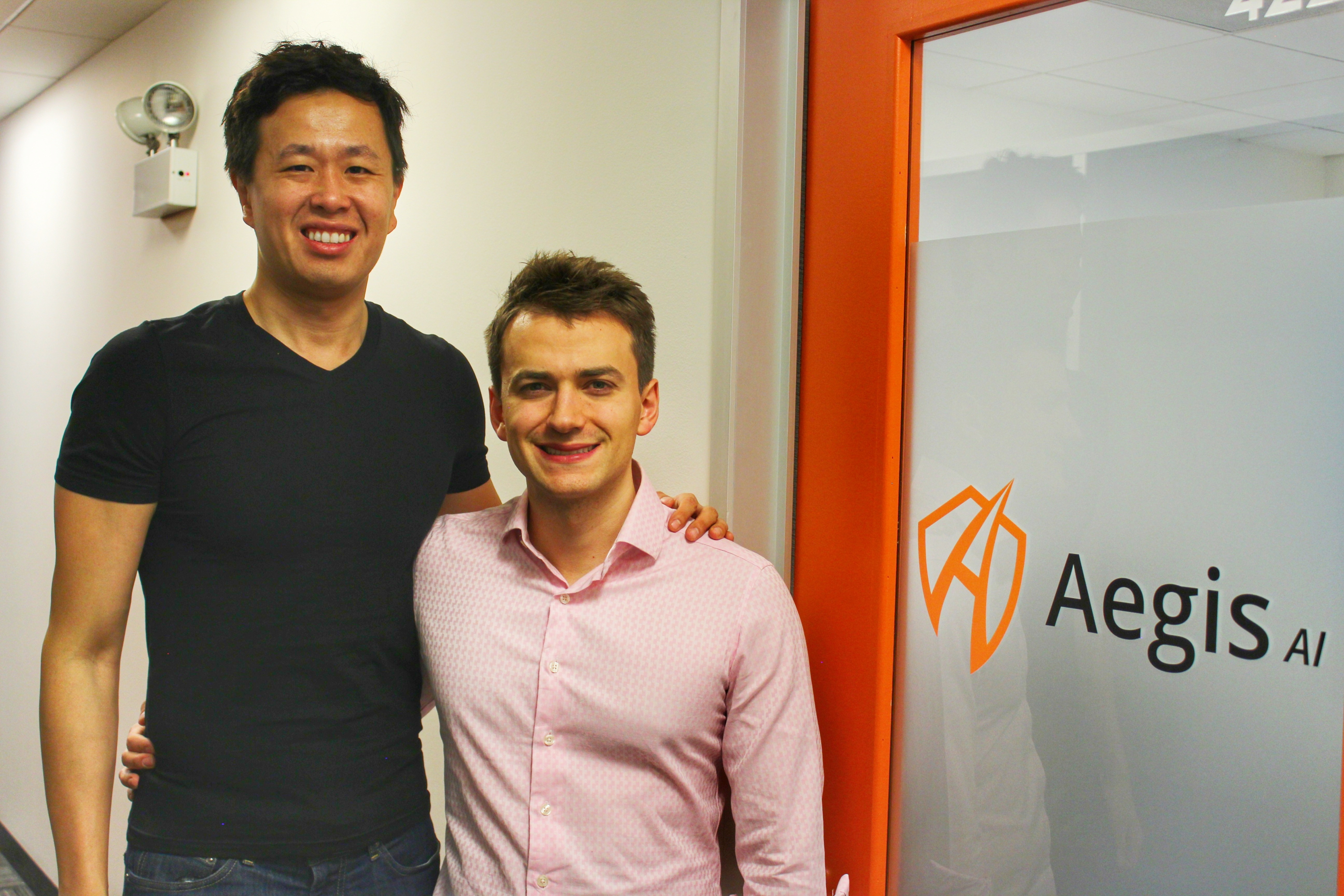
Aegis AI co-founders Sonny Tai (left) and Ben Ziomek

Lacking engineering expertise, Tai looked to Ziomek for technical support. Ziomek previously spent several years at Microsoft, most recently leading engineering and data science teams within the company’s AI program. Together they built Aegis, which is currently in the process of uprooting from Chicago to establish headquarters in New York City.

The pair spent 18 months building the technology they say can reliably recognize weapons in security camera footage. They had to take an “aggressive” data augmentation approach to develop the AI, Ziomek explains, as opposed to just scraping the web for images of weapons to feed to the platform.

“If you look at most of the state of the art computer vision models, they are really built specifically for the task of differentiating hundreds of different objects and the objects are very large,” Ziomek said. “We are looking for hard-to-see objects; we honed our system to look for small, dark objects in highly-complex scenes.”

“Traditionally — even if you’re working at Google or Microsoft — you scrape the internet for cats or hot dogs and you use a model based on that,” he added. “What happens when you do that same approach for weapons? You get product images, Instagram shots from people at the shooting range; all of these have no resemblance to real security camera footage.”

To teach its software to identify weapons, Aegis began by scrubbing the web for photos of weapons, then they reached out to key influencers in the personal safety space, who proved to be essential resources throughout the process. To complete the data collection process, they got their hands on real security footage and even took their own posed photos holding weapons to fill in any of the AI’s blind spots.

With a fresh bout of funding, Aegis will develop its technology to detect other threats, including bombs and vehicles.

01 Jul 2019

VCs bet on Aegis AI, a startup using computer vision to detect guns

A new startup using computer vision software to turn security cameras into gun-detecting smart cameras has raised $2.2 million in venture capital funding in a round led by Bling Capital, with participation from Upside Partnership and Tensility Venture Partners.

Aegis AI sells to U.S. corporations and school district its technology, which scans thousands of video feeds for brandished weapons and provides threat-detection alerts to customers within one second, for $30 per camera, per month. Coupling AI and cloud computing, Aegis integrates with existing camera hardware and video management software, requiring no on-site installation or maintenance.

“We can take over the role of a security guard with much higher accuracy at a much lower cost,” Aegis co-founder and chief product officer Ben Ziomek tells TechCrunch.

The financing round comes as a fresh cohort of businesses look to new technologies to protect against gun violence. AI-based gun detection is an unproven method, but investors and entrepreneurs alike are hopeful it represents a new era in threat-detection and safety. Seattle-based Virtual eForce, Israel’s AnyVision and Canadian tech startup SN Technologies are among the startups focused on improving security systems across the globe.

For Aegis co-founder and chief executive officer Sonny Tai, protecting against gun violence is personal. The first-time founder, who previously spent nearly a decade in the Marine Corps, grew up in South Africa where gun violence was all too common.

“We had a close family friend who was fatally shot in his own home 20 years ago,” Tai tells TechCrunch. “This prompted my mother to decide that we should immigrate to the U.S. On my end, it inspired a lifelong passion in me. I had to do something about the U.S. gun epidemic.”

IMG 9352 01 01

Aegis AI co-founders Sonny Tai (left) and Ben Ziomek

Lacking engineering expertise, Tai looked to Ziomek for technical support. Ziomek previously spent several years at Microsoft, most recently leading engineering and data science teams within the company’s AI program. Together they built Aegis, which is currently in the process of uprooting from Chicago to establish headquarters in New York City.

The pair spent 18 months building the technology they say can reliably recognize weapons in security camera footage. They had to take an “aggressive” data augmentation approach to develop the AI, Ziomek explains, as opposed to just scraping the web for images of weapons to feed to the platform.

“If you look at most of the state of the art computer vision models, they are really built specifically for the task of differentiating hundreds of different objects and the objects are very large,” Ziomek said. “We are looking for hard-to-see objects; we honed our system to look for small, dark objects in highly-complex scenes.”

“Traditionally — even if you’re working at Google or Microsoft — you scrape the internet for cats or hot dogs and you use a model based on that,” he added. “What happens when you do that same approach for weapons? You get product images, Instagram shots from people at the shooting range; all of these have no resemblance to real security camera footage.”

To teach its software to identify weapons, Aegis began by scrubbing the web for photos of weapons, then they reached out to key influencers in the personal safety space, who proved to be essential resources throughout the process. To complete the data collection process, they got their hands on real security footage and even took their own posed photos holding weapons to fill in any of the AI’s blind spots.

With a fresh bout of funding, Aegis will develop its technology to detect other threats, including bombs and vehicles.

01 Jul 2019

Samsung CEO calls Galaxy Fold mishap ‘embarrassing’

In a meeting with a group of journalists in South Korea, Samsung Electronics CEO DJ Koh candidly addressed the company’s latest hardware mishap. “It was embarrassing,” he told reporters, as quoted by The Independent. “I pushed it through before it was ready.”

That last bit no one can debate, really. After years of preamble, Samsung still managed to jump the gun with the Galaxy Fold. The company was eager to be the first major manufacture to market with the category’s most radical redesign in a decade. Ultimately, however, the company ended up pumping the breaks after multiple reviewers reported problems with their units.

Samsung was quick to place the blame at the hands of reviewers, but eventually shifted tacts after realizing that problems were more widespread. More than two months after the handset was initially expected to hit retail, we’re still very much in a holding pattern with Samsung’s first foldable. Though the company has promised a more concrete date for some time.

Samsung has been quick to deny any rumors that the phone has been altogether canceled, and Koh reiterated that the Fold is still being put through its paces. “I do admit I missed something on the foldable phone, but we are in the process of recovery,” the executive told the press. “At the moment, more than 2,000 devices are being tested right now in all aspects. We defined all the issues. Some issues we didn’t even think about, but thanks to our reviewers, mass volume testing is ongoing.”

Koh didn’t offer specifics with regards to a release date, though the company is reportedly gearing up to launch the next version of the Note at an event in August.

01 Jul 2019

Calm raises $27M to McConaughey you to sleep

Meditation app unicorn Calm wants you to doze off to the dulcet tones of actor Matthew McConaughey’s southern drawl or writer Stephen Fry’s english accent. Calm’s Sleep Stories feature that launched last year is a hit, with over 150 million listens from its 2 million paid subscribers and 50 million downloads. While lots of people want to meditate, they need to sleep. The 7-year-old app has finally found its must-have feature that makes it a habit rather than an aspiration.

Keen to capitalize on solving the insomnia problems plaguing people around the world, Lightspeed tells TechCrunch it has just invested $27 million into a Series B extension round in Calm alongside some celebrity angels at a $1 billion valuation. The cash will help the $70 per year subscription app further expand from guided meditations into more self-help masterclasses, stretching routines, relaxing music, breathing exercises, stories for children, and celebrity readings that lull you to sleep.

Calm App

The funding adds to Calm’s $88 million Series B led by TPG that was announced in Februay that was also at a $1 billion valuation, bringing the full B round to $115 million and it’s total funding to about $141 million. Lightspeed partner Nicole Quinn confirms the fund started talks with Calm around the same time as TPG, but took longer to finish due diligence, which is why the valuation didn’t grow despite Calm’s progress since February.

“Nicole and Lightspeed are valueable partners as we continue to double down on entertainment through our content” Calm’s head of communications Alexia Marchetti tells me. The startup plans to announce more celebrity content tie-ins later this summer.

Broadening its appeal is critical for Calm amidst a crowded meditation app market including Headspace, Simple Habit, and Insight Timer plus newer entrants like Peleton’s mindfulness sessions and Journey’s live group classes. It’s become easy to find guided meditations online for free, so Calm needs to become a holistic mental wellness hub.

While it risks diluting its message by doing so much, Calm plethora of services could make it a gateway to more of your personal health spend, including therapy, meditation retreats, and health merchandise from airy clothing to yoga mats. But subscription fees alone are powering a big business. Calm quadrupled  revenue in 2018 to reach $150 million in annual revenue and profitability.

That revenue is poised to keep up it’s rapid growth. After the launch of Sleep Stories, “it was incredible to see the engagement spike up and also the retention” says Quinn. Users can choose from having McConaughey describe the wonders of the cosmosm, John McEnroe walk you through the rules of tennis, fairy tales like The Little Mermaid, and more.

Quinn tells me “Sleep Stories is now a huge percentage of the business, and also the length of time people spend on the app has gone up dramatically.” She tells me that so many startups are “trying to invent a problem where there isn’t one.” But difficulty snoozing is so widespread and detrimental that users are eager to pay for an app instead of a sleeping pill.

01 Jul 2019

Video platform Kaltura adds advanced analytics

You may not be familiar with Kaltura‘s name, but chances are you’ve used the company’s video platform at some point or another, given that it offers a variety of video services for enterprises, educational institutions and video on demand platforms, including HBO,  Phillips, SAP, Stanford and others. Today, the company announced the launch of an advanced analytics platform for its enterprise and educational users.

This new platform, dubbed Kaltura Analytics for Admins, will provide its users with features like user-level reports. This may sound like a minor feature, since you probably don’t care about the exact details of a given user’s interactions with your video, but it will allow businesses to link this kind of behavior to other metrics. With this, you could measure the ROI of a given video by linking video watch time and sales, for example. This kind of granularity wasn’t possible with the company’s existing analytics systems. Companies and schools using the product will also get access to time period comparisons to help admins identify trends, deeper technology and geolocation reports, as well as real-time analytics for live events.

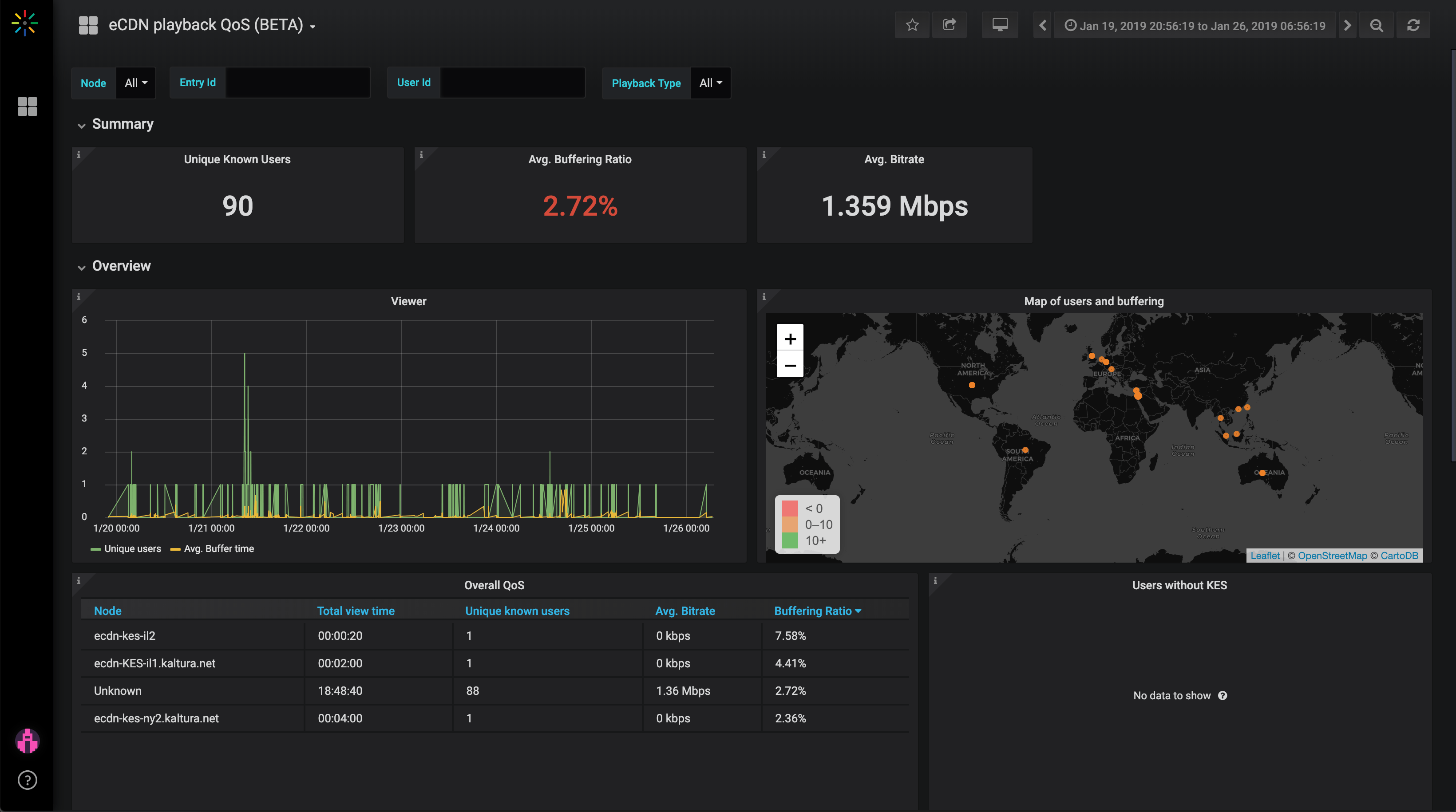
eCDN QoS dashboard

“Video is a unique data type in that it has deep engagement indicators for measurement, both around video creation – what types of content are being created by whom, as well as around video consumption and engagement with content – what languages were selected for subtitles, what hot-spots were clicked upon in video,” said Michal Tsur, President & General Manager of Enterprise and Learning at Kaltura. “Analytics is a very strategic area for our customers. Both for tech companies who are building on our VPaaS, as well as for large organizations and universities that use our video products for learning, communication, collaboration, knowledge management, marketing and sales.”

Tsur also tells me that the company is looking at how to best use machine learning to give its customers even deeper insights into how people watch videos — and potentially even offer predictive analytics in the long run.