Category: UNCATEGORIZED

27 Jun 2019

Former Anki engineers will steer Waymo’s self-driving trucks effort

More than a dozen engineers, who lost their jobs after consumer robotics startup Anki shut down in April, have found a new home.

The 13 robotics experts, a group that includes Anki’s co-founder and former CEO Boris Sofman, are heading over to self-driving vehicle company Waymo, to lead engineering in the autonomous trucking division, according to a LinkedIn post. Sofman will report to CTO Dmitri Dolgov.

The group of engineers comprises nearly the entire technical team at Anki, many of whom have roots at Carnegie Mellon University’s robotics program, and includes its former behavior lead Brad Neuman and perception lead Andrew Stein. Anki’s head of hardware Nathan Monson and its former program manager Charlie Hite have also joined Waymo.

Axios was the first to report the move.

Anki built several popular products, starting with Anki Drive in 2013 and later the popular Cozmo robot. The Bay Area-startup had shipped more than 3.5 million devices with annual revenues approaching $100 million, Sofman wrote Thursday in a LinkedIn post.

Anki had raised more than $180 million, according to Crunchbase. The company was apparently prepared to take its robots business beyond entertainment, but it ran out of runway before it was able to activate that plan. “In the end we couldn’t overcome recent hurdles and the complexities of consumer hardware,” Sofman wrote.

Anki was a consumer robots company, which would seem like a bit of a leap over to Waymo. However, Sofman noted that it was autonomous driving that “first sparked” his attraction to the field and was the focus of his thesis at Carnegie Mellon.

“Throughout the last decade, I would look over at what was happening at Waymo and be inspired by the progress they were making, and the inevitable impact their technology would have on everyone’s lives in the years to come,” Sofman wrote.

The trucking team will work out of Waymo’s San Francisco office, a newer development within the company’s structure.

Much of the attention on Waymo has been on its robotaxi ambitions and its Waymo One ride-hailing service in the Phoenix area. However, the company has intentions to apply its full self-driving stack to other commercial applications, including trucks and deliveries.

“The nice thing about all those properties is that while the specialization layer are very different, the core technology, and the hardest problems that you’re trying to solve on research and engineering are exactly the same,” Dolgov said during an interview in March at MIT Tech Review’s EmTech Digital conference.

27 Jun 2019

We’re talking Kubernetes at TC Sessions: Enterprise with Google’s Aparna Sinha and VMware’s Craig McLuckie

Over the past five years, Kubernetes has grown from a project inside of Google to an open source powerhouse with an ecosystem of products and services, attracting billions of dollars in venture investment. In fact, we’ve already seen some successful exits, including one from one of our panelists.

On September 5th at TC Sessions: Enterprise, we’re going to be discussing the rise of Kubernetes with two industry veterans. For starters we have Aparna Sinha, director of product management for Kubernetes and the newly announced Anthos product. Sinha was in charge of several early Kubernetes releases and has worked on the Kubernetes team at Google since 2016. Prior to joining Google, she had 15 years experience in enterprise software settings.

Craig McLuckie will also be joining the conversation. He’s one of the original developers of Kubernetes at Google. He went on to found his own Kubernetes startup, Heptio, with Joe Beda, another Google Kubernetes alum. They sold the company to VMware last year for $505 million after raising $33.5 million, according to Crunchbase data.

The two bring a vast reservoir of knowledge and will be discussing the history of Kubernetes, why Google decided to open source it and how it came to grow so quickly. Two other Kubernetes luminaries will be joining them. We’ll have more about them in another post soon.

Kubernetes is a container orchestration engine. Instead of developing large monolithic applications that sit on virtual machines, containers run a small part of the application. As the components get smaller, it requires an orchestration layer to deliver the containers when needed and make them go away when they are not longer required. Kubernetes acts as the orchestra leader.

As Kubernetes, containerization and the cloud-native ethos it encompasses has grown, it has helped drive the enterprise shift to the cloud in general. If you can write your code once, and use it in the cloud or on prem, it means you don’t have to manage applications using different tool sets and that has had broad appeal for enterprises making the shift to the cloud.

TC Sessions: Enterprise (September 5 at San Francisco’s Yerba Buena Center) will take on the big challenges and promise facing enterprise companies today. TechCrunch’s editors will bring to the stage founders and leaders from established and emerging companies to address rising questions, like the promised revolution from machine learning and AI, intelligent marketing automation and the inevitability of the cloud, as well as the outer reaches of technology, like quantum computing and blockchain.

Tickets are now available for purchase on our website at the early-bird rate of $395; student tickets are just $245.

Student tickets are just $245 – grab them here.

We have a limited number of Startup Demo Packages available for $2,000, which includes four tickets to attend the event.

For each ticket purchased for TC Sessions: Enterprise, you will also be registered for a complimentary Expo Only pass to TechCrunch Disrupt SF on October 2-4.

27 Jun 2019

Trump’s tweets likely to be impacted by Twitter’s new ‘abusive behavior’ notice

Twitter didn’t name any names with today’s new feature news, but one extremely online user loomed large over the announcement. The company took to its Safety blog to announce the addition of a new “abusive behavior” label that users will have to click through to access content.

This isn’t just any content warning, though. It applies to a pretty exclusive club of users whose writing breaks the company’s anti-abuse rules, but whose comments are still deemed part of “the public conversation.” In order to apply, they must,

  • Be or represent a government official, be running for public office, or be considered for a government position (i.e., next in line, awaiting confirmation, named successor to an appointed position)

  • Have more than 100,000 followers

  • Be verified.

Granted, the state of public discourse in 2019 and in the lead up to next year’s election will almost certainly ensure that a number of people fall squarely in the center of that Venn diagram, but Twitter probably could have saved a few paragraphs by just calling this one “Trump’s Law.” Jack Dorsey and other execs have clearly been extremely uncomfortable with the position the President has placed them in by regularly saber rattling and name calling on the site.

The new feature will look like other sensitive material notices on the platform, with the option to click through to read the content. It will show up in safe search, Top Tweets, push notifications and a few other places. Tweets sent before today will not be subject to the new feature.

The move is sure to stir up feelings amongst politicians already crying foul against perceived social media bias, and Twitter says it will “continue to evaluate how our rules and enforcement actions can be clearer and keep working to make our decision-making easier to understand.” Republican politicians have regularly called out Twitter, Facebook and other sites for “shadow banning” and other instances and what they believe to be a liberal Silicon Valley bias.

27 Jun 2019

A Boston startup developing a nuclear fusion reactor just got a roughly $50 million boost

After twenty five years of research, scientists at the Massachusetts Institute of Technology think that they have finally cracked the code for the commercialization for nuclear fusion reactions.

Commonwealth Fusion Systems is the fruit of that research. It’s a startup building on decades of research and development that plans to harness the power of the sun to create a cleaner, stable source of energy for consumers. And the company just raised another $50 million in funding from some of the country’s deepest pocketed private investors to continue on its path to commercialization.

The company unveiled its technology and a first $64 million in financing from investors including the Italian energy company, Eni; Breakthrough Energy Ventures, the investment consortium established by the world’s richest men and women, and The Engine, MIT’s own investment vehicle for frontier technologies.

Now Future Ventures, the investment firm created by Steve Jurvetson, Khosla Ventures, Chris Sacca’s Lowercase Capital, Moore Strategic Ventures, Safar Partners, Schooner Capital and Starlight Ventures.

Commonwealth Fusion Systems began as a student project in 2014 whose goal was to reduce the cost of nuclear fusion. The class, which was taught by Dennis Whyte, who is the head of MIT’s Plasma Science and Fusion Center, came up with a new reactor technology they called the ARC (standing for “affordable, robust, compact”). That technology still came in with a few billion dollar price tag — something that would make most investors balk.

So the class went back to the drawing board, trying to come up with a minimum viable product that could produce a net energy gain (with more energy coming out of the reaction than was put in).

Net energy gain is the real sticking point for most nuclear fusion technologies. A few research institutions and projects have been able to achieve a fusion reaction, but maintaining it and getting more power out than was put in has been elusive.

In Europe, the ITER reactor, a $20 billion, multi-national effort, is 60% of the way toward its 2045 target for generating energy. Closer to home, startups like TAE Technologies and General Fusion are two other North American entrants looking at lower-cost ways to generate fusion power. And in the UK, First Light Fusion and Tokamak Energy are trying to put their own spin on fusion power.

For Bob Mumgaard, the chief executive of Commonwealth Fusion Systems, everything appears to be proceeding according to plan. on track. “CFS is on track to commercialize fusion and deliver an inherently safe, globally scalable, carbon-free, and limitless energy source,” he said in a statement.

Commonwealth Fusion expects to have its smallest possible reactor built by 2025 thanks to the research that MIT has done on proprietary magnet technology that the company uses to confine its nuclear reaction. In fact, most of the financing will go toward construction of the full scale magnet technology Commonwealth Fusion uses to contain its reactions.

The ultimate goal is to build a fusion reactor that can generate 50 megawatts of energy either as heat or to create electricity using a steam turbine.

Unlike fusion reactors, which have significant environmental risks, a fusion power plant would be regulated in much the same way as any industrial facility, says Mumgaard. “The hazard profile of fusion continues to put it in [the category of] an industrial facility. The laws exist, but we haven’t gone out and built the plant yet, so no one has the precedent.”

Mumgaard envisions a 200 megawatt scale reactor that could slot into the place of a wind farm or solar power plant.

“You have to keep track of moving towards vs. going to get to,” he says. “The consensus is we do not have a solution in hand for deep decarbonization of the electricity grid. if you look at where the biggest gains even in renewables.. the biggest gains are in the utility scale were you’re talking hundreds of megawatts of power per site.”

Renewable energy alone will not be enough to meet the demand that’s coming from modern metropolises, according to Mumgaard. “There is huge demand for concentrated energy to power the modern lifestyle.

Public opinion on the issue is increasingly divided — especially among nuclear opponents who count themselves as part of the Sunrise Movement behind the Green New Deal that’s been the talk of the town in energy policy circles. But most energy analysts  argue for a blended approach and say that to get to zero carbon emissions (the ultimate goal for the scientific community), nuclear power will need to be incorporated into the mix.

“We have been looking for the right clean energy investment opportunity in fusion for the past 20 years, said Steve Jurvetson, chief executive of Future Ventures, in a statement. “We wanted a company that was ready to make a business of fusion and we have finally found it with Commonwealth Fusion Systems. The hard science from which their approach is based has been proven by this team as well as leaders in the field around the world.  With some clever engineering, CFS is ready to harness the power of the solar cycle to change the world and usher in the era of clean baseload energy generation for the betterment of all.”


27 Jun 2019

Assistive technologies will be a $26 billion dollar market, and investors are only now addressing it

Rohan Silva is obsessed with social mobility and why certain groups are so under-represented in the technology industry.

He co-founded Second Home, a coworking space looking to bring together disparate civic-minded, cultural, creative and commercial entrepreneurs at sites in Lisbon, London and (now) Los Angeles, and he has spent years examining how gender, race and class impact access to technology as a now-reformed politician. Throughout that work though, one area that he says he overlooked was accessibility and entrepreneurship focused on people with disabilities.

“At Second Home, we pride ourselves on having a diverse community. I can count on one hand the number of founders with disabilities we have in our community, so there is definitely something going profoundly wrong,” Silva says.

Enlisting the help of the European venture capital fund Atomico, Silva has set up a micro-investment fund of £100,000 to tackle the problem.

“It’s a large amount compared to what I have and a small amount compared to most venture capital funds,” he explains. “The much bigger prize here is the ability to fund technologies that have the opportunities to improve the lives of people with disabilities.”

Silva isn’t alone. Organizations like Not Impossible Labs, a Los Angeles-based company, and startups like OrCam Technologies, eSight, B-Temia, Kinova Robotics, Open Bionics, Voiceitt and Whill are harnessing technology to bring solutions to people with disabilities across the world.

27 Jun 2019

Mozilla previews a redesigned and faster Firefox for Android

Mozilla today announced the first preview of a redesigned version of Firefox for Android that promises to be up to two times faster. The new version also introduces an easier to use and rather minimalist user interface, as well as support for collections, Mozilla’s new take on bookmarks. The new browser also features Firefox’s tracking protection, which is on by default. Over time, this preview will become the default Firefox for Android.

A few years ago, with Quantum, the Firefox team make a number of under-the-hood improvements to the browser’s core backend technologies. Now, it is doing something similar with GeckoView, Mozilla’s browser engine for Android. Implementing the technology the team developed for this in the browser now “paves the way for a complete makeover of the mobile Firefox experience,” the organization writes in today’s announcement.

“While all other major Android browsers today are based on Blink and therefore reflective of Google’s decisions about mobile, Firefox’s GeckoView engine ensures us and our users independence,” says the Firefox team. “Building Firefox for Android on GeckoView also results in greater flexibility in terms of the types of privacy and security features we can offer our mobile users.”

An early version of Firefox with GeckoView is now available for testing on Android under the Firefox Preview moniker. Mozilla notes that the user experience will sill change quite a bit before it is final.

Screenshot 20190627 081245When you first launch it, Preview opens up a new default experience that lets you sign in to a Firefox account, decide on whether you want a light or dark theme (or have the system switch automatically depending on the time of day), turn on privacy features and more.

One feature I really appreciate is that, by default, the preview puts the URL bar at the bottom of the screen, so that it’s within easy reach of your thumb. If you swipe up on the URL bar, you get both a share and bookmark icon, too. That takes some getting used to but quickly becomes second nature.

I haven’t run any formal benchmarks, but the preview definitely feels significantly snappier and smoother than any previews Firefox version on Android, up to the point where I wouldn’t hesitate to make it my default browser on mobile, especially given its built-in privacy features. I haven’t run into any hard crashes so far either, but this is obviously a beta version, so your mileage may vary.

For the rest of the year, the team will focus on optimizing the preview for all Android devices, but for now, it’s already worth a look if you’re looking to play with a new mobile browser on your Android device and not afraid of the occasional bug.

image004

27 Jun 2019

Waymo starts self-driving pick-ups for Lyft riders

Autonomous driving company Waymo has launched its tie-in with Lyft, using a “handful” of vehicles to pick up riders in its Phoenix testing zone, per CNBC. To be eligible, Lyft users requesting a ride have to be doing a trip that both starts and ends in the area of Phoenix that it’s already blocked for for its own autonomous testing.

The number of cars on the road is less than 10, since Waymo plans to eventually expand to 10 total for this trial but isn’t there yet. Those factors combined mean that the number of people who’ll get this option probably isn’t astronomical, but when they are opted in, they’ll get a chance to decide whether to go with the autonomous option via one of Waymo’s vans (with a safety driver on board) or just stick with a traditional Lyft .

Waymo and Lyft announced their partnership back in May, and the company still plans to continue operating its own Waymo One commercial autonomous ride-hailing service alongside the Lyft team-up.

27 Jun 2019

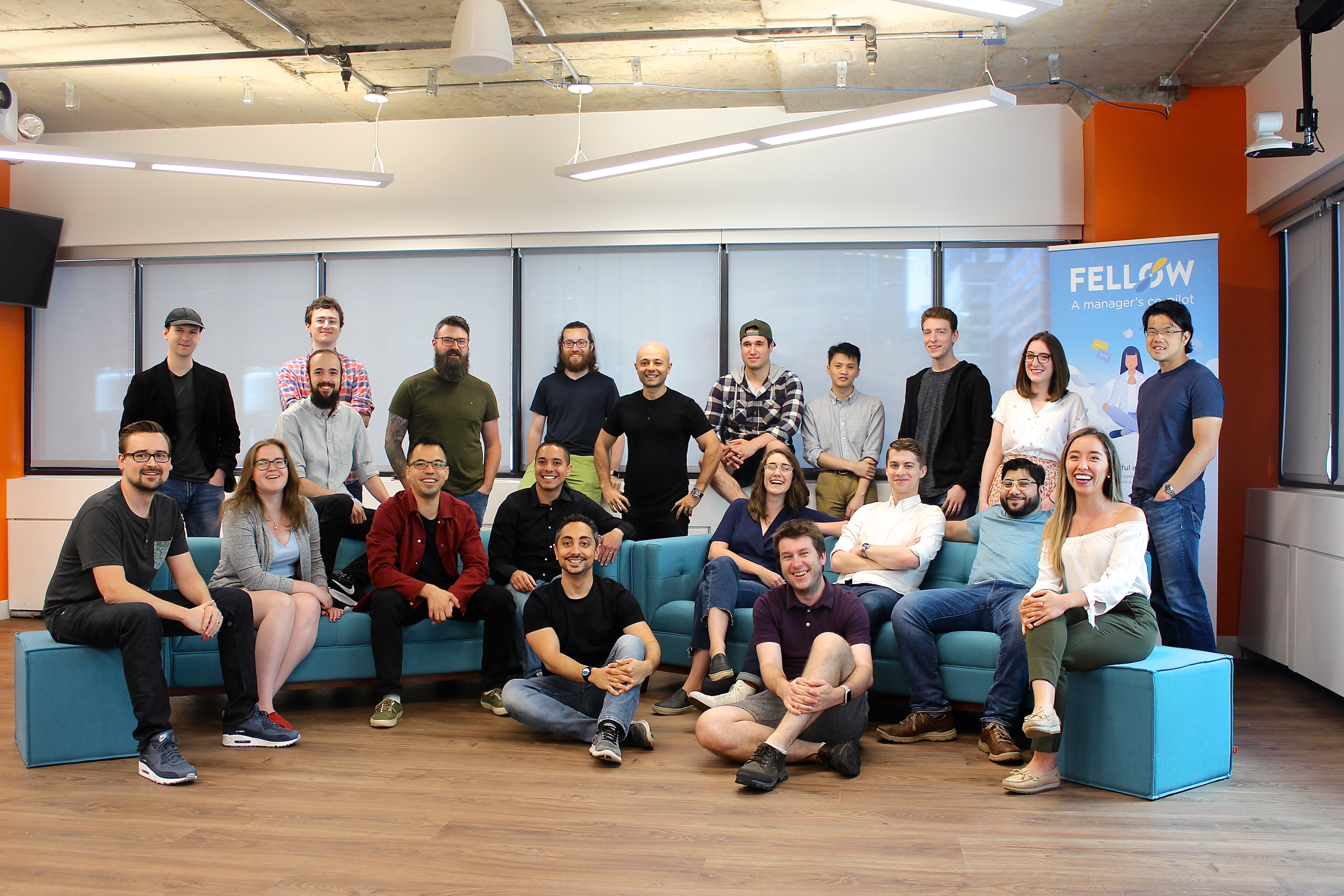
Fellow raises $6.5M to help make managers better at leading teams and people

Managing people is perhaps the most challenging thing most people will have to learn in the course of their professional lives – especially because there’s no one ‘right’ way to do it. But Ottawa-based startup Fellow is hoping to ease the learning curve for new managers, and improve and reinforce the habits of experienced ones with their new people management platform software.

Fellow has raised $6.5 million in seed funding, from investors including Inovia Capital, Felicia Ventures, Garage Capital and a number of angels. The funding announcement comes alongside the announcement of their first customers, including Shopify (disclosure: I worked at Shopify when Fellow was implemented and was an early tester of this product, which is why I can can actually speak to how it works for users).

The Fellow platform is essentially a way to help team leads interact with their reports, and vice versa. It’s a feedback tool that you can use to collect insight on your team from across the company; it includes meeting supplemental suggestions and templates for one-on-ones, and even provides helpful suggestions like recommending you have a one-on-one when you haven’t in a while; and it all lives in the cloud, with integrations for other key workplace software like Slack that help it integrate with your existing flow.

Fellow co-founder and CEO Aydin Mirzaee and his co-founding team have previous experience building companies: They founded Fluidware, a survey software company, in 2008 and then sold it to SurveyMonkey in 2014. In growing the team to over 100 people, Mirzaee says they realized where there were gaps, both in his leadership team’s knowledge and in available solutions on the market.

“Starting the last company, we were in our early 20s, and like the way that we used to learn different practices was by using software, like if you use the Salesforce, and you know nothing about sales, you’ll learn some things about sales,” Mirzaee told me in an interview. “If you don’t know about marketing, use Marketo, and you’ll learn some things about marketing. And you know, from our perspective, as soon as we started actually having some traction and customers and then hired some people, we just got thrown into it. So it was ‘Okay, now, I guess we’re managers.’ And then eventually we became managers of managers.”

Fellow Team Photo 2019

Mirzaee and his team then wondered why a tool like Salesforce or Marketo didn’t exist for management. “Why is it that when you get promoted to become a manager, there isn’t an equivalent tool to help you with that?” he said.

Concept in hand, Fellow set out to build its software, and what it came up with is a smartly designed, user-friendly platform that is accessible to anyone regardless of technical expertise or experience with management practice and training. I can attest to this first-hand, since I was a first-time manager using Fellow to lead a team during my time at Shopify – part of the beta testing process that helped develop the product into something that’s ready for broader release. I was not alone in my relative lack of management knowledge, Mirzaee said, and that’s part of why they saw a clear need for this product.

“The more we did research, the more we figured out that obviously, managers are really important,” he explained. “70% of customer engagements are due to managers, for instance. And when people leave companies, they tend to leave the manager, not the company. The more we dug into it the more it was clear that there truly was this management problem –  management crisis almost, and that nobody really had built a great tool for managers and their teams like.”

Fellow’s tool is flexible enough to work with specific management methodologies like setting SMART goals or OKRs for team members, and managers can use pre-set templates or build their own for things like setting meeting talking points, or gathering feedback from the colleagues of their reports.

Right now, Fellow is live with a number of clients including Shoify, Vidyard, Tulip, North and more, and it’s adding new clients who sign up on a case-by-case basis, but increasing the pace at which it onboard new customers. Mirzaee explained that it hopes to open sign ups entirely later this year.

27 Jun 2019

Fungible raises $200 million led by SoftBank Vision Fund to help companies handle increasingly massive amounts of data

Fungible, a startup that wants to help data centers cope with the increasingly massive amounts of data produced by new technologies, has raised a $200 million Series C led by SoftBank Vision Fund, with participation from Norwest Venture Partners and its existing investors. As part of the round, SoftBank Investment Advisers senior managing partner Deep Nishar will join Fungible’s board of directors.

Founded in 2015, Fungible now counts about 200 employees and has raised more than $300 million in total funding. Its other investors include Battery Ventures, Mayfield Fund, Redline Capital and Walden Riverwood Ventures. Its new capital will be used to speed up product development. The company’s founders, CEO Pradeep Sindhu and Bertrand Serlet, say Fungible will release more information later this year about when its data processing units will be available and their on-boarding process, which they say will not require clients to change their existing applications, networking or server design.

Sindu previously founded Juniper Networks, where he held roles as chief scientist and CEO. Serlet was senior vice president of software engineering at Apple before leaving in 2011 and founding Upthere, a storage startup that was acquired by Western Digital in 2017. Sindu and Serlet describe Fungible’s objective as pivoting data centers from a “compute-centric” model to a data-centric one. While the company is often asked if they consider Intel and Nvidia competitors, they say Fungible Data Processing Units (DPU) complement tech, including central and graphics processing units, from other chip makers.

Sindhu describes Fungible’s DPUs as a new building block in data center infrastructure, allowing them to handle larger amounts of data more efficiently and also potentially enabling new kinds of applications. Its DPUs are fully programmable and connect with standard IPs over Ethernet local area networks and local buses, like the PCI Express, that in turn connect to CPUs, GPUs and storage. Placed between the two, the DPUs act like a “super-charged data traffic controller,” performing computations offloaded by the CPUs and GPUs, as well as converting the IP connection into high-speed data center fabric.

This better prepares data centers for the enormous amounts of data generated by new technology, including self-driving cars, and industries such as personalized healthcare, financial services, cloud gaming, agriculture, call centers and manufacturing, says Sindu.

In a press statement, Nishar said “As the global data explosion and AI revolution unfold, global computing, storage and networking infrastructure are undergoing a fundamental transformation. Fungible’s products enable data centers to leverage their existing hardware infrastructure and benefit from these new technology paradigms. We look forward to partnering with the company’s visionary and accomplished management team as they power the next generation of data centers.”

27 Jun 2019

250 retailers will compete against Amazon’s Prime Day, up from 194 last year

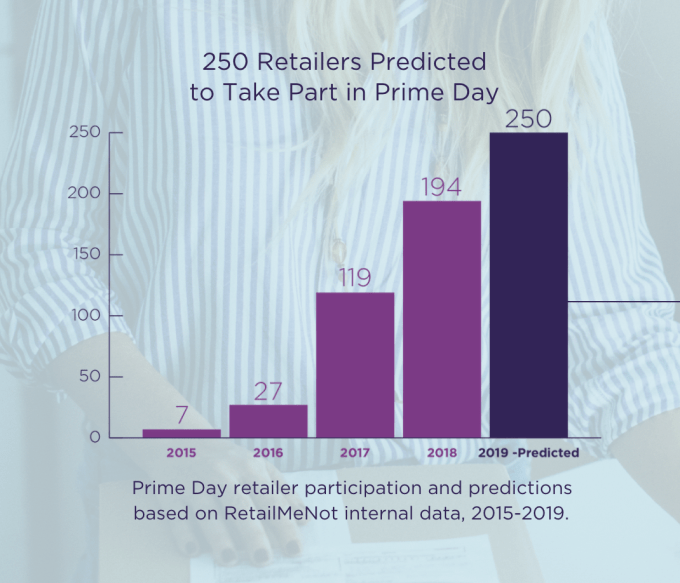
Amazon’s Prime Day event, now in its fifth year, is no longer just a big sales day for Amazon — it’s become the official kickoff to back-to-school shopping season and a new sales holiday that extends across the web among rival retailers. And those retailers’ competitive response to Prime Day is bigger than ever this year, according to a new report from RetailMeNot. In 2019, the firm estimates that 250 retailers will take part in Prime Day by offering deals of their own. That’s up from 194 last year, and up from just 7 retailers on Amazon’s first Prime Day in 2015.

Screen Shot 2019 06 27 at 10.46.07 AM

The increased participation may be related in part to the size of Amazon’s sale this year. Prime Day has been stretched out over the years. In 2018, for example, Prime Day became a 36-hour sale and, at the time, the biggest shopping event in Amazon’s history.

But more retailers today are aware that offering an alternative sale will bring in the shoppers, similar to how Black Friday and Cyber Monday sales also do.

Walmart, for example, is readying its answer to Prime Day by offering deals over a longer period of time than Amazon’s now 48-hour Prime Day 2019 event. Instead, of two days, the rival retailer is going for four. Walmart says it will offer “thousands” of special deals and Rollbacks starting on July 14 — the day before Prime Day starts. And these will continue until July 17, the day after Prime Day ends.

Walmart hasn’t announced what deals are in the works as of yet, beyond an HP 15.6″ HD Touch Display Laptop for $429 (currently $447), and the Dyson Multifloor Bagless Upright Vacuum for $154.00 (currently $175).

Target, meanwhile, is prepping its own answer to Prime Day with its biggest summer sale, Target Deal Days, which will take place concurrently with Prime Day (July 15-16). The retailer says it also will feature “thousands” of deals both online and in its app, with new deals each day. These deals haven’t yet been announced, either, but will expand across home, apparel, toys, and more, and will include both Target’s own brands and national brands.

While Prime Day brings the traffic and the sales, there’s some hint that the sale itself could be improved.

Based on RetailMeNot’s survey, 64% of shoppers are hoping that Amazon provides better deals on items this year, 58% want a greater selection, and 54% want more time to take advantage of deals. Nearly all also say they hope the overall Prime Day shopping experience this year is improved.

Back-to-school shoppers and parents will be dropping some cash on Prime Day, too, the report additionally found. 64% of parents say they’ll participate in Prime Day 2019 and will shop at 11 retailers, on average. Parents also plan to spend $162 on Prime Day and complete around 35% of their total back-to-school shopping during that time.