Category: UNCATEGORIZED

21 Jun 2019

Google Pay expands its integration with PayPal to online merchants

Google and PayPal have been strategic partners for some time. The companies in 2017 announced that PayPal would become a payment method in Android Pay, the service that later rebranded as Google Pay. Last year, users who added PayPal as a payment method on Google Pay could then pay for services like Gmail, YouTube, Google Play, and Google Store purchases via a PayPal option in Google Pay. Now, a similar integration is making its way to online merchants who accept Google Pay on their website or mobile app.

Explains Google, hundreds of millions of customers already have payment methods saved to their Google Account — including in some cases, PayPal, thanks to the 2018 integration.

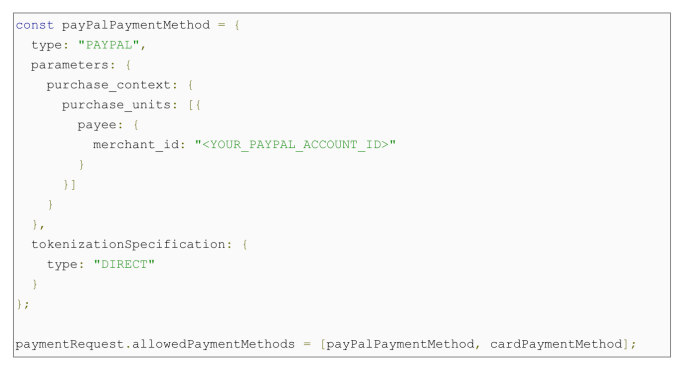
With this expanded integration, merchants can opt to enable PayPal as a payment method in their own Google Pay integration — something that’s easily done if Google Pay has already been implemented on their site. All that’s required is only a small code change to the list of allowed payment methods. (See below).

At that point forward, any online shopper who wants to check out using Google Pay will have the option of selecting PayPal to make the purchase.

The benefit of this integration for consumers is that they won’t have to sign in to PayPal when they use it through Google Pay, which cuts down the number of steps to take at checkout. That, in turn, can increase conversions. They’ll also have access to PayPal’s Purchase Protection and Return Shipping benefits.

For online merchants who are also PayPal merchants, when a customer selects PayPal through Google Pay, the merchant receives the money in their PayPal Business Account within minutes.

PayPal’s embrace of its one-time competitors like Apple and Google actually began several years ago, and is still gaining ground as the technology platforms better integration its service.

The company began teaming up with rivals like Visa, MastercardAppleGoogleSamsung and Walmart, to help it achieve better traction both at point-of-sale in retail stores, and within the popular mobile wallets offered by mobile OS platform makers, Apple, Google, and Samsung. Today, PayPal lives alongside other payment cards — like credit and debit cards — inside these mobile wallets.

For merchants who want to offer a variety of checkout methods, they can add support for the digital wallet platforms themselves, and PayPal simply comes along for the ride.

The PayPal option for Google Pay works in all 24 countries where customers can link a PayPal account to Google Pay,

21 Jun 2019

What money should be

With the release of the Facebook consortium’s project Libra whitepaper, the internet, tech world, financial services industry and policy circles are all burning with conversation on the project’s potential. We are still very early into Libra’s life — it is, after all, still a proposal — and there is an endless set of questions left to answer. The project could redefine how we view money or it could be a complete failure; we won’t know which for years to come.

While there isn’t much to add to the (likely thousands) of pundit takes on the project until more details come out, this moment does provide us with an opportunity to step back and take a look at money itself. We should be asking ourselves: how does money work today and how should it work?

Money is an anachronistically analog part of everyday life. The last 25 years saw the digitization of most services businesses, from communications (email) to bookstores (Amazon) to taxis (Uber). Yet, even with the rise of fintech and significant innovation in consumer finance, money itself has remained curiously unchanged.

The future of money is just beginning.

There are good reasons for money to have remained unchanged. Currencies are controlled and issued by states, and for many reasons, they need to be controlled and issued by states. But the reasons are a reflection of the “facts on the ground” today. Money is too sensitive and too critical to allow for the same level of disruptive innovation we’ve seen in other assets. But if we were to design money de novo today from a Rawlsian original position, it would probably look pretty different.

Libra gives us an opportunity to talk more openly not just about what money is, but about what money should be. And regardless of what happens with Libra — which faces regulatory and competitive headwinds — the moment won’t be wasted if we take this time to contemplate the future of money. Below are some (not collectively exhaustive) starting ideas for that conversation, from the most basic to the more exotic.

Money should be free

Let’s start with the most obvious: put simply, it shouldn’t cost anyone money to use money. Financial institutions and fintechs are (slowly) moving toward this consensus, but in many cases, people still have to pay just to access their money.

ATMs charge fees for withdrawals. Checks cost money to print (and for those who feel the U.S. is moving past them, 90% of checks are still written in the U.S.). Foreign remittances incur transfer fees, bank-to-bank wires incur fees, check-cashing incurs fees, paying vendors with PayPal incurs fees, etc. etc.

The early promise of apps like Venmo, Square Cash and WeChat Pay (and earlier, Clinkle) is to let people transfer and use their money at no cost. Apple Pay and Google Pay take that promise a step further by making the phone — not the dollar — the primary instrument for in-person purchases — all at no cost to debit directly from a bank or credit card account.

But these apps have no equivalent in many countries. While mobile money services like M-Pesa have been ubiquitously successful in Kenya and neighboring countries, countries like Nigeria — Africa’s largest economy — still have significant cost of cash problems and expensive policy restrictions on the use of cash. I ran into many “Unable to dispense cash” error messages in my time in east Africa, where just having a bank account could incur non-trivial costs.

Incurring a fee just to use money is an outdated standard.

Money should transfer instantly

To most people reading this, the difference between instant payments and those that take a couple of days is not significant. A paycheck could come on Friday or Monday. A Venmo cashout can take a day or two to hit a bank account.

But as Aaron Klein at Brookings notes, slow payments disproportionately affect poor people. The time it takes for a check to clear, for remittance funds to settle or for payroll to be deposited can mean the difference between paying a bill and incurring an overdraft fee. It can mean not having enough money for weekend grocery shopping. These realities drive consumers to turn to payday lenders ($7 billion in annual fees), check cashers ($2 billion) or overdraft fees ($24 billion!).

Identity should be programmed into money.

As NPR noted when they waited for a Kickstarter payment, “We just need Amazon’s bank to send money electronically to a checking account at Chase bank. It’s just information traveling over wires. How long could it take: A minute? An hour? It took five days.” That is because the rails on which money is moved in the U.S. are more than 40 years old. As Klein notes, you can now send money more quickly from Slovakia to France than DC to Philly — and fixing this delay could be the single fastest way to combat wealth inequality in the United States.

This is another obvious easy win for the future of money.

And signs of that future are emerging. Apps like Earnin and employers like Walmart are paying workers in real time, to allow people to use their money as soon as they earn it. Libra’s own website opines that getting and using money “should be as easy and cheap as sending a text message.” Money should move at the speed of communications.

Money should take ‘one click’ to use

Amazon is notorious for pursuing one-click purchase technology, removing the last small obstacles between consumers and their buying decisions. Money should be no different: moving money to savings, sending it to a friend, making a loan or investment, paying a bill — these activities could all use a more frictionless UI upgrade. Unfortunately, today, accessing your money frequently requires a string of passwords, PINs, IDs or 2FA — all absolutely critical for security, but friction-inducing.

Fortunately, digital identity systems have been a ripe area for innovation in the past few years. Smartphone OS’s now allow people to use biometric identifiers — like fingerprints or Face ID — to authorize the use of their money, with mixed success. Decentralized identity systems like 3Box sell the promise of one universal, self-owned ID profile that can be used to permission any service built on top of it (including financial ones).

Identity should be programmed into money. If units of currency can have an “ownership” field, that field can be unlocked using more frictionless identifiers tied to the user and then re-coded when ownership is changed, making one-click use possible. (This could operate similarly to Everledger’s diamond registration program.) This could also prevent theft: If the “ownership” identity field is secure enough only to be altered in legitimate transfers, money could also be programmed to be unusable if that field is transferred improperly (i.e. stolen). This brings up a related point…

Money should be secure

One of the cities with the fastest rate of mobile payments adoption is Mogadishu, Somalia. Why? Because mobile money is safe — in Mogadishu, where muggings are frequently deadly, carrying cash can be a matter of life or death. The future of money is one in which physical theft is no longer possible because money is securely digitized.

Money should be stable

While theft drives mobile money adoption in Somalia, a BBC report titled The surprising place where cash is going extinct found a different driver of cashless payments in neighboring Somaliland: hyperinflation. The rapidly devaluing Somaliland shilling has made goods that were previously affordable two times as expensive in as many years, leading shoppers to opt for mobile dollars over bundles of cash.

This is one of the expressed promises of Libra and other stablecoins like the Gemini Dollar or the ill-fated Basis: no wild fluctuations. As Caitlin Long points out, “central banks in developing countries are notorious for their lack of discipline in maintaining the value of their fiat currencies, which too often lose purchasing power.” A global, consortium-moderated currency could tame that irresponsibility.

How does money work today and how should it work?

Hyperinflation isn’t as rare as it sounds. It was the status quo two years ago when I visited Zimbabwe and goods were quoted in three prices. Over the last year in Europe, Turkey’s lira dropped 25% in value in its own crisis. And today in Venezuela, inflation stands at over 1,000,000%, making goods un-buyable. The most common explanation for these events is that they happen when people lose faith in governments to protect the value of their currency. The drop in value led to massive capital flight, ironically, to Bitcoin as a source of stability (including a Bitcoin ATM in Harare, Zimbabwe’s capital).

Interestingly, the Libra is not the first supranational currency to be proposed (see economist John Maynard Keynes’ Bancor plan). It isn’t even the first international reserve currency based on a basket: the IMF maintains the XDR, a currency pegged to a weighted mix of dollars, euros, yuan, yen and pounds (the Libra will be fiat-pegged to all those, less the yuan). But the Libra would be the first non-sovereign global reserve currency competitor, and the first one that individual people could actually use.

It remains to be seen whether the Libra itself one day gains enough intrinsic value (what Matt Levine refers to as a collective fiction) to separate from its underlying basket of currencies, the same way the U.S. dollar left the gold standard.

The money of the future should not be intrinsically tied to faith in local government — it should retain its value and stability independently so that it doesn’t risk rapid devaluation.

Money should be interoperable

The internet could have developed very differently. If we look back to the early days of the internet, there was always a chance that multiple competitive “walled garden” internets grew side by side, competing for users, and refusing to talk with each other. Fortunately, thanks to the work of nonprofit governing bodies like ICANN, the world mostly runs on one internet. Even in countries like China that wall off certain websites, internet pages still talk to each other using the same set of protocols that they do everywhere else in the world.

Money should be no different. It should be as easy to buy lunch with a currency in one country as with that same currency in another. The same payment protocol should underlie any type of purchase, physical or digital. Transferring between currencies should be instantaneous and free, not require visiting an (online or digital) exchange.

The explosion in cryptocurrencies built around narrowly vertical use-cases has been interesting to watch, but true adoption will only come with a universal resolver that allows people to frictionlessly move between use-cases without manually switching their unit of currency.

Different types of money should be use-based, not geography-based

Branching out from the prior point: What if money had built-in rules that determined what it was useful for? Dan Jeffries provides some instructive examples of what this could look like: deflationary coins could automatically adjust their value to track inflation. Inflationary tokens could be built to lose value quickly to incentivize spending.

Governments could reward spending on environmentally friendly goods by creating currencies that automatically discounted the prices of those goods. Currencies could have rewards and loyalty programs (e.g. Starbucks) automatically built in. Currencies could expire if not used in a given window, or only activate upon a certain date or trigger action. This is the promise of cryptocurrencies as “programmable money” rather than just “digital gold” (the Ethereum/Bitcoin debate).

Money should be an open development platform

If money becomes programmable, the possibilities for what can be built on top of money are endless and unexplored. Some of the most obvious examples are financial applications (like Calibra, the project Libra wallet).

It shouldn’t cost anyone money to use money.

The existence and ubiquity of a single-digital currency is just the first step. Following that step are applications, like lending (institutional or peer-to-peer), investing, savings, gift-giving, etc. Imagine, as a use case, being able to ping your bank via text and ask for a one-week microloan to cover a big purchase — and the loan being approved and sent back to you by text. Or imagine your kids’ allowance automatically accruing to them weekly via text — and an allowance “bonus” applied to any money they set aside for savings instead of spending. As David Graeber would note, it’s these credit and investment applications that create the potential for true growth in a financial ecosystem.

Many view Libra as a future platform, like the iOS Apple Store, that will house a potentially infinite volume of applications built on top of it. These could be universal rideshare apps, airline rewards accounts, e-commerce experiences, etc. that all plug into the same rails that your money is built on, so that the UI is entirely driven by the user intent (e.g. buying something) without requiring you to move any money between accounts.

Money should have (some) guardrails

The last feature money should have is built-in guardrails. This is the most controversial claim here, and one that will ruffle the feathers of the censorship-resistant, self-sovereign crypto community.

Digital money has the potential of traceability and programmable rules to create safety guardrails and prevent, for example, terrorist financing, black-market purchases, money laundering, transfer of stolen funds, etc. Libra, with its strict know-your-customer standards, will certainly work with financial regulators to ensure that it is meeting these guardrail standards. (Even though early reactions from legislators have run the gamut from skeptical to apoplectic.)

Yet there are sound reasons to be skeptical of digital money guardrails. Repressive regimes could use them to contain capital flight and offshoring (a key use case for Bitcoin in China). They could target an individual’s wallet to shut down their freedom of movement or purchase, and precisely trace their physical location. Back-door hacks that abuse guardrail functionality to disable money could have the effect of entirely freezing a country’s infrastructure and bringing down its financial system. It’s important to counterweight these possibilities when considering where guardrails should be set — and whether they should differ across borders.

The future of money is just beginning.

These are exciting times. The potential to move beyond centuries of slow progression in financial services has never been greater. The internet, combined with the ingenuity of blockchain and cryptosystems, could build the framework for a global network that brings the world onto one universal monetary standard. There are many questions to answer between here and there, but with Libra acting as a catalyst, people are finally beginning to ask them. Get ready for more innovation to come — this is just the beginning.


21 Jun 2019

Airbus-owned Voom will compete with Uber Copter in the U.S. in 2019

The U.S. air taxi market is heating up: Aeronautics industry giant Airbus will be among the companies operating on-demand air travel service in 2019 in American skies, FastCompany reports. Airbus’ Voom on-demand helicopter shuttle operation will set up shop in the U.S. starting this fall, after previously providing service exclusively in Latin America.

Uber announced its own Uber Copter service earlier this month, which will provide service from Manhattan to JFK airport starting in July, and Blade also already offers similar service between New York City and its three area airports, as well as Bay Area air shuttle routes. Airbus’ Voom is also going to expand to Asia in 2019, the company confirmed to FastCompany, and intends to cover 25 cities globally by 2025 with an anticipated passenger volume of two million people per year.

All of these companies see their helicopter service as an entry point for planned shifts to use of electric vertical takeoff and landing (eVTOL) craft. Airport shuttles seem to be the perfect use case for these early instantiates of air taxi services, since they greatly reduce travel times at peak hours, and also cater to clientele who are likely frequent traveler and can either expense or afford the ~$200 trips.


21 Jun 2019

Chan-Zuckerberg Initiative gives $68M to fund Human Cell Atlas projects

An ongoing global project to map the human body cell by cell has receive a $68 million shot in the arm from the Chan-Zuckerberg Initiative. It will support dozens of individual projects contributing to the eponymous atlas of human cells.

The Human Cell Atlas is a collection of projects that aim to document healthy human cells at about as detailed a level as is practical. And CZI has been supporting it for a few years in various ways as part of its ongoing philanthropic work in basic research.

In fact CZI announced that it would be backing these 38 three-year projects some time back, along with 85 one-year projects along the same lines. But the grants process moves slowly, since everything has to be approved, estimated, and arranged beforehand — it’s rare a scientist or lab just gets a blank check for whatever they feel like doing.

The $68 million figure, however, is new, and better delineates the scope of CZI’s involvement with the HCA. The actual projects being backed can be explored here, down to the researchers and institutions responsible for them.

The results of the work and tools created to enable it will be made available freely to other researchers — another priority of CZI is open source software and datasets.

“We’re excited to further support and build interdisciplinary collaborations that will accelerate progress towards a first draft of the Human Cell Atlas,” said CZI’s head of science Cori Bargmann in a press release. It’s a big job, all right. We’ll check back in a few years to see how they’re getting on.

21 Jun 2019

Ray Dalio is coming to Disrupt SF

When it comes to the gods of finance, few people reach the stratosphere of Ray Dalio . The founder of Bridgewater, the investment firm that has grown to manage $150 billion in assets, Dalio is one of the most successful financial entrepreneurs of his generation, and indeed, of all time.

While Dalio and Bridgewater are known for their pathbreaking analysis of the world economic machine that have reaped them billions in returns, they aren’t just known for their financial results. Rather, Bridgewater is also widely known for its unique culture shaped over decades of trial and error.

Dalio has made sharing that culture his mission in life, publishing Principles, a book and companion mobile app, to train the next generation of founders, executives and business leaders about how to build a culture that seeks truth and excellence in all of its activities.

Dalio will be joining us for a fireside chat on the Extra Crunch stage this October at TechCrunch Disrupt SF, where he will discuss how to build a culture at a startup.

For startup founders, building the culture of their companies is one of the most important yet enigmatic activities they will undertake as leaders. Culture isn’t just a list of values pasted in the corner of a WeWork cubicle; rather, it is the accumulated actions and interactions that founders, employees and investors undertake every single day.

But what exactly should those actions be? How can a founder guide their companies to embody the right values? Dalio has strong views on what a culture should look like at a company. His Principles are based on constantly seeking access to the best information, assessing that information objectively, and always striving to improve decision-making processes through thoughtful disagreement and learning.

On the Extra Crunch stage, Dalio will talk about how to instill the right behaviors into the core DNA of a company’s founders — even before they have hired employee number one. He will also discuss how to maintain and augment his Principles as a company scales, particularly in those high-growth phases where culture either intensifies or withers away amidst the deluge of new hires.

Dalio made his mark building out one of the most successful investment firms of all time. Now he will share his secrets to the founders building the next generation of unicorns.

Dalio joins a variety of amazing speakers who will be on our stage come October, with many still to be announced! Disrupt SF runs October 2 – October 4 at the Moscone Center right in SF. Tickets to the show are available here, but move quickly because the Early Bird pricing ends today!

21 Jun 2019

Crowdfunded spacecraft LightSail 2 prepares to go sailing on sunlight

Among the many spacecraft and satellites ascending to space on Monday’s Falcon Heavy launch, the Planetary Society’s LightSail 2 may be the most interesting. If all goes well, a week from launch it will be moving through space — slowly, but surely — on nothing more than the force exerted on it by sunlight.

LightSail 2 doesn’t have solar-powered engines, or use solar energy or heat for some secondary purpose; it will literally be propelled by the physical force of photons hitting its immense shiny sail. Not solar wind, mind you — that’s a different thing altogether.

It’s an idea, explained Planetary Society CEO and acknowledged Science Guy Bill Nye said in a press call ahead of the launch, that goes back centuries.

“It really goes back to the 1600’s,” he said; Kepler deduced that a force from the sun must cause comet tails and other effects, and “he speculated that brave people would one day sail the void.”

So they might, since more recent astronomers and engineers have pondered the possibility more seriously.

“I was introduced to this in the 1970s, in the disco era. I was in Carl Sagan’s astronomy class… wow, 42 years ago, and he talked about solar sailing,” Nye recalled. “I joined the Planetary Society when it was formed in 1980, and we’ve been talking about solar sails around here ever since then. It’s really a romantic notion that has tremendous practical applications; There are just a few missions that solar sails are absolutely ideal for.”

Those would primarily be long-term, medium-orbit missions where a craft needs to stay in an Earth-like orbit, but still get a little distance away from the home planet — or, in the future, long-distance missions where slow and steady acceleration from the sun or a laser would be more practical than another propulsion method.

Mission profile

The eagle-eyed among you may have spotted the “2” in the name of the mission. LightSail 2 is indeed the second of its type; the first launched in 2015, but was not planned to be anything more than an test deployment that would burn up after a week or so.

That mission had some hiccups, with the sail not deploying to its full extent and a computer glitch compromising communications with the craft. It was not meant to fly via solar sailing, and did not.

“We sent the CubeSat up, we checked out the radio, the communications, the overall electronics, and we deployed the sail and we got a picture of that deployed sail in space,” said COO Jennifer Vaughn. “That was purely a deployment test; no solar sailing took place.”

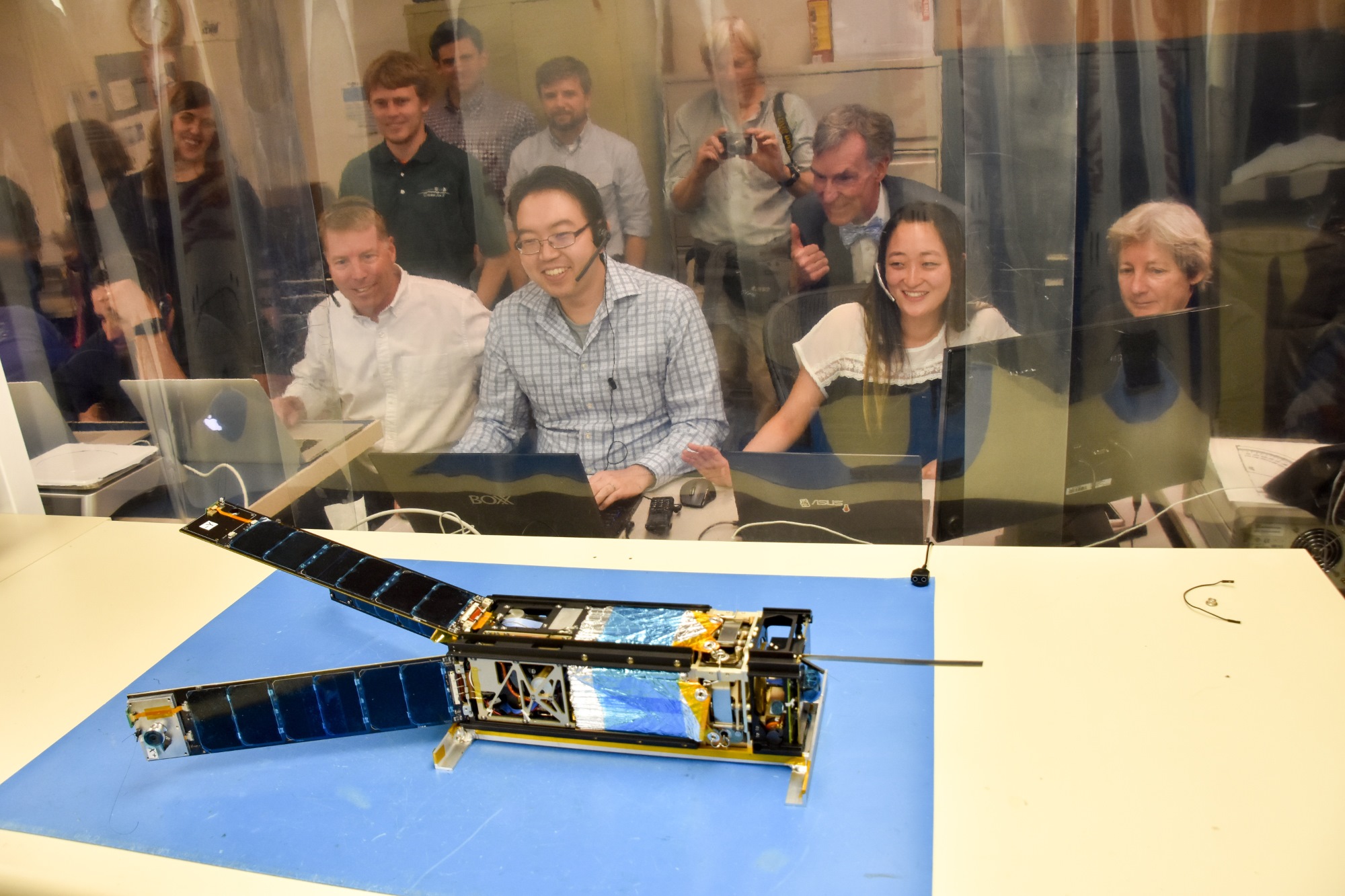
The spacecraft itself, minus the sail, of course.

But it paved the way for its successor, which will attempt this fantastical form of transportation. Other craft have done so, most notably JAXA’s IKAROS mission to Venus, which was quite a bit larger, though as LightSail 2’s creators pointed out, not nearly as efficient as their craft, and had a very different mission.

The brand new spacecraft, loaded into a 3U CubeSat enclosure — that’s about the size of a loaf of bread — is piggybacking on an Air Force payload going up to an altitude of about 720 kilometers. There it will detach and float freely for a week to get away from the rest of the payloads being released.

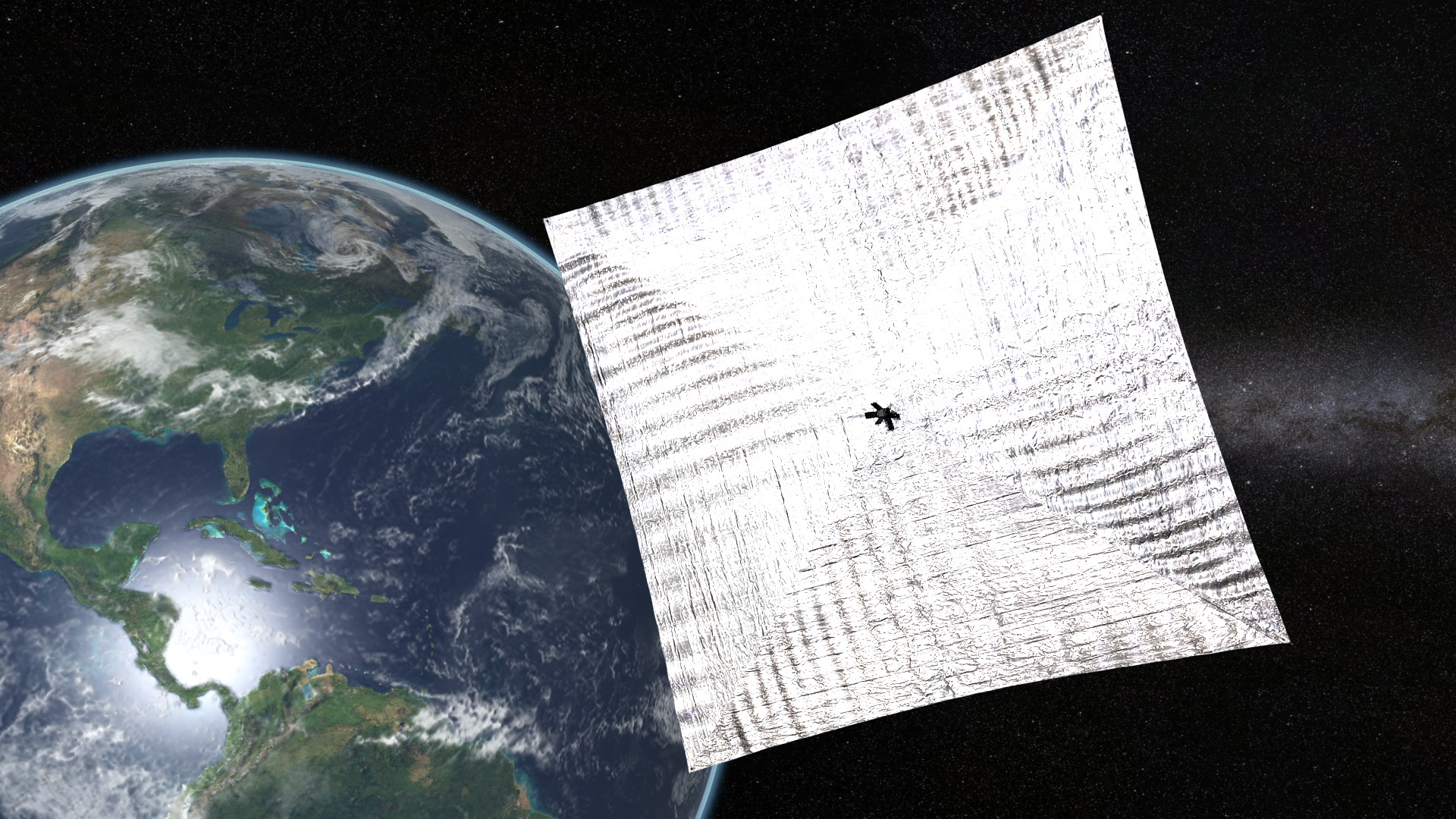
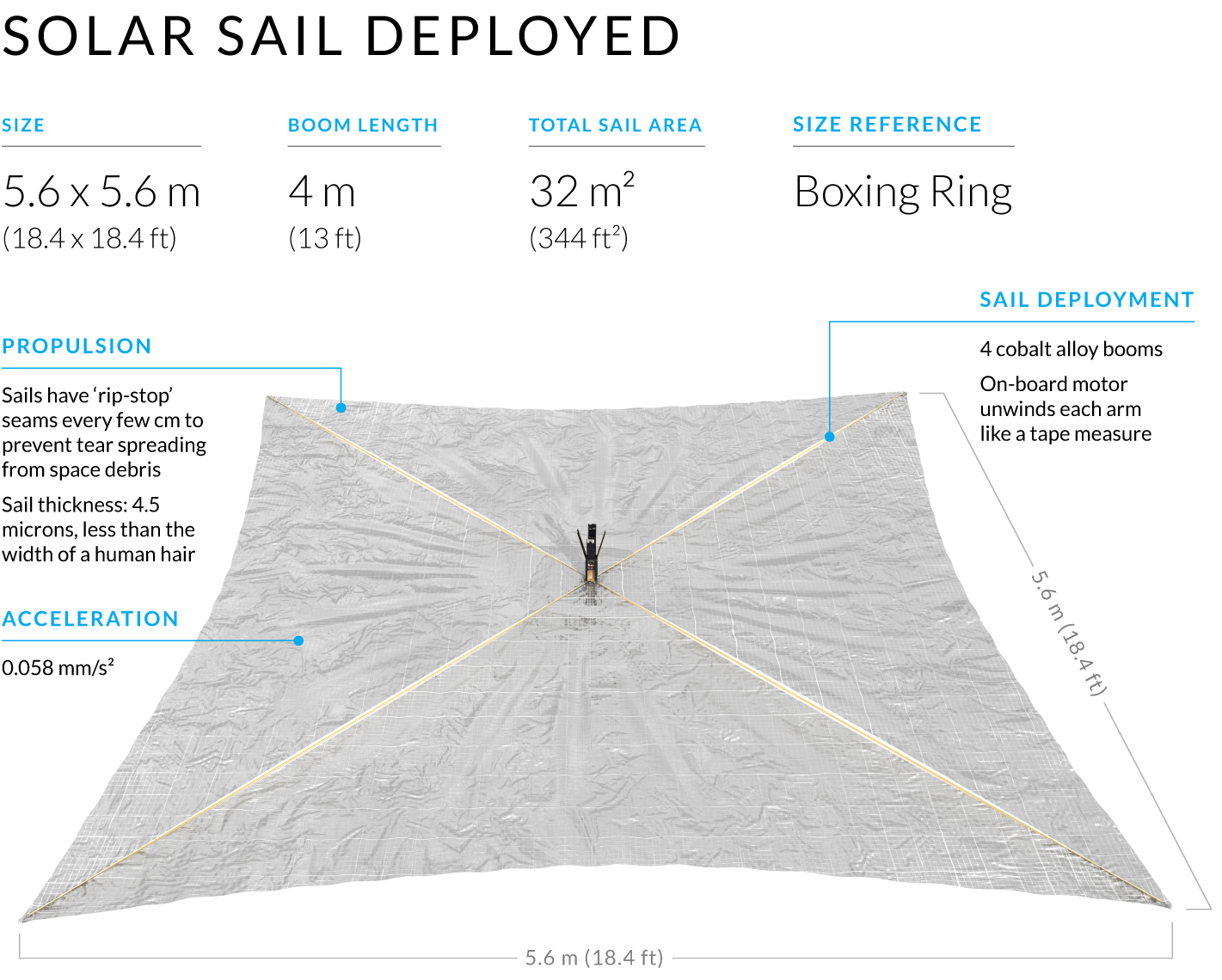
Once it’s safely on its own, it will fire out from its carrier craft and begin to unfurl the sail. From that loaf-sized package will emerge an expanse of reflective mylar with an area of 32 square meters — about the size of a boxing ring.

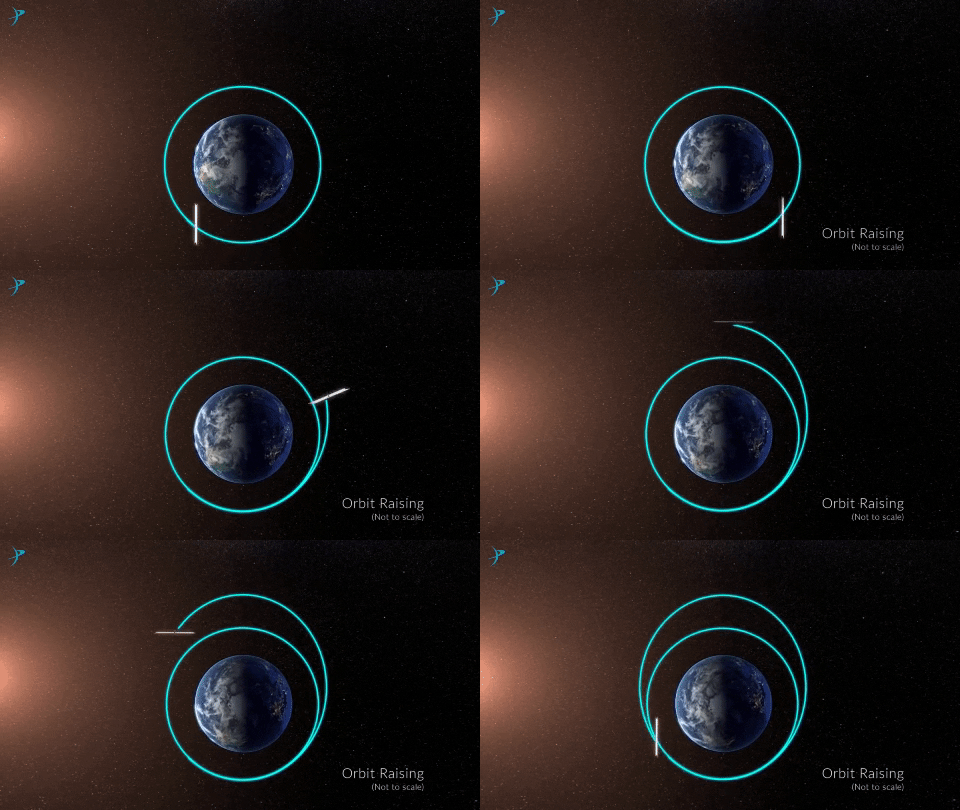
Inside the spacecraft’s body is also what’s called a reaction wheel, which can be spun up or slowed down in order to impart the opposite force on the craft, causing it to change its attitude in space. By this method LightSail 2 will continually orient itself so that the photons striking it propel it in the desired direction, nudging it into the desired orbit.

1 HP (housefly power) engine

The thrust produced, the team explained, is very small — as you might expect. Photons have no mass, but they do (somehow) have momentum. Not a lot, to be sure, but it’s greater than zero, and that’s what counts.

“In terms of the amount of force that solar pressure is going to exert on us, it’s on the micronewton level,” said LightSail project manager Dave Spencer. “It’s very tiny compared to chemical propulsion, very small even compared to electric propulsion. But the key for solar sailing is that it’s always there.”

“I have many numbers that I love,” cut in Nye, and detailed one of them: “It’s nine micronewtons per square meter. So if you have 32 square meters you get about a hundred micronewtons. It doesn’t sound like much, but as Dave points out, it’s continuous. Once a rocket engine stops, when it runs out of fuel, it’s done. But a solar sail gets a continuous push day and night. Wait…” (He then argued with himself about whether it would experience night — it will, as you see in the image below.)

Bruce Betts, chief scientist for LightSail, chimed in as well to make the numbers a bit more relatable: “The total force on the sail is approximately equal to the weight of a house fly on your hand on Earth.”

Yet if you added another fly every second for hours at a time, pretty soon you’ve got a really considerable amount of acceleration going on. This mission is meant to find out whether we can capture that force.

“We’re very excited about this launch,” said Nye, “because we’re going to get to a high enough altitude to get away from the atmosphere, far enough that we’ll really gonna be able to build orbital energy and take some, I hope, inspiring pictures.”

Second craft, same (mostly) as the last

The Lightsail going up this week has some improvements over the last one, though overall it’s largely the same — and a relatively simple, inexpensive craft at that, the team noted. Crowdfunding and donations over the last decade have provided quite a bit of cash to pursue this project, but it still is only a small fraction of what NASA might have spent on a similar mission, Spencer pointed out.

“This mission is going to be much more robust than the previous LightSail 1, but as we said previously, it’s done by a small team,” he said. “We’ve had a very small budget relative to our NASA counterparts, probably 1/20th of the budget that a similar NASA mission would have. It’s a low cost spacecraft.”

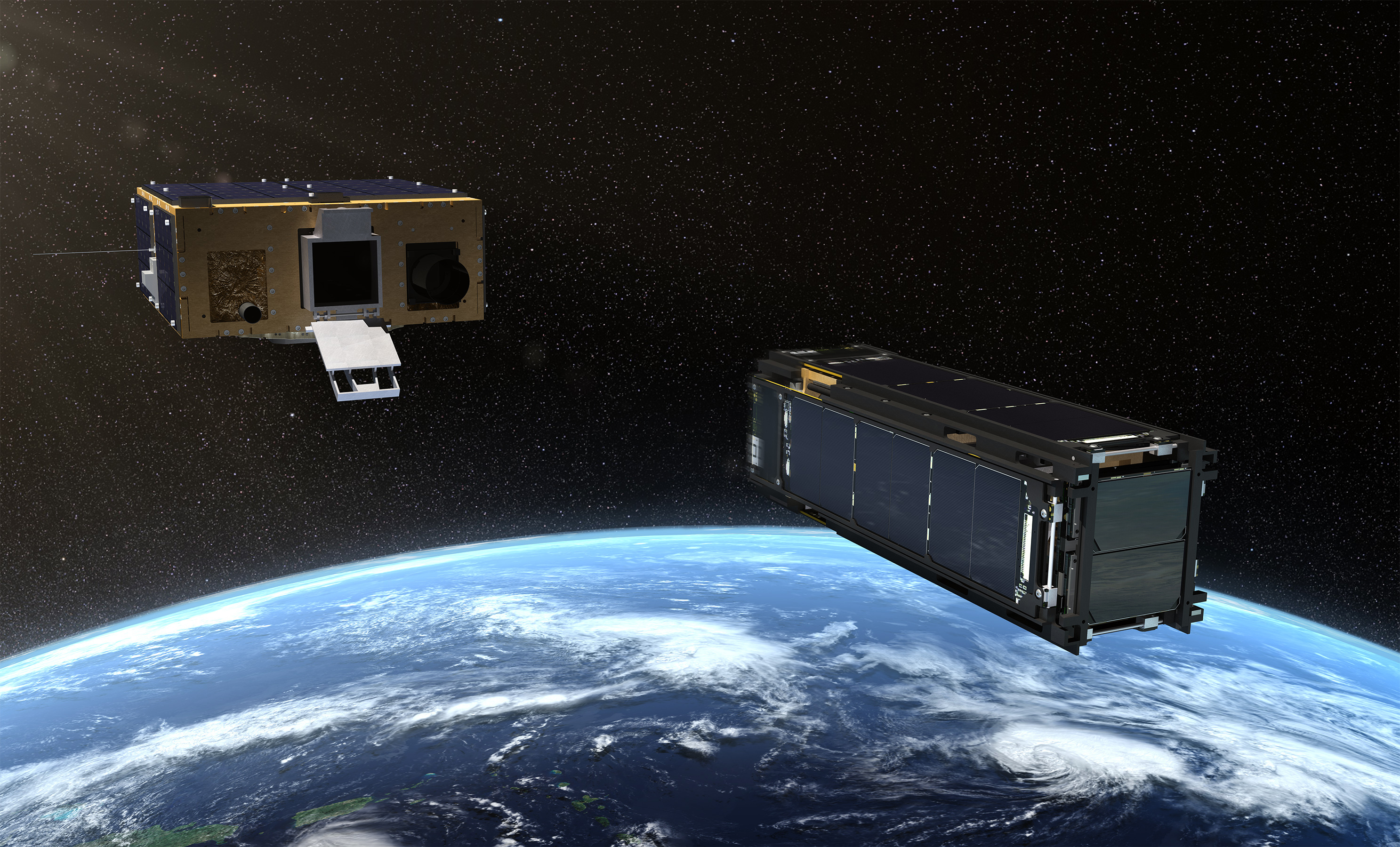
Annotated image of LightSail 2 courtesy of Planetary Society.

But the improvements are specifically meant to address the main problems encountered by LightSail 2’s predecessor.

Firstly, the computer inside has been upgraded to be more robust (though not radiation-hardened) and given the ability to sense faults and reboot if necessary — they won’t have to wait, as they did for LightSail 1, for a random cosmic ray to strike the computer and cause a “natural reboot.” (Yes, really.)

The deployment of the sail itself has also improved. The previous one only extended to about 90 percent of its full width and couldn’t be adjusted after the fact. Subsequently tests have been done, Betts told me, to exactly determine how many revolutions the motor must make to extend the sail to 100 percent. Not only that, but they have put markings on the extending booms or rods that will help double check how deployment has gone.

“We also have the capability on orbit, if it looks like it’s not fully extended, we can extend it a little bit more,” he said.

Once it’s all out there, it’s uncharted territory. No one has attempted to do this kind of mission, even IKAROS, which had a totally different flight profile. The team is hoping their sensors and software are up to the task — and it should be clear whether that’s the case within a few hours of unfurling the sail.

It’s still mainly an experiment, of course, and what the team learns from this they will put into any future LightSail mission they attempt, but also share it with the spaceflight community and others attempting to sail on sunlight.

“We all know each other and we all share information,” said Nye. “And it really is — I’ve said it as much as I can — it’s really exciting to be flying this thing at last. It’s almost 2020 and we’ve been talking about it for, well, for 40 years. It’s very, very cool.”

LightSail 2 will launch aboard a SpaceX Falcon Heavy no sooner than June 24th. Keep an eye on the site for the latest news and a link to the livestream when it’s almost time for takeoff.

21 Jun 2019

Daily Crunch: Google’s not making any more tablets

The Daily Crunch is TechCrunch’s roundup of our biggest and most important stories. If you’d like to get this delivered to your inbox every day at around 9am Pacific, you can subscribe here.

1. Google says it’s not making any more tablets

“For Google’s first-party hardware efforts, we’ll be focusing on Chrome OS laptops and will continue to support Pixel Slate,” the company said in statement.

Google SVP Rick Osterloh took to Twitter to emphasize that while Google’s hardware team will be “solely focused on building laptops moving forward,” the company will still be working with partners on Android and Chrome OS tablets.

2. Slack’s value rockets as stock closes up 48.5% in public debut

At the close of trading yesterday, Slack’s market cap sat well above $20 billion, or nearly 3 times its most recent private valuation of $7 billion.

3. One of NASA’s robotic astronaut helpers just flew on its own in space for the first time

The robot — called “Bumble” and one of a series of Astrobee robots that NASA developed to work along with astronauts on the ISS — is the first ever to fly on its own in space.

4. Samsung exec says the Galaxy Fold is ‘ready to hit the market’

Just last week, Huawei noted that it was holding off on its own Mate X release. But Samsung, at least, may finally be ready to unleash its foldable on the world, two months after the planned release.

5. Meet your new chief of staff: An AI chatbot

Mailbox’s founders are back with their second act: An AI-enabled assistant called Navigator meant to help teams work and communicate more efficiently.

6. Terry Gou resigns as Foxconn’s chairman to run for president of Taiwan

Gou, who founded Foxconn 45 years ago and is also its biggest shareholder, will remain on the company’s board.

7. A chat with Niantic CEO John Hanke on the launch of Harry Potter: Wizards Unite

Built in collaboration with WB Games, Wizards Unite is a reimagining of Pokémon GO’s real-world, location-based gaming concept through the lens of JK Rowling’s Harry Potter universe. (Extra Crunch membership required.)

21 Jun 2019

Slack and Zoom are flying high; they’re also being chased already by upstarts

Two of the highest-flying now-public enterprise companies of the year — Slack and Zoom — are different in many ways, besides the fact that one is focused on workplace messaging, while the other is centered around video conferencing.

Slack began life as a very different startup; Zoom founder Eric Yuan knew from the outset that he wanted to take on his former employer, Webex. Slack raised a lot of money from many sources before hitting the public market — roughly $1.4 billion over ten rounds; Zoom raised $160 million across five rounds, including a $100 million Series D round funded entirely by Sequoia. The two also approached their public offerings differently. Slack chose a direct listing that didn’t raise new money for the company; Zoom chose a traditional IPO, raising half a billion dollars in funding for its coffers just ahead of its first day of trading.

Still, the two companies also have much in common. Both took on incumbents (WebEx and email, respectively). Both are rooted in workplace collaboration and as such, have some of the same competitors, including Microsoft Teams.

As Zoom investor Gordon Ritter of Emergence Capital Partners also notes, both are “powered by viral end-user adoption, which is not the case for every SaaS company.” (Slack largely grows within a company, starting with one team; Zoom grows internally and externally, given the nature of video conferencing across companies.)

Perhaps more meaningfully, both may see fewer days at the top of the heap some of their predecessors. The reason, as says longtime VC Greg Gretsch, who cofounded Jackson Square Ventures in 2011, “The intensity of new competition is on a completely different level today from what it was 15 or 20 years ago.”

Put simply, the “cycle time of incumbents having their day in the sun is getting shorter and shorter.” adds RItter,  who cofounded Emergence in 2002 and has backed Box, Yammer and Veeva Systems, where he remains board chair.

It’s happening broadly to Fortune 500 companies, whose average lifespan is now less than 20 years, compared with 60 years in the 1950s. Now, even fast-growing companies like Zoom and Slack, which “have amazing futures,” says Ritter, will likely have startups nipping at their heels very soon.

Craig Hanson, a general partner and cofounder of NextWorld Capital in San Francisco explains it this way: “In the current environment, with all the entrepreneurs and capital looking for the next great idea, each startup success  story immediately blooms an entire field of new startups chasing after them.”

It’s almost possible to time it says Hanson. “Once a startup raises a big growth round or has an impressive exit, in two to three quarters, you’ll see rounds of funding for similar new companies. This happens in both consumer and enterprise tech. VCs may regret missing out on the first company that just raised big and hope that there’s room for another one, or some great IPO or acquisition may spark a newfound passion for a space they overlooked before or that they thought was too hard until someone proved them wrong.”

Consider the many failed video conferencing startups to precede Zoom, including TeamSlide, LiveMeeting, and Vyew among them. Eric Yuan’s startup was anything but a sure thing, But once a space has been validated by the kind of success it’s enjoying, it makes it easier for founders to raise money. This might partly explain why, in April, a nearly five-year-old, Boston-based startup named Owl Labs raised $15 million in Series B funding for its video conference camera with 360-degree capabilities. Another web conferencing startup, Highfive, based in Redwood City, Ca., raised $32 million last year, including from Lightspeed Venture Partners, General Catalyst, and Andreessen Horowitz.

“It’s easier to explain what they want to do [if they can say] ‘We’re like Twilio for ____,'” says Hanson, who says that as recently as 2016, “you’d have maybe two to three startups going after a space and chasing the incumbents.  Now there will be ten startups, and the incumbents were themselves startups just a handful of years earlier.”

The trend isn’t limited to recently public companies, adds Gretsch, noting that “success for many companies and sectors is declared long before the first IPO, and with that perceived success comes a wave of me-too competitors.” It goes “hand in hand with the explosion of seed rounds over the last 10 years, which itself has been largely driven by how little it really costs for a company to get a finished product into customers hands,” he says.

“Now when a new upstart company starts to get traction, there are almost immediately a handful –or more –of startup competitors. Think of the massive proliferation of on-demand startups that emerged in the wake of Uber’s early traction — many of them direct competitors to Uber’s core service.”

Gretsch isn’t so sure the trend is a new one, he says. Nevertheless, because the sheer number of startups that receive funding to put out new products is “off the charts,” it’s changing the game for consumer and enterprise companies alike.

“Any company that’s enjoying success has to remain paranoid and not ever settle for resting on their laurels,” says Gretsch. Now, it just happens to be “more true than it was 23 years ago, when [famed Intel CEO] Andy Grove used it for the title of his book.”

That book: “Only the Paranoid Survive.”

21 Jun 2019

Apply to Startup Battlefield for a shot at TC fame and fortune

What would a $100,000 cash infusion do for your early-stage startup? Don’t just imagine it. Apply to compete in Startup Battlefield at Disrupt San Francisco 2019 on October 2-4.

Our premier pitch competition has launched hundreds of startups on an exponential success trajectory, attracts massive media and investor attention and, yeah, it offers a fat $100K prize — equity free. But listen up founders, the application deadline expires on June 25th at 11:59 p.m. (PT). Don’t miss your shot at TC fame and fortune. Fill out an application to Startup Battlefield today.

You literally have nothing to lose. Any early-stage startup — from any country, in any vertical — is eligible, and it doesn’t cost anything to apply or to compete. TechCrunch doesn’t charge any fees or take any equity, either. We’re nice that way.

You’ll have plenty of time to prepare and plenty of sage advice from expert TechCrunch editors. Yup, all competing teams receive extensive, free pitch coaching. You’ll be rarin’ to go when you step on the Disrupt Main stage to deliver your six-minute pitch and live demo to a panel of top VC and tech judges.

We expect more than 10,000 attendees at our flagship Disrupt SF event, and the wildly popular Startup Battlefield always draws a huge audience. We’re talking thousands of spectators, including hundreds of media outlets, investors and tech influencers. These are the very people who could potentially take your company — whether you win the Battle or not — to the next level and beyond. Not to mention the international live stream to get the entire world’s attention.

Want more perks? We’ve got ’em. Battlefield startups get up to four free conference passes, access to TC’s investor-startup matching program and can exhibit for free in Startup Alley for all three days of Disrupt. Plus, you receive backstage access, invitations to VIP events and free passes to all future TechCrunch events.

Then there’s the Startup Battlefield alumni community — 857 companies strong and counting. Your startup will join an awesome group that includes Fitbit, Vurb, Dropbox, Get Around, Cloudflare, Mint and more. Alumni companies have collectively raised $8.9 billion and produced 110 successful IPOs or acquisitions.

Startup Battlefield takes place at Disrupt San Francisco 2019 on October 2-4, and your shot at $100,000 ends when the application deadline expires on June 25th at 11:59 p.m. (PT). Don’t miss all the opportunity. Apply right here, and we’ll see you in San Francisco!

21 Jun 2019

‘Harry Potter: Wizards Unite’ reaches 400K downloads, $300K in consumer spend in U.K. and U.S.

Harry Potter: Wizards Unite, the highly anticipated new mobile game from Pokémon Go makers Niantic and Warner Brothers’ games division, is off to a good start but it’s not breaking Pokémon Go records. According to preliminary estimates from Sensor Tower, the new game has been installed some 400,000 times in its first 24 hours in its launch markets of the U.S. and U.K. — where the game arrived ahead of schedule on Thursday. Gross player spending in these markets hit around $300,000 across both iOS and Android during this time.

This is not the full picture, however.

The game was also available in Australia and New Zealand during a pre-launch beta trial of sorts, and is only now rolling out to worldwide users on a country-by-country basis. During its beta test period, Sensor Tower estimates the game grossed around $80,000.

But in the same number of days, Pokémon Go had grossed $1.6 million in those two markets.

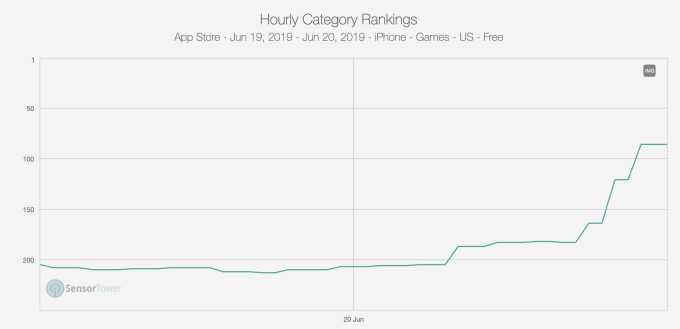
Following its U.S. launch, it took Harry Potter: Wizards Unite around 15 hours to reach the No.1 position on the iOS App Store. This ascension is also going a bit slower than Pokémon Go did when it arrived. That game was an immediate hit, debuting at No. 1 on its launch day of July 6, 2016. It was then installed 7.5 million times in the U.S. during its first 24 hours. And it didn’t reach the U.K. until seven days later.

In its first 24 hours, Pokémon Go had become the No. 1 app by revenue in the U.S., as well. The new Harry Potter title is ranked No. 102 overall for iPhone revenue, Sensor Tower says. It’s also No. 48 for U.K. revenue, and not yet ranked on Google Play. However, these figures differ from App Annie’s, which says the game has broken into the top 100.

App Annie hasn’t yet put out numbers related to Harry Potter: Wizards Unite’s revenue, but the company tells us it hit No. 1 in the U.S. for downloads as of 12 AM on June 21, 2019. And for consumer spending, App Annie says game broke into the top 100 grossing games by hitting No. 63 as of 7:00 AM June 21 on iPhone in the U.S.

The new game’s lesser demand compared with Pokémon Go could be attributed to a number of factors. Pokémon Go was hugely anticipated, had a massive fan base ready to download, and was one of the first compelling use cases of AR in gaming.

Harry Potter’s fan base is active as well, but they’ve also had other games to play before now.

For example, Jam City has a Harry Potter: Hogwarts Mystery game that’s been getting a huge boost since yesterday’s news of the new Niantic title. That points to a case of mistaken identity or perhaps clever App Store SEO…or both.


It’s also worth noting the App Store itself has changed in the years since Pokémon Go’s launch.

In September 2017, Apple introduced its brand-new App Store that took the emphasis off its Top Charts as a means of discovery, and instead features apps in editorial “stories” on its Today tab. Within the dedicated apps and games section, the revamped App Store points users to editorial collections, with Top Charts only found upon scrolling down the page quite a bit.

We’ve heard from some developers that these changes reduced their downloads, as getting into the Top Charts doesn’t drive numbers like it used to. They said getting into the Today tab’s feature editorial doesn’t send as many installs, either. But this is all anecdotal — and of course, Apple doesn’t talk about numbers like this. Further investigation is needed.

In any event, the two app store intelligence firms — App Annie and Sensor Tower — both predict big numbers for the new Harry Potter title over time.

Sensor Tower estimates the game will pull in $400 million to $500 million in revenue in its first year. However, the firm notes that Harry Potter isn’t as popular in Asia — a market that delivers Pokémon Go over 40% of its revenue.

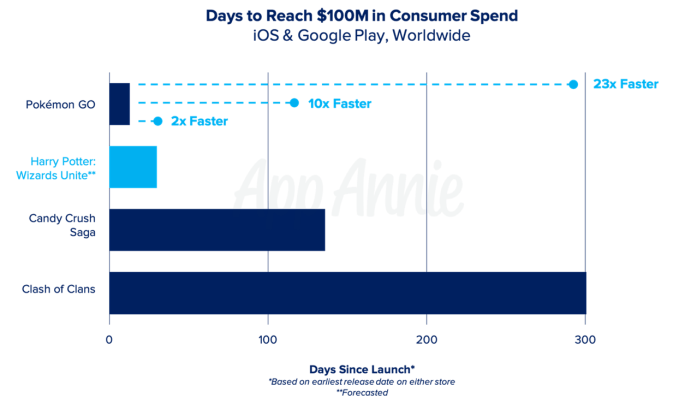
App Annie, meanwhile, predicts the game will hit $100 million in consumer spend in its first 30 days. (Pokémon Go hit this milestone in 2 weeks.)

Pokémon Go shattered mobile gaming records, clearing $100 million in its first two weeks and becoming the fastest game to reach $1 billion in consumer spend,” noted App Annie. “While we don’t expect it to surpass Pokémon Go’s launch, Harry Potter: Wizards Unite is set to clear $100 million in its first 30 days — which is no small feat.”