Category: UNCATEGORIZED

20 Jun 2019

Machine learning for everyone startup Intersect Labs launches platform for data analysis

Machine learning is the holy grail of data analysis, but unfortunately, that holy grail oftentimes requires a PhD in Computer Science just to get started. Despite the incredible attention that machine learning and artificial intelligence get from the press, the reality is that there is a massive gap between the needs of companies to solve business challenges and the availability of talent for building incisive models.

YC-backed Intersect Labs is looking to solve that gap by making machine learning much more widely accessible to the business analyst community. Through its platform, which is being launched fully publicly, business analysts can upload their data, and Intersect will automatically identify the right machine learning models to apply to the dataset and optimize the parameters of those models.

The company was founded by Ankit Gordhandas and Aaron Fried in August of last year. In his previous job, Gordhandas deployed machine learning models to customers and started working on a tool that would speed up his work. “I actually realized I could build a version of the tool that was a little more advanced,” he said, and that work ultimately led to the foundation of Intersect Labs. He linked up with Fried in October, and the two have been working on the platform since.

Intersect’s goal is to move analysts from purely retrospective analysis to creating models that can predictively determine business strategy. “People who live in SQL and Excel, they are really good at pulling the data of the past, but we are giving them the superpower of seeing the future,” Gordhandas explained. “All you need is your historical data, upload to our platform, and answer two questions.”

Ankit Gordhandas and Aaron Fried of Intersect Labs. Courtesy of Intersect Labs.

Those questions essentially ask what the model should predict (the outcome variable). From there, Intersect begins by cleaning up the data and ensuring that the various columns are properly scaled for data analysis. Then, the platform begins constructing a range of machine learning models and evaluating their performance against the target output. Once an ideal model is identified, customers can integrate it into their other systems through a REST-style API.

What’s interesting here is that Intersect can get better and better at identifying models over time based on the increasing diversity of datasets that it gets access to. Plus, as researchers identify new models or ways to tune them, the platform can potentially proactively improve the models it had previously identified for its customers, ensuring that they stay at the cutting edge of the field.

Today, the platform can handle one table of standard rows and columns for processing. Gordhandas said that the company intends to expand in the future to “image processing, audio processing, video processing, unstructured data processing” so that the platform can be applied to as diverse a set of data sources as possible

Gordhandas says that Intersect is attempting to sit in the middle of more specialized machine learning platforms that are limited to hyper-focused niches, while also offering more analytical power than comparably simpler solutions.

Certainly the space has seen a proliferation of options. New York City-based Generable (formerly Stan) uses Bayesian modeling and probabilistic programming to improve drug discovery, while Mintigo uses AI modeling to improve customer engagement. A huge number of other startups target different stages of the data analysis pipeline as well.

In the end, Intersect hopes to make these tools more widely accessible. The company has a couple of early customers already, and is going through the Y Combinator accelerator this batch.

20 Jun 2019

Google ramps up competition with Facebook Pages with new tools for local businesses

Google has been steadily updating its tools for businesses looking to reach more customers across Google’s platforms, including Search and Google Maps. Last year, the company took on Facebook Pages with a feature that let users “follow” and message businesses directly, as well as be updated about promotions, sales, and other events. Today, Google is rolling out a host of other tools for Google My Business, focused on attracting customers and encouraging follows.

The suite of tools known as Google My Business was first introduced five years ago, as a way for businesses with a Google presence to have a one-stop shop for updating their business information online, add photos, read reviews, and — at the time — use Google+. While the latter has since shut down, Google is still competing with Facebook in its own way.

But now, instead of building out a vast social network of its own, it’s focused on helping businesses reach customers through Google’s most-used platforms.

Already, customers could “follow” a business to track its updates in the new “For You” tab on Google Maps. It’s very much Google’s version of liking a Facebook Page, then getting updates in a feed. Meanwhile, businesses could use the new Customers tab to read reviews and respond to inquires. They can also post to their business profile on Google.

Today’s update includes a handful of other tools for making those profiles more appealing.

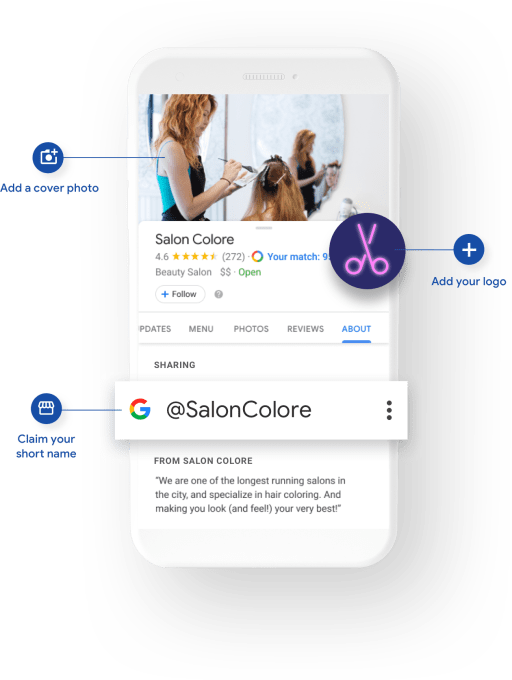
For example, businesses can now add a logo to their profile, upload photos that are then displayed in a new dynamic module on their profile (and soon with captions), and set a profile cover photo. Again, more features to rival Facebook Pages.

Businesses can now also claim a short name and URL for their business so they can more easily direct people right to their profile page.

In a few more months, customers will be able to search Google Maps by these short names, as well.

Also new today are welcome offers. This allows a business to reward a new customer for following them by offering them a discount or some kind of deal.


In addition to the new features, Google is today launching a Marketing Kit website where businesses can order free stickers and posters to place at their retail location, and download assets for social posts, among other things.

As a part of this launch, Google is highlighting the top 5% of businesses in a given category as with a “Local Favorite” designation. These businesses will later this summer be able to order digital and physical badges of honor, if they make the cut.

Google says there are now over 150 million businesses using the Google My Business platform, since its 2014 launch.

“We hope that these more descriptive profiles not only help consumers quickly find the business that best suits their needs, but also help businesses stand out and express what unique about them,” explains Google Business Senior Product Manager, Amir Fish, in today’s announcement. “We’re committed to helping businesses succeed on Google and are excited to keep improving the experience for all people on Maps and Search,” it says.

20 Jun 2019

Slack opens at $38.50, a pop of 48% on its first day of trading on NYSE as WORK

Slack, the workplace messaging platform that has helped define a key category of enterprise IT, made its debut as a public company today with a pop. Trading as “WORK” on the New York Stock Exchange, it opened at $38.50 after setting a reference price last night of $26, valuing it at $15.7 billion, and then setting a bid/asking price of $37 this morning.

Note: there was no “money raised” with this IPO ahead of today because Slack’s move into being a publicly traded company is coming by way of a direct listing — meaning the shares went directly on the market with no pre-sale. This is a less conventional route that doesn’t involve bankers underwriting the listing (nor all the costs that come along with the roadshow and the rest). It also means Slack does not raise a large sum ahead of public trading. But it does let existing shareholders trade shares without dilution and is an efficient way of going public if you’re not in need of an immediate, large cash injection. It’s a route that Spotify also took when it went public last year, and, from the front-page article on NYSE.com, it seems that there might be growing interest in this process — or at least, that the NYSE would like to promote it as an option.

Slack’s decision to go slightly off-script is in keeping with some of ethos that it has cultivated over the last several years as one of the undisputed juggernauts of the tech world. Its rocket ship has been a product that has touched on not one but three different hot growth areas: enterprise software-as-a-service, messaging apps and platform plays that, by way of APIs, can become the touchstone and nerve center for a seemingly limitless number of other services.

What’s interesting about Slack is that — contrary to how some might think of tech — the journey here didn’t start as rocket science.

Slack was nearly an accidental creation, a byproduct that came out of how a previous business, Tiny Speck, was able to keep its geographically spread-out team communicating while building its product, the game Glitch. Glitch and Tiny Speck failed to gain traction, so after they got shut down, the ever-resourceful co-founder Stewart Butterfield did what many founders who still have some money in the bank and fire in their bellies do: a pivot. He took the basic channel they were using and built it (with some help) into the earliest public version of what came to be known as Slack.

But from that unlikely start something almost surprising happened: the right mix of ease of use, efficient responsiveness and functionality — in aid of those already-important areas of workplace communication, messaging and app integration — made Slack into a huge hit. Quickly, Slack became the fastest-growing piece of enterprise software ever in terms of adding users, with a rapid succession of funding rounds (raising over $1.2 billion in total), valuation hikes, and multiple product improvements along the way to help it grow.

Today, like many a software-as-a-service business that is less than 10 years old and investing returns to keep up with its fast-growing business, Slack is not profitable.

In the fiscal year that ended January 31, 2019, it reported revenues in its S-1 of $400.6 million, but with a net loss of $138.9 million. That was a slight improvement on its net loss from the previous fiscal of $140.1 million, with a big jump on revenue, which was $220.5 million.

But its growth and the buzz it has amassed has given it a big push. As of January 31, it clocked up over 10 million daily active users across 600,000 organizations, with 88,000 of them on paid plans and 550,000 using the free version of the app. It will be interesting to see how and if that goodwill and excitement outweigh some of those financial bum notes.

Or, in some cases, possibly other bum notes. The company has made “Work” not just its ticker but its mantra. Its slogan is “Where work happens” and it focuses on how its platform helps make people more productive. But as you might expect, not everyone feels that way about it, with the endless streams of notifications, the slightly clumsy way of handling threaded conversations, and certain other distracting features raising the ire of some people. (Google “Slack is a distraction” and you can see some examples of those dissenting opinions.)

Slack has had its suitors over the years, unsurprisingly, and at least one of them has in the interim made a product to compete with it. Teams, from Microsoft, is one of the many rival platforms on the market looking to capitalise on the surge of interest for chat and collaboration platforms that Slack has helped to usher in. Other competitors include Workplace from Facebook, Mattermost and Flock, along with Threads and more.

20 Jun 2019

The boring genius of how Atrium kills legal busy work

Law firms have little incentive to build or buy software that will save their lawyers time since they often bill clients by the hour. Tasks like tracking down legal documents, extracting key information, and drawing up hiring offers or funding term sheet add up to make lawyers expensive even if they’re constantly repeating mindless busy work.

That’s why legal startup Atrium is so exciting even though it’s developing tech that might seem boring on the surface. After raising $75 million from Andreessen Horowitz and General Catalyst while growing to 400 clients, today Atrium is announcing its first customer-facing products.

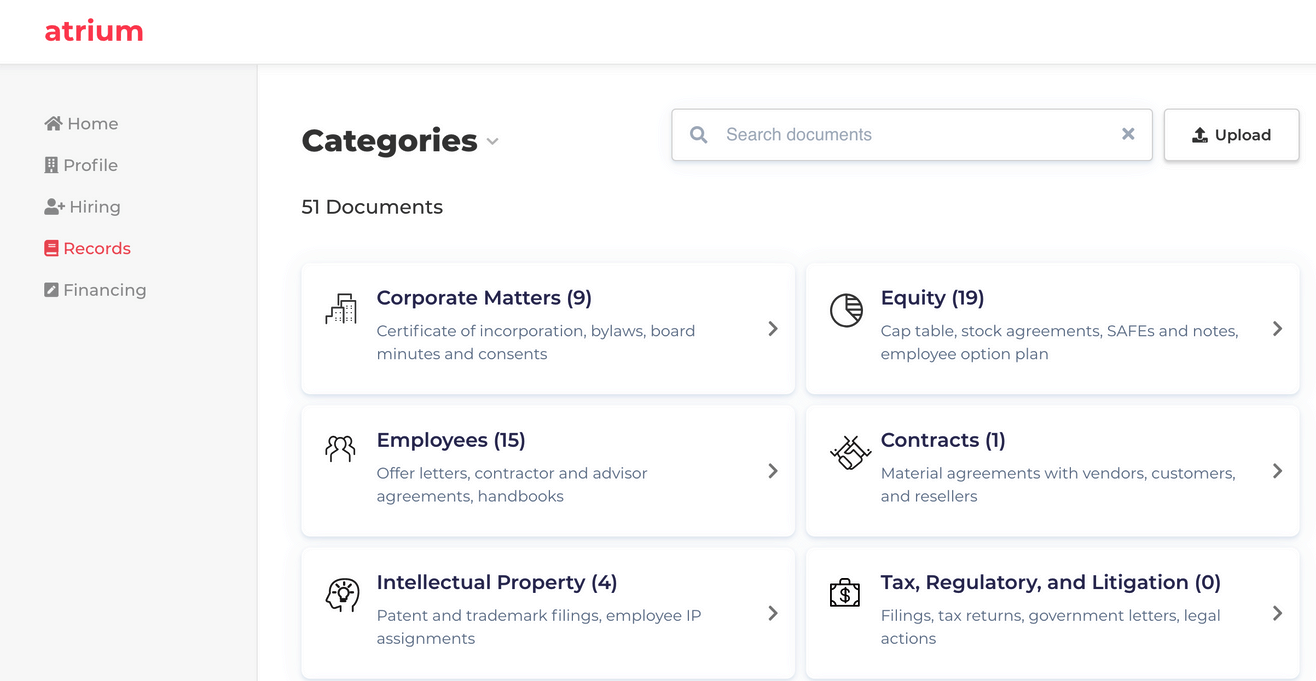
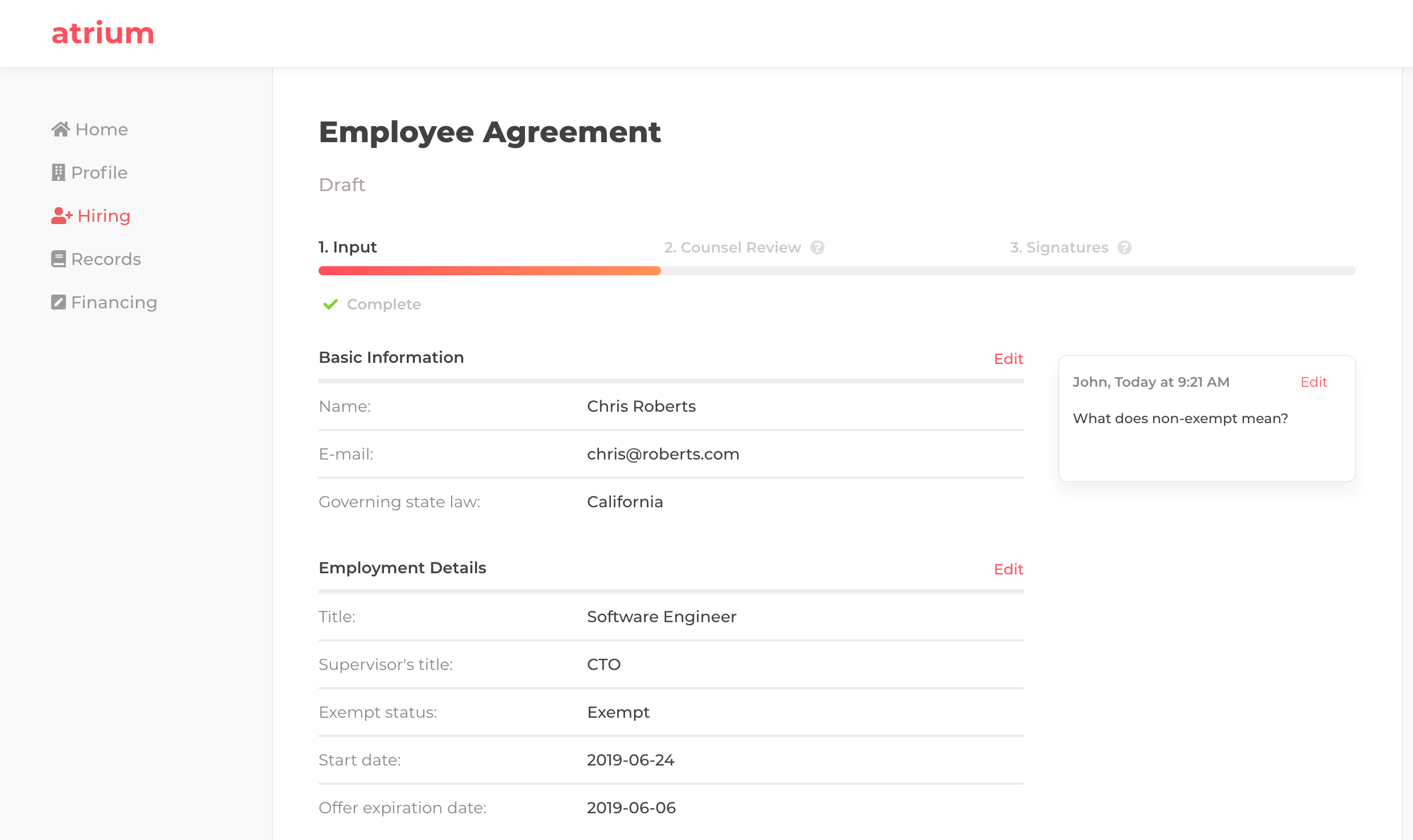
Atrium Records creates a collaborative file locker for you and your lawyer so you always have access to the latest versions of corporate documents. Atrium Hiring automatically generates hiring offers and contracts from details you add to a form, and tracks everyone’s approvals and signatures.

Atrium Records

Rather than having to pay for these tools separately, they come as part of a subscription to a bundle of Atrium’s legal services with special projects like counsel through an acquisition costing extra. This business model incentivizes Atrium to work as efficiently as possible instead of bilking hourly rates, and build tools to eliminate less skilled work or assist with common corporate duties. That’s allowed it to speed up legal work on incorporations, financings, M&A, and contract negotiations.

“One of the reasons we partnered with Andreessen Horowitz on the last round [a $65 million Series B] was we really align with the way they approach venture capital” Atrium co-founder and CEO Justin Kan tells me. “Marc’s initial observation was . . .  let’s not just provide capital but also other services like a talent network. We have kind of done the same stuff. Not only are we helping people with the legal stuff they want to get done but with the other stuff surrounding it.”

Atrium CEO Justin Kan at TechCrunch Disrupt SF 2017

For example, Atrium’s Fundraising Concierge service provides assistance to startups for defining their narrative, setting up investor meetings, and generating fair term sheets. Atrium has to date aided startups with raising over $1 billion, from seed rounds of a couple hundred thousand dollars to huge $50 million rounds

Developing drab but useful software for enterprises is a drastic shift for Kan. He pioneered life vlogging by strapping a camera to his head at his startup Justin.tv that eventually blossomed into Twitch and sold to Amazon for $2 billion. It’s been quite an adjustment for Kan going from making video game streaming consumer apps and angel investing to Atrium. “Two years. It has been an interesting and crazy ride. I wanted to get back to starting companies. That was the fastest learning I’d ever had. But I forgot learning means failing a lot” he says with a wry smile.

Whatever tribulations they required seem worth it now that Atrium’s new products are ready. Atrium Records improves on the clumsy status quo where clients have to dig through emails from their lawyers hoping to find the most up-to-date versions of important corporate documents. If they can’t, they wait around after emailing their lawyer who has to hope they remember where they buried that term sheet or cap table in their firm’s file tree. This messy process can rack up billable hours, lead to data mismatches, and let important signatures or approvals fall through the cracks.

Atrium Hiring

Kan says he’s seen some grisly situations. “You never signed your equity documents so you actually have no equity in this company. And now that there’s financing, there could be a taxable event. There’s often surprisingly serious problems that happen.” Atrium’s senior product manager Sahil Bhagat walks me through how Atrium can help clients avoid an issue like “Maybe you hired 10 employees but didn’t update your cap table and then you’re hiring the 11th employee but you don’t have any equity to grant so you have to go through the hassle of increasing your options pool.”

Atrium Records acts like your searchable legal Dropbox. The startup works with your last law firm to ingest your documents around equity, taxes, employees, and IP, and make sure they’re all up to date. Machine learning extracts critical data about financings and cap tables so that’s instantly available in the Atrium dashboard and you don’t have to dig into the original docs. Plus, you don’t have to pay for lawyers or paralegals to do that manually. And your lawyer can build a task list of documents for you to edit or sign so you always know what to do next, which is a relief when you’re wrangling approvals from all your existing investors.

Atrium Hiring operationalizes one of the biggest founder time-sucks. Instead of writing hiring contracts from scratch each time, you fill out a form and use menu selections to set the salary, share count, vesting schedule, and offer expiration. Looking across its anonymized data set of contracts, Atrium can recommend the best clauses and most common set ups, like four-year vesting with one-year cliffs. You can see the status of the contracts every step of the way, from drafting and finalizing to getting employees to accept.

Kan tells me Atrium’s goal is to continue building on its archive of over 100,000 legal documents to develop aggregated pools of data clients could opt into. If they’re willing to share their salary data, vendor contract pricing, and more, they’ll get access to that of Atrium’s other clients. “You’ll be able to see if you’re on the high end of being paid by Salesforce for a contract” Kan explains. That’s a much more data-driven approach than when most lawyers just think of the last few salaries they saw for that position and give you a rough average.

“Being able to tell what the market norms are is a powerful negotiating tool.” The startup has even been offering its tips for free as part of fundraising workshops it uses to attract clients. The challenge for the company will be ensuring efficiency doesn’t mean cutting corners.

Atrium has grown to 150 staffers split between legal practitioners and its product team in its two year since launch. Kan is trying to build a culture where everyone cooperates, unlike infamously cutthroat law firms where partners can compete for cases. He hopes that talent will stick with Atrium because it’s deleting the most tedious parts of their jobs. “No one wanted go to law school to review 1000 hiring docs.”

20 Jun 2019

Verified Expert Brand Designer: Stitzlein Studio

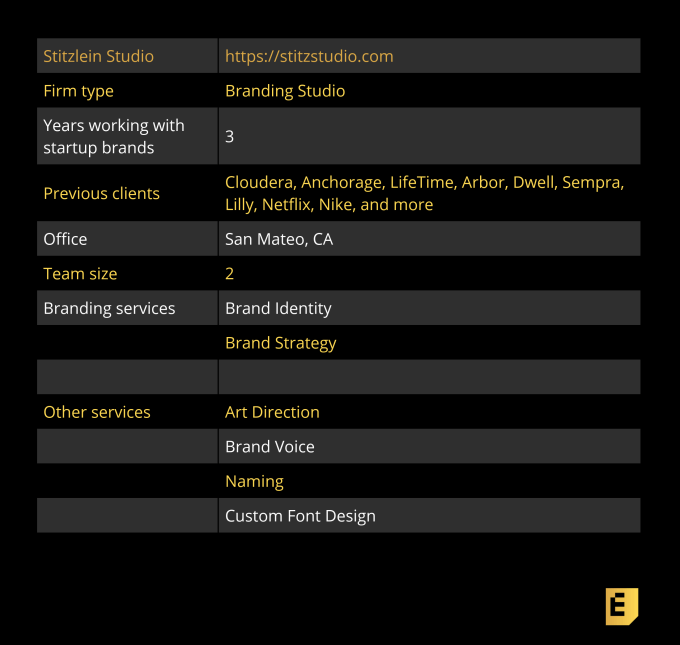
After spending years working for in-house design teams and well-known brand agencies such as Nike, Google, and Pentagram, Joe and Leslie Stitzlein, who are also husband and wife, decided to launch their own branding studio. You’ve seen their work in many places; from launching the identities for Netflix, Mac OS X, Nike Flyknit, dwell and Lilly.

Stitzlein Studio has ushered in a new chapter for the couple who now works with a global network of independent designers, illustrators, and developers to help companies develop or expand their brands. It doesn’t matter whether it’s designing an identity or launching a new product, the founders of Stitzlein Studio are eager to share their vast experiences and take on a new challenge.

Advice for startup founders

“Be yourself, and be courageous. That is not easy, especially when you have investors to satisfy and payroll to make [we’re business owners too at the end of the day and totally get it]. We’ve seen founders try to mimic successful brands rather than spending time and energy on what makes them unique. Instead of trying to look like Google, figure out what you are and amplify the shit out of that. It’s surprising how many companies underestimate themselves when what they do is amazing. Our job is to find what makes them distinctive and pour gas on it.”

Stitzlein Studio’s branding philosophy

“Each brand has its own DNA, just as each person is unique. A company’s DNA comes to life both on a surface level by how they look, but also how the brand interacts with people in the world.”


Below, you’ll find the rest of the founder reviews, the full interview, and more details like pricing and fee structures. This profile is part of our ongoing series covering startup brand designers and agencies with whom founders love to work, based on this survey and our own research. The survey is open indefinitely, so please fill it out if you haven’t already.


Interview with Stitzlein Studio Creative Directors Joe and Leslie Stitzlein

Yvonne Leow: Can you tell me a little bit about your background and why did the two of you decide to create a studio together?

Joe Stitzlein: Leslie and I had been working at a lot of different places before this. I had been in-house at Nike for seven years and spent three years at Google. There’s not a lot of opportunities to take risks in life, and we thought why not pivot from climbing the in-house ladder and share everything we’ve learned about branding with smaller startups as well as larger companies.

One aspect of our work that we really enjoy is taking a wonderful technical innovation and translating it into communications that are beautiful, helpful and inspiring. This is true for everything from a new running shoe to a new cryptocurrency; we love boiling complicated innovations down into a striking image or experience.

We wanted to take some of those lessons from the Nikes of the world, and the nonprofits and interactive clients Leslie had, and bring those to smaller scale clients. It was a fun opportunity.

20 Jun 2019

Plaid puts Quovo acquisition right to work with new investments product

When Plaid acquired Quovo earlier this year, it was clear the company wanted to move beyond checking and savings data to a broader view of investments. Today, the company announced Investments, an API based on Quovo, that enables customers to pull in investment data into their apps.

Lowell Putnam, head of partnerships at Plaid and former CEO and co-founder at Quovo, says there has been a hunger for this kind of data from customers and developers, and the Quovo purchase helped accelerate that inside Plaid .

“I think that the origins of the product comes from a company that I co-founded and also broader demand that Plaid has seen in the past several years. It shouldn’t come as a surprise that a lot of our customers want the full 360 degree view of their clients,” Putnam told TechCrunch.

An investment account provides unique challenges over a checking or savings account, which has a certain amount of cash at any given time.”Instead of owning just cash in an account, investment accounts hold multiple securities in the same accounts, and the securities change in value, regardless of [whether you engage in trade activity or not], Putnam said.

Plaid sees this capability greatly expanding how developers use their APIs moving forward. “With connectivity to investment accounts, Plaid can serve a whole new set of use cases to enable developers, technology platforms, and financial institutions to deliver more insightful and compelling products,” the company wrote in a blog post announcing the new product.

He says that the two companies had recognized the power of bringing this kind of information into any financial application, even before the acquisition, and they have been working hard to make it happen since. “We realized that we have the opportunity to bring Quovo’s investment data expertise into the Plaid API stack, and do that with all of the tweaks and changes and enhancements that we’ve both been thinking about for the past several years,” he said.

The new product is available in the US starting today. It will be rolled out in other regions throughout the year.

20 Jun 2019

Facebook announces dates for Oculus Connect 6

After a busy year, Facebook’s VR arm is returning to San Jose, Calif. on September 25 and 26 for the sixth annual Oculus Connect.

Oculus has had a transformative year with the release of its Quest and Rift S headsets, turning the high-end gaming company into one more focused on meeting the needs of mainstream consumers. Oculus Connect 6 will give the company an opportunity to hit a stride on content and software optimizations, without the specter of missing hardware features hanging heavy.

“With Quest and Rift S bringing more people into VR than ever before, OC6 is the perfect moment to think bigger, build smarter, and realize the true potential of what we’re creating together,” the company wrote in a short blog post.

For developers, this could be a more contentious meeting as Facebook’s top virtual reality hardware product remains a walled garden with only certain content permitted in the store. Apple has shifting its efforts over the past two years to nabbing top game developers and offering less monetary support to indies that are experimenting in VR for the first time.

In the teaser post, the company is already highlighting that one of the main announcements will be a first-person combat title created by Respawn Entertainment, the maker of Apex Legends.

20 Jun 2019

Harry Potter: Wizards Unite is now available in the US and UK, one day earlier than promised

Earlier this week, Niantic announced that Harry Potter: Wizards Unite — the company’s Potter-themed followup to Pokémon GO — would start rolling out to the world on June 21st.

Looks like they decided to get the ball rolling a bit early, though. The game just went live on the iOS and Android app stores in the US and UK, one day earlier than advertised. Wands at the ready!

As expected (and as with Pokémon GO) the launch is being rolled out on a country-by-country basis. It’s spent the last few weeks in a kinda-sorta-Beta phase, available in Australia and New Zealand to those who didn’t mind dealing with some pre-launch bugs. Today it rolled out to the US/UK, and it’ll open up to more countries as Niantic determines its servers are up for it.

20 Jun 2019

A.I.-based travel app Hopper expands price monitoring to hotels worldwide

Hopper, the handy travel app that uses A.I. to predict airfare pricing, is today expanding its service to include hotels. Like airfare, hotel pricing is also dynamic — it can fluctuate with traveler demand. During busy times, prices are higher. And when a hotel has rooms to fill, the prices drop. Now, Hopper is bringing its same prediction technology to over 270,000 hotels in more than 200 countries and territories worldwide.

The hotels, which can be booked directly within the Hopper app itself, span 1,600 major cities.

The company first began testing hotel prediction algorithms back in October 2017, but only in New York. At the time, Hopper CEO Frederic Lalonde explained how online hotel booking differed from airfare. With plane tickets, people are usually just in search of the best price. But with hotels, other factors come into play.

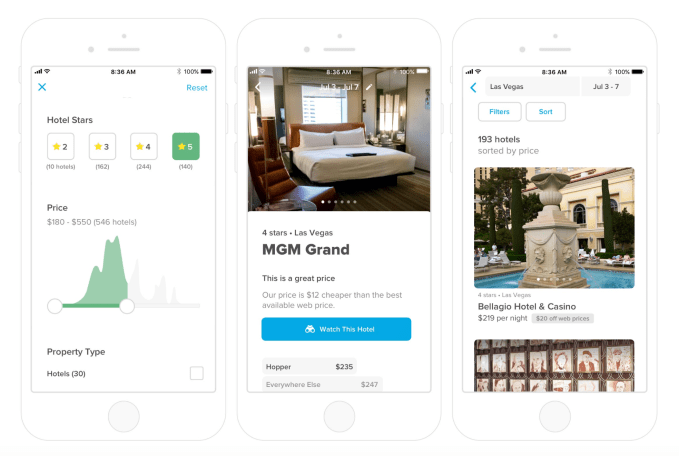
That’s why the new feature lets travelers narrow searches not only by city, but also by neighborhood and points of interest. Hotels can additionally be filtered by the neighborhood, rating, price and their amenities.

Hopper says people who book at the right time will save $62 per night, on average, off of the peak rates. But when people go shopping for hotels, they usually only spot check prices or wait until the last minute to book. To get a better deal, the company suggests you set the app to monitor hotel prices and send push notifications when the hotel prices drop or when private rates become available.

These private rates can include package deals, member rates, geofenced rates, closed user rates, pre-purchased inventory blocks, and more. Most people don’t know if these sort of rates are available to them, or if they would qualify. Hoppers says it will monitor these private rates, too, then alert you if you’re able to book a private deal.

In addition, the app offers a “Watch a Hotel” feature which will forecast and track the prices of specific hotels. That way, you can choose a handful of favorites places, then book when the prices become affordable to you — without having to waste time comparison shopping.

Over time, Hopper will learn more about your hotel preferences — for example, if you always book 4- or 5-star hotels or those with pools. It will then use this understanding combined with your usage of the app to make better recommendations in the future.

The company says it’s already seeing good results from using these sorts of A.I.-based recommendations for airfare, as now 25% of bookings are the result of people booking a trip they weren’t planning for, but Hopper knew to suggest.

Hopper will take a commission that varies by property, but that’s never more than 10% — anything higher is passed along to the customer in the form of savings. The company is using a number of different hotel data suppliers as well as working with hotels directly on the new feature, it says.

The expansion comes at a time when Hopper’s business is growing. Last fall, the company raised another $100 million, valuing its business at $780 million. Last year, it booked over a billion in sales, and users are today tracking $18 billion worth of flights and hotels per year in its app, which has passed 40 million downloads.

Since the beginning of 2019, Hopper’s sales are up 100% and conversion is up 80%, it says.

The hotel booking feature is live today in the Hopper app for iOS. It will roll out to Android in the next few weeks.

20 Jun 2019

Armoire is angling to become the every day Rent the Runway

When Armoire first emerged from MIT’s accelerator program back in 2016, the company’s vision was already fully formed — combine StitchFix and Rent the Runway to give women a low-cost, sustainable way to get a high-fashion, high-functioning wardrobe for every day.

Ambika Singh, the Seattle-based company’s chief executive set out to solve two problems, the amount of time wasted on shopping, some 216 hours spent in stores or online, and the waste associated with the impulse purchases and fast fashion that have become the byproduct of an accelerating consumer culture.

Carried along by two trends — the proliferation of direct to consumer brands trying to capture the attention of a new customer and the rise of the rental movement — Singh thought Armoire could provide a daily wardrobe for professional women at a price point that could be attractive enough to switch from an ownership to a rental model for fashion.

(Or as the New York Times put it in a strong contender for headline of the year: “They see it. They like it. They want it. They rent it.“)

It may have taken three years, but investors are now renting out some space of their own on the company’s cap table. Armoire recently raised a $4 million seed round from investors including Jesse Draper’s Halogen Ventures; Zulily co-founder, Darrell Cavens; Vijay Talwar, the former chief executive of BlueNile; and Rajeev and Jill Singh, former executives at Concur.

A subscription to Armoire’s service costs $149 per month and covers four items per shipmnet. The company’s average customer (Singh would not disclose how many of those there are), typically receive between 12 and 15 items in a month by swapping out the clothes they order.

Singh says this $149 per month is a discount to inventory that would otherwise cost around $300 if bought directly from stores.

The other benefit, says Singh, is that the company focuses on women-owned brands. Current suppliers include Of Mercer, Brass Clothing, and Zuri.

While the relationship between the company and its clothing providers is more of a wholesale model (Armoire buys the clothes at a discount), Singh envisions a time when the company could reduce costs or add revenues by marketing styles from its clothing suppliers to customers.

Other companies that are also taking the rental retail model to the masses have a consignment relationship where their suppliers are getting a portion of rental revenues.

The number of companies pitching rental retail has grown significantly since Armoire’s chief executive first stepped on the MIT pitch competition stage in Boston years ago. Now there’s Gwynnie Bee, Haverdash, and the grand dame of rental fashion, Le Tote.

Why enter a market when there’s already a global contender backed by over $62 million in venture financing?

Some competitors and retailers have a consignment relationship they’re getting a portion of a rental revenue.

“We’ve got a particular focus that a woman post-30 needs. We focus on maternity and nursing and we have a focus on fit.” says Singh. “The fact that rental has major headwinds around us and we have this consumer that is underserved and finding her voice in her wallet.”

Armoire’s team is 90% women and was hired from places like TheRealReal, Amazon, Zulily, and Rover. The company owns all of its own inventory, and is targeting a 30-to-60 year-old woman who’s typically a working mother.

Singh uses a $70,000 median household income as its targeting proxy on Facebook, but says she’s hoping to bring the price point down for middle class consumers. “This is a good way to get the volume ‘she’ might desire with a fixed budget,” says Singh.

And Armoire does have an option to buy the clothes that customers are renting — should they feel inclined. Singh expects the company booked roughly $200,000 in May.