Category: UNCATEGORIZED

12 Jun 2019

Google opens its Android security key tech to iPhone and iPad users

Google will now allow iPhone and iPad owners to use their Android security key to verify sign-ins, the company said Wednesday.

Last month, the search and mobile giant said it developed a new Bluetooth-based protocol that will allow modern Android 7.0 devices and later to act as a security key for two-factor authentication. Since then, Google said 100,000 users are already using their Android phones as a security key.

Since its debut, the technology was limited to Chrome sign-ins. Now Google says Apple device owners can get the same protections without having to plug anything in.
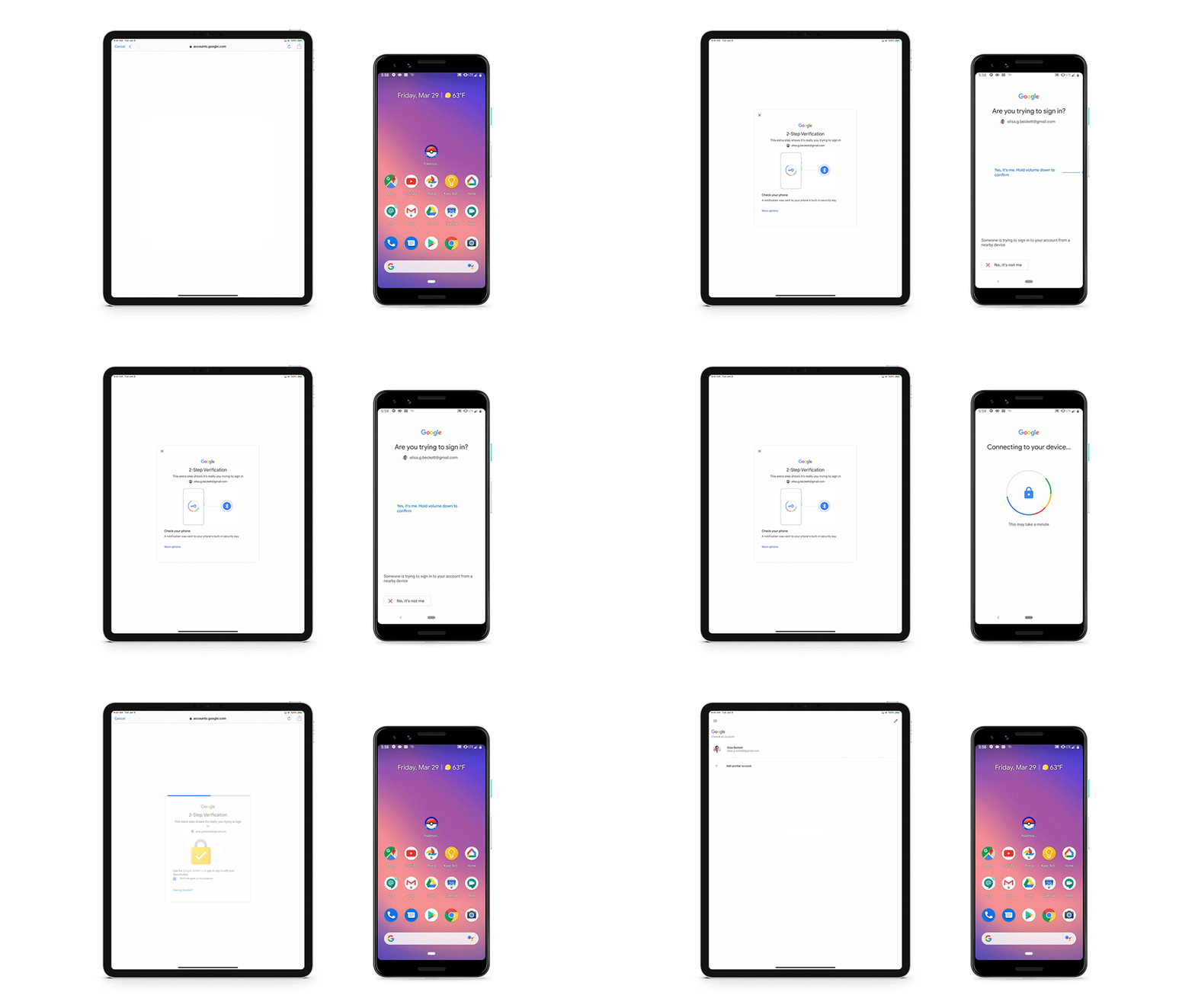
Signing in to a Google account on an iPad using an Android 7.0 device. (Image: Google)

Security keys are an important security step for users who are particularly at risk of advanced attacks. They’re designed to thwart even the smartest and most resourceful attackers, like nation-state hackers. Instead of a security key that you keep on your keyring, newer Android devices have the technology built-in. When you log in to your account, you are prompted to authenticate with your key. Even if someone steals your password, they can’t log in without your authenticating device. Even phishing pages won’t work because only legitimate websites support security keys.

For the most part, security keys are a last line of defense. Google admitted last month that its standalone Titan security keys were vulnerable to a pairing bug, potentially putting it at risk of hijack. The company offered a free replacement for any affected device.

The security key technology is also FIDO2 compliant, a secure and flexible standard that allows various devices and running different operating systems to communicate with each other for authentication.

For now, Google said the Android security key will be limited to sign-ins to Google accounts only.

12 Jun 2019

Only 48 hours left for early-bird tickets to TC Sessions: Mobility 2019

If you’re wild about anything and everything related to mobility and transportation, you do not want to miss the TC Sessions: Mobility 2019 conference in San Jose, Calif. on July 10.

If you’re also wild about saving money, then synchronize your Apple watches — there are 48 hours left to score the early-bird price and save $100. That train leaves the station on Friday, June 14 at 11:59 p.m. (PT), so book your pass now.

More than 1,000 of the industries’ top technologists, founders, investors, engineers and researchers will be there to explore the current and future states of transformational technologies — flying taxis, delivery drones, dockless scooters, autonomous vehicles and more.

World-class speakers and TechCrunch editors will look at both the exciting benefits and the formidable challenges that will ultimately and profoundly affect billions of people around the world. Here’s a taste of what’s coming (you can also check out the full agenda):

  • Bringing Ethics to Self-Driving Cars: Voyage’s Oliver Cameron and Uber’s Clark Haynes will discuss ethical decision-making in autonomous vehicles and detail how robot cars are designed to prioritize some objects over others.
  • Will Venture Capital Drive the Future of Mobility? Michael Granoff (Maniv Mobility), Ted Serbinski (Techstars) and Sarah Smith (Bain Capital) will debate the uncertain future of mobility tech and whether VC dollars are enough to push the industry forward.
  • Rebuilding the Motor City: Ken Washington, Ford’s CTO and vice president of research and advanced engineering, will discuss how the historic automaker is rapidly changing its culture and processes while it prepares for an electric future.
  • The Last Mile: Challenges and Opportunities for Startups: Regina Clewlow, Populus founder and CEO, and Stonly Baptiste, Urban Us co-founder break down what it means to be a last-mile innovation business — the money needed to succeed, how data and technology will change the way people move from Point A to Point B and the hurdles that stand in the way.

TC Sessions: Mobility 2019 takes place on July 10, and you have only 48 hours left to get wild, be an early-bird and save $100. Get your ticket today.

Is your company interested in sponsoring or exhibiting at TC Sessions: Mobility? Contact our sponsorship sales team by filling out this form.

12 Jun 2019

Citymapper is shutting down its efforts to reinvent the bus

City navigation and public transit app Citymapper is ending the program it called ‘Citymapper Ride,’ which has gone through a number of incarnations since its introduction back in 2017.

Since then, the company has gone from running bus one route in London designed to supplement a need for customers that wasn’t currently well-addressed by existing transit options, to operating shared cab rides, and the program has been renamed from Smarbus, to Smartride to finally Citymapper Ride.

In a Medium post detailing the decision to end the program, Citymapper noted a number of reasons why it’s shutting down the program and this line of product development. These include a mismatch with its mission in the evolution of the product from bus operation to shared cabs; a desire to focus on Pass, its subscription service that provides access to mobility services including public transit, bicycles and cabs for one fee; a desire to give its partners more emphasis rather than competing with them; economics that don’t make sense without focus specifically on making them work; and regulations that hampered some of its efforts, including operating bus lines.

In the end, Citymapper running buses and acting as a kind of Uber junior was always a bit of a weird distraction from its core mission, and it always felt experimental. The mobility market overall seems to be undergoing a maturation in recent years, so it makes sense for tech companies to be applying the learnings resulting from some of their more ambitious larks.

12 Jun 2019

Uber Air’s plan to get you from a skyport to an airport

Uber trips to and from the airport account for a significant number of rides. Uber doesn’t disclose the exact amount, but Uber Elevate Infrastructure Business Development Lead Chad Cashin told TechCrunch. That’s why Uber is already working with Signature Flight Support to ensure it has a place to land the electric vertical take-off and landing vehicles at airports.

Signature Flight Support operates a network of private aviation terminals, as well as provides services for flights. It’s done this for 35 years. Uber says that by partnering with Signature, it will have an easy way into big airports like SFO, LAX AND DFW and hundreds of other airports all over the world.

“If you think about why Signature is important to Uber, aside from the fact that so many traditional Uber trips start and end at an airport — they don’t release the number, but it’s a heavy amount of trips that are airport associated,” Cashin said. “So we look at skyports from a demand perspective, and heavy demand will and forever be at airports. So if you look at Signature’s infrastructure footprint, they have over 200 locations worldwide.”

The experience is also designed to be efficient. In fact, Signature Flight Support Chief Commercial Officer Shawn Hall told TechCrunch that’s one of the biggest value propositions.

“The biggest value proposition of private aviation flying around in a jet, or anything else, is really the efficiency,” Hall said. “It’s not the high end experience is the efficiency. And just to give you a sense for that, our passengers will literally show up minutes before they take off.”

Unsurprisingly, Uber Copter will be able to transport people from helipads to JFK thanks to its partnership with Signature. When Uber Air deploys in its first cities in 2023, Los Angeles, Dallas-Fort Worth and Melbourne, it will have five to seven skyports in each city plus an airport.

12 Jun 2019

iMovie’s big iOS update adds 80 new soundtracks, green screen effects, image overlays

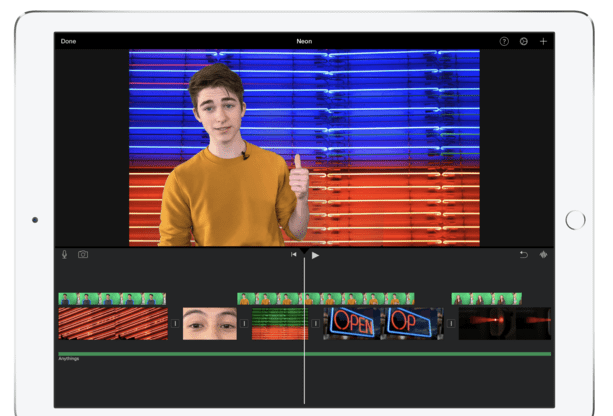
Ahead of the public launch of Apple’s revamped suite of first-party apps on iOS 13, the company has rolled out a new version of its popular video editor, iMovie for iOS. With the app’s most recent update, iMovie has received a host of new features — most notably, support for a green screen effect that lets you remove the background from clips, as well as the addition of 80 new soundtracks across a variety of genres.

The green screen support, in particular, could make iMovie a better competitor to the third-party video editors which tend to offer more advanced feature sets, while also keeping things simple for less savvy users.

Apple says users of the new version (2.2.7) will be able to remove backgrounds from any clips shot in front of a blue or green screen, as well as adjust the clip with a 4-point mask and strength slider.


Its 80 new soundtracks include genres like pop, chill and sentimental that will automatically adjust to the length of the movie.

In terms of new effects, iMovie will now allow users to add photos as overlays to create picture-in-picture and split screen effects as well as opt to hide the border on those. These were some of iMovie’s more requested features, in fact, and one of the reasons why people went elsewhere for video editing apps.

Other new features are designed to make iMovie easier to use. For example, when you switch back to the iOS app from other applications, it will take you right to the edit screen of your project. It has also tucked away access to iMovie Theater from the three-dot ( … ) more menu, as it’s shifting users to share videos to iCloud instead.

And, as part of other classroom-focused updates, iMovie now supports ClassKit, which means students can deliver their video assignments directly the teachers via Apple’s Schoolwork app.

Because iMovie is designed to work across Apple’s platforms, users can begin editing projects on their phone then transfer them to other devices like the iPad or Mac in order to complete edits, including those that may benefit from working via a larger screen — such as the green screen effect or color corrections, for example.

The updated iMovie is available for both iPhone and iPad from the App Store.

12 Jun 2019

‘This is Your Life in Silicon Valley’: Philz Coffee CEO Jacob Jaber on tech culture and Blue Bottle

Welcome to this week’s transcribed edition of This is Your Life in Silicon Valley. We’re running an experiment for Extra Crunch members that puts This is Your Life in Silicon Valley in words – so you can read from wherever you are.

This is your Life in Silicon Valley was originally started by Sunil Rajaraman and Jascha Kaykas-Wolff in 2018. Rajaraman is a serial entrepreneur and writer (Co-Founded Scripted.com, and is currently an EIR at Foundation Capital), Kaykas-Wolff is the current CMO at Mozilla and ran marketing at BitTorrent. Rajaraman and Kaykas-Wolff started the podcast after a series of blog posts that Sunil wrote for The Bold Italic went viral. The goal of the podcast is to cover issues at the intersection of technology and culture – sharing a different perspective of life in the Bay Area. Their guests include entrepreneurs like Sam Lessin, journalists like Kara Swisher and politicians like Mayor Libby Schaaf and local business owners like David White of Flour + Water.

This week’s edition of This is Your Life in Silicon Valley features Jacob Jaber, the CEO of Philz Coffee. During this episode, we try to convince TechCrunch’s Kate Clark why Philz Coffee is a better option than Starbucks. Jacob also talks about the tech community, his business goals, and whether he’d ever consider leaving San Francisco.

You don’t want to miss this week’s edition of TIYLISV, which is extremely lively and may change your coffee-drinking habits.

For access to the full transcription, become a member of Extra Crunch. Learn more and try it for free. 

Sunil Rajaraman: Welcome to season three of “This is Your Life in Silicon Valley” a podcast about the Bay Area, technology, and culture. I’m your host, Sunil Rajaraman, and I’m joined by my cohost, Jascha Kaykas-Wolff.

Jascha Kaykas-Wolff: I always wonder if things that happen on Twitter are actually real or not. Like is it just all made up stuff, or do people actually interact with each other and then see each other in the real world.

12 Jun 2019

KKR leads $300M investment in phishing training company KnowBe4

You might not have known about KnowBe4 before, but you should now because this morning, the company announced a massive $300 million investment led by private equity firm KKR. The deal is based on a billion valuation. Existing investors Elephant and TenEleven Ventures also participated in the round.

The massive influx of cash comes on top of a $50 million investment in March, also led by KKR. They really, really like this company. Today’s investment brings the total raised to $393 million, which is a fair amount of money for a company that helps train employees to recognize phishing emails.

KKR director Stephen Shanley says his company obviously sees a lot of potential for KnowBe4 . “The business is delivering a best-in-class product, over $100 million of recurring revenue, near triple digit growth that is accelerating, and profitability – a rare combination of qualities we see in businesses at this stage.  We see a huge opportunity for the business in both it’s current markets and in its international roll out strategy,” Shanley told TechCrunch.

You would think it’s a solved problem, or at least a smaller problem, but the phishing attempts grow ever more sophisticated, and the method still works, or we wouldn’t still see so much of it. What companies like KnowBe4 do is allow a company’s security staff to send out tests to employees. These are harmless attempts at phishing, but which are designed to see if you react or report the attempt. Ideally you would do the latter, or at least learn a valuable lesson if you fall for it.

“Threats like phishing, ransomware and other forms of social engineering continue to plague organizations of all sizes, meaning the market for our security awareness training is growing at a rapid pace,” company founder and CEO Stu Sjouwerman said in a statement.

The new funding should help push that further, and private equity investors also often look for ways to buy companies with adjacent kinds of services to build a platform of offerings. With this kind of money in the bank, it would appear to be poised to have the option of doing that if that’s the direction it chooses to go. For now, KKR’s Shanley sees other uses for the money.

“As demand for cybersecurity products continues to increase we believe KnowBe4 is serving an important market need. A big part of what we’ll be able to help KnowBe4 do is expand internationally and help them evolve in the next stage of their growth,” he said.

12 Jun 2019

SpaceX successfully re-launches and recovers Falcon 9 flown in March

SpaceX’s launch today from California’s Vandenberg Air Force base went off today without a hitch, bringing three satellites that make up the RADARSAT constellation to be used for observation by the Canadian Government.

The launch today included use of a Falcon 9 first stage that flew a mission only a few months ago in March, when it carried SpaceX’s Crew Dragon capsule to orbit during an uncrewed demonstration mission. The first stage was refurbished and reflown, bringing SpaceX yet another step closer to its goal of narrowing the window between flights for its reusable rocketry further still.

SpaceX also recovered the first stage with a controlled landing back at the company’s LZ-4 landing pad at Vandenberg. Which, now that SpaceX has demonstrated its ability to land up to three boosters at once when launching its larger Falcon Heavy orbital rocket.

The SpaceX rocket will now deploy its payload of three satellites into their target orbits, and we’ll update this post with the results of that aspect of the mission once it’s complete.

The next launch on the schedule for SpaceX is another Falcon Heavy launch set for June 24, which will be its third flight and its first for the US Air Force. On board, it’ll have the USAF’s Space Test Program Flight 2 which includes experimental small sat payloads, and also a number of research projects from NASA.

12 Jun 2019

Hyundai takes minority stake in self-driving car startup Aurora

Hyundai Motor Group has invested in Aurora, the latest sign that the scope of the year-old partnership between the automaker and self-driving car startup has expanded.

Aurora and Hyundai didn’t disclose terms of the investment. However, picking part new details of its Series B funding round and speaking to sources within the industry, Hyundai’s investment is below $30 million.

Aurora announced in February that it had raised more than $530 million in a Series B round that was led by Sequoia Capital and included “significant investment” from Amazon and T. Rowe Price Associates. Since then, that Series B round has expanded to more than $600 million with new investment from Hyundai, Baillie Gifford and the Canada Pension Plan Investment Board, TechCrunch has learned.

To date, Aurora has raised more than $700 million, a figure that includes its seed round Series A round of $90 million.

Hyundai’s stake in Aurora is an affirmation of the company and their working relationship. But it’s just one measure. What Aurora is actually doing matters as much.

When the partnership was first announced in January 2018, the details of the relationship were scant. New information reveals that Aurora has been working with Hyundai and Kia for the last year to integrate its “Driver” into Hyundai’s flagship fuel cell vehicle NEXO.

Aurora says it will expand research and development of a self-driving platform for a wide range of Hyundai and Kia’s models.

Aurora, which launched in January 2017, works with companies like Hyundai, Byton, and until more recently Volkswagen, to design and develop a package of sensors, software, and data services needed to deploy autonomous vehicles. The company describes this “full stack,” (an industry parlance) the Aurora Driver.

Aurora, like many of its competitors, are focused on Level 4 autonomous systems with an eye toward Level 5. Level 4 is a designation by SAE, the automotive engineering association, for autonomous vehicles that take over all driving in certain conditions. In Level 5 autonomy, the vehicle is self-driving in all situations.

About a year after Aurora’s official launch date, the company announced partnerships with Hyundai and Volkswagen, followed by a Series A funding raise that resulted in two new board members — LinkedIn co-founder and Greylock partner Reid Hoffman and Mike Volpi, former chief strategy officer at Cisco and general partner at Index Ventures.

Volkswagen has since ended its partnership with Aurora. Meanwhile, Fiat Chrysler Automobiles has announced a collaboration with Aurora to to develop self-driving commercial vehicles. The partnership with FCA will focus on integrating Aurora’s technology into the automaker’s line of Ram Truck commercial vehicles, a portfolio that includes cargo vans and trucks. The deal could extend to FCA’s Fiat Professional brand as well, TechCrunch has learned.

12 Jun 2019

Facebook’s Blood Donations feature arrives in U.S., will alert donors in times of need

Facebook today is expanding its set of features focused on blood donations. The company since 2017 has been working with blood donation centers worldwide who have been able to use the platform to reach potential donors and then reach out to them in times of need. Now, Facebook is bringing its Blood Donations feature to the U.S.

At launch, Facebook is partnering with leading blood donation organizations across the U.S., including America’s Blood Centers, the American Red Cross, Inova, New York Blood Center, Rock River Valley Blood Center, Stanford Blood Center, Versiti, and Vitalant.

It’s also first launching Blood Donations in select urban markets ahead of a nationwide rollout. To start, the feature will arrive in Chicago, New York City, the San Francisco Bay Area, Baltimore and Washington, D.C., the company says.

The U.S. Blood Donations feature is similar to the one already available elsewhere in the world — including Bangladesh, Brazil, India, and Pakistan.

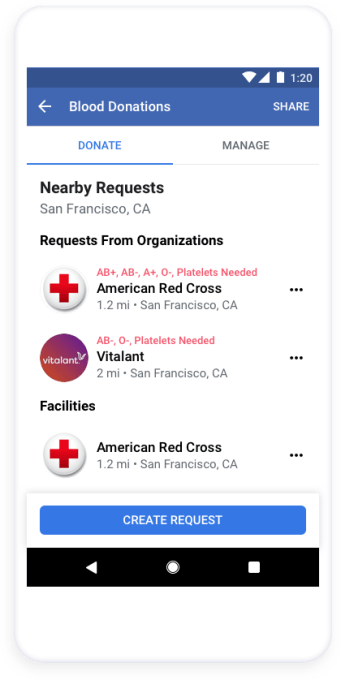
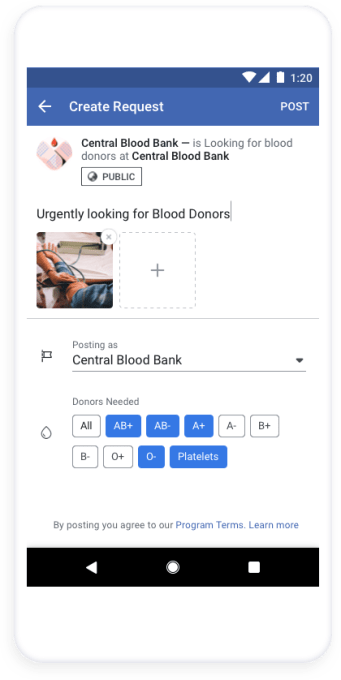
To access the Blood Donations feature, U.S. Facebook users in the supported markets can sign up by visiting its page from the “About” section of their Facebook profile. Here, they’ll give Facebook permission to notify them when nearby blood banks need their help. When the blood banks are running low on supply, they can also turn to Facebook to alert the nearby donors through the platform.

People will see and respond to these blood donation requests and opportunities on the Blood Donations destination on Facebook. They can also use tools on this page to inspire their friends to donate, too.

Since its 2017 launch, the Blood Donations feature has performed well. Over 35 million people signed up in the handful of worldwide markets where it was first available. In India and Brazil, blood donation centers said that 20% of people said Facebook influenced their decision to donate — a statistic based on in-person surveys conducted at the blood banks.

“Through our partnership with Facebook, individuals will be able to conveniently find and connect with their local blood center to help meet the ongoing need for a diverse pool of blood donors in the US and share their experiences and the importance of blood donation,” said Kate Fry, chief executive officer at America’s Blood Centers, in a statement about today’s launch. “By encouraging blood donation as a way of life, each of us can assure that the more than 30,000 pints of blood used daily throughout the country is available.”

The launch is timed just ahead of World Blood Donor Day on June 14. Founded by the World Health Organization, the day is meant to raise awareness of the regular need for blood donations. Facebook says it will host blood donations in some of its own offices on this day, and will run awareness campaigns in Brazil and India. It’s also partnering with Missing Types for a campaign with the American Red Cross and Vitalant to help draw attention to the need for blood donors, it says.

“We are grateful to Facebook for supporting the Missing Types campaign, which underscores the critical need for blood donors,” said Cliff Numark, senior vice president, American Red Cross. “This campaign comes at exactly the right time, as busy summer schedules make it extremely challenging to sign up sufficient blood donors. And Facebook’s new blood donation feature makes it even easier to make a lifesaving donation,” he added.