Category: UNCATEGORIZED

11 Jun 2019

As Alzheimer’s costs soar, startups like Neurotrack raise cash to diagnose and treat the disease

As studies show that early diagnosis and preventative therapies can help prevent the onset of Alzheimer’s, startups that are working to diagnose the disease earlier are gaining more attention and funding.

That’s a boon to companies like Neurotrack, which closed on $21 million in new financing led by the company’s previous investor, Khosla Ventures, with participation from new investors Dai-ichi Life and SOMPO Holdings.

Last year, the Japanese life insurance company, Dai-ichi Life partnered with Neurotrack to roll out a cognitive assessment tool to the company’s customers in Japan.

And earlier this year, the Japanese health insurer, SOMPO conducted a 16-week pilot with Neurotrack, where more than 550 of SOMPO’s employees took Neurotrack’s test and followed the Memory Health Program for four months. Neurotrack and SOMPO are now working to deepen and extend their partnership.

“As the global crisis around Alzheimer’s continues to grow, the private sector is joining government and nonprofits to address the problem in their markets. In Japan, for example, traditional insurance companies are developing novel solutions that incorporate Neurotrack’s products to advance better memory health among its population,” said Elli Kaplan, Neurotrack Co-founder and CEO. “These partnerships are innovative models that we hope to replicate in other markets, enabling traditional insurance companies to create new markets while helping to address the Alzheimer’s crisis. And now they’re also investing in our company so these companies have two ways of doing well by doing good.”

Neurodegenerative disorders are becoming a more serious issue for the island nation — and the rest of the world. In fact, over the weekend the G20 first raised the possibility that aging populations could be a global risk.

“Most of the G20 nations already experience or will experience ageing,” Bank of Japan governor Haruhiko Kuroda, told reporters from Agence France Presse. “We need to discuss problems that arise with societal aging and how to deal with them.”

In the U.S., the estimated cost of caring for Americans with Alzheimer’s and other dementias was an estimated $277 billion in 2018, according to a study cited by WebMD. Roughly $186 billion of those costs are borne by Medicare and Medicaid with another $60 billion in payments coming out-of-pocket. That number could top $1.1 trillion by 2050, according to the same report.

Neurotrack uses cognitive assessments that follow eye movements using the camera on a computer or mobile phone to create a baseline for cognitive functions. The company then uses a combination of brain training and diet, exercise, and sleep adjustments to try and improve cognitive function and health.

Its technology is one of several different approaches startups are taking to try and provide early diagnoses and potential preventative measures against the disease.

MyndYou is another company tackling neurodegenerative diagnostics uses an app to monitor movement among its users. The company assesses that data to determine whether there may be any issues related to cognitive function.  It recently partnered with the Japanese company Mizuho to test its efficacy among Japan’s aging population.

Then there’s Altoida, another startup which launched recently to tackle the cognitive assessment market. It uses augmented reality and a series of memory tests to assess brain function and attempt to detect neurodegeneration.

Neurotrack’s technology, based on research from Emory University, has managed to attract more than just Japanese corporations. Previous investors like Sozo Ventures, Rethink Impact, AME Cloud Partners, and Salesforce founder Marc Benioff have also thrown cash behind the company.

To date, the company has raised more than $50 million including $6.8 million in grants from the National Institutes of Health and National Institute of Aging.

The company said its new investment will be used to develop new partnerships in additional global markets and continue research and development.

“One can now feel empowered to test for potential memory decline, given that Neurotrack’s Memory Health Program can help stave off cognitive decline. This fully integrated platform enables users to assess the state of their memory, reduce future risk for decline, and monitor progress in order to take better control of one’s memory health. We combine these tools with deep analytics to further target and personalize, creating a very powerful precision medicine solution,” said Kaplan. “Just as when you go on a diet, you use a scale to provide evidence that you’re losing weight. Neurotrack now has the equivalent of both a scale to measure and the Memory Health Program for cognitive health. This is a game-changer for dementia risk.”

Japan has national efforts targeting a reduction in the onset of dementia in 6% of people in their 70s by 2025 (the country has the world’s largest population of the elderly with over 20% of the country over the age of 65). Roughly 13 million people are expected to develop Alzheimer’s in Japan by 2025.

Part of the company’s success in fundraising comes from the results of a preliminary study that showed improved cognitive functions for people diagnosed with some decline in cognitive function after a year of using Neurotrack’s Memory Health Program. The company claims it has the the first fully integrated, clinically-validated platform that can assess a person’s cognition through its cognitive assessment — which can predict conversion from healthy to mild cognitive impairment (MCI) or MCI to Alzheimer’s disease within 3 years at 89% accuracy, and within 6 years at 100% accuracy.

While that kind of assessment is good, Alzheimer’s symptoms can begin to appear as early as 25 years before the onset of the disease. So there’s still work to be done.

“Neurotrack has built an incredible integrative platform that is transforming our battle with Alzheimer’s,” said Jenny Abramson, Founder & Managing Partner of Rethink Impact. “Elli’s two decades of experience in the private sector and in government are helping her scale this solution to the millions of people suffering from cognitive decline around the world. We couldn’t be more excited to continue to support Neurotrack, given both the financial opportunity and the impact they are already having on this critical disease.”
11 Jun 2019

72 hours left on early-bird savings for TC Sessions: Mobility 2019

We’re totally stoked to see all of you at TC Sessions: Mobility 2019 on July 10 in San Jose, Calif. That’s slightly less than a month away, and if you want to save on the price of admission, you need to play beat the clock. Early-bird pricing ends on Friday, June 14 at 11:59 p.m. (PT).

That’s a hundred bucks, people. Why pay more? Buy your early-bird ticket now and save that Benjamin for a rainy day.

TC Sessions: Mobility 2019 is a day-long conference focusing on the current and future state of mobility and transportation. More than 1,000 members of these communities — founders, technologists, engineering students and investors — will gather to learn, share, demo and network.

TechCrunch editors will interview some of the best minds and makers in mobility and transportation — the people making it happen. They’ll look at the promises, expose the hype and address the complex challenges inherent in these revolutionary industries.

Autonomous vehicles are a hot topic, and you’ll hear a lot on that subject. We can’t wait to hear from Jesse Levinson, co-founder and CTO of Zoox. He oversees the company’s software, artificial intelligence, computing and sensing platforms. He’ll talk with us about the company’s deployment plans and the challenges ahead.

The jam-packed agenda includes some of the transportation industry’s biggest names. Folks like Seleta Reynolds of the Los Angeles Department of Transportation, Ford Motor CTO Ken Washington, Mobileye co-founder and CEO Amnon Shashua, Karl Iagnemma of Aptiv, Alisyn Malek with May Mobility and Dmitri Dolgov at Waymo.

What’s happening with mobility investment? We’ve got that covered, too. You’ll hear from Michael Granoff (Maniv Mobility), Ted Serbinski (Techstars) and Sarah Smith (Bain Capital).

Here’s another way to experience TC Sessions: Mobility 2019. Buy a demo table. You won’t find a better place to showcase your mobility startup to a more targeted, influential audience. We’re talking founders, investors, technologists and media. The price includes three attendee tickets for extra ROI.

TC Sessions: Mobility 2019 takes place July 10 in San Jose, Calif. It’s time to play beat the clock. Early-bird pricing ends in 72 hours on Friday, June 14 at 11:59 p.m. (PT). Buy your ticket today and save $100.

Is your company interested in sponsoring or exhibiting at TC Sessions: Mobility? Contact our sponsorship sales team by filling out this form.

11 Jun 2019

Facebook’s new Study app pays adults for data after teen scandal

Facebook shut down its Research and Onavo programs after TechCrunch exposed how the company paid teenagers for root access to their phones to gain market data on competitors. Now Facebook is relaunching its paid market research program, but this time with principles — namely transparency, fair compensation, and safety. The goal? To find out what other competing apps and features Facebook should buy, copy, or ignore.

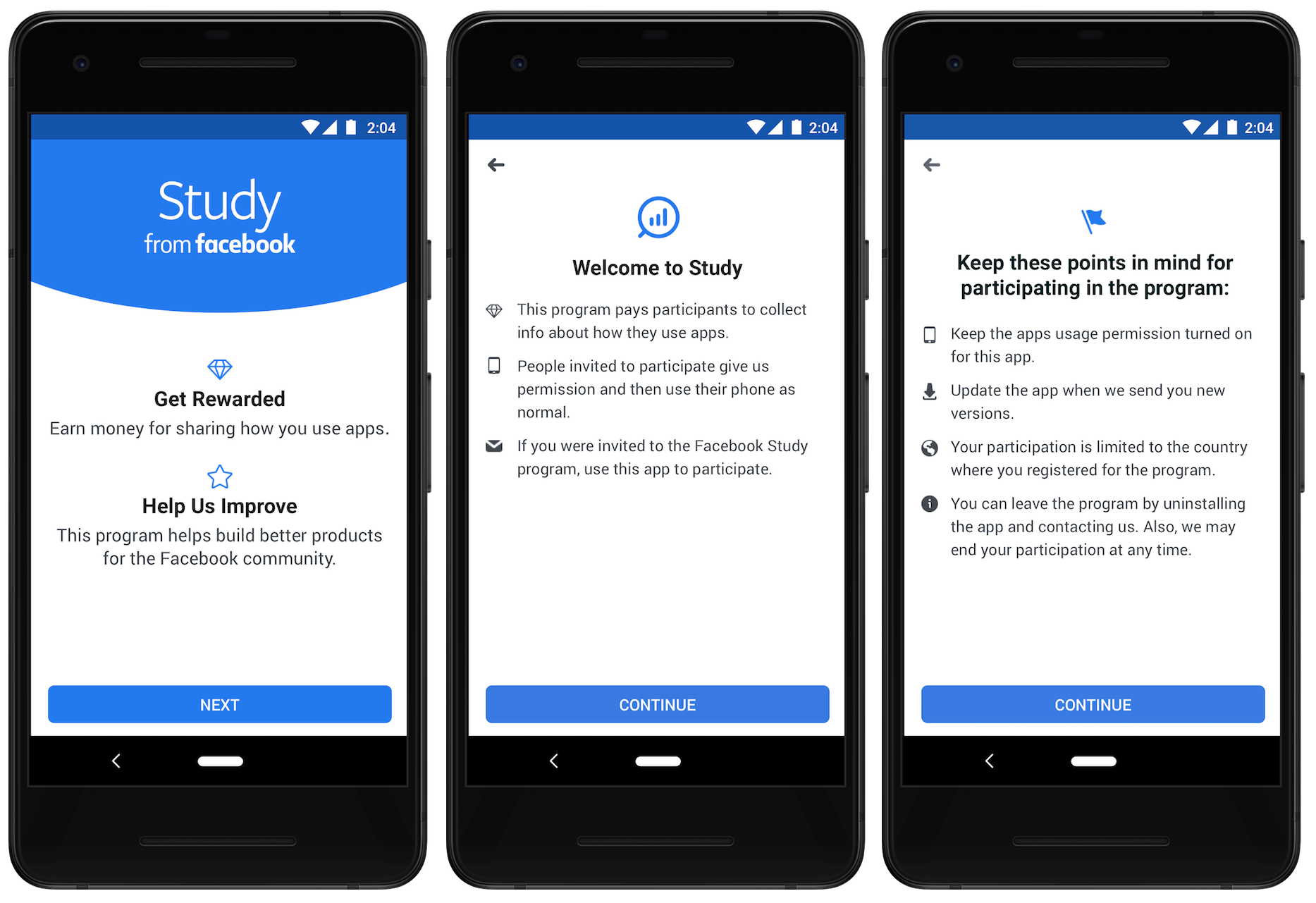
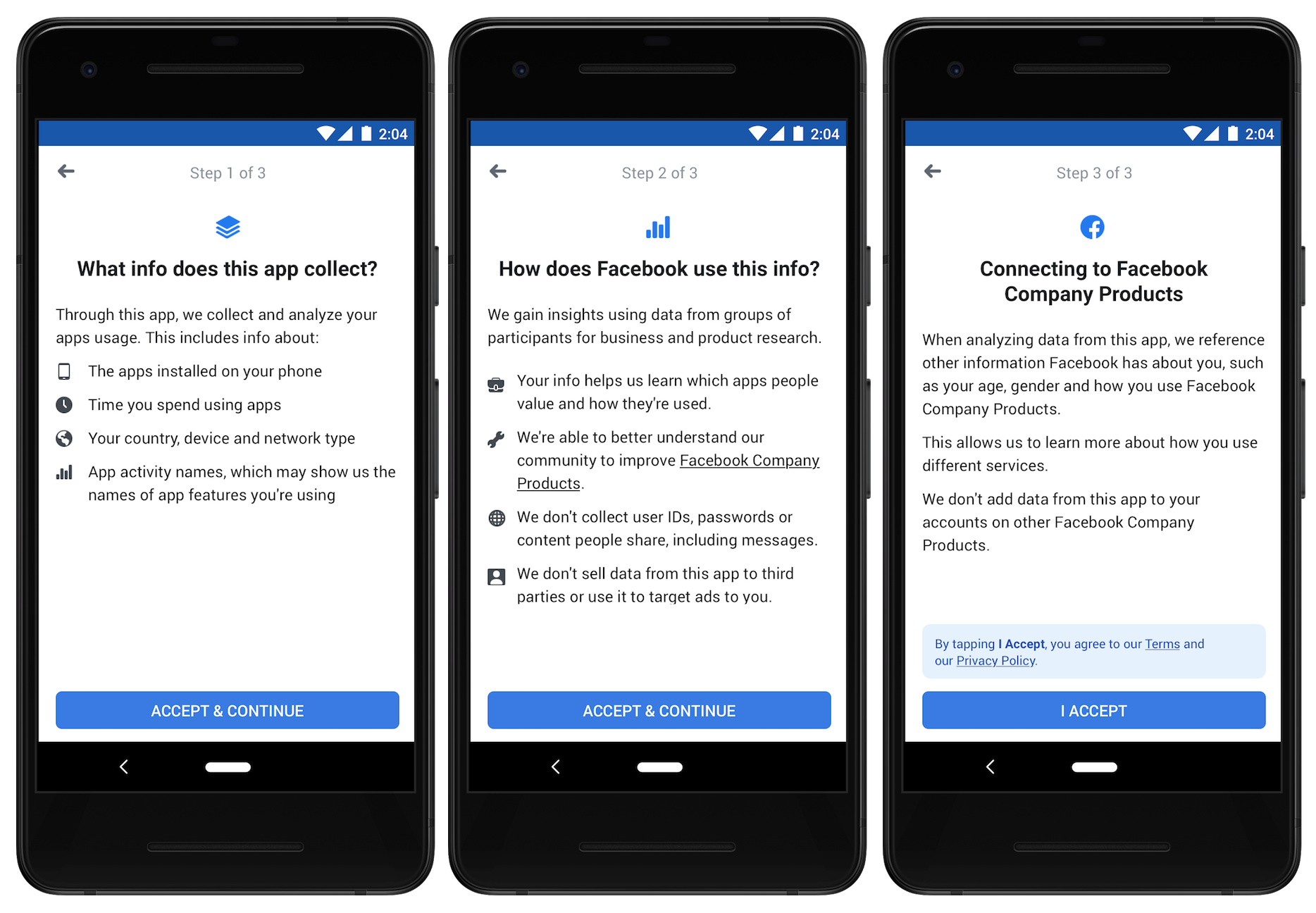
Today Facebook releases its “Study From Facebook” app for Android only. Some adults 18+ in the US and India will be recruited by ads on and off Facebook to willingly sign up to let Facebook collect extra data from them exchange for a monthly payment. They’ll be warned that Facebook will gather what apps are on their phone, how much time they spend using those apps, the app activity names of features they use in other apps, plus their country, device, and network type.

Facebook promises it won’t snoop on user IDs, passwords, or any of participants’ content including photos, videos, or messages. It won’t sell participants info to third parties, use it target ads, or add it to their account or the behavior profiles the company keeps on each user. Yet while Facebook writes that “transparency” is a major part of “Approaching market research in a responsible way”, it refuses to tell us how much participants will be paid.

“Study From Facebook” could give the company critical insights for shaping its product roadmap. If it learns everyone is using screensharing social network Squad, maybe it will add its own screensharing feature. If it finds group video chat app Houseparty is on the decline, it might not worry about cloning that functionality. Or if it finds Snapchat’s Discover mobile TV shows are retaining users for a ton of time, it might amp up teen marketing of Facebook Watch.

The launch shows Facebook’s boldness despite the threat of anti-trust regulation focusing on how it’s supressed competition through its acquisitions and copying. Democrat presidential candidates could use Study From Facebook as a talking point, noting how the company’s huge profits earned from its social network domination afford it a way to buy private user data to entrench its lead.

How Study From Facebook Works

Unlike Onavo or Facebook Research, users can’t freely sign up for Study. They have to be recruited through ads Facebook will show on its own app and others to both 18+ Facebook users and non-users in the US and India. That should keep out grifters and make sure the studies stay representative of Facebook’s user base. Eventually Facebook plans to extend the program to other countries.

If users click through the ad, they’ll be brought to Facebook’s research operations partner Applause’s website that clearly identifies Facebook’s involvement, unlike Facebook Research that hid that fact until users were fully registered.. There they’ll be explained how the Study app is opt-in, what data they’ll give up in exchange for what compensation, and that they can opt-out at any time. They’ll need to confirm their age, have a PayPal account that are only supposed to be available to users 18 and over, and Facebook will cross-check the age to make sure it matches the person’s Facebook profile if they have one. They won’t have to sign and NDA like with the Facebook Research program.

Anyone can download the Study From Facebook app from Google Play, but only those who’ve been approved through Applause will be able to log in and unlock the app. It will again explain what Facebook will collect, and ask for data permissions. The app will send periodic notifications to users reminding them they’re selling their data to Facebook and offering them an opt-out. Study From Facebook will use standard Google-approved APIs and won’t use a VPN, SSL bumping, root access, enterprise certificates, or permission profiles you install on your device like the Research Program that ruffled feathers.

At 15 years old, Facebook is at risk of losing touch with what the next generation wants out of their phones. Rather than trying to guess based on their activity on its own app, it’s putting its huge wallet to work so it can pay for edge on the competition.

11 Jun 2019

Over 1,400 self-driving vehicles are now in testing by 80+ companies across the U.S.

In a talk at the Uber Elevate summit in Washington, DC today, US Department of Transportation Secretary Elaine Chao shared a total overall figure for ongoing testing of autonomous vehicles on U.S roads: Over 1,400 self-driving cars, trucks and other vehicles are currently in testing by over 80 companies across 36 US states, plus DC itself.

This puts some sense of overall scale to the work being done to test and develop self-driving car tech in the US. For context, note that in California, one of the first states to have implemented AV testing on public roads, currently has 62 companies registered to perform testing – which represents a significant chunk of that 80+ figure provided by Secretary Chao.

Chao also shared that there are over 1.59 million registered drones currently in the U.S., of which more than 372,000 are classified as commercial, wth over 136,000 registered commercial drone operators also on the books. That represents a net new job category, Chao noted.

The secretary also later emphasized that the DoT over which she provides and the current administration aims to be “tech natural, and not command and control” and that the department is not “in the business of picking winners and losers,” something she said the assembled audience of mostly private-sector attendants would be “so pleased to hear.

Under Chao, the DoT has introduced and continues to overhaul guidelines, rules and programs that favor and unblock industry and commercial access to autonomous driving, drone operation and spacecraft launch capabilities. Recently, Chao has come under fire for potential conflict of interest related to use of her position.

11 Jun 2019

Mozilla gives Firefox a new logo as it looks beyond the browser

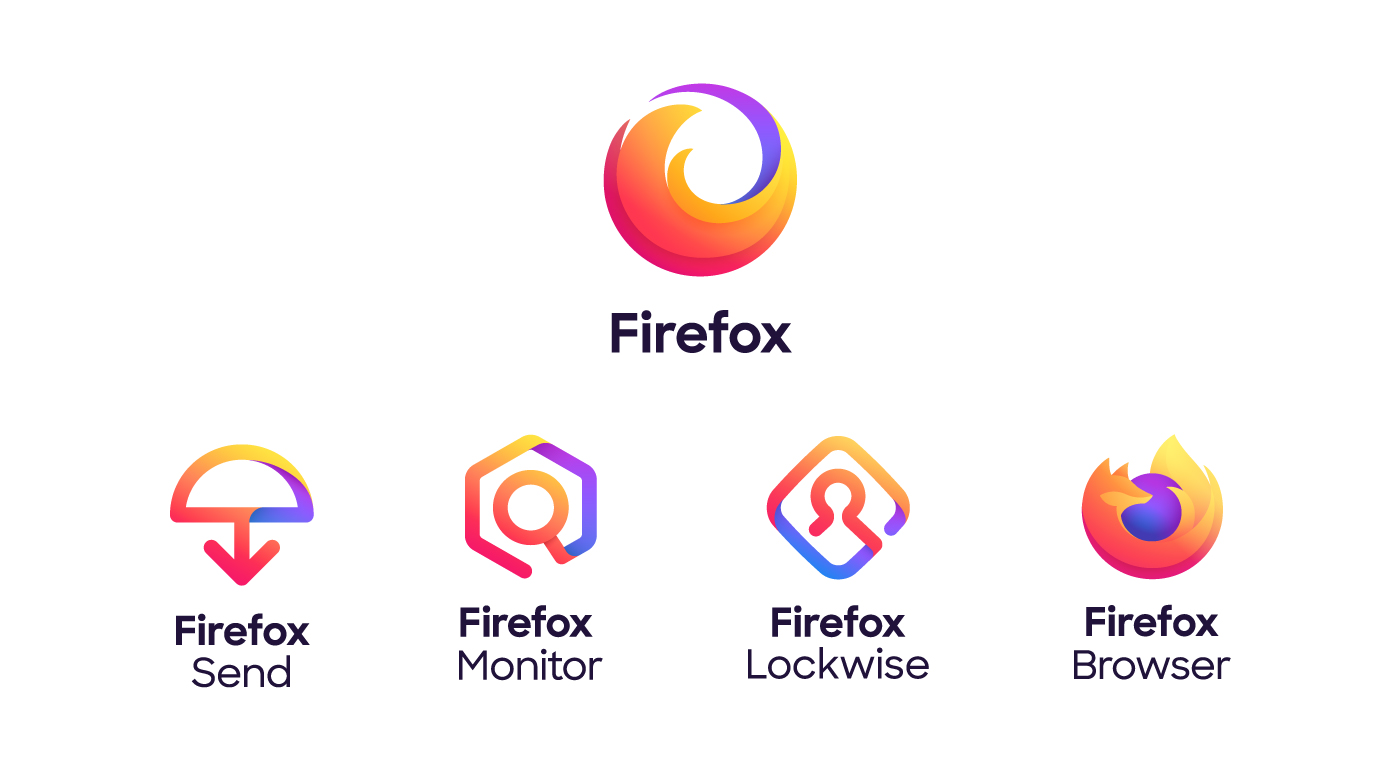
Mozilla’s Firefox is getting a new logo that is meant to reflect that the brand now stands for more than a browser.

With products like its password manager Lockwise, private file sharing service Send and security tools like Firefox Monitor, Mozilla has greatly expanded the brand. That’s a challenge no branding expert can refuse, so it’s no surprise the organization went on a quest for new logos and an update to its iconic Firefox brand.

In its announcement, Mozilla talks a lot about how the brand system rests on ideas like ‘it’s a radical act to be optimistic about the future of the internet’ and ‘we make transparency and a global perspective integral to our brand, speaking many languages and striving to reflect all vantage points.’

The result of this exercise is an updated Firefox logo that takes the fox out of the equation and basically only leaves the tail. To confuse things, though, that’s the brand for the overall Firefox brand — the browser itself still features a stylized fox wrapped around a ball.

That’s been the overall evolution of the brand in recent years anyway, so it’s not all that radical a change. Other Mozilla products use the same color palette, yet with a different system of shapes and a new typeface.

“As a living brand, Firefox will never be done,” Mozilla writes today. “It will continue to evolve as we change and the world changes around us.”

What’s probably more important, though, is that the Firefox browser tech continues to evolve in step with its competitors. After a long slog, Firefox is finally a competitive browser again. The last time this happened, Mozilla lost focus by trying to build a mobile operating system and lots of other side-projects. This time around, it seems to have a clearer mission that centers around privacy, so hopefully, it’ll be able to avoid the pitfalls of branching out well beyond the browser.

11 Jun 2019

Liberty’s challenge to UK state surveillance powers reveals shocking failures

A legal challenge to the UK’s controversial mass surveillance regime has revealed shocking failures by the main state intelligence agency, which has broad powers to hack computers and phones and intercept digital communications, in handling people’s information.

The challenge, by rights group Liberty, led last month to an initial finding that MI5 had systematically breached safeguards in the UK’s Investigatory Powers Act (IPA) — breaches the Home Secretary, Sajid Javid, euphemistically couched as “compliance risks” in a carefully worded written statement that was quietly released to parliament.

Today Liberty has put more meat on the bones of the finding of serious legal breaches in how MI5 handles personal data, culled from newly released (but redacted) documents that it says describe the “undoubtedly unlawful” conduct of the UK’s main security service which has been retaining innocent people’s data for years.

The series of 10 documents and letters from MI5 and the Investigatory Powers Commissioner’s Office (IPCO), the body charged with overseeing the intelligence agencies’ use of surveillance powers, show that the spy agency has failed to meet its legal duties for as long as the IPA has been law, according to Liberty.

The controversial surveillance legislation passed into UK law in November 2016 — enshrining a system of mass surveillance of digital communications which includes a provision that logs of all Internet users’ browsing activity be retained for a full year, accessible to a wide range of government agencies (not just law enforcement and/or spy agencies).

The law also allows the intelligence agencies to maintain large databases of personal information on UK citizens, even if they are not under suspicion of any crime. And sanctions state hacking of devices, networks and services, including bulk hacking on foreign soil. It also gives U.K. authorities the power to require a company to remove encryption, or limit the rollout of end-to-end encryption on a future service.

The IPA has faced a series of legal challenges since making it onto the statute books, and the government has been forced to amend certain aspects of it on court order — including beefing up restrictions on access to web activity data. Other challenges to the controversial surveillance regime, including Liberty’s, remain ongoing.

The newly released court documents include damning comments on MI5’s handling of data by the IPCO — which writes that: “Without seeking to be emotive, I consider that MI5’s use of warranted data… is currently, in effect, in ‘special measures’ and the historical lack of compliance… is of such gravity that IPCO will need to be satisfied to a greater degree than usual that it is ‘fit for purpose'”.”

Liberty also says MI5 knew for three years of failures to maintain key safeguards — such as the timely destruction of material, and the protection of legally privileged material — before informing the IPCO.

Yet a key government sales pitch for passing the legislation was the claim of a ‘world class’ double-lock authorization and oversight regime to ensure the claimed safeguards on intelligence agencies powers to intercept and retain data.

So the latest revelations stemming from Liberty’s legal challenge represent a major embarrassment for the government.

“It is of course paramount that UK intelligence agencies demonstrate full compliance with the law,” the home secretary wrote in the statement last month, before adding his own political spin: “In that context, the interchange between the Commissioner and MI5 on this issue demonstrates that the world leading system of oversight established by the Act is working as it should.”

Liberty comes to the opposite conclusion on that point — emphasizing that warrants for bulk surveillance were issued by senior judges “on the understanding that MI5’s data handling obligations under the IPA were being met — when they were not”.

“The Commissioner has pointed out that warrants would not have been issued if breaches were known,” it goes on. “The Commissioner states that “it is impossible to sensibly reconcile the explanation of the handling of arrangements the Judicial Commissioners [senior judges] were given in briefings…with what MI5 knew over a protracted period of time was happening.”

So, basically, it’s saying that MI5 — having at best misled judges, whose sole job it is to oversee its legal access to data, about its systematic failures to lawfully handle data — has rather made a sham of the entire ‘world class’ oversight regime.

Liberty also flags what it calls “a remarkable admission to the Commissioner” — made by MI5’s deputy director general — who it says acknowledges that personal data collected by MI5 is being stored in “ungoverned spaces”. It adds that the MI5 legal team claims there is “a high likelihood [of material] being discovered when it should have been deleted, in a disclosure exercise leading to substantial legal or oversight failure”.

“Ungoverned spaces” is not a phrase that made it into Javid’s statement last month on MI5’s “compliance risks”.

But the home secretary did acknowledge: “A report of the Investigatory Powers Commissioner’s Office suggests that MI5 may not have had sufficient assurance of compliance with these safeguards within one of its technology environments.”

Javid also said he had set up “an independent review to consider and report back to me on what lessons can be learned for the future”. Though it’s unclear whether that report will be made public. 

We reached out to the Home Office for comment on the latest revelations from Liberty’s litigation. But a spokesman just pointed us to Javid’s prior statement. 

In a statement, Liberty’s lawyer, Megan Goulding, said: “These shocking revelations expose how MI5 has been illegally mishandling our data for years, storing it when they have no legal basis to do so. This could include our most deeply sensitive information – our calls and messages, our location data, our web browsing history.

“It is unacceptable that the public is only learning now about these serious breaches after the Government has been forced into revealing them in the course of Liberty’s legal challenge. In addition to showing a flagrant disregard for our rights, MI5 has attempted to hide its mistakes by providing misinformation to the Investigatory Powers Commissioner, who oversees the Government’s surveillance regime.

“And, despite a light being shone on this deplorable violation of our rights, the Government is still trying to keep us in the dark over further examples of MI5 seriously breaching the law.”

11 Jun 2019

Some sage security advice after Radiohead’s unreleased music hack

Bad news: Radiohead was hacked.

Last week, a hacker stole the band’s lead singer Thom Yorke’s private minidisk archive from the band’s third album and subsequent major worldwide hit, OK Computer. The hacker demanded for $150,000 or they’d release it.

Stuck between a ransom and a hard place, Radiohead released the tapes themselves.

The recordings were “never intended for public consumption” and “only tangentially interesting,” the band said in a post on Facebook. But “instead of complaining – much – or ignoring it, we’re releasing all 18 hours on Bandcamp” in aid of Extinction Rebellion, a climate change group.

Until the end of the month, the stolen recordings will be available for £18 ($23).

We got hacked last week – someone stole Thom’s minidisk archive from around the time of OK Computer, and reportedly…

Posted by Radiohead on Tuesday, June 11, 2019

There is, though, a lesson to be learned. Holding files for ransom is more common today than ever thanks to ransomware. The event isn’t too dissimilar from a ransomware event. Pay the ransom or lose your files — or worse, have them spread all over the internet. That’s a business’ worst nightmare. We’ve seen ransomware destroy the computer networks of some of the largest companies around the world, like Arizona Beverages, Norsk Hydro, and shipping giant Maersk. Ransomware is now a multi-billion dollar business, and it’s growing.

But in any ransom-type situation, the FBI has long told victims of ransomware to never pay. Security experts agree. Simply put, you run the risk of losing your files even if they pay the demand.

ProPublica recently found that even some of the largest ransomware recovery companies are quietly paying the ransom — and passing on the costs to the victim — with mixed results. In many cases, paying the demand failed to recover the files.

If there’s one lesson from the Radiohead hack, never pay the ransom. Better yet, plan for the worst and have a backup just in case.

11 Jun 2019

Some sage security advice after Radiohead’s unreleased music hack

Bad news: Radiohead was hacked.

Last week, a hacker stole the band’s lead singer Thom Yorke’s private minidisk archive from the band’s third album and subsequent major worldwide hit, OK Computer. The hacker demanded for $150,000 or they’d release it.

Stuck between a ransom and a hard place, Radiohead released the tapes themselves.

The recordings were “never intended for public consumption” and “only tangentially interesting,” the band said in a post on Facebook. But “instead of complaining – much – or ignoring it, we’re releasing all 18 hours on Bandcamp” in aid of Extinction Rebellion, a climate change group.

Until the end of the month, the stolen recordings will be available for £18 ($23).

We got hacked last week – someone stole Thom’s minidisk archive from around the time of OK Computer, and reportedly…

Posted by Radiohead on Tuesday, June 11, 2019

There is, though, a lesson to be learned. Holding files for ransom is more common today than ever thanks to ransomware. The event isn’t too dissimilar from a ransomware event. Pay the ransom or lose your files — or worse, have them spread all over the internet. That’s a business’ worst nightmare. We’ve seen ransomware destroy the computer networks of some of the largest companies around the world, like Arizona Beverages, Norsk Hydro, and shipping giant Maersk. Ransomware is now a multi-billion dollar business, and it’s growing.

But in any ransom-type situation, the FBI has long told victims of ransomware to never pay. Security experts agree. Simply put, you run the risk of losing your files even if they pay the demand.

ProPublica recently found that even some of the largest ransomware recovery companies are quietly paying the ransom — and passing on the costs to the victim — with mixed results. In many cases, paying the demand failed to recover the files.

If there’s one lesson from the Radiohead hack, never pay the ransom. Better yet, plan for the worst and have a backup just in case.

11 Jun 2019

Opera launches a ‘gaming browser’ with Twitch integration

“You’re probably asking, ‘what is a gaming browser?’ ” Opera PM Maciek Kocemba says in the opening of the Opera GX introduction video. Fair enough. My first thought when the Norwegian browser company mentioned the concept to me was something akin Google Stadia, with remote game streaming.

Turns out a gaming browser — in this instance at least — is more about providing a custom browser for PC gamers, rather than a browser that does the heavy lifting for gaming itself. Instead, the system is more interest in minimizing system requirements as gamers game.

The browser’s central feature is the GX Control panel, which lets users determine how much of the system’s CPU and RAM are allotted to the browser. The idea being that gamers can, say, stream content from Twitch while playing, without slowing their computer to a crawl.

“Running a game might require a lot of effort from your machine. Even more so if you are streaming while you play,” says Kocemba in a release tied to today’s E3 announcement. “Before Opera GX, gamers often shut down their browsers in order to not slow down their gaming experience. We came up with the GX Control feature to make people’s games run more smoothly without requiring them to compromise on what they do on the Web.”

The other big piece here is Twitch integration, letting users log in to the service directly from the bowser sidebar. They’ll also get notifications when streamers they follow go live. There are various other touches through out, including “sounds and animation inspired by gaming consoles” and other customizable design features.

You probably think this is all all pretty gimmicky, and honestly, you’re not really wrong. Those who are interested can check out early access to browser at E3 this week.

11 Jun 2019

GitHub hires former Bitnami co-founder Erica Brescia as COO

It’s been just over a year since Microsoft bought GitHub for $7.5 billion, but the company has grown in that time, and today it announced that it has hired former Bitnami COO and cofounder, Erica Brescia to be its COO.

Brescia handled COO duties at Bitnami from its founding in 2011 until it was sold to VMware last month. In a case of good timing, GitHub was looking to fill its COO role and after speaking to CEO Nat Friedman, she believed it was going to be a good fit. The GitHub mission to provide a place for developers to contribute to various projects fits in well with what she was doing at Bitnami, which provided a way to deliver software to developers in the form of packages such as containers or Kubernetes Helm charts.

New GitHub COO Erica Brescia

She sees that experience of building a company, of digging in and taking on whatever roles the situation required, translating well as she takes over as COO at a company that is growing as quickly as GitHub. “I was really shocked to see how quickly GitHub is still growing, and I think bringing that kind of founder mentality, understanding where the challenges are and working with a team to come up with solutions, is something that’s going to translate really well and help the company to successfully scale,” Brescia told TechCrunch.

She admits that it’s going to be a different kind of challenge working with a company she didn’t help build, but she sees a lot of similarities that will help her as she moves into this new position. Right after selling a company, she obviously didn’t have to take a job right away, but this one was particularly compelling to her, too much so to leave on the table.

“I think there were a number of different directions that I could have gone coming out of Bitnami, and GitHub was really exciting to me because of the scale of the opportunity and the fact that it’s so focused on developers and helping developers around the world, both open source and enterprise, collaborate on the software that really powers the world moving forward,” she said.

She says as COO at a growing company, it will fall on her to find more efficient ways to run things as the company continues to scale. “When you have a company that’s growing that quickly, there are inevitably things that probably could be done more efficiently at the scale, and so one of the first things that I plan on spending time in on is just understanding from the team is where the pain points are, and what can we do to help the organization run like a more well oiled machine.”