Category: UNCATEGORIZED

05 Jun 2019

A first look at Amazon’s new delivery drone

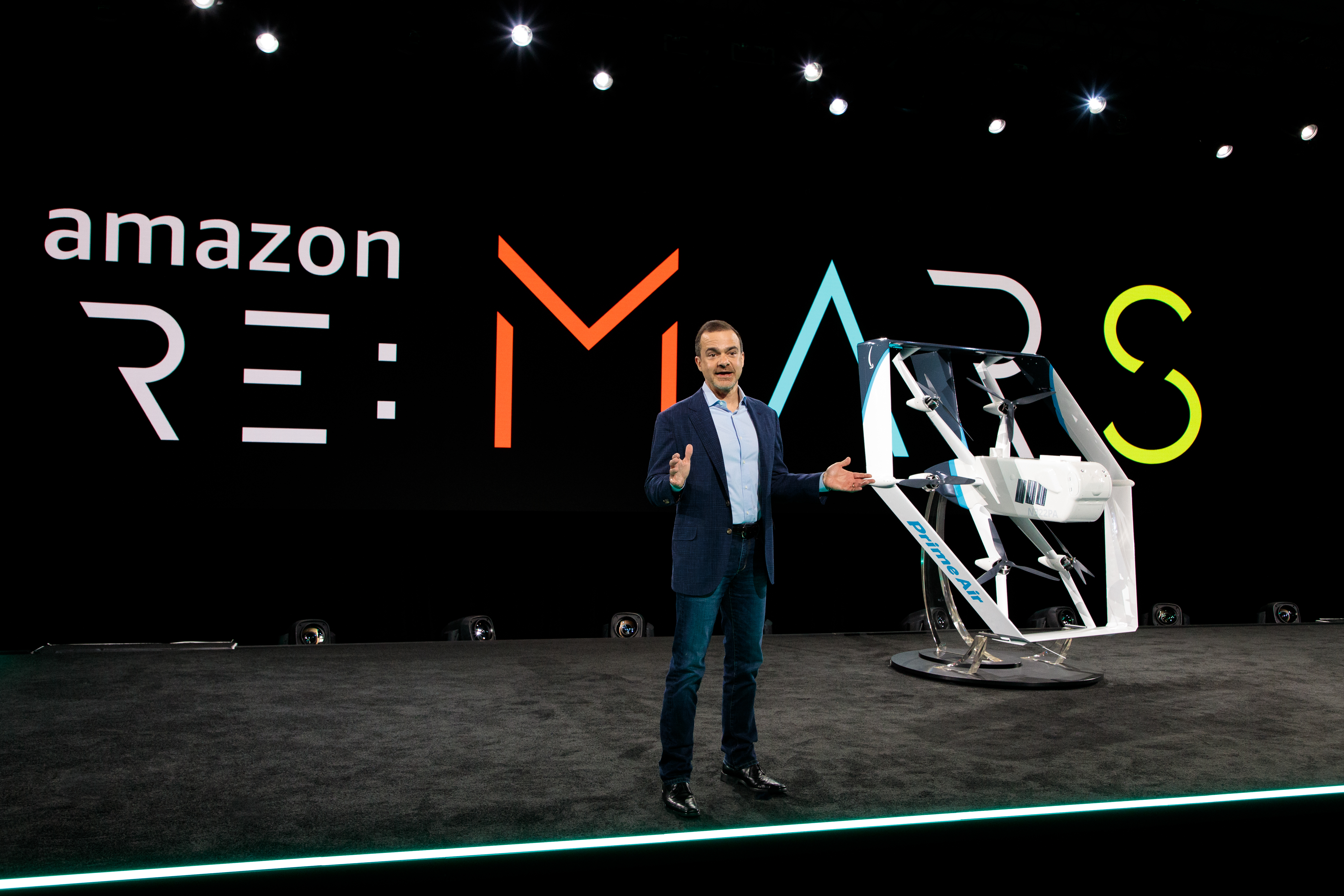
For the first time, Amazon today showed off its newest fully electric delivery drone at its first re:Mars conference in Las Vegas. Chances are, it neither looks nor flies like what you’d expect from a drone. It’s an ingenious hexagonal hybrid design, though, that has very few moving parts and uses the shroud that protects its blades as its wings when it transitions from vertical, helicopter-like flight at takeoff to its airplane-like mode.

These drones, Amazon says, will start making deliveries in the coming months, though it’s not yet clear where exactly that will happen.

What’s maybe even more important, though, is that the drone is chock-full of sensors and a suite of compute modules that run a variety of machine learning models to keep the drone safe. Today’s announcement marks the first time Amazon is publicly talking about those sensors, which it designed in-house, and how the drone’s autonomous flight systems maneuver it to its landing spot. The focus here was on building a drone that is as safe as possible and able to be independently safe. Even when it’s not connected to a network and it encounters a new situation, it’ll be able to react appropriately and safely.

When you see it fly in airplane mode, it looks a little bit like a TIE fighter, where the core holds all the sensors and navigation technology, as well as the package. The new drone can fly up to 15 miles and carry packages that weigh up to five pounds.

This new design is quite a departure from earlier models. I got a chance to see it ahead of today’s announcement and I admit that I expected a far more conventional design — more like a refined version of the last, almost sled-like, design.

Amazon’s last generation of drones looked very different.

Besides the cool factor of the drone, though, which is probably a bit larger than you may expect, what Amazon is really emphasizing this week is the sensor suite and safety features it developed for the drone.

Ahead of today’s announcement, I sat down with Gur Kimchi, Amazon’s VP for its Prime Air program, to talk about the progress the company has made in recent years and what makes this new drone special.

“Our sense and avoid technology is what makes the drone independently safe,” he told me. “I say independently safe because that’s in contrast to other approaches where some of the safety features are off the aircraft. In our case, they are on the aircraft.”

Kimchi also stressed that Amazon designed virtually all of the drone’s software and hardware stack in-house. “We control the aircraft technologies from the raw materials to the hardware, to software, to the structures, to the factory to the supply chain and eventually to the delivery,” he said. “And finally the aircraft itself has controls and capabilities to react to the world that are unique.”
(JORDAN STEAD / Amazon)

What’s clear is that the team tried to keep the actual flight surfaces as simple as possible. There are four traditional airplane control surfaces and six rotors. That’s it. The autopilot, which evaluates all of the sensor data and which Amazon also developed in-house, gives the drone six degrees of freedom to maneuver to its destination. The angled box at the center of the drone, which houses most of the drone’s smarts and the package it delivers, doesn’t pivot. It sits rigidly within the aircraft.

It’s unclear how loud the drone will be. Kimchi would only say that it’s well within established safety standards and that the profile of the noise also matters. He likened it to the difference between hearing a dentist’s drill and classical music. Either way, though, the drone is likely loud enough that it’s hard to miss when it approaches your backyard.

To see what’s happening around it, the new drone uses a number of sensors and machine learning models — all running independently — that constantly monitor the drone’s flight envelope (which, thanks to its unique shape and controls, is far more flexible than that of a regular drone) and environment. These include regular camera images and infrared cameras to get a view of its surroundings. There are multiple sensors on all sides of the aircraft so that it can spot things that are far away, like an oncoming aircraft, as well as objects that are close, when the drone is landing, for example.

The drone also uses various machine learning models to, for example, detect other air traffic around it and react accordingly, or to detect people in the landing zone or to see a line over it (which is a really hard problem to solve, given that lines tend to be rather hard to detect). To do this, the team uses photogrammetrical models, segmentation models and neural networks. “We probably have the state of the art algorithms in all of these domains,” Kimchi argued.

Whenever the drone detects an object or a person in the landing zone, it obviously aborts — or at least delays — the delivery attempt.

“The most important thing the aircraft can do is make the correct safe decision when it’s exposed to an event that isn’t in the planning — that it has never been programmed for,” Kimchi said.

The team also uses a technique known as Visual Simultaneous Localization and Mapping (VSLAM), which helps the drone build a map of its current environment, even when it doesn’t have any other previous information about a location or any GPS information.

“That combination of perception and algorithmic diversity is what we think makes our system uniquely safe,” said Kimchi. As the drone makes its way to the delivery location or back to the warehouse, all of the sensors and algorithms always have to be in agreement. When one fails or detects an issue, the drone will abort the mission. “Every part of the system has to agree that it’s okay to proceed,” Kimchi said.

What Kimchi stressed throughout our conversation is that Amazon’s approach goes beyond redundancy, which is a pretty obvious concept in aviation and involves having multiple instances of the same hardware on board. Kimchi argues that having a diversity of sensors that are completely independent of each other is also important. The drone only has one angle of attack sensor, for example, but it also has a number of other ways to measure the same value.

Amazon isn’t quite ready to delve into all the details of what the actual on-board hardware looks like, though. Kimchi did tell me that the system uses more than one operating system and CPU architecture, though.

It’s the integration of all of those sensors, AI smarts and the actual design of the drone that makes the whole unit work. At some point, though, things will go wrong. The drone can easily handle a rotor that stops working, which is pretty standard these days. In some circumstances, it can even handle two failed units. And unlike most other drones, it can glide if necessary, just like any other airplane. But when it needs to find a place to land, its AI smarts kick in and the drone will try to find a safe place to land, away from people and objects — and it has to do so without having any prior knowledge of its surroundings.

Amazon Prime Air drone

To get to this point, the team actually used an AI system to evaluate more than 50,000 different configurations. Just the computational fluid dynamics simulations took up 15 million hours of AWS compute time (it’s good to own a large cloud when you want to build a novel, highly optimized drone, it seems). The team also ran millions of simulations, of course, with all of the sensors, and looked at all of the possible positions and sensor ranges — and even different lenses for the cameras — to find an optimal solution. “The optimization is what is the right, diverse set of sensors and how they are configured on the aircraft,” Kimchi noted. “You always have both redundancy and diversity, both from the physical domain — sonar versus photons — and the algorithmic domain.”

The team also ran thousands of hardware-in-the-loop simulations where all the flight services are actuating and all the sensors are perceiving the simulated environment. Here, too, Kimchi wasn’t quite ready to give away the secret sauce the team uses to make that work.

And the team obviously tested the drones in the real world to validate its models. “The analytical models, the computational models are very rich and are very deep, but they are not calibrated against the real world. The real world is the ultimate random event generator,” he said.

It remains to be seen where the new drone will make its first deliveries. That’s a secret Amazon also isn’t quite ready to reveal yet. That will happen within the next few months, though. Amazon started drone deliveries in England a while back, so that’s an obvious choice, but there’s no reason the company could opt for another country as well. The U.S. seems like an unlikely candidate, given that the regulations there are still in flux, but maybe that’s a problem that will be solved by then, too. Either way, what once looked like a bit of a Black Friday stunt may just land in your backyard sooner than you think.

05 Jun 2019

Amazon will use AI to help you shop for clothes with StyleSnap

On its face, Amazon’s first Re:MARS conference is all about far out, world changing ideas, but the company is still very much a retailer at heart. Fitting then, that one of the first big announcements from this morning’s event is all about using artificial intelligence to help people better shop for close.

Amazon’s been talking about similar initiatives for a while, but StyleSnap looks to actually be coming soon via the Alexa iOS app (though the actual timeframe is still TBD).

Amazon’s Consumer Worldwide CEO Jeff Wilke introduced the feature today, telling the crowd, “When a customer uploads an image, we use deep learning for object detection to identify the various apparel items in the image and categorize them into classes like dresses or shirts. We then find the most similar items that are available on Amazon.”

The feature will be accessible by clicking the camera icon in the corner of the Alexa app. Users take a photo or upload a screenshot of a look they like, and Amazon will offer up suggestions, that factor in things like price, reviews and brands.

The company’s got a blog post detailing some of the steps taken in order to provide the service. It’s a series of complex asks for what seemingly amounts to a simple task for the human brain.

“To have neural networks identify a greater number of classes, we can stack a greater number of layers on top of each other,” the company writes. “The first few layers typically learn concepts such as edges and colors, while the middle layers identify patterns such as “floral” or “denim”. After having passed through all of the layers, the algorithm can accurately identify concepts like fit and outfit style in an image.”

Amazon has already begun to implement AI for other shopping applications, including Go and Whole Foods.

05 Jun 2019

Amazon debuts a pair of new warehouse robots

Amazon kicked its first re:MARS conference off with some ringers last night, bringing Robert Downey Jr., Boston Dynamics’ Marc Raibert and Disney Research’s Morgan Pope and Tony Dohl during the opening keynote. This morning’s big event puts the focus back on its own offerings — namely the work the company’s been doing in robotics.

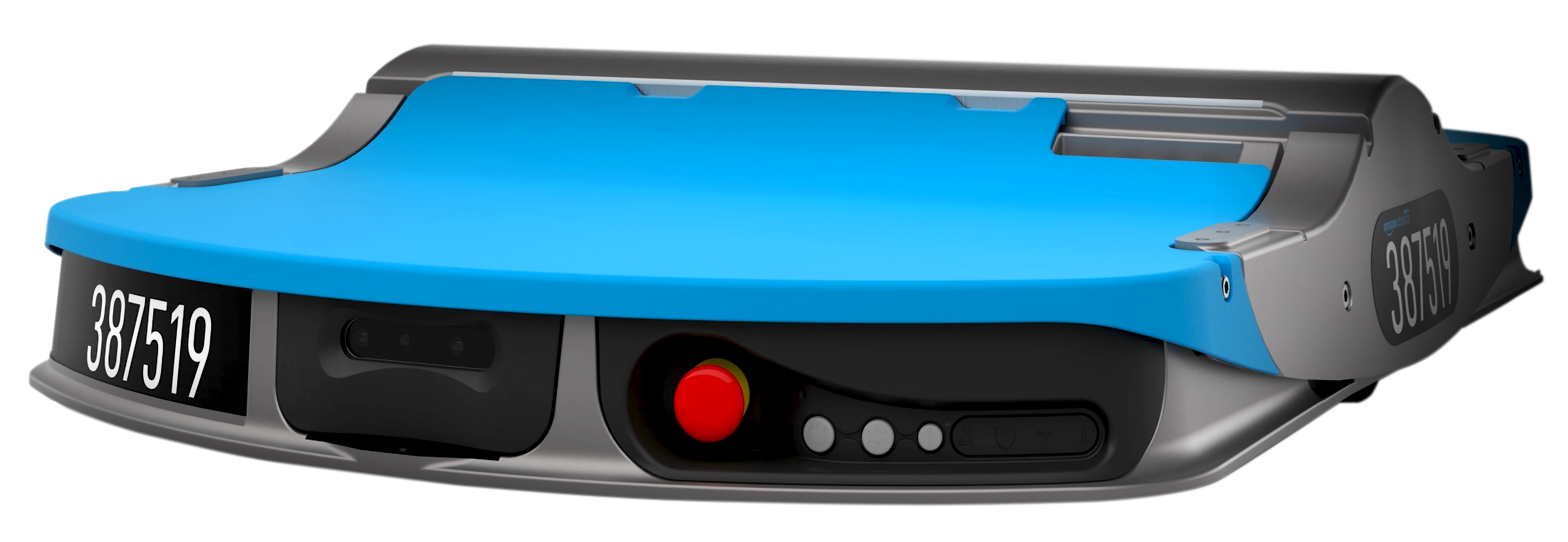
Amazon Robotics VP Brad Porter took to the stage to showcase a pair of new robotics designed to accelerate automation in the company’s fulfillment centers. Xanthus represents a major redesign of then company’s primary robots, which have been core to its strategy since its 2012 acquisition of Kiva Systems.

Modularity is the key here, as with competitors like Fetch. The drive foundation gives the in-house robotics team the ability to develop customized robotics for different warehouse takes, all with the same basic based system. Amazon says it will be showcasing some of the offerings this week at the show in Vegas, including the Xanthus Sort Bot and Xanthus Tote Mover.

More information on those later, no doubt, but all appear to be focused on different aspects of the same task: moving deliveries around the fulfillment center. Earlier in the year, the company stated that it’s already deployed north of 100,000 robotic systems in more than 25 fulfillment centers across the U.S., a key part of the retail giants push toward even faster delivery times. These days, it’s focused on single day delivery for most packages.

Today, the company says it’s expanded to 200,000 robotic drive robots internationally. That figure includes both in-house and third-party systems.

Also new is the Pegasus system. The robot will operate in a similar capacity as the Kiva robotic drives, which currently navigate around a fenced in “grid,” sporting large shelving pods. This robot, however, is is designed to sort and move individual packages. The system has already been deployed 800 Pegasus units in some of Amazon’s fulfillment centers.

The company believes the single package delivery system will further efficiency in the warehouse.

“We are always testing and trialing new solutions and robotics that enhance the safety, quality, delivery speed and overall efficiency of our operations,” a spokesperson for the company said in a statement issued at the event. “Our new Pegasus drive units help to reduce sort errors, minimize damage, and speed up delivery times. The Xanthus family of drives brings an innovative design, enabling engineers to develop a portfolio of operational solutions, all off the same hardware base through the addition of new functional attachments. We believe that adding robotics and new technologies to our operations network will continue improve the associate and customer experience.”

05 Jun 2019

Netflix tests an Instagram Stories-like feed called ‘Extras’ in its app

Netflix is testing a new way to help users find something to watch and stay connected with favorite shows with the introduction of an “Extras” tab in its mobile app. The tab, spotted first by Variety, is only a test at this time and is not showing to all users.

If you are in the test group, you’ll see a new button dubbed “Extras” at the bottom of the screen, in between Search and Downloads.

On Android, this is currently the “Coming Soon” section. iOS doesn’t offer this section.

However, instead of only teaser trailers as before in “Coming Soon,” you’ll now find both photos and videos from Netflix shows — including, in some cases, shows you already watch, the report notes.

The videos automatically play silently unless you tap the sound button, it appears. You also move through the feed horizontally. That’s a noticeable change from the “Coming Soon” section’s News Feed-like vertical scroll, and one that feels more like Instagram Stories.

And while you could previously tap “Remind Me” to add shows to your list in the “Coming Soon” section, the “Extras” section has tweaked this to display “Remind Me” on shows you currently watch and “My List” on those you want to add.

A sizable sharing button is also included, allowing you to pass along recommendations to friends through other apps.

Netflix has taken ideas from popular social platforms before, as it did when it launched its own Stories-like feature for previews. It has also leveraged social platforms for sharing recommendations — like when it added Instagram Story integrations. This feature combines both elements, in a way, so could prove popular.

The company confirmed the test with Variety in a statement:

“We are testing a feed of video extras in our mobile app to help fans connect more deeply with the titles they love and discover new ones to watch. These tests typically vary in length of time and by region, and may not become permanent.”

Image credit: Janko Roettgers / Variety

05 Jun 2019

Alibaba, Mail.Ru, Megafon form AliExpress Russia JV to double down on e-commerce in CIS

After announcing plans in September 2018 to build a joint venture together, today Russian internet giant Mail.ru,  Megafon and China’s Alibaba announced that the deal has closed. With support also from Russia’s sovereign wealth fund RDIF, the three are forming a new operation called AliExpress Russia JV — which will include business assets and investment from all three — to double down on building e-commerce services to serve consumers and businesses in Russia and neighboring countries. The joint effort is estimated to have a value in the region of $2 billion.

The operation has several moving pieces, which is one reason why it’s taken nearly eight months to bring it all together and close the deal:

  • Alibaba Group will invest $100 million and contribute AliExpress Russia into the joint venture. Alibaba says this includes Alibaba Group’s current Russia-based domestic and cross-border operations of the global retail marketplace business of AliExpress.
  • MegaFon will sell its 9.97% economic stake in Mail.ru Group to Alibaba Group. It will then own 24.3% of the AliExpress Russia JV with 30.2% voting rights.
  • Mail.ru Group will also contribute its Pandao e-commerce business and cash investments of $182 million in exchange for a 15% stake in the AliExpress Russia JV with 18.7% voting rights.
  • RDIF will invest $100 million into the AliExpress Russia JV “and may further acquire additional shares of the joint venture from Alibaba Group for $194 million.” Upon the exercise of the option to purchase the additional shares in the AliExpress Russia JV, the RDIF will own economic and voting stakes in the joint venture of 12.9% and 9.6%, respectively.
  • Alibaba and Mail.ru will respectively nominate a CEO each for the JV and they will run it jointly.

But while the business will largely be built on e-commerce know-how from Alibaba, it will be majority-controlled by Russian entities.

The deal underscores the potential of the Russian-speaking market, but also at the challenges of building a new e-commerce entity, or conversely expanding an established one into the market without deeper local knowledge. You could argue that Uber faced a similar challenge before forming a joint venture with Yandex to continue building out a combined ridesharing business.

Indeed, this is largely how the deal is being characterised by Alibaba:

“This partnership will enable the AliExpress Russia JV to accelerate the development of the digital consumer economy of Russia and CIS countries in ways that no one party could accomplish alone,” said Daniel Zhang, CEO of Alibaba Group, in a statement. “Together, we are uniquely positioned to offer consumers in Russia and neighbouring countries an innovative shopping experience by combining social platforms with commerce, as well as enabling regional brands and SMEs to sell their products locally and globally. Alibaba’s mission is to make it easy to do business anywhere. This JV is an important part of Alibaba’s international expansion and step toward our goal of supporting 10 million small businesses reach profitability and serving 2 billion consumers around the world.”

Megafon, the mobile operator that is an investor in Mail.ru, is not contributing an e-commerce business into the venture like Mail.ru and Alibaba are, but the fact that so much mobile commerce has moved to mobile creates some interesting possibilities for what they may contribute strategically in the longer term.

“MegaFon is pleased to enter into this partnership with global technology leaders Alibaba Group, RDIF and Mail.Ru Group,” said  Gevork Vermishyan, CEO of MegaFon, in a statement. “This agreement is in line with our digital strategy of ‘driving digital world’ aimed at creating new opportunities for over 76 million customers. E-commerce is a perfect fit for our rapidly developing ecosystem of partnerships to furnish best-in-class financial services, media, and other consumer offerings. This combination is beneficial for all parties, providing unparalleled access to the Russian consumer base.”

Russia and China have both been in the crosshairs of countries like the US over cybersecurity issues and allegations of nefarious online activity.

This is a turn away from that very messy issue, which is far from being resolved and will continue to see a lot of fallout, and focuses attention on the role of Russia as part of the “BRIC” bloc of large, emerging markets with lots of potential for growth.

“Mail.ru Group is looking forward to leveraging the synergies within a leading social commerce joint venture in Russia and CIS countries,” said Boris Dobrodeev, CEO of Mail.ru Group, commented. “AliExpress Russia JV will become an undisputed leader in Russian e-commerce and create an unparalleled social commerce offering for our users. This partnership is in line with our strategy of bringing together people and businesses, as we will offer customers richer social experience and provide entrepreneurs with a platform for growth. We hope that the successful realization of the deal will strengthen our cooperation with local and global technology leaders. This is a major milestone for the Russian e-commerce market, and we believe it will promote the development of the digital economy.”

“This landmark partnership will bring both significant benefits to customers and create unprecedented opportunities for services growth,” said Kirill Dmitriev, CEO of the Russian Direct Investment Fund (RDIF), in a statement. “RDIF continues to support the acceleration of the digital transformation of the Russian economy through the expansion of the e-commerce market. Bringing together the expertise of the companies at the forefront of social commerce and global retail opens a new era for the Russian market.”


05 Jun 2019

Which type of funding is actually best for your business?

When starting a tech company, there seems to be a playbook that most entrepreneurs follow. While some may start with a bit of bootstrapping, most will dive straight into raising seed money through investors. In many cases, this is a great path. It’s a path I’ve taken twice myself, first with GroupMe, and then again with Fundera.

Ironically, though, my second venture-backed company is a business focused on helping entrepreneurs find debt financing—a process I’ve gone through only once myself. But after five years of building and scaling this business, it’s made me take a step back and consider the question of when and where debt financing might be a better option for a business than equity financing, and vice versa.

I view these financing vehicles differently now than I did half a decade ago, and think it’s time we start to think a bit wider and diversely about how we finance our growing endeavors.

After all, when entrepreneurs take venture capital, they usually sign up to provide a 10x return on an investor’s capital. This expectation ultimately influences how they operate their business in the short-term. Maybe they’re not always ready for that expectation.

Or maybe they know they need to focus on building a good business before a great one. In this case, debt may be the better vehicle, where the only expectation is to pay it back.

Whether it’s money to get your business off the ground, capital to fuel additional growth, or cash to cover a gap, and whether you’re guiding the growth of a burgeoning startup, a smaller business, or even consulting firm helping other entrepreneurs, you should think critically about how you finance your business.

Here’s what to consider.

The power of debt

05 Jun 2019

Google Cloud gets capacity reservations, extends committed use discounts beyond CPUs

Google Cloud made two significant pricing announcements today. Those, you’ll surely be sad to hear, don’t involve the usual price drops for compute and storage. Instead, Googe Cloud today announced that it is extending its committed use discounts, which give you a significant discount when you commit to using a certain number of resources for one or three years, to GPUs, Cloud TPU Pods and local SSDs. In return for locking yourself into a long-term plan, you can get discounts of 55 percent off on-demand prices.

In addition, Google launching a capacity reservation system for Compute Engine that allows users to reserve resources in a specific zone for later use to ensure that they have guaranteed access to these resources when needed.

At first glance, capacity reservations may seem like a weird concept in the cloud. The promise of cloud computing, after all, is that you can just spin machines up and down at will — and never really have to think about availability.

So why launch a reservation system? “This is ideal for use cases like disaster recovery or peace of mind, so a customer knows that they have some extra resources, but also for retail events like Black Friday or Cyber Monday,” Google senior product manager Manish Dalwadi told me.

These users want to have absolute certainty that when they need the resources, they will be available to them. And while many of us think of the large clouds as having a virtually infinite amount of virtual machines available at any time, some machine types may occasionally only be available in a different availability zone, for example, that is not the same zone as where the rest of your compute resources are.

Users can create or delete reservations at any time and any existing discounts — including sustained use discounts and committed use discounts — will be applied automatically.

As for committed use discounts, it’s worth noting that Google always took a pretty flexible approach to this. Users don’t have to commit to using a specific machine type for three years, for example. Instead, they commit to using a specific number of CPU cores and memory, for example.

“What we heard from customers was that other commit models are just too inflexible and their utilization rates were very low, like 70, 60 percent utilization,” Google product director Paul Nash told me. “So one of our design goals with committed use discounts was to figure out how we could provide something that gives us the capacity planning signal that we need, provides the same amount of discounts that we want to pass on to customers, but do it in a way that customers actually feel like they are getting a great deal and so that they don’t have to hyper-manage these things in order to get the most out of them.”

Both the extended committed use discounts and the new capacity reservation system for Compute Engine resources are now live in the Google Cloud.

05 Jun 2019

Review: The 2019 Bentley Continental GT is beautiful, excessive and totally worth it

The Bentley Continental GT is iconic. The vehicle has long stood for excess and opulence, and I knew that going in. I expected the Continental GT to be over-engineered and capable of high-speed thrills. And it is, but there’s more.

The tester I’m driving costs $279,000. Of course it’s beautiful and fast and dripping with technology. It’s a Bentley. Inside and out, at high speed or low speed, the latest Continental GT exceeded all my expectations.

The machine glides over the road, powered by a mechanical symphony performing under the hood. The W12 engine is a dying breed, and it’s a shame. It’s stunning in its performance here. This is a 200 mph vehicle, but I didn’t hit those speeds. What surprised me the most is that I didn’t need to go fast. The new Continental GT is thrilling in a way that doesn’t require speed. It’s like a great set of speakers or exclusive liquor. Quality over quantity, and in this mechanical form, the quality is stunning.

[gallery ids="1837531,1837540,1837539,1837544,1837543,1837542,1837533,1837538,1837537,1837536,1837535,1837541"]

Review

Bentley debuted the Continental GT in 2003 and retained a familiar form over the years. Its mission has remained constant: To be the very best grand touring car available. It’s held that crown on and off since 2003 as other cars entered the game. But with this latest revision, the crown has returned to Bentley. This is an astounding vehicle to take on a road trip. It’s like a private jet on the highway.

Under the long hood sits a massive W12 engine with twin turbos. The setup results in over 620 HP and 664-foot pounds of torque. And it knows how to translate those numbers to the payment. The engine pounds not like a stack of Marshall amps at a Motorhead concert, but pounds like a symphony playing Beethoven’s 5th with intensity.

The Bentley Continental GT performance is where it stands apart.

It glides as speeds reach illegal levels. There’s no drama from the transmission or argument from the engine. When the accelerator drops to the floor, a gateway opens in front of the Bentley, allowing it to transcend space and time as it exceeds posted speed limits.

The Bentley Continental GT lays out its power with the precision of an electric vehicle but the intensity of a street racer. The power delivery is unreal. Under normal driving modes, the transmission is hardly noticeable, and under strain of chasing a quarter mile, the shifts are barely noticeable as it arm wrestles the massive W12.

Driving the Bentley Continental GT is an exercise in restraint. At times, say, when coming’s out of a gnarly curve, you feel the need to slam the pedal to the floor and launch the car off the apex. But that would land you in jail. This is a car that could live its best life on a track, but it doesn’t need the track to be happy. Even driving the Continental GT to the golf course or office park is nearly a thrill.

The GT is just excellent. It inspires confidence and regal intrigue that’s often missing in many of its contemporaries.

Entering the latest Continental is like sinking behind the controls of a fantasy rocket ship. Brushed metal adorns the center stack and handcrafted wood and leather wrap the cabin. Adorable metal pulls control the vents, and machined knobs perform various functions.

The leather is soft and metal real. It’s the little things, too. The lume on the analog clock is fantastic and the wood grain matches throughout. The seats feature a lovely diamond pattern with multiple layers of embroidered detail. Don’t want to look at an LCD screen? Hit a button, and it rotates away, revealing a set of three analog gauges in its place.

However, throughout the Continental GT, there are odd choices of material. Example: The gear shift is plastic and creaks like a well-used toy. It’s an odd choice for a substantial touchpoint. It feels cheap in comparison to gear shifters in other vehicles. BMW, for instance, is using manufactured crystal in its new large SUV and it conveys a sense of stoutness missing in the Bentley’s.

Other plastic bits feel out of place. When sitting down, a bar extends from behind the seats, pushing the seatbelt within reach of the driver. It’s flimsy plastic. The handle on the outside feels loose. Even the key fob is underwhelming; I think the fob for my F-150 is more substantial.

I’m nitpicking, but the Bentley Continental GT costs north of $279,000.

The controls are familiar. The Bentley uses a lot of switch plates and instruments from Audi’s part’s bin though, in the Bentley, they’re chrome. The Audi theme continues to the digital instrument cluster where the shares the same design as the one found in most Audi’s. Expect a similar experience throughout. This isn’t a bad thing. Audi has one of the best interfaces available throughout the industry.

The 2019 Bentley Continental GT is unforgettable. It’s a beautiful combination of obscene power and luxury materials.

I took delivery of this tester on the eve of a long weekend and spent as much time in it as I could. It’s more comfortable than my house. The seats are supple and supportive. The dash impressive with its woodwork and analog dials. The power is intoxicating.

Cars like the Continental GT will likely continue to exist after electric vehicles become the norm. At least until the Earth runs out of oil. They have to. Cars like this will always be a luxury item. They have a soul missing from electric vehicles. There’s nothing like putting your foot down on a Bentley W12 and feeling the world come alive around you.

05 Jun 2019

Yellowbrick Data raises $81M Series C for hybrid data warehouse

There’s lots of data in the world these days, and there are a number of companies vying to store that data in data warehouses or lakes or whatever they choose to call it. Old school companies have tended to be on prem, while new ones like Snowflake are strictly in the cloud. Yellowbrick Data wants to play the hybrid angle, and today it got a healthy $81 million Series C to continue its efforts.

The round was led by DFJ Growth with help from Next47, Third Point Ventures, Menlo Ventures, GV (formerly Google Ventures), Threshold Ventures and Samsung. New investors joining the round included IVP and BMW i Ventures. Today’s investment brings the total raised to a brisk $173 million.

Yellowbrick sees a world that many of the public cloud vendors like Microsoft and Google see, one where enterprise companies will be living in a hybrid world where some data and applications will stay on prem and some in the cloud. They believe this situation will be in place for the foreseeable future, so its product plays to that hybrid angle, where your data can be on prem or in the cloud.

The company did not want to discuss valuation in spite of the high amount of raised dollars. Neither did it want to discuss revenue growth rates, other than to say that it was growing at a healthy rate.

Randy Glein, partner at DFJ Growth, did say one of the things that attracted his company to invest in Yellowbrick was its momentum along with the technology, which in his view, provides a more modern way to build data warehouses. “Yellowbrick is quickly providing a new generation of ultra-high performance data warehouse capabilities for large enterprises. The technology is a step function improvement on every dimension compared to legacy solutions, helping modern enterprises digest and interpret massive data workloads in a fraction of the time at a fraction of the cost,” he said in a statement.

It’s interesting that a company with just 100 employees would require this kind of money, but as company COO Jason Snodgrass told TechCrunch, it costs a lot of money to build out a data warehouse. He’s not wrong. Snowflake, a company that’s building a cloud data warehouse, has raised almost a billion dollars.

05 Jun 2019

World View’s sub-space high-altitude balloon lasts over two weeks aloft

World View is a company focused on alternative methods of doing some of the work traditionally handled by satellites – but just a bit closer to Earth. Its ‘Stratollites’ are balloons that can ascend to heights in Earth’s stratosphere (basically at the edge of space) and one key ingredient towards making them more commercially viable is ensuring they can spend a long time up in the air without coming down.

To that end, the company just completed its longest ever mission for a Stratollite continuously in flight: 16 days, according to The Verge, which is still a ways off from its goal of 60 days but much longer than its previous record of five days continuously aloft.

The Earth’s stratosphere starts at about 23,000 feet at the north and south poles, and at as high as 66,000 feet at the equator, and World View’s Stratollite operates between 50,000 and 75,000 in their ideal functional configuration. The plan from the company is to replace a lot of the work done by low-Earth orbit satellites, including high-altitude site photography, and eventually even to ferry passengers to those lofty heights.

World View’s latest trip included tests of its ability to stay relatively in-place despite variable high-altitude winds. It managed to stay in an area roughly 75 miles square for a period of eight days, and zeroed in on a much smaller target of just six miles wide for a total of 6.5 hours. These are crucial for its long-term success, since once of the values it provides over satellites is the ability to hover over a defined area for an extended period.

The company debuted its Tucson HQ and launch site in 2017, and a few months later flew a record flight of just 27 hours, so it’s come a long way in two years for a relatively new and unproven technology, which it hopes commercialize by 2020.