
Category: UNCATEGORIZED

04 Jun 2019

Ori Living partners with IKEA to bring robotic furniture to customers by 2020

Welcome to the robotic bedroom of the future, coming in 2020 to tiny apartments beginning in Hong Kong and Japan, but expanding around the world.

IKEA is now selling robotic furniture that can convert from a storage and seating unit into a bed and closet and back again.

The new line of furniture, based on the company’s PLATSA storage unit, is called ROGNAN and is designed to use space inside the home more efficiently, especially as housing units become smaller to accommodate the 1.5 million people who move to a city somewhere in the world every week, IKEA said in a statement.

“We have been working with developing small space living solutions for a long time, and we know that some of the biggest challenges in peoples’ homes are storage and finding the place to do all the activities that you’d want to do in your home,” said Seana Strawn, Product developer for new innovations at IKEA of Sweden, in a statement. “This is especially the case in big cities where people have to make compromises in the functions of their homes. We wanted to change that,”

Conversations between Ori Living and IKEA have been underway for the past two years and the launch of the collaboration in Hong Kong in 2020 is only the first step in their collaboration, according to Ori Living chief executive Hasier Larrea.

“People across the US have been living large in a small footprint with Ori’s robotic interiors since we introduced our first commercial product two years ago. At about the same time, we began working with IKEA to bring robotic furniture to the world,” Larrea said in a statement. “We share IKEA’s passion to enable people to make the most of their living spaces, and look forward to helping realize this as we continue to develop living spaces for the next generation.”

Born from research conducted by Larrea and MIT professor Kent Larson at the university’s famous Media Lab, Ori launched in 2015 as a way to reduce the footprint of living spaces in urban environments.

The two men were inspired by the Urban Land Institute’s blockbuster study, “The Macro View on Micro Units,” and collaborated with rockstar designer Yves Béhar, to create bed/storage/workspace units that were designed to meet the needs of folks who are trying to do more in increasingly cramped urban spaces.

The company’s first system consists of a retractable bed that can slide in or out at the push of a button from a wall mounted controller, an app on a smart phone, or by using a skill the company has programmed into Alexa.

With IKEA, Ori Systems has licensed the technology and will leave the manufacturing to IKEA and its incredibly sophisticated supply chain. “With this collaboration there is a license arrangement, which is one of the ways Ori can work with partners due to our technology’s modularity,” Larrea wrote in an email.

[gallery ids="1836789,1836790,1836791,1836792"]

“With ROGNAN, small space living customers will no longer have to compromise their needs, dreams or comfort in order to achieve a multi-functional living environment. With ROGNAN the customer gets eight extra square meters of living space, using robotics to transform the solution from bedroom to walk-in closet, to work space, to living room. An all-in-one solution activated through a simple interface touchpad,” says Seana Strawn.

04 Jun 2019

Facebook fails to stop Europe’s top court weighing in on EU-US data transfers

Facebook has failed in its last ditch attempt to block a referral by Ireland’s High Court of questions over the legality of EU-US data transfer mechanisms to the region’s top court.

Ireland’s Supreme Court unanimously refused its request to appeal the decision Friday, via Reuters.

Irish law does not include a provision to appeal against referrals to the CJEU but Facebook sought to both stay and appeal the decision anyway.

It was denied the stay but granted leave to appeal last year — only for the Supreme Court to extinguish its hope of preventing Europe’s top judges from weighing in on privacy concerns attached to key data transfer mechanisms which are used by thousands of companies to authorize flows of EU citizens’ personal data to the US.

The case originates in a complaint against Facebook’s use of another data transfer mechanism, Standard Contractual Clauses (SCCs), by lawyer and EU privacy campaigner, Max Schrems .

He famously brought down the prior EU-US data transfer arrangement, Safe Harbor — after successfully challenging its legality in the wake of NSA whistleblower Edward Snowden’s 2013 disclosures about US government mass surveillance programs. (Hence this follow-on challenge being referred to as ‘Schrems II‘.)

“Facebook likely again invested millions to stop this case from progressing. It is good to see that the Supreme Court has not followed Facebook’s arguments that were in total denial of all existing findings so far,” said Schrems in a statement responding to the Supreme Court’s rejection of Facebook’s appeal. “We are now looking forward to the hearing at the Court of Justice in Luxembourg next month.”

Also commenting in a statement, a Facebook spokesperson said: “We are grateful for the consideration of the Irish Court and look ahead to the Court of Justice of the European Union to now decide on these complex questions. Standard Contract Clauses provide important safeguards to ensure that Europeans’ data are protected once transferred overseas. SCCs have been designed and endorsed by the European Commission and are used by thousands of companies across Europe to do business.”

Schrems’ complaint to the Irish data protection regulator led, rather unusually, to the watchdog to itself refer privacy concerns to the courts — which then widened the complaint, asking for the CJEU’s opinion on a range of fine-grained points around whether EU citizens’ rights are being adequately protected by both Privacy Shield and SCCs.

It’s shaping up as to be a replay of the close CJEU scrutiny that skewered Safe Harbor — a definitive strike down that instantly left thousands of companies scrambling to put in place alternative legal arrangements to avoid illegally processing EU citizens’ data.

At the time of writing there are 4,756 organizations signed up to the replacement Privacy Shield framework.

The European data protection landscape has also evolved since 2015 — with the General Data Protection Regulation (GDPR) ramping up the size of potential fines for privacy violations.

SCCs were one of the alternative mechanisms the European Commission suggested companies use in the interim between Safe Harbor’s demise in fall 2015, and Privacy Shield getting up and running, in mid 2016, although they too are now facing legal questions, per the Schrems II case.

During renegotiations and since, the European Commission has always maintained that the Privacy Shield framework — which bakes in an annual review, and makes provision for an ombudsperson to handle any EU citizens’ complaints about how US companies handle their data — is more robust than its predecessor mechanism, claiming too that it is confident it will survive legal testing.

That confidence will soon be tested at Europe’s highest legal level.

Meanwhile both Privacy Shield and SCCs are not short of critics — including from within the EU’s institutions, with both the parliament and an influential body representing national data protection watchdogs expressing ongoing concerns

The Trump administration’s entrenchment of privacy hostile surveillance laws targeting non-US citizens has not helped Privacy Shield’s cause.

The US under Trump has also been tardy to fulfil key posts the Commission has said are required for full functioning of privacy shield — leading even it to apply a compliance deadline earlier this year.

To a degree, all that is just fiddling round the edges, though, vs the core contention at the heart of the complaints driving challenges to Privacy Shield and SCCs — i.e. that there is a fundamental incompatibility between US law that prioritizes national security and EU law which privileges personal privacy — which Europe’s top judges will soon be weighing in on again.

It’s already been more than a year since Ireland’s High Court referred eleven questions to the CJEU. And while the court can take years to deliberate it’s worth noting that it did not do so with the original Schrems challenge. In that case judges took only a little over a year to return their landmark verdict to strike down Safe Harbor, demonstrating they are willing to move quickly to defend EU privacy rights against the threat of mass surveillance.

Now, with Facebook’s last ditch attempt to de-rail the CJEU referral kicked into touch, it’s quite possible they will could move just as quickly towards a verdict on Schrems II. Certainly if they feel EU citizens’ fundamental rights are being infringed.

Privacy Shield is also facing a legal challenge brought by French digital rights groups — who similarly argue that it breaches fundamental EU rights. That complaint will be heard by the General Court of the EU on July 1 and 2.

04 Jun 2019

Jewish dating app JCrush exposed user data and private messages

A security lapse at JCrush, a dating app designed for the Jewish community, left a databases open without a password, exposing sensitive user records and private messages to anyone who knew where to look.

The site’s backend database had around around 200,000 user records, according to security researchers Noam Rotem and Ran Locar, who shared their findings exclusively with TechCrunch and wrote up their findings at vpnMentor.

None of the data was encrypted, the researchers told TechCrunch.

We obtained a sample of the records to verify. From what we saw, the records contained the user’s name, gender, email address, IP address, geolocation as well as their city, state and country, date of birth, their sexual preferences, their religious denomination, and the photos they use on JCrush.

Depending on how the user signed up, the records also show the user’s Facebook ID, which points directly to their Facebook profile. It also includes the access token, which can be used to take over a JCrush user’s account without needing their password.

In some cases, the geolocation data was so accurate it was easy to identify exactly where some users lived — especially in residential neighborhoods.

The database also contained private messages — many were explicit and graphic.

Although the researchers didn’t dig into the data — mindful of the privacy implications — they found records relating to “incognito” accounts, which allow users to pay to browse the site anonymously.

The app’s founder Natasha Nova did not respond to a request for comment. An unnamed spokesperson for JCrush’s parent company Northsight Capital said it was “aware” of the situation and “secured the database immediately when the problem occurred.”

“There have been not been any indications that the data had been accessed by malicious parties or misused in anyway,” said the company. When asked, the company did not say what evidence it had for its claim, but noted that the company plans to notify its users and authorities of the incident.

It’s the latest in a series of data exposure at dating apps, or companies that tout anonymity and privacy.

Last year, a dating app for conservative supporters — Donald Daters — admitted a database leak on its first day of operations. Only about 1,600 users had their information exposed. In May, a popular Chinese dating app for gay and queer women, Rena, which had more than five million users, left its database open and exposed.

Read more:

04 Jun 2019

NASA’s Space Launch System passes key milestone for Moon mission

NASA is celebrating a key step towards its mission to get people back to the Moon: The first large core rocket stage that will power the new Space Launch System being built by contractor Boeing is now four-fifths assembled. Wait – did I just say four-fifths? So like this stage isn’t even complete?

No, it’s not – but when it comes to building gigantic rocket cores that will propel the Orion crewed spacecraft all the way to the Moon in time for the Artemis program’s target date of 2024, you celebrate when you take any significant step forward.

Also, remember we’re talking about four-fifths of a rocket stage that when complete, will be over 200 feet long including engines and fuel tanks, which NASA helpfully points out is approximately the length of a dozen cars parked back-to-back. It’s the biggest rocket NASA will have built since the Saturn V first stage that helped bring the first human visitors to the Moon, which was quite a bit smaller at around 140 feet long.

Next up, NASA will take delivery of other aspects of the SLS launch system and vehicle, and Boeing will of course work on that remaining fifth of this stage. 2024 may seem like a distant target, but rockets take time, and rockets with people on board rightly take even more.

04 Jun 2019

Bill Gates, NEO, Gigafund backing Luminous in photonics supercomputer moonshot

Luminous Computing, a one-year-old startup, is aiming to build a photonics chip that will handle workloads needed for AI at the speed of light. It’s a moonshot and yet, the young company already has a number of high-profile investors willing to bet on the prospect.

The company has raised $9 million in a seed round led by Bill Gates, NEO’s Ali Partovi and Luke Nosek and Steve Oskoui of Gigafund.

The round also attracted other new investors, including Travis Kalanick’s fund 10100, BoxGroup, Uber CEO Dara Khosrowshahi, and Emil Michael as well as pre-seed investors Class 5 Global, Joshua Browder, Ozmen Ventures, Schox Investments and Third Kind Venture Capital.

Luminous was founded by Michael Gao, the company’s chief strategist, CEO Marcus Gomez and CTO Mitchell Nahmais, whose research at Princeton is the basis of the chip. Gomez started a software-as-a-service business in the fashion industry and more recently worked as a data scientist at Tinder. Gao also founded software startup AlphaSheets.

Luminous’ approach in basic terms is based on using light to move a dense amount data quickly and efficiently. The idea is that by using photonics for all of the major bottlenecks that traditional processors struggle with will be removed.

“While many photonics research efforts focus on general-purpose data movement, Luminous appropriately targets the AI compute market, which is where the demand is,” Partovi of NEO said.

Luminous is not the only startup out there trying to build a supercomputer on a chip, nor is it the first to be focused on photonics. For instance, Lightmatter raised $11 million in 2018 to make photonic chips.

The driving factor is a boom in companies seeking to develop chips specifically designed to handle AI and machine learning applications. In 2018, there were at least 45 startups working on AI chips, New York Times reported at the time. Some technology companies, including Apple, Amazon, Facebook and LG are developing their own AI and ML chipsets for specific purposes. The pursuit is fueling interest among venture capitalists and leading to acquisitions.

The architecture of the chip that Luminous Computing is building is based on Nahmias’ research. As part of his thesis at Princeton University, Nahmias built photonic integrated circuits for computing and became a founding researcher in the field of neuromorphic photonics.

“Training an AI system still takes days, when it should take just minutes,” Gomez told TechCrunch in a recent interview.

The foundation of today’s machine learning systems is based on relatively simple operations — but a lot of them. Training these models still takes a lot of time and involves vasts amount of training data. Even when using today’s generation of specialized AI chips, it still often takes days to train a model. Then, that model has to be tested, refined and trained again. So a task that would help accelerate the development of autonomous vehicles, for example, can benefit from chips that can process these operations faster than ever before.

It’s still early days for Luminous. However, Gomez says they already have working silicon. While Gomez wouldn’t disclose when this new chip would be launched, he emphasized that this isn’t some distant fantasy. The company is aiming to ship development kits within the next few years.

Still, Gomez acknowledges the scale of what they’re trying to achieve: to ship a single chip that will replace the robustness of 3,000 boards containing Google’s Tensor processing unit (TPU) AI chips.

The 7-person company plans to use the new round of capital to grow its team, specifically with people who have experience in the semiconductor industry.

04 Jun 2019

Bird is launching a two-seater electric vehicle to become more than a kick scooter startup

Bird won’t stop deploying new mobility vehicles and services. Bird has just unveiled the Bird Cruiser, an electric vehicle that is essentially a blend between a bicycle and a moped. The Bird Cruiser can seat up to two people and, depending on the market, the Cruiser will either be pedal-assist or just have a peg. This marks Bird’s first move outside of the kick scooter space.

Bird Cruiser is designed to be part of the startup’s shared vehicles fleet and its Bird Platform program where it enables entrepreneurs to run their own businesses using Bird’s assets.

Launching this summer in a few markets, Bird Cruiser is equipped with hydraulic disc brakes, a 52-volt battery, which many e-bikes have, and is designed to handle hills.

Since this vehicle falls into the classification of an e-bike or motorized scooter, the Bird Cruiser is regulated at the state level. This type of vehicle is regulated at the state level, so local regulations should not hinder Bird’s deployment. Of course, riders must adhere to city laws around bike lanes and speeds.

“Bird’s introduction of shared e-scooters spurred a global phenomenon and mode shift away from cars,” Bird founder and CEO Travis VanderZanden said in a statement. “To further accelerate progress on our mission to make cities more livable, we are providing additional environmentally friendly micro-mobility alternatives—including Bird Cruiser. Starting this summer, people can move about their city and explore new neighborhoods together, without a car. Designed and engineered in California, Bird Cruiser is an inclusive electric-powered option that is approachable, easy-to-ride and comfortable on rough roads.”

Earlier this year, startup Wheels raised $37 million for its electric bike startup. While they look slightly similar, Wheels can only seat one person and requires pedaling.

This news comes shortly after Bird began selling its electric scooters directly to consumers. Bird also recently started offering a monthly rental option for riders in cities where regulators do not currently allow Bird to operate its shared scooter program.

04 Jun 2019

Firefox gets enhanced tracking protection, desktop password manager and more

It’s no secret that Mozilla sees privacy as a differentiating feature for its revitalized Firefox browser. Today, the Firefox team is launching one of its broadest set of releases that aim to keep advertisers and others from following you across the web, while also making it harder for Facebook to track you. In addition, the organization is launching a desktop version of its password manager and some improvements to its Firefox Monitor data breach notification service.

“This past year, we’ve seen tech companies talk a big game about privacy as they’re realizing that, after several global scandals, people feel increasingly vulnerable,” Firefox SVP Dave Camp writes in today’s announcement, explaining the organization’s reasoning for today’s update. “It’s unfortunate that this shift had to happen in order for tech companies to take notice. At Firefox, we’re doing more than that. We believe that in order to truly protect people, we need to establish a new standard that puts people’s privacy first.”

The launch of Enhanced Tracking Protection, which allows you to keep third-party trackers and cookies from following you around the web, doesn’t come as a surprise. Mozilla has been talking about its new anti-tracking measures for a while. Previously, it offered a similar feature, but that was restricted to private windows, which was useful — and probably a good way for Mozilla to test these new capabilities — but far from comprehensive. For new users, Enhanced Tracking Protection will now be on by default, while existing users will either have to enable it manually for now or wait for Mozilla to turn it on for them in the near future.

In the browser, you’ll see these new features in the form of a new set of controls in the settings menu, as well as by clicking on the new shield icon in the URL bar. In its standard setting, which is the default, Enhanced Tracking Protection will block all third-party tracking cookies, based on the Disconnect list. You can also opt for a strict setting, which may break some sites, or opt for your own custom settings, too.

While it’s not directly built into the browser, Mozilla also today launched an updated version of its Facebook container extension that now allows you to also put Facebook share and like buttons into the container and disable them by default. That way, Facebook won’t be able to build a useful a shadow profile of you when you are locked out (or not even a Facebook user).

With today’s announcements, Mozilla is also expanding its Lockbox password manager to the desktop. Until now, Lockbox only existed as a set of mobile apps, but Mozilla launched a Firefox desktop extension, too. It’s also changing the name to Lockwise. It’s a pretty straightforward password manager experience, though, at least for the time being, notably near not as fully features as Dashlane, 1Password, LastPass or similar options.

To round out today’s set of announcements, Mozilla is also launching a new dashboard for Firefox Monitor, its tool that lets you check whether your email addresses popped up in any data breaches and set alerts for any future breaches. Monitor now features a dashboard that lets you see which email addresses you are monitoring and which ones have likely been compromised.


04 Jun 2019

Why four security companies just sold for $1.5B

If you’re thinking about starting a technology company, you may want to consider focusing on cybersecurity.

Last week was an incredible M&A whirlwind with four security companies getting acquired over just a three-day period:

  • On Tuesday, FireEye bought Verodin, a five-year-old startup that helps measure the effectiveness of your cybersecurity defenses for $250 million.
  • On Wednesday, Palo Alto Networks entered the fray, buying not one, but two Israeli security startups. The big prize was container security company Twistlock for $410 million. It also snagged serveless security company PureSec. Reports in Israeli media pegged that deal at between $60 and $70 million.
  • If that wasn’t enough for you, private equity firm Insight Partners bought 10-year old threat intelligence company, Recorded Future for $780 million.

That’s more than $1.5 billion changing hands for those of you keeping score at home. If you take a look at the four firms, the one common denominator was that each one was covering a different aspect of cybersecurity. Two were looking at more operational tasks, while the two companies that Palo Alto Networks grabbed were aimed squarely at modern developers using containers and serverless technologies.

04 Jun 2019

Facebook can be told to cast a wider net to find illegal content, says EU court advisor

How much of an obligation should social media platforms be under to hunt down illegal content?

An influential advisor to Europe’s top court has taken the view that social media platforms like Facebook can be required to seek out and identify posts that are equivalent to content that an EU court has deemed illegal — such as hate speech or defamation — if the comments have been made by the same user.

Platforms can also be ordered to hunt for identical repostings of the illegal content.

But there should not be an obligation for platforms to identify equivalent defamatory comments that have been posted by any user, with the advocate general opining that such a broad requirement would not ensure a fair balance between the fundamental rights concerned — flagging risks to free expression and free access to information.

“An obligation to identify equivalent information originating from any user would not ensure a fair balance between the fundamental rights concerned. On the one hand, seeking and identifying such information would require costly solutions. On the other hand, the implementation of those solutions would lead to censorship, so that freedom of expression and information might well be systematically restricted.”

We covered this referral to the CJEU last year.

It’s an interesting case that blends questions of hate speech moderation and the limits of robust political speech, given that the original 2016 complaint of defamation was made by the former leader of the Austrian Green Party, Eva Glawischnig.

An Austrian court agreed with Glawischnig that hate speech posts made about her on Facebook were defamatory and ordered the company to remove them. Facebook did so, but only in Austria. Glawischnig challenged its partial takedown and in May 2017 a local appeals court ruled that it must remove both the original posts and any verbatim repostings and do so worldwide, not just in Austria. 

Further legal appeals led to the referral to the CJEU which is being asked to determine where the line should be drawn for similarly defamatory postings, and whether takedowns can be applied globally or only locally.

On the global takedowns point, the advocate general believes that existing EU law does not present an absolute blocker to social media platforms being ordered to remove information worldwide.

“Both the question of the extraterritorial effects of an injunction imposing a removal obligation and the question of the territorial scope of such an obligation should be analysed, in particular, by reference to public and private international law,” runs the non-binding opinion.

Another element relates to the requirement under existing EU law that platforms should not be required to carry out general monitoring of information they store — and specifically whether that directive precludes platforms from being ordered to remove “information equivalent to the information characterised as illegal” when they have been made aware of it by the person concerned, third parties or another source. 

On that, the AG takes the view that the EU’s e-Commerce Directive does not prevent platforms from being ordered to take down equivalent illegal content when it’s been flagged to them by others — writing that, in that case, “the removal obligation does not entail general monitoring of information stored”.

Advocate General Maciej Szpunar’s opinion — which can be read in full here — is not the last word on the matter, with the court still to deliberate and issue its final decision (usually within three to six months of an AG opinion). However advisors to the CJEU are influential and tend to predict which way the court will jump.

We’ve reached out to Facebook for comment.

04 Jun 2019

Majelan is a personal podcast player with premium content

Meet Majelan, a French startup that wants to make podcasts more accessible. Behind the scene, Majelan is the startup created by former Radio France CEO Mathieu Gallet and Arthur Perticoz. The app is launching today on iOS and Android in the coming days.

Given that Gallet was previously at the head of all French public radios, the company has already raised $4.5 million from Idinvest Partners, Jacques Veyrat, Kima Ventures, Fabrice Larue and others.

At a press conference, Gallet said that Majelan isn’t the Netflix of podcasts. “It’s an experience that is 99.99% free. We are a content aggregator, an RSS feed aggregator,” he said.

But it doesn’t mean that the company hasn’t been inspired by Netflix, Spotify, Molotov and other streaming platforms. So let’s unpack what all of this means.

A more personal podcast player

Podcasts are an interesting content format. If you listen to the same host for a while, it feels like you know them and they’ve become your friends. But many podcast players provide a dry experience that feels more like using Google News than interacting with people you listen to.

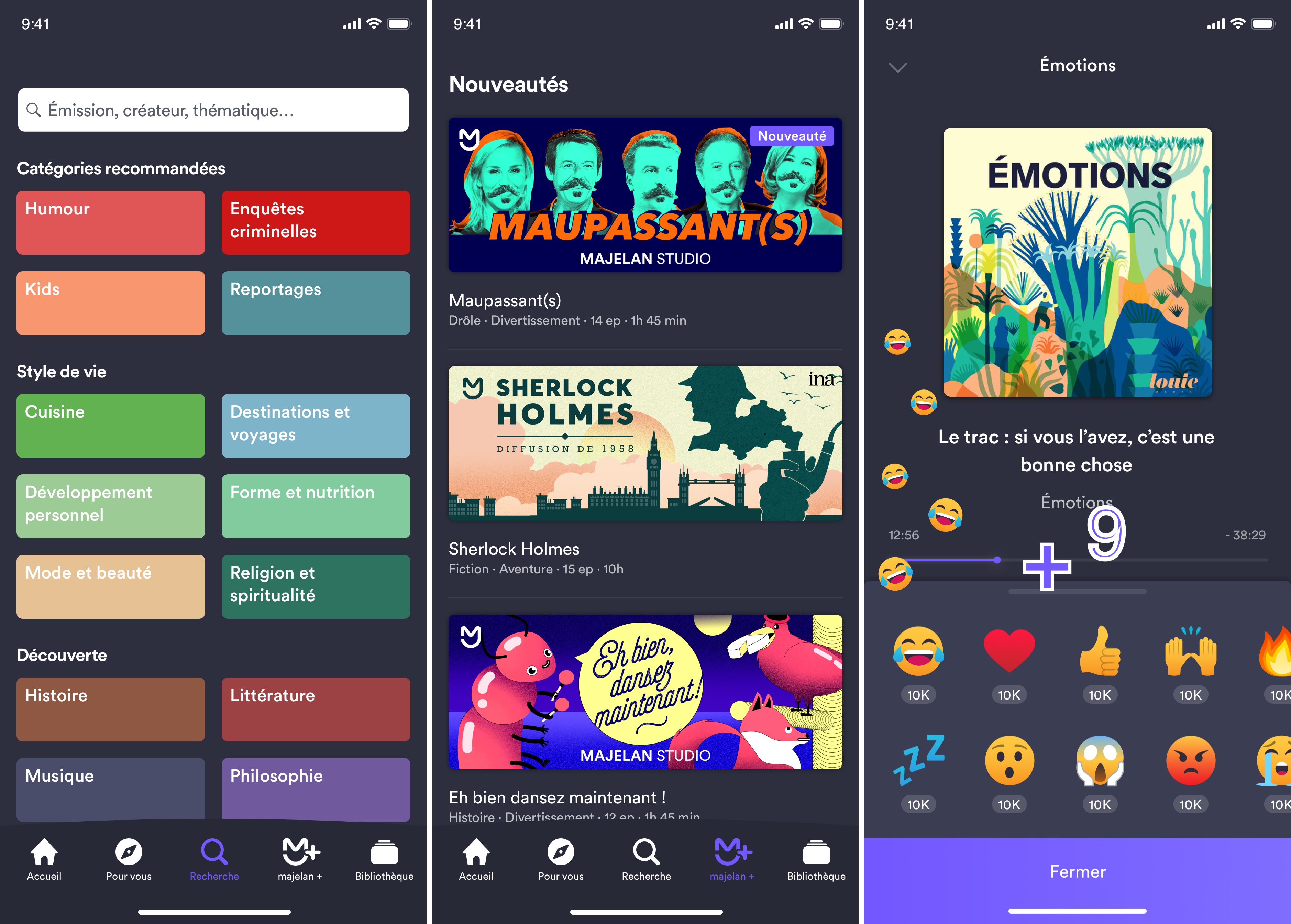
Majelan gets the basic rights when it comes to podcast players. Pretty much like the Apple Podcasts app, you can search for podcasts, download and listen to episodes. If you like what you’re hearing, you can subscribe to a podcast and get new episodes when they’re released. It’s a true podcast player as you can even paste a podcast URL to add any podcast you want.

But Majelan thinks Apple Podcasts and the iTunes podcast directory are reminiscent of a phone book — Apple Podcasts is by far the leading podcasting app right now. It’s hard to find content and you don’t get any customized recommendations.

In other words, you probably know someone who wants to get into podcasts but doesn’t know where to start.

“The homepage is completely editorialized by the Majelan teams — they create topic-based playlists. They have listened to hours and hours of content and we already have 50 playlists,” Gallet said.

Each playlist is a collection of podcast episodes based on a specific subject — for instance the S01E01 playlist is all about TV series. Some playlists are based on a mood, such as “tropical shower”. The editorial team will regularly update playlists, phase out some of them and add new ones. It works like Spotify playlists made by the Spotify team.

On the search page, Majelan is using a grid view of buttons so that you can find podcasts on your favorite subjects (cooking, soccer, crime stories, philosophy, romance, etc.).

The Majelan team has met with the French TV and radio archive institue INA to learn how to tag a giant library of content. They are now manually tagging thousands of podcasts with hundreds of tags so that you can find the perfect podcast for your.

After you listen to podcasts for a while, you’ll find personalized recommendations in a tab called “For You”. This is an algorithm-driven tab that will soon tell you why Majelan thinks you’ll like a particular podcast.

A premium podcast network

Majelan’s business model is as interesting as the app itself. The company doesn’t show you any banner ad and doesn’t insert audio ads. Instead, you can subscribe to Majelan+ for €4.99 per month, or €1.99 per podcast ($5.57 and $2.22 respectively) — companies can sponsor curated playlists though.

Subscribers don’t get any premium feature, but they can access Majelan+ content. The company doesn’t mix premium content with free content for now. You have to head over to the Majelan+ tab to see premium content and listen to teasers and episodes.

There are 20 premium podcasts at launch. Half of them have been produced and recorded in the Majelan studio, and half of them have been produced with partners. Majelan is distributing those podcasts and sharing revenue with those creators.

Launch partners include INA, Universal Music, Society, Sara Yalda’s conferences and Clique.TV interviews. When it comes to in-house content, there are podcasts for kids, teens and adults.

For instance, Mautpassant(s) features short stories written by Mautpassant and read by famous TV anchors. “Tu deviendras grand” talks about the childhood of historical figures.

It’s all about data

By controlling the player, Majelan is collecting a ton of data about podcasts. For instance, the startup knows when people usually stop listening to a podcast. They can spot some trends and adjust their premium content based on what users want.

On each episode, you can react with various emojis, such as a heart, a thumbs up, a fire emoji, etc. Majelan plans to let podcast creators access this data in the Majelan back end. The company doesn’t want to monetize this data itself.

And this is the challenge with all podcast startups. Apple has been a neutral actor and its podcast directory has been open to anyone. For instance, you can create a podcast player and leverage Apple’s podcast directory for free. But many creators in the podcast community don’t want to see a well-funded private actor ruin everything.

So far, Majelan has had a cautious approach. Sure, you won’t be able to access Majelan+ content from another podcast player. But Majelan isn’t alienating the podcast ecosystem by monetizing free podcasts with audio ads for instance. It’s a fine line, so let’s see if the startup can keep the right balance over time.

Eventually, Majelan thinks audio content isn’t just about podcasts. The company plans to launch audiobooks and play with different formats to make audiobooks more accessible.

Everything has been designed to work in other languages and you can already switch the app to another language. And the startup should launch curated playlists and premium content in other languages soon.