Category: UNCATEGORIZED

30 May 2019

Alibaba pumps $100 million into Vmate to grow its video app in India

Chinese tech giant Alibaba is doubling down on India’s burgeoning video market, looking to fight back local rival ByteDance, Google, and Disney to gain its foothold in the nation. The company said today that it is pumping $100 million into Vmate, a three-year-old social video app owned by subsidiary UC Web.

Vmate was launched as a video streaming and sharing app in 2016. But in the years since, it has added features such as video downloads and 3-dimensional face emojis to expand its use cases. It has amassed 30 million users globally, and will use the capital to scale its business in India, the company told TechCrunch. Alibaba Group did not respond to TechCrunch’s questions about its ownership of the app.

The move comes as Alibaba revives its attempts to take on the growing social video apps market, something it has missed out completely in China. Vmate could potentially help it fill the gap in India. Many of the features Vmate offers are similar to those by ByteDance’s TikTok, which currently has more than 120 million active users in India. ByteDance, with valuation of about $75 billion, has grown its business without taking money from either Alibaba or Tencent, the latter of which has launched its own TikTok-like apps with limited success.

Alibaba remains one of the biggest global investors in India’s e-commerce and food-tech markets. It has heavily invested in Paytm, BigBasket, Zomato, and Snapdeal. It was also supposedly planning to launch a video streaming service in India last year — a rumor that was fueled after it acquired majority stake in TicketNew, a Chennai-based online ticketing service.

UC Web, a subsidiary of Alibaba Group, also counts India as one of its biggest markets. The browser maker has attempted to become a super app in India in recent years by including news and videos. In the last two years, it has been in talks with several bloggers and small publishers to host their articles directly on its platform, many people involved in the project told TechCrunch.

UC Web’s eponymous browser rose to stardom in the days of feature phones, but has since lost the lion’s share to Google Chrome as smartphones become more ubiquitous. Chrome ships as the default browser on most Android smartphones.

The major investment by Alibaba Group also serves as a testament to the growing popularity of video apps in India. Once cautious about each megabyte they spent on the internet, thrifty Indians have become heavy video consumers online as mobile data gets significantly cheaper in the country. Video apps are increasingly climbing up the charts on Google Play Store.

In an event for marketers late last year, YouTube said that India was the only nation where it had more unique users than its parent company Google. The video juggernaut had about 250 million active users in India at the end of 2017. The service, used by more than 2 billion users worldwide, has not revealed its India-specific user base since.

T Series, the largest record label in India, became the first YouTube channel this week to claim more than 100 million subscribers. What’s even more noteworthy is that T-Series took 10 years to get to its first 10 million subscribers. The rest 90 million subscribers signed up to its channel in the last two years. Also fighting for users’ attention is Hotstar, which is owned by Disney. Earlier this month, it set a new global record for most simultaneous views on a live streaming event.

30 May 2019

Password manager Dashlane raises $110M in Series D, adds CMO

Password manager maker Dashlane has raised $110 million in its latest round of funding, the company said Thursday.

The company said Sequoia Capital led the Series D round, with partner Jim Goetz joining the board. Dashlane also said former Lyft executive Joy Howard was appointed as its new chief marketing officer and will start in August.

Dashlane said it will invest its latest funds back into its core product and will focus on addressing the needs of its consumer and business customers.

Chief executive Emmanuel Schalit said the company is “only scratching the surface” of its security opportunities.

“Billions of people and millions of businesses around the world feel the pain of digital identity – from breaches to stolen identities and the nuisance of remembering passwords,” said Schalit.

“With this new capital and the addition of Joy to our leadership team, we have the resources to increase our product leadership, grow the team, and build the brand that will define the future of digital identity protection,” he added.

Password managers have become all the rage in recent years following a spate of credential stuffing attacks, where hackers take breached usernames and passwords from sites and reuse them on other site accounts. By storing passwords in a single place protected by a master password or a biometric — such as a fingerprint — users can take their strong and uniquely generated passwords with them wherever they go.

Dashlane has raised over $185 million to date.

30 May 2019

OpenAI’s Sam Altman and Greg Brockman will tell Disrupt about tomorrow’s jobs

OpenAI’s co-founders Greg Brockman and Sam Altman aren’t afraid of Terminator robots. At TechCrunch Disrupt SF in October, they’ll tell our audience why it’s the more subtle repercussions of artificial general intelligence like its impact on employment, cyberwarfare, and concentration of power that shake the duo.

But the epic potential for the technology to generate widescale abundance for humanity led Altman to leave his gig as the head of iconic accelerator Y Combinator to become CEO of OpenAI.

“I really do believe that the work we’re doing at OpenAI…will not only far eclipse the work I did at YC but the work that anyone in the tech industry does,” Altman said recently.

Brockman and Altman will join us on stage at Disrupt to talk about why they’re building potentially the most lucrative startup of all time, yet plan to cap returns for investors at 100X and donate the rest. They’ll reveal the challenges of hiring and raising capital when OpenAI has no idea how it will earn money. And we’ll discuss how humans will derive a sense of purpose and how capitalism will function if we manage to distribute the resources born from AI to provide for everyone…or if we don’t.

These are heady questions beyond the scope of most founders who are just trying sell something right now. Luckily, OpenAI’s founders are ridiculously smart. Brockman dropped out of both Harvard and MIT before becoming Stripe’s first CTO who built it up from four employees to a 250-person fintech powerhouse. Altman meanwhile dropped out of Stanford to demo his location sharing app Loopt on Steve Jobs’ stage at WWDC 2008. And as the president of Y Combinator, he reviewed and mentored a thousand startups while turning the accelerator into an epicenter of innovation.

At Disrupt, expect an exciting chat filled with ideas that sound like science fiction jokes until you realize Brockman and Altman are actually serious. For example, to OpenAI’s investors, “We have made soft promise that once we build a generally intelligent system, that basically we will ask it to figure out a way to make an investment return for you” Altman said at a Strictly VC event this month.

We’ll ask about fellow OpenAI co-founder Elon Musk and why he stepped back from the company. Brockman will reveal what the latest in AI research means for the startup ecosystem. And Altman will give his reflections on YC as well as the big picture about how the world must prepare for the arrival of computers that are smart than us, regardless of the timeline.

Disrupt isn’t merely about the unicorn businesses of today. We strive to give you an edge on tomorrow. And whether OpenAI invents general artificial intelligence or the company moves to support and safeguard whoever does, this panel will make sure you’re not stuck in yesterday.

Tickets are available here.

30 May 2019

XFactor, the early stage VC that invests in women-led startups, raises a second fund

XFactor, the pre-seed and seed-stage VC out of FlyBridge Capital, has today announced that it has raised a second fund of $8.5 million.

XFactor first came on the scene in 2017 with $3 million. FlyBridge Capital partner Chuck Hazard started the fund alongside several female founders who were interested in getting into investment.

The idea is not just to fund startups led by at least one female, but also to give female founders a path into investing.

With Fund 2, XFactor is able to not only increase its check size from $100K to $150K, but it also makes room for more partners at the firm. From Fund 1, XFactor has grown from 9 investment partners to 23, operating in cities like LA, Seattle and Denver alongside original markets of Boston, NY, and SF. Collectively, this group of women has raised more than $550 million in venture capital for their own businesses.

Some notable investments from Fund 1 include Chief, The Riveter, Choosy, CourtBuddy, and MixLab, which today raised an $8.5 million seed round.

The increase in fund size will allow XFactor to invest in 53 companies, and the fund is looking to finance companies in new verticals, such as healthcare, fintech, agtech, and frontier tech.

All of the investors at XFactor, which include Anna Palmer, Kathryn Minshew, Kate Ryder, Danielle Morrill, Allison Koopf, and Aubrey Pagano, work on the fund part-time while running their respective businesses.

“The greatest challenge is managing deal flow, given we’re all operators at our day jobs,” said Anna Palmer, cofounder and CEO of Dough and investment partner at XFactor. “We saw 1,500 opportunities come through on the first fund, and we’re expecting to see the same if not more this time around. The biggest challenge is seeing everything and managing that alongside our day jobs.”

30 May 2019

‘Weirdo’ Fintech VC Anthemis marches to its own drummer

Entering into the world of Anthemis is a bit like stepping into the frame of a Wes Anderson film. Eclectic, offbeat people situated in colorful interiors? Check. A muse in the form of a renowned British-Venezuelan economist? Check. A design-forward media platform to provoke deep thought? Check. An annual summer retreat ensconced in the French Alps? Bien sûr.

Sitting atop this most unusual fintech(ish) VC is its ponytailed founder and chairman Sean Park, whose difficult-to-place accent and Philosophy professor aura belie his extensive fixed income capital markets experience. He’s joined by founder and CEO Amy Nauiokas, who in addition to being one of Fintech’s most prominent female investors also owns a high-minded film and television production company.

When Arman Tabatabai and I recently sat down with Park and Nauiokas in their New York office, the firm’s leaders were in an upbeat mood, having blown past the temporary perception-setback associated with the abrupt resignation last year of Anthemis’ former CEO Nadeem Shaikh .

And as the conversation below demonstrates, Park and Nauiokas are well poised to bring the quirk into everything they touch, which these days runs the gamut from backing companies involved in sustainable finance, advancing their home-grown media platform and preparing a soon-to-be-announced initiative elevating female entrepreneurs.

Gregg Schoenberg: With the two of you now at the helm, how does Anthemis present itself today?

Sean Park: I’ll step back and say that when Amy and I were working at big financial institutions in the noughties, we saw that the industry was going to change and that existing business models were running into their natural diminishing returns.

We tried to bring some new ideas to the organizations we were working in, but we each had epiphany moments when we realized that big organizations weren’t built to do disruptive transformation — for bad reasons, but also good reasons, too.

GS: Let’s fast forward to today, where you have several strong Fintech VCs out there. But unlike others, Anthemis puts weirdness at the heart of its model.

Yes, you’ve backed some big names like Betterment and eToro, but you’ve done other things that are farther afield. What’s the underlying thesis that supports that?

Amy Nauiokas: Whatever we do at Anthemis has to be a non-zero-sum game. It has to be for good, not for evil. So that means that we aren’t looking in any place where you see predatory opportunities to make money.

30 May 2019

Fintech and clean tech? An odd couple or a perfect marriage?

The Valley’s rocky history with clean tech investing has been well-documented.

Startups focused on non-emitting generation resources were once lauded as the next big cash cow, but the sector’s hype quickly got away from reality.

Complex underlying science, severe capital intensity, slow-moving customers, and high-cost business models outside the comfort zones of typical venture capital, ultimately caused a swath of venture-backed companies and investors in the clean tech boom to fall flat.

Yet, decarbonization and sustainability are issues that only seem to grow more dire and more galvanizing for founders and investors by the day, and more company builders are searching for new ways to promote environmental resilience.

While funding for clean tech startups can be hard to find nowadays, over time we’ve seen clean tech startups shift down the stack away from hardware-focused generation plays towards vertical-focused downstream software.

A far cry from past waves of venture-backed energy startups, the downstream clean tech companies offered more familiar technology with more familiar business models, geared towards more recognizable verticals and end users. Now, investors from less traditional clean tech backgrounds are coming out of the woodworks to take a swing at the energy space.

An emerging group of non-traditional investors getting involved in the clean energy space are those traditionally focused on fintech, such as New York and Europe based venture firm Anthemis — a financial services-focused team that recently sat down with our fintech contributor Gregg Schoenberg and I (check out the full meat of the conversation on Extra Crunch).

The tie between clean tech startups and fintech investors may seem tenuous at first thought. However, financial services has long played a significant role in the energy sector and is now becoming a more common end customer for energy startups focused on operations, management and analytics platforms, thus creating real opportunity for fintech investors to offer differentiated value.

Finance powering the world?

Though the conversation around energy resources and decarbonization often focuses on politics, a significant portion of decisions made in the energy generation business is driven by pure economics — Is it cheaper to run X resource relative to resources Y and Z at a given point in time? Based on bid prices for Request for Proposals (RFPs) in a specific market and the cost-competitiveness of certain resources, will a developer be able to hit their targeted rate of return if they build, buy or operate a certain type of generation asset?

Alternative generation sources like wind, solid oxide fuel cells, or large-scale or even rooftop solar have reached more competitive cost levels – in many parts of the US, wind and solar are in fact often the cheapest form of generation for power providers to run.

Thus as renewable resources have grown more cost competitive, more, infrastructure developers, and other new entrants have been emptying their wallets to buy up or build renewable assets like large scale solar or wind farms, with the American Council on Renewable Energy even forecasting cumulative private investment in renewable energy possibly reaching up to $1 trillion in the US by 2030.

A major and swelling set of renewable energy sources are now led by financial types looking for tools and platforms to better understand the operating and financial performance of their assets, in order to better maximize their return profile in an increasingly competitive marketplace.

Therefore, fintech-focused venture firms with financial service pedigrees, like Anthemis, now find themselves in pole position when it comes to understanding clean tech startup customers, how they make purchase decisions, and what they’re looking for in a product.

In certain cases, fintech firms can even offer significant insight into shaping the efficacy of a product offering. For example, Anthemis portfolio company kWh Analytics provides a risk management and analytics platform for solar investors and operators that helps break down production, financial analysis, and portfolio performance.

For platforms like kWh analytics, fintech-focused firms can better understand the value proposition offered and help platforms understand how their technology can mechanically influence rates of return or otherwise.

The financial service customers for clean energy-related platforms extends past just private equity firms. Platforms have been and are being built around energy trading, renewable energy financing (think financing for rooftop solar) or the surrounding insurance market for assets.

When speaking with several of Anthemis’ clean tech portfolio companies, founders emphasized the value of having a fintech investor on board that not only knows the customer in these cases, but that also has a deep understanding of the broader financial ecosystem that surrounds energy assets.

Founders and firms seem to be realizing that various arms of financial services are playing growing roles when it comes to the development and access to clean energy resources.

By offering platforms and surrounding infrastructure that can improve the ease of operations for the growing number of finance-driven operators or can improve the actual financial performance of energy resources, companies can influence the fight for environmental sustainability by accelerating the development and adoption of cleaner resources.

Ultimately, a massive number of energy decisions are made by financial services firms and fintech firms may often times know the customers and products of downstream clean-tech startups more than most.  And while the financial services sector has often been labeled as dirty by some, the vital role it can play in the future of sustainable energy offers the industry a real chance to clean up its image.

30 May 2019

Google Maps now uses machine learning to find restaurants’ best dishes, make suggestions

Google Maps want to help restaurant diners know what to order. The company today is rolling out an update to Google Maps on Android, with iOS to follow, which will highlight the restaurant’s most popular dishes. The feature itself is using machine learning to uncover these dish suggestions based on the restaurants’ reviews and photos.

That is, if diners have praised an item in their review, Google Maps will use that information to determine what to suggest, while also matching the dish to the photos uploaded by customers to create its selection of what’s popular there. Of course, that means restaurants with few reviews or none at all, won’t benefit from this addition.

And as an automated system as opposed to manual curation, Google may also get things wrong on occasion — especially at first, since machine learning typically improves a set of recommendations over time.

Restaurant goers will be able to help by snapping photos of their own meals and upload them to Google Maps. The app will then prompt them to add the dish name to help better inform this new feature.

The dish suggestions will appear in the Overview tab in Google Maps. When you see a dish you like, you can tap on it to see all the related reviews where the dish is discussed by other diners. You can also tap on the menu tab to see dishes by popularity or broken down by dishes for breakfast, lunch, dinner, etc.

The feature is a minor but useful addition to Google Maps, which has been steadily becoming a more robust platform for businesses in recent months. Last fall, it began to challenge Facebook with tools that allow consumers to track favorite businesses to stay alerted to sales, events, and other information shared by the business owner. It also last year rolled out personalized suggestions in a “For You” tab, where the app would recommend places you’d like to visit, dine, shop and more.

Combined, these features have helped push Google Maps beyond being a simple utility for finding places and navigating to them — but have turned it into more of a platform that leverages technology to offer a personalized experience for end users.

Google says the new popular dishes feature is live today on Android and will reach iOS in the “coming months.”


30 May 2019

Firefly raises $30M to bring more ads to Ubers, Lyfts and taxis

Firefly, a startup that allows ridehail drivers to make money from advertising, has raised $30 million in Series A funding.

The company is about to launch in New York City, where it’s also acquiring the digital operations of advertising company Strong Outdoor. Co-founder and CEO Kaan Gunay said this will allow Firefly to start working with traditional taxis in a big way.

“It’s essentially locking in the largest taxi advertising contract, partnering with the largest taxi trade organization in the United States,” Gunay said.

Firefly already operates in San Francisco and Los Angeles, where it works with drivers for Uber, Lyft and other services to install a “digital smart screen” that can run targeted, geofenced advertising from companies like Brex, Segment, Caviar and Zumper. And although the startup is starting to work with taxis too, Gunay said it won’t be ignoring ridehail drivers: “Firefly is for everyone.”

The new funding comes just six months after Firefly announced a big seed round of $21.5 million. Gunay said that by raising even more money, the company can “make sure we are able to scale very quickly and very efficiently.”

Firefly

The round was led by GV (formerly Google Ventures), with participation from NFX.

“Firefly is creating a significant new ad format at scale,” said GV’s Adam Ghobarah in a statement. “In addition to taxis, the scale of rideshare networks has created a large opportunity to provide digital out of home advertising with granular city-block and time targeting.”

The recent IPOs of Uber and Lyft have also brought more attention to the issue of driver compensation, with some drivers staging a brief strike. (Last year, Firefly said it was bringing its drivers an additional $300 per month on average.)

“In this current environment, where unfortunately it is becoming more difficult for our driver partners to make a livelihood in these expensive cities, I think having a platform like Firefly whose mission really is to help these drivers make a better living is incredible,” Gunay said. “We have been extremely lucky to see such an incredible reception from our driver partners, and we’re doing everything possible to make sure we continue to increase the income we are providing to them.”

He also described the Firefly approach as a “win-win-win scenario” — not just for drivers and advertisers, but also for local businesses, nonprofits and local governments, to whom the company has committed 10 percent of its inventory.

30 May 2019

Netflix releases new trailer for ‘The Dark Crystal: Age of Resistance’

Netflix has released a new teaser trailer for its collaboration with The Jim Henson Company on “The Dark Crystal: Age of Resistance,” and wow, is it a doozy.

For a certain generation of moviegoer (including this author), “The Dark Crystal” was an eye-opening introduction to the darker, explicitly fantastic side of Jim Henson’s genius. Long-known for his work with “Sesame Street” and “The Muppet Show,” “The Dark Crystal” had… well… darker themes and was set in an alternative universe replete with magical creatures embodying good and evil.

It preceded Henson’s other fantasy films “Labyrinth” and “The NeverEnding Story” (both excellent), and explored a more mature narrative with visual and thematic elements that remain compelling.

Now it’s getting a reboot nearly 27 years after the film debuted through the collaboration with Netflix. The trailer returns audiences to the world of Thra with its alien races of Gelflings and Skeksis. As Henson said in a documentary about the making of the first movie, “It’s probably the hardest thing that I’ve worked on.”

The teaser looks stunning and the show will likely prove to be another win for Netflix’s budding entertainment juggernaut.

30 May 2019

Google’s Indigo subsea cable is now online

Google and its partners today announced that the 5,600-miles-long INDIGO subsea cable, which connects Sydney and Perth with Jakarta and Singapore, is now ready for service. To build the cable, which will significantly strengthen the connectivity between Australia and Southeast Asia, Google partnered with AARnet, Indosat, Singtel, SubPartners and Telstra.

The cable, which features about 110 repeaters, will have a total design capacity of 36 terabits per second with the option to expand in the future. Google says that’s more than enough to handle a few million simultaneous Hangout (or Meet) video chats between Singapore and Sydney.

The cable was first announced in 2016, when it was still called APX-West and didn’t include the extension to Sydney, which is now called Indigo Central. Google joined the efforts in early 2017 and construction started in 2018.

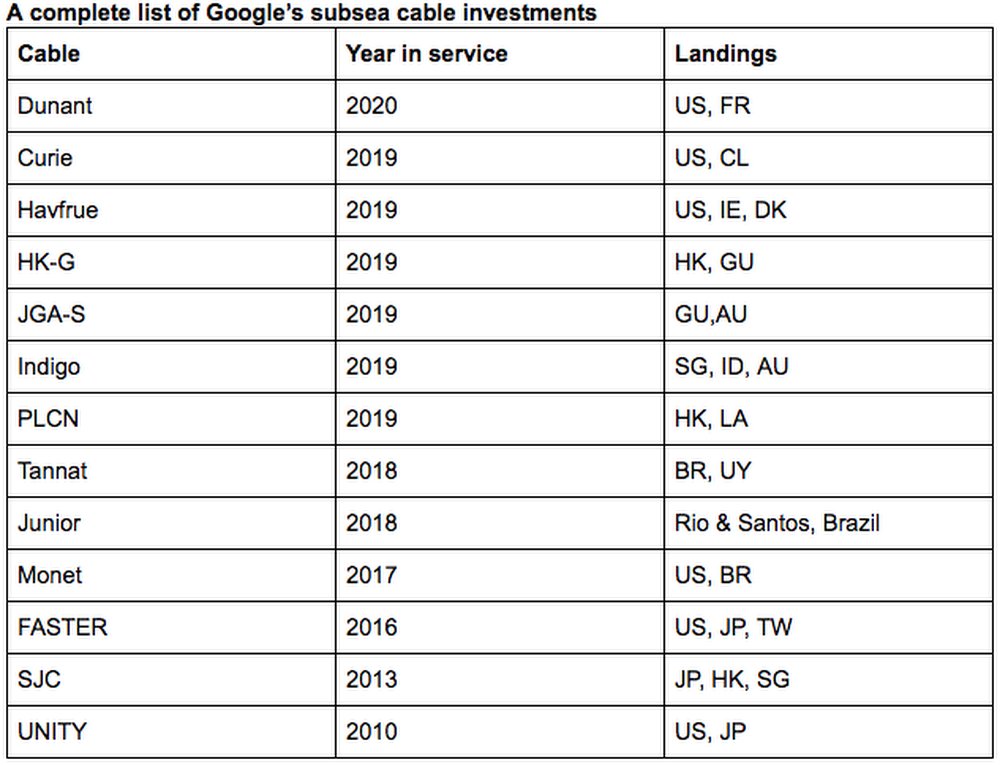
Indigo is a good example of Google’s expanding network of submarine cables. Typically, the company builds those with partners — and even occasionally competitors — but last year, for example, it also announced that it would build its own cable between the U.S. and France, the company’s fourth private cable.

Quite a few of the cables Google invested in in recent years are scheduled to go online in 2019, so chances are we’ll hear a bit more about the company’s efforts in this area in the coming months.