Category: UNCATEGORIZED

30 May 2019

LEGO celebrates Apollo 11 with a lovely, bricky Lunar Lander

The 50th anniversary of Apollo 11 and the first lunar landing is approaching, and there will be no shortage of fanfare — so why shouldn’t LEGO get in on the fun? This Lunar Lander set looks like a great way to celebrate the missions of the space program’s past, while the space station and launch sets celebrate its present and future.

The Apollo 11 set looks like a real treat for both space-loving kids and parents — and grandparents — who remember or otherwise venerate the historic missions. LEGO worked with NASA to put together a replica Eagle lander that’s a lot like the original, though slightly smaller, of course.

There are two astronauts, a crater, and a flag — just like the real landing. And the detailed ascender module actually detaches and fits two minifigs inside. And, inquiring LEGO enthusiasts will want to know, there are some cool new gold-colored bricks that will surely make for lovely additions to your other brick-based space projects.

Apollo is what we’re celebrating, but Artemis is what’s ahead of us. The next moon mission will involve quite a few interesting pieces of hardware, though nothing is finalized yet — so you can excuse LEGO for improvising a bit. (I feel sure the Shuttle design has been ruled out, though.)

[gallery ids="1834260,1834255,1834261,1834258"]

The launch control set looks great: an actual mission control area, an astronaut-delivery rail car, and a convincing rocket that could be the Space Launch System. There’s also a fairly realistic space station setup with segments you can connect in various ways and a cool airlock I would have loved to have when I was an avid builder.

I like that these aren’t huge — kids shouldn’t get the wrong idea about space travel. It’s like crawling into a hot can and being rolled down a hill, then you live in the can for months constantly smelling the other astronauts’ breath. At the end of it, you’re at Mars, sure — but it’s not exactly first class.

Making spaceships out of LEGO is a highlight of my childhood, and one in which I still indulge now and then, but I never felt particularly constrained by reality. I think it’s great that these sets provide that option — even if they’re fantasy, they’re definitely quasi-realistic and when kids see the Lunar Gateway in a few years they’ll think, huh, looks a lot like what I built a while back. So far that hasn’t happened with any of my ships.

Head over to the LEGO Shop to grab your own set.

30 May 2019

Healthcare data integration startup Abacus Insights lands $12.7M Series A

Abacus Insights, an early stage startup that wants to help coordinate healthcare information across systems, announced a $12.7 million Series A investment today led by CRV. Existing investors 406 Ventures and Echo Health Ventures also participated in the round.

The company is trying to make it easier for health insurance companies to share data with various parties in the healthcare system with the ultimate goal of lowering costs and helping participants across the system from doctors to pharmacists and other healthcare practitioners have a better understanding of the overall patient record.

Company founder and CEO Dr. Minal Patel says they chose insurance companies as the target customer for their solution because they have a greater understanding of a person’s overall healthcare as everything flows through them for payment.

“We launched in 2017 with the purpose of helping our clients, who are typically large health insurance companies, liberate all the data they sit on so that they can help their members become healthier and have better experience with the overall health care system,” he said.

The platform is essentially a data integration play tuned specifically for the healthcare industry. Trying to pull data from the variety of legacy systems in place across the different players in healthcare is challenging, and that’s the problem the company is trying to solve.

“Abacus makes gathering a patient’s healthcare history simpler for insurance companies by using a data management platform that houses their complete medical history in one place. Making it easier for both insurance companies and healthcare providers to look at a patient’s data in real-time and make better medical decisions to treat the patient in the best way possible,” a company spokesperson explained.

The startup has offices in Boston and New York and currently has 40 employees. Using some of the money from this round, it hopes to double that by the end of the year, particularly adding engineering talent to build out the product further.

30 May 2019

The latest modular Moto Z has a beefy battery and improved low-light camera

When it arrived in 2016, the Moto Z felt revolutionary — or, at the very least, novel. Motorola soon announced it was making the Moto Z its flagship device. In the intervening three years, the line has yet to set the world on fire.

It’s seemingly been a decent seller for the company, but with rare exceptions (as it happens, today is the second anniversary of the Essential announcement) the rest of the smartphone industry has yet to embrace the modular handset revolution.

It’s not for lack of trying, of course. Motorola’s released a wide range of Mods, including, most notably, a 5G unit, marking the first time that technology was widely available in North America. This morning the Lenovo-owned brand just announced the availability of the Moto Z4 (though not before the product accidentally went on sale at at least one retail location).

As ever, the latest version of the line points to one of the peculiarities of the modular phone concept, with upgraded base specs on a phone whose features rely largely on peripherals. Of course, the reasonable $499 starting price certainly cushions the blow a bit.

The base specs are a mixed bag. It’s got a 6.39-inch display, coupled with a middling Qualcomm Snapdragon 675 and a beefy 3,600mAh battery that the company rates at two days. The phone also adds a night-vision mode to the rear-facing 48 megapixel sensor.

The gray version of the handset starts shipping June 13, with a white model arriving over the summer. The unlocked version ships with a free Moto 360. Verizon’s also making the 5G Mod available for $200 (down from $350) for a limited time.

I’ll be spending more time with the phone in the near future — for now, however, it feels like Motorola’s most intriguing and promising handset is beginning to feel more and more like a middle of the road device.

30 May 2019

UK Internet attitudes study finds public support for social media regulation

UK telecoms regulator Ofcom has published a new joint report and stat-fest on Internet attitudes and usage with the national data protection watchdog, the ICO — a quantitative study to be published annually which they’re calling the Online Nation report.

The new structure hints at the direction of travel for online regulation in the UK, following government plans set out in a recent whitepaper to regulate online harms — which will include creating a new independent regulator to ensure Internet companies meet their responsibilities.

Ministers are still consulting on whether this should be a new or existing body. But both Ofcom and the ICO have relevant interests in being involved — so it’s fitting to see joint working going into this report.

As most of us spend more time than ever online, we’re increasingly worried about harmful content — and also more likely to come across it,” writes Yih-Choung Teh, group director of strategy and research at Ofcom, in a statement. “ For most people, those risks are still outweighed by the huge benefits of the internet. And while most internet users favour tighter rules in some areas, particularly social media, people also recognise the importance of protecting free speech – which is one of the internet’s great strengths.”

While it’s not yet clear exactly what form the UK’s future Internet regulator will take, the Online Nation report does suggest a flavor of the planned focus.

The report, which is based on responses from 2,057 adult internet users and 1,001 children, flags as a top-line finding that eight in ten adults have concerns about some aspects of Internet use and further suggests the proportion of adults concerned about going online has risen from 59% to 78% since last year (though its small-print notes this result is not directly comparable with last year’s survey so “can only be interpreted as indicative”).

Another stat being highlighted is a finding that 61% of adults have had a potentially harmful online experience in the past year — rising to 79% among children (aged 12-15). (Albeit with the caveat that it’s using a “broad definition”, with experiences ranging from “mildly annoying to seriously harmful”.)

While a full 83% of polled adults are found to have expressed concern about harms to children on the Internet.

The UK government, meanwhile, has made child safety a key focus of its push to regulate online content.

At the same time the report found that most adults (59%) agree that the benefits of going online outweigh the risks, and 61% of children think the internet makes their lives better.

While Ofcom’s annual Internet reports of years past often had a fairly dry flavor, tracking usage such as time spent online on different devices and particular services, the new joint study puts more of an emphasis on attitudes to online content and how people understand (or don’t) the commercial workings of the Internet — delving into more nuanced questions, such as by asking web users whether they understand how and why their data is collected, and assessing their understanding of ad-supported business models, as well as registering relative trust in different online services’ use of personal data.

The report also assesses public support for Internet regulation — and on that front it suggests there is increased support for greater online regulation in a range of areas. Specifically it found that most adults favour tighter rules for social media sites (70% in 2019, up from 52% in 2018); video-sharing sites (64% v. 46%); and instant-messaging services (61% v. 40%).

At the same time it says nearly half (47%) of adult internet users expressed recognition that websites and social media platforms play an important role in supporting free speech — “even where some people might find content offensive”. So the subtext there is that future regulation of harmful Internet content needs to strike the right balance.

On managing personal data, the report found most Internet users (74%) say they feel confident to do so. A majority of UK adults are also happy for companies to collect their information under certain conditions — vs over a third (39%) saying they are not happy for companies to collect and use their personal information.

Those conditions look to be key, though — with only small minorities reporting they are happy for their personal data to be used to program content (17% of adult Internet users were okay with this); and to target them with ads (only 18% didn’t mind that, so most do).

Trust in online services to protect user data and/or use it responsibly also varies significantly, per the report findings — with social media definitely in the dog house on that front. “Among ten leading UK sites, trust among users of these services was highest for BBC News (67%) and Amazon (66%) and lowest for Facebook (31%) and YouTube (34%),” the report notes.

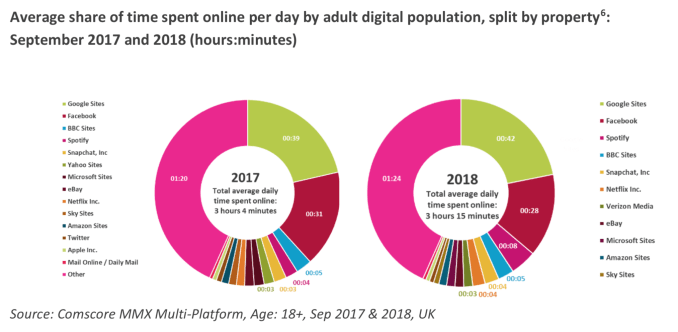
Despite low privacy trust in tech giants, more than a third (35%) of the total time spent online in the UK is on sites owned by Google or Facebook.

“This reflects the primacy of video and social media in people’s online consumption, particularly on smartphones,” it writes. “Around nine in ten internet users visit YouTube every month, spending an average of 27 minutes a day on the site. A similar number visit Facebook, spending an average of 23 minutes a day there.”

And while the report records relatively high awareness that personal data collection is happening online — finding that 71% of adults were aware of cookies being used to collect information through websites they’re browsing (falling to 60% for social media accounts; and 49% for smartphone apps) — most (69%) also reported accepting terms and conditions without reading them.

So, again, mainstream public awareness of how personal data is being used looks questionable.

The report also flags limited understanding of how search engines are funded — despite the bald fact that around half of UK online advertising revenue comes from paid-for search (£6.7BN in 2018). “[T]here is still widespread lack of understanding about how search engines are funded,” it writes. “Fifty-four per cent of adult internet users correctly said they are funded by advertising, with 18% giving an incorrect response and 28% saying they did not know.”

The report also highlights the disconnect between time spent online and digital ad revenue generated by the adtech duopoly, Google and Facebook — which it says together generated an estimated 61% of UK online advertising revenue in 2018; a share of revenue that it points out is far greater than time spent (35%) on their websites (even as those websites are the most visited by adults in the UK).

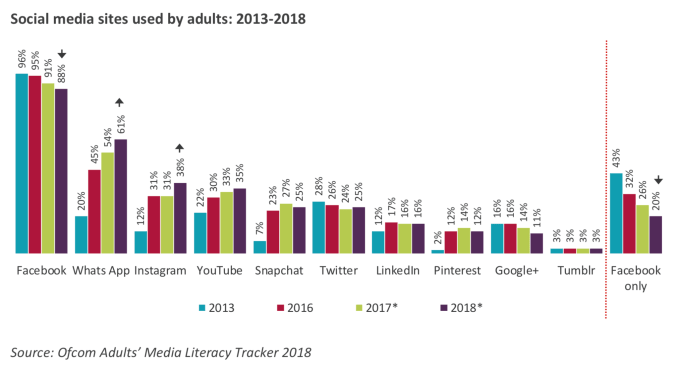
As in previous years of Ofcom ‘state of the Internet’ reports, the Online Nation study also found that Facebook use still dominates the social media landscape in the UK.

Though use of the eponymous service continues falling (from 95% of social media users in 2016 to 88% in 2018). Even as use of other Facebook-owned social properties — Instagram and WhatsApp — grew over the same period.


The report also recorded an increase in people using multiple social services — with just a fifth of social media users only using Facebook in 2018 (down from 32% in 2018). Though as noted above, Facebook still dominates time spent, clocking up way more time (~23 minutes) per user per day on average vs Snapchat (around nine minutes) and Instagram (five minutes).  

A large majority (74%) of Facebook users also still check it at least once a day.

Overall, the report found that Brits have a varied online diet, though — on average spending a minute or more each day on 15 different internet sites and apps. Even as online ad revenues are not so equally distributed.

“Sites and apps that were not among the top 40 sites ranked by time spent accounted for 43% of average daily consumption,” the report notes. “Just over one in five internet users said that in the past month they had used ‘lots of websites or apps they’ve used before’ while a third (36%) said they ‘only use websites or apps they’ve used before’.”

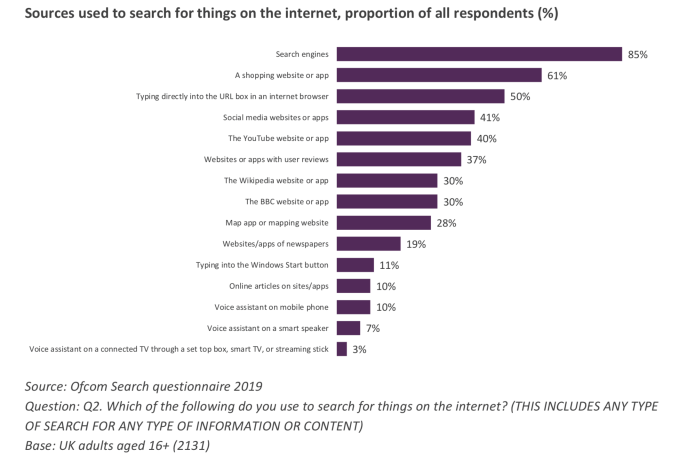
There is also variety when it comes to how Brits search for stuff online, and while 97% of adult internet users still use search engines the report found a variety of other services also in the mix. 

It found that nearly two-thirds of people (65%) go more often to specific sites to find specific things, such as a news site for news stories or a video site for videos; while 30% of respondents said they used to have a search engine as their home page but no longer do.

The high proportion of searches being registered on shopping websites/apps (61%) also looks interesting in light of the 2017 EU antitrust ruling against Google Shopping — when the European Commission found Google had demoted rival shopping comparison services in search results, while promoting its own, thereby undermining rivals’ ability to gain traffic and brand recognition.

The report findings also indicate that use of voice-based search interfaces remains relatively low in the UK, with just 10% using voice assistants on a mobile phone — and even smaller percentages tapping into smart speakers (7%) or voice AIs on connected TVs (3%).

In another finding, the report suggests recommendation engines play a major part in content discovery.

“Recommendation engines are a key way for platforms to help people discover content and products — 70% of viewing to YouTube is reportedly driven by recommendations, while 35% of what consumers purchase on Amazon comes from recommendations,” it writes. 

In overarching aggregate, the report says UK adults now spend the equivalent of almost 50 days online per year.

While, each week, 44 million Brits use the internet to send or receive email; 29 million send instant messages; 30 million bank or pay bills via the internet; 27 million shop online; and 21 million people download information for work, school or university.

The full report can be found here.

30 May 2019

MMC Ventures launches fresh £52M seed fund aimed at London startups

Synthesia is a London-based startup which recently achieved notoriety after powering the technology behind the recent global campaign showing Malaria survivors speaking through David Beckham to help raise awareness around the Malaria Must Die initiative.

That is, at least now, well known. What was less well known until today was that to achieve this, Synthesia was backed by the (also) London-based VC MMC Ventures, via its new fund, announced today by the Mayor of London. The new £100m Greater London Investment Fund — of which MMC Ventures has been appointed to manage £52m ($65.6M) — is aimed at enabling investment into high-potential tech companies in London.

As well as investing in 170 companies, the fund will seek to secure at least another £103 million in private sector investment, with the aim of creating 3,500 new jobs in the capital.

The bulk of the money for the new fund comes from European Union sources, which the Government is yet to give any assurances about replacing post-Brexit: £35 million from the European Regional Development Fund (ERDF) programme, overseen by City Hall and the London Economic Action Partnership (LEAP); and £50 million is from the European Investment Bank (EIB). But the ERDF cash has long since been banked by the city, prior to the UK’s moves towards Brexit, and the fund has already started drawing down funds from the EIB.

MMC will invest from the GLF at Seed and Series A, creating a portfolio in which MMC can deploy capital, utilising MMC Ventures’ other funds, over multiple rounds as they scale.

The new fund has to be seen partly thought the optics of Brexit. Not only is Mayor Sadiq Khan a staunch opponent of Brexit, and a potential Prime Ministerial candidate, but the new fund will boost his image as a business-friendly politician in an era where most politicians seem to have replaced their business credentials with ‘Brexit credentials’. Furthermore — and somewhat ironically — London is finally having to shout about itself, having rested on the laurels of being the EU’s financial heart for 40+ years.

The new fund will primarily back companies already based in London, but will also seek investments in businesses either relocating to London or opening or expanding an office in London, providing local support to the business and any co-investors. Clearly this may be tempting to some European startups which were previously put off by the UK’s strange Brexit optics.

What’s to be welcomed is that it will also target investments in businesses founded or run by individuals from under-represented groups – including female entrepreneurs, entrepreneurs of minority ethnic groups, and those with disabilities, in partnership with the Mayor’s team.

Plus, it will invest in sectors that align with the Mayor’s Economic Development Strategy including; Advanced Urban Services, Cultural and Creative Industries, Financial and Business and the Circular Economy.

Simon Menashy, partner, MMC Ventures said: “MMC has been investing in London’s start-ups and scale-ups for the past twenty years, supporting some of Europe’s most successful growth stories. Over that time, we’ve proven that you can generate growth and financial value while creating well-paying jobs and supporting sustainable business – something close to our hearts.”

MMC has already made its first investments through the fund – backing the afore-mentioned AI video synthesis platform, Synthesia, as part of a $3.1 million funding round, and yulife – the life insurance business – in a $12.6m Series A.

MMC has also created a pre-seed programme – the MMC Greater London Lab – that will write cheques alongside angels, seed funds, incubators and programmes of different types.

MMC has a bit of a track-record in this respect, The MMC London Fund, launched in 2013, managed in partnership with City Hall, that is now entering its 8th year. That leveraged £14m of initial investment to raise more than £120m of co-investment from private partners, and invested in startups like Gousto, Appear Here, Love Home Swap, and Masabi.

30 May 2019

Medivis gets FDA approval for its augmented reality surgical planning toolkit

Augmented reality is coming to the operating room theater sooner than anyone may have predicted.

Medivis, which launched its product suite earlier this year, has now received approvals from the Food and Drug Administration and will begin rolling out its service in hospitals around the country.

The SurgicalAR platform is a visualization tool that guides surgical navigation, which the company claims can decrease complications and improve patient outcomes, while lowering surgical costs.

The New York-based company, which was founded by Osamah Choudhry and Christopher Morley who met as senior residents at NYU Medical Center, raised $2.3 million in financing led by Initialized Capital  and has secured partnerships with Dell and Microsoft to supply its hardware.

“Holographic visualization is the final frontier of surgical imaging and navigation,” said Osamah Choudhry, a trained neurosurgeon who serves as the chief executive at Medivis, in a statement. “The surgical world continues to primarily rely on two-dimensional imaging technology to understand and operate on incredibly complex patient pathology. Medivis introduces advancements in holographic visualization and navigation to fundamentally advance surgical intervention, and revolutionize how surgeons safely operate on their patients.”

In addition to its hardware partnership with Microsoft, Medivis has also lined up Verizon (whose media group owns TechCrunch) as a partner for its much ballyhooed 5G network.

The company has also launched a toolkit for educational training in augmented reality. The AnatomyX platform for medical training is available on Hololens and Magic Leap’s devices and is already in use at West Coast University.

Medivis is one of a number of companies that are looking to bring new technologies like AR and VR into the OR.

Vicarious Surgical is another upstart that’s got a vision for medicine’s future that includes augmented or extended reality. That company is combining visualization tools with robotics to enable remote surgeries that could, one day, happen across the country or across globe.

What these technologies have in common, and the reason why Verizon is likely very happy to partner with a company like Medivis, is the huge amounts of bandwidth that are going to be required to make their visions of the future come true.

As high speed networks begin cropping up, the attendant use cases haven’t kept pace. And new visualization tools that hoover up data are just the thing to keep money flowing into my corporate overlord’s pockets.

Not that it’s a bad thing. As Medivis’ chief operating officer, Dr. Christopher Morley said in a statement. “We are achieving this by rethinking core limitations in current medical visualization pipelines, and continuously pushing the limits of what’s possible.”

30 May 2019

Rumpus, the collaborative toolkit from Oblong Industries, is now available on Webex

In a previous life, John Underkoffler spent his days in Los Angeles dreaming up all of the possible ways men and machines would interact as a science adviser on films like Minority Report.

Now, he designs those systems for the real world through his company Oblong Industries, which has labored to create a full stack of collaborative tools for business users that are every bit as high-tech as the one’s Underkoffler dreamt for the silver screen.

The first bolt in the quiver of tools that Underkoffler began building out over the course of 15 years spent at MIT’s Media Lab was Mezzanine. A multipurpose collaborative platform that allowed business users to share documents and interact in real time through a powerful combination of videoconferencing hardware and software.

In the age of Zoom though, Oblong’s tools have become more lightweight, and the company is steadily adding multi-share capabilities to platforms other than its own. That new gaggle of collaboration tools launched under the moniker of Rumpus, and Oblong has been partnering with different video services to add its services to their own.

The latest to get the Rumpus treatment is Cisco Webex.  Now Cisco’s videoconferencing customers will get access to Rumpus’ personal cursors that point and emphasize content on shared screens, presence indicators to show who is looking where and at what, and emoji reactions to provide feedback without disrupting the flow of a meeting.

The company’s tools enable all of the users in a meeting to share their screens without competing for screen time.

“We’ve worked closely with Cisco over the last year to bring the capabilities of our flagship product, Mezzanine, to the Cisco suite of enterprise solutions for meetings paces. So as we completed Oblong’s own set of content-first collaboration offerings by building out Rumpus for pure-virtual work, it was obvious that Webex should be among the first conferencing solutions to be directly integrated,” said Underkoffler in a statement. “We’re thrilled to bring . the next level of engagement and productivity to millions of Webex users when their meetings require more than basic video and messaging.”

Rumpus is currently available for free to Mac computer users with Windows support coming soon.

30 May 2019

London fintech Yapily raises $5.4M to offer a single API to connect to banks

Yapily, a London fintech startup that offers an Open Banking-based API platform to enable financial services providers and other types of enterprises, such as merchants, to connect to banks, has raised $5.4 million in seed funding.

Leading the round is HV Holtzbrinck Ventures and LocalGlobe. Investors also include Taavet Hinrikus (TransferWise Chairman and co-founder), Ott Kaukver (Twillio’s CTO) and Roberto Nicastro (UniCredit’s former deputy CEO).

Founded in mid 2017 by ex-Goldman Sachs employee Stefano Vaccino, Yapily is another platform play aiming to grasp the opportunity of Open Banking by making it easier for various service providers to connect to banks. The platform provides a way to retrieve financial data and initiate payments via a “single secure API” that in turn connects to each supported bank’s open API.

Customers include accountancy firms, companies in the payment space, crypto currency providers, digital wealth applications and e-commerce companies.

“Yapily removes the technical barriers for enterprises that want to benefit from Open Banking, helping them to innovate and bring new products to life faster,” Vaccino tells TechCrunch. “Legislators have been implementing Open Banking differently in various countries and even within the same jurisdiction banks all have disparate technical implementations. For a service provider that wants to benefit from it, the technical barriers to integrating with hundreds or thousands of banks are very high”.

To that end, Vaccino says Yapily’s mission is to enable service providers to connect to all banks, both for data retrieval and payment initiation, via one single API. “We manage the upfront integrations and the ongoing maintenance of these connections,” he says, thus removing the technical obstacle for companies that want to benefit from “the Open Banking revolution”.

In that sense, similar to a cloud provider, Yapily is positioning itself as a pure technology enabler. “Our objective is to offer all the tools that an enterprise will need to manage this connectivity layer easily,” adds Vaccino.

To date, the Yapily API supports 35 of the biggest banks in Europe, both for data retrieval and payments initiation. This equates to 250 million bank accounts, the startup says. By the end of the year, Yapily aims to have connected to 536 banks, as more banks across Europe bring their open APIs online in order adhere to European Union PSD2 legislation.

“By mid-september, 5,000 banks across Europe will need to have an API in place,” notes Yapily. “Governments in Australia, Japan, Canada, Singapore, South Korea, Mexico and several other countries are also committed to delivering open banking”.

Meanwhile, Yapily says this seed round will be used to help the company expand its tech team and further develop the platform. It also plans to build out a sales team to respond to demand for its Open Banking product.

30 May 2019

Apple, Google, Microsoft, WhatsApp sign open letter condemning GCHQ proposal to listen in on encrypted chats

An international coalition of civic society organizations, security and policy experts and tech companies — including Apple, Google, Microsoft and WhatsApp — has penned a critical slap-down to a surveillance proposal made last year by the UK’s intelligence agency, warning it would undermine trust and security and threaten fundamental rights.

“The GCHQ’s ghost protocol creates serious threats to digital security: if implemented, it will undermine the authentication process that enables users to verify that they are communicating with the right people, introduce potential unintentional vulnerabilities, and increase risks that communications systems could be abused or misused,” they wrire.

“These cybersecurity risks mean that users cannot trust that their communications are secure, as users would no longer be able to trust that they know who is on the other end of their communications, thereby posing threats to fundamental human rights, including privacy and free expression. Further, systems would be subject to new potential vulnerabilities and risks of abuse.”

GCHQ’s idea for a so-called ‘ghost protocol’ would be for state intelligence or law enforcement agencies to be invisibly CC’d by service providers into encrypted communications — on what’s billed as targeted, government authorized basis.

The agency set out the idea in an article published last fall on the Lawfare blog, written by the National Cyber Security Centre’s (NCSC) Ian Levy and GCHQ’s Crispin Robinson (NB: the NCSC is a public facing branch of GCHQ) — which they said was intended to open a discussion about the ‘going dark’ problem which robust encryption poses for security agencies.

The pair argued that such an “exceptional access mechanism” could be baked into encrypted platforms to enable end to end encryption to be bypassed by state agencies would could instruct the platform provider to add them as a silent listener to eavesdrop on a conversation — but without the encryption protocol itself being compromised.

“It’s relatively easy for a service provider to silently add a law enforcement participant to a group chat or call. The service provider usually controls the identity system and so really decides who’s who and which devices are involved — they’re usually involved in introducing the parties to a chat or call,” Levy and Robinson argued. “You end up with everything still being end-to-end encrypted, but there’s an extra ‘end’ on this particular communication. This sort of solution seems to be no more intrusive than the virtual crocodile clips that our democratically elected representatives and judiciary authorise today in traditional voice intercept solutions and certainly doesn’t give any government power they shouldn’t have.”

“We’re not talking about weakening encryption or defeating the end-to-end nature of the service. In a solution like this, we’re normally talking about suppressing a notification on a target’s device, and only on the device of the target and possibly those they communicate with. That’s a very different proposition to discuss and you don’t even have to touch the encryption.”

“[M]ass-scale, commodity, end-to-end encrypted services… today pose one of the toughest challenges for targeted lawful access to data and an apparent dichotomy around security,” they added.

However while encryption might technically remain intact in the scenario they sketch, their argument glosses over both the fact and risks of bypassing encryption via fiddling with authentication systems in order to enable deceptive third party snooping.

As the coalition’s letter points out, doing that would both undermine user trust and inject extra complexity — with the risk of fresh vulnerabilities that could be exploited by hackers.

Compromising authentication would also result in platforms themselves gaining a mechanism that they could use to snoop on users’ comms — thereby circumventing the wider privacy benefits provided by end to end encryption in the first place, perhaps especially when deployed on commercial messaging platforms.

So, in other words, just because what’s being asked for is not literally a backdoor in encryption that doesn’t mean it isn’t similarly risky for security and privacy and just as horrible for user trust and rights.

“Currently the overwhelming majority of users rely on their confidence in reputable providers to perform authentication functions and verify that the participants in a conversation are the people that they think they are, and only those people. The GCHQ’s ghost protocol completely undermines this trust relationship and the authentication process,” the coalition writes, also pointing out that authentication remains an active research area — and that work would likely dry up if the systems in question were suddenly made fundamentally untrustworthy on order of the state.

They further assert there’s no way for the security risk to be targeted to the individuals that state agencies want to specifically snoop on. Ergo, the added security risk is universal.

“The ghost protocol would introduce a security threat to all users of a targeted encrypted messaging application since the proposed changes could not be exposed only to a single target,” they warn. “In order for providers to be able to suppress notifications when a ghost user is added, messaging applications would need to rewrite the software that every user relies on. This means that any mistake made in the development of this new function could create an unintentional vulnerability that affects every single user of that application.”

There are more than 50 signatories to the letter in all, and others civic society and privacy rights groups Human Rights Watch, Reporters Without Borders, Liberty, Privacy International and the EFF, as well as veteran security professionals such as Bruce Schneier, Philip Zimmermann and Jon Callas, and policy experts such as former FTC CTO and Whitehouse security advisor, Ashkan Soltani .

While the letter welcomes other elements of the article penned by Levy and Robinson — which also set out a series of principles for defining a “minimum standard” governments should meet to have their requests accepted by companies in other countries (with the pair writing, for example, that “privacy and security protections are critical to public confidence” and “transparency is essential”) — it ends by urging GCHQ to abandon the ghost protocol idea altogether, and “avoid any alternative approaches that would similarly threaten digital security and human rights”.

Reached for a response to the coalition’s concerns, the NCSC sent us the following statement, attributed to Levy:

We welcome this response to our request for thoughts on exceptional access to data — for example to stop terrorists. The hypothetical proposal was always intended as a starting point for discussion.

It is pleasing to see support for the six principles and we welcome feedback on their practical application. We will continue to engage with interested parties and look forward to having an open discussion to reach the best solutions possible.

Back in 2016 the UK passed updated surveillance legislation that affords state agencies expansive powers to snoop on and hack into digital comms. And with such an intrusive regime in place it may seem odd that GCHQ is pushing for even greater powers to snoop on people’s digital chatter.

Even robust end-to-end encryption can include exploitable vulnerabilities. One bug was disclosed affecting WhatsApp just a couple of weeks ago, for example (since fixed via an update).

However in the Lawfare article the GCHQ staffers argue that “lawful hacking” of target devices is not a panacea to governments’ “lawful access requirements” because it would require governments have vulnerabilities on the shelf to use to hack devices — which “is completely at odds with the demands for governments to disclose all vulnerabilities they find to protect the population”.

“That seems daft,” they conclude.

Yet it also seems daft — and predictably so — to suggest a ‘sidedoor’ in authentication systems as an alternative to a backdoor in encrypted messaging apps.


30 May 2019

Ekasbo’s Matebot may be the cutest cat robot yet created

If Shrek saw Matebot, no amount of sad-eyes could win him back to Puss in Boots’ side. Created by Shenzhen-based robotics company Ekasbo, Matebot looks like a black and white cartoon cat and responds to your touch by wiggling its ears, changing the expression in its big LED eyes and tilting its head.

Ekasbo's Matebot in a sad mood

Built with voice recognition, infrared technology and seven moving parts, the Matebot is designed to serve as an interactive companion, including for people who can’t keep pets, creator Zhang Meng told TechCrunch at Computex in Taiwan.

The Matebot is controlled with a smartphone app and can be integrated with Android voice control systems. Its price starts at about 4,999 yen or about $45 USD.