Category: UNCATEGORIZED

14 May 2019

Twitter’s new Developer Labs offers beta access to rebuilt APIs

Twitter is finally modernizing its core APIs after 7 years of stagnation, and it wants early feedback from developers. That’s why today it’s launching Twitter Developer Labs, which app makers can sign up for to experiment with pre-release beta APIs. First up will be real-time streaming access to the Twitter firehose with the expansion of tweet filtering plus impressions and engagement metrics that were only previously only available in its expensive enterprise API tiers. Twitter will also be adding newer features Polls to the API.

Giving developers longer lead-times and more of a voice when it comes to rebuilding its APIs could help Twitter get more app makers paying for its premium API ($339 to $2.899 per month) and enterprise API tiers (even more expensive). It might also stimulate the creation of dev-made analytics, measurement, and ads businesses that convince brands to spend more money on Twitter marketing. The Labs program will roll out in the coming weeks, but people can sign up for developer accounts in the meantime to get prepped for access and join an email list for updates.

Twitter’s data and enterprise solutions product manager Ian Cairns acknowledged some of the whiplash Twitter has put developers through in the past, rapidly changing strategies and restricting rate limits in ways that made developers’ businesses unsustainable. “There are certainly times over the years when the ways in which we’ve managed our APIS . . . have changed and we know some of those have changed in ways that have been disruptive to developers. What we’re doing with the Twitter Developer Labs program is focusing on trying to use that as a vehicle to build trust and make sure we’re having a two-way conversation and that the voice of the people who use our platform the most are driving the future.”

The announcement comes two years after Twitter announced a streamlining of its APIs that also instituted the paid tiers. And this year, Twitter has made moves to crack down on API use for spamming and services for buying followers.

Developer Labs will act serve as the nerdy brother of the new “twttr” beta consumer app that launched in March to let people try out potential changes to how replies and the feed work. Twitter writes that “Our initial focus in Labs will be on developers who work with conversational data, including academics and researchers who study and explore what’s happening on Twitter, and social listening and analytics companies that build products for other businesses.”


14 May 2019

Google Cloud launches its second region in Japan

Google today announced the launch of its Osaka region, its second cloud region in Japan and seventh in Asia Pacific. With this, the company now offers its users a total of twenty regions, all of which feature at least three availability zones.

In Japan, the Osaka region joins Google’s Tokyo region and will offer lower latencies for local customers, Google notes, though Tokyo and Osaka are obviously pretty close, so that’s likely not a big difference. For businesses in Japan, having two geographically separate regions is a major boon as far as being able to add additional redundancies and disaster recovery is concerned, though.

“Two cloud regions in-country provide improved business continuity planning with distributed, secure infrastructure needed to meet IT and business requirements for disaster recovery. Services and support from our robust partner ecosystem in Japan,” Google Cloud CEO Thomas Kurian writes in today’s announcement.

“We’re looking forward to the Osaka cloud region,” says Tatsuhito Chiku, Corporate Officer, General Manager, Information Technology Section at Asahi Group Holdings. “Using Google Cloud Platform services like BigQuery have enabled us to build a system with low latency and high resiliency, and the Osaka cloud region will further improve our system availability and achieve business continuity.”

It’s worth noting that Azure also currently offers two regions in Japan, though AWS only offers a single region at this time.

Like its competitors, Google continues to expand its data center availability across the globe. Kurian notes that the company has now spent $47 billion on its global infrastructure, which includes the likes of new data centers and dedicated links between them. Later this year, Google will also launch new regions in Seoul, Salt Lake City and Jakarta.

14 May 2019

Voi unveils ‘longer-lasting’ e-scooters designed to withstand rentals, and launches its first e-bikes

Voi Technology, the “micro-mobility” startup that operates an e-scooter service on the streets of a growing number of European cities, has unveiled a range of new scooters and a first e-bike more suited to rentals.

The company is also revealing plans to expand to another 150 cities and towns, having ratcheted up 2 million rides in eight months since launching. Voi currently operates in 18 cities in nine European countries — including Stockholm, Madrid, Copenhagen, Paris, Lyon and Lisbon — and with will open up in Germany, Belgium, Poland and Italy this summer.

In a call, Voi CEO and co-founder Fredrik Hjelm told me the new hardware rollouts are part of the Swedish company’s plans to become a broader micro-mobility play with a range of travel options that meet the demands of people living in urban areas and the sustainability concerns of city and town authorities. The new e-scooters have been designed and engineered in-house using data collected and other learnings from riders during Voi’s relatively short lifespan.

Voi’s main new model, dubbed “Voiager 2,” is said to be designed for maximum durability as well as future recycling (should and when it full apart or be superseded). The body is cast in one single piece of 5mm high-grade aluminium, coupled with performance enhancements thanks to a custom electric powertrain and 10″ wheels. There’s also a kickstand to prevent the e-scooter from falling over when parked (a common sight in some cities) and a three-wheel version particularly suitable for slippery conditions.

The Voiager 2’s display features “Advanced Rider Assistance System (ARAS) functions,” such as navigation support, alerts and notifications. The idea, explained Hjelm, is to avoid riders having to juggle looking at their mobile phone or to continuously stop to navigate. The Internet of Things (IoT) Telematics unit is integrated into the body of the scooter.

Hjelm says the Voiager 2 is Voi’s first scooter based on the Voi modular scooter architecture (VOI MSA), which allows for easy service, repair and upgrades. There’s also a swappable battery to reduce scooter downtime, as well as reduce the environmental impact and cost of charging scooters.

Overall, the design is not just intended to improve the e-scooter experience for consumers and city authorities but should go someway to addressing concerns around the questionable unit economics of micro-mobility services.

See also: Voi Technology, the European e-scooter rentals startup, raises an additional $30M

In a bid to launch at speed and test the market, companies have used off-the-shelf consumer-grade e-scooters that aren’t durable enough to withstand the battering they receive through shared commercial use and being left outside in varied weather conditions. They’re also not designed with rental logistics in mind and even something as simple as a hot swappable battery can reduce the cost of running an e-scooter service since more scooters remain in motion, potentially increasing revenue per scooter. There’s also a reduction in the cost of collecting dead batteries for re-charging as they are de-coupled from the scooter itself.

Voi Cargo

A second model, the new “Voiager 1” has been designed for the German market. This month the German government will green light e-scooters for use on its roads. Hjelm thinks Germany will quickly become one of the world’s biggest e-scooter markets and its new rugged scooter features brakes and indicator lights that meet strict German regulations, which the Voi CEO believes are likely to be adopted elsewhere.

Voi is also unveiling the Voi Bike and Voi Cargo. The former is an e-bike that has been adapted for sharing and meets European e-bike regulations. It can travel at 25km/h fully assisted and is suitable for longer distances than e-scooters. Voi Cargo is a three-wheel electric cargo bike that caters specifically to riders who have to carry bulky loads, such as groceries or children. The bike has a large box on the front which features three-point seatbelts.

Meanwhile, Voi isn’t the only European e-scooter startup developing its own hardware. Flash — the stealthy mobility startup from Delivery Hero and Team Europe founder Lukasz Gadowski has talked up its own hardware product plans, while Berlin’s Wind Mobility is also developing a proprietary model of electric scooters specifically designed for the sharing market.

Other competitors in Europe include Tier and Taxify’s Bolt. Silicon Valley’s Bird and Lime also operate in Europe.

14 May 2019

Africa e-tailer Jumia issues post-IPO results amid short-sell assault

For Pan-African e-commerce startup Jumia, going public has been an up and down affair.

The company filed SEC IPO docs in March and saw its share rise 70% after listing on the NYSE in April at $14.50. Then last week, Jumia’s stock tumbled when it came under assault from a short-seller accusing the company of fraud.

This occurred against the backdrop of a debate playing out across Africa’s tech ecosystem on Jumia’s legitimacy as an African startup and set the stage for the company’s first post-IPO earnings call on Monday.

The results

There’s a lot to unpack around Jumia and the first item out of the vault is its Q1 results.

Key takeaways were that Jumia’s Gross Merchandise Value (GMV)—the total amount of goods sold over the period— grew by 58% to €240 million. Other highlights included marketplace revenue growth of 102% to €16 million, and gross profits as a percentage of GMV growth of 6.5% in Q1 2019 vs. the same period in 2018.

Overall, Jumia’s operating losses for the period widened to €45.4 million from €34.3 and negative EBITDA increased to €39.5 million from €30.2.

So the startup’s still losing money—see the big losses reported in the IPO filing—but is improving its ability to earn.

“GMV is not the end all but it’s…a starting point because to generate revenue it’s gotta start with GMV,” Citibank Frontier Markets Analyst Andrew Howell told TechCrunch. “The side that was less…encouraging was the expenses are still very high,” he said.

Jumia’s earnings call revealed the startup’s intention to expand to new markets in Ethiopia, DR Congo, and Angola in coming years.

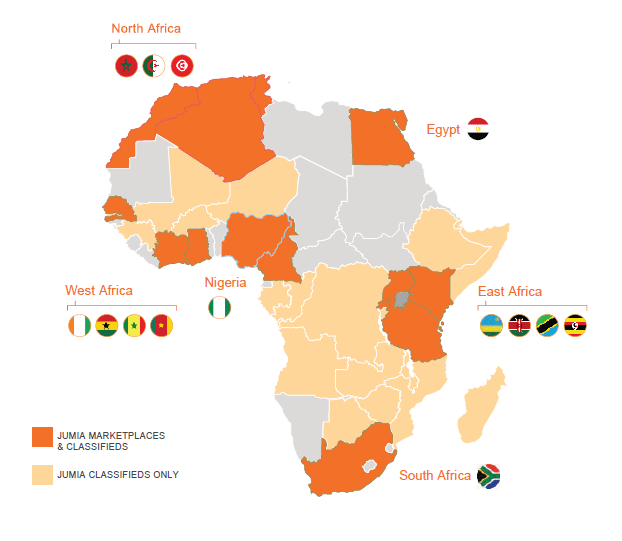
Founded in Lagos in 2012, the company currently operates multiple online verticals in 14 African countries — from B2C consumer retail to travel bookings.
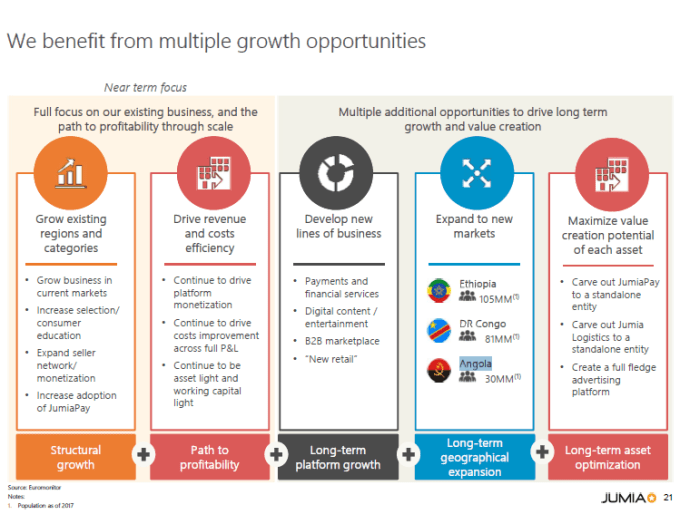
Jumia also shared a longer-term revenue strategy on its Q1 earnings call toward converting its JumiaPay and Jumia Logistics capabilities to standalone services across Africa.

The accusations

Jumia CEO Sacha Poignonnec responded to claims made by short-seller Andrew Left—derived from Left’s firm Citron Research—that Jumia committed securities fraud in its IPO filing.

Speaking to TechCrunch, Left said he had found “major discrepancies in the key performance metrics, the amount of customers, also the amount of vendors [reported], which, when you’re talking about e-commerce, are the most important things.”

Citron Research’s report, published May 9, makes a number of critical claims regarding Jumia, but the one it labels “the smoking gun” refers to material discrepancies between an October 2018, Jumia confidential investor presentation it obtained and Jumia’s April 2019 SEC Form F-1.

For the year 2017, there’s a difference of 600,000 active customers and 10,000 merchants in Jumia’s reporting between the fall 2018 investor presentation and the recent 2019 F-1, according to Citron Research.
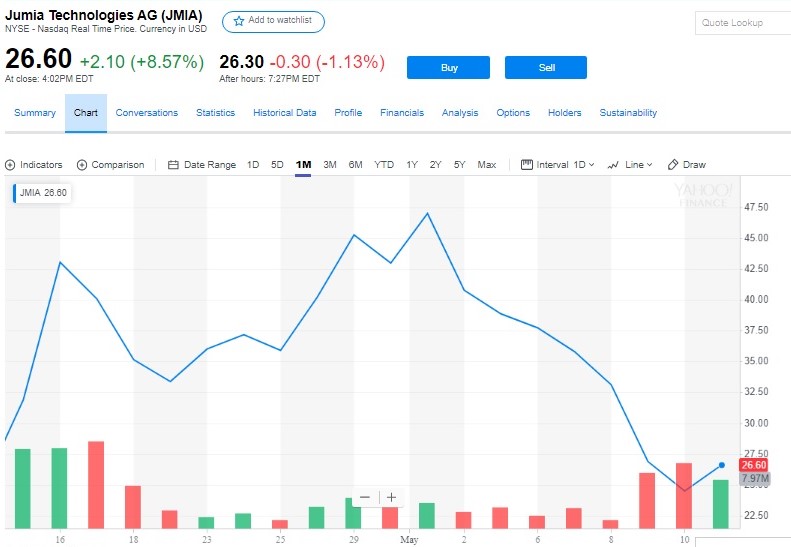
Left confirmed to TechCrunch that he holds short-positions in Jumia’s stock—which means he could benefit financially from declines in Jumia’s share value. The company’s stock dropped 26% last week after the Citron Research report published.

On Monday’s earnings call, Sacha Poignonnec responded to Citron’s report, saying that “Jumia stands by our prospectus and audited financials…and will not be distracted by those who look to create doubt, to profit at our expense and that of our long-term stakeholders.” He later took to media and refuted claims as “market rumors rather than facts.”

Citibank Analyst Andrew Howell published his own response to the Citron Research (now bouncing around on social media). On Left’s material discrepancy claims regarding active consumers and merchants, Howell pointed to Jumia’s explanation of different calculations across the reporting documents, one being net and the latter gross. “It’s perfectly reasonable; a legitimate distinction,” Howell told TechCrunch, adding that he didn’t see Left’s claims of securities fraud as credible.

The read

Jumia’s path from becoming Africa’s first startup unicorn to listing on a global exchange to issuing its first-earnings release has been a bit dramatic.

Things to watch moving forward include whether the startup can finally generate profits and ROI. Now that Jumia’s publicly traded, we’ll have a quarterly snapshot (and analyst reporting) on its progress (or not) toward that endeavor. 
Jumia’s pivot to offer its JumiaPay and classifieds services more broadly across Africa could make it a competitor in the continent’s fintech space and improve its revenues vs. expenses, since digital payments and ads have higher margins than B2C e-commerce.

And eyes will be on whether Citron Research’s fraud claims and short-sell position escalate.

In response to a TechCrunch inquiry, an SEC spokesperson declined to comment on whether there is any active investigation into Jumia based on Left’s reporting.

On the possibility of taking legal action against Citron Research, Jumia CEO Sacha Poignonnec did not rule it out, telling TechCrunch, “We are considering our options.”

And on the prospect of recourse, “Tell Jumia if they have a problem with my report go ahead and sue me,” Left told TechCrunch.

In the meantime, Jumia’s stock rose  5% by close of trading Monday with Citibank analyst Andrew Howell maintaining his “Neutral” rating and Morgan Stanley’s Brian Nowak his “Underweight” recommendation. Overall, Wall Street seemed confident in Jumia’s post-IPO results and outreach. Bloomberg this morning summarized additional bullish analyst reporting, including Raymond James and Berenberg upgrades in their Jumia stock recommendations to buy-equivalent ratings.

Expect the Pan-African e-commerce startup’s Q2 earnings call sometime in August.

14 May 2019

Daily Crunch: Impossible Foods raises $300M

The Daily Crunch is TechCrunch’s roundup of our biggest and most important stories. If you’d like to get this delivered to your inbox every day at around 9am Pacific, you can subscribe here.

The company behind the Impossible Burger gets a big infusion of capital, a major WhatsApp exploit is revealed and Uber stock has a rough day. Here’s your Daily Crunch for May 14, 2019.

1. Crowned by Burger King, meat replacement company Impossible Foods raises $300M

After being crowned by Burger King as the first meat replacement patty to roll out nationally with one of the largest fast food chains, Impossible Foods has raised $300 million in capital.

The financing brings the company’s total equity raise to $750 million — and provides a sizable pool of funds to draw from as it continues to compete with its newly publicly traded rival, Beyond Meat.

2. WhatsApp exploit let attackers install government-grade spyware on phones

WhatsApp just fixed a vulnerability that allowed malicious actors to remotely install spyware on affected phones, and an unknown number reportedly did so with a commercial-grade snooping package usually sold to nation-states.

3. Uber had an abysmal second day of trading

Yesterday, Uber closed its second day of trading down more than 18.8% from its IPO price, at $37.25 per share, with a market cap of $62.2 billion.

4. Supreme Court rules against Apple, allows an App Store antitrust case to proceed

The iPhone owners suing Apple allege that the company’s 30% commission on App Store sales is passed along to users, representing an unlawful and unfair use of Apple’s monopoly power.

5. Amazon rolls out Alexa Guard, to help protect your home while you’re out

The feature lets the company’s line of smart home products double as home security devices while the user is out. Say “Alexa, I’m leaving” on your way out the door, and the Echo device will start listening.

6. Spotify-owned Soundtrap launches a podcast studio in the cloud

Like Anchor (which Spotify also acquired), Soundtrap is focused on making it easier to podcast. But unlike Anchor, which is free, Soundtrap is available by subscription, starting at $14.99 per month.

7. Market map: the 200+ innovative startups transforming affordable housing

Immuta’s Daniel Wu has been looking at innovation in inclusive housing, and in this article, he breaks down more than 200 companies doing notable work in the space. (Extra Crunch membership required.)

14 May 2019

Walmart, Tyson Foods and J.B. Hunt launch a logistics accelerator in Arkansas with Plug and Play

Plug and Play, the accelerator network that works with corporations to invest and advise startup technology companies, is partnering with Walmart, Tyson Foods and J.B. Hunt to set up a logistics-focused program in Northwest Arkansas.

Retailers, software vendors and any number of contracting companies have been forced to make the trek to Bentonville, Ark. to prostrate themselves before Walmart’s corporate juggernaut and now it seems some of Silicon Valley’s startup gurus are going to make the trek as well.

“We are very excited to begin our work with these great organizations like Walmart, J.B. Hunt, and Tyson Foods in Northwest Arkansas to develop the ecosystem and culture of entrepreneurship,” says Saeed Amidi, Founder & chief executive officer of Plug and Play, in a statement. “With our startups, we can bring efficiency and cost savings in the supply chain. Through this new operation here, we will be able to connect Northwest Arkansas to Silicon Valley, China, Singapore, Germany, and the rest of our global network.”

The new initiative is backed by the Walton Family Foundation (the non-profit affiliated with Walmart’s founding family), the Arkansas Economic Development Commission, and the accelerators three corporate partners.

“This new relationship with Plug and Play will leverage our regional strength in supply chain and logistics,” said Nelson Peacock, the Northwest Arkansas Council’s president and chief executive officer.  “This program will shine a greater spotlight on all of the great things happening in Northwest Arkansas.”

Plug and Play’s program will identify ten companies to participate in two cohorts annually. The focus will be on supply chain optimization, last-mile delivery, warehouse automation, sensor technologies, predictive analytics and machine learning.

“Innovation that increases efficiency in our supply chain will help our team continue to be a competitive advantage for the company and ensure we can maintain everyday low prices for our customers however they want to shop,” said Greg Smith, Executive Vice President, Supply Chain, Walmart U.S. “By combining the strength of Walmart and the speed of startups, this partnership with Plug and Play will accelerate innovation and support our efforts to maintain a best-in-class supply chain.”

A grant from the Walton Family Foundation will support the entrepreneurial education and training curriculum for accelerator participants, as well as support community events and mentoring workshops, Plug and Play said in a statement.

“Northwest Arkansas is known for driven entrepreneurs who created access to opportunity and transformed communities,” said Karen Minkel, Home Region Program Director at the Walton Family Foundation. “Plug and Play’s accelerator will support the next generation of promising startups that will strengthen our innovation ecosystem.”

14 May 2019

Verified Expert Brand Designer: Phil Weiner

As a former entrepreneur turned independent designer, Phil Weiner gets the startup life. He often describes himself as a second co-founder for his clients, unafraid of 2AM phone calls and prepping pitch decks for investors. He’s a “full stack” creative director based in Oakland, CA with a passion for tackling cultural tension. Learn more about why design runs in his blood, his branding philosophy, and more.

On his ideal client:

“There are certain values that we have to have in line. The number one value is that they don’t view their people as resources, they view them as people. If I start to get the inkling that a founder isn’t necessarily great at managing their teams and their people, empowering them or removing obstacles, it’s probably going to be difficult for us to figure out customer empathy. Number two, design is an investment, not an expense.”

“Phil has worked with us to create and shape a number of impact brands like 100% Human at Work – and hundreds of visual presentations that have inspired hundreds of entrepreneurs to do something bigger in their lives.” Jean Oelwang, London, UK, CEO, Virgin Unite

On the power of branding:

“I get to be able to shape culture because that’s what brands are able to do. You can build a really great product and introduce it into the market and that’ll have it’s own life cycle until trends change. Brands can last a lifetime. I think that’s the only way that I can make a mark on the world, even if my name isn’t on the company. If it’s contributing to the brand, I’ve scaled my potential impact in the world.”

Below, you’ll find the rest of the founder reviews, the full interview, and more details like pricing and fee structures. This profile is part of our ongoing series covering startup brand designers and agencies with whom founders love to work, based on this survey and our own research. The survey is open indefinitely, so please fill it out if you haven’t already.


The Interview

Yvonne Leow: Tell me about your background. How did you get into design and branding?

Phil Weiner: So I actually didn’t study design. I’m self-taught designer. I come from a pretty cool line of designers. My grandfather drew the “I Love Lucy” heart and did album artwork for Motown Records, and typography. My mom’s also a graphic designer. She’s been with The Washington Post and The NY Daily News for years. She just retired.

The first thing they actually told me was “Don’t go to school for design. Go to school for business. Because if you don’t understand business, you don’t understand design.” So I went to school for econ and math. I studied design in “the streets”. I started my first company when I was 21 years old. It was an early version of Hired.com. When you don’t have any money, you have to do things yourself and be creative so I learned everything from basically failing. I know a lot about what startups are going through, whether it’s designing a pitch deck, selling a product, A/B testing, or trying to convert traffic on a webpage. I ended up selling that first company, which was a recruiting business that was based on scraping Linkedin for what we call, “The most placeable candidate.”

14 May 2019

OnePlus redefines premium with the 7 Pro

OnePlus has never been particularly beholden to industry trends. Nowhere is that better demonstrated than with the 7 Pro. In the face of a stagnated smartphone market, Apple, Samsung and Google all went budget, releasing lower-tier takes on their pricey flagships to appeal to consumers looking for something akin to a premium experience without having to shell out four figures.

The 7 Pro, on the other hand, is OnePlus’ most premium device to date. But while the shift marks a break from much of the industry, it’s a very logical step for the company’s current trajectory. OnePlus made a name for itself creating low-cost flagship devices with features that were just slightly behind the bleeding edge.

In recent years, however, the company has looked to change that perception, becoming one of the first Android phones with an in-display fingerprint sensor and promising to be among the first to deliver 5G. The 7 Pro, however, marks a new era for the company. The existing six-month release strategy is still in place here (fittingly, given that Google has recently adopted something similar with its Pixel line), but the language OnePlus is using has shifted.

In a meeting ahead of launch, a rep for the company told TechCrunch OnePlus considers its twice-yearly phones to all be “flagships,” but the new model introduces the paradigm of “premium flagship” and “ultra-premium flagship.”

That’s a markety speak way of saying the company doesn’t compromise — which I think is a fair point. Oftentimes the concept of a “budget flagship” is heavily weighted toward the budget side of things. But OnePlus long ago established its knack for providing well-rounded, high-end smartphone experiences at well below the price of premium handsets.

The 7 Pro’s $669 starting price hedges much closer to the iPhone XR and Samsung Galaxy S10e’s $749 than the Pixel 3a’s $399. It’s also a pretty significant bump over the OnePlus 6T’s $549 starting point. It’s likely enough to make longtime fans of the service do a double take, but the sizable increase does come with a truly premium handset.

That starts with the design (though it’s certainly more than skin deep). This is immediately apparent with the 6.67-inch display. If curved sides of the edge to edge design are familiar, it’s because it was built custom for OnePlus by Samsung. And while it’s similar, it is, in fact, a custom design for the line, meaning that it’s still distinguished from the Galaxy line — namely the 516ppi density and a 90Hz refresh rate.

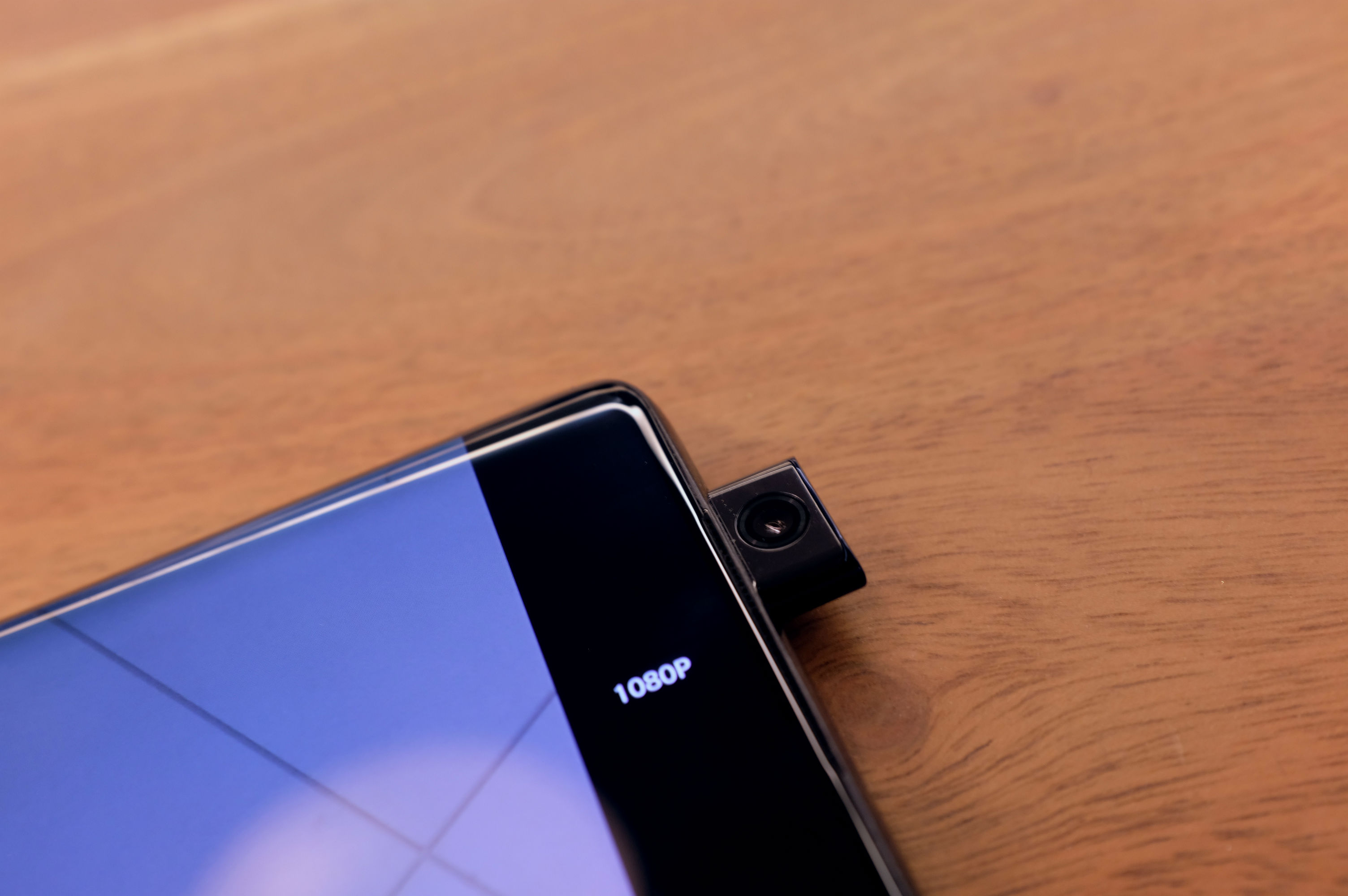
What’s really notable, however, is the complete absence of a notch or a pinhole. The 7 Pro takes another key step toward a world of uninterrupted screen time. Open the camera app, flip to front-facing and wait just under a second, as it mechanically extends on top of the device.

It’s not the first time we’ve seen the technology — fellow Chinese manufacturers Oppo and Vivo have already introduced us to pop-up cameras. But given OnePlus’ ongoing T-Mobile partnership, this is arguably the first time this technology has really been available to mainstream U.S. consumers.

The execution is quite good. As someone who almost never takes selfies, I’ve come to appreciate the semblance of privacy of a hidden front-facing camera. If I need it, it’s just a tap of the screen away. There are some safety features built in, as well. Should it slip from your grip while the camera is out, the phone uses the accelerometer to automatically retract it. It will also automatically return home if the phone goes to sleep with it out.

OnePlus won’t say what this specifically means for things like water resistance. In fact, the company’s a little cagey on the subject — even recently taking to Twitter to brag that it didn’t submit for an IP rating, in order to lower the cost of the devices for the end user. Here’s a video of it dropping the new phone in a bucket:

Do with that what you will. It’s certainly clear why OnePlus would decide to skip elements it deemed unnecessary, but there is a certain peace of mind in knowing that a product has been submitted to rigorous testing by outside parties. The closest we got to a definitive answer was a recommendation against attempting to take an underwater selfie with the phone. So take that as you will.

On the rear of the device is a three-camera system that pairs a beefy 48-megapixel lens with a 78mm telephoto and 117-degree ultra-wide angle. I’ve had some opportunity to play with the phone, and this really does seem to be the most utilitarian set up for a three-camera system, and the camera software does a nice job transitioning between lenses as you zoom in.

This is a premium device inside, as well. The Snapdragon 855 is coupled with 6-12GB of RAM and either 128 or 256GB of storage. The battery is a beefy 4,000 mAh, which will get you through more than a day on a single charge, no problem. The “Warp Charge” maintains the company’s fast-charging tradition, letting you fill up around half the battery in 20 minutes using the included adapter.

OnePlus has really outdone itself here, once again proving that a truly premium device doesn’t require a four-digit investment. Other companies have explored a similar price point with varying degrees of success. For OnePlus fans not ready to take the step up, the company will continue to provide a more more affordable line going forward. For now, however, the 7 Pro is easily one of the best ways to get a truly premium smartphone experience without paying an arm and leg.

The 7 Pro will be available online May 17 through OnePlus’ site and T-Mobile.

14 May 2019

You probably weren’t a target of the WhatsApp surveillance hack

Every once in a while a major bug, vulnerability or security scare will spark panic. In most cases, it’s absolutely unnecessary panic.

Take yesterday’s reported vulnerability. Israeli hacking outfit NSO Group, a developer of malware typically used by governments, was caught using a hack targeting WhatsApp that allowed the attackers to remotely spy on the victim’s phone. The exploit was almost invisible, according to The Financial Times, which broke the story. The only indication that a phone might have been hacked is a missed call, often later deleted from the call log.

WhatsApp owner Facebook said it detected the hack and pushed out a fix to the app stores last night. WhatsApp didn’t mention the attack in its release notes, sparking criticism from some security experts for downplaying the risk of the vulnerability.

There was just one small missing piece of information from most reports: You probably weren’t a target.

Unless you’re a nuclear scientist or a government spy — or in this case a human rights lawyer — you’re probably not of any interest.

Exploits like the ones used in WhatsApp require a lot of time and effort to develop. They also have to be effective, undetected and reusable. Every time an exploit is used against a target runs the risk that someone finds out — the very opposite of covert surveillance.

“This attack was not about mass surveillance, it was used against highly targeted people,” said Alan Woodward, a computer science professor at the University of Surrey. “The likely cost and risks to those deploying this exploit means they would have used it only on very selective targets,” he said.

It’s becoming increasingly common to report hacks and breaches without offering context to the victims involved. Every time we report a security lapse, we try to contextualize it so confirmed or possible victims can take measures to protect themselves. The risk is if we don’t, it sparks panic and uncertainty. Worse, confusion leads to misinterpretation which results in shoddy reporting and a misinformed public.

It’s sometimes called “hack porn,” where fanciful and obscure hacking techniques are covered like they’re drive-by downloads, or nation states are hacking everyone en masse. There’s no harm in reporting the information, but in a way that’s proportional to the risk posed to the possible victims involved.

“The general public should be aware, update the software, but certainly not rush to abandon the application,” said Woodward. “To their credit WhatsApp found this almost invisible attack,” he said.

“No software is 100 percent secure,” said Woodward. “As long as you practice good security hygiene such as keeping your passwords secure and your apps up to date, the vast majority should be quite safe from this attack, even if you are a target.”

Yesterday’s news is a reminder that as much as sophisticated, nation state-backed hacks exist to target a fraction of the 1 percent, it never hurts to keep your apps up to date.

Read more:

14 May 2019

Sisense acquires Periscope Data to build integrated data science and analytics solution

Sisense announced today that it has acquired Periscope Data to create what it is calling, a complete data science and analytics platform for customers. The companies did not disclose the purchase price.

The two company CEOs met about 18 months ago at a conference, and running similar kinds of companies, hit it off. They began talking and after a time, realized it might make sense to combine the two startups because each one was attacking the data problem from a different angle.

Sisense, which has raised $174 million, tends to serve business intelligence requirements either for internal use or externally with customers. Periscope, which has raised over $34 million, looks at the data science end of the business.

Both company CEOs say that they could have eventually built these capabilities into their respective platforms, but after meeting they decided to bring the two companies together instead, and they made a deal.

Harry Glasser from Periscope Data and Amir Orad of Sisense.

Harry Glasser from Periscope Data and Amir Orad of Sisense.

“I realized over the last 18 months [as we spoke] that we’re actually building leadership positions into two unique areas of the market that will slowly become one as industries and technologies evolve,” Sisense CEO Amir Orad told TechCrunch.

Periscope CEO Harry Glasser says that as his company built a company around advanced analytics and predictive modeling, he saw a growing opportunity around operationalizing these insights across an organization, something he could do much more quickly in combination with Sisense.

“[We have been] pulled into this broader business intelligence conversation, and it has put us in a place where as we do this merger, we are able to instantly leapfrog the three years it would have taken us to deliver that to our customers, and deliver operationalized insights on integration day on day one,” Glasser explained.

The two executives say this is part of a larger trend about companies becoming more data-driven, a phrase that seems trite by now, but as a recent Harvard Business School study found, it’s still a big challenge for companies to achieve.

Omad says that you can debate the pace of change, but that overall, companies are going to operate better when they use data to drive decisions. “I think it’s an interesting intellectual debate, but the direction is one direction. People who deploy this technology will provide better care, better service, hire better, promote employees and grow them better, have better marketing, better sales and be more cost effective,” he said..

Omad and Glasser recognize that many acquisitions don’t succeed, but they believe they are bringing together to like-minded companies that will have a combined ARR of $100 million and 700 employees.

“That’s the icing on the cake, knowing that the cultures are so compatible, knowing that they work so well together, but it starts from a conviction that this advanced analytics can be operationalized throughout enterprises and [with] their customers. This is going to drive transformation inside our customers that’s really great for them and turns them into data-driven companies,” Glasser said.