Category: UNCATEGORIZED

14 May 2019

Shares of SoftBank Group, Uber’s biggest stakeholder, slide after its disappointing IPO

As Uber’s biggest shareholder, SoftBank Group had high hopes for the ride-sharing company’s stock market debut last week. Instead, the Japanese conglomerate’s shares have been sliding along with Uber’s following its disappointing initial public offering. SoftBank shares began sliding at the end of last week after Uber set its IPO price at the low end of its planned range. Since the start of trading on Friday morning, SoftBank Group shares have fallen 14.4 percent in value from 11,700 yen (about $106.69) to 10,020 yen (about $91.37)

On paper, SoftBank Group, which became an investor in Uber in early 2018, had expected to make a profit of $3 billion from its debut. According to its IPO filing, SoftBank Group is Uber’s largest shareholder, owning 16.3 percent of pre-IPO shares through its Vision Fund.

After shares continued falling on their second day of trading, Uber CEO Dara Khosrowshahi told employees in a memo that “like all periods of transition, there are ups and downs. Obviously, our stock did not trade as well as we had hoped post-IPO. Today is another tough day in the market, and I expect the same as it relates to our stock.”

All major market indexes fell on Monday as the China-U.S. trade war continued to escalate, with China planning to raise customs on American imports after the U.S.increased tariffs on Chinese goods last week.

14 May 2019

Walmart announces next-day delivery on 200K+ items in select markets

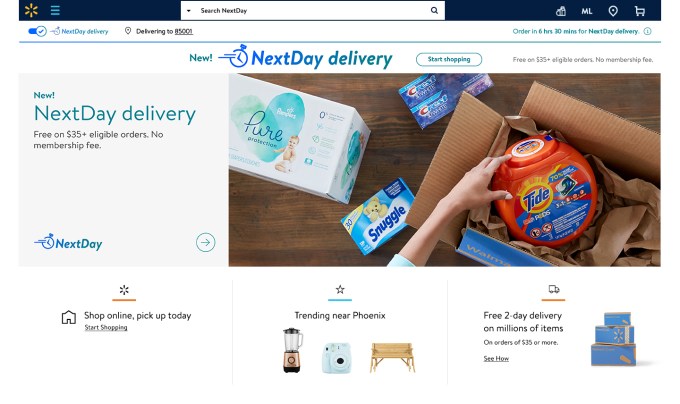
This month, Amazon announced it’s investing $800 million in its warehouses and delivery infrastructure in order to double the speed of Prime shipping by reducing it to only one day. Now Walmart is following suit with a one-day shipping announcement of its own. The rival retailer says it will begin to offer free, NextDay delivery on select Walmart .com orders over $35 — without a membership fee.

This offer will initially be available to customers only in Phoenix and Las Vegas beginning on Tuesday, May 14, 2019, and will then expand to customers in Southern California over the next few days. The rollout will then continue “gradually” over the months ahead, with a goal of reaching 75% of the U.S. population — including 40 of the top 50 U.S. metros — by year-end.

Today, Amazon Prime covers more than 100 million items, which are available for two-day shipping to Prime’s more than 100 million subscribers. To make an inventory of that size available for one-day shipping is a massive investment on Amazon’s part.

Walmart, on the other hand, is starting smaller. Its NexDay delivery will be available as a standalone, curated shopping experience where customers can browse up to 220,000 of the most frequently purchased items.

This includes things like diapers, electronics, toys and household needs, and soon more. Everything in the cart has to be NextDay-eligible and total more than $35 to qualify. The cut-off times for the order will vary by location, Walmart says. Orders will be delivered primarily by national carriers, and in some cases, regional carriers.

This more limited focus in terms of inventory (for now at least) makes NextDay more of a competitor to Target’s Restock than to Amazon one-day Prime ambitions, as — like Restock — it requires a $35 minimum order. Restock, though, has customers “filling a box” with items and is largely focused on day-to-day shopping. Meanwhile, Walmart’s NextDay selection is wider than Restock’s some 35,000 items. (However, ahead of Walmart’s announcement, Target pushed out news that its same-day “Drive Up” curbside service had now expanded to over 1,250 U.S. stores.)

Walmart’s focus on matching Amazon’s efforts — but with a different set of conditions and “without a membership fee” — is now par for the course.

For example, Walmart in early 2017 first announced it would begin to offer free, two-day shopping on more than 2 million items with no need for a membership — as long as orders totaled $35.00 or more. The retailer had been trialing such a sped-up shipping system for years — starting with a test of its answer to Prime back in 2015. Dubbed ShippingPass at the time, the program initially began with 1 million items and three-day delivery, then was lowered to two days while the number of eligible items doubled. 

This past October, Walmart expanded two-day shipping to its Marketplace sellers, as well.

Now, it’s focused on one-day. Walmart says this is not in response to Amazon’s news, but rather had plans already in progress.

“We can offer fast, convenient shipping options because we’ve built a network of fulfillment assets that are strategically located across the U.S. We’ve also done extensive work to ensure we have the right products in the right fulfillment centers based on where customers are located and what they’re ordering,” said president and CEO of Walmart E-Commerce, Marc Lore.

Lore had sold his e-commerce startup Jet.com to Walmart for $3 billion in 2016. While it lives on as a more urban-focused delivery service, its influence on Walmart’s broader e-commerce efforts — particularly around delivery logistics — is seen in these expanded efforts to improve delivery times that also reduce costs while keeping prices low for consumers. Jet, for example, had offered credits to consumers who bought their items from the same nearby warehouse. That’s not entirely different from what Walmart NextDay is doing.

As Lore explains, NextDay is affordable for Walmart.

“Our new NextDay delivery isn’t just great for customers, it also makes good business sense. Contrary to what you might think, it will cost us less – not more – to deliver orders the next day,” he says. “That’s because eligible items come from a single fulfillment center located closest to the customer. This means the order ships in one box, or as few as possible, and it travels a shorter distance via inexpensive ground shipping. That’s in contrast to online orders that come in multiple boxes from multiple locations, which can be quite costly.”

Forrester analyst Sucharita Kodali suggests a bit more caution. She agrees that having another place to get overnight shipping is a win for consumers, but there could still be challenges.

“I think that makes sense theoretically, but whether or not they can make the economics work depends on the quality of the assortment and how many people actually use it. Also, I don’t know how easily it scales,” she says.

14 May 2019

XPRIZE seeks high-tech solutions to California’s fire problems

The fire season is just a few weeks away here in California, and it’s expected to be worse than ever. But there’s a new plan in the works to help catch fires before they get out of control. XPRIZE is organizing a public competition for technology that can quickly find and extinguish wildland fires.

Announced by Gov. Gavin Newsom and XPRIZE founder Peter Diamandis on Friday at the Near Future Summit in San Diego, the competition will be open to any company and inventor in the world.

“It’ll be head-to-head between companies, and if one can detect and extinguish a fire in a repeatable fashion, then it becomes technology that every farm, every piece of land [can get],” Diamandis explained on stage. “Let’s reinvent what has been an old form of fire suppression — of people putting themselves in danger.”

Instead of the remote (and decaying) fire lookouts like the one that Jack Kerouac lived in on Desolation Peak, this wildland firefighter turned tech writer imagines Internet of Things devices and satellites helping to pick up even small smoke or heat trails, perhaps combined with some drones that can go dump precision-guided buckets of water.

XPRIZE competitions are designed to attract outside investment for new approaches to major problems, with its ambitious goals typically taking many years for anyone to win. So far, the nonprofit entity has successfully fostered results around space flight, health care and pollution cleanup among many other areas. The fire prize is currently finding sponsors to support the full program and has already raised an initial half-million dollars in funding from Dick Merkin, the CEO of Heritage Provider Network, to develop the plan.

The problem that this prize addresses has only been getting more obvious. Climate change, urban sprawl into naturally burning ecosystems, and an overly successful historical approach to limiting wildland fires have all contributed to bigger and more damaging conflagrations in recent decades.

Today, California is full of kindling-like new plant growth from the wet winter we just had, and it is just about dried out and ready to burn when the next lightning storm, mechanical spark, cigarette butt or willful arsonist shows up.

The winner of the prize will not be able to solve all of the bigger problems, of course, but detection and fast suppressions will at least buy humans time to figure out the other parts while preventing much of the state from going up in smoke.

“Just since 2015 we’ve had ten of the most destructive wildfires in California’s entire history,” Newsom highlighted. “You look at the last 24 months, all those headlines… We lost 139 lives to 16,600 wildfires. We lost over 32,000 structures in this state. [We’re] still trying to calculate the destruction in terms of costs. Just the debris removal costs currently in Paradise… are now close to three billion dollars.”

Meanwhile, like much else in the state, firefighting infrastructure is stuck in the middle of last century.

Gavin Newsom at the near future summit

“I mean, we’re still trying to get old-time cameras out there in the forest,” Newsom continued. “We still have an analog 911 system in the state of California. We have 234 of these Cal Fire forest stations. Over half of them are more than 50 years old, or dilapidated, falling down. People can’t even be pre-positioned out there. It is hard to describe how antiquated we are in this response. The first responders do an extraordinary job, and the mutual aid from around the world is second to none. But we shouldn’t just be celebrating that heroism on the back end. We should be celebrating the heroism and ingenuity on the front end.”

Diamandis offered a few more ideas for what a successful prize competitor might offer.

“You should be able to say in this 500 acres of forest land, there should not be a fire over ten times the size of a camp fire…. If something gets spotted by infrared by satellites, and drones, that is bigger than that, [then] put it out immediately. Autonomously. The concept is a fire detection and extinguishing XPRIZE. Can we find it and put it out before it grows? How it gets put out, is it drones, is water cannons, who knows? That’s our hope, and our working with you, you got plenty of test facilities here.”

He and Newsom also highlighted the economic angles and the physical proximity of the problem, noting geographic areas like the East Bay Hills where (to my knowledge) some of the wealthy and tech-focused Near Future attendees live — which could help with fundraising for the prize.

“They’re not insuring folks in what they call this wildland urban interface any longer,” Newsom noted. “Eleven million Californians live in that wildland-urban interface. You’re seeing your deductibles go up, your premiums go up — or they’re simply not renewing it because they cannot absorb these losses anymore.”

The governor has also been busy debating other ways to plan against fires as he unveils his first state budget. The prize concept, which he has talked about before, is in this light a handy way to save taxpayer dollars, while potentially getting far better tools than the state could build or buy today. If successful, it could also produce solutions for the many other fire-prone parts of the world.


13 May 2019

WhatsApp exploit let attackers install government-grade spyware on phones

WhatsApp just fixed a vulnerability that allowed malicious actors to remotely install spyware on affected phones, and an unknown number reportedly did so with a commercial-grade snooping package usually sold to nation-states.

The vulnerability (documented here) was discovered by the Facebook-owned WhatsApp in early May, the company confirmed to TechCrunch. It apparently leveraged a bug in the audio call feature of the app to allow the caller to allow the installation of spyware on the device being called, whether the call was answered or not.

The spyware in question that was detected as having been installed was Israel-based NSO Group’s Pegasus, which is usually (ostensibly) licensed to governments looking to infect targets of investigations and gain access to various aspects of their devices.

This is, as you can imagine, an extremely severe security hole, and it is difficult to fix the window during which it was open, or how many people were affected by it. Without knowing exactly what the exploit was and what data WhatsApp keeps regarding that type of activity, we can only speculate.

The company said that it suspects a relatively small number of users were targeted, since it would be nontrivial to deploy, limiting it to advanced and highly motivated actors..

Once alerted to the issue’s existence, the company said it took less than 10 days to make the required changes to its infrastructure that would render the attack inoperable. After that, an update went out to the client that further secured against the exploit.

“WhatsApp encourages people to upgrade to the latest version of our app, as well as keep their mobile operating system up to date, to protect against potential targeted exploits designed to compromise information stored on mobile devices,” the company said in a statement.

So what about NSO Group? Is this attack their work as well? The company told the Financial Times, which first reported the attack, that it was investigating the issue. But it noted that it is careful not to involve itself with the actual applications of its software — it vets its customers and investigates abuse, it said, but it has nothing to do with how its code is used or against whom.

WhatsApp did not name NSO in its remarks, but its suspicions seem clear:

“This attack has all the hallmarks of a private company known to work with governments to deliver spyware that reportedly takes over the functions of mobile phone operating systems.”

Naturally when a security-focused app like WhatsApp finds that a private company has, potentially at least, been secretly selling a known and dangerous exploit of its protocols, there’s a certain amount of enmity. But it’s all part of the 0-day game, an arms race to protect against or breach the latest security measures. WhatsApp notified the Department of Justice and “a number of human rights organisations” of the issue.

You should, as WhatsApp suggests, always keep your apps up to date for situations like this, although in this case the problem was able to be fixed in the backend before clients could be patched.

13 May 2019

Announcing TechCrunch Sessions: Enterprise this September in San Francisco

Of the many categories in the tech world, none is more ferociously competitive than enterprise. For decades, SAP, Oracle, Adobe, Microsoft, IBM and Salesforce, to name a few of the giants, have battled to deliver the tools businesses want to become more productive and competitive. That market is closing in on $500 billion in sales per year, which explains why hundreds of new enterprise startups launch every year and dozens are acquired by the big incumbents trying to maintain their edge.

Last year alone, the top ten enterprise acquisitions alone were worth $87 billion and included IBM’s acquiring Red Hat for $34 billion, SAP paying $8 billion for Qualtrics, Microsoft landing GitHub for $7.5 billion, Salesforce acquiring MuleSoft for $6.5 billion Adobe grabbing Marketo for $4.75 billion. No startup category has made more VC and founders wildly wealthy, and none has seen more mighty companies rise faster or fall harder. That technology and business thrill ride makes enterprise a category TechCrunch has long wanted to tackle head on.

TC Sessions: Enterprise (Sept. 5 at San Francisco’s Yerba Buena Center) will take on the big challenges and promise facing enterprise companies today. TechCrunch’s editors, notably Frederic Lardinois, Ron Miller, and Connie Loizos, will bring to the stage founders and leaders from established and emerging companies to address rising questions like the promised revolution from machine learning and AI, intelligent marketing automation, and the inevitability of the cloud, as well as the outer reaches of technology, like quantum and blockchain.

We’ll enlist proven enterprise-focused VCs to reveal where they are directing their early, middle and late stage investments. And we’ll ask the most proven serial entrepreneurs to tell us what it really took to build that company, and which company they would like to create next. All throughout the show, TechCrunch’s editors will zero in on emerging enterprise technologies to sort the hype from the reality. Whether you are a founder, an investor, enterprise-minded engineer, or a corporate CTO / CIO, TC Sessions: Enterprise will provide a valuable day of new insights and great networking.

Tickets are now available for purchase on our website at the early-bird rate of $395. Want to bring a group of people from your company? Get an automatic 15% savings when you purchase 4 or more tickets at once. Are you an early stage startup? We have a limited number of Startup Demo Packages available for $2000 which includes 4 tickets to attend the event. Students are invited to apply for a reduced price student ticket at just $245. Additionally, for each ticket purchase for TC Sessions: Enterprise, you will also be registered for a complimentary Expo Only pass to TechCrunch Disrupt SF on October 2-4.

Interested in sponsoring TC Sessions: Enterprise? Fill out this form and a member of our sales team will contact you.

13 May 2019

Tech stocks tumble as China retaliates in latest salvo of the trade war

Shares of technology companies were hit hard as China retaliated against the U.S. in the latest salvo of the ongoing trade war between the two countries.

The S&P 500 Index shed roughly $1.1 trillion of value while the Dow Jones Industrial Average and the Nasdaq Composite Index fell 2.38 percent and 3.41percent, respectively.

On Monday, China responded in equal measure to the U.S. raising tariffs on imports to 25%, by imposing 25% duties on some $60 billion of U.S. exports to the country.

On June 1, Beijing will impose 25% tariffs on more than 5,000 products. Several more exports to the country will see their duties rise to 20%. That’s up from 10% and 5% previously. The highest tariffs seem to be on products designed to cause pain among President Donald Trump’s political base of support — animal products, fruits and vegetables that come from the Midwest.

But tech companies are particularly expose in the trade war. Indeed, the news sent technology shares spiraling in what venture capitalist (and former TechCrunch co-editor-in-chief) Alexia Bonatsos called the “Tech Red Wedding”.

Rising tariffs will make the tech products from Apple and other American tech companies more expensive to manufacture, which will likely cause hardware manufacturers to raise prices at home, while duties on the finished goods coming to China could make them prohibitively expensive for local buyers in the country.

More expensive consumer products also mean less money to spend on non-essential items, which could mean more frugal behavior from consumers and less spending in the on-demand economy. It could also cause a pull-back in advertising as companies retrench and cut spending in areas that are considered to be non-core.

All of that could leave tech stocks exposed — beyond algorithms just dumping holdings and taking profits in what looks to be a prolonged market downturn.

The trade war, which already took a toll on Uber’s initial public offering, took another bite out of the company’s (short term) stock market performance today.

Uber was far from the only tech stock seeing red. Shares of Amazon were down 3.56 percent, Alphabet was down 2.66 percent, and Apple fell 5.81 percent. Meanwhile Facebook shares fell 3.61 percent; Netflix tumbled over 4 percent on the day.

Things may look up for some tech companies again, but they’re unlikely to receive the kind of bailouts or subsidies that the President is offering to American farmers hit by the economic battle with China. Unless Congress can get stalled negotiations around an infrastructure package back on track (something that seems less and less likely as the 2020 elections start to cast their shadow over the business of governing), there’s little hope for any government assistance that could cushion the blow.

“Our view is this could escalate for at least a matter of weeks, if not months, and it’s really to get the two back to the negotiating table and finish the deal, is probably going to require more pain in the markets…Really the only question is if we need a 5%, 10% or bigger market correction,” Ethan Harris, head of global economics at Bank of America Merrill Lynch, told CNBC.

13 May 2019

Uber had an abysmal second day of trading

It’s not looking great for ride-hailing giant Uber (NYSE: UBER). Today, Uber closed its second day of trading down more than 18.8 percent from its IPO price at $37.25 per share with a market cap of $62.2 billion.

Uber, which was previously valued at $72 billion by venture capitalists on the private market, priced its stock at $45 a share for an $82.4 billion valuation last week. On day one, Uber closed at $41.57 a share.

In a memo obtained by CNBC, Uber CEO Dara Khosrowshahi told employees today that, “like all periods of transition, there are ups and downs. Obviously, our stock did not trade as well as we had hoped post-IPO. Today is another tough day in the market, and I expect the same as it relates to our stock.”

Moving forward, Khosrowshahi urged employees to focus on the long-term. He also pointed to the comebacks both Facebook and Amazon made post-IPO.

Lyft has similarly suffered on the public market since its IPO in March. Lyft closed the day at $48.15 with a market cap of $13.8 billion.

13 May 2019

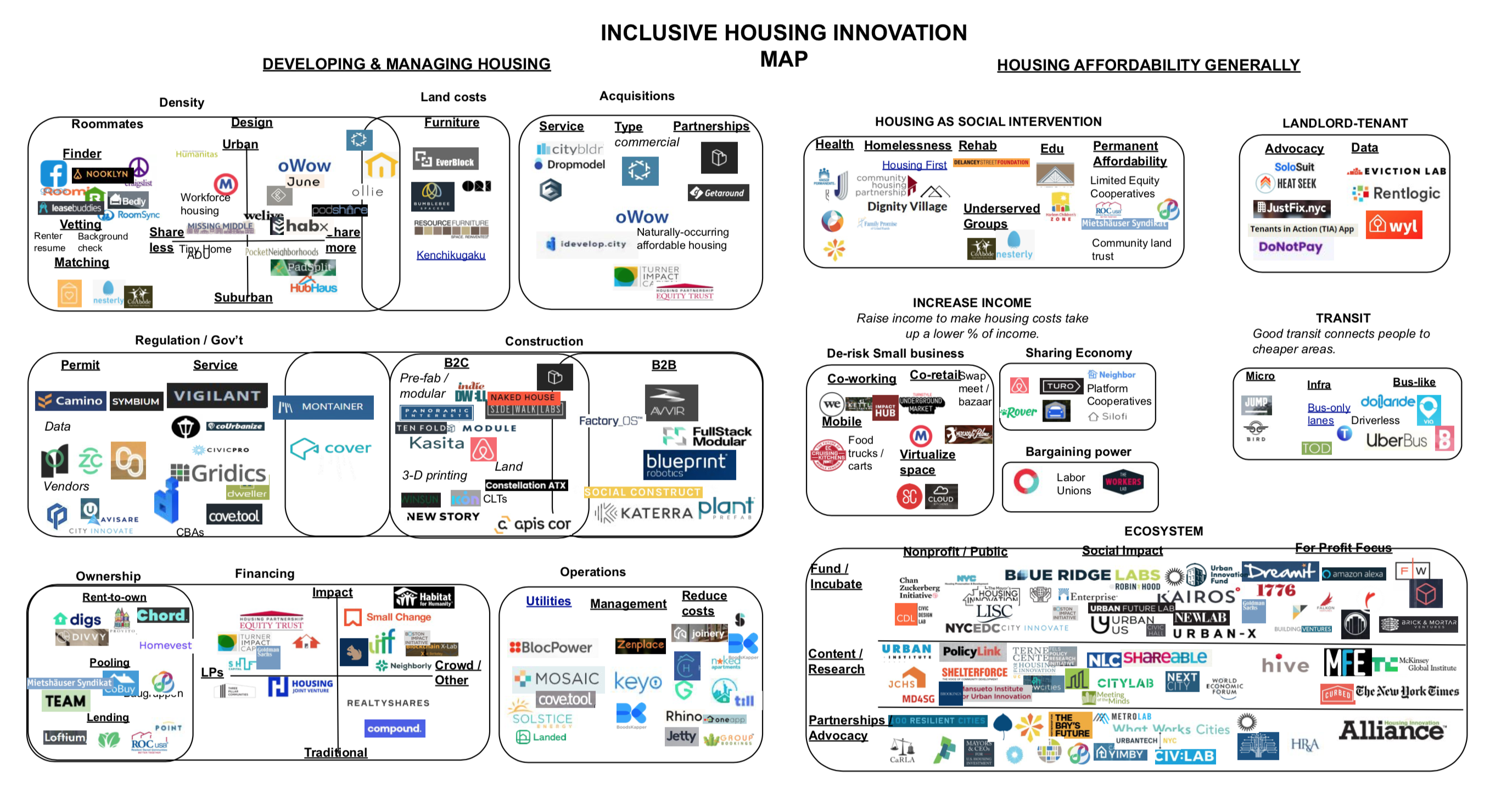
Market map: the 200+ innovative startups transforming affordable housing

In this section of my exploration into innovation in inclusive housing, I am digging into the 200+ companies impacting the key phases of developing and managing housing.

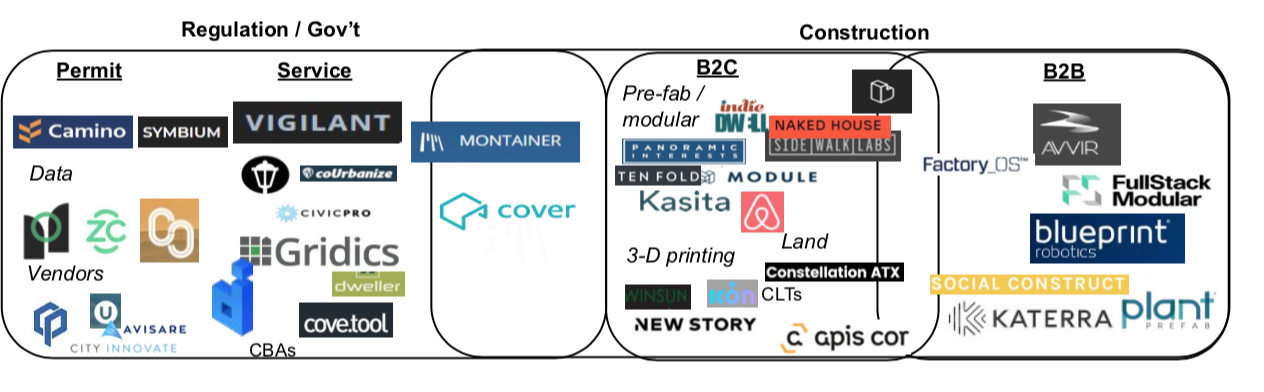
Innovations have reduced costs in the most expensive phases of the housing development and management process. I explore innovations in each of these phases, including construction, land, regulatory, financing, and operational costs.

Reducing Construction Costs

This is one of the top three challenges developers face, exacerbated by rising building material costs and labor shortages.

13 May 2019

Innovations in inclusive housing

Housing is big money. The industry has trillions under management and hundreds of billions under development.

And investors have noticed the potential. Opendoor raised nearly $1.3 billion to help homeowners buy and sell houses more quickly. Katerra raised $1.2 billion to optimize building development and construction, and Compass raised the same amount to help brokers sell real estate better. Even Amazon and Airbnb have entered the fray with high-profile investments.

Amidst this frenetic growth is the seed of the next wave of innovation in the sector. The housing industry — and its affordability problem — is only likely to balloon. By 2030, 84% of the population of developed countries will live in cities.

Yet innovation in housing lags compared to those of other industries. In construction, a major aspect of housing development, players spend less than 1% of their revenues on research and development. Technology companies, like the Amazons of the world, spend nearly 10% on average.

Innovations in older, highly-regulated industries, like housing and real estate, are part of what Steve Case calls the “third wave” of technology. VCs like Case’s Revolution Fund and the SoftBank Vision Fund are investing billions into what they believe is the future.

These innovations are far from silver bullets, especially if they lack involvement from underrepresented communities, avoid policy, and ignore distributive questions about who gets to benefit from more housing.

Yet there are hundreds of interventions reworking housing that cannot be ignored. To help entrepreneurs, investors, and job seekers interested in creating better housing, I mapped these innovations in this package of articles.

To make sense of this broad field, I categorize innovations into two main groups, which I detail in two separate pieces on Extra Crunch. The first (Part 1) identifies the key phases of developing and managing housing. The second (Part 2) section identifies interventions that contribute to housing inclusion more generally, such as efforts to pair housing with transit, small business creation, and mental rehabilitation.

Unfortunately, many of these tools don’t guarantee more affordability. Lowering acquisition costs, for instance, doesn’t mean that renters or homeowners will necessarily benefit from those savings. As a result, some tools likely need to be paired with others to ensure cost savings that benefit end users — and promote long-term affordability. I detail efforts here so that mission-driven advocates as well as startup founders can adopt them for their own efforts.


Topics We Explore

Today:

Coming Tomorrow:

  • Part 2. Other contributions to housing affordability
    • Social Impact Innovations
    • Landlord-Tenant Tools
    • Innovations that Increase Income
    • Innovations that Increase Transit Accessibility and Reduce Parking
    • Innovations that Improve the Ability to Regulate Housing
    • Organizations that Support the Housing Innovation Ecosystem
  • This is Just the Beginning
  • I’m Personally Closely Watching the Following Initiatives.
  • The Limitations of Technology
  • Move Fast and Protect People


Please feel free to let me know what else is exciting by adding a note to your LinkedIn invite here.

If you’re excited about this topic, feel free to subscribe to my future of inclusive housing newsletter by viewing a past issue here.

13 May 2019

Spotify is testing its own version of Stories called ‘Storyline’

Spotify is testing its own version of Stories — the sharing format popularized by social apps like Snapchat and Instagram and has since made its way to other apps like Facebook, YouTube, WhatsApp, and others. In Spotify’s case, it’s not called “Stories” but rather “Storyline,” and the focus is on allowing artists to share their own insights, inspiration, details about their creative process, or other meanings behind the music.

This is very much similar to what Spotify’s “Behind the Lyrics” feature today offers. But instead of pop-up cards that load in time with the music, Spotify Storyline is very much a Stories-like experience where users tap through the different screens at their own pace, and where horizontal lines at the top indicate how many screens still await them ahead.

By comparison, “Behind the Lyrics” pulls in this sort of background information from Spotify’s partner, Genius — and Genius doesn’t always get things right. This, in fact, was the cause of a bit of an uproar recently, when Paramore singer Hayley Williams took to Twitter to yell at Spotify for running “outdated facts” on “Behind the Lyrics” — something she said her management team had tried to get changed for a year.

After her tweet went viral, Genius reached out to help. But following the incident, music fans pointed out other inaccuracies in “Behind the Lyrics” including misstated facts on 21 Pilots’ song “Jumpsuit” and Travis Scott’s “Yosemite,” for example.


For Spotify, one possible solution to this problem could be to allow artists and their management teams to take control over what’s displayed as the song plays — while adopting the popular Stories format in the process. But at present, the Storyline feature is appearing on top of “Behind the Lyrics” which is a bit odd and confusing.

We understand that Storyline is only a test for the time being on both iOS and Android, but not desktop. It’s available in the U.S. and in other markets, but Spotify isn’t commenting as to who may be seeing the test at this time or where.

If you are a part of the test group, you’ll see an indicator on the bottom of the screen that alerts you to the additional content. You can then swipe up anywhere on the screen that’s not a button in order to reveal the story and start tapping. The stories may contain lyrics, text or images.

For the time being, there’s no direct way for any artist or management team to contribute to Storyline. Those involved are working with Spotify directly. But it wouldn’t be unreasonable to think that the feature could be something that’s built into the Spotify Artist Dashboard in the future, if it proved to deliver the sort of positive engagement Spotify hopes to see.

The feature, if launched, would give Spotify its own sort of original content — an area that hadn’t fared so well in the past when Spotify was producing its own original videos, for example. And it would better cater to Spotify’s younger demographic who already understand and regularly use Stories in other social apps.

Android Police was first to spot the news (via Reddit), and found it was live on a handful of songs including Jonas Brothers’ “Sucker” and several by Billie Eilish (“Bad Guy,” “Bury a Friend,” “When the Party’s Over,” “Wish You Were Gay.”) We also understand it’s showing up on MAX’s “Love Me Less.” Plus, Reddit users claim to have seen on it 2 Chainz’ “Forgiven,” The Beaches’ “Snake Tongue,” and others.

Spotify confirmed to TechCrunch it’s testing Storyline in a brief statement.

“We are always testing new ways to create better experiences for more users,” a spokesperson said, when asked about the feature. The company didn’t offer any information about when it would roll out more broadly.