Category: UNCATEGORIZED

09 May 2019

Smartphone shipments hit a five year low in North America

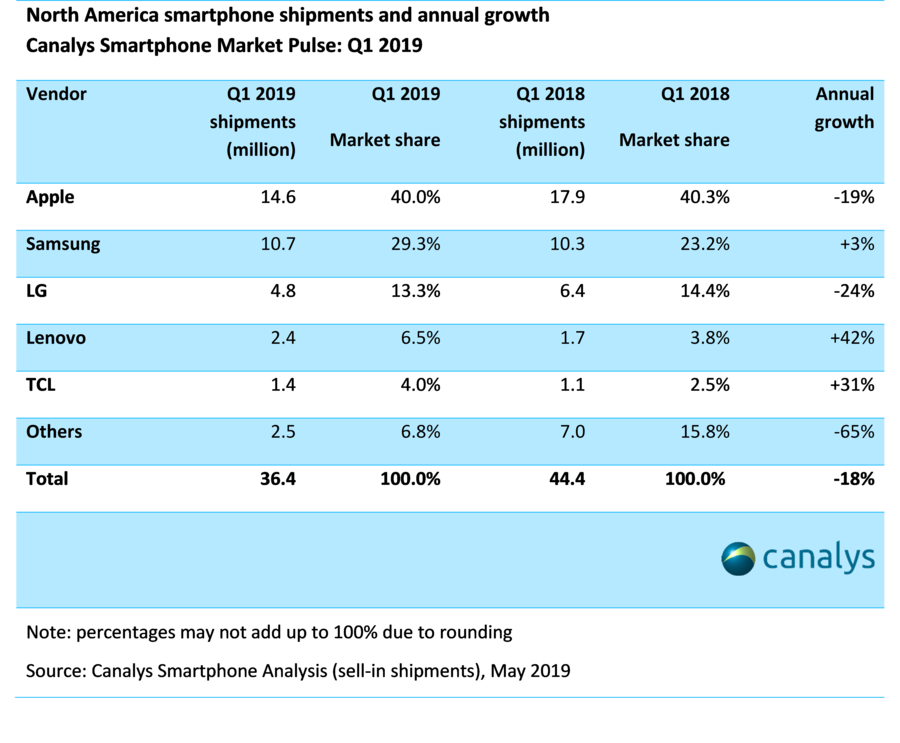
More dismal news from the smartphone number crunchers. New figures out of Canalys put the North American smartphone market at five year low for the first quarter of 2019. That’s…bad. But also, pretty inline with what we’ve been seeing globally. The market has stagnated, and while manufacturers aren’t in full on panic mode, there’s certainly cause for concern.

Shipments dropped from 44.4 million down to 36.4 million, marking an an 18 percent drop year over year for the first quarter. Canalys says it’s the steepest drop it’s recorded for the category, chalking some of the issues up to “a lackluster performance by Apple and the absence of ZTE.”

Apple is still the top of the heap, commanding 40 percent of the North American market with help from the sale of older discounted units. But Samsung managed to to tighten the gap on the back of a successful Galaxy S10 launch. The company grew by three percent for the year, up to 29.3 percent of the market.

LG, Lenovo and TCL rounded out the top five, with the latter two making pretty solid marketshare strides. The remainder of the market took a massive hit, however, with a 65 percent drop off in shipments. Analysts seem confident that 5G imminent arrival will help give the market a boost in coming quarters, but it’s going to be hard for manufacturers to maintain that momentum.

09 May 2019

Clean.io raises $2.5M to fight malicious advertising

Existing approaches to blocking malicious advertising aren’t working — at least according to digital ad veteran Seth Demsey.

That should resonate with anyone who’s ever encountered an ad that immediately redirected them to a website filled with annoying gift card offers. And it’s the issue that the startup Demsey co-founded, clean.io, is working to address.

Today, the company is unveiling the new clean.io name (a rebrand from its old moniker of Clean Creative), and also announcing that it’s raised $2.5 million in seed funding from Real Ventures.

“When you think about what we’re really dealing with, forget media, forget ads — we’re dealing with the beautiful openness of the web,” Demsey said. “That allows you to compose different elements from different people on the page, but that power of composition also opens the door to abuse.”

Hence the aforementioned ads that suddenly overwhelm you with scammy-sounding offers.

Demsey — who worked at Microsoft and Google before spending several years as CTO for TechCrunch-owner AOL’s advertising business — said companies have tried to fight back by scanning website code and by creating blacklists of bad advertisers. But the clean.io team saw that “these things were moving and changing so fast that blacklists were not effective anymore, and that scanning wasn’t effective anymore.”

Instead, Demsey said the company has created “a general purpose system for JavaScript security that allows us to determine what should and should not be allowed to execute in JavaScript.” Put another way, clean.io provides “granular control over who gets to load JavaScript.”

As a simple example, if clean.io detects JavaScript that redirects your browser, it can check to see who’s actually calling for the redirect — if it’s the publisher whose page you’re on, then that’s probably fine. But, Demsey said, if it’s “some random JavaScript CDN,” then clean.io will say, “Let’s block this one.”

CEO Matt Gillis added that clean.io’s approach is particularly tough on the sources of malicious advertising, who he described as “the most sophisticated performance advertisers on the planet.” That’s because the startup’s technology doesn’t simply block the ad. Instead, it runs the ad and blocks the bad JavaScript, which means the advertiser pays for the impression without getting results.

“We make it unprofitable for the bad actors,” Gillis said. “Most of the others who are scanning or URL blocking not really eliminating [the bad behavior], they’re just playing the game of cat and mouse.”

As for why the company changed its name, Demsey suggested that clean.io could eventually apply this technology in areas beyond advertising.

“The name change is to really signify the fact that our ambitions and our technology are broader than merely cleaning up the ad ecosystem,” he said.

09 May 2019

Facebook VR VP Hugo Barra is being replaced

Facebook’s VP of VR product Hugo Barra is out after some leadership changes at the top of the Oculus organization. He’ll be stepping down into a new role leading AR/VR partnerships, while Eric Tseng, Facebook’s director of product management, will be replacing Barra in a new title as head of VR product management.

The leadership structure at Facebook’s virtual reality team has been a bit contentious.

Barra came on in early 2017 after the ouster of Oculus’s existing leadership structure, when then-CEO Brendan Iribe was demoted alongside much of the founding team to lead product-specific verticals. Later that year Oculus founder Palmer Luckey was ousted.

Barra’s role inside CEO Mark Zuckerberg’s inner-circle was soon diminished after longtime executive Andrew Bosworth was placed ahead of him in the org chart leading AR/VR at Facebook in a role that also included other consumer hardware efforts like Portal. Barra’s departure comes as the company prepares to release two of its latest virtual reality products, the Rift S and Quest.

Late last year, Oculus had an internal reorganization that shifted the team to more specialization-focused groups as opposed to product-focused.

It’s unclear what the full scope of Barra’s new role is. Facebook partnered with Xiaomi — where Barra previously led international efforts — to build the Oculus Go and Xiaomi’s Mi VR headset. 

Alongside this news, Facebook noted that longtime content exec Jason Rubin has seen his role expand as well, we’ve asked for more details.

09 May 2019

Netflix acquires kids’ educational content co., StoryBots

Netflix is further investing in its children’s programming ahead of the launch of a highly anticipated rival: Disney+. The company announced today it has acquired StoryBots — a children’s media company and brand created by JibJab’s founders, Gregg and Evan Spiridellis.

The streaming service isn’t disclosing the acquisition price, but CNBC says the price was “immaterial to Netflix,” citing sources.

Netflix doesn’t often make acquisitions, as it prefers to spend directly on content. However, it does rarely buy content companies — as it did with its first acquisition,  indie comic book maker MillarWorld in 2017.

StoryBots’ kids show “Ask the StoryBots” first launched on Netflix in 2016, and features five curious creatures who track down answers to the questions that kids are often curious about — like how night happens, or why we brush our teeth, for example.

Over the years, it has featured several celeb voices to accompany its animated characters, including Snoop Dogg, Edward Norton, Whoopi Goldberg and Wanda Sykes, among others.

Season 3 of the program is launching in the fall on the streaming service.

The Netflix deal will see the Spiridellis brothers producing more StoryBots original programming, including additional series and short-form content.

The larger goal with Netflix is to have its own brand of popular kids’ educational programming – a Sesame Street for the Netflix era, perhaps.

Other streaming services, including HBO NOW and Apple TV+, already have deals with Sesame Workshop, the former which now airs Sesame Street and the latter which will have the muppets teaching kids programming basics.

“Together with Netflix, our goal is to make StoryBots the leading educational entertainment brand for connected kids and families globally. We see this as a once-in-a-lifetime opportunity to bring something epically good into the world,” said Evan and Gregg Spiridellis, in a prepared statement.

09 May 2019

Daily Crunch: Google Play rethinks app ratings

The Daily Crunch is TechCrunch’s roundup of our biggest and most important stories. If you’d like to get this delivered to your inbox every day at around 9am Pacific, you can subscribe here.

1. Google Play is changing how app ratings work

Specifically, Google says it will start giving more weight to reviews that discuss the most recent releases of an app. When this rolls out for consumers in August, it should ideally ensure that ratings better reflect the latest fixes and changes, positive or negative.

“You told us you wanted a rating based on what your app is today, not what it was years ago, and we agree,” said Google’s Milena Nikolic.

2. Sextech company scorned by CES scores $2M and an apology

In January, the Consumer Technology Association nullified the award it had granted Lora DiCarlo (that’s a startup, not a person), which is building a hands-free device that uses biomimicry and robotics to help people achieve a “blended” orgasm. Yesterday, the CTA reversed that decision and apologized.

3. Facebook stops blocking some blockchain ads

Facebook still won’t let you advertise for ICOs or binaries, and ads for cryptocurrencies and exchanges need prior approval. But a year after banning all blockchain-related ads, it’s reopening to “blockchain technology, industry news, education or events related to cryptocurrency.”

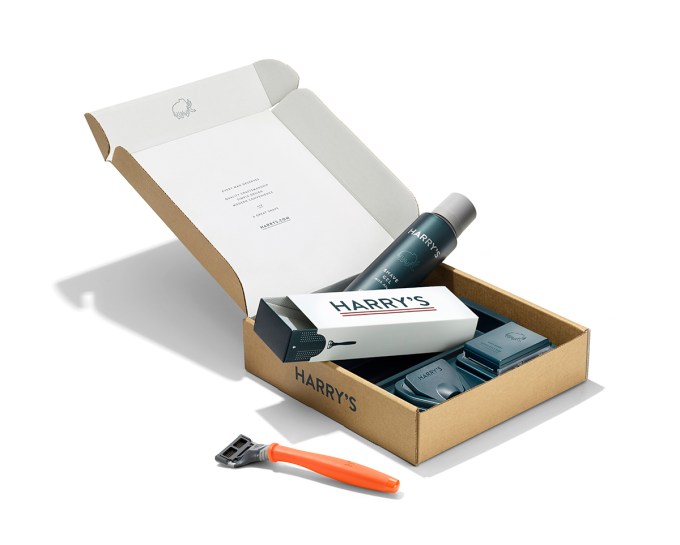
Harrys

4. Razor startup Harry’s will be acquired by Edgewell Personal Care for $1.37B

Consumer giants are taking note of the direct-to-consumer trend, with this deal following Unilever’s acquisition of Dollar Shave Club and Procter & Gamble’s acquisition of Walker & Company.

5. Google and Qualcomm launch a dev kit for building Assistant-enabled headphones

Traditionally, building these headphones involved building a lot of the hardware and software stack — something top-tier manufacturers could afford to do, but it kept second- or third-tier headphone developers from adding voice assistant capabilities to their devices.

6. With new Fit technology, Nike calls itself a tech company

Nike Fit uses a proprietary combination of computer vision, data science, machine learning, artificial intelligence and recommendation algorithms to find your right fit.

7. Keyword research in 2019: Modern tactics for growing targeted search traffic

Detailed.com founder Glen Allsopp highlights some of the most overlooked ideas and sources of data to find words and phrases relevant to your business that are high in intent but lacking in competition. (Extra Crunch membership required.)

09 May 2019

Instagram will block hashtag pages full of vaccine misinfo

Instagram will begin blocking vaccine-related hashtag pages when content surfaced on a hashtag page features a large proportion of verifiably false content about vaccines. If there is some violating content but under that threshold, Instagram will lock a hashtag into a “Top-only” post where Recent posts won’t show up to decrease visibility of problematic content. Instagram says that it will test this approach and expand it to other problemaic content genres if it works.

One other new change announced this week is that Instagram will no longer determine whether to suspend an account based on the percentage of their content that violates policies, but by a tally of total violations within a certain period of time. Otherwise, Newton says “It would disproportionately benefit those that have a large amount of posts” because even a large number of violations would be a smaller percentage than a rare violation by someone who doesn’t post often. Instagram won’t disclose the exact time frame or number of violations that trigger suspensions to prevent bad actors from gaming the system.

Instagram recently announced several new tests on the safety front at F8, including a “nudge” not to post a potentially hateful comment a user has typed, “away mode” for taking a break from Instagram without deleting your account, and a way to “manage interations” so you can ban people from taking certain actions like commenting on your content or DMing you without blocking them entirely.

The announcement comes as Instagram has solidified its central place in youth culture. That means it has intense responsibility to protect its user base from bullying, hate speech, graphic content, drugs, misinformation, and extremism. “We work really closely with subject matter experts, raise issues that might be playing out differently on Instagram than Facebook, and we identify gaps where we need to change how our policies are operationalized or our policies are changed” says Instagram’s head of public policy Karina Newton.

09 May 2019

Docpack offers a simple, enterprise-friendly way to share documents

Docpack is offering businesses a simple way to share their documents — particularly with customers at large enterprises that may block services like Dropbox or Google Drive.

Founder and CEO Rurik Bradbury said he encountered this issue while serving as the head of conversational strategy at LivePerson (he’s also been as an executive and/or co-founder at Trustev and Unison Technologies, and he oeprates operating the beloved Prof Jeff Jarviss parody account). Many of the largest companies that LivePerson was working with just wouldn’t accept file-sharing links, so “we had to print out things and FedEx things” — and in at least one case, ship Android tablets pre-loaded with documents.

Apparently this is a broader issue, with research suggesting that services like Box, Dropbox and Google Drive remain among the most blacklisted apps by enterprise IT departments.

In particular, Bradbury said companies are worried about “full, two-way file sharing,” so he found a way around it by “building these microsites for each company,” where someone could download documents. From the IT perspective, they just regular websites, with no capabilities for employees to share documents back, so they stayed off the blacklists.

The problem with microsites, however, is that they’re “not scalable.” So with Docpack, Bradbury aims to make it quick and easy to create them for a wide range of clients. He compared his approach to website builders like Wix and Squarespace, “Where you can make a website even if you’re not technical.”

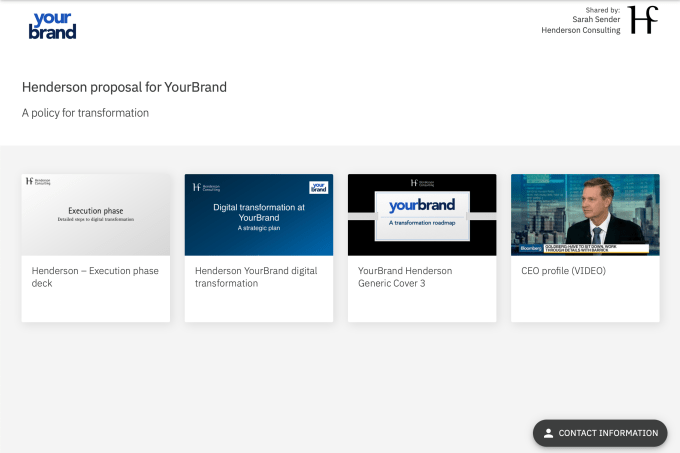
Docpack Screenshot

Similarly, it should only take Docpack users a few clicks to create a new microsite, add customized branding and upload documents. These documents can be protected with security that limits access to users with a specific company email domain, and the publisher can also track which documents are actually getting downloaded.

Docpack has raised less than $500,000 in funding from Asian accelerator Zeroth, Trustev founder Pat Phelan and other individuals.

The startup’s standard plan costs $10 per seat. Bradbury suggested that the service could be useful across sales, business development and marketing: “There’s a huge amount of business transacted via document-sharing.” He also suggested that PR professionals and journalists could use it to share documents, and he’s offering free accounts for credentialed journalists.

As for competition from the big file-sharing services, Bradbury suggested that as they try to accommodate enterprise needs, they’re creating “a product that’s stretched out, that was not really designed at all for cross-company sharing.”

“This is a big enough space … that it deserves its own thing,” he added.

09 May 2019

Jeff Bezos reportedly set to unveil moon plans today

Blue Origin is hosting a media later today in Washington, D.C. TechCrunch will be on the ground, reporting live, though details around precisely what will be announced are still pretty minimal. According to new reporting from Reuters, however, boss man Jeff Bezos is set to unveil his plans to help the U.S. government establish a lunar outpost over the next five years.

That word arrives via “people familiar with the matter.” Blue Origin hasn’t responded yet — though we’ve only got to wait until around 4PM ET time to find out what the company will reveal via its “update on our progress and share our vision of going to space to benefit Earth.”

The subject is nothing new for Bezos and Blue Origin, of course. This time last year, the world’s richest man discussed his hopes for space travel. “In the not-too-distant future — I’m talking decades, maybe 100 years,” he told a crowd at the Space Development Conference in L.A., “it’ll start to be easier to do a lot of the things that we currently do on Earth in space, because we’ll have so much energy. We will have to leave this planet. We’re going to leave it, and it’s going to make this planet better.”

As Reuters notes, VP Mike Pence recently discussed the White House’s own hopes for an astronaut lunar outpost being established by 2024. He singled out NASA, but even with an on-going war of words between Trump and Bezos, it seems likely what the cabinet would be open to working with private space organizations like Blue Origin.

09 May 2019

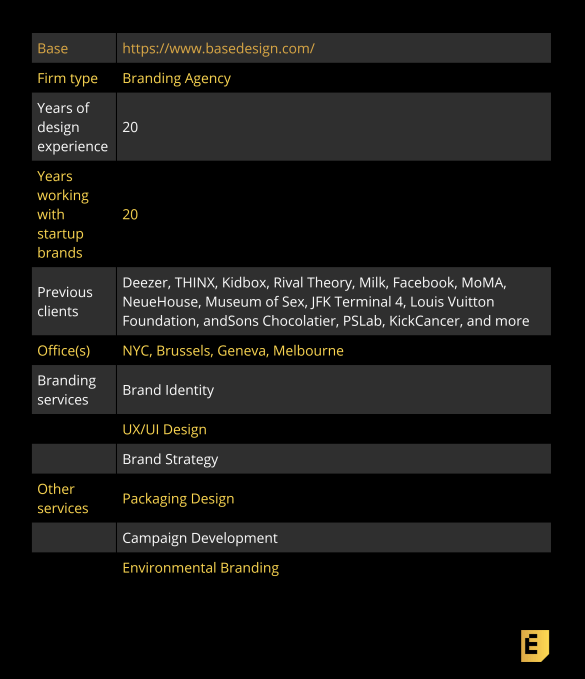
Verified Expert Brand Designer: Base

Base coined the term “blanding,” but the international branding agency is anything but boring. With clients ranging from AI startup Rival Theory to e-commerce company Kidbox, Base leverages its broad portfolio of clients and designers from all around the world to help startups develop their individual personas. As they celebrate their 20th anniversary this year, we talked to Base Partner Geoff Cook about how the agency continues to evolve.

On Base’s culture:

“Base strives to have a profound cultural impact. Yes, we do strategy, and yes, we do identity, and all sorts of brand executions, but the end goal is to have a significant cultural impact for our clients. The end goal isn’t the product, it’s the result.”

“As one of our longest-standing mentors at Techstars in New York, Base partner Geoff Cook (with Base as back up) has helped to brand several of our portfolio companies and provided counsel to hundreds more.” Jenny Fielding, NYC, Managing Director, Techstars

On common founder mistakes:

“This may sound provocative, but I think the most common mistake is that there is a belief in the tech world that branding should be approached iteratively like their approach to product development. Having now been through that process of iteration with both startups and the largest tech companies, we’ve found that the results are often compromised. Oftentimes if you iterate or have different groups weighing in throughout the process, it can be detrimental to the end result. It’s a conversation we’re now having with founders to say, “We’ve tried both ways, we’ve seen these results, and we would ask that you go along for the ride and put your trust in us, and we’ll ensure that you will arrive someplace really compelling.”

Below, you’ll find the rest of the founder reviews, the full interview, and more details like pricing and fee structures. This profile is part of our ongoing series covering startup brand designers and agencies with whom founders love to work, based on this survey and our own research. The survey is open indefinitely, so please fill it out if you haven’t already.


Interview with Base Partner Geoff Cook

Yvonne Leow: To kick things off, could you tell me about your backstory? How did you get into branding?

Geoff Cook: I actually came from DKNY, back in its heyday, and met Base’s Belgian partners through the world of fashion. I always joke that I wanted out of fashion and they wanted out of Brussels. So I invested in Base and brought it to New York City in 1999. My background is in marketing and strategy. When I was leading the International Menswear division at DKNY, I started realizing that I always had the most fun working with our internal branding group. So, when I left, I knew I wanted to pivot and go more in that direction. I think what appealed to me was the combination of creativity and the massive impact branding could have on the world. The intersection of those two things really drew me in.

09 May 2019

Facebook co-founder, Chris Hughes, calls for Facebook to be broken up

The latest call to break up Facebook looks to be the most uncomfortably close to home yet for supreme leader, Mark Zuckerberg.

“Mark’s power is unprecedented and un-American,” writes Chris Hughes, in an explosive op-ed published in the New York Times. “It is time to break up Facebook.”

It’s a long read but worth indulging for a well articulated argument against the market-denting power of monopolies, shot through with a smattering of personal anecdotes about Hughes’ experience of Zuckerberg — who he at one point almost paints as ‘only human’, before shoulder-dropping into a straight thumbs-down that “it’s his very humanity that makes his unchecked power so problematic.”

The tl;dr of Hughes’ argument against Facebook/Zuckerberg being allowed to continue its/his reign of the Internet knits together different strands of the techlash zeitgeist, linking Zuckerberg’s absolute influence over Facebook — and therefore over the unprecedented billions of people he can reach and behaviourally reprogram via content-sorting algorithms — to the crushing of innovation and startup competition; the crushing of consumer attention, choice and privacy, all hostage to relentless growth targets and an eyeball-demanding ad business model; to the crushing control of speech that Zuckerberg — as Facebook’s absolute monarch — personally commands, with Hughes worrying it’s a power too potent for any one human to wield.

“Mark may never have a boss, but he needs to have some check on his power,” he writes. “The American government needs to do two things: break up Facebook’s monopoly and regulate the company to make it more accountable to the American people.”

His proposed solution is not just a break up of Facebook’s monopoly of online attention by re-separating Facebook, Instagram and WhatsApp — to try to reinvigorate a social arena it now inescapably owns — he also calls for US policymakers to step up to the plate and regulate, suggesting an oversight agency is also essential to hold Internet companies to account, and pointing to Europe’s recently toughened privacy framework, GDPR, as a start.

“Just breaking up Facebook is not enough. We need a new agency, empowered by Congress to regulate tech companies. Its first mandate should be to protect privacy,” he writes. “A landmark privacy bill in the United States should specify exactly what control Americans have over their digital information, require clearer disclosure to users and provide enough flexibility to the agency to exercise effective oversight over time. The agency should also be charged with guaranteeing basic interoperability across platforms.”

Once an equally fresh faced co-founder of Facebook alongside his Harvard roommate, Hughes left Facebook in 2007, walking away with what would become eye-watering wealth writing later that he made half a billion dollars for three years’ work, off of the back of Facebook’s 2012 IPO.

It’s harder to put a value on the relief Hughes must also feel, having exited the scandal-hit behemoth so early on — getting out before early missteps hardened into a cynical parade of privacy, security and trust failures that slowly, gradually yet inexorably snowballed into world-wide scandal — with the 2016 revelations about the extent of Kremlin-backed political disinformation lighting up the dark underbelly of Facebook ads.

Soon after, the Cambridge Analytica data misuse scandal shone an equally dim light into similarly murky goings on Facebook’s developer platform. Some of which appeared to hit even closer to home. (Facebook had its own staff helping to target those political ads, and hired the co-founder of the company that had silently sucked out user data in order to sell manipulative political propaganda services to Cambridge Analytica.) 

It’s clear now that Facebook’s privacy, security and trust failures are no accident; but rather chain-linked to Zuckerberg’s leadership; to his strategy of neverending sprint for relentless, bottomless growth — via what was once literally a stated policy of “domination”. 

Hughes, meanwhile, dropped out — coming away from Facebook a very rich man and, if not entirely guilt-free given his own founding role in the saga, certainly lacking Zuckerberg-levels of indelible taint.

Though we can still wonder where his well-articulated concern, about how Facebook’s monopoly grip on markets and attention is massively and horribly denting the human universe, has been channelled prior to publishing this NYT op-ed — i.e. before rising alarm over Facebook’s impact on societies, democracies, human rights and people’s mental health scaled so disfiguringly into mainstream view.

Does he, perhaps, regret not penning a critical op-ed before Roger McNamee, an early Zuckerberg advisor with a far less substantial role in the whole drama, got his twenty-cents in earlier this year — publishing a critical book, Zucked, which recounts his experience trying and failing to get Zuckerberg to turn the tanker and chart a less collaterally damaging course.

It’s certainly curious it’s taken Hughes so long to come out of the woodwork and join the big techlash.

The NYT review of Zucked headlined it as an “anti-Facebook manifesto” — a descriptor that could apply equally to Hughes’ op-ed. And in an interview with TC back in February, McNamee — whose more limited connection to Zuckerberg Facebook has sought to dismiss — said of speaking out: “I may be the wrong messenger, but I don’t see a lot of other volunteers at the moment.”

Facebook certainly won’t be able to be so dismissive of Hughes’ critique, as a fellow co-founder. This is one Zuckerberg gut-punch that will both hurt and be harder to dodge. (We’ve asked Facebook if it has a response and will update if so.)

At the same time, hating on Facebook and Zuckerberg is almost fashionable these days — as the company’s consumer- and market-bending power has flipped its fortunes from winning friends and influencing people to turning frenemies into out-and-out haters and politically charged enemies.

Whether it’s former mentors, former colleagues — and now of course politicians and policymakers leading the charge and calling for the company to be broken up.

Seen from that angle, it’s a shame Hughes waited so long to add his two cents. It does risk him being labelled an opportunist — or, dare we say it, a techlash populist. (Some of us have been banging on about Facebook’s intrusive influence for years, so, er, welcome to the club Chris!) 

Though, equally, he may have been trying to protect his historical friendship with Zuckerberg. (The op-ed begins with Hughes talking about the last time he saw Zuckerberg, in summer 2017, which it’s hard not to read as him tacitly acknowledging there likely won’t be any more personal visits after this bombshell.)

Hughes is also not alone in feeling he needs to bide his time to come out against Zuckerberg.

The WhatsApp founders, who jumped the Facebook mothership last year, kept their heads down and their mouths shut for years, despite a product philosophy that boiled down to ‘fuck ads’ — only finally making their lack of love for their former employer’s ad-fuelled privacy incursions into WhatsApp clear post-exit from the belly of the beast — in their own subtle and not so subtle ways.

In their case they appear to have been mostly waiting for enough shares to vest. (Brian Acton did leave a bunch on the table.) But Hughes has been sitting on his money mountain for years.

Still, at least we finally have his critical — and rarer — account to add to the pile; A Facebook co-founder, who had remained close to Zuckerberg’s orbit, finally reaching for the unfriend button.