Category: UNCATEGORIZED

03 May 2019

‘The Key’, a VR story about dreams and refugees, wins Storyscapes prize at Tribeca

“The Key,” a surreal story with a real-world political message, has won the Storyscapes award at this year’s Tribeca Film Festival

That’s the festival’s juried award for immersive art. It comes with a $10,000 cash prize, which the creators say will be donated to the Friends of Refugees organizations.

I actually had a chance to experience “The Key” for myself last week, and it’s a unique story, starting with an exploration of the nameless narrator’s dreams, before connecting to an explicit message about the plight of refugees. The core experience takes place in virtual reality, through an Oculus headset, but participants begin by entering a room-size installation and interacting with a live actor.

I’m being a bit vague about the story to preserve some of the surprise for New Yorkers who might still get a chance to try out “The Key” at the Tribeca Virtual Arcade (which is open until tomorrow, May 4).

And for those of you who won’t get that chance, director Celine Tricart said in a statement that “this award will help us find venues to showcase The Key around the United States and abroad, delivering this important message to the public.”

“The Key” is narrated by Alia Shawkat, and was produced by Gloria Bradbury and Lucid Dreams Productions, in partnership with the Oculus VR for Good Creators Lab and Friends of Refugees. It made its world premiere at Tribeca.

03 May 2019

How Amazon’s HQ2 could disrupt government IT, for the worse

When Amazon entered markets like bookselling or groceries, its competition proved highly disruptive to incumbents. In November 2018, Amazon declared that it had selected northern Virginia as one of two locations for its new second headquarters, and four months later it announced that HQ2 would only proceed in the Virginia site. The Seattle company has grandly entered yet another market, that for science, technology, engineering, and math (STEM) talent in the metro Washington, D.C., area.

There, Amazon’s insatiable hunger for customers will turn into a voracious appetite for up to 50,000 highly paid new employees. One other employer is particularly ill-suited to compete: the federal government, with its centenary history alternating world-changing innovation and unbelievable stodginess, could emerge shriveled and unable to fulfill its mission. Such an outcome could have dramatic consequences for the nation’s security and public services for years to come.

HQ2 has the potential to drain tech talent away from the public sector, leaving federal, state, and local agencies unable to address all of today’s challenges. From protecting critical infrastructure from hostile hackers to providing driver’s licenses and business permits, all the way to managing regulations large and small, we all rely on the work done in the often-drab halls of government.

So, what can we expect in the competition for people between one of the world’s largest bureaucracies and one of the most dynamic companies?

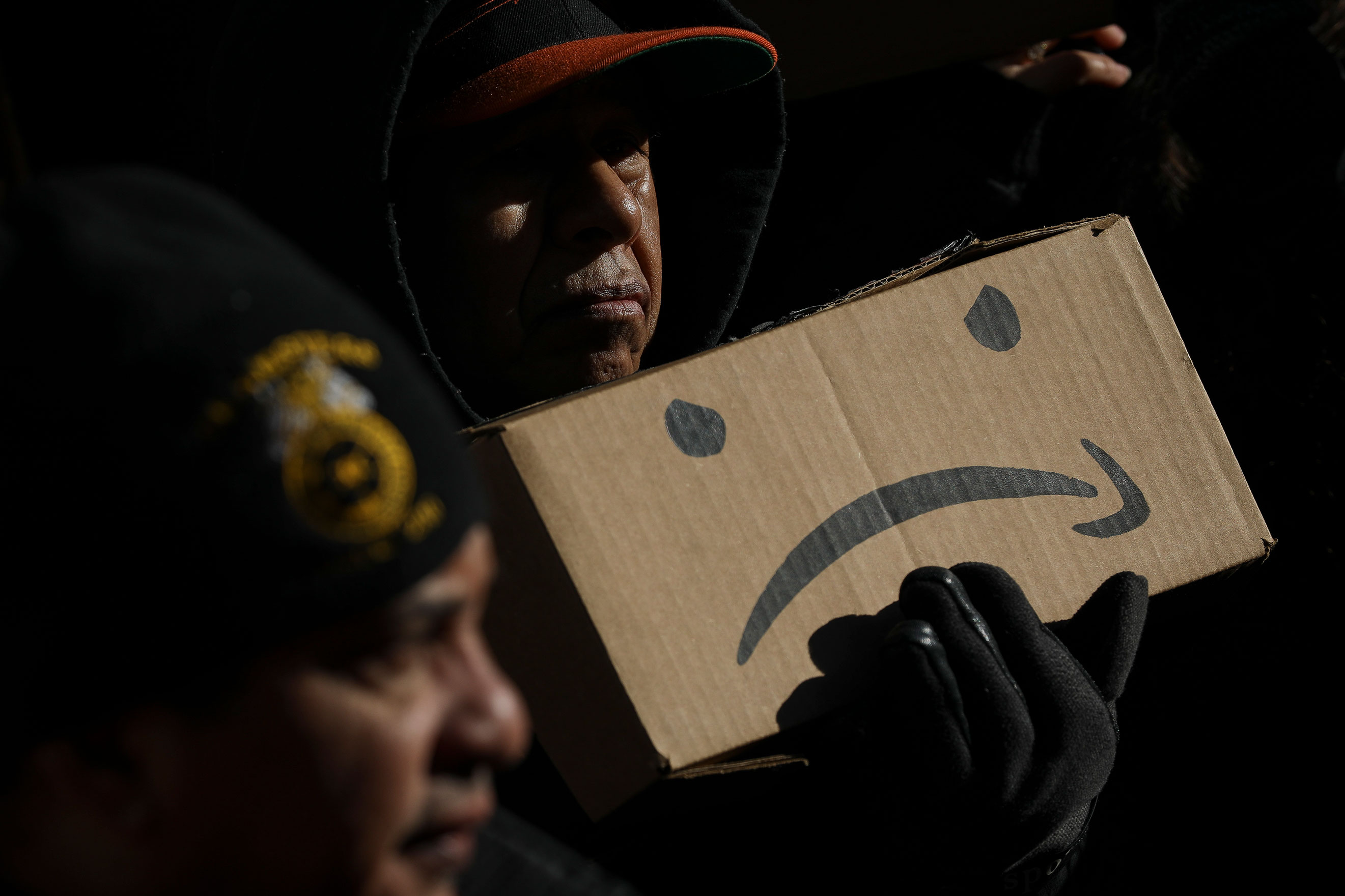
Anti-Amazon Protestors Rally At NYC City Hall Against Queens Second Headquarters

(Photo by Drew Angerer/Getty Images)

Playing catch-up

Today, competition for developers, data scientists, designers, and other skilled roles is intense. As government departments struggle to match the salaries, perks, and professional opportunities that the private sector offers, they cannot hire the in-house staff that they need to develop and run modern websites and applications, perform cutting-edge analytics, and maintain secure systems. Amazon did not create this problem, but it may worsen it.

I’ve experienced this personally from my vantage point in the innovation-oriented Massachusetts Digital Service, which sits within the state’s Executive Office of Technology Services and Security. As our team consists of between 40 and 50 people, each additional candidate or colleague gained or lost makes a large difference to our ability to accomplish our objectives. Despite the growth of civic tech, a combination of organizational and resource factors often leaves us and the agencies we work with to play catch-up with competing employers in the greater Boston area.

What I’ve witnessed at a small scale is likely to play out with HQ2. First, the federal tech workforce is large, and accounts for a large portion of the D.C. area’s pool of STEM workers. According to Office of Personnel Management data for the executive branch, 47,000 civilian federal employees worked in occupations like computer engineering, statistics, cryptanalysis, and information technology management in the Washington, D.C., Maryland, and Virginia region in March 2018. (OPM’s database does not include the military and intelligence community, so the actual total is higher.)  Depending on how you cut data on private-sector employment, the federal government accounts for roughly one in eight STEM workers in greater D.C.

Second, the federal tech workforce skews older, and is compensated significantly less than its private-sector equivalent. The OPM data shows that only 13 percent of tech employees are younger than 35; half are 50 or older. Salaries for employees under 35 averaged $91,000; those 35 and over, $127,000. By comparison, Amazon announced that its new staff will have an average wage of $150,000.

These figures suggest that the federal workforce is simultaneously a potential recruiting source because of its size, precarious because of its age, and vulnerable because of its less-than-competitive salaries. These dynamics are accentuated by the skills gap in federal IT, which already leads agencies to struggle to compete with existing players, like defense contractors. The most recent government shutdown further deepened the doubts that highly skilled staff harbor towards working in a public sector that can’t even offer job security.

Image via Getty Images / Gary Waters

HQ2 comes to Washington

Amazon can hire from three main sources of labor: graduating students, professionals willing to move to D.C., and existing tech workers. This last category has the most limited supply in the short run. Because Amazon needs to hire so many new people, it will necessarily need to adopt an “all of the above” recruiting strategy. However, given the immediate constraints on the availability of graduates or people who relocate, Amazon will have to start from workers who are already in the region, like those in the federal workforce.

This suggests a first outcome, where Amazon hires most of its new staff from STEM professionals who already work in the greater D.C. area. The increased competition for tech talent would attract many government employees from across federal, state, and local agencies.

The magnitude of the existing skills gap bodes poorly for this scenario. Ironically, public-sector tech staff might not have the competence levels that Amazon demands. In that case, though the exodus might be smaller in scale it would still deplete the government’s ranks of top STEM employees.

These effects would spill over to the private sector, as increased competition won’t stop at government employees. Federal contractors and consultants would feel pressure to raise salaries to avert losing staff to Amazon. In turn, these cost increases would be passed on to government — that is, to taxpayers.

An alternative scenario would see Amazon rely more heavily on talent from outside the Beltway, perhaps enabled by generous relocation packages or a more patient recruiting strategy. By attracting candidates from other locations, the Seattle firm would bring new dynamism and ways of thinking. At the same time, local universities would do well to expand their STEM programs to meet the increased demand for graduates in those fields. (More residents would also increase pressure on housing prices and infrastructure, causing second-order repercussions that have already been described elsewhere.)

This enriched regional STEM ecosystem could benefit the public sector. Amazon employees might join the local civic tech community, and some might even go for “tours of duty” at local, state, or federal agencies. Programs like the U.S. Digital Service or the Presidential Innovation Fellows could flourish. Other initiatives — like TechCongress, which places technologists in congressional staffs — would benefit other branches of government. In this ideal scenario, Amazonians’ desire to “give back” or to switch to workplaces with a different pace would also percolate outside of the federal government, as state and local agencies are just as in need of skilled tech staff.

Beyond working in government directly, Amazon staff might found companies to tackle public issues in innovative ways, invigorating the pool of vendors that the public sector can call upon. Ultimately, these multiple pathways would allow the enlarged STEM community in the greater D.C. region to diffuse knowledge and best practices.

Amazon Buys Whole Foods For Over 13 Billion

(Photo by David Ryder/Getty Images)

Playing the long game

It’s difficult to forecast how these dynamics might play out. Amazon has been vague about its hiring strategy, and unpredictable factors — the resurrection of the New York City location, a new presidential administration — have the potential to sway the outcomes. Looking ahead, however, the immediate inelasticity of the regional tech workforce makes the first outcome more plausible in the short run. Over the longer term, the talent pool will expand, benefiting both new entrants like Amazon and incumbents in the private and public sectors alike.

This will force government to confront Amazon’s competition for tech talent in the next few years. Unfortunately, its capacity to respond is limited: levers like salaries and professional development are fixed by laws, regulations, and norms. Some key barriers to recruiting and retaining the right talent that the public sector might improve more quickly include accelerating the time it takes to hire candidates, creating modern job titles, and providing predictable promotion ladders. However, with little ability to adapt rapidly, government agencies should instead focus on making the most of the long-run growth in the region’s STEM population.

In my own microcosm in Massachusetts, I work daily with people who strive to improve the way government uses technology. We fight against legacy systems and mindsets, and are proud of our victories. But it is a fragile ecosystem, and a large-enough shock — such as a talent-hungry company setting up a big campus nearby — could tip us over the edge.

The public sector depends on internal capabilities to solve digital challenges, from delivering public services to securing its systems and infrastructure against malicious actors. The federal government needs talented professionals to manage and deliver the $80 billion dollars it spends annually on IT, lest it fall even further behind the private sector in its technologies and practices. The same applies to state and local agencies.

Amazon’s hunger for growth is coming for government STEM workers. This challenge matters to everyone — the entrepreneur applying for a business permit, the parent renewing their driver’s license, the veteran accessing medical services. We can’t afford to take it lightly.

03 May 2019

Daily Crunch: Facebook bans far-right figures

The Daily Crunch is TechCrunch’s roundup of our biggest and most important stories. If you’d like to get this delivered to your inbox every day at around 9am Pacific, you can subscribe here.

1. Facebook bans a fresh batch of mostly far-right figures

The banned figures include Milo Yiannopoulos, Paul Joseph Watson, Laura Loomer, Paul Nehlen and Louis Farrakhan — plus, Facebook doubled down on banning Alex Jones.

The company said this is part of its policy to ban “individuals or organizations who promote or engage in violence and hate, regardless of ideology.”

2. Microsoft makes a push to simplify machine learning

Ahead of its Build conference, Microsoft today released a slew of new machine learning products and tweaks to some of its existing services. These range from no-code tools to hosted notebooks, with a number of new APIs and other services in-between.

3. YouTube confirms plans to make Originals available for free

Since last fall, YouTube has acknowledged that it’s moving toward an ad-supported model for its Originals. Last night, its chief business officer said all original programming moving forward will have a free window.

4. Why you don’t want Tumblr sold to exploitative Pornhub

The Wall Street Journal reports that TechCrunch parent company Verizon is considering selling Tumblr, and Pornhub VP Corey Price told BuzzFeed, “We’re extremely interested in acquiring the platform.”

5. Spotify spotted testing ‘Your Daily Drive,’ a personalized playlist that includes podcasts

This is the first Spotify playlist to mix music and podcasts, customized to users’ tastes.

6. Sonic the Hedgehog director says character is getting makeover after backlash

After the release of the film’s trailer, director Jeff Fowler tweeted, “The message is loud and clear… you aren’t happy with the design & you want changes. It’s going to happen.”

7. 3 key secrets to building extraordinary teams

For one thing, hire people before skills, because scrappiness and cultural fit matter more than intelligence and experience. (Extra Crunch membership required.)

03 May 2019

When it comes to elections, Facebook moves slow, may still break things

This week, Facebook invited a small group of journalists — which didn’t include TechCrunch — to look at the “war room” it has set up in Dublin, Ireland, to help monitor its products for election-related content that violates its policies. (“Time and space constraints” limited the numbers, a spokesperson told us when he asked why we weren’t invited.)

Facebook announced it would be setting up this Dublin hub — which will bring together data scientists, researchers, legal and community team members, and others in the organization to tackle issues like fake news, hate speech and voter suppression — back in January. The company has said it has nearly 40 teams working on elections across its family of apps, without breaking out the number of staff it has dedicated to countering political disinformation. 

We have been told that there would be “no news items” during the closed tour — which, despite that, is “under embargo” until Sunday — beyond what Facebook and its executives discussed last Friday in a press conference about its European election preparations.

The tour looks to be a direct copy-paste of the one Facebook held to show off its US election “war room” last year, which it did invite us on. (In that case it was forced to claim it had not disbanded the room soon after heavily PR’ing its existence — saying the monitoring hub would be used again for future elections.)

We understand — via a non-Facebook source — that several broadcast journalists were among the invites to its Dublin “war room”. So expect to see a few gauzy inside views at the end of the weekend, as Facebook’s PR machine spins up a gear ahead of the vote to elect the next European Parliament later this month.

It’s clearly hoping shots of serious-looking Facebook employees crowded around banks of monitors will play well on camera and help influence public opinion that it’s delivering an even social media playing field for the EU parliament election. The European Commission is also keeping a close watch on how platforms handle political disinformation before a key vote.

But with the pan-EU elections set to start May 23, and a general election already held in Spain last month, we believe the lack of new developments to secure EU elections is very much to the company’s discredit.

The EU parliament elections are now a mere three weeks away, and there are a lot of unresolved questions and issues Facebook has yet to address. Yet we’re told the attending journalists were once again not allowed to put any questions to the fresh-faced Facebook employees staffing the “war room”.

Ahead of the looming batch of Sunday evening ‘war room tour’ news reports, which Facebook will be hoping contain its “five pillars of countering disinformation” talking points, we’ve compiled a run down of some key concerns and complications flowing from the company’s still highly centralized oversight of political campaigning on its platform — even as it seeks to gloss over how much dubious stuff keeps falling through the cracks.

Worthwhile counterpoints to another highly managed Facebook “election security” PR tour.

No overview of political ads in most EU markets

Since political disinformation created an existential nightmare for Facebook’s ad business with the revelations of Kremlin-backed propaganda targeting the 2016 US presidential election, the company has vowed to deliver transparency — via the launch of a searchable political ad archive for ads running across its products.

The Facebook Ad Library now shines a narrow beam of light into the murky world of political advertising. Before this, each Facebook user could only see the propaganda targeted specifically at them. Now, such ads stick around in its searchable repository for seven years. This is a major step up on total obscurity. (Obscurity that Facebook isn’t wholly keen to lift the lid on, we should add; Its political data releases to researchers so far haven’t gone back before 2017.)

However, in its current form, in the vast majority of markets, the Ad Library makes the user do all the leg work — running searches manually to try to understand and quantify how Facebook’s platform is being used to spread political messages intended to influence voters.

Facebook does also offer an Ad Library Report — a downloadable weekly summary of ads viewed and highest spending advertisers. But it only offers this in four countries globally right now: the US, India, Israel and the UK.

It has said it intends to ship an update to the reports in mid-May. But it’s not clear whether that will make them available in every EU country. (Mid-May would also be pretty late for elections that start May 23.)

So while the UK report makes clear that the new ‘Brexit Party’ is now a leading spender ahead of the EU election, what about the other 27 members of the bloc? Don’t they deserve an overview too?

A spokesperson we talked to about this week’s closed briefing said Facebook had no updates on expanding Ad Library Reports to more countries, in Europe or otherwise.

So, as it stands, the vast majority of EU citizens are missing out on meaningful reports that could help them understand which political advertisers are trying to reach them and how much they’re spending.

Which brings us to…

Facebook’s Ad Archive API is far too limited

In another positive step Facebook has launched an API for the ad archive that developers and researchers can use to query the data. However, as we reported earlier this week, many respected researchers have voiced disappointed with what it’s offering so far — saying the rate-limited API is not nearly open or accessible enough to get a complete picture of all ads running on its platform.

Following this criticism, Facebook’s director of product, Rob Leathern, tweeted a response, saying the API would improve. “With a new undertaking, we’re committed to feedback & want to improve in a privacy-safe way,” he wrote.

The question is when will researchers have a fit-for-purpose tool to understand how political propaganda is flowing over Facebook’s platform? Apparently not in time for the EU elections, either: We asked about this on Thursday and were pointed to Leathern’s tweets as the only update.

This issue is compounded by Facebook also restricting the ability of political transparency campaigners — such as the UK group WhoTargetsMe and US investigative journalism site ProPublica — to monitor ads via browser plug-ins, as the Guardian reported in January.

The net effect is that Facebook is making life hard for civil society groups and public interest researchers to study the flow of political messaging on its platform to try to quantify democratic impacts, and offering only a highly managed level of access to ad data that falls far short of the “political ads transparency” Facebook’s PR has been loudly trumpeting since 2017.

Ad loopholes remain ripe for exploiting

Facebook’s Ad Library includes data on political ads that were active on its platform but subsequently got pulled (made “inactive” in its parlance) because they broke its disclosure rules.

There are multiple examples of inactive ads for the Spanish far right party Vox visible in Facebook’s Ad Library that were pulled for running without the required disclaimer label, for example.

“After the ad started running, we determined that the ad was related to politics and issues of national importance and required the label. The ad was taken down,” runs the standard explainer Facebook offers if you click on the little ‘i’ next to an observation that “this ad ran without a disclaimer”.
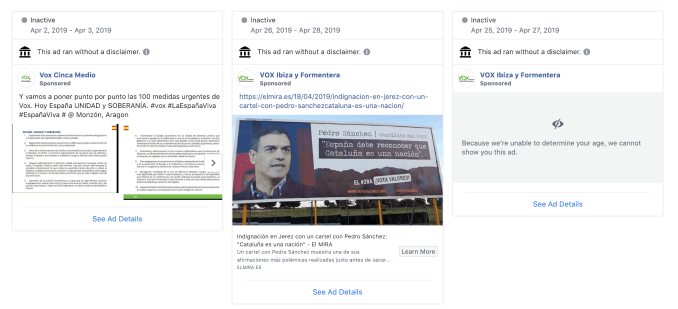
What is not at all clear is how quickly Facebook acted to removed rule-breaking political ads.

It is possible to click on each individual ad to get some additional details. Here Facebook provides a per ad breakdown of impressions; genders, ages, and regional locations of the people who saw the ad; and how much was spent on it.

But all those clicks don’t scale. So it’s not possible to get an overview of how effectively Facebook is handling political ad rule breakers. Unless, well, you literally go in clicking and counting on each and every ad…

There is then also the wider question of whether a political advertiser that is found to be systematically breaking Facebook rules should be allowed to keep running ads on its platform.

Because if Facebook does allow that to happen there’s a pretty obvious (and massive) workaround for its disclosure rules: Bad faith political advertisers could simply keep submitting fresh ads after the last batch got taken down.

We were, for instance, able to find inactive Vox ads taken down for lacking a disclaimer that had still been able to rack up thousands — and even tens of thousands — of impressions in the time they were still active.

Facebook needs to be much clearer about how it handles systematic rule breakers.

Definition of political issue ads is still opaque

Facebook currently requires that all political advertisers in the EU go through its authorization process in the country where ads are being delivered if they relate to the European Parliamentary elections, as a step to try and prevent foreign interference.

This means it asks political advertisers to submit documents and runs technical checks to confirm their identity and location. Though it noted, on last week’s call, that it cannot guarantee this ID system cannot be circumvented. (As it was last year when UK journalists were able to successfully place ads paid for by ‘Cambridge Analytica’.)

One other big potential workaround is the question of what is a political ad? And what is an issue ad?

Facebook says these types of ads on Facebook and Instagram in the EU “must now be clearly labeled, including a paid-for-by disclosure from the advertiser at the top of the ad” — so users can see who is paying for the ads and, if there’s a business or organization behind it, their contact details, plus some disclosure about who, if anyone, saw the ads.

But the big question is how is Facebook defining political and issue ads across Europe?

While political ads might seem fairly easy to categorize — assuming they’re attached to registered political parties and candidates, issues are a whole lot more subjective.

Currently Facebook defines issue ads as those relating to “any national legislative issue of public importance in any place where the ad is being run.” It says it worked with EU barometer, YouGov and other third parties to develop an initial list of key issues — examples for Europe include immigration, civil and social rights, political values, security and foreign policy, the economy and environmental politics — that it will “refine… over time.”

Again specifics on when and how that will be refined are not clear. Yet ads that Facebook does not deem political/issue ads will slip right under its radar. They won’t be included in the Ad Library; they won’t be searchable; but they will be able to influence Facebook users under the perfect cover of its commercial ad platform — as before.

So if any maliciously minded propaganda slips through Facebook’s net, because the company decides it’s a non-political issue, it will once again leave no auditable trace.

In recent years the company has also had a habit of announcing major takedowns of what it badges “fake accounts” ahead of major votes. But again voters have to take it on trust that Facebook is getting those judgement calls right.

Facebook continues to bar pan-EU campaigns

On the flip side of weeding out non-transparent political propaganda and/or political disinformation, Facebook is currently blocking the free flow of legal pan-EU political campaigning on its platform.

This issue first came to light several weeks ago, when it emerged that European officials had written to Nick Clegg (Facebook’s vice president of global affairs) to point out that its current rules — i.e. that require those campaigning via Facebook ads to have a registered office in the country where the ad is running — run counter to the pan-European nature of this particular election.

It means EU institutions are in the strange position of not being able to run Facebook ads for their own pan-EU election everywhere across the region. “This runs counter to the nature of EU institutions. By definition, our constituency is multinational and our target audience are in all EU countries and beyond,” the EU’s most senior civil servants pointed out in a letter to the company last month.

This issue impacts not just EU institutions and organizations advocating for particular policies and candidates across EU borders, but even NGOs wanting to run vanilla “get out the vote” campaigns Europe-wide — leading to a number to accuse Facebook of breaching their electoral rights and freedoms.

Facebook claimed last week that the ball is effectively in the regulators’ court on this issue — saying it’s open to making the changes but has to get their agreement to do so. A spokesperson confirmed to us that there is no update to that situation, either.

Of course the company may be trying to err on the side of caution, to prevent bad actors being able to interfere with the vote across Europe. But at what cost to democratic freedoms?

What about fake news spreading on WhatsApp?

Facebook’s ‘election security’ initiatives have focused on political and/or politically charged ads running across its products. But there’s no shortage of political disinformation flowing unchecked across its platforms as user uploaded ‘content’.

On the Facebook-owned messaging app WhatsApp, which is hugely popular in some European markets, the presence of end-to-end encryption further complicates this issue by providing a cloak for the spread of political propaganda that’s not being regulated by Facebook.

In a recent study of political messages spread via WhatsApp ahead of last month’s general election in Spain, the campaign group Avaaz dubbed it “social media’s dark web” — claiming the app had been “flooded with lies and hate”.

Posts range from fake news about Prime Minister Pedro Sánchez signing a secret deal for Catalan independence to conspiracy theories about migrants receiving big cash payouts, propaganda against gay people and an endless flood of hateful, sexist, racist memes and outright lies,” it wrote. 

Avaaz compiled this snapshot of politically charged messages and memes being shared on Spanish WhatsApp by co-opting 5,833 local members to forward election-related content that they deemed false, misleading or hateful.

It says it received a total of 2,461 submissions — which is of course just a tiny, tiny fraction of the stuff being shared in WhatsApp groups and chats. Which makes this app the elephant in Facebook’s election ‘war room’.

What exactly is a war room anyway?

Facebook has said its Dublin Elections Operation Center — to give it its official title — is “focused on the EU elections”, while also suggesting it will plug into a network of global teams “to better coordinate in real time across regions and with our headquarters in California [and] accelerate our rapid response times to fight bad actors and bad content”.

But we’re concerned Facebook is sending out mixed — and potentially misleading — messages about how its election-focused resources are being allocated.

Our (non-Facebook) source told us the 40-odd staffers in the Dublin hub during the press tour were simultaneously looking at the Indian elections. If that’s the case, it does not sound entirely “focused” on either the EU or India’s elections. 

Facebook’s eponymous platform has 2.375 billion monthly active users globally, with some 384 million MAUs in Europe. That’s more users than in the US (243M MAUs). Though Europe is Facebook’s second-biggest market in terms of revenues after the US. Last quarter, it pulled in $3.65BN in sales for Facebook (versus $7.3BN for the US) out of $15BN overall.

Apart from any kind of moral or legal pressure that Facebook might have for running a more responsible platform when it comes to supporting democratic processes, these numbers underscore the business imperative that it has to get this sorted out in Europe in a better way.

Having a “war room” may sound like a start, but unfortunately Facebook is presenting it as an end in itself. And its foot-dragging on all of the bigger issues that need tackling, in effect, means the war will continue to drag on.


03 May 2019

How tech entrepreneurs think of Universal Basic Income

As tech has grown, policy debates have become an important pastime. Today’s tech industry aspires to replace human drivers with self-driving cars, secretaries with AI assistants, permanent jobs with gigs — and as a result, the human impact of tech has become an everyday conversation.

No other idea is as emblematic of this as Universal Basic Income, a policy that would distribute a monthly sum to every adult regardless of their income or employment status.

The conversation is widespread. Mark Zuckerberg and Elon Musk have said that UBI may be desirable or necessary. Y-Combinator Research and Facebook co-founder Chris Hughes are running basic income studies. Tech-friendly presidential hopefuls Bernie Sanders and Andrew Yang support the issue.

But should the average tech entrepreneur or investor support UBI? The answer is not entirely clear.

The good news is that the tech industry is deeply familiar with risk, which is an important component of arguments for UBI. The bad news: risk isn’t the whole story, and both positive and negative evidence for the policy are currently thin.

Image via H. Armstrong Roberts/ClassicStock/Getty Images

The role of risk

Entrepreneurs understand the risk component of UBI because it’s the same risk they take in starting companies. Many entrepreneurs start with savings or seed funding that reduce their downside risk — and it’s not hard for them to imagine that others lack these resources. A UBI could solve the issue.

“The hypothesis is, [UBI will] fundamentally change people’s lives. They’ll do something different from what they were doing, because they have a continuous stream of basic income they can depend on. They can start small firms, invest in assets that give them better incomes and wealth, and that translates into better health and education for their kids,” summarizes Tavneet Suri, an applied economics professor at MIT who is helping GiveDirectly run a UBI program providing about 75 cents per day to recipients in rural Kenya.

Risk is clearly important in the developing world, but it’s also an increasingly urgent story in the US. Rates of new business formation have, in recent years, fallen below business closings. There’s a correlation between low entrepreneurship and low savings rates: 40 percent of American adults say they can’t cover a $400 emergency expense, according to the Federal Reserve. Starting businesses may simply be too risky for this generation.

In fact, a newly insecure class is already growing in developed countries worldwide. Guy Standing, a professorial research associate at the University of London, calls this class the precariat. “What is distinctive about global capitalism today, and this will continue, is that even many of those currently earning enough to put them into middle-income categories feel insecure, and often live on the edge of unsustainable debt,” Standing wrote to TechCrunch. “What is significant for those interested in promoting entrepreneurial risk-taking is that one can show that the emancipatory value of a basic income is greater than its monetary value, which is the opposite to all other forms of social policy.”

The universality of risk in both rich and poor countries is a positive for UBI proponents, since studies like Suri’s are taking place in the developing world. An argument can easily be made that behaviors like immigrating to a city or going to college may be riskier in developing countries, but also carry risks in the rich world, which aren’t necessarily offset by financial instruments like loans. “I would never have done my Ph.D. if I’d had to pay for it. There’s no probability in any world. I wouldn’t have wanted to take the loans, because what if I don’t get a job?” says Suri.

However, it will take years to answer the question of how UBI interplays with risk. Suri’s study, for instance, includes cohorts who receive an up-front lump sum, a 2-year monthly UBI payout, and a 12-year payout — so the full effects won’t be visible for some time.

Image via Getty Images / iNueng

The effects on workers

Estimating the effects of a UBI on entrepreneurship, immigration or higher education offer clear arguments for risk. But when it’s extended to people who are currently employed and have no obvious need or desire to start their own company, the picture becomes more muddled.

Some hypothesize that a UBI could lead to workers quitting jobs, or the unemployed choosing to stay that way. Wesley Pech, a behavioral economist at Wofford College, frames these possibilities as a tension between two theories of consumer behavior. The income effect and substitution effect respectively predict that people given basic incomes would choose unemployment or choose to continue seeking work. No basic income study has definitively shown that either outweighs the other. “I can’t think of an experiment so well designed that it could serve as a benchmark,” says Pech.

So here, too, UBI needs more study. But for the time being, anecdotal reports praise basic income.

In Germany, which is generally regarded as fairly wealthy and egalitarian, a startup called Mein Grundeinkommen is using crowdfunding to supply a €1,000 monthly income to 316 people, and currently adds about 15 more people each month. Founder Michael Bohmeyer says universality is an important psychological component of basic income.

“When you frame basic income as a poverty distinction instrument, then it feels like welfare money. You’re the one who didn’t make it, the stupid one, and now you get money to fix it,” he told TechCrunch. “Basic income is something else, it’s for everyone and free of conditions.” That leads to different results than welfare. For instance, one older man on welfare — an identical amount to the Mein Grundeinkommen basic income — decided to end his own unemployment by starting an online business after receiving his basic income from Mein Grundeinkommen.

The psychological effects can be huge even for the well-off. “Surprisingly, we’ve found out that the people who thought that they wouldn’t really need it, they had the biggest effects and changes in their lives,” says Bohmeyer.

Image via Getty Images / Mongkol Chuewong

Another of Mein Grundeinkommen’s basic income recipients was unhappy with her family inheritance, a hotel she was expected to run. After starting to receive her stipend, she had the mental space needed to work through her issues, and took the steps necessary to become a good business owner.

“We have a strong idea that when basic income is introduced, people will stop working. This is even what people think before receiving the money. They think, I’ll start a business, I’ll quit my job, and we have a lot of women who say, I’ll quit my marriage to my stupid husband because I’m not dependent on him anymore. All of a sudden, the basic income comes, and you have more possibilities. You’re free to go. Once you can say no, it’s different to say yes,” says Bohmeyer.

These stories reveal a side of UBI that goes beyond risk and basic human behavior: it can also be framed as an argument for basic human dignity, and a world that exists for more than just work. “The people with basic incomes seemed to not be so ego focused anymore, they had an empathetic, wider approach to look at the world,” says Bohmeyer.

“It sounds so silly when I say it, but that’s what I realized. I think we need to find more about this because we have tremendous changes in our society. It’s the ending of the industrial age and beginning of the digital age, and I think this is what we need in our society.”

At the end of the day, though, Mein Grundeinkommen’s stories remain anecdotal, and thus flawed, just like past basic income studies. Bohmeyer is aware of the problem: Mein Grundeinkommen will join the ranks of more rigorous projects by the end of this year, as it works with the German government to begin a multi-year study giving €1,200 monthly to on 100 participants.

And that’s the best policy that anyone in tech can take: wait, watch, and if possible, contribute support to the studies taking place around the world. UBI is too complicated an issue for partisan stands or knee-jerk reactions. And in the future that the tech industry expects and hopes for, it may yet prove to be one of the best policy ideas available.

03 May 2019

Report: Sinclair to buy Disney’s 21 regional sports networks for $10B

TV broadcasting company Sinclair will buy 21st Century Fox’s 21 regional sports networks from Disney for $10 billion, according to a report from The Wall Street Journal. Sinclair was one of several bidding for the sports networks, which had also seen interest from Liberty Media, MLB, and Big 3 Basketball LLC. Sinclair had come out on top thanks to its mostly-cash deal, according to a report last week from Fox Business crediting unknown sources.

The earlier report had also pegged the deal price of $10 billion.

Disney had come to own the regional sports networks by way of its $71.3 billion purchase of Fox, which closed in March. That acquisition gave it more movies, TV and IP including film titles like “The Shape of Water,” “Avatar,” and “Deadpool,” TV shows like “The Simpsons” and “Atlanta,” and majority ownership of Hulu.

The company agreed to sell off the sports networks in order to win government approval for the Fox deal.

Separate from the new deal with Sinclair, Disney sold off the YES Network, the most prominent of the 22 regional sports networks it was looking to unload. The buying group, which included the New York Yankees, Amazon, as well as Sinclair, had agreed to pay $3.5 billion for the network, according to other media reports.

The WSJ confirmed this as well, noting the deal hadn’t been finalized.

The new agreement with Sinclair will see it acquiring other major sports networks, including channels in L.A. and Detroit.

The deal is expected to be announced today.

03 May 2019

Google’s budget Pixel 3a XL pops up at an Ohio Best Buy

The Pixel 3a is arriving next week at Google I/O. That statement felt like all but a given before, and now that’s the handset is showing up at Ohio-area Best Buys, well, you can pretty much bank on it at this point.

Google’s budget take on its Pixel flagship is expected to take the stage during the May 7 keynote at Mountain View. Meantime, we’ve got another pretty good look at the thing courtesy of an Android Police reader who spotted boxes at a Springfield store.

The shots confirm Google’s strict adherence to silly color naming conventions, with the appearance of “Purple-ish” alongside “Just Black.” The former is a new color and looks to be about as subtle as you can get with a purple piece of electronics. Other side-of-the-box specs confirm what we’ve seen so far, including a 6-inch display on the XL version, coupled with 64GB of storage.

The handsets arrive just six or so months after the release of the Pixel 3. The company addressed the flagship device’s poor sales on this week’s earnings call, noting, among other things, that it had some hardware planned for I/O, marking a break from past years. It will be interesting to see how Google positions the product, as it continues to make software, AI and ML the focus of upgrades over hardware specs.

More info on what to expect next week in Mountain View can be found here.

03 May 2019

Tesla bumps its capital raise up by $400 million, with Elon Musk taking an additional $15 million

Tesla is going to raise an additional $400 million in its latest sale of stock, with co-founder and chief executive Elon Musk committing to buy an additional $15 million in shares, according to a filing with the Securities and Exchange Commission.

The electric vehicle, energy storage and solar panel manufacturer said it will sell 3.1 million shares at $243 per share. The underwriters are jointly underwritten by Goldman Sachs and Citigroup . At the same time, the company said it would boost its convertible note offering by another $100 million.

Initially Tesla was going to sell $2.3 billion in stock and warrants, but the new totals boost that number to $2.7 billion, with Elon Musk upping the ante of his own purchase as part of the revised deal.

The company said that Musk would boost his purchase from $10 million to $25 million as part of the sale of stock.

News of the increased share sale, revised just one day after Tesla announced that it would turn to capital markets to raise more cash, comes despite its report of a rocky first quarter, just one week ago.

Zachary Kirkhorn even called it “one of the most complicated quarters” in Tesla’s history.

Tesla lost $702 million in the first quarter of the year, but its challenges and cash constraints haven’t dimmed investor appetite for shares in the stock.


03 May 2019

CBS says streaming services & Super Bowl helped it achieve record revenues in Q1

CBS credited its direct-to-consumer streaming services in helping it achieve double-digit revenue growth and  record quarterly revenues in Q1, along with the gains that came from hosting Super Bowl LIII and those from affiliate revenue. The network said its over-the-top service for cord cutters, CBS All Access, combined with Showtime’s direct-consumer subscriptions grew 71 percent year-over-year — its biggest quarter of growth ever.

Both services are continuing to grow in Q2, as well, thanks to The Twilight Zone on CBS All Access and Billions on Showtime, the company noted.

In addition, CBS is benefitting from other streamers’ needs for content. It spoke of gains from increasing sales of its content to providers like Amazon, Apple, and Netflix, for example. The latter has just debuted Dead to Me from CBS Television Studios, on its service. And CBS is producing Diary of a Female President for the Disney+ streaming service, which begins filming this summer.

The market’s appetite for over-the-top streaming TV services has helped CBS succeed in the cord cutting era, thanks to its investment in streaming platforms and original content for subscribers, like The Twilight Zone, The Good Fight, Star Trek: Discovery, and other shows.

However, the Super Bowl played a huge role in boosting subscriptions this quarter — the company even noted that CBS All Access had its “biggest quarter of [subscriber] growth ever.”

But CBS may be able to retain subscribers who joined for the Big Game with its other original programming, like The Twilight Zone which was the most-watched original premier, for instance.

It also touted upcoming new originals, including a dark comedy starring Lucy Liu called Why Women Kill from Desperate Housewives’ creator Mark Cherry; a true crime drama called Interrogation; and a brand-new Star Trek series starring Patrick Stewart.

CBS said it’s now working to take CBS All Access to more international customers. Having already launched in Canada and Australia, it’s coming next to Latin America and Western Europe.

In February, CBS said it had reached its goal of 8 million streaming subscribers two years early — a figure which included Showtime’s direct-to-consumer subscribers, as well. It said it was aiming to reach 25 million domestic subscribers by 2022, up from its early plan to reach 16 million by that time.

Earlier this week, Hulu announced it had topped 28 million customers, for comparison’s sake.

CBS didn’t update those numbers, but said the company still feels “very good” about achieving them.

What CBS can’t project, though, is how its growth may be impacted by the arrival of the other new streaming services coming to market in the months ahead, including Apple TV+, Disney+, the WarnerMedia streaming service, and perhaps even Jeffrey Katzenberg’s mobile streaming service Quibi. As all will rely on subscriptions, consumers may end up having to pick-and-choose which ones to pay for — as few can afford to subscribe to all.

It did say that it believes Apple TV+ will help it to grow, however, because it will help distribute CBS content to more customers, and boost its own subscriptions as a result.

“Given our company’s strong programming pipeline and our early-mover advantage in direct-to-consumer, we feel very confident about CBS’ leadership position in a media landscape that values must-have content above all else,” noted Joe Ianniello, CBS President and Acting CEO, in a statement. 

CBS reported earnings of $1.37 per share in Q1 on $4.2 billion in revenue. It was projected to earn $1.36 per share on $4.3 billion.

03 May 2019

Sustainability-focused Ecosystem Integrity Fund closes on $100 million

With six deals already under its belt, the sustainability focused investment firm Ecosystem Integrity Fund has closed its third investment vehicle at its $100 million target.

Investments in the third fund include EV Connect, an electric charging company; eMotorWerks, the charging demand management software and service provider acquired by Enel; solar mounting company, Pegasus Solar; the water management company, Opti; and Flying Embers, a probiotic adult beverage company.

Investing in disparate sectors like consumer-focused wellness and organic brands and utility-focused software and services may seem like strange portfolio bedfellows, but the portfolio addresses a key issue for early-stage investment firms, which is following where money gets spent.

The San Francisco-based firm, led by managing partners James Everett and Devin Whatley, with partners Geoff Eisenberg and Sasha Brown, formed after the managing partners left their roles at the boutique investment bank Aquillian. 

EIF launched its first fund in 2011 with $19.6 million under management and returned 1.84 times the capital invested in the fund with a 34.4% net internal rate of return to limited partners. Its second fund raised $57 million and backed six portfolio companies.

“We seek to invest in areas that have not received sufficient investor attention,” said James Everett, managing partner, Ecosystem Integrity Fund, in a statement. “The movement toward environmental sustainability is making incremental improvements to the largest industries in the world. Sustainability is fundamentally about making things better: more efficient, more functional, less toxic, less costly.”

Overall, sustainability focused investments or investments in clean technology are gaining ground again after years of languishing. Last year, global venture capital and private equity investment jumped 127% to $9.2 billion, the highest since 2010.

And some of the biggest opportunities exist in an investment category that was largely unexplored by the first wave of clean tech investors. In the years since clean technology’s initial boom in the mid-2000s, investments focused on health and wellness and sustainable food production have surged.

Recent examples include the blockbuster public offering for Beyond Meat and that trend is even reflected in the largest dollar value exit for EIF, an over $200 million sale of the beverage maker Kevita to Pepsico.

“What we can do is change consumer preferences,” says Eisenberg. “We can get people to stop eating things that have unsustainable ingredients.”