Category: UNCATEGORIZED

02 May 2019

A 30-mph e-bike to compete with cars in cities? Investors just bet $20 million on it

Bird and Lime are scooting along, backed by hundreds of millions in venture capital. But there are still plenty of companies hoping to dominate the still-nascent micro mobility market, given what huge financial opportunity it promises. Among them: Bond Mobility, a three-year-old Palo Alto, Calif.- and Zurich, Switzerland-based startup that says its “high-performance” dockless electric bikes will leave e-scooters in the dust.

Investors think the company might be right — at least, they think it might be right for a certain type of customer who wants to get to where she is going faster. DENSO’s New Mobility Group, which includes Toyota and Softbank, just provided $20 million in Series A funding to the upstart, whose vehicles can travel at up to 30 miles per hour. That’s twice what electric scooter companies have decided is a safe speed.

Electric mopeds like that of Scoot have a top speed of 30 miles per hour and they only require a bit of in-app instruction. Yet Bond doesn’t see these as direct competitors, either, perhaps because they must be parked in legal parking spaces, whereas dockless electric bikes can be left nearly anywhere.

Whether or not it’s a good idea to travel so fast on a bike in an urban environment is apparently up to the customer to decide. Though Bond’s bikes are only available for now in Zurich and in Bern, Switzerland, they are coming to the U.S. soon, says the company, and a loophole in California law should help. To wit, any motor bike that can’t go more than 30 miles per hour can be rented with just a car license in the golden state. Some states are even more lax when it comes to motorized vehicles.

It’s perhaps no coincidence that Bond’s founder, Kirt McMaster, has shown himself to be a bit of a risk taker in the past. McMaster previously founded Cyanogen, a now discontinued open-source operating system for mobile devices that was based on the Android mobile platform and which burned through at least $115 million in venture capital, including from Andreessen Horowitz,  Tencent, and Benchmark, before shutting down in December of 2016.

By then, McMaster – –  who famously boasted once of Cyanogen, “We’re putting a bullet through Google’s head” —  was already gone, having been ousted months earlier and replaced by a new CEO for whom it was apparently too late to turn things around.

Whether Bond — which operates in Switzerland as Smide and uses hardware from the Swiss e-bike company Stromer — can compete on U.S. soil, let alone elsewhere in Europe, is something it has yet to prove. McMaster seemingly hasn’t lost his penchant for talking up his products in the meantime, however.  As he told Business Insider earlier today, in his view, the “speed e-bike is the apex predator” that may just kill better-funded “scooter guys” if all goes as planned.

McMaster is smart to try.  According to a recent McKinsey study, by 2030, the micro-mobility market in expected to reach $200 billion to $300 billion in the United States, $100 billion to $150 billion in Europe, and $30 billion to $50 billion in China.

It’s also a lot easier to scale up micro-mobility assets than any kind of car-based sharing business, notes the same McKinsey brief. Besides, Bond’s new backers have plenty of those types of bets already.

01 May 2019

Facebook pivots to what it wishes it was

In Facebook’s dreams, it’s a clean and private place. People spend their time having thoughtful discussions in “meaningful” Groups, planning offline meetups with Events, or laughing together in a Facebook Watch party.

In reality, Facebook is a cluttered mess of features that seem to constantly leak user data. People waste their time viewing inane News Feed posts from “friends” they never talk to, enviously stalking through photos of peers, or chowing on click-bait articles and viral videos in isolation. Facebook will never shake this reputation if it just keeps polishing its old features.
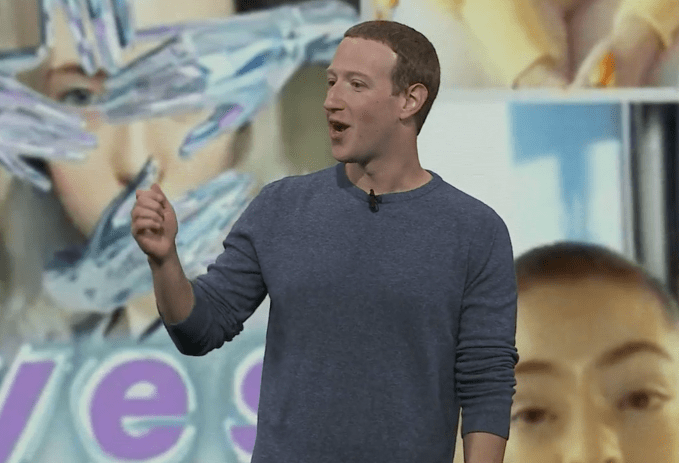
That’s why Facebook is rolling out what could be called an “aspirational redesign” known as FB5. Rather than polishing what Facebook was, it tries to spotlight what it wants to be. “This is the biggest change we’ve made to the Facebook app and site in five years” CEO Mark Zuckerberg said to open Facebook’s F8 conference yesterday.

The New Facebook

Most noticeably, that starts with sucking much of the blue out of the Facebook interface to making it look sparse and calming — despite a More button that unveils the social network’s bloat into dozens of rarely used features. A new logo features a brighter blue bubble around Facebook’s distinctive white f, which attempts to but a more uplifting spin on a bruised brand.
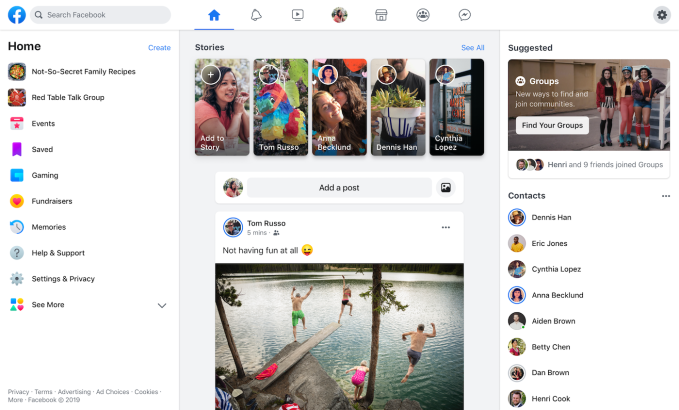
Functionally, FB5 means placing Groups near the center of a freshly tabbed interface for the both Facebook’s website and app, and putting suggestions for new ones to join across the service. “Everywhere there are friends, there should be Groups” says the head of the Facebook app Fidji Simo. Groups already has 1 billion monthly users, so Facebook is following the behavior pattern and doubling down. But Facebook’s goal is not only to have 2.38 billion people using the feature — the same number as use its whole app — but to get them all into meaningful Groups that emblematize their identity. 400 million already are. And now Groups for specific interests like gaming or health support will get special features, and power users will get a dashboard of updates across all their communities.

Groups will be flanked by Marketplace, perhaps the Facebook feature with the most latent potential. It’s a rapidly emerging use case Facebook wants to fuel. Just a a year and a half after launch, Marketplace had 800 million monthly users. Zuckerberg took Craigslist, added real identity to thwart bad behavior, and now is bolting it to the navigation bar of the most-used app on earth. The result is a place where it’s easy to put things up for sale and get tons of viewers. I once sold a couch on Marketplace in 20 minutes. Now sellers can take payments directly in the app instead of with cash or Venmo, and they can offer to ship items anywhere at the buyer’s expense. By following Zuckerberg’s mandate that 2019 focus on commerce, Facebook has become a viable Shopify competitor.
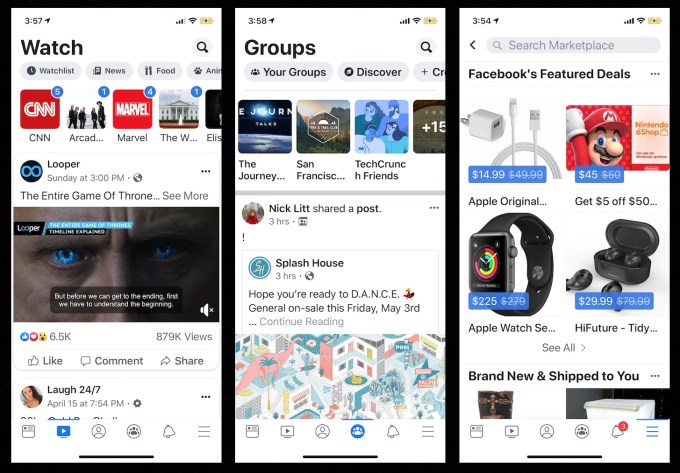
If Groups is what’s already working about Facebook’s future, Watch is the opposite. It’s a product designed to capture the video viewing bonanza Facebook observes on Netflix and YouTube. But without tent pole content like a “Game Of Thrones” or “Stranger Things”, it’s failed to impact the cultural zeitgeist. The closest thing it has to must-see video is Buffy The Vampire Slayer re-runs and a docuseries on NBA star Steph Curry. Facebook claims 75 million people now Watch for at least one minute per day though those 60 seconds don’t have to be  sequential. That’s still just 4 percent of its users. And a Diffusion study found 50 percent of adult US Facebook users had never even heard of Watch. Sticking it front and center demonstrates Facebook commitment to making Watch a hit even if it has to cram it down our throats.

Not The Old Facebook

The products of the past got little love on stage at F8. Nothing new for News Feed, Facebook’s mint but also the source of its misinformation woes. In the age of Snapchat and Zuckerberg’s newfound insistence on ephemerality to prevent embarrassment, the Timeline profile chronicling your whole Facebook life got nary a mention. And Pages for businesses that were the center of its monetization strategy years ago didn’t find space in the keynote, similar to how they’ve been butted out of the News Feed by competition and Facebook’s philosophical shift from public content to friends and family.

The one thing we heard a lot about but didn’t actually see much of was privacy. Zuckerberg started the conference declaring “The future is private!” He spoke about how Facebook plans to make its messaging apps encrypted, how it wants to be a living room rather than just a town hall, and how it’s following the shift in user behavior away from broadcasting. But we didn’t see any new privacy protections for the developer platform, a replacement for its Chief Security Officer that’s been vacant for nine months, or the Clear History feature Zuckerberg announced last year.
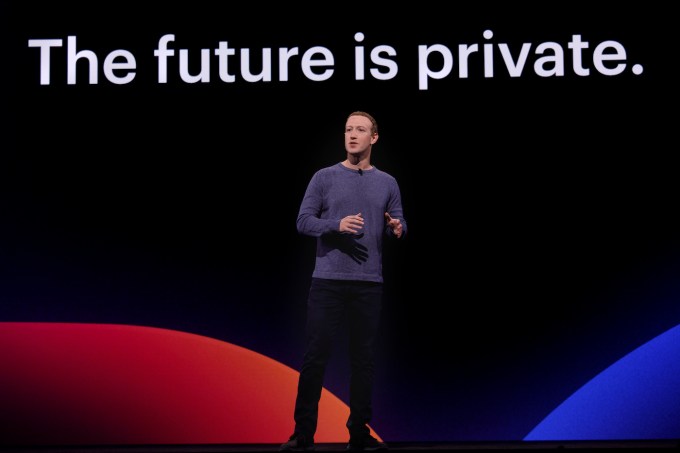
“I get that a lot of people aren’t sure that we’re serious about this. I know that we don’t exactly have the strongest reputation on privacy right now, to put it lightly” Zuckerberg joked without seeming to generate a single laugh. Combined with having little to show to enhance privacy, making fun of such a dire situation doesn’t instill much confidence. When Zuckerberg does take things seriously, it quickly manifests itself in the product like with Facebook’s 2012 shift to mobile, or in the company like with 2018’s doubling of security headcount. He knew mobile and content moderation failures could kill his network. But does someone who told Time magazine in 2010 that “What people want isn’t complete privacy” truly see a loose stance on privacy as an existential threat?

Interoperable, encrypted messaging will boost privacy, but it’s also just good business logic given Zuckerberg’s intention to own chat — the heart of your phone. Facebook’s creepiness stems from it sucking in data to power ad targeting. Nothing new was announced to address that. Despite his words, perhaps Zuckerberg doesn’t aspire to make Facebook as private as he aspired to make it mobile and secure. 
Wired reported that Zuckerberg authored a strategy book given to all employees ahead of the IPO that noted “If we don’t create the thing that kills Facebook, someone else will.” But F8 offered a new interpretation. Maybe given the lack of direct competitors in its league, and the absence of a mass exodus over its constant privacy scandals, it was the outdated product itself that was killing Facebook. The permanent Facebook. The all-you-do-is-scroll Facebook. The bored-of-my-friends Facebook. Users were being neglected rather than pushed away or stolen. By ignoring the past and emphasizing the products it aspires to have dominate tomorrow — Groups, Marketplace, Watch — Facebook can start to unchain itself from the toxic brand poisoning its potential.

01 May 2019

Google opens Android Automotive OS to Spotify, other media app developers

Google is opening its Android Automotive operating system up to third-party developers to bring music and other entertainment apps into vehicle infotainment systems, starting with the Polestar 2, an all-electric vehicle developed by Volvo’s standalone electric performance brand.

Google announced Wednesday that media app developers will be able to create new entertainment experiences for Android Automotive OS and the Polestar 2, starting at Google I/O 2019, the annual developer’s conference that kicks off May 7.

Google is starting with media app developers such as Spotify and other entertainment sites. However, the company plans to expand into other categories of apps as well such as navigation, Haris Ramic, Google’s product lead for Android Automotive told TechCrunch in a recent interview.

Android Automotive OS shouldn’t be confused with Android Auto, which is a secondary interface that lies on top of an operating system. Android Automotive OS is modeled after its open-source mobile operating system that runs on Linux. But instead of running smartphones and tablets, Google modified it so it could be used in cars.

Polestar  introduced in February its first all-electric vehicle, a five-door fastback called the Polestar 2, ahead of the Geneva Motor Show. The Polestar 2’s infotainment system is powered by Android Automotive OS and, as a result, brings into the car embedded Google services such as Google Assistant, Google Maps and the Google Play Store.

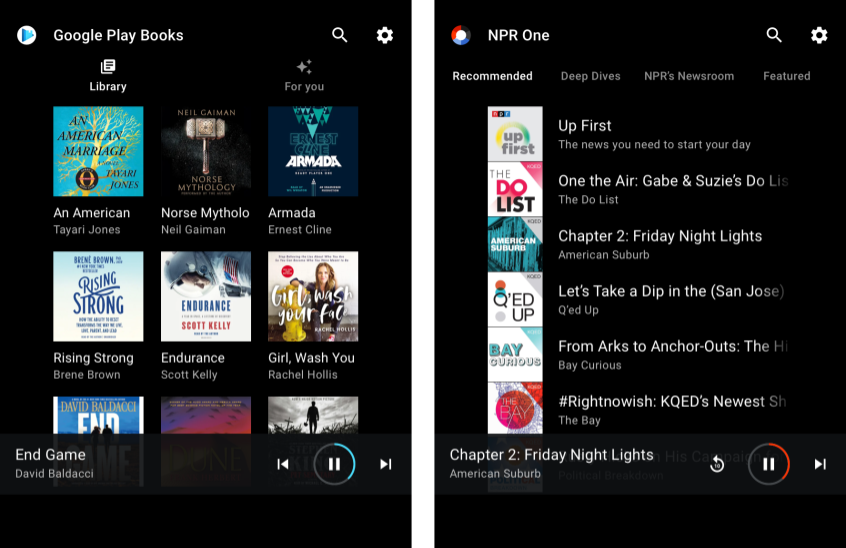
Ramic noted that the system shown in Geneva has improved and now has updated Google Maps and a media center that allows third-party applications like Spotify, NPR and YouTube Music to function more seamlessly in the vehicles. These applications will be ready when the vehicle goes into volume production, which is slated to begin in early 2020 at its Chengdu, China factory. The company is initially targeting sales in China, the U.S., Canada and a handful of European countries that include Belgium, Germany, the Netherlands, Norway, Sweden and the U.K.

Polestar isn’t the only company with plans to incorporate a version of its Android operating system into its car infotainment systems. Volvo announced in 2017 that it would use the Android OS and a year later said it would embed voice-controlled Google Assistant, Google  Play Store, Google Maps and other Google services into its next-generation Sensus infotainment system. lvo.

Fiat Chrysler Automobiles announced Tuesday that it will use tech from Harman and Google to build out its connected-car services. Google’s Android Automotive OS will power FCA’s next version of its Uconnect infotainment system, while Samsung-owned Harman’s Ignite cloud platform will handle the out-of-car services.

Renault-Nissan-Mitsubishi Alliance has also publicly announced plans for Android Automotive OS as well as other automakers that Google can’t reveal at this time, Ramic said.

“Interest is very high,” Ramic said, noting that a growing number of companies have come to see the value in leveraging Google’s expertise.

That’s a shift from the traditionally protective stance of automakers intent of keeping Google out of the car. But as the divide between the capabilities of smartphones and in-car infotainment systems grows, automakers have been more willing to turn to Google.

01 May 2019

Pluralsight will acquire GitPrime for $170M

Pluralsight, an online training platform focusing on subjects like web development, IT certification, and security training, announced today that it will acquire GitPrime, a dev team productivity tool, for $170M in cash.

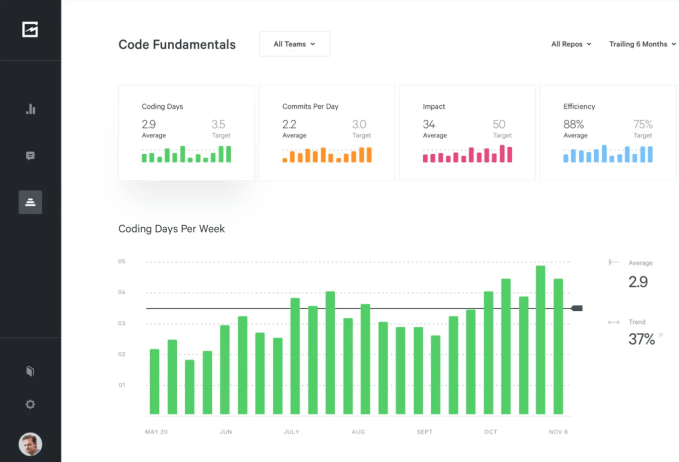
GitPrime is like an analytics dashboard for code projects. It watches your team’s code repositories on services like GitHub or Bitbucket, tracking things like user-by-user code commits over time, ticket activity, and how different team members tackle things like pull requests. The idea is that by providing this data in a visual/at-a-glance way, it helps to identify bottlenecks and highlight where your teams are most efficient.

The company was a part of Y Combinator’s Winter 2016 class, and CrunchBase indicates their most recent round was a $10.5M Series A.

Pluralsight went public in May of last year. The company says this is its first acquisition post-IPO, and that they expect the deal to close by the end of next week.

01 May 2019

Epic Games is buying the studio behind Rocket League

Epic Games is in the process of acquiring the studio behind one of the most popular cross-platform games out there, Rocket League.

The studio behind Fortnite is buying Psyonix for an undisclosed sum and bringing its 132 employees onboard. There doesn’t appear to be a ton changing at the San Diego game studio, Epic says the company will continue to support the game on all platforms.

The real competitive advantage seems to rely on Rocket League coming to the Epic Games store in “late 2019” and ceasing new downloads on Valve’s Steam store at that time, though Epic specifically notes that users that have already downloaded the title on Steam will continue to have support.

The whimsical title has been an unlikely smash success. Rocket League has more than 57 million players, the studio says.

Epic owning two of the biggest cross-platform gaming titles is obviously a major boon to the company and a sign that they’re committed to ensuring that the studio’s success continues long after Fortnite downloads slow. This is one of their most important acquisitions to date and brings a cash cow exclusive to their games store which is continuing to aggressively pursue exlclusives as it tries to take down one of gaming’s biggest powerhouses.


01 May 2019

Epic Games is buying the studio behind Rocket League

Epic Games is in the process of acquiring the studio behind one of the most popular cross-platform games out there, Rocket League.

The studio behind Fortnite is buying Psyonix for an undisclosed sum and bringing its 132 employees onboard. There doesn’t appear to be a ton changing at the San Diego game studio, Epic says the company will continue to support the game on all platforms.

The real competitive advantage seems to rely on Rocket League coming to the Epic Games store in “late 2019” and ceasing new downloads on Valve’s Steam store at that time, though Epic specifically notes that users that have already downloaded the title on Steam will continue to have support.

The whimsical title has been an unlikely smash success. Rocket League has more than 57 million players, the studio says.

Epic owning two of the biggest cross-platform gaming titles is obviously a major boon to the company and a sign that they’re committed to ensuring that the studio’s success continues long after Fortnite downloads slow. This is one of their most important acquisitions to date and brings a cash cow exclusive to their games store which is continuing to aggressively pursue exlclusives as it tries to take down one of gaming’s biggest powerhouses.


01 May 2019

Fanduel is now charging inactive users $3 per month for not playing

You expect to lose money gambling, but you don’t really expect to lose it abstaining from gambling. But if you’re Fanduel user who hasn’t made any bets or deposits for two years, the site will now deduct $3 per month until you put some money on the table. You have to play to win, it seems, but not to lose.

In an email sent to such lapsed (or perhaps recovering) users, including Engadget’s Richard Lawler, Fanduel wrote:

It appears your account has been inactive for over two years, which means you have neither deposited nor entered a contest during that time. We’ve recently updated our Terms of Use to impose a monthly inactivity fee of $2.99 for any accounts that have no play or deposit activity for a period of 24+ months. Per our terms, we are providing you with 30 days notice prior to imposing this fee.

How many inactive accounts do you think you have at random sites you signed up for and never ended up using? Dozens, maybe even a hundred for some? Has any one of these sites ever attempted to charge you for not using their service? Not a monthly fee you have to pay whether you use it or not — literally charging you money because you didn’t use the site. Can’t say I’ve ever heard of it.

In a statement, Fanduel explained that “inactive account fees are a common practice amongst other companies that maintain online account balances in the U.S and Europe. In some of those cases, entire account balances are forfeited after a defined period of inactivity.”

I checked a few gambling and fantasy sites and did find one (wsop.com) that imposes an inactivity fee, though many don’t. So it’s not unprecedented. And indeed depending on the state your account balance may be forfeit after as little as a year, or as many as five or six.

The rules will naturally apply to a lot of people who, for instance, tried the site out but not for a long time, and perhaps even sent Fanduel notifications to spam. Can you blame them? It’s been safe with every other site, and when they signed up there was no inactivity fee. It was added in a recent terms of service update.

But how many of these people will have heard of and agreed to those updated terms. Can people who didn’t agree to the terms be held to them? Exactly how binding EULAs and such truly are is an open legal question. But Fanduel’s approach here seems beyond the pale.

The terms do mention that the company may “modify or replace the Terms of Use at any time.” But they also state that “Use of the Services by you after any modification to the Terms constitutes your acceptance of the Terms of Use as modified.” So if the users haven’t used the service post modification, they haven’t accepted the terms. How can the new fee be applied? I’ve asked Fanduel about this.

To be clear, the money comes out of your Fanduel account balance, and once that bottoms out it’s done — they’re not going to reach out and ding your actual bank account. The fees will continue until the account is empty or the inactivity reaches the state-determined limit defining abandonment, at which point the remaining funds are remitted to the proper authorities as “unclaimed property.” The idea, I suppose, is to let as little go unclaimed as possible.

Naturally anyone can delete your account, withdraw your balance, or play a free game on the site to avoid the fee. And they’ve got a month to do it — assuming they even see the email Fanduel sent. And in its statement the company also said that “if any user asks to reactivate their account prior to December 31, 2019 we will reimburse all fees charged and the user may withdraw that money from their account.”

Of course there is a certain amount of personal responsibility a user must bear for leaving their money in what amounts to a privately operated lock box. But they did so with the understanding that the operator wouldn’t change the policies and then sneak a few bills out.

I’ll update this post if I hear back from Fanduel as to how the terms can apply to people who haven’t agreed to them, implicitly or explicitly. In the meantime if you have an account there, you should check the balance — you’ll have to use it, move it, or lose it.

01 May 2019

Square reports Q1 sales of $489M, up 59%, but net loss widens to $38M

After Square issued weak guidance in Q4, all eyes were on the payments company to see what kind of growth it really had in Q1. Results reported today underscored some of the challenges the company is facing.

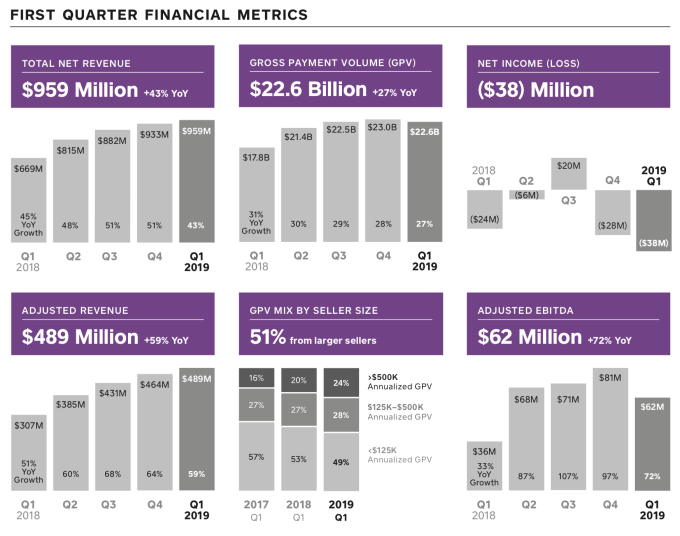
Square’s adjusted revenues were $489 million, up 59 percent year-on-year, with adjusted earnings per share of $0.11. Both figures beat analysts’ estimates. The company had been expected to report earnings per share of $0.08 and revenues of $479.63 million, respectively up 33.3 percent and 56.2 percent on a year ago.

But on the other hand, they were also a signal of a continued slowdown: in the last quarter, Square’s revenues of $464 million represented a rise of 64 percent. It also posted a widening net loss of $38 million, versus $28 million last quarter and $24 million a year ago. (It noted that its “mark-to-market valuation of our Eventbrite investment” accounted for $14 million of that loss.)

The company’s stock is down nearly six percent in after-hours trading.

Since going public in November 2015, the company has seen strong growth and has generally beaten expectations. But Square has reported a net loss for four of the last five quarters, and so any kind of slowdown in growth poses a challenge for turning that around.

Square continued to grow business operations like Square Cash — its instant money transfer service — and its core payments business (subscription and services revenue). The latter was up 126 percent to $219 million.

But in the last quarter the company started to make some moves into one of the newer areas of fintech, cryptocurrencies, with CEO Jack Dorsey announcing that it was hiring engineers to work on open source contributions to the crypto and bitcoin ecosystems, its first effort to do so “independent of its business objectives.”

The last quarter it also started to make more moves into pure e-commerce and for people who are not physically taking payments with its dongles. That included launching the Square Online Store to complement brick-and-mortar transactions, and the Square Invoices app, for those who are not taking payments in person.

More to come

01 May 2019

Fitbit beats Q1 revenue expectations as smartwatch growth continues

Fitbit’s financial rebound continued in the first quarter, as the company generated $271.9 million in revenue, beating Wall Street expectations of $259.7 million. The good news is almost exclusively the domain of the company’s increased focus on smartwatches, which grew 117 percent year over year.

That, in turn, is thanks to this year’s debut of the Versa Lite, a version of Fitbit’s best smartwatch that’s focused on cost, one of the company’s primary selling point against the dominant Apple Watch. It’s a continued payoff of Fitbit’s purchase of Pebble, Vector and Coin — a hail Mary designed to put the company back on track after initially ceding the smartwatch space to Apple, Samsung, Garmin and the like.

Interestingly, while revenue has been shifting from trackers to smartwatches, the tracker side of things also saw modest year on year gains of 17 percent (bringing the total number of devices sold up 36 percent y-o-y), courtesy of the launch of the Inspire, which consolidates several of Fitbit’s trackers into a single line. While the category is generally believed to have plateaued, CEO James Park tells TechCrunch the company is predicting continued growth on that side — albeit at a significantly slower pace than watches.

“We’re continuing to forecast growth in the tracker business, and even faster growth and smartwatch business — but group growth in both segments,” the executive explains.

Forward momentum will require continued innovation on Fitbit’s part and while Park wouldn’t comment directly on plans to release successors to the standard Versa and Ionic, he says the company has “a pretty predictable spring fall launch cadence. And it just really depends on where things are in our product roadmap and market conditions.”

Park’s sentiments echoed those of Apple’s on its own earnings call yesterday, as the company increasingly looks to services for revenue growth. In Fitbit’s case, the plan involves a premium offering launching later this year that will straddle the line between its consumer and growing healthcare business.

“At a very high level, the vision for our premium offering is a service that uses and gathers Fitbit data and data from other sources to screen and diagnose different disease and health conditions for users, that analyzes this data to give people richer and deeper insights about their health, and also provides coaching and guidance,” says Park. “Next steps are for people to address their health conditions or to reach their fitness and wellness goals.”

01 May 2019

Final Niantic EC-1 lessons, F8 call, Slack, WeWork, and TED

Live Conference Call: Josh Constine and Frederic Lardinois talk all things F8 in just a bit

Facebook’s annual F8 conference is in full swing, with major redesigns of the company’s apps and all sorts of news trickling out of San Jose. We have Josh Constine and Frederic Lardinois on the ground talking to everyone, and now we invite all EC members to join us for a live conference call today at 5pm EST / 2pm PST (i.e. about an hour or so from now).

Dial-in information will be sent an hour before the call to all Extra Crunch members.

Niantic EC-1, Part 4: Nine lessons on growth

Greg Kumparak warps up his massive dive into the (virtual) world of Niantic, the producer behind Pokémon GO and Harry Potter: Wizards Unite. In this final conclusion, he takes stock of all the lessons learned from the company and how Niantic’s methods turned it into a $4 billion AR behemoth: