Category: UNCATEGORIZED

30 Apr 2019

Hackers went undetected in Citrix’s internal network for six months

Hackers gained access to technology giant Citrix’s networks six months before they were discovered, the company has confirmed.

In a letter to California’s attorney general, the virtualization and security software maker said the hackers had “intermittent access” to its internal network from October 13, 2018 until March 8, 2019, two days after the FBI alerted the company to the breach.

Citrix said the hackers “removed files from our systems, which may have included files containing information about our current and former employees and, in limited cases, information about beneficiaries and/or dependents.”

Initially the company said hackers stole business documents. Now it’s saying the stolen information may have included names, Social Security numbers, and financial information.

Citrix said in a later update on April 4 that the attack was likely a result of password spraying, which attackers use to breach accounts by brute-forcing from a list of commonly used passwords that aren’t protected with two-factor authentication.

We asked Citrix how many staff were sent data breach notification letters but a spokesperson did not immediately comment.

Under California law, the authorities must be informed of a breach if more than 500 state residents are involved.

Read more:

30 Apr 2019

Why women are indefinitely sharing their locations

New York-based DJ and creative consultant Amrit and I are sitting at a women’s empowerment dinner waiting for her manager, Ramya Velury. Another friend of ours asks where Ramya is. “She said she was getting an Uber 15 minutes ago,” Amrit says as she unlocks her phone to check Ramya’s location.

“She’s still at home!” Ramya and Amrit share their locations with each other indefinitely through Apple’s Find My Friends app, which allows you to see a contact’s location at all times. Most of us have our locations shared with a friend.

One can easily wonder why anyone would want to allow someone complete 24-hour access to their location, especially the type who text “On my way!” before they’ve even stepped foot into the shower. However, women are foregoing privacy among their most trusted friends to offer full access to their location (more specifically, the location of their phone) at all times.

Conveniences by way of technological advances are normalizing a culture of being alone with strangers. Uber launched 10 years ago and multiple ridesharing apps followed. Tinder changed the world of online dating (and dating as a whole) with its millennial-friendly, instantly gratifying match-making. You can connect with someone nearby and be on the way to meet them as soon as you can get out the door.

We talk to strangers online, pay them to get into their cars and meet up with them alone. These developments go against every rule about strangers that our parents imbedded in our childhood brains.

Danueal Drayton, known as the “dating app murderer,” confessed to killing seven women, all of whom he met on dating apps. His criminal trial has been put on hold pending further psychiatric treatment and evaluation after a Los Angeles County judge deemed him incompetent for trial. And 24-year-old Sydney Loofe was murdered after a 2018 Tinder date.

“We utilize a network of industry-leading automated and manual moderation and review tools, systems and processes — and spend millions of dollars annually — to prevent, monitor and remove bad actors who have violated our Community Guidelines and Terms of Use from our app,” a Tinder spokesperson tells me, regarding the measures it takes to keep users safe. “These tools include automatic scans of profiles for red-flag language and images, manual reviews of suspicious profiles, activity and user-generated reports, as well as blocking email addresses, phone numbers and other identifiers.”

While these aren’t necessarily common occurrences, they are real-life horror stories nonetheless.

Sexual assault and sexual misconduct has gotten bad enough within Ubers that the company can no longer ignore it. In 2018, the company released a list of 21 types (categories, not 21 incidents) of sexual misconduct reported by drivers and riders, ranging from explicit gestures to rape.

Uber offers an option where you can share with a friend the status of your ride. The company did not respond to a request for comment about what they’re doing to combat the sexual misconduct within Ubers.

But, that’s just for cars that are actually employed by rideshare apps. Los Angeles resident and self-proclaimed introvert Erika Ramirez pointed to a crime of opportunity when a young woman got into a car that wasn’t her Uber.

“Recently, a 21-year-old woman [Samantha Josephson] was kidnapped and murdered by a man who pretended to be her Uber driver. Unfortunately, it feels like not a day goes by that you don’t hear of a case where a man kills a woman.” (That prompted Uber and Lyft to implement safety features in their apps.)

Conveniences by way of technological advances are normalizing a culture of being alone with strangers.

Ramirez is a freelance journalist and runs her indie publication ILY Magazine mainly from her one-bedroom apartment. “My schedule isn’t too set in stone. I wander to run errands, do laundry, grab food, meet with friends and go on dates at random times of the day or at night,” she says. “To be safe, I share my location with a close girlfriend, in case anything ever goes wrong during any of those instances. I let her know when I’m going on a late snack run or when I’m going on a date with someone.”

Naturally, there are concerns about sharing locations. In 2018, The New York Times reported there were 75 companies that track your location and use, sell or store it. They even illustrated how they were able to get the data and align the anonymous traveling dot to the human it belonged to based on a distinct daily routine.

“When my siblings first asked to share my location with them, I thought they were weird. It’s not like I was doing anything sketchy, but why do you need to know where I am all the time?,” Dr. Brittanny Keeler laments. She was living in Buffalo, N.Y., where she completed her residency and lived for six years. “If someone didn’t see me for 24 hours, the police would be notified. I have a bigger social circle there.”

Now she is an OBGYN in Norwalk, Conn., and newborns don’t adhere to a 9-to-5 work week. “If I deliver babies in the middle of the night, I’m getting out of work at all hours. Here, no one would know I was missing unless I didn’t show up for work.”

It wasn’t an incident or a friend or family member that caused her to reconsider sharing her location. It was one of those horror stories. “I listened to this podcast called Up And Vanished. I think it’s from 2016. It’s about a 30-year-old-woman that left a party and was supposedly going home and was never seen again. I thought to myself, I leave places alone all of the time and hopefully get home. That actual podcast is what prompted me to start sharing my location,” Keeler recalls.

Not at all as a result of Ubers, Tinders and other beneficial disruptive tech, socially, there’s a significant shift in traditional gender norms coinciding with and ultimately utilizing all of these advancements. The percentage of unpartnered adults living alone has risen from 56% in 2007 to 61% in 2017, and women are more likely to live alone than men. Sons are also more likely to live with their parents later in life than daughters, and in 2018, the median age for Americans’ first marriages was the oldest it has ever been, at 30 for men and 28 for women.

Dr. Keeler, Ramirez and Ramya are all unmarried and live alone. Amrit’s boyfriend just moved in after she lived on her own for the majority of her seven years in New York. She’s from Perth, Australia, and her family still lives there.

“Because my family is so far, Ramya is probably the closest to my family and would act responsibly in case of an emergency,” Amrit says. While Ramya is Amrit’s manager, she’s also one of her best friends, and Amrit regularly checks on her location, too. “She always stays out later. If it’s the morning, I’ll check where she is and that she’s made it home.”

It’s not just the number of women living alone that has increased, but more are also traveling alone. As recording artist Tommy Genesis’ tour DJ, it’s not unnatural for Amrit to be traveling as many days as she spends at home in New York. “I’m usually home for two to three weeks and gone for about the same,” she says. Ramirez is nearly bi-coastal, traveling to her former home of New York City once a month and sometimes spending weeks at a time there.

The New York Times just released a discouraging story connecting the dots of dangers the increased number of solo women travelers experience. In it, they highlighted a 2018 study conducted by online hostel booking site Hostelworld that showed a 45 percent increase in solo women travelers from 2015 to 2017. The bottom line of their findings: “Most countries do not comprehensively track violence against female travelers.”

This isn’t to say that women believe sharing their locations with each other will prevent violence against them. However, regardless of their awareness that Apple is not utilizing or sharing their data from Find My Friends, women are in favor of someone they trust to be able to track their every move in case something happens.

It actually may have saved Jaila Gladden’s life. After Jaila’s attacker kidnapped her from outside Atlanta and raped her in her own car, he tasked her with finding a gas station for him to rob, as he planned to take her to Michigan. She convinced him to let her use her phone to do so. She sent her location and alerted her boyfriend what was happening while “looking” for a gas station. Ultimately, police were able to find her, the car and her attacker.

While plenty of users are definitely hot and cold on location services, there is undeniable value and security in knowing someone can find you in case of emergency.

Since 2018, Apple iOS 12 securely and automatically shares location with first responders when U.S. users call 911. Now, iPhone 8s and later have the Emergency SOS feature that requires some setup but ultimately allows for an emergency call to trigger a text to a preselected group of contacts and a location alert to emergency services.

Google also has the iPhone and Android-friendly Google Trusted Contacts App, which allows users to trust and request locations from trusted contacts.

“Not only did I think it was weird that my family wanted to know where I am all the time, but our phones tracking everything in general is creepy to me,” says Dr. Keeler. “I don’t know what data collection I’m contributing to, but I do think it’s necessary for someone to have my location now.”

And it’s because of what Ramirez knows to be true: “Women have been killed by ex-boyfriends, men who’ve forced themselves on them on dates, men whose catcalling were ignored or rejected. Women have to be keenly aware of their surroundings, and sadly have a backup plan in case we are placed in harm’s way.”


30 Apr 2019

Instagram will now let creators and influencers sell items directly

The monetization hose is on full blast at Instagram now, and today at F-8 Facebook unveiled one of the latest developments on that front. The company said that creators will now be able to tag items to sell them directly to people viewing their posts and Stories.

For now, this will work only on items that are tagged from businesses that are part of the new checkout beta program Instagram is running in the US.

It’s also part of a bigger transactional swing that we’re seeing at Instagram that extends beyond just catering to consumerism and influencers speaking to Instragram’s billion-plus users.

Today Instagram also confirmed that it would be adding donation stickers in Stories — something we reported it was working on several months ago.

The tags that creators and influencers can now add is a significant development on product tagging, which up to now had been reserved just for businesses and brands, not open to individuals.

But the purpose for now doesn’t seem to be to help creators make commissions on those sales. Facebook tells us that “at this time,” creators will not make a cut on any purchases made as a result of anyone clicking on links in their posts (meaning: it may come down the line).

Rather, the point is to cut down on some of the repeat questions that creators get about what they are wearing, and where to buy it. “People are already shopping from creators by asking product questions in comments and Direct,” a spokesperson said. “With the ability to tag products, creators can provide the information their followers are looking for and get back to expressing themselves and sharing what’s on their mind, which will make their followers happy too.”

But they are not getting diddly, either. The spokesperson notes that creators will also receive additional insights with shopping posts, such as engagements and shopping insights. For those who are making a living out of their influencer status, these could help them leverage better deals with those brands longer term.

Instagram will start testing first with a small group of creators over the next few weeks including on the accounts of Gigi Hadid, Kim Kardashian West, Kris Jenner, Kylie Jenner and Leesa Angelique (who runs @saythelees). 

“It’s my job to share beauty secrets and tips,” she said about the new feature. “I’m usually writing long, detailed captions about the latest products I’ve been using. Having this tool just makes it that much easier to let everyone know what I’m wearing and from where – down to the shade.”


30 Apr 2019

NSA says warrantless searches of Americans’ data rose in 2018

The intelligence community’s annual transparency report revealed a spike in the number of warrantless searches of Americans’ data in 2018.

The data, published Tuesday by the Office of the Director of National Intelligence (ODNI), revealed a 28 percent rise in the number of targeted search terms used to query massive databases of collected Americans’ communications.

Some 9,637 warrantless search queries of the contents of Americans’ calls, text messages, emails and other communications were conducted by the NSA during 2018, up from 7,512 searches on the year prior, the report said.

The figures also don’t take into account queries made by the FBI or the Drug Enforcement Administration, which also has access to the database, nor do they say exactly how many Americans had their information collected.

The NSA conducts these searches under its so-called Section 702 powers, reauthorized in 2018 despite heated opposition by a bipartisan group of pro-privacy senators. These powers allow the NSA to collect intelligence on foreigners living overseas by tapping into the phone networks and undersea cables owned by U.S. phone companies. The powers also allow the government to obtain data in secret from U.S. tech companies. But the massive data collection effort also inadvertently vacuums up Americans’ data, who are typically protected from unwarranted searches under the Fourth Amendment.

The report also noted a 27 percent increase in the number of foreigners whose communications were targeted by the NSA during the year. In total, an estimated 164,770 foreign individuals or groups were targeted with search terms used by the NSA to monitor their communications, up from 129,080 on the year prior.

It’s the largest year-over-year leap in foreign surveillance to date.

The report also said the NSA collected at most 434.2 million phone records on Americans, down from 534.3 million records on the year earlier. The government said the figures likely had duplicates.

The phone records collection program was the first classified NSA program disclosed by whistleblower Edward Snowden, which revealed a secret court order compelling Verizon — which owns TechCrunch — to turn over daily phone records on millions of Americans. The program was later curtailed following the introduction of the Freedom Act.

Earlier this month, the NSA reportedly asked the White House to end the program altogether, citing legal troubles.

Despite the apparent rollback of the program, NSA still reported 164,770 queries of Americans’ phone records, more than a five-fold increase on the year earlier.

Last week, the Trump administration revealed it had been denied 30 surveillance applications by the Foreign Intelligence Surveillance Court, a specialist closed-door court that grants the government authority to spy inside the U.S., where surveillance is typically prohibited.

Since figures were made available in 2015 following the Edward Snowden disclosures, the number of denials has trended upwards.

30 Apr 2019

Valve Index pre-orders launch tomorrow for a blistering $999

Valve is throwing a little bit of a “screw you” to Oculus this morning, announcing the specs of their high-end VR headset the Valve Index, just before Facebook CEO Mark Zuckerberg announced some minor updates to the Rift.

The Valve Index is a high-end headset with few compromises. It’s $999 for the whole system but you can buy each of the components individually as well.

The headset’s 1440×1600 per eye display is the same as the Vive Pro but it features some insane 144 hz refresh rates and a much wider 130-degree field-of-view. It comes with Valve’s newly-names Index “Knuckles” controllers that developers have been playing with for the past year or two. Everything can be tracked by the SteamVR tracking sensors that came with your Vive or Valve’s new-generation trackers.

Pre-orders are launching tomorrow and the system ships June 28.

30 Apr 2019

Facebook takes its Portal international, adds WhatsApp support

At its F8 developer conference, Facebook today announced that it is launching its Portal video chat hardware internationally by bringing it to Canada and a select number of European countries, too. This roll-out will begin in June for $199 and $349, depending on the screen size. The company did not announce international pricing.

Portal originally only launched in the U.S. for  As the company’s co-founder and CEO Mark Zuckerberg noted during his F8 keynote today, the service has done better than the company expected. Given that it launched right during some of Facebook’s biggest privacy scandals, that’s a bit of a surprise, though we don’t know what Facebook’s own expectations were, of course, or how many of the device it has sold.

In addition, Zuckerberg also announced that its WhatsApp messenger is also coming to Portal. That means end-to-end encrypted video chats are coming to Portal, something that should reduce some of the privacy concerns around the device. “Now, you can be sure that when you’re having conversations with your friends and family, everything says between you,” Zuckerberg said, though most current users probably hope that’s this has always been the case, even when using Portal without WhatsApp .

30 Apr 2019

Aperture dies the true death in Apple’s next macOS update

Aperture was a great application for editing photos back in the day, but it hasn’t been supported by Apple for years. You can, however, still run it on the latest Macs, should you need to. But that won’t be the case for long, the company has announced.

In a support page pointed out by MacRumors, Apple explains that “for technical reasons, Aperture will not run in future versions of macOS after macOS Mojave.”

What exactly those technical reasons are only Apple knows, but it isn’t hard to imagine the various file structures, architectures, libraries and so on that Aperture relied on are simply no longer compatible with the changes the company has made to the OS. macOS has come quite a distance since Aperture was abandoned in 2014, and it’s actually kind of impressive that the app still runs.

You can of course keep a machine running Mojave around if you really need to use Aperture for some reason or another, but honestly, there’s not much reason any more. The photo editor has long been outpaced by its competition, the likes of Lightroom, Capture One, and of course mobile photography software. Apple’s own Photos app is nothing like Aperture but fills some of the same roles.

To that end Apple suggests you migrate your Aperture photo library into either Lightroom Classic, which has an import tool specifically for this, or Photos, which should automatically import your old library when you launch it for the first time. If it hasn’t already, you can hold option while opening it and it will let you manually add a library to it.

Be aware however that adjustments and other settings you’ve made in Aperture may not carry over or might be set in stone once they arrive in their new home. So if you’ve been putting off editing that one shoot from all those years ago… better do that first.

It’s sad to see a good product finally fade away completely, but I’ve already shed those tears, moved on to Lightroom, and never looked back. I wish Apple prioritized its pro and pro-ish users more too, but what can I say? They don’t.

30 Apr 2019

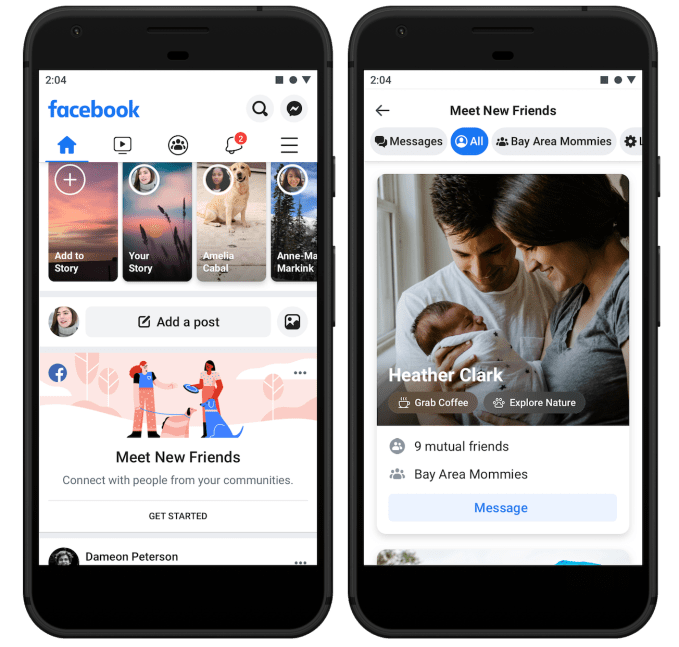
Old Facebook finally wants you to ‘Meet New Friends’

Facebook’s social graph is aging, full of long-lost acquaintances and hometown friends you don’t care much about seeing in the News Feed any more. But Facebook is now testing a pivot away from its core identity of connecting you with existing friends so it can revitalize the social graph and keep people coming back. Facebook’s “Meet New Friends” lets you browse people from shared communities such as your school, workplace or city who’ve also opted in to the feature. It’s now in testing in a few markets before it’s rolled out more widely soon.

Meet New Friends could give people fresh pals to follow in their News Feed, or help recently registered users grow their network until they have access to enough content to keep them busy. And eventually, Facebook could layer on monetization features similar to dating apps where users pay to be shown more prominently to potential connections.

Fidji Simo, the head of Facebook’s main app, tells me Meet New Friends was based on emerging behaviors the company had spotted. “Developing relationships with people they didn’t already know is very different from the core use case of Facebook,” but she notes, “We’ve already seen that naturally happen in Groups, and Meet New Friends will make that a bit easier.”
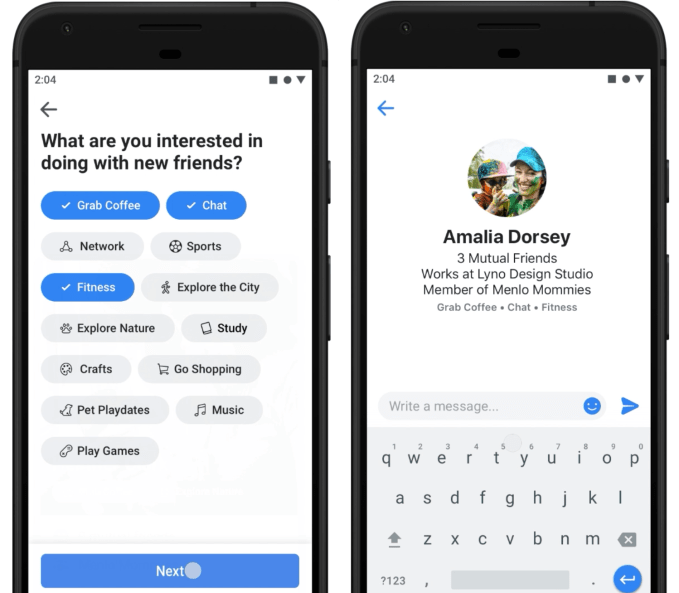
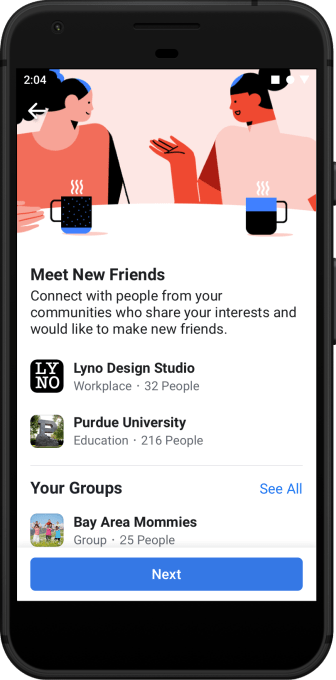
When users open Meet New Friends, they pick the communities through which they’re open to meeting new friends. For now they choose between schools, employers and locations, but Facebook will eventually add Groups too. In that sense it works a bit like Facebook Dating, which rolls out to 14 new countries today and opens to dating friends with its new Secret Crush feature.

Algorithms will sort potential connections by who is most relevant, such as those with mutual friends or shared interests, but you won’t get “matched” where both users have to state their interest in the other. Instead, users can just browse profiles, and then either send people a friend request (which might feel a bit out of the blue), or send them a single text-only message to a recipient’s dedicated Meet New Friends chat inbox. They can’t message that same person again until they respond (to prevent spamming), and the text-only limitation ensures no unsavory photos get blasted around. If they do reply, the thread moves to Facebook Messenger.

Meet New Friends will pit Facebook against a range of other apps, from local-focused Meetup and Nextdoor to verticalized apps like Hey Vina for women only to dating-affiliated apps like Bumble BFF. But Facebook benefits from its ubiquity, so users can try Meet New Friends without feeling embarrassed by downloading an app just to make them less lonely.

For years, the mildly creepy People You May Know feature has been a cornerstone of Facebook’s growth strategy. But it’s still just about recreating your offline social graph online. As Facebook strives to become more meaningful to people’s lives, fostering new friendships could give people a fuzzy feeling about the giant corporation.

30 Apr 2019

Microsoft’s Mixer now lets streamers reward fans for participation, not just subscriptions

On game streaming platforms today, there’s really only one way to earn status within a creator’s community: you have to become a subscriber. Microsoft’s game streaming service Mixer is today aiming to offering a third path to status through loyalty and participation. In doing so, it hopes to better differentiate itself from larger rivals like Twitch and YouTube.

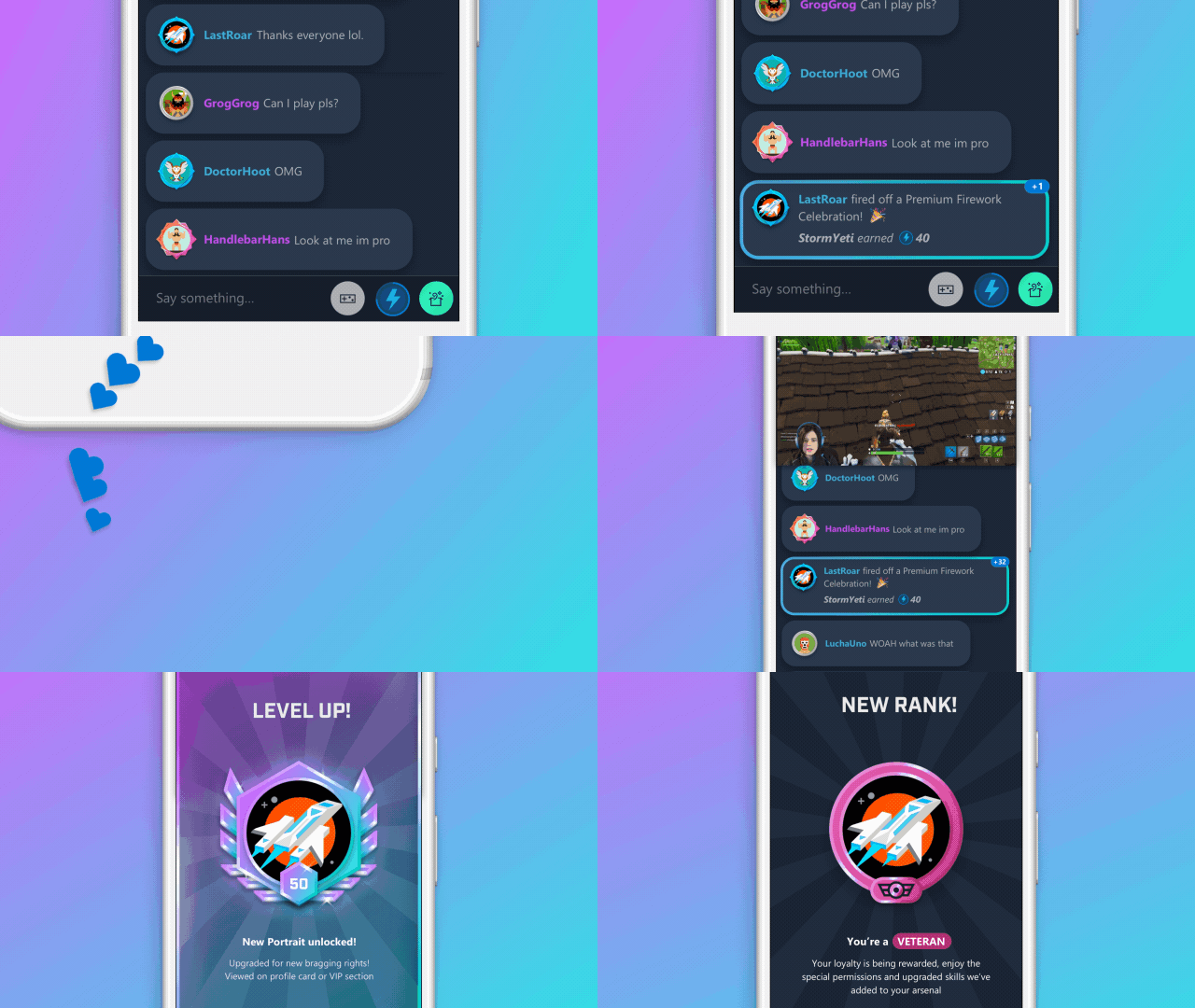
Channel Progression, as this new feature is called, is a system that rewards community members and a streamer’s fans for more than just their financial contributions. It also takes into account other activity within the channel and on Mixer as a whole.

Members can level up by participating in the stream’s chat, by their repeat visits, by using Skills (aka other forms of expression like stickers, effects and GIFs that are used in chats), and more. That means that viewers will be able to earn rewards and raise their rank by just participating — watching, chatting, following, subscribing, and later, through other actions, as well.

As streamers participate, they’ll rank up, gaining them bragging rights and other perks that will vary by their rank level. They can also check on their rank at any time by clicking on the “Your Rank” button at the bottom left corner of the chat box.

The feature is rolling out on Wednesday May 1, 2019 to all streamers on Mixer — not just Mixer Partner, as it’s designed to not only be a way for streamers to grow their own communities, but for Mixer itself to grow.

In the future, however, Mixer Partners will be able to also reward monetization actions, like subscribing, gift subscriptions, and for spending Embers (virtual currency).

The changes come at a time when there’s been a rise in complaints over how hard it is to get noticed on the leading game streaming site, Twitch. Some smaller streamers told The Verge last summer they spent years broadcasting to no one, and found it difficult to grow their community, despite the effort Twitch has made in this area. More recently, that’s included the launch of a four-person Squad Stream, to help creators get discovered.

Despite this, Twitch’s longtail continues to grow — according to a recent report from StreamElements, the top 1,000 Twitch channels were responsible for 57% of Twitch’s viewership hours in Q1 2019, and the longtail (those beyond the top 10,000 channels) was responsible for 20%. In total, Twitch hit 2.7 billion hours of content watched in Q1, the report claimed.

Mixer, by comparison, is much smaller. Its numbers may have quadrupled since Q1 2019, but that’s only going from 22 million hours watched to 89 million. It still has much, much further to go to catch up with YouTube Live, not to mention Twitch.

Mixer’s channel progression feature was originally announced in November as part of Mixer’s “Season 2” release. It launches tomorrow to all on Mixer.com on the desktop and will roll out to all other platforms in the weeks ahead.

30 Apr 2019

Facebook Dating opens to friends with Secret Crush

Facebook built Dating to be privacy-safe, hoping to avoid the awkwardness of friends or family checking out your romance profile. But now Facebook has found a way to let you silently express your affection for a friend without them knowing unless they reciprocate.

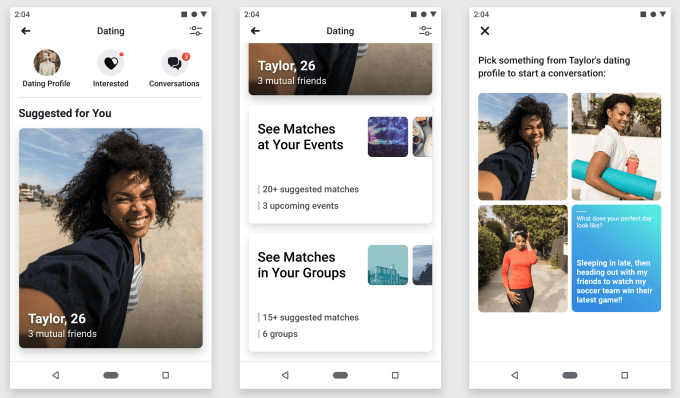
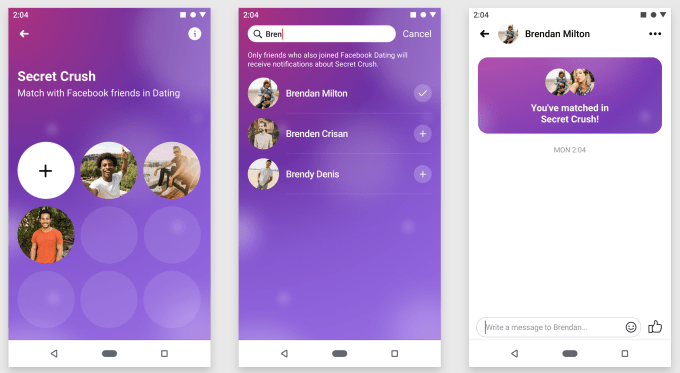
Facebook Dating is opening in 14 more countries, bringing the total to 19. It will launch in the US before the end of the year. Dating brings with it a new feature called Secret Crush that expands it beyond strangers and friends-of-friends. Choose up to 9 friends you like-like. If they’ve opted into Facebook Dating, they’ll get a notification that some friend has a crush on them. If they add you as a Secret Crush too, you’re both notified and can chat on Messenger.

Facebook Dating product manager Charmaine Hung tells me that “I have 2000 Facebook friends. I’m not best friends with all 2000 people, and there’s a good chance that one of that could be a really good match with me. I trust them, I appreciate them, and I know we’re compatible. The only thing missing is knowing if we’re both interested in being more than just friends without the fear of rejection if you were to do this in real life.”

Facebook announced Dating at F8 a year ago and launched it in Colombia in September. Users opt-in, and then browse Events and Groups they’re part of for potential matches. They send them a text-only message based on something in their profile which goes to a special Dating inbox. And if that person reciprocates, they can chat and maybe meet up. Now it’s opening in the Philippines, Vietnam, Singapore, Malaysia, Laos, Brazil, Peru, Chile, Bolivia, Ecuador, Paraguay, Uruguay, Guyana, and Suriname.

One concern with Secret Crush is that users might spam the feature by constantly adding a removing people from their list until they discover a match. That’s why Facebook will only let you sub out one person per day after you reach your initial limit of 9.

Currently there’s still no plan to monetize Dating, but that’s not the point. After years of scandals, Facebook needs to prove it deserves to be your social network. Mindlessly browsing the News Feed has proven to be exhausting and at times detrimental to health. But if the app can introduce you to your future spouse, or even just a summer fling, you might keep a place in your for Facebook too.