Category: UNCATEGORIZED

26 Apr 2019

Wheely raises $15 million for its luxury ride-hailing app

London-based startup Wheely has raised a $15 million Series B round led by Concentric with Oleg Tscheltzoff, Misha Sokolov and other investors also participating. The company wants to build an Uber competitor focused on the luxury market.

It’s a bit ironic when you think about it as Uber started as a luxury company. But everybody knows someone with horrific Uber stories. That’s why Wheely is building a reliable and predictable ride-hailing experience.

The company is currently live in London, Moscow and St. Petersburg — Paris is coming this summer. It works with 3,500 drivers and it currently has a run rate of $80 million in gross bookings.

Wheely doesn’t try to reinvent the wheel as the company works with third-party partners and doesn’t employ its drivers. Similarly, the company takes a 20 percent cut on each ride.

But the startup insists on its strict recruitment process. For instance, you can’t become a Wheely driver from day one. The company requires at least three years of previous chauffeur driving experience. You also need to pass multiple tests including driving tests and etiquette tests. Only one in four UberBlack drivers pass the exam.

There are currently three different classes — a normal one with Mercedes-Benz E-Class cars, a fancy one with Mercedes-Benz S-Class cars and a van category with Mercedes-Benz V-Class vehicles.

Minimum rides cost £12 with the entry-level class, £16 in an S-Class and at least £40 for a van. You then pay more depending on distance traveled and time spent in the car.

And it’s been working well as Wheely now represents around 11 percent of gross bookings in London. Given that each ride is more expensive than a traditional ride-hailing ride, it makes sense that Wheely already captured a good chunk of the money pie. Now let’s see if the company can find enough cities with affluent people to scale its business.

Anton Chirkunov – Founder of Wheely.

26 Apr 2019

RosieReality, a Swiss startup using AR to get kids interested in robotics and programming, scores £2.2M seed

RosieReality, a startup out of Zürich developing consumer augmented reality experiences, has raised $2.2 million in seed funding led by RedAlpine. Other backers include Shasta Ventures, Atomico Partners Mattias Ljungman and Siraj Khaliq (both of whom invested in a personal capacity), and Akatsuki Entertainment Fund.

Founded in early 2018, RosieReality’s first AR experience is designed to ignite kids interested in robotics and programming. The smart phone camera-based app is centred around “Rosie,” a cute AR robot that inhabits a “Lego-like” modular AR world within which you and your friends are tasked with building and solving world-size 3D puzzles.

The kicker: to solve these 3D-puzzle games requires “programming” Rosie to move around the augmented reality world.

“By developing Rosie the Robot, we created the first interactive and modular world that exclusively lives in your camera feed,” RosieReality co-founder and CEO Selim Benayat tells TechCrunch. “We use this new computational platform to enable kids to creatively build, solve and share world-sized puzzle games with friends and families – much like modern-day Lego”.

Describing Rosie the Robot’s typical users as teens that “like the challenge of intricately crafted puzzles,” Benayat says part of the inspiration behind the AR game was remembering how as a kid he used to love spending time building stuff and then inviting friends over to show them what he’d built.

“Kids today are not that different,” he argues, before adding that AR makes it possible for them to have the same tangible and contextual sensation while giving them a bigger outlet for their creativity.

“We see the camera as a tool to teach and enable [the] next generation of creators. For us gaming is the ultimate creative, social and educational outlet,” says the RosieReality CEO.

26 Apr 2019

FT parent Nikkei confirms it has acquired new media startup Deal Street Asia

It’s official: Nikkei, the Japanese media firm that owns the FT, has confirmed that it has acquired Singapore-based new media startup Deal Street Asia. (The Nikkei announcement is buried behind a paywall — make of that what you will!)

The deal is undisclosed, but the announcement does confirm a TechCrunch report from last month which broke news of the impending acquisition.

Deal Street Asia covers a mix of news from Asia’s financial markets, business verticals and startups… which I guess makes it a competitor to us here at TechCrunch. Like TechCrunch, it also runs an events business — its main show in Singapore in September costs upwards of $1,000 and features senior executives from the likes of DBS, Grab, Sea, GGV, Allianz and IFC.

Initially, we reported that the deal valued Deal Street Asia at around the $5 million mark, but we now understand that the valuation is between $5 million and $10 million. The arrangement will see Nikkei take a majority stake in the business, which includes buying out existing investors and making a separate capital investment into Deal Street Asia worth around $3 million, according to what we’ve heard.

Launched in 2014, Deal Street Asia never disclosed its funding total, but its backers include Singapore Press Holdings, North Base Media, Alpha JWC, K2 VC, SGAN and Hindustan Times, the Indian media firm that operates Mint which is a Deal Street Asia content partner. Its Angel investors include Vijay Shekhar Sharma — the founder of Alibaba-backed Paytm — the Singapore Angel Network and Rogers Holdings chairman Jim Rogers.

Deal Street Asia confirmed that all of those agreed to sell with the exception of Mint which “continues to be a minority shareholder.” We understand that all investors enjoyed a positive outcome from the deal, so Mint’s continued involvement is down to strategy not any kind of issue on Deal Street Asia’s side, a source disclosed.

Nikkei said its capture of Deal Street Asia will “deepen its coverage of the Asian startup ecosystem and tech industries, the fastest-growing sectors in the region” and boost its ScoutAsia news and data offering.

Indeed, it looks like you can expect to see links form between Deal Street Asia and Nikkei media properties.

“Joining forces with Nikkei will help us accelerate our mission of helping the PE-VC industry and dealmakers understand the changing megatrends in this space. As we expand our reportage across Asia, we look forward to greater collaboration across Nikkeiʼs publications and group of companies such as the FT, Nikkei Asia Review and scoutAsia,” read a statement from Deal Street Asia founder and editor-in-chief Joji Thomas Philip.

The deal follows Nikkei’s majority share acquisition of The Next Web [disclaimer: my former employer] in March. As we previously reported, both of those acquisitions are part of a new subscription media strategy that Nikkei is hatching:

This is far from it for the FT in terms of deals. TechCrunch understands that the company is actively seeking acquisition and investment opportunities in media startups across the world. Beyond augmenting its existing events business, one source told TechCrunch that the FT is considering a new media subscription business, which could bundle together some of its acquisitions. That’s very much an ongoing work in progress as it seeks additional deals to plump up that potential subscription offering.

Keep an eye out for more deals, we certainly will!

26 Apr 2019

Facebook says it filed a US lawsuit to shut down a follower-buying service in New Zealand

Facebook is cracking down on services that promise to help Instagram users buy themselves a large following on the photo app. The social network said today that it has filed a lawsuit against a New Zealand-based company that operates one such ‘follower-buying service.’

The suit is in a U.S. court and is targeting the three individuals running the company, which has not been named.

“The complaint alleges the company and individuals used different companies and websites to sell fake engagement services to Instagram users. We previously suspended accounts associated with the defendants and formally warned them in writing that they were in violation of our Terms of Use, however, their activity persisted,” Facebook wrote in a post.

We were not initially able to get a copy of the lawsuit, but have asked Facebook for further details.

This action comes months after a TechCrunch expose identified 17 follower-buyer services that were using Instagram’s own advertising network to peddle their wares to users of the service.

Instagram responded by saying it had removed all ads as well as disabled all the Facebook Pages and Instagram accounts of the services that we reported were violating its policies. However, just one day later, TechCrunch found advertising from two of the companies Instagram, while a further five were found to be paying to promote policy-violating follower-growth services.

Facebook has stepped up its efforts to crack down on “inauthentic behavior” on its platforms in recent months. That’s included removing accounts and pages from Facebook and Instagram in countries that include India, Pakistan, the Philippines, the U.K, Romania, Iran, Russia, Macedonia and Kosovo this year. Higher-profile action has included the suspension of removal of UK far-right activist Tommy Robinson from Facebook and in Myanmar, where Facebook has been much-criticized, the company banned four armed groups.

26 Apr 2019

Facebook says it filed a US lawsuit to shut down a follower-buying service in New Zealand

Facebook is cracking down on services that promise to help Instagram users buy themselves a large following on the photo app. The social network said today that it has filed a lawsuit against a New Zealand-based company that operates one such ‘follower-buying service.’

The suit is in a U.S. court and is targeting the three individuals running the company, which has not been named.

“The complaint alleges the company and individuals used different companies and websites to sell fake engagement services to Instagram users. We previously suspended accounts associated with the defendants and formally warned them in writing that they were in violation of our Terms of Use, however, their activity persisted,” Facebook wrote in a post.

We were not initially able to get a copy of the lawsuit, but have asked Facebook for further details.

This action comes months after a TechCrunch expose identified 17 follower-buyer services that were using Instagram’s own advertising network to peddle their wares to users of the service.

Instagram responded by saying it had removed all ads as well as disabled all the Facebook Pages and Instagram accounts of the services that we reported were violating its policies. However, just one day later, TechCrunch found advertising from two of the companies Instagram, while a further five were found to be paying to promote policy-violating follower-growth services.

Facebook has stepped up its efforts to crack down on “inauthentic behavior” on its platforms in recent months. That’s included removing accounts and pages from Facebook and Instagram in countries that include India, Pakistan, the Philippines, the U.K, Romania, Iran, Russia, Macedonia and Kosovo this year. Higher-profile action has included the suspension of removal of UK far-right activist Tommy Robinson from Facebook and in Myanmar, where Facebook has been much-criticized, the company banned four armed groups.

26 Apr 2019

U.S. slams Alibaba and its challenger Pinduoduo for selling fakes

China’s biggest ecommerce company Alibaba was again on the U.S. Trade Representative’s blacklist over suspected counterfeits sold on its popular Taobao marketplace that connects small merchants to consumers.

Nestling with Alibaba on the U.S.’s annual “notorious” list that reviews trading partners’ intellectual property practice is its fast-rising competitor Pinduoduo . Just this week, Pinduoduo founder Colin Huang, a former Google engineer, wrote in his first shareholder letter since listing the company that his startup is now China’s second-biggest ecommerce player by the number of “e-way bills”, or electronic records tracking the movement of goods. That officially unseats JD.com as the runner-up to Alibaba.

This is the third year in a row that Taobao has been called out by the U.S. government over IP theft, despite measures the company claims it has taken to root out fakes, including the arrest of 1,752 suspects and closure of 1,282 manufacturing and distribution centers.

“Although Alibaba has taken some steps to curb the offer and sale of infringing products, right holders, particularly SMEs, continue to report high volumes of infringing products and problems with using takedown procedures,” noted the USTR in its report.

In a statement provided to TechCrunch, Alibaba said it does “not agree with” the USTR’s decision. “Our results and practices have been acknowledged as best-in-class by leading industry associations, brands and SMEs in the United States and around the world. In fact, zero industry associations called for our inclusion in the report this year.”

Pinduoduo is a new addition to the annual blacklist. The Shanghai-based startup has over the course of three years rose to fame among China’s emerging online shoppers in smaller cities and rural regions, thanks to the flurry of super-cheap goods on its platform. While affluent consumers may disdain Pinduodou products’ low quality, price-sensitive users are hooked to bargains even when items are subpar.

“Many of these price-conscious shoppers are reportedly aware of the proliferation of counterfeit products on pinduoduo.com but are nevertheless attracted to the low-priced goods on the platform,” the USTR pointed out, adding that Pinduoduo’s measures to up the ante in anti-piracy technologies failed to fully address the issue.

Pinduoduo, too, rebutted the USTR’s decision. “We do not fully understand why we are listed on the USTR report, and we disagree with the report,” a Pinduoduo spokesperson told TechCrunch. “We will focus our energy to upgrade the e-shopping experience for our users. We have introduced strict penalties for counterfeit merchants, collaborated closely with law enforcement and employed technologies to proactively take down suspicious products.”

The attacks on two of China’s most promising ecommerce businesses came as China and the U.S. are embroiled in on-going trade negotiations, which have seen the Trump administration repeatedly accused China of IP theft. Tmall, which is Alibaba’s online retailer that brings branded goods to shoppers, was immune from the blacklist, and so was Tmall’s direct rival JD.com.

Taobao has spent over a decade trying to revive its old image of an online bazaar teeming with fakes and “shanzhai” items, which are not outright pirated goods but whose names or designs intimate those of legitimate brands. Pinduoduo is now asked to do the same after a few years of growth frenzy. On the one hand, listing publicly in the U.S. subjects the Chinese startup to more scrutiny. On the other, small-town users may soon demand higher quality as their purchasing power improves. And when the countryside market becomes saturated, Pinduoduo will need to more aggressively upgrade its product selection to court the more sophisticated consumers from Chinese megacities.

26 Apr 2019

Grocery delivery startup Honestbee is running out of money and trying to sell

Honestbee, the online grocery delivery service in Asia, is nearly out of money and trying to offload its business.

The company has held early conversations with a number of suitors in Asia, including ride-hailing giants Grab and Go-Jek, over the potential acquisition of part, or all, of its business, according to two industry sources with knowledge of the talks.

Founded in 2015, Honestbee works with supermarkets and retailers to deliver goods to customers using its store pickers, delivery fleet and mobile apps. The company is based in Singapore and operates in eight markets across Asia: Hong Kong, Singapore, Taiwan, Thailand, Indonesia, Malaysia, Philippines and Japan. In some markets it has expanded to food deliveries and, in Singapore, it operates an Alibaba-style online/offline store called Habitat.

The company makes its money by taking a cut of transactions from consumer transactions, while it also monetizes delivery services separately.

Despite looking impressive from the outside, the company is currently in crisis mode due to a cash crunch — there’s a lot happening right now.

From talking to several former and current staff, TechCrunch has come to learn that Honestbee is laying off employees, it has a range of suppliers who are owed money, it has “paused” its business in the Philippines, it has closed R&D centers in Vietnam and India, it isn’t going to make payroll in some markets and a range of executives have quit the firm in recent months.
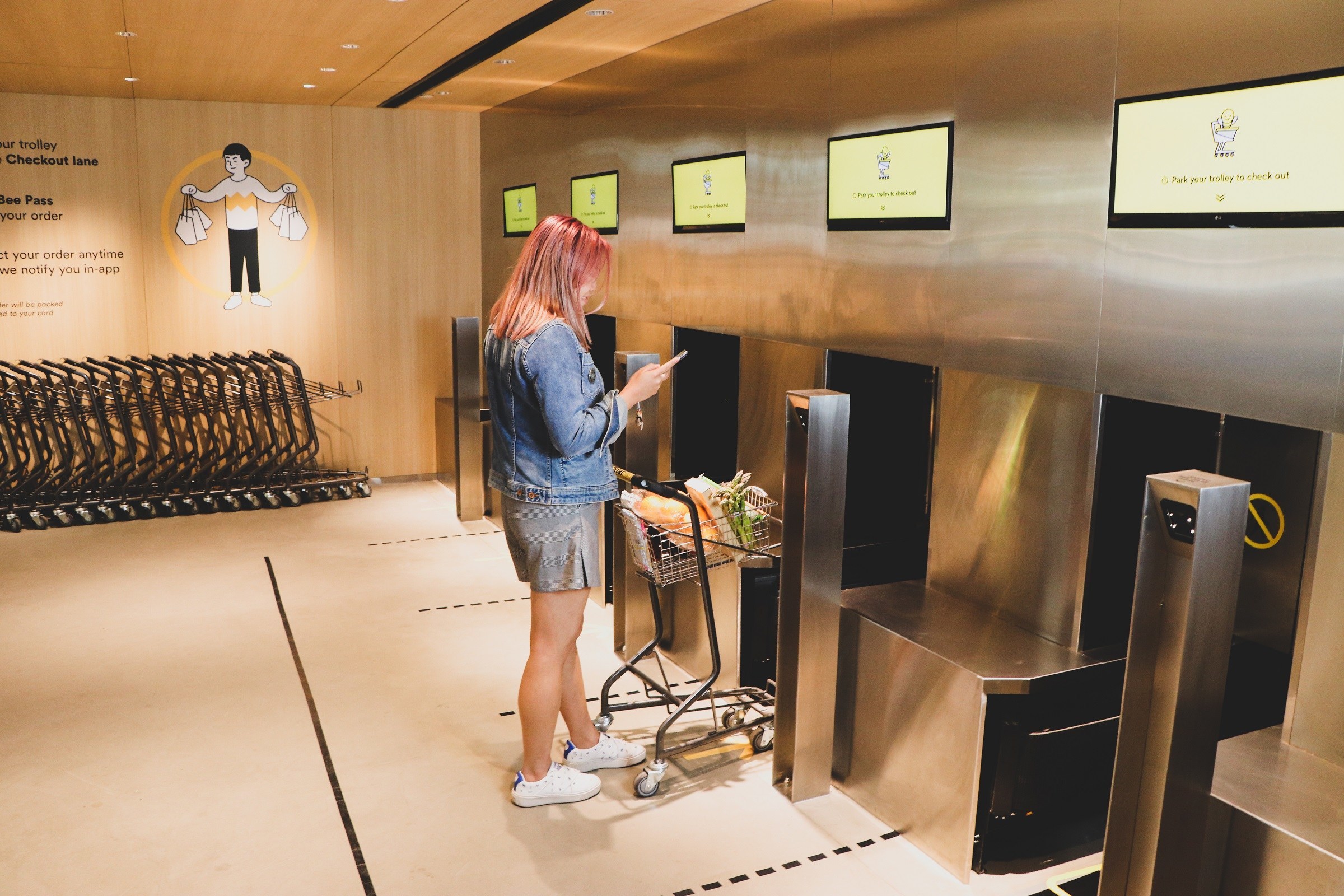
Honestbee’s Habitat store includes a cashless and automated checkout experience, among other online-offline services

The issue is that the company is running out of money thanks to a business model with tight margins that’s largely unproven in Asia Pacific.

One source told TechCrunch that the company doesn’t currently have the funds to pay its staff this month. A source inside the company confirmed that Honestbee has told Singapore-based staff that they won’t be paid in time, but it isn’t clear about employees based in other markets. Previously, staff have been paid inconsistently — with late salary payments sent as bank transfers happening twice this year, according to the source.

One reason that the Philippines business has closed temporarily — as Tech In Asia first reported this week — is that it is out money, and waiting on Honestbee HQ in Singapore to provide further capital. Already, the saga has proven to be too much for Honestbee’s head of the Philippines — Crystal Gonzalez — who has quit the company, according to a source within Honestbee Philippines.

Gonzalez helped build Viber’s business in the Philippines, where it is a top messaging player, and she was previously with Yahoo before launching Honestbee. She is said to have grown frustrated at a lack of funds when the Philippines is the company’s best-performing market on paper.

Indeed, the situation is so dire that suppliers and partners have been paid late, or left unpaid entirely, in the Philippines and other markets. Honestbee takes payment for grocery deliveries, after which it is supposed to provide the transaction, minus its cut, to its supermarket partners. But it has been slow to pay vendors, with two in Singapore — FairPrice and U Stars — cutting ties with the startup.

Unclear financing

On the subject of financials, Honestbee looks to be toward the end of its runway.

The company has always taken a fairly secretive line on its financing. On launch, it announced a $15 million Series A investment from Formation8, a Korean firm where Honestbee CEO Joel Sng was a co-founder, but it has said nothing more since. Tech In Asia dug up filings last year that show it has raised a further $46 million from more Korean investors, but the startup declined to comment on its financing when contacted by TechCrunch.

It looks like that capital is nearly gone, at least based on what has been declared.

Internal numbers for Honestbee in December 2018, seen by TechCrunch, show that it lost nearly $6.5 million, with around $2.5 million in net revenue for the month. GMV — the total amount of transactions on its platform before deductions to partners — reached nearly $12.5 million in December, but costs — chiefly discounts to lure new customers and online marketing spend — dragged the company down. A former employee said that monthly retention is often single-digit percent in some markets because of the “outrageous” use of coupons to hit short-term revenue goals.

That internal data showed that the Philippines business accounted for around 40 percent of Honestbee’s overall GMV, which backs up Gonzalez’ apparent frustration at a lack of investment. That said, the Philippines unit remains some way from profitability, with a net loss of more than $1 million in December.

High burn rate

Three markets — Singapore, the Philippines and Taiwan — accounted for more than 80 percent of GMV and net income, making it unclear why Honestbee continues to operate in other countries, including the expensive Japanese market, when its funding level is perilously low.

Brian Koo, whose family controls LG, is listed as a shareholder for both of Honestbee’s ventures registered in Singapore. His Formation 8 VC firm has provided significant funding for the startup.

More pertinently, operating at that burn rate would give Honestbee less than 10 months of runway if it used the $61 million capital float that it is known to have raised. That suggests that the company has raised more money; however, none of the sources who spoke to TechCrunch were able to verify whether there has been additional fundraising.

Current and former employees explained that Honestbee doesn’t have a CFO and that all high-level decisions, and particularly those around budgets and spending, are managed by CEO Sng and his right-hand man, Roger Koh, whose LinkedIn lists his current job as a principal with Formation 8.

Filings in Singapore indicate that Honestbee has $55.9 million in assets through two registered companies. A common shareholder across the two is Brian Koo, a member of the LG family that founded Formation Group, the parent behind the Formation 8 fund.

Layoffs and a potential sale

While the financials are hazy, it is very clear that Honestbee is up against it right now.

The company released a statement earlier this week that makes some admissions around layoffs and restructuring but still glosses over current struggles:

In 2014, honestbee started in Singapore with the mission of providing a positive social and financial impact on the lives and businesses that we touch. Today, we are a regional business with footprints in Hong Kong, Thailand, Indonesia, Taiwan, Philippines, Japan and Malaysia.

Over the years, we have continued to be committed to our staff, partners and consumers. We have made good progress to implement new process and ways of working to remain efficient and relevant in the ever-changing business environment. The launch of habitat by honestbee in Singapore was a valuable lesson for us where it showed the potential growth in the O2O business and *it has been voted one of the must-see retail innovations in the world this year.

Following a strategic review of our company’s business, we are temporarily suspending our food verticals in Hong Kong and Thailand to simplify what we do and how we do it to better meet what our consumers want. Some roles within the organization will no longer be available. Approximately 6% of our global headcount in the organization are affected.

The status of honestbee in the remaining markets remain unchanged as we evaluate and we will continue to operate and contribute to honestbee Pte Ltd.

Sources close to the company told TechCrunch that more job losses are likely to come beyond the six percent in this statement. Executives who saw the writing on the wall have left in recent months, including the heads of business for Japan and Indonesia, a senior member of the team behind Habitat and the company’s head of people. One executive hired to raise capital for Honestbee quit within a month; he declined to comment and doesn’t list the company on his LinkedIn bio.

Secondly, Honestbee’s temporary suspension of food services in Hong Kong and Thailand isn’t likely to have a huge impact on its overall business, as groceries are the primary focus and neither market is particularly huge for the company. While Habitat has gotten attention for its forward-thinking, a physical retail store will require significant capital and it is likely, in its early days, to only increase the burn rate. Sources in the company told TechCrunch that, already, it has switched suppliers for some items as invoices went unpaid.

Despite the chaos, the potential of a sale is real.

Fresh from a recent $1.5 billion Vision Fund investment with the promise of $2 billion more this year, Grab — which is valued at $14 billion — is on a spending spree.

The Singapore-based company has pledged to make at least half a dozen acquisitions in 2019 and a deal to boost its nascent food and grocery play in Southeast Asia has some merit. Grab has the challenge of competing with Go-Jek, its $9.5 billion-valued rival that built a strong offering in Indonesia and is expanding across Southeast Asia with an emphasis on its food delivery. Grab, meanwhile, is active in eight markets across Southeast Asia and is now actively expanding from transportation services to food and more.

Likely adding to the frustration for Honestbee, its rival HappyFresh this week announced a $20 million investment. HappyFresh has undergone tough times, too. It pulled out of markets in 2016 to make its business more sustainable and today its CEO Guillem Segarra told TechCrunch that it is now operationally profitable.

Honestbee declined to respond to a range of questions from TechCrunch on whether it has plans to sell its business, its financing history and whether it has delayed paying employees.


If you have a tip about this story or others, you can contact TechCrunch reporter Jon Russell in the following ways:

  • DM to @jonrussell on Twitter
  • Email jr@techcrunch.com
  • For PGP use the public key listed on MIT’s keyserver (here) or jonrussell@protonmail.com
  • Contact directly for WhatsApp or Signal number
26 Apr 2019

Wireless broadband startup Starry files to raise up to $125 million

The never-ending quest to kill Comcast is poised to receive some renewed investment as an ambitious startup readies to secure some new cash.

Starry, a Boston-based wireless broadband internet startup, has filed to raise up to $125 million in Series D funding according to a Delaware stock authorization filing uncovered by Pitchbook. If Starry closes the full authorized raise it will hold a post-money valuation of $870 million.

A spokesperson for the company confirmed it had already raised new capital, but disputed the numbers.

The company has already raised over $160 million from investors including FirstMark Capital and IAC. The company most recently closed a $100 million Series C this past July.

The internet startup takes a different approach from fiber-toting competitors by relying on radio tower and high rise-mounted transmitters that dispatch millimeter wavelength signals to receivers connected to a building’s existing wiring. Customers with Starry’s slick touchscreen routers can whirl through setup, contact customer service, tailor parental controls and conduct speed tests. The company claims its solution can provide up to 200 mbps up/download service for just $50 per month with no data caps or long-term contracts.

The technology is not without its skeptics, while laying fiber optic cable has proven to be an expensive task for internet companies, going over the airwaves with the company’s high-frequency radio waves has its own set of problems. Signal can be affected by harsh weather and obstacles, though Starry has indicated they are content with their performance in less-than-ideal conditions.

We’ve built a robust network in Boston and our technology is working well,” CEO Chet Kanojia told us last year. “We’ve gone through a full year of seasonality to test various weather and foliage conditions and we’ve been very happy with our network’s performance.”

Last year marked a major period of expansion for Starry, which expanded beyond its home market of Boston and now holds a presence in Los Angeles, New York City, Denver and DC.

Kanojia previously founded Aereo, which raised $97 million in VC funding with the dream of letting consumers watch live TV over the web. The company proved a little too disruptive for its time, and was shut down as the result of a Supreme Court case brought about by major broadcasting networks.

26 Apr 2019

Carbon, the fast-growing 3D printing business, is raising up to $300M

Carbon, the poster child for 3D printing, has authorized the sale of $300 million in new shares, according to a Delaware stock filing uncovered by PitchBook. If Carbon raises the full amount, it could reach a valuation of $2.5 billion.

Using its proprietary Digital Light Synthesis technology, the business has brought 3D printing technology to manufacturing, building high-tech sports equipment, a line of custom sneakers for Adidas and more. It was valued at $1.7 billion by venture capitalists with a $200 million Series D in 2018.

Carbon declined to comment on its upcoming fundraising plans.

Redwood City-based Carbon is well-capitalized. To date, it’s raised a total of $422 million from investors like Sequoia, GV, Fidelity, General Electric, Hydra Ventures and Adidas Ventures, not including the incoming round of capital.

25 Apr 2019

Amazon beats optimistic profit expectations for Q1

Amazon announced today that it has beat Wall Street’s already optimistic Q1 projections. The e-commerce giant’s revenues have slowed a bit, contributing to moderate fluctuations in after hours trading, but the company’s greatly benefit by ever-increasing profit margins.

Net income for the quarter hit $3.6 billion, a new record for the company. Much of those inflated margins can be chalked up to online services, including advertising and, most notably, cloud services through AWS.

The earnings report demonstrates just how much the site has diversified its portfolio, with earnings that now include results from Whole Foods, which Amazon absorbed last year. The grocery store chain has seen the impact of multiple rounds of price cuts since becoming a part of Amazon, though growth on that side is slow compared to the company’s cloud offerings.

Jeff Bezos took the opportunity to note the company’s increased investment in education. Amazon’s been pushing to highlight its softer side of late, as its been the target of negative publicity over working conditions in its fulfillment centers and its since shuttered plans for opening an HQ2 in Queens.

“The son of a working single mom, Leo Jean Baptiste grew up speaking Haitian Creole in a New Jersey home without internet access. He’s also one of our inaugural group of 100 high school seniors to receive a $40,000 Amazon Future Engineer scholarship and Amazon internship,” he said in a statement. “Our passion for invention led us to create Amazon Future Engineer so we could help young people like Leo from underrepresented groups and underserved communities across the country.”

It’s a rosy picture for a company that’s been killing it on earnings, though the company was less bullish when it comes to Q2 as its growth has been slowing. Amazon offered guidance of as much as $1.6 billion below Wall Street’s $4.2 billion expectations. As CNBC notes, that could well point to the company’s intentions of making additional investments going forward.