Category: UNCATEGORIZED

24 Apr 2019

AV8 Ventures launches with $170M to invest in digital health, mobility and enterprise tech

AV8 Ventures has closed on €150 million (about $170 million) for its debut early-stage venture capital fund to invest in seed and Series A startups in the U.S. and Europe focused on the “machine-enabled future.”

Allianz, a German insurance and asset management business, is the fund’s sole backer.

Headquartered in Palo Alto and London, the new effort is led by George Ugras (pictured above, right), the former head of IBM Ventures, and Miles Kirby (pictured above, left), previously a managing director at Qualcomm Ventures in Europe. The pair have brought on two full-time partners and five additional venture partners to hit its goal of 10 investments per year.

The AV8 team brings together technical backgrounds and strong business acumen, Kirby told TechCrunch: “That’s something fairly unique about us, we can really help the entrepreneurs as opposed to just investing and sitting back. Having been through this a few times, we can really help through the journey.”

“We think of ourselves as builders versus transactors,” Ugras, who began his career as an astrophysicist, added. “Quite often in venture you’ll notice investors get perked up around transactions, but the magic happens in-between rounds.”

Though AV8 is backed by a corporate, it is indeed not a corporate venture capital fund. Ugras, in a conversation with TechCrunch, compared AV8 with Sapphire Ventures, an early-stage fund supported by SAP. Sapphire was formerly known as SAP Ventures but rebranded as Sapphire in 2014 to reinforce its status as a firm independent from the German corporation.

AV8 has a general focus on digital health, big data and artificial intelligence, mobility and enterprise tech. Having been investing out of the fund for roughly one year already, the team has deployed capital to seven companies to date. Their portfolio includes Locomation, an autonomous trucking startup spun-out of The Robotics Institute at Carnegie Mellon University; weather forecasting and climate monitoring business PlanetIQ; and Alpha Medical, a women’s healthcare platform.

In an era of venture capital when one or two $100 million-plus funds launch each week, Ugras and Kirby say it’s their lack of vanity that sets them apart.

“What I noticed in this era with hundreds of funds, especially in the early stages, is there’s still a need for people who know how to build businesses,” he said. “Anyone can structure a term sheet and write a check, but at the end of the day, we are really conduits between limited partners, who trust us with their precious capital, and entrepreneurs, who trust us with their precious dream. Creating this aura of celebrity has created an imbalance with these relationships, which has caused a lot of issues with behavior in the industry.”

“What it’s all about is helping the portfolio companies do well, they are the ones doing the heavy lifting,” Kirby concluded. “At the end of the day, it’s the entrepreneurs that are driving it.”

24 Apr 2019

A new Tesla Model S or X can now drive from Los Angeles to San Francisco on a single charge

Tesla has announced that it has extended the range of its Model S vehicle to 370 miles and Model X to 325 miles on a single charge — extending the range of its cars to make the trip from Los Angeles to San Francisco on a single charge. 

The extensions beat Tesla’s previous records for mileage per charge using the same 100 kWh battery pack, the company said.

The company also announced a new adaptive suspension system and upgrades to its Ludicrous Mode.

Both models now have the newest drive unit technology, Tesla said. Combining an optimized permanent magnet synchronous reluctance motor, silicon carbide power electronics and improved lubrication, cooling, bearings and gear designs the new cars can achieve better than 93% efficiency, Tesla said in a statement.

By pairing a permanent magnet motor in the front with an induction motor in the rear gives both models better performance times adding up to a 10% improvement in range — offering bidirectional performance benefits as energy flows out of the battery during acceleration and back into the battery through regenerative braking.

The company also announced faster charging on V3 and V2 Superchargers of 200 kW and 145 kW, respectively — which should half the time it takes to recharge the cars.

Improvements to the suspension are also helping to increase performance. The company added fully adaptive damping giving the car a better feel on the highway or in autopilot mode.

Tesla touts that its suspension software was developed in-house and includes algorithms that predict how damping would need to be adjusted based on road conditions, speed, and “vehicle and driver inputs”, according to a statement.

The new models also reduce drag by improving the system’s ability to level — keeping the car lower to the ground. As a thank you to early customers that wish to buy the new Tesla models, the company said it would throw in a Ludicrous Mode upgrade for no additional charge.

We also want to emphasize the critical impact each of our early Tesla owners has had on advancing our mission, so as a thank you, all existing Model S and Model X owners who wish to purchase a new Model S or Model X Performance car will get the Ludicrous Mode upgrade, a $20,000 value, at no additional charge.


24 Apr 2019

The IPO market is heating up again, but it won’t change how fast companies go public

It’s been an exciting couple of months for startup employees and public market shareholders alike, as a growing number of brands that have talked about going public for some time are finally marching out the door and, on the whole, receiving enthusiastic receptions. Lyft, Zoom, PagerDuty, and Pinterest all priced above their marketed ranges in splashy public offerings. Uber is meanwhile veering toward what’s expected to be the biggest IPO in years by seeking what’s rumored to be a $100 billion valuation.

But industry watchers hoping that companies might start going public sooner as they once did may be in for some disappointment. At least, according to industry players with whom we’ve spoken, a broader shift isn’t likely to happen soon – – if ever — again. In fact, absent a dramatic development, it’s far more likely that startups will continue staying private as long as they possibly can.

The numbers largely tell the story. According to the investment bank Scenic Advisement, private investors doused technology and biotech companies with $130.9 billion last year — far outpacing the $50.3 billion raised via IPOs and follow-on offerings. Meanwhile, says Scenic, the total value of private market investment surged 57.8 percent in 2018, the tenth consecutive year in which private share sales were worth more than those in public markets. That trend continues, too, with venture investment flows far outpacing public-market fundraising so far in 2019.

Consider that Lyft raised $4.91 billion in the private market versus the roughly $2.34 billion it picked up in its recent IPO. Dropbox, which went public last year, raised $756 million in its IPO, versus the $1.7 billion it raised privately. Uber has raised almost $20 billion privately and is expected to raise around $10 billion in its upcoming offering. (There have also been companies that buck this trend. Zoom raised $161 million privately and raised $750 million when it went public last week. DocuSign, which went public last year, also raised more in its IPO — $630 million — than the $550 million investors had funneled into the company when it was still privately held.)

Altogether, IPO proceeds totaled $47 billion last year, compared with $130 billion provided to privately held companies, and that ratio might not change much in 2019 despite the current IPO hoopla. “In the early part of this decade, there was relative parity between how much money was raised in venture and how much was raised through IPOs,” says Shriram Bhashyam, a founder and advisor at the secondary trading platform EquityZen. “But private funding has been outpacing IPO proceeds for a few years, and that gap is continuing to grow.”

Even if not all privately held startups are eventual public market candidates, it “gives you an idea directionally” of how the public and private markets are continuing to shift, he suggests.

The public market exchanges readily acknowledge the change. We talked last week with Jeff Thomas, who oversees Nasdaq’s operations for the Western U.S. and who previously spent several years as a president with Nasdaq Private Market, which the exchange formed in 2013 to offer companies alternative liquidity solutions while remaining private.

Thomas talked at length about companies no longer needing to go public in order to access capital, noting there’s a “ton of capital” flooding into private companies and predicting much more is coming. (Note: the $130 billion invested in startups last year broke the previous record of $105 billion plugged into startups in 2000.)

The appeal of staying private is well-known and well-documented. Aside from the easy money available, founders can avoid the scrutiny of research analysts and regulators, not to mention sometimes short-sighted public market shareholders who aren’t afraid to take action when they feel cheated. Lyft is already being sued by shareholders who are angry the company’s shares are down roughly 25 percent from their opening day peak.  As Bloomberg recently reported, Snap was sued within 10 weeks of going public; Blue Apron was sued within seven weeks of its IPO.

Still, the public markets aren’t going anywhere, also for well-understood reasons. Even as they shrink compared with the public market, companies that can go public will continue to do so because it’s easier for them to acquire other companies once their shares are converted to common shares, because companies will lose employees if they don’t go public (most private companies limit how much equity employees can sell), and because there’s still a certain cache associated with being a publicly traded company. The last is especially important when it comes to charming other companies into partnerships. “Being a publicly traded company and being able to provide visibility into your balance sheet is very helpful in customer development,” says Thomas.

Taking a company public is also one way to tackle income inequality, which has worsened as more private companies investors — already the wealthiest investors in the world — have enjoyed near exclusive access to companies during some of their fastest growing years.

It may not be top of mind for chief executives, but it’s an important point that will hopefully resonate more as these trend lines, and their consequences, grow clearer. “There are now so few people who can participate in the private market on a relative basis,” says Thomas. “America stands for life, liberty, and the pursuit of happiness, including having enough money to pay for college and retirement.” The ongoing shift toward staying private longer is “making it much harder for individuals to pursue that dream,” he adds.

It’s why the Securities and Exchange Commission under current chair Jay Clayton wants to make it easier for individuals like mom-and-pop investors to invest in private companies.

Whether Clayton gets his way remains an open question. If there’s any consolation in the meantime, it may be that mutual fund investors, including T. Rowe Price and Fidelity, have continued pouring more of their own assets into startups, recognizing that if they want alpha, the private market is where they’re going to find it. Private shares are still a small fraction of their assets, but for everyday investors who want access to more of the buzziest startups as they are coming up, it may have to suffice. Still.

23 Apr 2019

‘Avengers: Endgame’ is a very silly movie, but it ends in exactly the right way

With just a few days until the release of “Avengers: Endgame,” Marvel fans everywhere are probably wondering A) Who dies?? and B) Will this actually resolve the cliffhanger ending of “Infinity War” in a satisfying way?

So, just to get it out of the way: A) I’m not telling, and B) Kind of? Mostly? It depends?

Certainly, if you’re like me and found yourself fatigued by the constant, overcrowded battles of “Infinity War,” the beginning of “Endgame” will come as an enormous relief. There’s a brief flicker of action, then we get plenty of time to deal with the fallout from “Infinity War.” (And if you don’t already know how that movie ends, why are you reading this review?)

We see that half the population of Earth, and the universe, really died after Thanos’ magical finger snap, leaving the original Avengers team and a few other heroes to try to rebuild and move on. There’s plenty about the aftermath that simply gets hand waved away with a few shots of empty streets and grieving extras — but we get to spend time with characters like Iron Man, Captain America and the Hulk, to see how they’ve responded and changed in the wake of universal catastrophe.

Avengers: Endgame

Marvel Studios’ AVENGERS: ENDGAME ©Marvel Studios 2019

Of course, they’re not sitting around moping for the entire three-hour (!) runtime. Eventually, a plan is hatched to reverse what Thanos has done. And while I’m going to stay as vague as possible about that plan, I think it’s safe to say that the results are textbook fan service.

After all, as its name makes clear, “Endgame” is meant to serve as the culmination of the entire Marvel Cinematic Universe, and as a final act for some of its most famous heroes. The film’s middle stretch feels very much like a farewell tour, working overtime to remind viewers of everything they like about these characters and their stories.

Diehard Marvel fans, I suspect, will eat it up.  Casual viewers may not be quite as thrilled.

Personally, I was delighted when I realized what the filmmakers were going to do. But as these sequences went on, and on, and on, my enthusiasm waned. By the time the grand finale began, virtually all the goodwill built up during the film’s beginning had evaporated.

By the simple metric of whether “Endgame” finds a way to reverse the ending of “Infinity War” in a way that doesn’t feel cheap or cynical, I’m afraid I’d say it’s a failure. And I’m not sure I can claim that the ending is any less cynical or sentimental.

For this viewer, however, that ending absolutely works — so effectively that it not only salvages the movie, not only helps me forgive the draggy bits, but even makes me think of “Infinity War” more warmly.

See, as the MCU has gone on, it’s become increasingly difficult to regard the whole enterprise without skepticism — as something other than an excuse to create one guaranteed blockbuster that inevitably leads into the next big hit. And Marvel’s weakest moments feel like obvious concessions to this strategy, with stories can either grind to a halt introducing new characters and subplots, or get dragged out needlessly in sequel after sequel.

But in the closing minutes of “Endgame,” I forgot all that. As our heroes arrived for a final, desperate battle, it felt like the triumphant climax that every single one of these films has been building up to.

And when the end came, it didn’t feel like an excuse to conveniently shuffle certain actors offstage. Instead, they found a natural endpoint for the characters’ stories. And in one case — the film’s final shot — it didn’t just feel natural. It felt perfect.

There will be more Marvel movies. The Avengers will, inevitably, return — at least in some form. But I was thrilled and moved with the way some of them said goodbye here.

23 Apr 2019

Jack Dorsey just met with Trump to talk about the health of Twitter’s public discourse

Twitter’s co-founder and CEO historically doesn’t have the most discerning tastes when it comes to who he decides to engage with. Fresh off the podcast circuit, today a thoroughly beardy Jack Dorsey sat down with President Trump for his most high profile tête-à-tête yet.

Unlike his recent amble onto the Joe Rogan show, Dorsey’s 30 minute meeting with Trump happened behind closed doors. Motherboard reported the meeting just before Trump tweeted about it.

Unless either of the men decides to share more about what they discussed we won’t know how things went down exactly, though it’s probably easy enough to guess. According to the Motherboard report, the initial internal Twitter email named “the health of the public conversation on Twitter” as the topic of the day.

Given that, we’d guess that Trump probably took the chance to bring up recent unfounded gripes about conservative censorship on the platform while Dorsey likely offered reassurances, active listening and other assorted gestures of noncommittal mildness.

According to the internal memo, Dorsey preemptively defended his decision to accept an invite from Trump. “Some of you will be very supportive of our meeting [with] the president, and some of you might feel we shouldn’t take this meeting at all,” Dorsey wrote in an email. “In the end, I believe it’s important to meet heads of state in order to listen, share our principles and our ideas.”

23 Apr 2019

Postmates has launched in 1,000 new cities since December

Postmates is expanding like crazy ahead of an initial public offering expected later this year. The food delivery business has launched in 1,000 new cities since December, the company announced today.

San Francisco-based Postmates now operates its on-demand delivery platform, powered by a network of local gig economy workers, in 3,500 cities across all 50 states. Postmates does not yet operate in any international markets aside from Mexico City.

“We want to enable anyone to have anything delivered on demand and this latest expansion allows us to deliver on that promise across all 50 states in the US,” Postmates co-founder and chief executive officer Bastian Lehmann said in a statement.

The company says it now reaches 70 percent of U.S. households and delivers food from some 500,000 restaurants, helping it to compete with food-delivery powerhouses Uber Eats and DoorDash. Additionally, Postmates recently launched Postmates Party, a new feature that lets customers within the same neighborhood pool their orders.

Postmates is poised to follow Uber into the public markets. The company — which has raised more than $670 million in venture capital funding, including a $100 million pre-IPO financing in January that valued the business at $1.85 billion — filed confidentially for a U.S. IPO in February.

The company makes completes 5 million deliveries per month and was reportedly expected to record $400 million in revenue in 2018 on food sales of $1.2 billion. Uber Eats, for its part, was expected to begin reaching 70 percent of the U.S. households by the end of 2018 and reportedly has plans in the works to use drones to deliver food by 2021.

DoorDash, meanwhile, is a rocketship. The food delivery company is active in 3,300 cities and claims to be growing 325 percent year-over-year. The company recently closed a $400 million Series F financing at a $7.1 billion valuation. It’s likely to go public in the next year, too.

23 Apr 2019

Manufacturing giant Aebi Schmidt hit by ransomware

Aebi Schmidt, a European manufacturing giant with operations in the U.S., has been hit by a ransomware attack, TechCrunch has learned.

The Switzerland-based maker of airport maintenance and road cleaning vehicles had operations disrupted Tuesday following the malware infection, according to a source with knowledge of the incident.

Systems went down across the company’s international network, including its U.S. subsidiaries, but much of the damage was in the company’s European base. A number of systems connected to the Aebi Schmidt network across the world were left paralyzed. The source said systems necessary for manufacturing operations were inaccessible following the attack. The company’s email is also said to be affected.

It isn’t immediately known what kind of ransomware knocked the company’s systems offline.

The multinational manufacturing giant recently expanded its U.S. presence with the acquisition of M-B Companies, a maker of snow removal and cleaning machines, following earlier acquisitions of winter maintenance equipment maker Meyer Products and Swenson Products.

After several efforts to reach the company by email, phone or unsolicited LinkedIn messages, spokesperson Thomas Schiess confirmed a systems outage, specifically “e-mail system troubles” in a Facebook message. “I can confirm that the availability of other systems was or may still be limited, our specialists are still working on resolving the issue, the cause is not yet clear,” he said, but would not comment further.

Aebi Schmidt is the latest company downed by ransomware in recent weeks.

Aluminum manufacturing giant Norsk Hydro was forced offline briefly following a ransomware attack in March. The company quickly recovered after it put in place its backup recovery process. It was a better response than drinks company Arizona Beverages, which was hit by ransomware a month later, causing its systems to shutter for a week — despite warnings from the FBI weeks earlier that the company was infected with malware lying dormant.

23 Apr 2019

Singapore’s SalesWhale raises $5.3M to bring AI to sales and marketing teams

SalesWhale, a Singapore-based startup that uses AI to help marketers and salespeople generate leads, has announced a Series A round worth $5.3 million.

The investment is led by Monk’s Hill Ventures — the Southeast Asia-focused firm that led SalesWhale’s seed round in 2017 — with participation from existing backers GREE Ventures, Wavemaker Partners, and Y Combinator. That’s right, SalesWhale is one a select few Southeast Asian startups to have been through YC, it graduated back in summer 2016.

SalesWhale — which calls itself “a conversational email marketing platform” — uses AI-powered ‘bots’ to handle email. In this case, its digital workforce is trained for sales leads. That means both covering the menial parts of arranging meetings and coordination, and the more proactive side of engaging old and new leads.

Back when we last wrote about the startup in 2017, it had just half a dozen staff. Fast forward two years, and that number has grown to 28, CEO Gabriel Lim explained in an interview. The company is going after more growth with this Series A money, and Lim expects headcount to jump past 70 while SalesWhale is deliberating opening an office in California. That location would be primarily to encourage new business and increase communication and support for existing clients, most of whom are located in the U.S, according to Lim. Other hires will be tasked with increasing integration with third-party platforms, and particularly sales and enterprise services.

The past two years have also seen SalesWhale switch gears and go from targeting startups as customers, to working with mid-market and enterprise firms. SalesWhale’s “hundreds” of customers include recruiter Randstad, educational company General Assembly, and enterprise service business Unit4. As it has added greater complexity to its service, so the income has jumped from an initial $39-$99 per seat all those years ago to over $1,000 per month for enterprise customers.

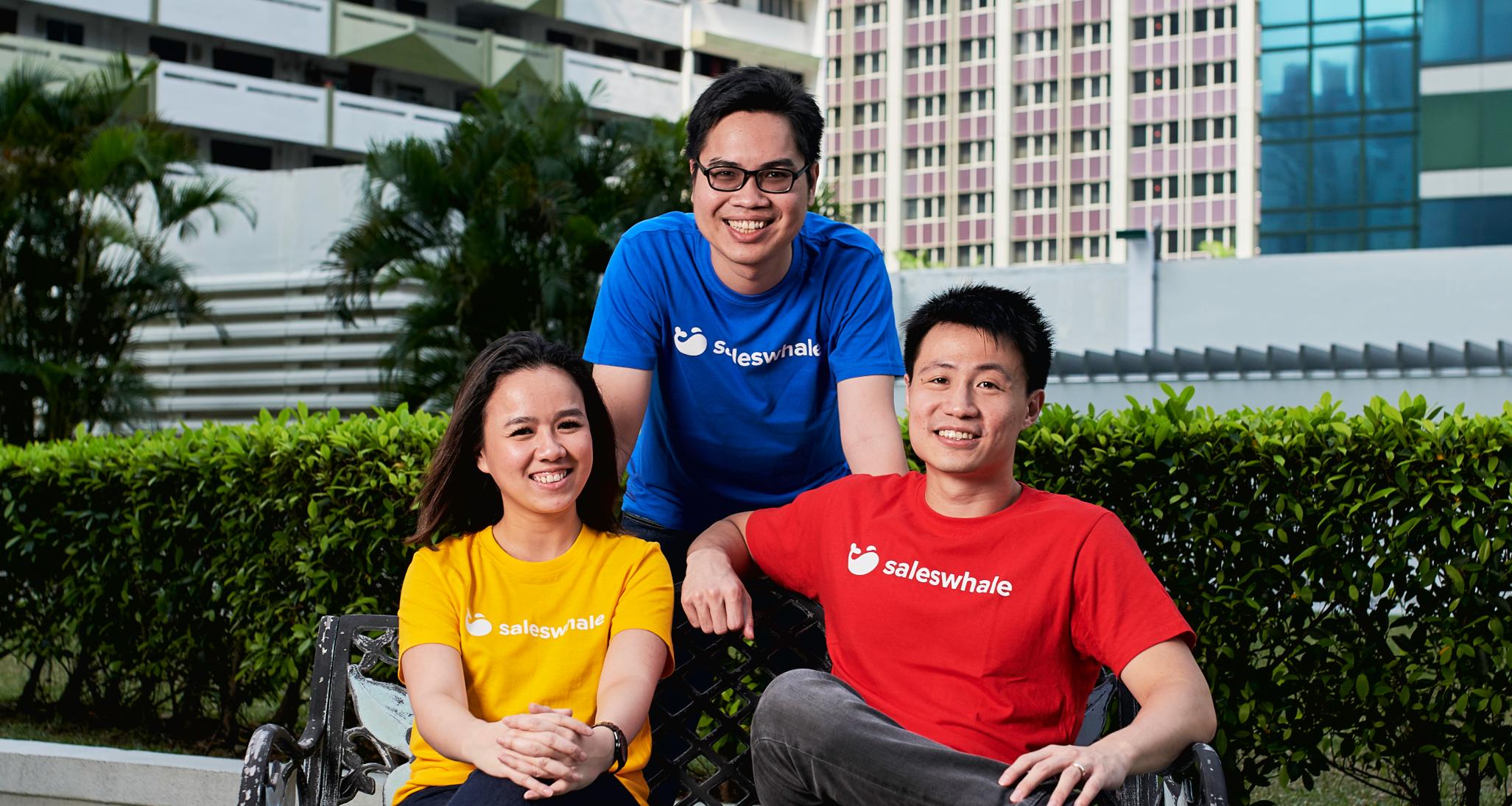
SalesWhale’s founding team (left to right): Venus Wong, Ethan Lee and Gabriel Lim

While AI is a (genuine) threat to many human jobs, SalesWhale sits on the opposite side of that problem in that it actually helps human employees get more work done. That’s to say that SalesWhale’s service can get stuck into a pile (or spreadsheet) of leads that human staff don’t have time for, begin reaching out, qualifying leads and sending them on to living and breathing colleagues to take forward.

“A lot of potential leads aren’t touched” by existing human teams, Lim reflected.

But when SalesWhale reps do get involved, they are often not recognized as the bots they are.

“Customers are often so convinced they are chatting with a human — who is sending collateral, PDFs and arranging meetings — that they’ll say things like ‘I’d love to come by and visit someday,'” Lim joked in an interview.

“Indeed, a lot of times, sales team refer to [SalesWale-powered] sales assistant like they are a real human colleague,” he added.

23 Apr 2019

Why unicorns can raise $1 billion but can’t figure out diversity and inclusion

In the early 2000s, Hasbro revived its “My Little Pony” toy franchise. Of all the colorful creatures in Ponyville, my favorite were the unicorn ponies.

Unicorn ponies were magical, whimsical and, most importantly, rare. I identified with the latter.

I was 13 years old and had just been selected for a competitive math, science and computer science program. Of the 100 students in the program, I was one of two black girls. But, I was lucky. Just like the Earth ponies embraced the unicorns, my white and Asian classmates made me feel welcome.

I wish that was always my experience in the tech industry.

The tech industry is no more diverse than it was when I was 13. But more tech companies than ever have committed to becoming more diverse and inclusive.

So why doesn’t commitment always translate to Ponyville?

Goodbye Ponyville, hello world

Six years in my intensive math, science and computer science program almost prepared me to study at MIT. Multivariable calculus? Check. Getting over the fact that you’re not the smartest person at school? Check. Having to worry about being discriminated against by your classmates? Not check.

Here’s an example. My senior year, I was working with a team of 21 other students to develop a new medical device. Peer valuations determined part of my grade, which concerned me. I worried that some of my classmates’ feedback would be clouded by biases against black women. I felt pressured to be perceived as intelligent-but-not-intimidating, confident-but-not-aggressive and approachable-but-not-dense.

Though I largely received positive evaluations, not one, but two, of my teammates told me to “be less aggressive.”

I felt singled out and discouraged until I heard from some of my other black classmates. They’d been excluded from team meetings, and assigned the most menial tasks.

Creating diverse and inclusive tech companies starts with individuals.

How could this happen at MIT, a place that prides itself on being a diverse and inclusive center of innovation?

People discriminate. Institutions tolerate discrimination. People learn to tolerate the discrimination against them. It’s a simple, vicious cycle that few institutions and companies design against.

During the three years after I graduated from MIT, I became fed up with being treated as “less than.” It was time to find a unicorn.

Unicorn (noun)

uni·corn | \ ˈyü-nə-ˌkȯrn

  1. a mythical, usually white animal generally depicted with the body and head of a horse with long flowing mane and tail and a single often spiraled horn in the middle of the forehead
  2. a diverse and inclusive tech company

Following the Rainbow Trail

Finding a unicorn was not easy. My Google search yielded plenty of startups with billion-plus valuations. Few startups were very diverse or inclusive.

That’s why Temboo, a NYC-based industrial IoT startup, intrigued me:

  • A tech company led by a woman of color.
  • An engineering team with an equal number of women and men.
  • A product focused on accessibility and the democratization of programming.
  • A diverse team of employees from different cultural backgrounds.
  • And, most surprisingly, when I arrived for my first interview, I was greeted with a giant hug. This is New York. Random hugs don’t just happen.

Every person I met had a background and interests different from the next. Of all the companies I interviewed with, only Temboo asked why I chose to lead the black employee resource group at my previous position. Even the company’s physical space was different than most tech companies — an independent office nestled in the heart of the TriBeCa neighborhood of NYC.

When I made the decision to join the team, I was hopeful. Maybe this would be a place where I would be respected and appreciated for just being myself.

My Little Pony: NYC tales

During my first few months, I held onto the past lessons that taught me I needed to formulate an acceptable version of myself for my colleagues. However, with time, I understood that at Temboo, Sarah is enough.

My kinky hair could be braided or in an afro, but my hairstyle had no bearing on my perceived intelligence. I could openly critique the lack of diversity at the industrial IoT conferences we attend, and hear resounding agreement.

There were, admittedly, a few times I felt judged. My deep love of obscure reality TV shows and pumpkin-flavored foods is questionable.

I found my unicorn and I’m happier for it. Now, I want everyone working in tech to find their unicorn, so I’ve started to think about ways that I can help pass the torch.

Stuck in Bro-nyville

Most tech companies are following the same recommendations to become more diverse and inclusive:

  1. Diversify your talent pool.
  2. Create community with employee resource groups.
  3. Tie performance evaluations to diversity and inclusion goals.
  4. Call out the lack of diversity.

Take the example of this medium-sized tech company that was preparing to revamp its employee resource groups. The company invited me to speak on a panel, and share what I’d learned from leading the black employee resource group at my previous company.

For example, my team organized Microaggression Awareness Week. The results were tangible: the next week during an executive leadership meeting, a senior manager stopped to ask his peers if something he said was a microaggression.

But we could not convince the recruiting team to tie their performance ratings to diversity and inclusion goals. They did not want the burden of responsibility, and asked my team to come up with new ideas to attract more diverse talent.

Diverse and inclusive tech companies have better retention and financial performance.

Another panelist shared her experience of coming out in the workplace at 50 years old. After 18 years as a senior executive at a Fortune 500 company, she moved to a small tech company. The atmosphere was totally different. Jokes about someone’s sexual orientation were faux pax, and the company even built a float for the NYC Pride Parade. After a 30-year career, she finally felt safe enough to be herself at work.

The panel ended on an encouraging note, but issues remained. One of the company’s employees shared with me that in order to avoid discrimination, he goes by his Anglo-sounding middle name. His job is to lead diversity and inclusion initiatives.

How to grow a horn

Unfair behaviors like stereotyping, harassment and microaggressions are the primary reasons employees quit tech companies. Women, underrepresented minorities and LGBTQ employees bear the brunt of discrimination (Kapor Center).

Diverse and inclusive tech companies have better retention and financial performance. McKinsey examined the relationship between the diversity of company leadership and financial performance in 2014 and 2017: companies in the top quartile for gender diversity were 15-21 percent more likely to experience above-average profitability compared to companies in the fourth quartile. For ethnic and cultural diversity, the likelihood of above-average performance increased to 33-35 percent.

Creating diverse and inclusive tech companies starts with individuals. From management to junior employees, everyone needs to continually rethink, unlearn and relearn.

Rethink personal biases.

Unlearn habits of discrimination.

Relearn how to respect others who are different.

Companies help end workplace discrimination by signaling their intolerance. Temboo’s culture and practices are a great model.

Unicorns are magical, but diverse and inclusive tech companies are not. They ask the people who work there to redefine what is ordinary.


23 Apr 2019

Tumblr – finally – enables HTTPS for all accounts

Better late than never, Tumblr has rolled out HTTPS across its entire site.

In a brief post on Tumblr’s engineering page, the company said all Tumblr sites will now have the web encryption setting enabled by default, though it admitted the move was “long-overdue.”

Tumblr, which like TechCrunch is owned by Verizon, has 464 million users and at the time of writing ranks in at 44 of the top 100 sites based on Alexa traffic data. Until the HTTPS switchover, it was the highest ranked site that didn’t enable HTTPS across its entire site.

The rollout followed an earlier effort to switch the site over to HTTPS in 2017, but required users to enable the feature.

HTTPS — the ‘s’ stands for ‘secure’ — ensures the website or app you’re using is encrypted, ensuring nobody can intercept and steal your data or modify the website. Millions of websites have embraced the web encryption standard in recent years amid concerns about privacy, tracking and surveillance.