Category: UNCATEGORIZED

19 Apr 2019

Alphabet’s Sidewalk Labs is developing visual cues to indicate when their tech is monitoring you

Alphabet’s subsidiary focused on urban tech development, Sidewalk Labs, is now trying to reinvent signage for smart cities. These signs aren’t to direct the flow of traffic, or to point the way to urban landmarks — they’re designed to let citizens know when they’re being monitored.

The proposal is part of a push by the company to acclimate people to the technologies that it’s deploying in cities like New York and Toronto.

Globally, competition for contracts to deploy sensors, data management, and predictive technologies in cities can run into the tens of millions, if not billions of dollars, and Sidewalk Labs knows this better than most. Because its projects are among the most ambitious deployments of sensing and networking technologies for smart cities, the company has also faced the most public criticism.

So at least partially in an attempt to blunt attacks from critics, the company is proposing to make its surveillance and monitoring efforts more transparent.

“Digital technology is all around us, but often invisible. Consider: on any one urban excursion (your commute, perhaps), you could encounter CCTVs, traffic cameras, transit card readers, bike lane counters, Wi-Fi access points, occupancy sensors that open doors — potentially all on the same block.” writes Jacqueline Lu, who’s title is “assistant director of the public realm” at Sidewalk Labs.

Lu notes that while the technologies can be useful, there’s little transparency around the data these technologies are collecting, who the data is being collected by, and what the data is collected for.

Cities like Boston and London already indicate when technology is being used in the urban environment, but Sidewalk Labs convened a group of designers and urban planners to come up with a system for signage that would make the technology being used even more public for citizens going about their day.

Image courtesy of Sidewalk Labs

Back in 2013, the U.S. Federal Trade Commission called for the development of these types of indicators when it issued a call for mobile privacy disclosures. But that seems to have resulted in companies just drafting reams of jargon-filled disclosures that obscured more than they revealed.

At Sidewalk, the goal is transparency, say the authors of the company’s suggested plan.

“We strongly believe that people should know how and why data is being collected and used in the public realm, and we also believe that design and technology can meaningfully facilitate this understanding. For these reasons, we embarked on a collaborative project to imagine what digital transparency in the public realm could be like,” writes Lu and her co-authors Principal Designer Patrick Keenan and Legal Associate Chelsey Colbert.

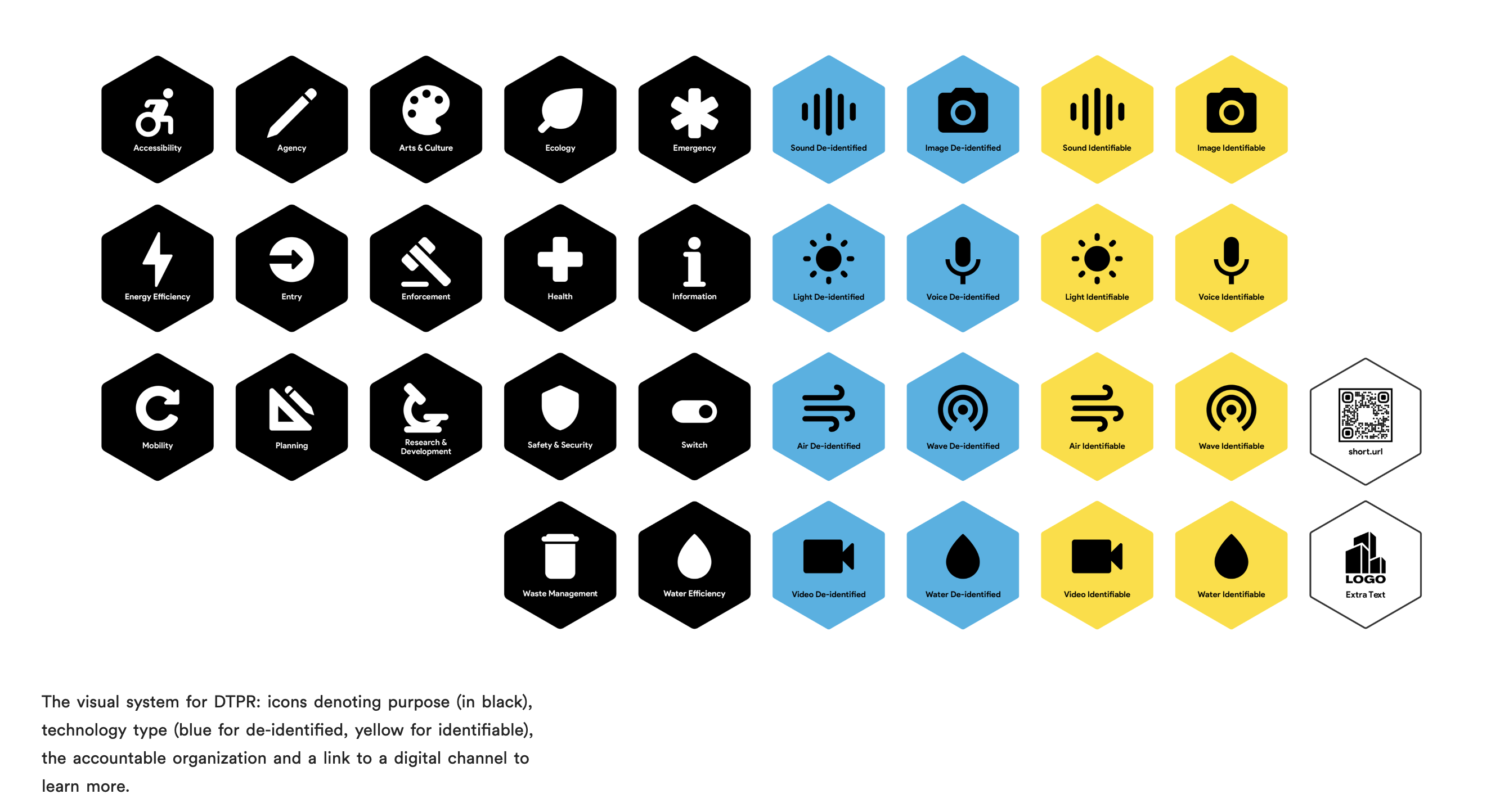
As an example, Sidewalk showed off potential designs for signage that would alert people to the presence of the company’s Numina technology.

That tech monitors traffic patterns by recording, anonymizing and transmitting data from sensors using digital recording and algorithmically enhanced software to track movement in an area. These sensors are installed on light poles and transmit data wirelessly.

At the very least, the technology can’t be any worse than the innocuously intended cameras that are monitoring publicly spaces already (and can be turned into surveillance tools easily).

The hexagonal designs indicate the purpose of the technology, the company deploying it, the reason for its use, whether or not the tech is collecting sensitive information and a QR code that can be scanned to find out more information.

The issue is with experiments like these in the public sphere is that there’s no easy way to opt out of them. Sidewalk Lab’s Toronto project is both an astounding feat of design and the apotheosis of surveillance capitalism.

Once these decisions are made to cede public space to the private sector, or sacrifice privacy for security (or simply better information about a location for the sake of convenience) they’re somewhat difficult to unwind. As with most of the salient issues with technology today, it’s about unintended consequences.

Information about a technology’s deployment isn’t enough if the relevant parties haven’t thought through the ramifications of that technology’s use.

19 Apr 2019

Netflix says it’s testing a shuffle feature for when you don’t know what to watch

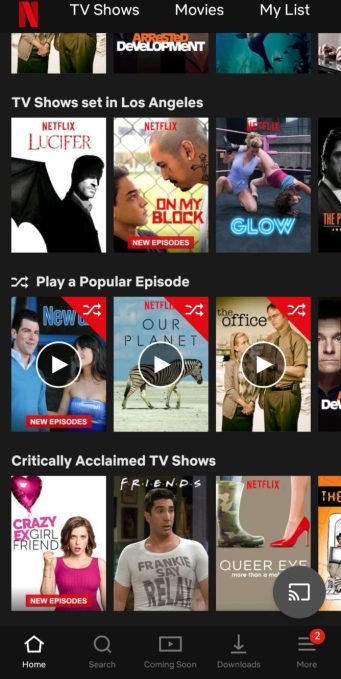
Netflix is testing a new feature that can help you start streaming when you don’t know what to watch. The company confirmed it’s testing a shuffle mode of sorts, that will allow you to easily click on a popular show to start playing a random episode. The idea with the feature is to offer an experience that’s more like traditional TV — where you could just turn the set on, and there would be something to watch.

With today’s streaming services, that sort of seamless experience is more difficult to achieve. Instead, viewers now have to first select a streaming app, then scroll through endless menus and recommendations before they can settle on their next title.

The new shuffle feature, instead, offers something closer to the experience of turning on cable TV, when there was always some classic favorite show playing in syndication.

The shows being tested with the new feature appear to be those that people choose when they don’t know what else to watch, like The Office, New Girl, Our Planet, Arrested Development and others.

The Office, in particular, has a reputation for being a go-to pick for when you’re not in the middle of some other binge fest.

The TV shows appear in a new row, titled “Play a Random Episode.” To get started, you’d click any TV show’s thumbnail, and a random episode from the series then starts playing.

The thumbnails themselves are also adorned with a red “shuffle” icon to indicate they’ll play a random episode.

(Above: Seems someone had the right idea)

The new feature was first spotted by the folks at Android Police, who saw the option appear in the Android version of Netflix’s app.

Netflix confirmed to TechCrunch the shuffle feature is something it’s considering, but hasn’t yet committed to rolling out.

“We are testing the ability for members to play a random episode from different TV series on the Android mobile app. These tests typically vary in length of time and by region, and may not become permanent,” a Netflix spokesperson said.

Netflix for some time has been focused on ways to get users streaming its content faster, after they log in. That’s where it’s decision to run autoplaying trailers comes in, for example, or why it now features those Stories-inspired previews; or why it tested promoting its shows right on the login screen.

Image credit: Android Police

19 Apr 2019

Daily Crunch: Zoom and Pinterest go public

The Daily Crunch is TechCrunch’s roundup of our biggest and most important stories. If you’d like to get this delivered to your inbox every day at around 9am Pacific, you can subscribe here.

1. Zoom pops 81 percent in Nasdaq debut

Thursday was a big day for tech IPOs, with Zoom opening trading at $65 a share. The company’s initial public offering gave it a fully diluted market cap of roughly $16 billion.

Meanwhile, Pinterest debuted on the New York Stock Exchange at $23.75 per share.

2. Facebook now says its password leak affected ‘millions’ of Instagram users

“We discovered additional logs of Instagram passwords being stored in a readable format,” the company said. “We now estimate that this issue impacted millions of Instagram users. We will be notifying these users as we did the others.”

3. Mueller report sheds new light on how the Russians hacked the DNC and the Clinton campaign

At one point, the Russians used servers located in the U.S. to carry out the massive data exfiltration effort, the report says.

The Instagram app is seen on an iPhone on 16 March, 2017. (Photo by Jaap Arriens/NurPhoto via Getty Images)

4. Instagram hides Like counts in leaked design prototype

Hiding Like counts could reduce the herd mentality, where people just Like what’s already got tons of Likes. It could also reduce the sense of competition.

5. The consumer version of BBM is shutting down on May 31

While the consumer version of BlackBerry Messenger is shutting down, the service will still exist. In fact, BlackBerry announced a plan to open its enterprise version to general consumers.

6. Amazon launches ad-supported music service to Echo owners

Until this week, Echo owners who wanted to stream music from Amazon could either pay for an annual Prime membership in order to access Prime Music, or they could pay $3.99 per month to stream from Amazon Music Unlimited.

7. The different playbooks of D2C brands

Venture capital firms have invested over $4 billion in D2C brands since 2012, with 2018 alone accounting for over $1 billion. How are these D2C brands going to evolve and how could they sustain as businesses? (Extra Crunch membership required.)

19 Apr 2019

Verified Expert Brand Designer: Ramotion

Ramotion is a remote branding and product design agency that has worked with Bay Area tech startups since 2014. While they typically do branding for funded, fast-growing startups, Ramotion has helped companies ranging from Bitmoji’s early brand identity to Mozilla’s rebrand. We spoke to Ramotion’s CEO Denis Pakhaliuk about their iterative approach, his favorite branding projects, and more.  


Ramotion’s branding philosophy:

“We are a big fan of starting small: designing a small package, releasing it, and then iterating on top of that. So, founders need to be focused on what’s really necessary right now for their next round of investment or product releases.”

On common founder mistakes:

“I think some founders think they need everything, but they actually need an MVP and product design. The same goes for brand identity. They need to have some key elements like colors, typeface, and the logo. There is no need to do everything in the beginning, because the logo and brand identity becomes meaningful after it’s used. It’ll eventually improve.”

“They’re the reason we have such an amazing logo today.” Kevin Sproles, Austin, Founder & CEO at Volusion

Below, you’ll find the rest of the founder reviews, the full interview, and more details like pricing and fee structures. This profile is part of our ongoing series covering startup brand designers and agencies with whom founders love to work, based on this survey and our own research. The survey is open indefinitely, so please fill it out if you haven’t already.


Interview with Ramotion’s CEO Denis Pakhaliuk

Yvonne Leow: Can you tell me about your journey and how you came to create Ramotion?

Denis Pakhaliuk: Yea, I started as a CG designer more than 10 years ago. I was doing computer graphics, CG modeling, digitalization of architectural design and automotive design. I was initially very focused on German cars and industrial design. Once iPhone 3G came out, I switched to doing UI design for mobile apps, which was a very hot topic at the time.

From that point I met a guy who just said, “Hey, I’m thinking of building an agency,” and so we decided to do it together. It started with a few people and now we have up to 30. We focus on different products, from small companies to more established brands, like Salesforce, among others. So yeah, it’s been a fun journey.

Yvonne Leow: At what point did Ramotion start working with startups?

19 Apr 2019

How do you hire a great growth marketer?

Editors Note: This article is part of a series that explores the world of growth marketing for founders. If you’ve worked with an amazing growth marketing agency, nominate them to be featured in our shortlist of top growth marketing agencies in tech.

Startups often set themselves back a year by hiring the wrong growth marketer.

This post shares a framework my marketing agency uses to source and vet high-potential growth candidates.

With it, early-stage startups can identify and attract a great first growth hire.

It’ll also help you avoid unintentionally hiring candidates who lack broad competency. Some marketers master 1-2 channels, but aren’t experts at much else. When hiring your first growth marketer, you should aim for a generalist.

This post is split into two halves:

  1. How I find growth candidates.
  2. How I identify which candidates are legitimately talented.

Great marketers are often founders

One interesting way to find great marketers is to look for great potential founders.

Let me explain. Privately, most great marketers admit that their motive for getting hired was to gain a couple years’ experience they could use to start their own company.

Don’t let that scare you. Leverage it: You can sidestep the competitive landscape for marketing talent by recruiting past founders whose startups have recently failed.

Why do this? Because great founders and great growth marketers are often one and the same. They’re multi-disciplinary executors, they take ownership, and they’re passionate about product.

You see, a marketing role with sufficient autonomy mimics the role of a founder: In both, you hustle to acquire users and optimize your product to retain them. You’re working across growth, brand, product, and data.

As a result, struggling founders wanting a break from the startup rollercoaster often find transitioning to a growth marketing role to be a natural segue.

How do we find these high-potential candidates?

Finding founders

To find past founders, you could theoretically monitor the alumni lists of incubators like Y Combinator and Techstars to see which companies never succeeded. Then you can reach out to their first-time founders.

You can also identify future founders: Browse Product Hunt and Indie Hackers for old projects that showed great marketing skill but didn’t succeed.

There are thousands of promising founders who’ve left a mark on the web. Their failure is not necessarily indicative of incompetence. My agency’s co-founders and directors, including myself, all failed at founding past companies.

How do I attract candidates?

To get potential founders interested in the day-to-day of your marketing role, offer them both breadth and autonomy:

  • Let them be involved in many things.
  • Let them be fully in charge of a few things.

Remember, recreate the experience of being a founder.

Further, vet their enthusiasm for your product, market, and its product-channel fit:

  • Product and market: Do their interests line up with how your product impacts its users? For example, do they care more about connecting people through social networks, or about solving productivity problems through SaaS? And which does your product line up with?
  • Product-channel fit: Are they excited to run the acquisition channels that typically succeed in your market?

The latter is a little-understood but critically important requirement: Hire marketers who are interested in the channels your company actually needs.

Let’s illustrate this with a comparison between two hypothetical companies:

  1. A B2B enterprise SaaS app.
  2. An e-commerce company that sells mattresses.

Broadly speaking, the enterprise app will most likely succeed through the following customer acquisition channels: sales, offline networking, Facebook desktop ads, and Google Search.

In contrast, the e-commerce company will most likely succeed through Instagram ads, Facebook mobile ads, Pinterest ads, and Google Shopping ads.

We can narrow even further: In practice, most companies only get one or two of their potential channels to work profitably and at scale.

Meaning, most companies have to develop deep expertise in just a couple channels.

There are enterprise marketers who can run cold outreach campaigns on autopilot. But, many have neither the expertise nor the interest to run, say, Pinterest ads. So if you’ve determined Pinterest is a high-leverage ad channel for your business, you’d be mistaken to assume that an enterprise marketer’s cold outreach skills seamlessly translate to Pinterest ads.

Some channels take a year or longer to master. And mastering one channel doesn’t necessarily make you any better at the next. Pinterest, for example, relies on creative design. Cold email outreach relies on copywriting and account-based marketing.

(How do you identify which ad channels are most likely to work for your company? Read my Extra Crunch article for a breakdown.)

To summarize: To attract the right marketers, identify those who are interested in not only your product but also how your product is sold.

Other approaches

The founder-first approach I’ve shared is just one of many ways my agency recruits great marketers. The point is to remind you that great candidates are sometimes a small career pivot away from being your perfect hire. You don’t have to look in the typical places when your budget is tight and you want to hire someone with high, senior potential.

This is especially relevant for early-stage, bootstrapping startups.

If you have the foresight to recognize these high-potential candidates, you can hopefully hire both better and cheaper. Plus, you empower someone to level up their career.

Speaking of which, here are other ways to hire talent whose potential hasn’t been fully realized:

  • Find deep specialists (e.g. Facebook Ads experts) and offer them an opportunity to learn complementary skills with a more open-ended, strategic role. (You can help train them with my growth guide.)
  • Poach experienced junior marketers from a company in your space by offering senior roles.
  • Hire candidates from top growth marketing schools.

Part II: Vetting growth marketers

If you don’t yet have a growth candidate to vet, you can stop reading here. Bookmark this and return when you do!

Now that you have a candidate, how do you assess whether they’re legitimately talented?

At Bell Curve, we ask our most promising leads to incrementally complete three projects:

  • Create Facebook and Instagram ads to send traffic to our site. This showcases their low-level, tactical skills.
  • Walk us through a methodology for optimizing our site’s conversion rate. This showcases their process-driven approach to generating growth ideas. Process is everything.
  • Ideate and prioritize customer acquisition strategies for our company. This showcases their ability to prioritize high-leverage projects and see the big picture.

We allow a week to complete these projects. And we pay them market wage.

Here’s what we’re looking for when we assess their work.

Level 1: Basics

First — putting their work aside — we assess the dynamics of working with them. Are they:

  • Competent: Can they follow instructions and understand nuance?
  • Reliable: Will they hit deadlines without excuses?
  • Communicative: Will they proactively clarify unclear things?
  • Kind: Do they have social skills?

If they follow our instructions and do a decent job, they’re competent. If they hit our deadline, they’re probably reliable. If they ask good questions, they’re communicative.

And if we like talking to them, they’re kind.

Level 2: Capabilities

A level higher, we use these projects to assess their ability to contribute to the company:

  • Do they have a process for generating and prioritizing good ideas? 
    • Did their process result in multiple worthwhile ad and landing page ideas? We’re assessing their process more so than their output. A great process leads to generating quality ideas forever.
    • Resources are always limited. One of the most important jobs of a growth marketer is to ensure growth resources are focused on the right opportunities. I’m looking for a candidate that has a process for identifying, evaluating, and prioritizing growth opportunities.
  • Can they execute on those ideas? 
    • Did they create ads and propose A/B tests thoughtfully? Did they identify the most compelling value propositions, write copy enticingly, and target audiences that make sense?
    • Have they achieved mastery of 1-2 acquisition channels (ideally, the channels your company is dependent on to scale)? I don’t expect anyone to be an expert in all channels, but deep knowledge of at least a couple channels is key for an early-stage startup making their first growth hire.

If you don’t have the in-house expertise to assess their growth skills, you can pay an experienced marketer to assess their work. It’ll cost you a couple hundred bucks, and give you peace of mind. Look on Upwork for someone, or ask a marketer at a friend’s company.

Recap

  • If you’re an early-stage company with a tight budget, there are creative ways to source high-potential growth talent.
  • Assess that talent on their product fit and market fit for your company. Do they actually want to work on the channels needed for your business to succeed?
  • Give them a weeklong sample project. Assess their ability to generate ideas and prioritize them.
19 Apr 2019

Reese Witherspoon’s Hello Sunshine is considering book-themed subscription boxes

Reese Witherspoon’s media company Hello Sunshine already has its hands in movies, television, Apple TV+ shows, podcasts, Audible originals, books, and more. Now, it’s weighing an entry into the subscription box business, to further capitalize on its brand and its appeal to women.

The subscription boxes under consideration would operate out of Reese’s Book Club — the curated selection of book recommendations whose focus is on titles with strong, female leads. The club, which some believe may one day rival Oprah’s, is already capable of driving sales at Amazon and elsewhere. It’s also now a feeder into other Hello Sunshine projects — like HBO’s “Big Little Lies,”  Hulu’s upcoming adaptation of “Little Fires Everywhere,” and others.

Now the company is gathering feedback as to how to turn the book club’s online brand — which began with Witherspoon posting books to Instagram — into a revenue-generating business of its own.

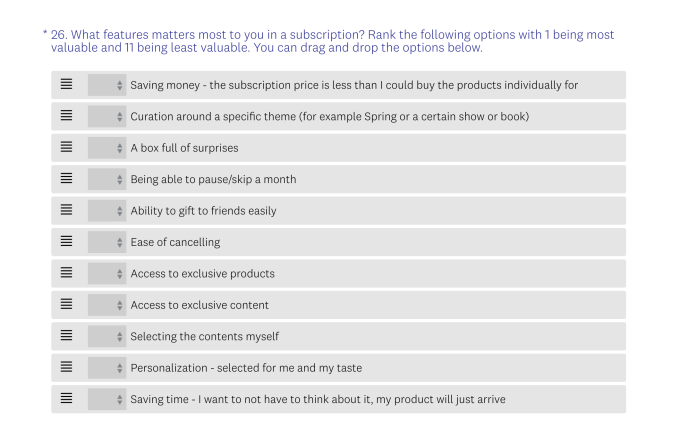
Hello Sunshine members recently received a survey asking for their feedback about Hello Sunshine and Reese’s Book Club. But the questions it posed were almost entirely focused on gathering information about what members would want to see in a subscription box.

For example, would they prefer items that are seasonal, themed to the book club’s current pick, or those that  are related to reading — like booklamps and bookmarks? Or would members be open to anything Reese just likes herself, for whatever reason?

To some extent, Hello Sunshine has already begun the process of curating other non-book items, through the site’s online shop where it features things like totes, mugs, pins, hats, notebooks, makeup bags, and even jewelry. These could be easily added into subscription boxes, if the time comes.

The survey also asked for feedback about how the books would be paired with the other items. Members were asked if they would prefer the monthly book club selection or themed boxes like “favorite books,” “classics” or “summer reads,” for example.

Finally, the survey asked about how customers would like to pay — monthly, quarterly, annually, and so on.

While the larger subscription box craze may have passed, many that have a more female-friendly focus are still surviving — like Birchbox and Ipsy’s makeup boxes, jewelry focused Rocksbox, FabFitFun, and others. And some are even thriving — like Stitch Fix’s subscription-based clothing boxes.

Hello Sunshine’s potential in this space would instead come from its growing fan base, rather than something it has to start from scratch. Today the book club has 1 million Instagram followers, up from 390,000 a year ago. That’s in addition to the 471K who follow Hello Sunshine and the 17.3 million who follow Witherspoon.

Hello Sunshine did not return requests for comment.


19 Apr 2019

Apple could be adding Siri Shortcuts and Screen Time to macOS

Apple wants to add more iOS features to macOS according to a report from 9to5mac’s Guilherme Rambo. And it starts with improvements to Siri.

While Siri has been available on macOS for a while, it feels like a scaled-down version of Siri. Sure, you can ask for the weather, NBA scores or a word translation. You can also turn off the Wi-Fi or look up a file on your hard drive.

But Siri on macOS doesn’t work with any third-party app. You can’t send a message on WhatsApp, you can’t send some money using Square Cash, you can’t order an Uber.

According to 9to5mac, this will change with macOS 10.15 this fall. Apple is working on adding support Siri Shortcuts, which means that you’ll theoretically be able to create custom voice shortcuts to trigger actions in third-party apps.

Existing macOS apps won’t be able to add hooks for Siri Shortcuts — the feature should be limited to iOS ports that leverage the upcoming Marzipan framework. As a result, you can also expect a Shortcuts app to create your own scripts in a visual interface. Shortcuts has become the equivalent of Automator for iOS. Let’s see what happens to Automator after macOS 10.15.

The macOS update won’t just focus on Siri. You should expect to see Screen Time, the iOS feature that tells you how much time you spent in each app on your devices. The current implementation of Screen Time combines your usage across all your iOS devices, such as your iPhone and your iPad. But adding macOS data to the mix is key if you want to see the full picture.

Finally, Apple will let you control your Apple ID more easily from the Mac. Instead of relying on Apple’s website, you’ll be able to set up family sharing and more from a new panel in System Preferences.

19 Apr 2019

ProcessOut improves payment data visualization

ProcessOut has grown quite a lot since I first covered the startup. The company now has a ton of small and big clients, from Glovo to Vente-Privée and Dashlane. The company has become an expert on payment providers and payment analytics.

The core of the product remains the same. Clients sign up to get an overview on the performance of their payment systems. After setting up ProcessOut Telescope, you can monitor payments with expensive fees, failed payments and disappointing payment service providers.

And this product is quite successful. Back in October 2018, the company had monitored $7 billion in transactions since its inception — last month, that number grew to $13 billion.

The company is adding new features to make it easier to get insights from your payment data. You can now customize your data visualization dashboards with a custom scripting language called ProcessOut Lang. This way, if you have an internal payment team, they can spot issues more easily.

ProcessOut can also help you when it comes to generating reports. The company can match transactions on your bank account with transactions on different payment providers.

If you’re a smaller company and can’t optimize your payment module yourself, ProcessOut also builds a smart-routing checkout widget. When a customer pays something, the startup automatically matches card information with the best payment service provider for that transaction in particular.

Some providers are quite good at accepting all legit transactions, such as Stripe or Braintree. But they are also more expensive than more traditional payment service providers. ProcessOut can predict if a payment service provider is going to reject this customer before handing the transaction to that partner. It leads to lower fees and a lower rejection rate.

The company recently added support for more payment service providers in Latin America, such as Truevo, AllPago and Mercadopago. And ProcessOut now routes more transactions in one day compared to the entire month of October 2018.

As you can see, the startup is scaling nicely. It will be interesting to keep an eye on it.

19 Apr 2019

Security flaw in French government messaging app exposed confidential conversations

The French government just launched its own messaging app called Tchap in order to protect conversations from hackers, private companies and foreign entities. But Elliot Alderson, also known as Baptiste Robert, immediately found a security flaw. He was able to create an account even though the service is supposed to be restricted to government officials.

Tchap wasn’t built from scratch. The DINSIC, France’s government agency in charge of all things digital, forked an open source project called Riot, which is based on an open source protocol called Matrix.

In a few words, Matrix is a messaging protocol that features end-to-end encryption. It competes with other protocols, such as the Signal Protocol that is widely used by consumer apps, such as WhatsApp, Signal, Messenger’s secret conversations and Google Allo’s incognito conversions — Messenger and Allo conversations aren’t end-to-end encrypted by default.

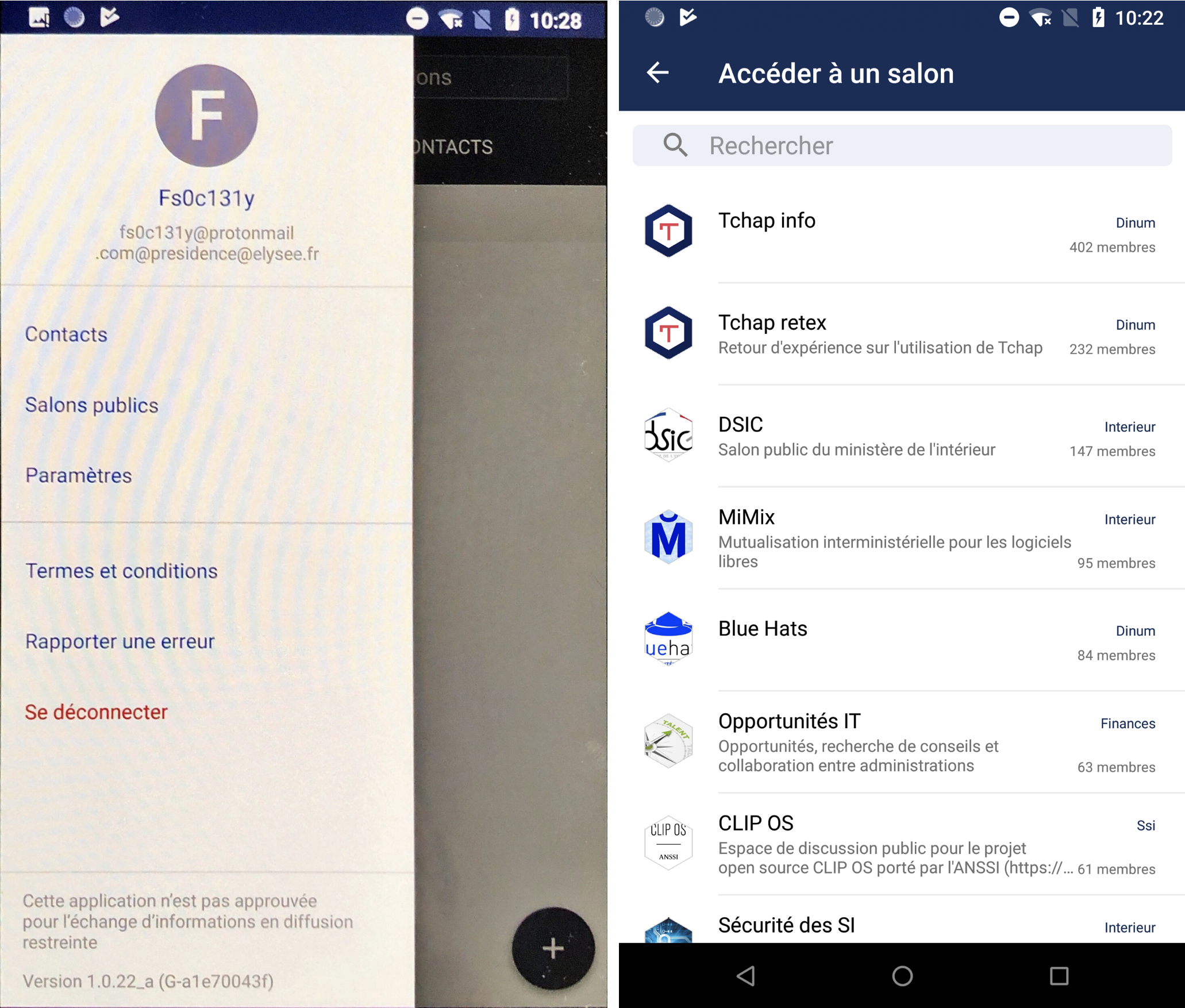
Riot is a Matrix client that works on desktop and mobile. You can join rooms, start private conversations, share photos and do everything you’d expect from a modern messaging app. Here’s what it looks like:

Developing Tchap became essential as Emmanuel Macron’s campaign team relied heavily on Telegram — the French government still uses Telegram and WhatsApp for many sensitive conversations. By default, Telegram doesn’t use end-to-end encryption. In other words, people working for Telegram could easily read Macron’s conversations. It’s a serious security weakness.

Similarly, you don’t want the Ministry of Defense to use Slack to talk about sensitive operations. The U.S. government could potentially issue a warrant to access those conversations on Slack’s servers.

Tchap features end-to-end encryption, and encrypted messages are stored on French servers. Access is restricted to government officials as you need to have an active email address that ends in @something.gouv.fr, or in @elysee.fr.

Yesterday, Alderson found out that you can create an account and access public channels even if you don’t have an official address. Adding @elysee.fr at the end of his email address was enough to receive the confirmation email to his real email address.

Alderson quickly disclosed the bug to the Matrix team. Matrix quickly issued a fix and deployed it. It was related to the identification system used by the French government.

According to Alderson, there’s a bug in the parsing method used in a well-known Python module. The bug hasn’t been fixed since July 2018.

The good news is that Tchap is officially launching today. The DINSIC managed to fix this security flaw just in time before the official launch and somebody could leverage it. In its press release, the government says that the DINSIC will launch a bug bounty program to identify other vulnerabilities.

19 Apr 2019

Sequoia reveals first cohort for its ‘Surge’ accelerator program in India and Southeast Asia

Back in January, Sequoia India announced plans for its first early-stage startup accelerator program in India and Southeast Asia, and today the firm announced its first cohort of 17 startups.

To recap, the program — which is called Surge — gives each startup a $1.5 million check and participation in a four-month program that’s split across India and Singapore, as well as the wider Sequoia global presence in China and San Francisco.

The program kicked off last month, but the startups were only unveiled for the first time today — here they are:

  • Azani Sports: a ‘full stack’ sports clothing startup based in India that sells online and through selected high street retails
  • Bobobox: a capsule hotel company based in Indonesia
  • Bulbul: a live-streaming service with a focus on e-commerce across India
  • DancingMind: a Singapore startup that uses VR to enable remote for stroke victims and patients of debilitating diseases like Parkinson’s
  • Doubtnut: an India-based education startup that uses photos, videos and AI
  • Flynote: a travel booking service with a focus on personalized trips
  • Hippo Video: a platform developing, editing and analyzing marketing and sales videos
  • InterviewBit Academy: a computer science training and development platform in India — that’s not unlike recent Y Combinator graduate Skill-Lync
  • Khatabook: an accounting service for SMEs in India that already claims 120,000 weekly users
  • Qoala: a micro-insurance startup based in Indonesia, which competes with rivals like PasarPolis — which is backed by three of Indonesia’s unicorns
  • ShopUp: a social commerce startup that helps sellers in Bangladesh do business through Facebook — that’s a similar concept to established Indian startups Meesho (another YC alum) and LimeRoad which enable sellers on WhatsApp
  • Skillmatics: a startup headquartered in India that develops learning games for pre-school and primary school kids aged under 10
  • Telio: a b2b commerce platform that aims to digitize the process of brands and wholesalers selling to retailers
  • Uiza: a Singapore-Vietnam startup that lets publishers and companies develop their own video infrastructure independent of platforms like YouTube
  • Vybes: an e-commerce platform for social media influencers that’s based out of Singapore
  • Zenyum: a startup that provides invisible braces for consumers in Southeast Asia at a lower cost than traditional alternatives

Sequoia India managing director Shailendra Singh previously told TechCrunch that Surge would support a ‘curated’ selections of fellow VCs who could invest alongside in the cohort alongside the firm, and Sequoia said that the 17 startups have attracted a total of $36 million in investment. A spokesperson also pointed out that five of the selection have at least one female co-founders, which is almost certainly above average for the region although it is tricky to get reliable data covering India and (in particular) Southeast Asia.

Surge is an interesting effort for Sequoia, which has traditionally played in post-seed and growth stages of the investment cycle. Sequoia closed its most recent fund for India and Southeast Asia at $695 million last year, and it also has access to a globally active ‘growth’ fund that is targeted at $8 billion. Reports have suggested that Surge will get its own sparkling new $200 million fund, which would make a lot of sense given the potential conflict and confusion of investing via its main fund. But the firm is declining to comment on that possibility for now.

One major addition to the program that has been confirmed, however, is Rajan Anandan, the executive who previously ran Google’s business in India and Southeast Asia and is a well-known angel investor. His arrival was announced earlier this month and he will lead the Surge initiative.

His recruitment is a major win for Sequoia, which is betting that Surge’s early stage push will reap it richer dividends in India and Southeast Asia. That part remains to be seen, but certainly, there is a dearth of early-stage programs in both regions compared to other parts of the world.