Category: UNCATEGORIZED

09 Apr 2019

Travel activities platform Klook raises $225M led by SoftBank’s Vision Fund

We recently noted that SoftBank’s Vision Fund has stepped up its deal-making in Asia this year, and today it added a new company to its roster: travel services platform Klook.

Hong Kong-based Klook announced today that it has raised a $225 million round led by the Vision Fund with participation from existing investors. The deal — which is described as a “Series D plus” — comes just eight months after Klook announced its $200 million Series D at a valuation of over $1 billion. The company didn’t confirm what its new valuation is, but co-founder and president Eric Gnock Fah (second from right in the photo above) did confirm to TechCrunch that it has increased.

Klook was founded in 2014 and it serves as an activities platform for users who travel overseas. That covers areas like visits to adventure parks, scuba diving, more localized tours or basics such as train travel, food or airport transfers, all of which can be found, paid for and taken using Klook’s platform. Today, Klook claims to host 100,000 activities across over 270 destinations. Its team has grown to over 1,000 staff and it has 20 offices, including sites in Europe and the U.S. as well as, of course, on its home turf in Asia Pacific.

This new injection means that Klook has now raised $425 million to date. Its investors include Sequoia China, Matrix Partners, TCV, OurCrowd, Goldman Sachs, Boyu Capital, Technology Crossover Ventures (TCV) among others.

Gnock Fah said that Klook has maintained a dialogue with SoftBank “for a while.” The company only recently raised its Series D so didn’t need the additional capital, but he said that it was moved by SoftBank’s “bigger vision” and its potential role in the SoftBank “ecosystem.”

That, in particular, means opportunities to work with other Vision Fund-backed startups in Asia. Gnock Fah specifically name-checked ride-hailing firm Grab in Southeast Asia and hospitality company OYO, as well as e-commerce companies Coupang in Korea and Tokopedia in Southeast Asia.

“We don’t do point to point or on demand so it’s synergistic on both ends,” he said of potential tie-ins with Grab — which is already working with OYO — while he cited Klook’s ongoing work with Alibaba, which has relationships with Tokopedia and Lazada in Southeast Asia.
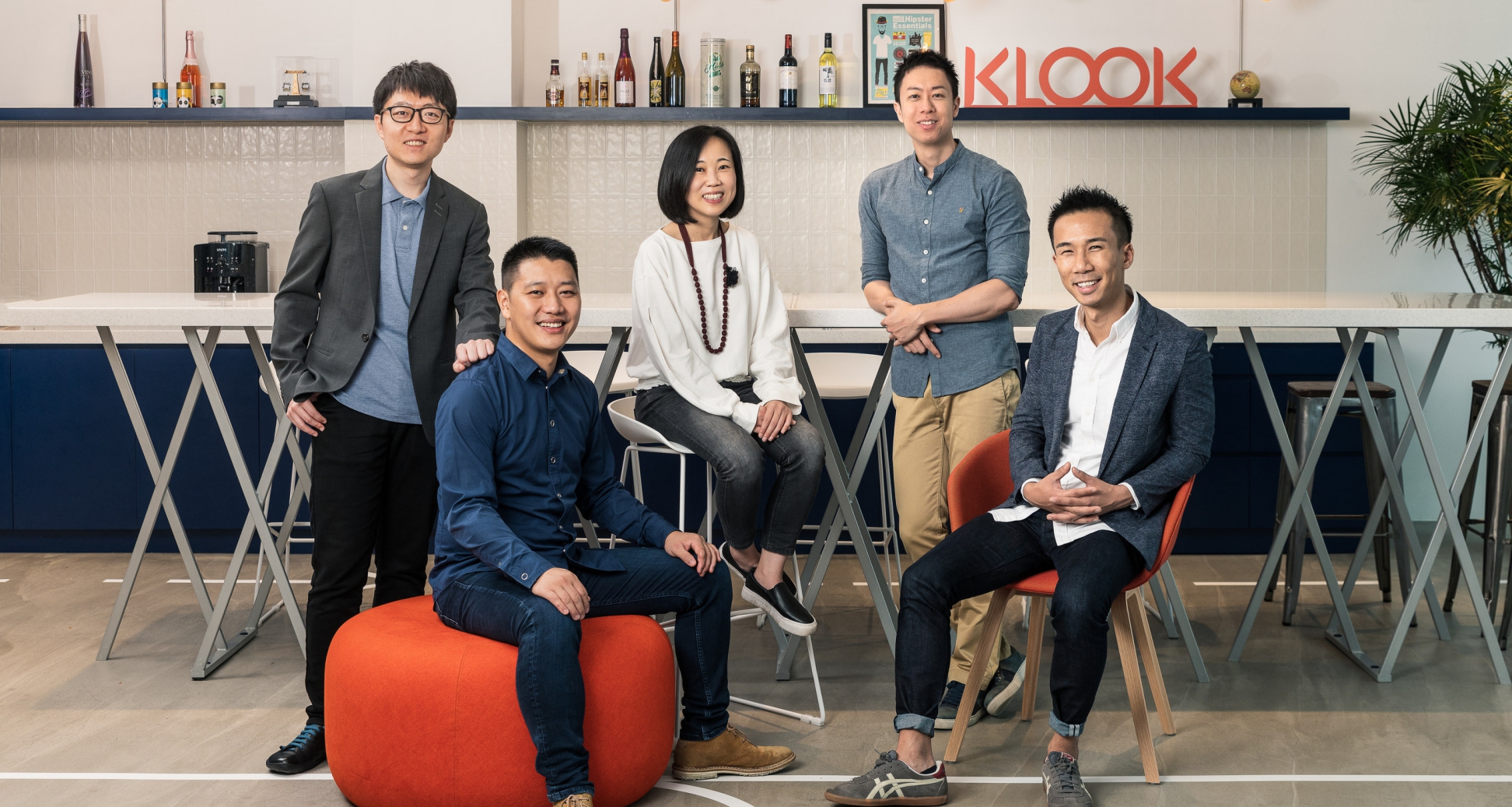
(From left to right) David Liu, Chief Product Officer; Bernie Xiong, Chief Technology Officer and Co-Founder; Anita Ngai, Chief Revenue Officer; Eric Gnock Fah, Chief Operating Officer and Co-Founder; Ethan Lin, Chief Executive Officer and Co-Founder (PRNewsfoto/Klook)

The new funds will be used to go after growth in Western markets, Gnock Fah explained, as well as increasing Klook’s efforts in Japan — where it has been ramping up ahead of the Summer Olympics in 2020, and now has the SoftBank connection.

“Now is the time to scale up the fundamentals we’ve built in Western regions,” Gnock Fah said in an interview. “We already have a team on the ground — fundamentals are built — now it is about investing more on the supply-demand side.”

That sounds like increased online advertising spend — I often wonder how handsomely Facebook and Google profit from Vision Fund investments — while in Japan the company is working to cater to more Japanese travelers heading overseas on trips as well as inbound tourism. SoftBank has launched a number of joint ventures with Vision Fund companies to bring their services to the Japanese market — Paytm, WeWork, OYO and Didi Chuxing immediately come to mind — but Gnock Fah said nothing definitive has been decided.

“We’re in a lot of conversations with their team about how to work closely with them,” he said, pointing out that — unlike those aforementioned examples — Klook already has a presence in Japan.

Whenever the Vision Fund has invested in Asia-based companies, I’ve asked the founders how they handle the fund’s links to the murder of journalist Jamal Khashoggi, an outspoken critic of the Saudi regime. Crown Prince Mohammad bin Salman is widely believed to have ordered the killing, and he runs Public Investment Fund (PIF), the main LP anchor behind the Vision Fund.

Clearly, based on an increase in deals in Asia this year, the link isn’t putting founders off.

Most founders of Vision Fund portfolio startups that TechCrunch spoke to have supplied fairly platitudinous comments or declined to say anything at all — you can read a collection of them here — but Gnock Fah suggested a new (and unique) perspective.

“Because it is a relatively new fund, there’s more spotlight” on the Vision Fund, he offered.

Klook declined to provide a further statement on the Vision Fund and the Khashoggi murder following our interview despite a request from TechCrunch.

“The new capital isn’t about capital per se — our economics are heath — but more for a strategic investment angle,” he said, getting back to more fundamental founder talking points.

The Vision Fund-led cash infusion does mean that Klook, which has been pretty candid about a potential IPO, is putting off plans for a liquidity exit further down the road.

“Right now, there is no fixed timeframe,” Gnock Fah said. “Back in the early days, we had that aspiration… back then, if we wanted to raise $300-400 million [then] IPO was the way to get that.”

“We believe Klook is a leader in taking a mobile-first approach to the travel activities and services industry. The company has seen great success in scaling its business across different geographies and cultures, and we are excited to help them drive further innovation in the global travel industry,” said SoftBank partner Lydia Jett in a statement.


09 Apr 2019

Blackpink’s “Kill This Love” sets new YouTube records, including the biggest Premiere

Blackpink, one of the highest-profile Korean pop groups, is breaking YouTube records with its latest video. A Google spokesperson confirmed to TechCrunch that “Kill This Love” is the fastest music video to hit 100 million views, having hit that number in less than three days. It is also now YouTube’s most viewed music video debut, racking up 56.7 million in the first 24 hours after it was posted.

Furthermore, “Kill This Love,” the first single and title track of Blackpink’s new EP, is the biggest YouTube Premiere to date, with a peak of 979,000 concurrent views. This surpasses the 829,000 concurrent views racked up during the YouTube Premiere of Ariana Grande’s “thank u, next” in December. YouTube launched Premieres as part of a new suite of creator tools in October. The feature allows them to create a landing page to promote a video ahead of its release and includes a chat feature like live videos, allowing YouTube to compete more directly with Twitch.

“Kill This Love” also hit milestones on iTunes, reaching the number one position in the US store, the first Asian girl group to do so.

Blackpink, a quartet of four women formed by YG Entertainment, one of Korea’s biggest music labels, is one of the most popular K-Pop groups. While it has already gained a massive fan following in Asia (and abroad) since its debut in 2016, Blackpink is now poised to follow BTS as the next K-Pop group to break into the mainstream in Western markets, with its first North American tour starting in Los Angeles later this month. Blackpink has always mixed Korean and English in its lyrics, but “Kill This Love” is notable for being more multilingual than the group’s previous tracks, broadening its potential appeal.

09 Apr 2019

Blackpink’s “Kill This Love” sets new YouTube records, including the biggest Premiere

Blackpink, one of the highest-profile Korean pop groups, is breaking YouTube records with its latest video. A Google spokesperson confirmed to TechCrunch that “Kill This Love” is the fastest music video to hit 100 million views, having hit that number in less than three days. It is also now YouTube’s most viewed music video debut, racking up 56.7 million in the first 24 hours after it was posted.

Furthermore, “Kill This Love,” the first single and title track of Blackpink’s new EP, is the biggest YouTube Premiere to date, with a peak of 979,000 concurrent views. This surpasses the 829,000 concurrent views racked up during the YouTube Premiere of Ariana Grande’s “thank u, next” in December. YouTube launched Premieres as part of a new suite of creator tools in October. The feature allows them to create a landing page to promote a video ahead of its release and includes a chat feature like live videos, allowing YouTube to compete more directly with Twitch.

“Kill This Love” also hit milestones on iTunes, reaching the number one position in the US store, the first Asian girl group to do so.

Blackpink, a quartet of four women formed by YG Entertainment, one of Korea’s biggest music labels, is one of the most popular K-Pop groups. While it has already gained a massive fan following in Asia (and abroad) since its debut in 2016, Blackpink is now poised to follow BTS as the next K-Pop group to break into the mainstream in Western markets, with its first North American tour starting in Los Angeles later this month. Blackpink has always mixed Korean and English in its lyrics, but “Kill This Love” is notable for being more multilingual than the group’s previous tracks, broadening its potential appeal.

09 Apr 2019

Rocket Lab adds satellite manufacturing to its offerings

Rocket Lab, one of the biggest startups in the NewSpace category of companies providing launch and satellite services, has added satellite manufacturing to the array of services it offers to customers.

The company, which already had developed launch capabilities and has begun sending payloads into space, can now deliver fully built satellites to its customers, according to a statement.

The “Photon” satellite platform was developed so that customers would not have to build their own satellite hardware.

“Small satellite operators want to focus on providing data or services from space, but building satellite hardware is a significant barrier to achieving this,” said Rocket Lab founder and chief executive Peter Beck, in a statement.
“The time, resources and expertise required to build hardware can draw small satellite operators away from their core purpose, delaying their path to orbit and revenue. As the turn-key solution for complete small satellite missions, Rocket Lab brings space within easy reach. We enable our customers to focus on their payload and mission – we look after the rest.”

The satellites are designed for a range of Low Earth Orbit missions including technology demonstrations, risk reduction pathfinders, constellations, and hosted payloads, the company said in a statement.

The satellites will stay in orbit for five years and include an S-band communication system, high-performance attitude controls, and a set of avionics tools for in-space propulsion and movement.

The new satellites will be manufactured at Rocket Labs’ Huntington Beach, Calif. headquarters and can be launched on the company’s Electron launch platform. The first such launch is scheduled for later in the first quarter of the year, and the company said it would have its first paying customer missions in 2020.

08 Apr 2019

Microsoft says its data shows FCC reports massively overstate broadband adoption

The broadband divide in the U.S. is real, but if you want to know how real, don’t ask the FCC. Its yearly broadband deployment report, already under fire for serious data problems, has now been further questioned by Microsoft, which says its own data contradicts coverage data provided by internet providers. Despite $22 billion in government spending, the company says, “adoption has barely budged.”

In a blog post, Microsoft explained that it was concerned with apparent inaccuracies in reports purporting to document broadband availability throughout the country. Leveraging what seems to be its Windows telemetry data, it came to vastly different conclusions than the FCC. (I’ve asked about the source of the data.)

For instance, the FCC report suggests that broadband, as it is currently defined, is not currently available to around 25 million people. Sounds reasonable. But Microsoft’s data says that some 163 million people “do not use the internet at broadband speeds.”

Those aren’t the same thing, obviously, but you’d think if a person had broadband available they would use it at least now and then, right?

To look further into the problem, Microsoft checked out a few locales:

In our home state of Washington, the FCC data indicates that 100 percent of Ferry County residents have access to broadband. When we spoke to local officials, they indicated that very few residents in this rural county had access and those that did were using broadband in business. Our data bears this out, showing that only 2 percent of Ferry County is using broadband.

So the entire county has broadband, but next to no one uses it? Seems odd. The pattern repeats elsewhere as well, rural and urban, with similar deltas between reported broadband availability and observed broadband activity.

“These significant discrepancies across nearly all counties in all 50 states indicates there is a problem with the accuracy of the access data reported by the FCC,” concludes Microsoft’s chief data analytics officer, John Kahan.

Part of the issue is that internet providers essentially just report their own coverage via a form, and the FCC reports it more or less as fact. That’s a problem not just when a mistake on a form adds tens of millions of subscribers that don’t actually exist, but when large ISPs overstate their coverage so they don’t have to pay to fill in the gaps.

Microsoft’s suggestions, which it plans to make directly to the Senate Commerce Committee in testimony on Wednesday, would make it far more difficult to fib on the Form 477, which as written seems to provide enormous leeway for a company to imply coverage that isn’t actually there.

The problems described here are not new or obscure, and even FCC commissioners have taken issue with the way this data is collected. Hopefully given the continued and growing outcry concerning this misleading report we will soon know better who in our country has, or needs, help getting online. That the FCC wants to help I don’t doubt, but in order to do so they need better data.

08 Apr 2019

Lime just pulled its scooters out of Lubbock ahead of tonight’s NCAA game, in a maneuver that could usher in similar moves

Fans attending tonight’s NCAA Men’s National Championship basketball game between the University of Virginia and Texas Tech will have numerous ways to get back to their homes and hotels when one team or the other has won, but Lime -branded electric scooters not be among them.

Six months after Lime rolled out its motorized vehicles in Lubbock — the city in Northwest Texas that Texas Tech calls home — Lime has pulled them from city streets for tonight and tonight, owing to overzealous fans who gathered near the school after its win over Michigan State on Saturday night, reportedly began tearing down street signs, throwing glass bottles in the air, tipping over at least one car and, yes, setting scooters on fire.

It was an embarrassment for the school, which proudly calls Chiefs quarterback Patrick Mahomes an alum (he was at Saturday’s game). In fact, it quickly issued a statement, reading: “After the Texas Tech Men’s Basketball team defeated Michigan State in a NCAA Championship Final Four game, hundreds of fans gathered on Broadway, near University. The crowd engaged in extremely dangerous, and disappointing, behavior including vandalizing property. We are proud, and excited, for Texas Tech, but behavior like this will not be tolerated. We want Red Raider fans to support the team and celebrate lawfully and responsibly. We are on the national stage so make Lubbock proud.”

Still, Lime clearly didn’t want to take any chances with its scooters, which reportedly cost anywhere from $100 to $500 at retail. Neither does it want someone getting . killed on one before or after the big game.  Said Lime in a statement sent to TechCrunch a bit ago, “While we too are excited and proud of Texas Tech’s victory and tournament run, we also share the city of Lubbock’s concerns for public safety. In anticipation of tonight’s big game, we have pulled our fleet from the streets before it commences, and will re-deploy scooters after activities subside early Tuesday morning.”

Lime didn’t answer questions today, including how many scooters are currently in Lubbock on a daily basis, whether the company consulted first with city officials, and if this is the first decision of its kind. Rival Bird has also not responded to related questions. But Thom Rickert, a Dallas-based risk specialist focused on both traditional and emerging trends that impact public entities – – from scooters to automated vehicles —  says he is not aware of any scooter company previously yanking its fleet out of crowd-control concerns and that it may well become the norm.

It should, in his view. For one thing, Rickert, like others of us, has seen scooters abused in settings involving large numbers of people and alcohol. He points to Dallas’s Saint Patrick’s Day parade, which attracted more than 100,000 people this year.  “I saw some pretty bad behavior” as it relates to scooters, Rickert recounts with a stifled laugh.

Rickert, who works for the specialty insurance company Argo Group, further notes that there’s plenty of data that’s available to Lime and anyone else who wants a better understanding of incident patterns, including when and where and under what conditions vandalism tends to take place. It’s the same kind of data that informs lot of things to which Americans are accustomed, including parks that close at sundown, and pools rendered inaccessible after Labor Day. “Communities make certain decisions about facilities and equipment based on risk assessment to lessen the impact of certain behaviors,” he says.

It’s conceivable, in fact, that armed with such information, scooter companies may ultimately have no choice but to sweep their products off city streets in advance of certain happenings, that with knowledge comes greater liability. Only time will tell, but don’t be surprised. It would be a pretty natural evolution for the companies, which already have their scooters collected at sundown owing to similar safety, liability, and expense-related concerns — because, in short, people sometimes behave badly.

08 Apr 2019

Don’t worry, RED’s $1,595 titanium Hydrogen One is finally shipping

I know it’s been tough. All the waiting. The sleepless nights. But fear not, the Titanium version of RED’s wholly ridiculous Hydrogen One is finally here. And yes, it costs as much as you remember.

The $1,595 phone is essentially the same as its $1,295 counterpart, save for the different material casing. That means the same ole Snapdragon 835 processor that it was announced with way back in 2017.

It’s a lot to pay for limited edition novelty, especially when the whole “holographic” display ended up being a moderately interesting disappointment. We said as much in our review, and certainly weren’t alone in our thinking. Aside from an interesting phone design that can double as a blunt weapon in a pinch, there’s not really a lot to say about the thing.

There is some good news for the true believers who ordered one early, however. In addition to the aluminum version the company shipped to supporters, a free titanium model is supposedly on way as well, according to The Verge.

If you’re not that lucky, you can purchase one now through RED’s site, for some reason.

You do you, friend.

08 Apr 2019

Human rights activist Amira Yahyaoui is battling the US college financial aid system

Tunisian human rights activist Amira Yahyaoui couldn’t go to college.

Not because she couldn’t afford it; where she comes from, college is virtually free. She lost the opportunity to pursue higher education, to finish high school, even, when she was exiled from Tunisia at age 17, under the repressive regime of the country’s former President, Zine El Abidine Ben Ali.

As part of the Tunisian human rights diaspora, she was inspired to build Al Bawsala, a globally renowned NGO that fights for government accountability, transparency and access to information. Now, Yahyaoui has traveled thousands of miles to San Francisco to fight another battle near and dear to her heart: civic education, or in Silicon Valley terms, edtech.

“I always knew that I wouldn’t allow myself to do anything else before solving the problem in my country and today, Tunisia is the only Arab democracy in the world,” Yahyaoui told TechCrunch.

With that in mind, her focus has shifted to Mos, a tech-enabled platform for students to apply for financial aid. With backing from Uber co-founder Garrett Camp, his startup studio Expa, Kleiner Perkins chairman John Doerr, Base Ventures, Sweet Capital and others, Mos has closed a $4 million seed round and plans to take its recently-launched product to the next level.

The startup seeks to decrease American student debt, which totaled nearly $1.6 trillion in 2018, and digitize the antiquated government systems that deter students from applying for financial aid. For a one-time fee of $149 and about 20 minutes of their time, Mos helps students of all backgrounds maximize their aid awards.

“Our mission is to bridge the gap between citizens and government in a way that works with technology today,” Yahyaoui said.

Yahyaoui is applying what she’s learned building a government-fighting NGO to the startup world, and with the support of top-tier investors, she’s well on her way to proving an “uneducated” immigrant woman of color can write a Silicon Valley success story for the masses.

A face of the Arab Spring

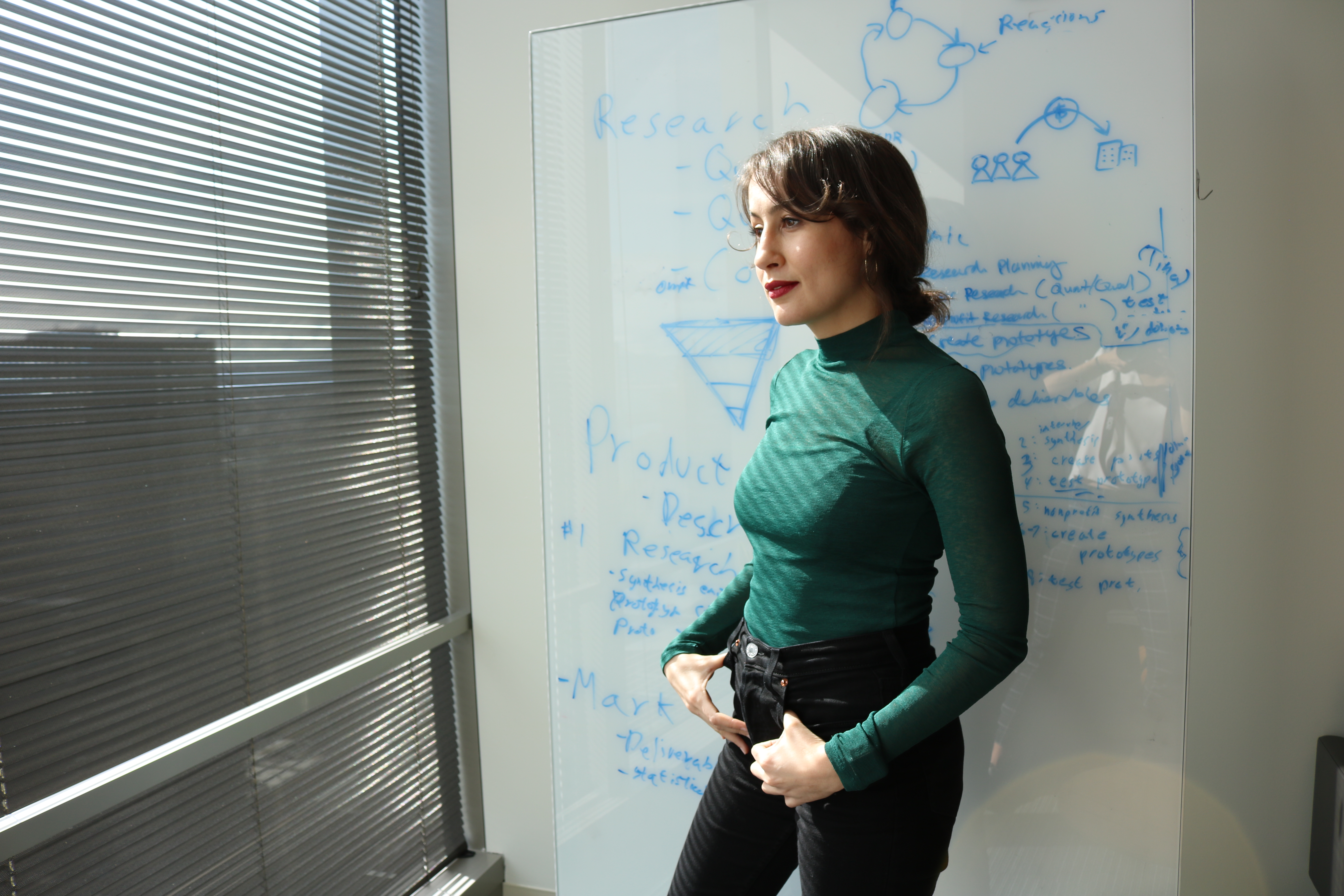
Mos founder and chief executive officer Amira Yahyaoui.

After being forced out of her home country, Yahyaoui fled to France, where she lived as an illegal immigrant and continued to fight against Tunisia’s authoritarian leadership through her blog and an anti-censorship campaign she started online.

When social media sparked anti-government protests across the Middle East, Yahyaoui, still unable to reenter Tunisia, became a face of what was later called the Arab Spring. Her digital prowess, activist reputation and persistent efforts to highlight the Tunisian administration’s human rights abuses quickly made her a face of the movement.

On January 14, 2011, when the protests succeeded in making Tunisia a pioneer of Arab democracy and ended Ben Ali’s reign, Yahyaoi got her passport back and went home, immediately.

Back in Tunisia with newfound freedom, she had an agenda: To hold the governing agency charged with writing a new Tunisian constitution accountable.

Yahyaoui built Al Bawsala, translated as The Compass, an NGO focused on transparency and government accountability. Al Bawsala became one of the largest NGOs in the Middle East, a bona fide success that attracted numerous awards and cemented Yahyaoui’s status as a fearless advocate for human rights, a freedom fighter and one of the most influential Arab women in the world.

“I had to work probably 10 times harder to get to be the self-educated me I am today,” she said. “I saw way too many people getting their education refused and therefore their future ruined.”

Her global standing earned her a seat on the board of the United Nation’s High Commissioner For Refugees Advisory Group on Gender, Forced Displacement, and Protection, as well as the title of Young Global Leader at the World Economic Forum and co-chair of the Davos Conference in 2016, a title she shard with Microsoft’s Satya Nadella and GM’s Mary Barra .

Three years later, with a resume enviable to any dignitary, Yahyaoui is leveraging her unique experience to lure in venture capitalists and use their cash for good.

Repairing a broken financial aid system

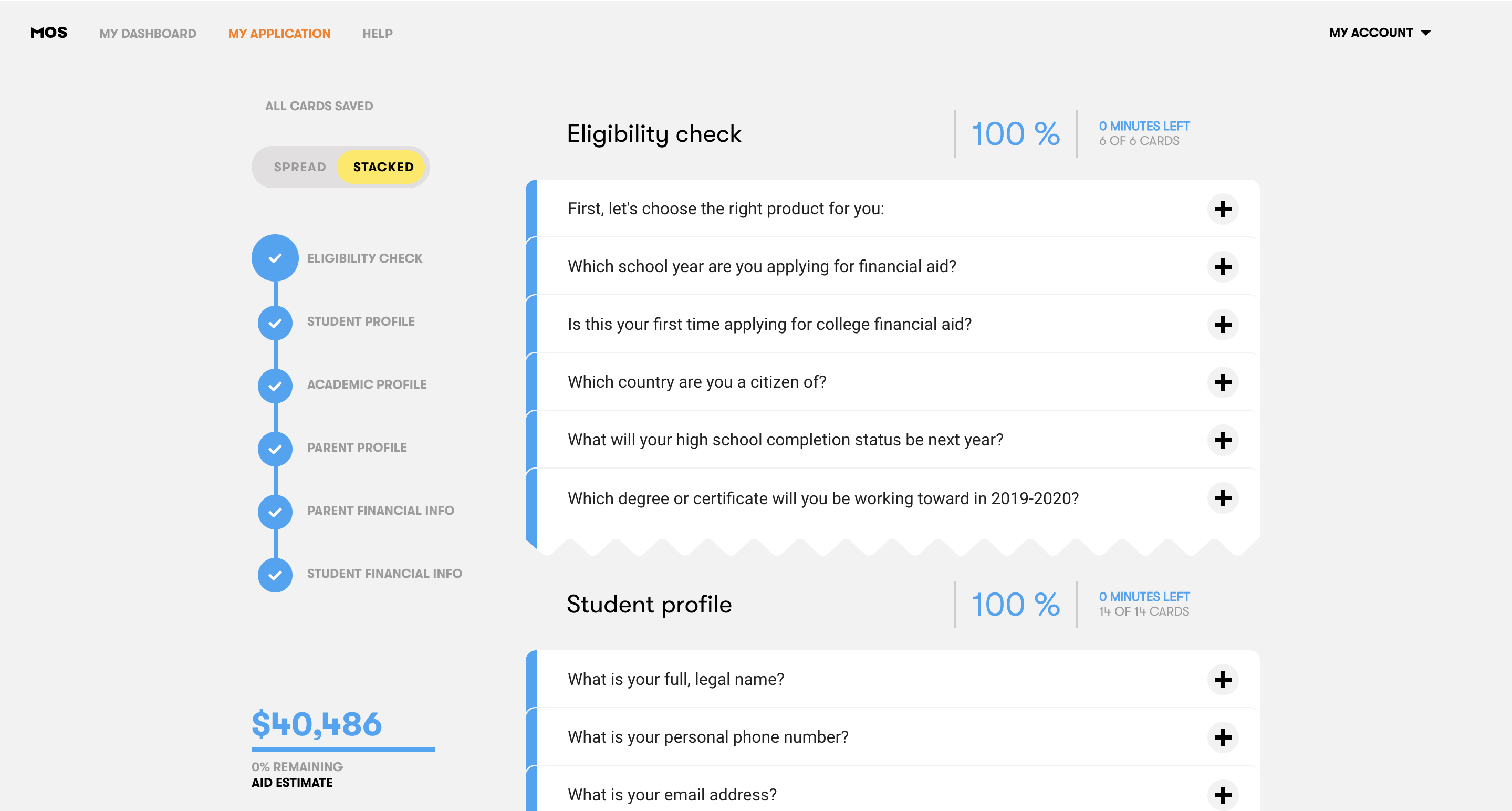
The Mos dashboard.

Mos is like if Turbo Tax married Typeform and had a baby, Yahyaoui explained. Not dissimilar to Common App, Mos lets students apply to more than 500 federal and state-based aid programs in minutes using a survey that matches them to every grant and scholarship program they qualify for, while simultaneously completing the FAFSA and state aid applications. To ensure every family is getting the most financial support possible, a Mos financial aid advisor reviews each case and negotiates with colleges for higher awards.

“Today, the biggest problem is people think they are not eligible for financial aid just because of how the thing is designed,” Yahyaoui said. “You’re supposed to just go ahead and fill a form that has 200 questions and then send it like a bottle in the sea and wait for months.”

Mos will complete a full-scale launch this summer and eventually tackle other nation’s college financial aid systems thanks to the new infusion of capital and the high-profile relationships Yahyaoui has forged in just one year living in the Bay Area.

Ultimately, it was Yahyaoui’s activism that granted her a ticket into the opaque world of Silicon Valley VC. As it turns out, angel investor Khaled Helioui, a fellow Tunisian immigrant who’d taken up residence in San Francisco, was familiar with Yahyaoui’s work and when he heard she had relocated to the Bay Area to launch a technology startup, he wanted to know exactly what she was building. Today, he’s a Mos investor and board member and it was his introductions that helped Yahyaoui quickly and skillfully close her seed round.

An early angel investor in Uber, Helioui connected Yahyaoui with his friend Garrett Camp, the very wealthy co-founder and chairman of the ride-hailing giant, who was sold on Mos’s mission right off the bat.

“I think because Garrett is an immigrant, he knows what it is to suffer with bureaucracy,” Yahyaoui said. “He was a huge believer. He actually made it so easy for me because he said, okay, here’s an office, just stay and work.”

Camp then introduced her to John Doerr, the chairman of the esteemed VC firm Kleiner Perkins, known for his successful bets on companies like Google and Amazon. With Camp and Doerr on board, Mos didn’t struggle to raise additional capital; in fact, Yahyaoui was in an unusual position of being able to reject investors whose values and vision for Mos clearly didn’t align with hers.

Tearing down barriers

Yahyaoui, center, with the Mos team in San Francisco.

Yahyaoui isn’t in the startup business to get rich off students trying to navigate their way through the absorbently expensive process of applying to and attending college. She’s part of a growing class of founders out to prove that you can pair profits with good morals and lead venture-backed values-based businesses.

“I know if I created the same thing as an NGO, I could have already raised $100 million, but I like the accountability of business,” she said. “We can create businesses that are good for people.”

Yahyaoui’s story, from being exiled from her home country at a young age to fighting an authoritarian regime is not one that’s ever been told before in Silicon Valley.

In addition to being a trailblazing human rights advocate, she’s a woman, an immigrant, “uneducated” by Silicon Valley standards and a first-time tech founder that was able to walk into a meeting with John Doerr and walk out with a term sheet.

If she’s successful in building a global edtech business, she’ll be emblematic of the meritocratic culture The Valley has falsely claimed to uphold. Even if she’s not successful, she’ll have torn down barriers for other underrepresented founders and written a success story fitting for this new era of accountability in tech.

08 Apr 2019

No one, not even the Secret Service, should randomly plug in a strange USB stick

If you’ve been on Twitter today, you’ve probably seen one story making the rounds.

The case follows a Chinese national, Yujing Zhang, who is accused of trying to sneak into President Trump’s private Florida resort Mar-a-Largo last month. She was caught by the Secret Service with four cellphones, a laptop, cash, an external hard drive, and a signals detector to spot hidden cameras, and a thumb drive.

The arrest sparked new concerns about the president’s security amid concerns that foreign governments have tried to infiltrate the resort.

Allegations aside and notwithstanding, what sent alarm bells ringing was how the Secret Service handled the USB drive — which cannot be understated — were not good.

From the Miami Herald:

Secret Service agent Samuel Ivanovich, who interviewed Zhang on the day of her arrest, testified at the hearing. He stated that when another agent put Zhang’s thumb-drive into his computer, it immediately began to install files, a “very out-of-the-ordinary” event that he had never seen happen before during this kind of analysis. The agent had to immediately stop the analysis to halt any further corruption of his computer, Ivanovich said. The analysis is ongoing but still inconclusive, he testified.

What’s the big deal, you might think? You might not think it but USB keys are a surprisingly easy and effective way to install malware — or even destroy computers. In 2016, security researcher Elie Bursztein found dropping malware-laden USB sticks was an “effective” way of tricking someone into plugging it into their computer. As soon as the drive plugs in, it can install malware that can remotely surveil and control the affected device — and spread throughout a network. Some USB drives can even fry the innards of some computers.

A Secret Service spokesperson said the device was “standalone,” but wouldn’t be pressed on details. It remains unknown why the agent “immediately” pulled out the drive in a panic.

It didn’t take long for security folks to seize on the security snafu.

Jake Williams, founder of Rendition Infosec and former NSA hacker, criticized the agent’s actions “threatened his own computing system and possibly the rest of the Secret Service network.”

“It’s entirely possible that the sensitivities over determining whether Zhang was targeting Mar-a-Lago or the president — or whether she was a legitimate guest or member — may have contributed to the agent’s actions on the ground,” he said, “Never before has the Secret Service had to deal with this type of scenario and they’re probably still working out the playbook.”

Williams said the best way to forensically examine a suspect USB drive is by plugging the device into an isolated Linux-based computer that doesn’t automatically mount the drive to the operating system.

“We would then create a forensic image of the USB and extract any malware for analysis in the lab,” he said. “While there is still a very small risk that the malware targets Linux, that’s not the normal case.”

08 Apr 2019

Democratic Senators question Juul about its Altria deal

Eleven democratic senators, led by Sen. Dick Durbin (D-IL), have penned a letter to Juul Labs, asking a series of questions around the product’s marketing, its effectiveness as a tool to help people quit smoking combustible cigarettes, sales figures, and perhaps most importantly, more information on the deal that gave Altria a minority stake in Juul Labs.

“The corporate marriage between two companies that have been the most prolific at marketing highly addictive nicotine products to children is alarming from a public health standpoint and demonstrates, yet again, that JUUL is more interested in padding its profit margins than protecting our nation’s children,” writes Sen. Durbin in the letter.

Questions in the letter include records around advertising and marketing spend for Juul products, as well as any changes that might have been made to Juul’s Youth Prevention Plan following the deal with Altria.

In late 2018, Juul announced that it had sold a 35 percent minority stake of the company to Altria Group, makers of Marlboro cigarettes, for $12.8 billion. The company said that a partnership with Altria would help Juul market and distribute to currently addicted adult cigarette smokers.

In the letter, the senators cite the American Heart Association, which called the Altria/Juul deal “a match made in tobacco heaven.” Juul was already in hot water over its product’s popularity among young people, so it’s only expected that a partnership with traditional Big Tobacco would further fuel concerns among critics.

More from the letter:

JUUL’s decision to team up with Altria, the parent company of Philip Morris USA, is also bad news for children considering that Altria has a long and sordid history of spending billions to entice children to smoke through targeted campaigns that intentionally lied about the science and health effects from cigarettes. And their efforts have clearly paid off. According to the CDC, Altria’s Marlboro cigarette continues to be the most popular cigarette brand among children in the United States, with 48.8 percent of high school smokers preferring Marlboro cigarettes. Further, the proportion of high school smokers who smoked Marlboro cigarettes increased dramatically between 2012 and 2016, by a whopping 27 percent. While JUUL has promised to address youth vaping through its modest voluntary efforts, by accepting $12.8 billion from Altria—a tobacco giant with such a disturbing record of deceptive marketing to hook children onto cigarettes—JUUL has lost what little remaining credibility the company had when it claimed to care about the public health.

A Juul Labs spokesperson had this to say in response to the letter:

We welcome the opportunity to share information regarding JUUL Labs’ commitment to curbing underage use of our products while fulfilling our mission to eliminate combustible cigarettes, the number one cause of preventable death in our country. We agree that companies such as ours must step up with meaningful measures to limit access and appeal of vapor products to young people. That’s exactly what we’ve done, and we will do more to combat teen use to save the harm-reduction opportunity for the 34 million adult smokers in the United States. Don’t take our word for it — look at our actions. As part of our action plan deployed in November 2018 to keep JUUL products out of the hands of youth, we stopped the sale of certain flavored JUULpods to traditional retail stores, strengthened our retail compliance and secret shopper program, enhanced our online age-verification, exited our Facebook and Instagram accounts and are continuously working to remove inappropriate third-party social media content. We support the FDA’s draft guidance restricting the sale of certain flavored products, including JUULpods, at retail outlets and online, and will continue to work with FDA, Congress, state Attorneys General, local municipalities, and community organizations as a transparent and responsible partner in combating underage use.

U.S. Senators Patty Murray (D-WA), Ron Wyden (D-OR), Sherrod Brown (D-OH), Richard Blumenthal (D-CT), Jack Reed (D-RI), Elizabeth Warren (D-MA), Tom Udall (D-NM), Ed Markey (D-MA), Jeff Merkley (D-OR), and Chris Van Hollen (D-MD) joined Sen. Durbin in sending the letter. It comes just a month after the FDA proposed further regulations to the sale of flavored e-cig products.

Juul has until April 25 to provide answers and information in response to the letter.