Category: UNCATEGORIZED

28 Mar 2019

Moolah Mobile partners with Surge to offer free mobile service with ads

Moolah Mobile is teaming up with SurgePhone Wireless to offer people a new way to pay their cell phone bills — by putting ads on their homescreens.

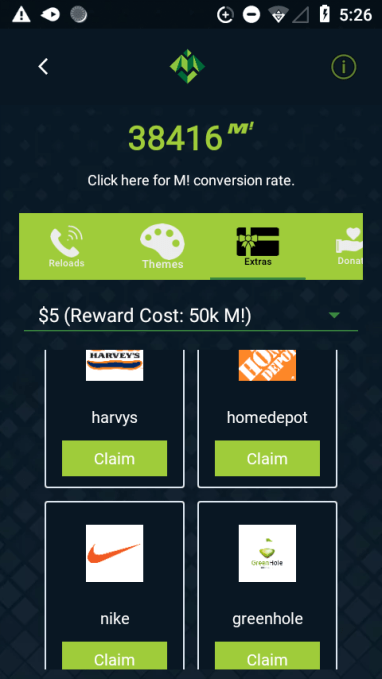
Moolah CEO Vernell Woods (pictured above) said the startup has already been offering gift cards and other rewards to users who view its homescreen ads. So this is a similar model, except instead of leading to gift cards, the ads are subsidizing cell phone service from Surge.

The ads show up on users’ homescreen during all those interstitial moments between using apps, so the goal is to offer free service without consumers having to change their behavior. Woods said all that ad time adds up, with “the average person who’s using their phone on a consistent basis” viewing “easily between two to three hours” of home screen ads each day. And that’s enough to pay for the “equivalent” of Surge’s $10 monthly plan.

On the other hand, if for some reason a subscriber isn’t hitting the necessary total, Woods said they can also earn more points by accepting offers or taking surveys.

Moolah isn’t the only company using advertising to make previously paid products free. Just last week, I wrote about PreShow, a startup promising a free movie ticket for watching 15 to 20 minutes of ads. (Not everyone was crazy about the idea.)

Moolah Mobile screenshot

Moolah Mobile screenshot

But Woods said he’s doing this because he wants to make wireless service more affordable to people in low-income communities. In the announcement, Moolah investor Tip “T.I.” Harris said it’s “one of the few tech companies I’ve seen who truly want to help everyday people have access to technology.”

But could this also be seen as a way to harvest personal data from a vulnerable population? Woods said he wants to protect against that with a blockchain initiative set to launch this fall, allowing users to see exactly what data is being shared with advertisers.

“No personal information should be going to advertisers without users knowing about it,” he said, adding that companies “definitely should not be making money off” personal data without giving users a cut of the profits.

The subsidized wireless service should be available on Surge Volt Android devices with Moolah install kits, as well as on SIM Starter Kits distributed by Surge. Moolah and Surge said they will roll this out Florida, Virginia, Georgia and Texas initially, with an aim of reaching 40,000 locations by the end of the year.

28 Mar 2019

Forge acquires IRA Services to expand offering for private company shares

Forge, the marketplace for trading private company shares formerly known as Equidate, announced that it will be acquiring custodial trust company IRA Services for a purchase price of $55 million.

IRA Services is a trust company that provides custodial services for retirement accounts managed by individuals and mid-to-large sized Institutions. Stripped of financial jargon, the primary function of a custodian is to hold on to (or maintain “custody” of) its clients’ securities and keep them safe from potential external complications such as theft or otherwise.

Many custodians, like IRA Services, also provide administrative services such as collecting the actual dividend payments made to the owner of a stock, and advisory services such as helping clients understand what they can and should invest in.

Since its founding in 2014, Forge has been one of the primary marketplaces where employees and early investors of leading startups can monetize privately-held shares without having to wait years for an IPO, exit or liquidity event.

Forge also creates value by providing some of the world’s leading private equity and institutional investors with high-demand access to some of the top pre-IPO companies, having worked with companies like Spotify, Airbnb and others.

By acquiring IRA Services, Forge can expand its support offerings for private market securities, and more importantly, can move closer to becoming a one-stop shop for private market investors who will no longer have to transfer shares acquired with Forge to an external custodial trust.

“Investors across asset classes want the ease, transparency, and security provided by a seamless investing experience from trading through to settlement to custody,” said IRA Services president Patrick Hughes. “In bringing together Forge and IRA Services, we look to deliver an unparalleled end-to-end investing experience for private markets investors.”

What differentiates IRA Services from other custody providers, and what makes the company particularly attractive to Forge, is that it specialized in deals involving alternative and non-traded asset classes. As a result, the company already maintains systems and workflows that are structured to deal with private securities and associated complexities.

Additionally, IRA Services’ API, which automates and supports the process of connecting custody accounts directly to investment platforms, is becoming increasingly valuable as the exchange market for private company shares, as well as average transaction size and volume, continues to swell.

Pending necessary agency approvals, the combined entity also intends to become both a registered broker-dealer and separate non-fiduciary trust company, meaning the company will be able to provide custodial services for clients even when they’re investing in assets outside of the Forge platform.

Satisfying growing needs of a budding market

The acquisition fits squarely into Forge’s long-term vision of being a leading institution in the rapidly growing private markets. “We believe that the private markets are where innovation is happening and there needs to be an institution that provides services that enable that whole ecosystem,” Forge CEO Kelly Rodriques said in a conversation with TechCrunch.

Rodriques believes that creating secure and transparent custody services for private market securities can provide millions of new investors with access to a space that is currently limited to around 400,000 private equity players, early-stage investors and early employees.

In Rodriques’ view, broadening the marketplace to more investors creates serious network effects and a significant positive flywheel. Having more participating private company investors creates more liquidity, which not only entices other investors to play in the space but also attracts more private companies to partner with Forge and provide access to their shares.

At the same time, innovative startups are continuing to grow larger in size, with more than 250 private companies around the world boasting valuations of $1 billion or greater. Companies are also opting to stay private for longer due to the growing availability of late-stage capital, the desire to operate strategically without the scrutiny of the public markets and quarterly performance requirements, or otherwise.

As a result, locating sources of secure daily liquidity is becoming a bigger need for more private companies. Forge believes that with its growing set of offerings and the credibility it has earned from working with key regulators and several of the world’s largest financial institutions, Forge is well-positioned to be the go-to solution for secondary market investors and companies alike.

“Our long-term hope is that our technology will be used to make the private market ecosystem stable, safe and sound,” Rodriques told TechCrunch.

The near-term outlook for Forge doesn’t look too bad either. Forge almost doubled its trading volume in 2018, surpassing just shy of $2 billion worth of transactions, with the company expecting another billion dollars in transactions by the end of the year.

As with any large acquisition, particularly in the financial services sector and particularly in the US, the companies will have to receive the requisite regulatory approvals to complete the deal in full. While the companies haven’t expressed an official expected close date for the deal, Forge expects the regulatory process will take anywhere from two-to-four months.

Forge will go through yet another name change once the deal closes. The combined entity will go by the name Forge Trust to better reflect the custodial services gained through IRA Services and the new company’s full suite of capabilities. Additionally, IRA Services CEO, Edwin Blue, will retire from the company, though current IRA Services employees will continue to operate from the firm’s existing offices.

To date, Forge has raised around $88.5 million in venture capital, according to data from Crunchbase, with backing from a number of Silicon Valley heavy hitters including Peter Thiel, Tim Draper, Scott Bannister, Charlie Cheever, and others.

28 Mar 2019

Amy Klobuchar makes broadband access a key component of presidential bid

In a new Medium post this morning, 2020 presidential candidate Amy Klobuchar outlined her plans for infrastructure spending, which she says will be “her top budget priority.” The bulk of the plan details what you’d more or less expect from a Democratic presidential candidate, including the repair and replacement of roads and bridges, reliable public transit, investment in schools and housing and a focus on green energy.

But the Minnesota Senator also details an interesting approach to the internet. Namely, Klobuchar wants to bridge the rural internet divide, with plans to connect every American household with broadband internet by 2022. It’s a bold plan, but more importantly, it points to a shift in America’s expectations of Internet connectivity, from privilege to right. In recent years, it’s been viewed as something more akin to a household utility.

The platform rightly notes that the internet has become a key driver in economic and job opportunities, and keep America competitive means ensuring that everyone is connected. Klobuchar, in particular points to rural areas, which have traditionally had difficulty accessing high-speed internet. After all, the U.S. is, in a word, huge.

“Amy’s plan will help close the urban-rural divide by creating accurate broadband maps to identify areas that lack adequate access,” the piece reads, “focus on bringing high-speed internet infrastructure to areas most in need, and provide greater incentives for existing providers to use funds to upgrade their networks to cover unserved and underserved areas.”

Infrastructure is always a major talking point int he lead up to big elections, but perhaps 2020 will find the internet playing a key role in those conversations.

28 Mar 2019

Consumer spending in apps to reach $156B across iOS and Google Play by 2023

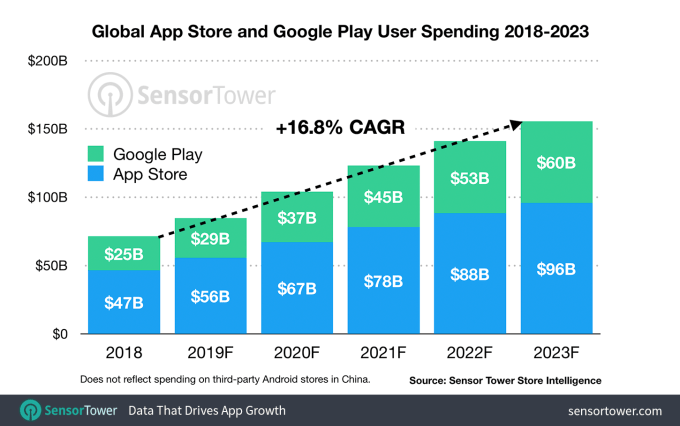
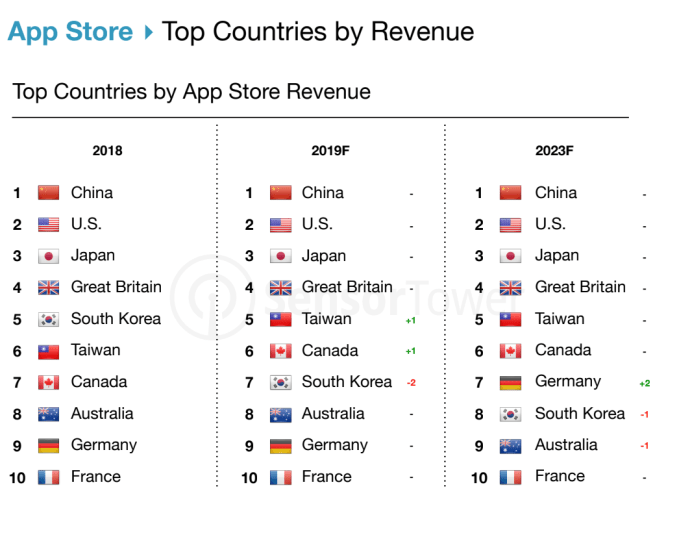
Consumer spending in mobile apps across both Apple’s App Store and Google Play will grow by 120 percent to reach $156 billion worldwide by 2023, according to a new report out today from app store intelligence firm, Sensor Tower. The forecast estimates that both stores will more than double their revenues during the next five years, with China, the U.S. and Japan leading the way on iOS and the U.S., South Korea and Japan leading on Google Play.

The report projects that Apple will reach $96 billion in worldwide consumer spending by 2023, an increase of 104 percent over 2018’s total of $47 billion. Google Play is set to grow by 140 percent over 2018 to reach $60 billion — closing the gap even further with Apple’s platform. However, Apple’s store will account for nearly 62 percent of all revenue generated by the two platforms, Sensor Tower says.

The firm’s estimates for 2018 are a little lower than App Annie’s data, which estimated iOS and Google Play stores topped $76 billion in consumer spend last year. (Sensor Tower says $72 billion). However, App Annie’s forecast was calculated before year-end. After the year wrapped, it estimated consumer spend grew to $101 billion in 2018 across Apple’s App Store, Google Play and third-party Chinese app stores. Sensor Tower doesn’t delve into third-party app store data.

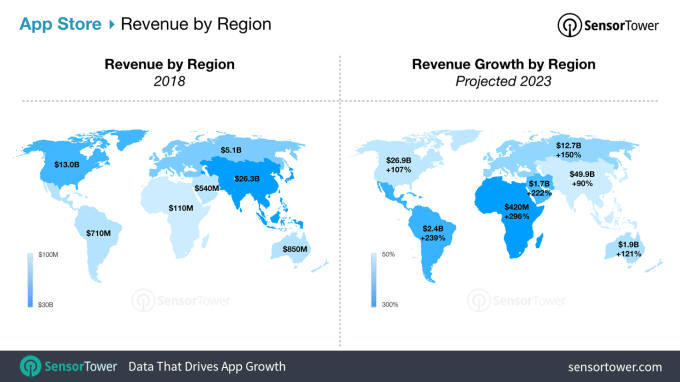
Another trend in the new forecast is the projected growth for emerging markets. Africa and Latin America will see the largest revenue growth over the next five years, with the former poised for 296 percent growth to $420 million on the Apple App Store by 2023 and the latter with 239 percent growth to $2.4 billion.

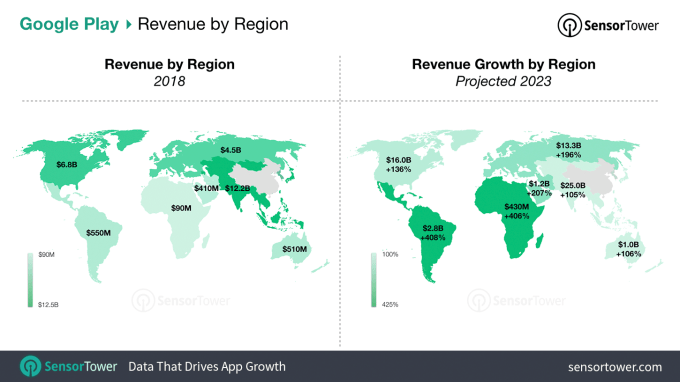
Revenue growth from Google Play will be even larger, with Latin America reaching $2.8 billion in 2023, up 408 percent from 2018. African countries will grow 296 percent during this same time to reach $430 million by 2023.

These are still far smaller numbers than what’s predicted for top markets, of course.

The U.S., for example, is on track to reach $40 billion in consumer spend across both app stores by 2023, up 110 percent over 2018’s total of $19 billion. Apple’s App Store will account for $25 billion of that figure, and Google Play will account for the remaining $15 billion.

Other notable moves include Taiwan becoming a top-five App Store country by revenue in 2023 ($2.1 billion), and the U.S. overtaking Japan in Google Play revenue in 2019. Japan’s Google Play revenue was driven by top games in 2018 like Monster Strike and Fate/Grand Order, but is expected to slow this year.

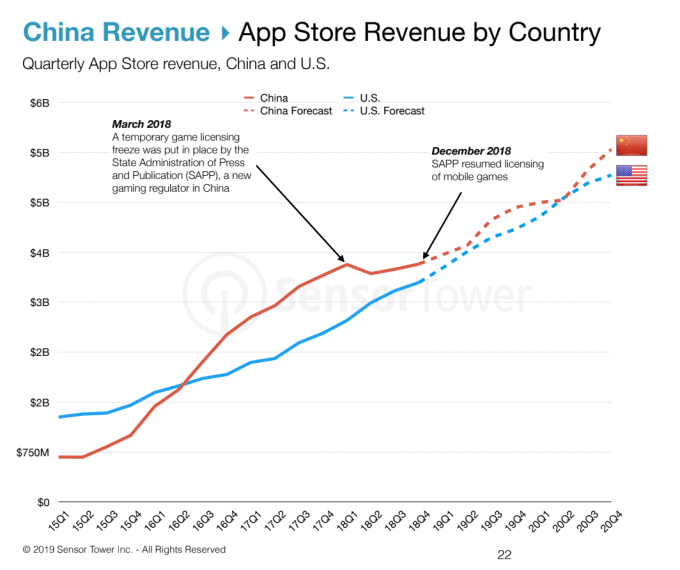
Sensor Tower is also estimating the U.S. will briefly pass China in App Store revenue by 2020 — a figure that ties to Apple’s slower iPhone sales in China, which led it to cut its revenue forecast. China was also substantially impacted by the game-licensing freeze, which saw app downloads fall 4 percent between 2017 to 2018, after having grown 8 percent the year before. Consumer spending then grew only 14 percent in 2018, versus 60 percent the prior year.

China’s revenue is expected to recover with the renewal of mobile game licensing, but the U.S. is now projected to reach China’s levels over the next few years.

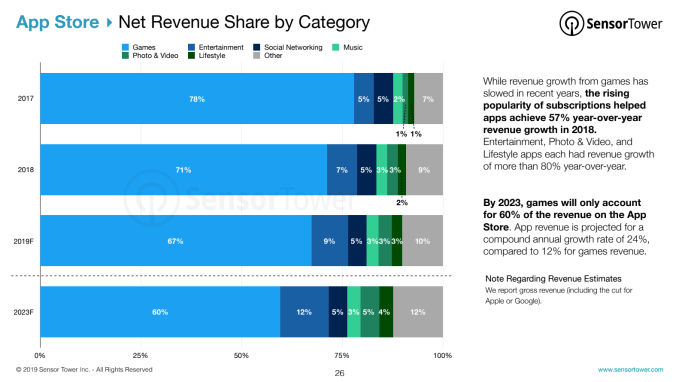
Thanks to subscriptions and the Entertainment category (e.g. streaming apps), revenue growth in non-game apps on iOS (24 percent) will pass growth of revenue in games (10 percent) over the next five years. This will lead non-game apps to accounting for 40 percent of App Store revenue in 2023, or $38.8 billion.

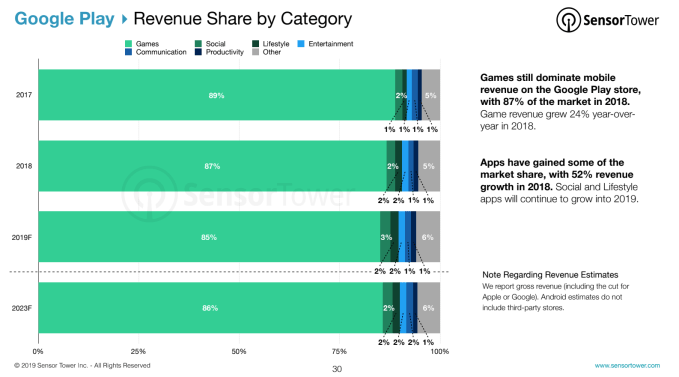
Games will continue to have a larger share on Google Play during this time, accounting for 86 percent of revenue by 2023, down from only 89 percent in 2017.

The full report is on Sensor Tower’s site.

28 Mar 2019

BBC wants to add 3rd parties to its Sounds app to balance Apple and Spotify dominance in podcasts and music

Earlier this week, the BBC pulled its podcasts from Google’s Podcast app and Assistant platform after determining that it wasn’t getting enough out of the relationship, specifically noting that Google wasn’t providing it with enough audience data and search links to its own sites and services. Today, we get some more context and development on that decision.

The UK media giant announced that it is working on an expansion of its own Sounds app: it’s in talks with other media companies to add their podcasts and live radio streams to it, a move it hopes will help not just the BBC itself but other media owners find some more competitive leverage against not just Google, but also Apple and Spotify — with the latter two currently accounting for 80 percent of the podcast and music streaming markets in the UK.

The plan to expand Sounds — which has had 1.7 million downloads since being launched just over four months ago — with third-party content producers was outlined today in the broadcaster’s annual report, where it details strategy for the year ahead. James Purnell, the former politician who is now the BBC’s head of radio and education, dove a little deeper into the details in a separate blog post.

“Choice and plurality are good. But dominance by one or two gatekeepers would not be,” Purnell wrote. “With BBC Sounds, we are already offering an alternative audio destination to the global platforms. But for the last few months we have also been talking to colleagues in British radio to see if Sounds could help them… We would like to make Sounds a platform that serves British audiences and British creativity.”

Purnell also made clear that this was not a grand move to building a walled garden of its own.

“We want to continue to make our content available to third party platforms,” he said. “But we want to do so in a way that ensures choice and competition.”

He is, of course, referring here to the kerfuffle earlier this week when the BBC pulled its podcasts from Google platforms, after Google refused to link to other places (apart from on Google) where the content could be heard.

“We’ve asked Google to stop favouring their own app from search, but were told this wasn’t possible, and instead that the only option was to take our podcasts off their service. This is disappointing,” he notes. “We are in discussions with Google to resolve the situation.”

The blog post published today by Purnell provides an interesting template and one more example of how the BBC has tried to double down over the years on building its own platforms and technology to determine its own digital destiny, rather than have it be too tied to third-party platforms it cannot control.

(As with other TV broadcasters and their own streaming platforms, one of the more notable examples of how the BBC has struck out on its own is its development of iPlayer, the online and OTT on-demand service for catching up on all the TV and radio programming that the BBC puts out on its linear channels. Sounds was built to complement that since there has been a strong and clear trend for people opting to use specific and purpose-built audio apps for audio services.)

But for all that, it is also still early days.

The blog post does not detail what other content providers and producers are in conversations with the BBC, nor is there any mention of how the BBC would handle the commercial aspects of those relationships, considering that its own content within the UK is delivered as an ad-free, free public service. (Internationally, this is not the case.) Nor does it say whether the BBC would consider how to export Sounds to other markets.

Purnell also takes the opportunity at the mike, so to speak, to level a strike against the likes of Facebook and the false sense of security that many media companies fell into during the early days of using social networking sites to build audiences for their content online.

“Colleagues from other industries often tell me they wish they had put more emphasis on building up their distribution channels rather than relying on social media,” he notes. “Many of them are addressing that through changes to their business models.”

Radio, he adds, “isn’t in that situation yet” since only a small porportion of listening happens online in the UK. But  with Spotify seemingly expanding its podcast strategy by the week at the moment, and Apple making a very large move this week to lay out its own ambitions for media services, even if social media’s star is no longer in the ascendant, there will be many others tussling to own the digital consumer.

“We should heed the lessons of other industries and change before we have to,” Purnell notes.

28 Mar 2019

Kazuo Hirai, the former CEO who led Sony’s turnaround, is retiring

Here’s a well-earned retirement. Kazuo Hirai, the former CEO who spearheaded Sony’s turnaround in recent years, is leaving the company following 35 years of service, according to an announcement made today.

Hirai became Sony CEO in 2012, replacing Sir Howard Stringer with a mission of bringing the good times back to the then-bloated electronics giant through a strategy of increased focus and streamlining.

When he stepped down from the role in April 2018, Hirai and CFO Kenichiro Yoshida had turned Sony from a loss-making business into a profitable one thanks to a ‘One Sony’ policy that downsized poorer performing divisions like mobile and a deeper focus on products. The PlayStation business, which Hirai once managed as Sony’s head of gaming, was a key part of the revival, too.

Yoshida took over as CEO last year as Hirai transitioned to the chairman of the board, but now that tenure is over. Going forward in retirement, Hirai will be a ‘senior advisor’ to the company who is available to “provide counsel as requested by Sony`s management team.”

Here’s the statement issued by Hirai:

Since passing the baton of CEO to Yoshida-san last April, as Chairman of Sony, I have had the opportunity to both ensure a smooth transition and provide support to Sony’s management. I am confident that everyone at Sony is fully aligned under Yoshida-san’s strong leadership, and are ready to build an even brighter future for Sony. As such, I have decided to depart from Sony, which has been a part of my life for the past 35 years. I would like to extend my warmest gratitude to all our employees and stakeholders who have supported me throughout this journey.

Shuzo Sumi, who is chairman of Tokio Marine Holdings, will take over as Sony’s chairman.

28 Mar 2019

Crypto 2.0, accessibility, and Apple’s future strategy

From Extra Crunch

  • Jon Evans has a comprehensive look at the most compelling futures for “Crypto 2.0.” With the trading frenzy out of the way (at least for the time being), engineers and product designers can now get back to the real world of improving these systems.
  • Digital accessibility expert Beth Franssen has a piece on how to improve accessibility for websites. Handling this well can improve the quality of a product for all users, while limiting legal liability.
  • We’ve published our post-Apple extravaganza conference call transcript with TechCrunch editor-in-chief Matthew Panzarino. Lots of nuggets in here about the future of Apple’s strategy.

Wide Angle

Rajesh Vijayarajan Photography via Getty Images

Stories from outside the 280/101 corridor

Thanks

To every member of Extra Crunch: thank you. You allow us to get off the ad-laden media churn conveyor belt and spend quality time on amazing ideas, people, and companies. If I can ever be of assistance, hit reply, or send an email to danny@techcrunch.com.

28 Mar 2019

UK report blasts Huawei for network security incompetence

The latest report by a UK oversight body set up to evaluation Chinese networking giant Huawei’s approach to security has dialled up pressure on the company, giving a damning assessment of what it describes as “serious and systematic defects” in its software engineering and cyber security competence.

Although the report falls short of calling for an outright ban on Huawei equipment in domestic networks — an option U.S. president Trump continues dangling across the pond.

The report, prepared for the National Security Advisor of the UK by the Huawei Cyber Security Evaluation Centre (HCSEC) Oversight Board, also identifies new “significant technical issues” which it says lead to new risks for UK telecommunications networks using Huawei kit.

The HCSEC was set up by Huawei in 2010, under what the oversight board couches as “a set of arrangements with the UK government”, to provide information to state agencies on its products and strategies in order that security risks could be evaluated.

And last year, under pressure from UK security agencies concerned about technical deficiencies in its products, Huawei pledged to spend $2BN to try to address long-running concerns about its products in the country.

But the report throws doubt on its ability to address UK concerns — with the board writing that it has “not yet seen anything to give it confidence in Huawei’s capacity to successfully complete the elements of its transformation programme that it has proposed as a means of addressing these underlying defects”.

So it sounds like $2BN isn’t going to be nearly enough to fix Huawei’s security problem in just one European country.

The board also writes that it will require “sustained evidence” of better software engineering and cyber security “quality”, verified by HCSEC and the UK’s National Cyber Security Centre (NCSC), if there’s to be any possibility of it reaching a different assessment of the company’s ability to reboot its security credentials.

While another damning assessment contained in the report is that Huawei has made “no material progress” on issues raised by last year’s report.

All the issues identified by the security evaluation process relate to “basic engineering competence and cyber security hygiene”, which the board notes gives rise to vulnerabilities capable of being exploited by “a range of actors”.

It adds that the NCSC does not believe the defects found are a result of Chinese state interference.

This year’s report is the fifth the oversight board has produced since it was established in 2014, and it comes at a time of acute scrutiny for Huawei, as 5G network rollouts are ramping up globally — pushing governments to address head on suspicions attached to the Chinese giant and consider whether to trust it with critical next-gen infrastructure.

“The Oversight Board advises that it will be difficult to appropriately risk-manage future products in the context of UK deployments, until the underlying defects in Huawei’s software engineering and cyber security processes are remediated,” the report warns in one of several key conclusions that make very uncomfortable reading for Huawei.

“Overall, the Oversight Board can only provide limited assurance that all risks to UK national security from Huawei’s involvement in the UK’s critical networks can be sufficiently mitigated long-term,” it adds in summary.

Reached for its response to the report, a Huawei UK spokesperson sent us a statement in which it describes the $2BN earmarked for security improvements related to UK products as an “initial budget”.

It writes:

The 2019 OB [oversight board] report details some concerns about Huawei’s software engineering capabilities. We understand these concerns and take them very seriously. The issues identified in the OB report provide vital input for the ongoing transformation of our software engineering capabilities. In November last year Huawei’s Board of Directors issued a resolution to carry out a companywide transformation programme aimed at enhancing our software engineering capabilities, with an initial budget of US$2BN.

A high-level plan for the programme has been developed and we will continue to work with UK operators and the NCSC during its implementation to meet the requirements created as cloud, digitization, and software-defined everything become more prevalent. To ensure the ongoing security of global telecom networks, the industry, regulators, and governments need to work together on higher common standards for cyber security assurance and evaluation.

Seeking to find something positive to salvage from the report’s savaging, Huawei suggests it demonstrates the continued effectiveness of the HCSEC as a structure to evaluate and mitigate security risk — flagging a description where the board writes that it’s “arguably the toughest and most rigorous in the world”, and which Huawei claims shows at least there hasn’t been any increase in vulnerability of UK networks since the last report.

Though the report does identify new issues that open up fresh problems — albeit the underlying issues were presumably there last year too, just laying undiscovered.

The board’s withering assessment certainly amps up the pressure on Huawei which has been aggressively battling U.S.-led suspicion of its kit — claiming in a telecoms conference speech last month that “the U.S. security accusation of our 5G has no evidence”, for instance.

At the same time it has been appealing for the industry to work together to come up with collective processes for evaluating the security and trustworthiness of network kit.

And earlier this month it opened another cyber security transparency center — this time at the heart of Europe in Brussels, where the company has been lobbying policymakers to help establish security standards to foster collective trust. Though there’s little doubt that’s a long game.

Meanwhile, critics of Huawei can now point to impatience rising in the U.K., despite comments by the head of the NCSC, Ciaran Martin, last month — who said then that security agencies believe the risk of using Huawei kit can be managed, suggesting the government won’t push for an outright ban.

The report does not literally overturn that view but it does blast out a very loud and alarming warning about the difficulty for UK operators to “appropriately” risk-manage what’s branded defective and vulnerable Huawei kit. Including flagging the risk of future products — which the board suggests will be increasingly complex to manage. All of which could well just push operators to seek alternatives.

On the mitigation front, the board writes that — “in extremis” — the NCSC could order Huawei to carry out specific fixes for equipment currently installed in the UK. Though it also warns that such a step would be difficult, and could for example require hardware replacement which may not mesh with operators “natural” asset management and upgrades cycles, emphasizing that it does not offer a sustainable solution to the underlying technical issues.

“Given both the shortfalls in good software engineering and cyber security practice and the currently unknown trajectory of Huawei’s R&D processes through their announced transformation plan, it is highly likely that security risk management of products that are new to the UK or new major releases of software for products currently in the UK will be more difficult,” the board writes in a concluding section discussing the UK national security risk.

“On the basis of the work already carried out by HCSEC, the NCSC considers it highly likely that there would be new software engineering and cyber security issues in products HCSEC has not yet examined.”

It also describes the number and severity of vulnerabilities discovered, as well as architectural and build issues, by what the relatively small team in the HCSEC as “a particular concern”.

“If an attacker has knowledge of these vulnerabilities and sufficient access to exploit them, they may be able to affect the operation of the network, in some cases causing it to cease operating correctly,” it adds. “Other impacts could include being able to access user traffic or reconfiguration of the network elements.”

In another section on mitigating the risks of using Huawei kit, the report notes that architectural controls in place in most UK operators can limit the ability of attackers to exploit any vulnerable network elements not explicitly exposed to the public Internet — adding that such controls, combined with good opsec generally, will “remain critically important in the coming years to manage the residual risks caused by the engineering defects identified”.

In other highlights from the report the board does have some positive things to say, writing that an NCSC technical review of its capabilities showed improvements in 2018, while another independent audit of HCSEC’s ability to operate independently of Huawei HQ once again found “no high or medium priority findings”.

“The audit report identified one low-rated finding, relating to delivery of information and equipment within agreed Service Level Agreements. Ernst & Young concluded that there were no major concerns and the Oversight Board is satisfied that HCSEC is operating in line with the 2010 arrangements between HMG and the company,” it further notes.

Last month the European Commissioner said it was preparing to step in to ensure a “common approach” across the European Union where 5G network security is concerned.

And earlier this week it issued a set of recommendations for Member States that combine legislative and policy measures to assess 5G network security risks and help strengthen preventive measures.

Among the suggested operational measures it advises Member States to take is to complete a national risk assessment of 5G network infrastructures by the end of June 2019, and follow that by updating existing security requirements for network providers — including conditions for ensuring the security of public networks.

“These measures should include reinforced obligations on suppliers and operators to ensure the security of the networks,” it recommended. “The national risk assessments and measures should consider various risk factors, such as technical risks and risks linked to the behaviour of suppliers or operators, including those from third countries. National risk assessments will be a central element towards building a coordinated EU risk assessment.”  

At an EU level the Commission said Member States should share information on network security, saying this “coordinated work should support Member States’ actions at national level and provide guidance to the Commission for possible further steps at EU level” — leaving the door open for further action.

While the EU’s executive body has not pushed for a pan-EU ban on any 5G vendors it did restate Member States’ right to exclude companies from their markets for national security reasons if they fail to comply with their own standards and legal framework.


28 Mar 2019

Brandwatch turns its war-chest on acquiring market research startup Qriously

In the past few years it’s become increasingly evident that while social media was a fantastic new way to get into the minds of people and understand what they thought in order to sell them things, you couldn’t just rely on the blathering of millions of people. You also had to literally ask them questions. At the darker end of-of the spectrum, this was used by the likes of Cambridge Analytica to first poll questions, then use the data to target audiences for dark political purposes. At the lighter end, it’s a method used every day by legitimate brands and ad agencies. But until now, most social listening agencies and most polling companies plowed different sectors of the tech industry. The news that a major social intelligence company is acquiring a research platform is an indication that these two worlds are about to come together.

Brandwatch, a leading social intelligence company, has acquired London-based SaaS research platform Qriously. Although terms have not been disclosed, the notion is clear: to fuse modern market research methods with social media listening and analytics. Qriously had previously raised $6.2M while Brandwatch has raised $65 million from European VCs Nauta Capital, Highland Europe and Partech.

Brandwatch also needs the tools Qriously has in order to differentiate itself from the legacy social listening players, thus meaning its clients won’t have to go to both a market research firm and a social listening agency.

The acquisition marks a continuation of Brandwatch’s roll-up of services that add to its offering. The October 2018 merger between Brandwatch and Crimson Hexagon created a business with around $100 million in recurring annual revenues.

The Qriously acquisition will add first-party quantitative research to Brandwatch’s total pool of brand and consumer insight and enables its customers to proactively dig deeper into their online research by launching targeted surveys, with global reach and near-immediate results.

The innovation Qriously made was to turn mobile ad-networks into a distribution platform for polling and quizzes. This hadn’t previously been done extensively before, and enabled it to, for example, predict the results of the last US election.

Qriously has developed a next-generation technology to access, via mobile ad networks in particular, over 2 billion devices all over the world in real-time. Clients include Spotify, Coinbase and P&G.

“It’s not often you meet a group of people as fresh and innovative as the Qriously team who have built a deep, technically strong solution to a problem that is on your own roadmap,” said Giles Palmer, co-founder and CEO of Brandwatch. “We’ve never met such a team who saw the world the way we do and want to join up to create something really new, but that’s what happened with Qriously.”

“The future of market research is 100 percent combining different data types,” said Christopher Kahler, co-founder and CEO of Qriously. “Prompted survey and unprompted social data surface different types of insights, and looking at them together gives you a 360-degree picture.”

28 Mar 2019

HUD hits Facebook with housing discrimination charges over ad targeting

The U.S. Department of Housing and Urban Development this morning hit Facebook with charges of housing discrimination. The filing states that the the online giant has violated the Fair Housing Act through its ad targeting tools, which allow sellers to limit listings based on categories like race, sex and nation of origin.

The charges are the result of an investigation initiated in August of last year, investigating a formal complaint that homesellers and landlords can target ads across a broad range of different categories.

“Facebook is discriminating against people based upon who they are and where they live,” HUD Secretary Ben Carson said in a statement tied to the news. “Using a computer to limit a person’s housing choices can be just as discriminatory as slamming a door in someone’s face.”

Facebook said it was “surprised” by the decision, in a statement offered to TechCrunch. A spokesperson for the company went on to discuss “significant steps” taken to above the discrimination detailed in HUD’s filing.

“Last year we eliminated thousands of targeting options that could potentially be misused, and just last week we reached historic agreements with the National Fair Housing Alliance, ACLU, and others that change the way housing, credit, and employment ads can be run on Facebook,” the company says. “While we were eager to find a solution, HUD insisted on access to sensitive information – like user data – without adequate safeguards. We’re disappointed by today’s developments, but we’ll continue working with civil rights experts on these issues.”

Last week, the social network avoided legal woes by reaching an agreement with The ACLU, Outten & Golden LLC and the Communications Workers of America. The deal is designed to help adhere to section VII of the Civil Rights Act of 1964, with Facebook removing gender, age and race-based targeting from housing and employment ads and creating a new one-stop portal for listings.