Category: UNCATEGORIZED

27 Mar 2019

Microsoft memo bans April Fools’ Day pranks, because they’re the worst

Beware children. April Fools’ Day is nearly upon us. It’s arguably the worst day of the year, but one we stubbornly cling to because of tradition. Tech companies certainly aren’t immune from the draw of building up and instantly crushing the dreams of millions of users, and pranks have become pretty common place with many top companies. These range from the fun to the terrible, with roughly 98 percent landing firmly in the former.

This year, Microsoft is taking a bold stand against pranks. Chris Capossela sent a memo asking teams “not do any public-facing April Fools’ Day stunts.”  In the letter obtained by the Verge, the marketing head notes that “these stunts have limited positive impact and can actually result in unwanted news cycles.”

As good natured as the pranks may be, they can have problematic repercussions in the era of social media, where readers and reporters alike are having enough trouble filter out the bullshit, even when it doesn’t come from trusted, official sources like Microsoft PR.

Maybe Chris and I are being sticks in the mud, but honestly, what’s the return on investment for the rare good April Fool’s Day prank? “I appreciate that people may have devoted time and resources to these activities, but I believe we have more to lose than gain by attempting to be funny on this one day,” says Capossela.

The cynic in me (embittered by years of bad pranks) thinks this could all be the lead up to some master prank. In which case, my god have mercy on our souls.

27 Mar 2019

Goodly replaces lame office perks with student loan repayment

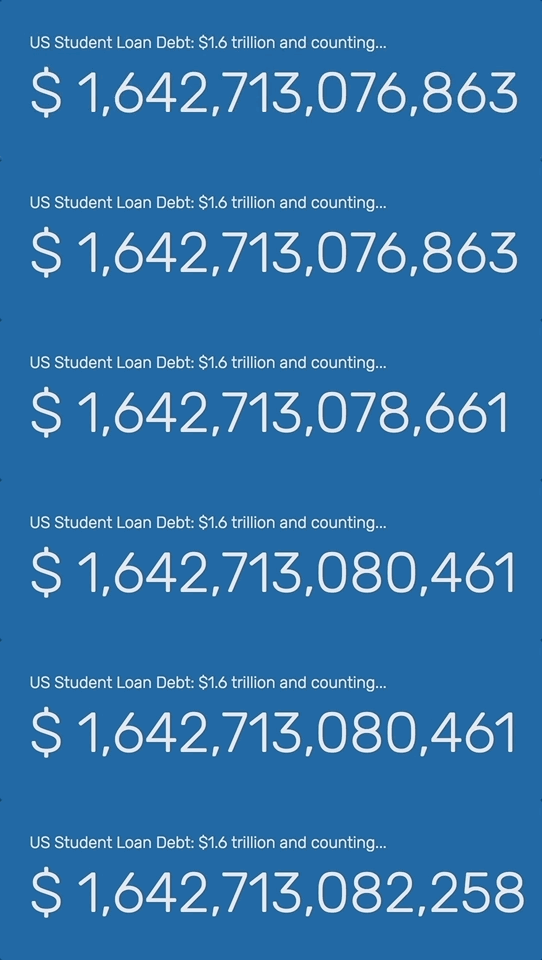
There are better employee perks than a ping-pong table. 70 percent of Americans graduate college with student loan debt. That’s 45 million people who owe $1.6 trillion. So when employers use Goodly to offer $100 per month in student loan payback for a $6 fee, talent sticks around. The startup found 86 percent of employees said they’d stay with a company for at least five years if their employer helped pay down their student loans. Yet employers break even if workers stay just two extra months, and get a 5X return if they stay an extra year since it costs so much to hire and train replacement staff.

Now, Y Combinator-backed Goodly has raised a $1.3 million seed round led by Norwest. The startup hopes capitalize on corporate America waking up to student loan payback as a benefit, which is expected grow from being offered by 4 percent of companies today to 32 percent by 2021.

Goodly co-founder and CEO Greg Poulin knows the student loan crisis personally. “When I was in school, my father passed away very unexpectedly due to a heart attack. I had to borrow $80,000 to for college at Dartmouth” he tells me. His monthly payment is now $900. The stress that debt creates can poison the rest of life. He says 21 percent of employees with student loan debt have delayed marriage, 28 percent have put off starting a family, and 1 out of 8 divorces is now directly attributed to student loan debt. “I’ve seen first-hand how challenging it is for employees to save for retirement or start a family” when they’re strapped with debt, Poulin says.

He met his co-founder and CTO Hemant Verma when they started working at Zenefits’ founder Parker Conrad’s new employee onboarding startup Rippling in 2017. That tought them how simplifying the benefits sign-up process could become its own business. Typically it requires that benefits be integrated with a company’s financial software like payroll and be set up with proper provisioning access. It’s enough of a chore that companies don’t go to the trouble of offering student loan repayment.

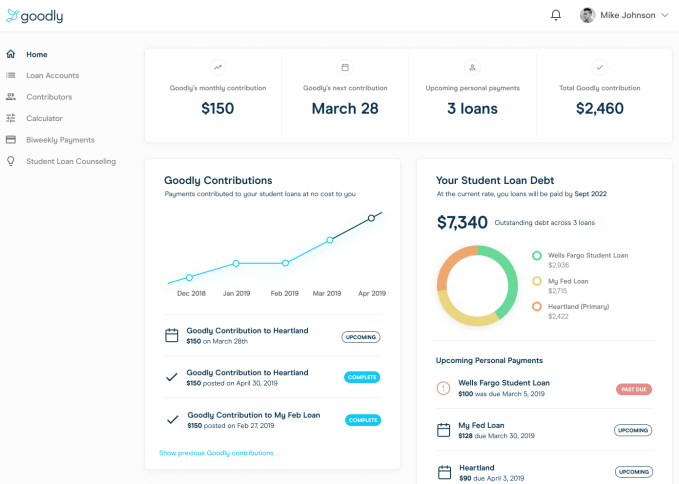
Poulin and Hemant started Goodly to create a “set it and forget it” system that automates everything. They charge $6 per month per participating employee and typically see adoption by 30 percent to 40 percent of employees. Rather than help with their monthly payment that includes interest, Goodly clients pay down their employees’ core debt so they can escape more quickly. Employees get a dashboard where they can track their debt and all of the contributions their company has made. Goodly hasn’t had a single customer churn since launch, demonstrating how badly employers want to keep job-hopping talent in their roles.

“We found that our people put off contributing to their 401Ks and buying a house because of their student loan debt. We thought that offering a Student Loan Repayment Benefit would be a great low-cost and high-impact benefit to attract and retain talent while alleviating some of the stress and the financial burden on our employees.” says Kim Alessi, an HR Generalist.

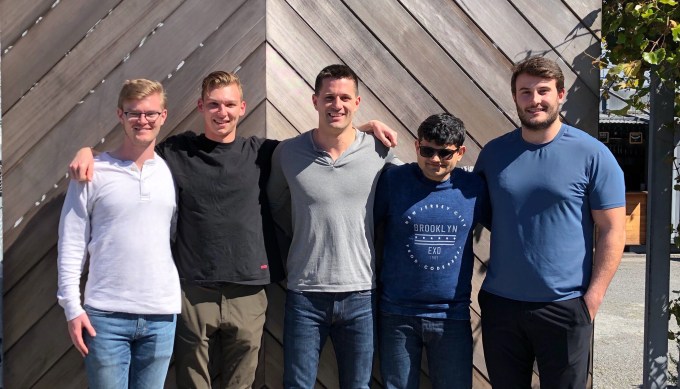
Goodly’s founders and first employees

The business opportunity here is relatively young but there are a few competitors. Boston-based Gratify was acquired by First Republic, which Santa Monica’s Tuition.io pivoted to offering student loan benefits. But Goodly’s connection to so many potential clients plus its new funding could help it make student loan repayment a ubiquitous perk. Along with Norwest and YC, the funding comes from ACE & Company, Arab Angel, Zeno Ventures, and angel investors including Optimizely’s Pete Koomen, DreamHost’s Josh Jones, ShipStation’s Jason Hodges, Fairy’s Avlok Kohli, and Telly’s Mo Al Adham.

Beyond improving talent retention, Goodly may also help erase some of the systematic discrimination against minorities in our country. Women hold 66 percent of all student loan debt, black and Latinx Americans have 31 percent more student debt than their peers, and LGBTQ borrowers owe $16,000 more than an average member of the population. Convincing employers to address student loan debt could give everyone more freedom of choice when it comes to what they work on and how they live their lives.

27 Mar 2019

Instacart rolls out an Instant Cashout feature for shoppers

Instacart is today launching a new feature aimed at allowing shoppers to access their earnings more quickly, the company announced this morning. Instant Cashout, as the option is called, was built in partnership with payments platform Stripe and is being made available to shoppers in-app for instant transfers to a debit card.

Previously, workers would have to wait a week to get paid.

With Instant Cashout, they can instead opt to have their pay immediately transferred to a debit card.

The company says setting up Instant Cashout takes less than five minutes, and shoppers will then be able to use the feature anytime going forward, 24/7.

The option will begin rolling out today in select cities, including Boston, Mass. and Bend, Ore. It will reach all Instacart shoppers by June 2019.

Shoppers will be alerted by email when the feature becomes available in their location, Instacart says.

The launch comes at a time when Instacart is trying to reset relations with workers, with whom it’s had a rocky relationship over the years.

Last month, the company reversed a controversial change to its tipping policy where it was using customers’ tips to offset wages. In some cases, when customers tipped up front believing their shopper was receiving that as a bonus on top of their wages, the shopper was actually receiving less money because the hefty tip was used for the guaranteed minimum payments Instacart promised.

Following the backlash from shoppers (and the threat of a class action suit), Instacart CEO Apoorva Mehta admitted the tipping policy was misguided, apologized and said the company would stop taking workers’ tips going forward. It also retroactively compensated shoppers when tips were taken, and raised its minimum batch payments.

That wasn’t the first time that Instacart has faced issues around worker pay, either.

The company settled a $4.6 million suit in 2017 regarding claims that it had misclassified its shoppers as independent contractors and didn’t reimburse them for work expenses. As a result, it also had to change the section in the app describing its “service fee,” which many customers believed was a tip.

The year prior to that, Instacart removed the option to tip entirely in favor of higher delivery commissions, until workers’ complaints led the company to reconsider.

While workers will likely welcome a way to more quickly access their pay, it’s not exactly a groundbreaking feature at this point. In fact, it’s a case of Instacart catching up with other gig economy businesses — including Uber, Lyft, Postmates and DoorDash, for example — which already offer instant payments.

The feature was rumored to be in development as of a few months ago, so today’s launch may not come as a huge surprise for some. However, its arrival may help to retain some shoppers who would have otherwise decided to ditch Instacart given the ongoing issues around pay.

27 Mar 2019

Report: Grindr’s Chinese owner Kunlun is selling the dating app after CFIUS raised personal data concerns

Grindr, the popular dating app for gay, bisexual, transgender and queer people, looks like it might be changing hands again, a year after it was acquired at a valuation of $245 million. According to a report in Reuters, Grindr’s owner Kunlun is looking for a buyer of the company after the Committee on Foreign Investment in the United States (CFIUS) determined that having the app owned by a Chinese company poses a national security risk.

Kunlun originally acquired a 60 percent stake in the company in 2016 for $93 million and completed the acquisition in January 2018, reportedly paying an additional $152 million.

Kunlun also publishes games, provides online financial services, and has other internet holdings such as the Opera internet browser. It has something of a track record with regulators over data privacy concerns, but also of being okay with losing battles to win the war, so to speak.

In 2016, when the company was part of a consortium acquiring the internet company Opera for $1.2 billion, it eventually renegotiated the deal down to $600 million for only part of the business after regulators raised red flags over data protection concerns. Kunlun is now a 48 percent shareholder of Opera Software as part of the Chinese consortium that owns the Norwegian company.

In August, it was reported that Kunlun had started the ball rolling for an IPO of the Grindr app. That is a process that has now been halted, writes Reuters, with the investment bank Cowen now handling enquiries in a sale process instead.

Interested parties  reportedly include investment groups and competitors. We have reached out to the Match Group (which owns Tinder), Bumble and Bumble’s owner Badoo to ask if they are among the bidders.

So far, Badoo’s founder and CEO Andrey Andreev has responded to say his company is not among the bidders.

“We are aware Grindr is looking for a new buyer,” he said, “however Badoo is not looking for any new additions to bring into our family. We are currently committed to our gay dating app and community, Chappy, along with the many other apps under our umbrella. As opposed to other technology groups, we have never bought an existing dating app as we believe in building and growing our own dating apps leveraging the technology and talent within the Group.”

We have also contacted Kunlun and Grindr for comment and will update this post as we learn more.

According to the report, the main reason for the CFIUS flagging Kunlun’s ownership is its concern over personal data protection.

Personal data protection has become a growing area of concern for government agencies because of an increasing number of data breaches, and how that data in turn gets used. The problem is not just private individuals, but specifically those who are in the government or military, who might be more vulnerable routes to disclosing confidential state information if their data gets compromised.

It’s not clear from the report what the specific concerns are that the CFIUS had with Grindr’s own data and how it is used. However, it’s notable that the company — which reported 3.3 million daily active users globally at the time of its acquisition last year, with some 27 million registered users overall as of 2017 — has been in the spotlight several times in the last few years over personal data and its handling of it.

Back in 2016, a researcher demonstrated how malicious hackers could pinpoint the location of users on the app. In 2018, it got embroiled in a controversy around how it shared users’ HIV status with third parties. Later in the year, the app was found again to be exposing users’ exact locations, this time to a third-party app that had gained unauthorized access to Grindr’s private API. And at a time when opinion has very much soured over just how much Facebook knows about us and how that information is used, Grindr was found (along with other apps) to be sending a lot of information to them, by way of its use of the Facebook login.

Agencies and others in positions of power in government have not been the quickest-responding to changing tides in technology, what the implications of those might be, and how they could and should act on behalf of consumers and the state to help protect them. (As one small example, if you watched any of the hearings involving Facebook and other internet companies, the elementary nature of some of the questions highlighted just how far behind certain decision makers are in their understanding of tech.)

In light of that, the CFIUS seems to be trying to redouble its efforts to help address that.

Notably, as Reuters points out, this is a very rare instance of the inter-agency committee flagging an acquisition that has already closed. Usually, it will halt a deal before it is completed, such as in the case of China’s Alipay dropping its planned acquisition of MoneyGram or Broadcom’s failed acquisition of Qualcomm, both stemming from objections by the CFIUS.

It seems that one of the reasons why the CFIUS has acted, or is in a position to be able to flag the sale after it’s completed, is because Kunlun never submitted its acquisition of Grindr to the agency for review at the time of either the first or second tranche of the deal, Reuters writes.

The twist that the acquirer happened to be Chinese, of course, is also notable.

China has been identified numerous times as the backer of many state-sponsored hacking groups; leading companies from the country, like Huawei, are embroiled in ongoing cases of corporate espionage; and more generally country is in the middle of a trade war with the US. That trade war concerns tariffs between the two countries, and technology is one of the leading actors in it because of the huge business that it represents. Beyond that, technology and specifically the data that can be collected using technology provide huge leverage in the power one country can hold over the other.


27 Mar 2019

Amazon is developing a show based on Octavia Butler’s ‘Wild Seed’

Amazon Prime Video is developing a series based on “Wild Seed,” the novel by acclaimed science fiction writer Octavia Butler.

Deadline reports that the project comes from Juvee Productions (the production company of Viola Davis and Julius Tennon) and will be written by author Nnedi Okorafor and filmmaker Wanuri Kahiu, with Kahiu directing.

Hollywood seems to be taking notice of Butler, who died in 2006, and is seen as a pioneer of Afrofuturist fiction. As of 2017, “Wrinkle in Time” director Ava DuVernay was reportedly developing a TV series based on another Butler novel, “Dawn.”

“Wild Seed” is part of Butler’s Patternist saga, and while it was one of the final books published in the series, it sets the stage for the larger conflict, laying out the romance and rivalry between the African immortals Doro and Anyanwu. (I still have vivid memories of ignoring my high school homework so that I could finish the novel in a single sitting.)

Okorafor, meanwhile, is the author of the award-winning fantasy novel “Who Fears Death,” which was optioned by HBO, with “Game of Thrones” writer George R.R. Martin attached as an executive producer.

“We love Octavia Butler and her work and have for decades,” Kahiu and Okorafor told Deadline. “But Wild Seed is our favorite. It’s expansive, disturbing, and unique.”

27 Mar 2019

Google has scaled back, moved forward with robotics

In 2013, Google went big on robotics. Under the leadership of Android father Andy Rubin, the company went on a shopping spree that included marquee companies like Boston Dynamics. The division was named Replicant, in an homage to Blade Runner that worked with the whole Alphabet motif. It was big and secretive and expensive, and within a few years, everything kind of went to hell.

The past few years have found the company picking up the pieces and moving on. It recently felt ready to give The New York Times a look at what it’s been working on under the leadership of Principal Scientist Vincent Vanhoucke in a new lab at its Mountain View headquarters.

The results, it seems, are modest by design. The company has moved away from the flashiness that defined the space under Rubin. No humanoids, no Big Dogs. The relatively simple hardware is tasked with less exciting tasks: manufacturing, warehouse logistics and the like. Clearly the company has taken a page or two out of the Amazon Robotics playbook. From the sound of it, the company is looking to solve more immediate issues, with a look toward the three Ds (dull, dirty, dangerous) that automation experts always talk about.

In an important sense, it’s also a much more Google approach to the category, with hardware in service of software. Google Brain and machine learning are at the heart of the innovations the company seeks to develop. It’s a smart rethink that focuses on the companies strength, even though it may lose the moonshot nature that’s long been promoted within Google X.

27 Mar 2019

Contacts app Cardhop comes to iOS

Productivity nerds, rejoice! Flexibits, the company behind Fantastical, is releasing Cardhop on the iPhone and iPad today. Cardhop was originally released on macOS, and it lets you text or call your contacts as well as add information more quickly.

If you have an iPhone, chances are you're using the default Contacts app. It's a pretty straightforward app, but it hasn't evolved in years.

For instance, one of my biggest pain points is that I use many different messaging apps depending on the person I'm talking with. You can long-press on the call or video button app to change the default app to Skype, WhatsApp, Telegram and more. But that ‘message’ button only works with Messages.

Cardhop solves that problem by becoming the gateway for all contact-based actions. In addition to phone calls, Messages, FaceTime and FaceTime Audio, the app supports WhatsApp, Telegram, Messenger, Skype, Viber and Twitter.

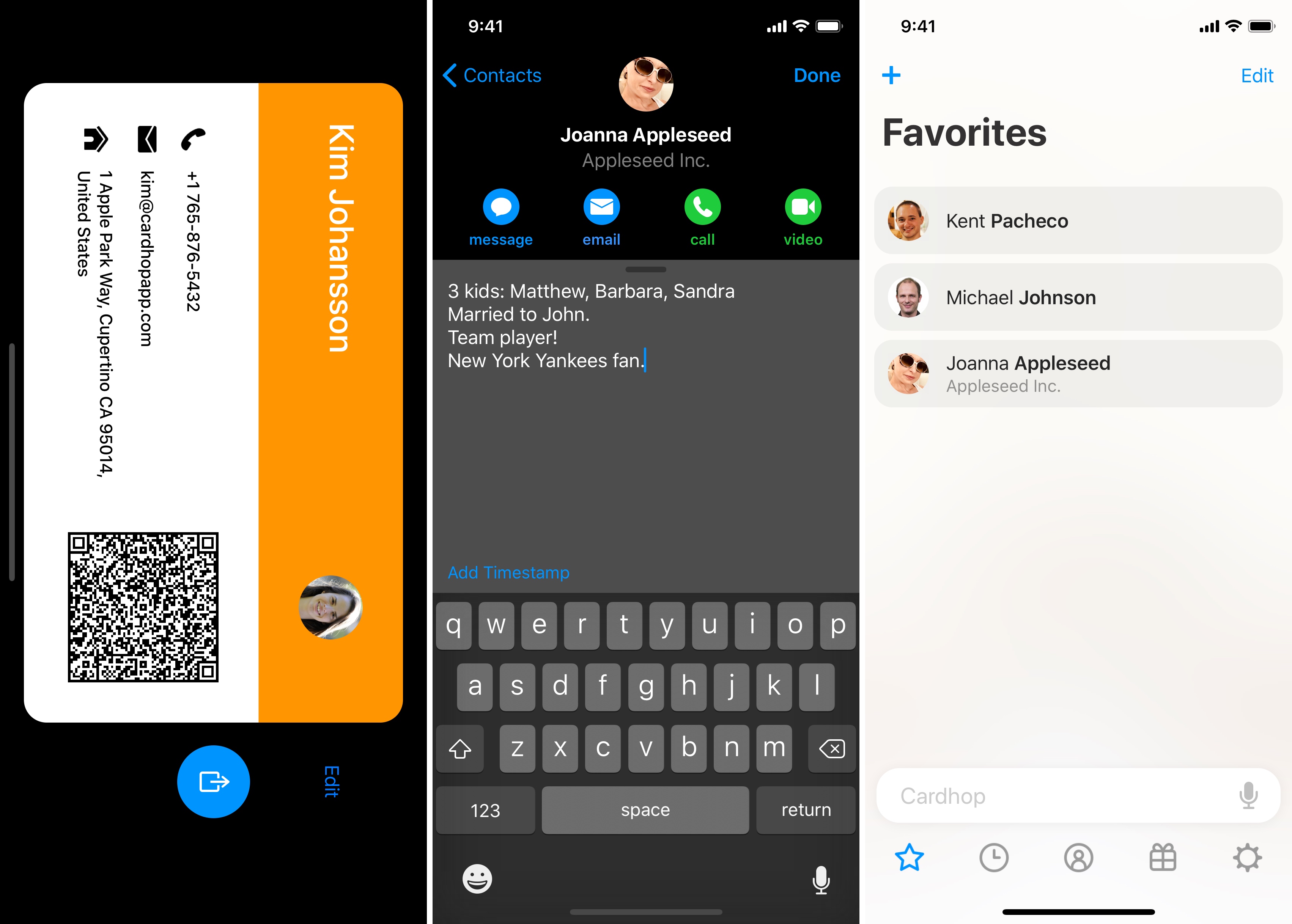
When you tap on the ‘message’ button in a contact card or when you swipe on a name, you can select the messaging app to use. The ‘Recents’ tab doesn't just show contact names but also actions. This way, you can repeat past actions and contact your friends using their favorite app more easily.

Cardhop also features a birthday tab with an overview of the upcoming birthdays in your contacts. Now that people use Facebook less and less, adding birthday information to your contacts could be a way to rely even less on Facebook.

Your company may be using a contact directory in G Suite or Exchange. Cardhop now supports looking up people in those directories on both iOS and macOS.

And if you share your contact information with a lot of people, Cardhop lets you customize your vCard. For instance, you can exclude your birthday or your home address. This way, when you send your information in iMessage or over Airdrop, professional contacts get a limited set of information.

You can also create a virtual business card with a QR code. This feature reminds me of the QR codes to quickly add friends on WeChat, Snapchat or Instagram.

Command line for contacts

Cardhop features a search bar right above the tab buttons. And this is the app’s most powerful feature. Just like on the map, you can learn shortcuts to trigger actions in no time.

For instance, if you type ‘WhatsApp Natasha’ or ‘wa Natasha’, it launches your conversation thread with Natasha. If you type ‘copy Zack’, you get Zack’s contact card with a copy button next to each field (phone number, email address, etc.).

Adding a new contact is also as easy as typing things in the search area. If you type ‘Amy Poehler 202-555-0172’ and she's not in your address book, Cardhop creates a new entry with a first name, a last name and a phone number.

If you’re into Siri Shortcuts, you can also create custom command to call or text your most important people in your life with a voice command.

Replacing a default app

Many companies have tried to replace a default app. Replacing Calendar or Podcasts is easier than the Phone app. The Phone app is deeply integrated with iOS. When you call someone in Cardhop, iOS jumps to the Phone app to initiate the call. And you won't see any missed call in Cardhop.

But Flexibits doesn't want to reinvent the wheel and leverage the same contact database. Every time you add a card in Cardhop, it appears in the Phone app, and vice versa.

I think most people don't need a new contact app and it could be more confusing than anything else. But if you contact a ton of people and you know Cardhop could make this process a little bit easier, Cardhop works well. It is now available in the App Store for $4.99. You can get it for $3.99 for a limited time.

27 Mar 2019

For Basecamp, brand identity and product development are all about the customer

[Editor’s note: This is part of a series we’re writing about branding for startups. Join our latest initiative to find the best brand designers and agencies in the world who work with early-stage companies by nominating a talented brand designer you’ve worked with.]  

Basecamp, maker of project management and team communications software, is a company that does things differently.

Cofounders Jason Fried and David Heinemeier Hansson reject outside investment, make no long-term goals, ignore KPIs, and forbid working on weekends. They focus on keeping the workday focused, enjoyable, and short.

The company’s approach to work is an expression of its origin story, which revolves around frustration with poorly designed project management software. They created Basecamp in 1999 as a way to do things better.

A company’s brand identity can emanate from its origin story, which in Basecamp’s case might suggest simplicity and efficiency, perhaps a brand with a certain modern slickness. But Fried rejects that categorically. In fact, he comes close to rejecting the idea of brand identity altogether.

“For us, clarity is the most important thing,” he says. “We don’t have a visual guidelines saying ‘you can’t use this color next to that color.’ I feel like those exercises are mostly a waste of time.”

Spending time wisely is a defining value at Basecamp. Employees are encouraged to hold “office hours” to protect unbroken chunks of work time. The company doesn’t use digital meeting-scheduling software to prevent unnecessary meetings. And of course Basecamp software itself is all about making project management more streamlined.

This focus on helping people use their time well suggests a brand identity based on consideration of people’s experiences and needs at work: kind, attentive, supportive. When Fried finally comes around to describing Basecamp’s brand, he puts it like this: “We prefer to be cozy and approachable as opposed to sterile and museum-like. I feel like a lot of brands are overly slick; I think it’s intimidating and pushes people away.”

Basecamp, on the other hand, is all about bringing people in, about making them feel confident and well-cared-for. The company is designed to help people work smarter and happier, with the assurance that Basecamp has their back.  

The product itself and the product development cycle both reflect this perspective. The company focuses on making the simplest possible product with the fewest necessary features. It provides extremely straightforward pricing at $99/month for every customer. And it is known for a laser-like focus on improving its flagship product instead of developing other products, add-ons, or features.

Every six weeks a management team decides on new projects to pursue based on ideas submitted by staff and customers. Such a short product development cycle means many people’s ideas can be implemented throughout the year and keeps the company nimble to pursue new things. The team emphasizes extreme care when developing and rolling out changes, concerned with the potential disruption to their customers’ work.

“We recognize that our customers who use Basecamp are managing projects with it, and those projects are ongoing and real,” says Fried. “And they have too much on their plate already to have the software they use change under them out of nowhere.”

It’s this focus on customer experience that is Basecamp’s special sauce — the core of its origin story; the center of its brand identity; the ethos behind its thoughtful product development procedures; and the force behind its workplace innovations that keep its 50 employees in 32 cities happy.

Placing high value on the perspectives of customers and employees is the most powerful way to align brand, product development, and company culture. But it takes a dose of humility and dollop of empathy.

“Real people use our stuff,” says Fried. “We are not the most important thing in their day. We are a tool they use to get their work done. Whatever we do, we should focus on doing the least disruptive thing for them.”

27 Mar 2019

New experiments with transcripts, plus game streaming and social platforms

From Extra Crunch

Wide Angle

ANNECORDON via Getty Images

Stories from outside the 280/101 corridor

27 Mar 2019

Enterprise drone service Kespry raises new funding from Salesforce Ventures

Kespry, a company that offers industrial users a subscription-based drone service, today announced that it has raised funding from Salesforce Ventures, marking that firm’s first hardware investment. With this, Salesforce and Kespry are also partnering around bringing Kespry’s drone services for the insurance industry to Salesforce’s own tools for this vertical. Sadly, the companies did not disclose the actual funding amount, but our understanding is that it’s a substantial amount that’s comparable to other Salesforce Ventures investments.

With its focus on industrial use cases the company, which was founded in 2013, has developed a strong foothold in the mining and aggregates space, where it offers tools for doing volumetric measurements of stockpiles based on the imagery it captures from its drones, for example. In addition, though, the company also focuses on the construction, insurance and — most recently — energy sector.

Today, Kespry has over 300 customers, the company’s CEO George Mathew tells me. Over 200 of those are the mining aggregates business and over 40 of these signed up for the company’s services in the last twelve months alone.

So while drones may not be at the top of the hype cycle right now, those companies that found their niche early on are clearly thriving. “Drones are very much a vibrant and moving landscape in terms of how much activity has gone on,” he said. “For us, we’ve been largely and continuously focused on the commercial aspects of the market that we can solve for really difficult industrial challenges. […] But I think others have had some challenges because it’s not the most straightforward thing to figure out a viable business model for scale in the drone space.”

Mathew argues that Kespry’s subscription model and the fact that it offers an end-to-end hardware and software solution is one of the reasons why the company is thriving today.

The Salesforce investment came about thanks to a chance encounter with that company’s CEO Marc Benioff at an industry event. As Salesforce was looking to offer more vertically oriented applications for the insurance industry, there was clearly a role for Kespry in this business. “We need a lot of need in the insurance space to get a claim processed when it comes to physical damage that may have occurred after a catastrophic event,” Mathew said. In those cases, Salesforce’s tools may be used to dispatch adjudicators already and these claims adjusters often also use Kespry’s services to fly the drones to assess roof damage, for example.

Kespry also signed on to Saleforce’s Pledge 1% program and as part of this, it contributes one percent of its employees’ time to corporate social responsibility and charitable endeavors.