Category: UNCATEGORIZED

21 Sep 2021

VC Mark Suster: “The bet we’re making now is on founder skills,” not customers or products

We recently caught up with longtime VC Mark Suster of Upfront Ventures, which last raised both an early-stage fund and a growth stage fund several years ago and, according to regulatory filings, is in the market right now, though Suster couldn’t discuss either owing to SEC regulations.

We did talk about a wide range of things, from his firm’s big bet on the micro mobility business Bird (which could be publicly traded soon), to his views on decentralized finance, to his fitness regime (we had to ask, as Suster has shed 60 pounds since early last year). If you’re curious to hear that conversation, you can listen here. In the meantime, what follows are outtakes of his reflections on broader industry trends, including the feverish pace of deal-making.

On changing check seed-stage sizes, and how much time VCs have to write them right now:

It used to be 10 years ago that I could write a $3 million or $4 million or $5 million [check] and that was called an A round, and that company probably had raised a few hundred thousand dollars from angels and maybe some seed funds, and I could get a lot of data on how companies were doing. I could talk to customers. I could look at customer retention. I could look at a startup’s marginal cost structure. I could talk to references of the founders. I could take my time and be thoughtful . . .

Fast forward a decade, and $5 million is a seed round, and now there are pre seed rounds and “day zero” companies” and seed extensions and A rounds and “A prime,” there’s B . . . I’m not actually doing anything differently than I did 10 years ago, in terms of deploying capital, getting involved with founders very early, helping you build your executive team, set your strategy, work on pricing, [figure out] which market are you in, [figure out] the sequence of how you launch products and how to raise downstream capital. But the pressure on me is, I now need to make faster decisions. I need to be involved with your company earlier. So I’m taking a little more risk in terms of not being able to look at customers. You may not even have customers.

On why his firm is averse to today’s A and B rounds and leaning more heavily into growth rounds. (It just brought aboard a former Twitter exec to lead the charge here and has meanwhile plugged more than $50 million in to several of its portfolio companies, including Bird; Rally, an investing platform for buying shares in collectibles; and Apeel Sciences, which makes edible coatings for fruit.)

I would never rule out any round. But what I will tell you is that the new a round that I maybe have an aversion to is call it $20 million to $30 million. What does that imply? It implies that you’re paying a $50 million, $60 million, $70 million valuation. It implies that to really drive fund-level returns, you have to have $5 billion, $10 billion, or $15 billion outcomes or greater.

The world is producing more of those. There are maybe 11 companies in the United States that are pure startups that are worth more than $10 billion. I get it. But if you want to be writing $20 million A rounds where you’re taking that level of risk, you have to have a $700 million to an $800 million to a $1 billion fund. And I don’t want to be in that business, not because I think it’s bad, but it’s a different business that implies different skills. . .

We want to be super early, like the earliest capital, we’ll even take a risk on you want to leave your company and we’ve known you. Let’s say we knew you at Riot Games we knew you at Snapchat, we knew you at Facebook, we knew you when you were working at Stripe or PayPal. We will back you at formation — at day zero. We want to [then] skip the expensive rounds and come in later.

On whether Upfront invests in priced rounds as well as convertible notes, wherein an investor is entitled to invest at a discount to the next round:

I think there’s a lot of misnomers that rounds themselves aren’t priced. Almost every round is priced. People just think they’re not priced. So [maybe the question is] are willing to do convertible notes, are we willing to do SAFE notes, are we willing to do all this stuff, and the answer is yes. Now, most convertible notes, most SAFE notes, they don’t fix a price, but they have a cap. And the cap is the price. What I always try to tell founders is, what you have is a maximum price with no minimum price. If you were willing to just raise capital and set the price, you’d have a maximum and it’s better for you. But for whatever reason, a generation of founders has been convinced that it’s better not to set a price, which really what they’re doing is setting a max, not a [minimum], and I’m not going to have that argument again. People don’t understand it. [The short version is] we will do convertible notes; we would not fund something that had no maximum price.

Regarding how Upfront competes in a world where deals are happening within shorter time windows than ever before:

If you’re looking for [a firm that will invest after one call] you’re calling the wrong firm. We don’t have as much time to know if customers love your product. You may not even have customers. But please don’t mistake that. We spend as much time as we can getting to know the founders. We might know the founders for five years before they create a company. We might be the people egging them on to quit Disney and go create a company. So we really want to know the founder. The bet that we’re making is now more on the founder skills and vision than on customer adoption of a product. That’s really what’s changed for us.

I always tell founders: if someone is willing to fund you after a 30-minute meeting, that’s a really bad trade for you. If a fund is doing 35 investments or 50 investments or even 20 investments and they get it wrong because they didn’t do due diligence, okay, well, they have 19 or 30 other investments. If you get it wrong and you chose an investor who’s not helpful, not ethical, not leaning in, not supportive, not adding value, you live with that. There’s no divorce clause.


21 Sep 2021

MIT study finds Tesla drivers become inattentive when Autopilot is activated

By the end of this week, potentially thousands of Tesla owners will be testing out the automaker’s newest version of its “Full Self-Driving” beta software, version 10.0.1, on public roads, even as regulators and federal officials investigate the safety of the system after a few high-profile crashes.

A new study from the Massachusetts Institute of Technology lends credence to the idea that the FSD system, which despite its name is not actually an autonomous system but rather an advanced driver assist system (ADAS), may not actually be that safe. Researchers studying glance data from 290 human-initiated Autopilot disengagement epochs found drivers may become inattentive when using partially automated driving systems.

“Visual behavior patterns change before and after [Autopilot] disengagement,” the study reads. “Before disengagement, drivers looked less on road and focused more on non-driving related areas compared to after the transition to manual driving. The higher proportion of off-road glances before disengagement to manual driving were not compensated by longer glances ahead.”

Tesla CEO Elon Musk has said that not everyone who has paid for the FSD software will be able to access the beta version, which promises more automated driving functions. First, Tesla will use telemetry data to capture personal driving metrics over a seven-day period in order to ensure drivers are still remaining attentive enough. The data may also be used to implement a new safety rating page that tracks the owner’s vehicle, which is linked to their insurance.

The MIT study provides evidence that drivers may not be using Tesla’s Autopilot (AP) as recommended. Because AP includes safety features like traffic-aware cruise control and autosteering, drivers become less attentive and take their hands off the wheel more. The researchers found this type of behavior may be the result of misunderstanding what the AP features can do and what its limitations are, which is reinforced when it performs well. Drivers whose tasks are automated for them may naturally become bored after attempting to sustain visual and physical alertness, which researchers say only creates further inattentiveness.

The report, titled “A model for naturalistic glance behavior around Tesla Autopilot disengagements,” has been following Tesla Model S and X owners during their daily routine for periods of a year or more throughout the greater Boston area. The vehicles were equipped with the Real-time Intelligent Driving Environment Recording data acquisition system1, which continuously collects data from the CAN bus, a GPS and three 720p video cameras. These sensors provide information like vehicle kinematics, driver interaction with the vehicle controllers, mileage, location and driver’s posture, face and the view in front of the vehicle. MIT collected nearly 500,000 miles’ worth of data. 

The point of this study is not to shame Tesla, but rather to advocate for driver attention management systems that can give drivers feedback in real time or adapt automation functionality to suit a driver’s level of attention. Currently, Autopilot uses a hands-on-wheel sensing system to monitor driver engagement, but it doesn’t monitor driver attention via eye or head-tracking.

The researchers behind the study have developed a model for glance behavior, “based on naturalistic data, that can help understand the characteristics of shifts in driver attention under automation and support the development of solutions to ensure that drivers remain sufficiently engaged in the driving tasks.” This would not only assist driver monitoring systems in addressing “atypical” glances, but it can also be used as a benchmark to study the safety effects of automation on a driver’s behavior.

Companies like Seeing Machines and Smart Eye already work with automakers like General Motors, Mercedes-Benz and reportedly Ford to bring camera-based driver monitoring systems to cars with ADAS, but also to address problems caused by drunk or impaired driving. The technology exists. The question is, will Tesla use it?

21 Sep 2021

MIT study finds Tesla drivers become inattentive when Autopilot is activated

By the end of this week, potentially thousands of Tesla owners will be testing out the automaker’s newest version of its “Full Self-Driving” beta software, version 10.0.1, on public roads, even as regulators and federal officials investigate the safety of the system after a few high-profile crashes.

A new study from the Massachusetts Institute of Technology lends credence to the idea that the FSD system, which despite its name is not actually an autonomous system but rather an advanced driver assist system (ADAS), may not actually be that safe. Researchers studying glance data from 290 human-initiated Autopilot disengagement epochs found drivers may become inattentive when using partially automated driving systems.

“Visual behavior patterns change before and after [Autopilot] disengagement,” the study reads. “Before disengagement, drivers looked less on road and focused more on non-driving related areas compared to after the transition to manual driving. The higher proportion of off-road glances before disengagement to manual driving were not compensated by longer glances ahead.”

Tesla CEO Elon Musk has said that not everyone who has paid for the FSD software will be able to access the beta version, which promises more automated driving functions. First, Tesla will use telemetry data to capture personal driving metrics over a seven-day period in order to ensure drivers are still remaining attentive enough. The data may also be used to implement a new safety rating page that tracks the owner’s vehicle, which is linked to their insurance.

The MIT study provides evidence that drivers may not be using Tesla’s Autopilot (AP) as recommended. Because AP includes safety features like traffic-aware cruise control and autosteering, drivers become less attentive and take their hands off the wheel more. The researchers found this type of behavior may be the result of misunderstanding what the AP features can do and what its limitations are, which is reinforced when it performs well. Drivers whose tasks are automated for them may naturally become bored after attempting to sustain visual and physical alertness, which researchers say only creates further inattentiveness.

The report, titled “A model for naturalistic glance behavior around Tesla Autopilot disengagements,” has been following Tesla Model S and X owners during their daily routine for periods of a year or more throughout the greater Boston area. The vehicles were equipped with the Real-time Intelligent Driving Environment Recording data acquisition system1, which continuously collects data from the CAN bus, a GPS and three 720p video cameras. These sensors provide information like vehicle kinematics, driver interaction with the vehicle controllers, mileage, location and driver’s posture, face and the view in front of the vehicle. MIT collected nearly 500,000 miles’ worth of data. 

The point of this study is not to shame Tesla, but rather to advocate for driver attention management systems that can give drivers feedback in real time or adapt automation functionality to suit a driver’s level of attention. Currently, Autopilot uses a hands-on-wheel sensing system to monitor driver engagement, but it doesn’t monitor driver attention via eye or head-tracking.

The researchers behind the study have developed a model for glance behavior, “based on naturalistic data, that can help understand the characteristics of shifts in driver attention under automation and support the development of solutions to ensure that drivers remain sufficiently engaged in the driving tasks.” This would not only assist driver monitoring systems in addressing “atypical” glances, but it can also be used as a benchmark to study the safety effects of automation on a driver’s behavior.

Companies like Seeing Machines and Smart Eye already work with automakers like General Motors, Mercedes-Benz and reportedly Ford to bring camera-based driver monitoring systems to cars with ADAS, but also to address problems caused by drunk or impaired driving. The technology exists. The question is, will Tesla use it?

20 Sep 2021

Evil Geniuses CEO Nicole LaPointe Jameson is coming to Disrupt

Nicole LaPointe Jameson Evil geniuses

Image Credits: Evil Geniuses

As the opportunities in the gaming world continue to expand aggressively as part of post-COVID shifts to the entertainment sector, esports has found its own opportunities in reaching new audiences. While competitive gaming is still in its early stages, the stakeholders of the industry are some of gaming’s most prominent publishers and organizations, and disrupting how business gets done can be a major challenge for rising leagues and platforms.

We’re excited to have Evil Geniuses CEO Nicole LaPointe Jameson join us at TechCrunch Disrupt this week to discuss the business of competitive gaming and how esports is faring in its quest to gain an even larger audience. We’ll talk to LaPointe Jameson about the various leagues and stakeholders in the industry and where the momentum is shifting.

Evil Geniuses is a two decade-old competitive gaming brand, but over the past few years, the esports company has seen a dramatic revamp, exiting leagues and joining new ones while bulking up its roster and looking to find new opportunities in a space that has matured dramatically this decade but is still chasing after mainstream audiences. The esports organization was formerly part of Amazon as a result of the Twitch acquisition, but in 2019 was acquired by Chicago-based Peak6 Investments.

LaPointe Jameson joined Evil Geniuses as CEO back in 2019. At the time, the 25-year-old investor had scant experience running a gaming organization, but since her appointment, the esports company has looked to shake up how companies in the esports world operate. Earlier this year, the company launched its own esports analytics platform, collecting and parsing professional and amateur gameplay data and giving the industry access to more streamlined tools to analyze players and recruit.

As one of very few Black women in charge of an esports organization, LaPointe Jameson has looked to build out a more diverse organization and find a more expansive audience outside traditional niches. The league has helped pioneer signing mixed-gender teams to compete at major competitions.

“To clarify for the people in the back that didn’t catch it the first time… I don’t care where you come from. Nor your creed, gender, religion, class, past industry, or sexual orientation. If you are the best of the best, you have a home here at [Evil Geniuses],” LaPointe Jameson tweeted earlier this year.

We look forward to chatting with LaPointe Jameson, alongside a whole host of amazing speakers at Disrupt, including Canva CEO Melanie Perkins, and actor-entrepreneur Ryan Reynolds.

20 Sep 2021

TrueLayer nabs $130M at a $1B+ valuation as open banking rises as a viable option to card networks

technolovy banking data
Image Credits: ipopba / Getty Images

Open banking — a disruptive technology that seeks to bypass the dominance of card networks and other traditional financial rails by letting banks open their systems directly to developers (and new services) by way of APIs — continues to gain ground in the world of financial services. As a mark of that traction, a startup playing a central role in open banking applications is announcing a big round of funding with a milestone valuation.

TrueLayer, which provides technology for developers to enable a range of open-banking-based services — these currently include payments  payouts, user account information and user verification — has raised $130 million in a funding round that values the London-based startup at over $1 billion.

Tiger Global Management is leading the round, and notably, payments juggernaut Stripe is also participating.

Open Banking is a relatively new area in the world of fintech — the UK was an early adopter in 2018, Europe then signed on, and it looks like we are now seeing more movements that the U.S. may soon also join the party — and TrueLayer is considered a pioneer in the space.

The vast majority of transactions today are still made using card rails or more antiquated banking infrastructure, but the opportunity with open banking is to build a completely new infrastructure that works more efficiently, and might come with less (or no) fees for those using it, with the perennial API promise: all by way of few lines of code.

“We had a vision that finance should be opened up, and we are actively woking to remove the frictions that exist between intermediaries,” said CEO Francesco Simoneschi, who co-founded the company with Luca Martinetti (who is now the CTO), in an interview. “We want a financial system that works for everyone, but that hasn’t been the case up to now. The opportunity emerged five years ago, when open banking came into law in the UK and then elsewhere, to go after the most impressive oligopoly: the card networks and everything that revolves around them. Now, we can easily say that open banking is becoming a viable alternative to that.”

It seems that the world of finance and commerce is slowly catching on, and so the funding is coming on the heels of some strong growth for the company.

The startup says it now has “millions” of consumers making open banking transactions enabled by TrueLayer’s technology, and some 10,000 developers are building services based on open banking standards. TrueLayer so far this year has doubled its customer base, picking up some key customers like Cazoo to enable open-banking based payments for cars; and it has processed “billions” of dollars in payments, with payment volume growing 400%, and payment up 800%.

The plan is to use the funding to invest in building out that business further — specifically to extend its payments network to more regions (and more banks getting integrated into that network), as well as to bring on more customers using open banking services for more regular, recurring transactions.

“The shift to alternative payment methods is accelerating with the global growth of online commerce, and we believe TrueLayer will play a central role in making these payment methods more accessible,” said Alex Cook, partner, Tiger Global, in a statement. “We’re excited to partner with Francesco, Luca and the TrueLayer team as they help customers increase conversion and continue to grow the network.”

Notably, Stripe is not a strategic investor in TrueLayer at the moment, just a financial one. That is to say, it has yet to integrate open banking into its own payments infrastructure.

But you can imagine how it would be interested in it as part of the bigger mix of options for its customers, and potentially also to build its own standalone financial rails that well and truly compete with those provided by the card networks (which are such a close part of what Stripe does that its earliest web design was based on the physical card, and even its name is a reference to the stripe on the back of them.

There are other providers of open banking connectivity in the market today — Plaid out of the U.S. is one notable name — but Simoneschi believes that Stripe and TrueLayer on the same page as companies.

“We share a profound belief that progress comes through the eyes of developers so it’s about delivering the tools they need to use,” he he said. “We are in a very complementary space.”

20 Sep 2021

TrueLayer nabs $130M at a $1B+ valuation as open banking rises as a viable option to card networks

Open banking — a disruptive technology that seeks to bypass the dominance of card networks and other traditional financial rails by letting banks open their systems directly to developers (and new services) by way of APIs — continues to gain ground in the world of financial services. As a mark of that traction, a startup playing a central role in open banking applications is announcing a big round of funding with a milestone valuation.

TrueLayer, which provides technology for developers to enable a range of open-banking-based services has raised $130 million in a funding round that values the London-based startup at over $1 billion.

Tiger Global Management is leading the round, and notably, payments juggernaut Stripe is also participating.

Open Banking is a relatively new area in the world of fintech — the UK was an early adopter in 2018, Europe then signed on, and it looks like we are now seeing more movements that the U.S. may soon also join the party — and TrueLayer is considered a pioneer in the space.

The vast majority of transactions in the world today are still made using card rails or more antiquated banking infrastructure, but the opportunity with open banking is to build a completely new infrastructure that works more efficiently, and might come with less (or no) fees for those using it, with the perennial API promise: all by way of few lines of code.

“We had a vision that finance should be opened up, and we are actively woking to remove the frictions that exist between intermediaries,” said CEO Francesco Simoneschi, who co-founded the company with Luca Martinetti (who is now the CTO), in an interview. “We want a financial system that works for everyone, but that hasn’t been the case up to now. The opportunity emerged five years ago, when open banking came into law in the UK and then elsewhere, to go after the most impressive oligopoly: the card networks and everything that revolves around them. Now, we can easily say that open banking is becoming a viable alternative to that.”

It seems that the world of finance and commerce is slowly catching on, and so the funding is coming on the heels of some strong growth for the company.

Services that TrueLayer currently include payments, payouts, user account information and user verification; while end users range from neobanks, crypto startups, and wealth management apps through to e-commerce companies, marketplaces and gaming platforms.

And the startup says it now has “millions” of consumers making open banking transactions enabled by TrueLayer’s technology, and some 10,000 developers are building services based on open banking standards. TrueLayer so far this year has doubled its customer base, picking up some key customers like Cazoo to enable open-banking based payments for cars; and it has processed “billions” of dollars in payments, with payment volume growing 400%, and payment up 800%.

The plan is to use the funding to invest in building out that business further — specifically to extend its payments network to more regions (and more banks getting integrated into that network), as well as to bring on more customers using open banking services for more regular, recurring transactions.

“The shift to alternative payment methods is accelerating with the global growth of online commerce, and we believe TrueLayer will play a central role in making these payment methods more accessible,” said Alex Cook, partner, Tiger Global, in a statement. “We’re excited to partner with Francesco, Luca and the TrueLayer team as they help customers increase conversion and continue to grow the network.”

Notably, Stripe is not a strategic investor in TrueLayer at the moment, just a financial one. That is to say, it has yet to integrate open banking into its own payments infrastructure.

But you can imagine how it would be interested in it as part of the bigger mix of options for its customers, and potentially also to build its own standalone financial rails that well and truly compete with those provided by the card networks (which are such a close part of what Stripe does that its earliest web design was based on the physical card, and even its name is a reference to the stripe on the back of them.

There are other providers of open banking connectivity in the market today — Plaid out of the U.S. is one notable name — but Simoneschi believes that Stripe and TrueLayer on the same page as companies.

“We share a profound belief that progress comes through the eyes of developers so it’s about delivering the tools they need to use,” he he said. “We are in a very complementary space.”

20 Sep 2021

Evil Geniuses CEO Nicole LaPointe Jameson is coming to Disrupt

As the opportunities in the gaming world continue to expand aggressively as part of post-COVID shifts to the entertainment sector, esports has found its own opportunities in reaching new audiences. While competitive gaming is still in its early stages, the stakeholders of the industry are some of gaming’s most prominent publishers and organizations, and disrupting how business gets done can be a major challenge for rising leagues and platforms.

We’re excited to have Evil Geniuses CEO Nicole LaPointe Jameson join us at TechCrunch Disrupt this week to discuss the business of competitive gaming and how esports is faring in its quest to gain an even larger audience. We’ll talk to LaPointe Jameson about the various leagues and stakeholders in the industry and where the momentum is shifting.

Evil Geniuses is a two decade-old competitive gaming brand, but over the past few years, the esports company has seen a dramatic revamp, exiting leagues and joining new ones while bulking up its roster and looking to find new opportunities in a space that has matured dramatically this decade but is still chasing after mainstream audiences. The esports organization was formerly part of Amazon as a result of the Twitch acquisition, but in 2019 was acquired by Chicago-based Peak6 Investments.

LaPointe Jameson joined Evil Geniuses as CEO back in 2019. At the time, the 25-year-old investor had scant experience running a gaming organization, but since her appointment, the esports company has looked to shake up how companies in the esports world operate. Earlier this year, the company launched its own esports analytics platform, collecting and parsing professional and amateur gameplay data and giving the industry access to more streamlined tools to analyze players and recruit.

As one of very few Black women in charge of an esports organization, LaPointe Jameson has looked to build out a more diverse organization and find a more expansive audience outside traditional niches. The league has helped pioneer signing mixed-gender teams to compete at major competitions.

“To clarify for the people in the back that didn’t catch it the first time… I don’t care where you come from. Nor your creed, gender, religion, class, past industry, or sexual orientation. If you are the best of the best, you have a home here at [Evil Geniuses],” LaPointe Jameson tweeted earlier this year.

We look forward to chatting with LaPointe Jameson, alongside a whole host of amazing speakers at Disrupt, including Canva CEO Melanie Perkins, and actor-entrepreneur Ryan Reynolds.

The show is coming up fast. Get your ticket now for less than $100 before the price increases tonight — and we’ll see you soon.

20 Sep 2021

Daily Crunch: European regulators share more privacy concerns over Facebook “smart” glasses

To get a roundup of TechCrunch’s biggest and most important stories delivered to your inbox every day at 3 p.m. PDT, subscribe here.

Hello and welcome to Daily Crunch for September 20, 2021. It is Disrupt week, everyone, and TechCrunch is buzzing. Kicking off tomorrow morning, Disrupt is set to be a pretty butt-kicking affair. Check the agenda here, speakers here, Battlefield companies here, and if you want to see your humble servant doing his first run (last run?) at hosting, well, stick to the Extra Crunch stage. Nice tweets only, please.

See you tomorrow morning! — Alex

The TechCrunch Top 3

  • Coinbase pulls plug on lending product: U.S. cryptocurrency exchange Coinbase has decided to shelve its “Lend” product that would have provided yield to investors who stake their crypto assets. Why? The U.S. regulatory body involved with such products views the creation as a security and said that it would sue Coinbase if it launched the product. Coinbase CEO Brian Armstrong publicly made the case that the SEC was being silly, which didn’t seem to help much. Perhaps somewhat-snarky Twitter threads are not the way to regulatory victory.
  • IPOs galore: Alrighty folks who care about public-market liquidity, we have a bevy of stories for you today. Here’s who is going to get rich from GitLab’s IPO, here is a dig into the new pricing for Toast’s IPO, and here are a few notes on Freshworks’ raised IPO price. Enjoy!
  • Europe wants Facebook to turn its lights on: Or at least more on. In the wake of Facebook’s announced Ray-Ban camera-glasses, the “lead privacy regulator in Europe has raised concerns” about the hardware. At issue is the small light indicating that they are recording. Perhaps a bigger light would be better. That or we may be in another cycle of Glasshole discourse, which I am sure we’d all rather avoid.

Startups/VC

  • You don’t have to go to space to image the Earth: That’s the lesson from Near Space Labs’ latest round of capital, a $13 million infusion. While several startups want to take lots of pictures of the Earth for commercial purposes from satellites (Albedo is one we’ve covered before), Near Space wants to use balloons that are merely, well, near space. Reaching orbit is cheaper than ever, but certainly still not cheap. Perhaps this is the way forward?
  • Fivetran raises huge round, buys smaller company: Hard enterprise reporter Ron Miller covered this $565 million investment for TechCrunch, noting that Fivetran is now worth some $5.6 billion. The company is also shelling out $700 million for HVR, what Miller describes as a “data integration competitor that had raised more than $50 million.” The latter deal is a mix of cash and stock. Fivetran helps companies move data around. Given the scale of data in the world, that’s big business.
  • Salesforce makes investment in Razorpay: As the Chinese market for startup investment retreats, India’s continues to collect checks, with the latest being an investment from Salesforce Ventures into Razorpay, a major fintech player in the Indian market that was last valued at $3 billion. This deal doesn’t appear huge in dollar terms, but that Salesforce is bridging the Pacific does in fact matter.
  • Video and photo editing is an industry: As companies like Picsart raise nine-figure rounds, it’s perhaps not a surprise to see the company behind Facetune and other editing applications raise similar-sized rounds. In this case, Facetune developer Lightricks has put together a $130 million round. The company “operates more than a dozen subscription-based photo- and video-editing apps across iOS and Android,” TechCrunch reports.
  • B2B fintech is hot: Airwallex just secured a $200 million round at a $4 billion valuation, which is notable not only for the dollars involved but also due to the fact that the company is based in Australia. The now-multiple unicorn offers embedded fintech services for other companies, as well as business banking services.
  • A marketplace for selling businesses sells part of its business: That’s the news from Flippa, a marketplace where online businesses and digital assets can be bought and sold. The company just secured an $11 million round, and as part of that released what has to be the single worst non-GAAP metric since community-adjusted EBITDA. TechCrunch writes that the company “sees over 600,000 monthly searches from investors looking to connect with business owners.” To which I say, sirs, are you so afraid of sharing real metrics that that is what you went with?
  • In related news, this newsletter is the leading internet missive that includes both “daily” and “crunch” in its heading, giving us a market-leading pace of readership activation and conversion of our newsletter-to-reads pipeline.
  • Cars24 raises $450 million in cash, debt: Indian used-car marketplace Cars24 is now worth $1.84 billion after raising $340 million in equity capital and $110 million in debt. It’s a healthy round for a company that has “sold 400,000 vehicles to date.” See? That’s an actually useful metric. Not incredibly useful; a rate of sales would be better than an absolute stat, but still!

The next healthcare revolution will have AI at its center

In an excerpt from “AI 2041: Ten Visions For Our Future,” author Kai-Fu Lee makes the case that recent advances in artificial intelligence are starting to transform healthcare.

Studies have shown that AI is as good as humans when it comes to diagnosing disease, but the pandemic has accelerated the digitization of patient records and data.

“Over the coming decades, we can expect medical diagnosis to evolve from an AI tool that provides analysis of options to an AI assistant that recommends treatments,” writes Lee.

Lee identifies several areas where AI will improve outcomes in drug discovery, complex surgeries and monitoring, but also looks at potential concerns, such as legal liabilities.

“AI healthcare is not just a market — it represents a tidal wave of transformations that will change the entire industry.”

(Extra Crunch is our membership program, which helps founders and startup teams get ahead. You can sign up here.)

Big Tech Inc.

  • Maybe we’ve figured out this generation of mobile operating systems: TechCrunch’s dive into iOS 15 notes that the new mobile OS brought with it quality-of-life improvements and feature-bumps to Apple’s own apps. That’s what you have to look forward to. Or, more precisely, you will update to the new code, I reckon, and then instantly forget that you have. Such is the state of today’s mobile OSes, which, along with smartphone hardware, seem to have reached a plateau of boring excellence. It’s time for a new paradigm to shake things up.
  • Big Tech wins some awards that your parents cared about: How much stock do you put in the Emmys? Do you actually know what an Emmy is? I don’t. But it turns out that Netflix and Apple won some the other day. Good for them. It turns out that if you are among the most wealthy companies in the history of the world, you are able to buy talent and take enough shots on goal that you score some points. Or in this case, small, ugly trophies.

TechCrunch Experts: Growth Marketing

Illustration montage based on education and knowledge in blue

Image Credits: SEAN GLADWELL (opens in a new window) / Getty Images

TechCrunch wants you to recommend growth marketers who have expertise in SEO, social, content writing and more! If you’re a growth marketer, pass this survey along to your clients; we’d like to hear about why they loved working with you.

If you’re curious about how these surveys are shaping our coverage, check out this interview Anna Heim did with Ammo, “Australian growth marketing agency Ammo helps startups calibrate their efforts.”


from TechCrunch https://ift.tt/3lMsSMb
https://ift.tt/3xeGCmO
20 Sep 2021

Daily Crunch: European regulators share more privacy concerns over Facebook “smart” glasses

To get a roundup of TechCrunch’s biggest and most important stories delivered to your inbox every day at 3 p.m. PDT, subscribe here.

Hello and welcome to Daily Crunch for September 20, 2021. It is Disrupt week, everyone, and TechCrunch is buzzing. Kicking off tomorrow morning, Disrupt is set to be a pretty butt-kicking affair. Check the agenda here, speakers here, Battlefield companies here, and if you want to see your humble servant doing his first run (last run?) at hosting, well, stick to the Extra Crunch stage. Nice tweets only, please.

See you tomorrow morning! — Alex

The TechCrunch Top 3

  • Coinbase pulls plug on lending product: U.S. cryptocurrency exchange Coinbase has decided to shelve its “Lend” product that would have provided yield to investors who stake their crypto assets. Why? The U.S. regulatory body involved with such products views the creation as a security and said that it would sue Coinbase if it launched the product. Coinbase CEO Brian Armstrong publicly made the case that the SEC was being silly, which didn’t seem to help much. Perhaps somewhat-snarky Twitter threads are not the way to regulatory victory.
  • IPOs galore: Alrighty folks who care about public-market liquidity, we have a bevy of stories for you today. Here’s who is going to get rich from GitLab’s IPO, here is a dig into the new pricing for Toast’s IPO, and here are a few notes on Freshworks’ raised IPO price. Enjoy!
  • Europe wants Facebook to turn its lights on: Or at least more on. In the wake of Facebook’s announced Ray-Ban camera-glasses, the “lead privacy regulator in Europe has raised concerns” about the hardware. At issue is the small light indicating that they are recording. Perhaps a bigger light would be better. That or we may be in another cycle of Glasshole discourse, which I am sure we’d all rather avoid.

Startups/VC

  • You don’t have to go to space to image the Earth: That’s the lesson from Near Space Labs’ latest round of capital, a $13 million infusion. While several startups want to take lots of pictures of the Earth for commercial purposes from satellites (Albedo is one we’ve covered before), Near Space wants to use balloons that are merely, well, near space. Reaching orbit is cheaper than ever, but certainly still not cheap. Perhaps this is the way forward?
  • Fivetran raises huge round, buys smaller company: Hard enterprise reporter Ron Miller covered this $565 million investment for TechCrunch, noting that Fivetran is now worth some $5.6 billion. The company is also shelling out $700 million for HVR, what Miller describes as a “data integration competitor that had raised more than $50 million.” The latter deal is a mix of cash and stock. Fivetran helps companies move data around. Given the scale of data in the world, that’s big business.
  • Salesforce makes investment in Razorpay: As the Chinese market for startup investment retreats, India’s continues to collect checks, with the latest being an investment from Salesforce Ventures into Razorpay, a major fintech player in the Indian market that was last valued at $3 billion. This deal doesn’t appear huge in dollar terms, but that Salesforce is bridging the Pacific does in fact matter.
  • Video and photo editing is an industry: As companies like Picsart raise nine-figure rounds, it’s perhaps not a surprise to see the company behind Facetune and other editing applications raise similar-sized rounds. In this case, Facetune developer Lightricks has put together a $130 million round. The company “operates more than a dozen subscription-based photo- and video-editing apps across iOS and Android,” TechCrunch reports.
  • B2B fintech is hot: Airwallex just secured a $200 million round at a $4 billion valuation, which is notable not only for the dollars involved but also due to the fact that the company is based in Australia. The now-multiple unicorn offers embedded fintech services for other companies, as well as business banking services.
  • A marketplace for selling businesses sells part of its business: That’s the news from Flippa, a marketplace where online businesses and digital assets can be bought and sold. The company just secured an $11 million round, and as part of that released what has to be the single worst non-GAAP metric since community-adjusted EBITDA. TechCrunch writes that the company “sees over 600,000 monthly searches from investors looking to connect with business owners.” To which I say, sirs, are you so afraid of sharing real metrics that that is what you went with?
  • In related news, this newsletter is the leading internet missive that includes both “daily” and “crunch” in its heading, giving us a market-leading pace of readership activation and conversion of our newsletter-to-reads pipeline.
  • Cars24 raises $450 million in cash, debt: Indian used-car marketplace Cars24 is now worth $1.84 billion after raising $340 million in equity capital and $110 million in debt. It’s a healthy round for a company that has “sold 400,000 vehicles to date.” See? That’s an actually useful metric. Not incredibly useful; a rate of sales would be better than an absolute stat, but still!

The next healthcare revolution will have AI at its center

In an excerpt from “AI 2041: Ten Visions For Our Future,” author Kai-Fu Lee makes the case that recent advances in artificial intelligence are starting to transform healthcare.

Studies have shown that AI is as good as humans when it comes to diagnosing disease, but the pandemic has accelerated the digitization of patient records and data.

“Over the coming decades, we can expect medical diagnosis to evolve from an AI tool that provides analysis of options to an AI assistant that recommends treatments,” writes Lee.

Lee identifies several areas where AI will improve outcomes in drug discovery, complex surgeries and monitoring, but also looks at potential concerns, such as legal liabilities.

“AI healthcare is not just a market — it represents a tidal wave of transformations that will change the entire industry.”

(Extra Crunch is our membership program, which helps founders and startup teams get ahead. You can sign up here.)

Big Tech Inc.

  • Maybe we’ve figured out this generation of mobile operating systems: TechCrunch’s dive into iOS 15 notes that the new mobile OS brought with it quality-of-life improvements and feature-bumps to Apple’s own apps. That’s what you have to look forward to. Or, more precisely, you will update to the new code, I reckon, and then instantly forget that you have. Such is the state of today’s mobile OSes, which, along with smartphone hardware, seem to have reached a plateau of boring excellence. It’s time for a new paradigm to shake things up.
  • Big Tech wins some awards that your parents cared about: How much stock do you put in the Emmys? Do you actually know what an Emmy is? I don’t. But it turns out that Netflix and Apple won some the other day. Good for them. It turns out that if you are among the most wealthy companies in the history of the world, you are able to buy talent and take enough shots on goal that you score some points. Or in this case, small, ugly trophies.

TechCrunch Experts: Growth Marketing

Illustration montage based on education and knowledge in blue

Image Credits: SEAN GLADWELL (opens in a new window) / Getty Images

TechCrunch wants you to recommend growth marketers who have expertise in SEO, social, content writing and more! If you’re a growth marketer, pass this survey along to your clients; we’d like to hear about why they loved working with you.

If you’re curious about how these surveys are shaping our coverage, check out this interview Anna Heim did with Ammo, “Australian growth marketing agency Ammo helps startups calibrate their efforts.”

20 Sep 2021

Study finds half of Americans get news on social media, but percentage has dropped

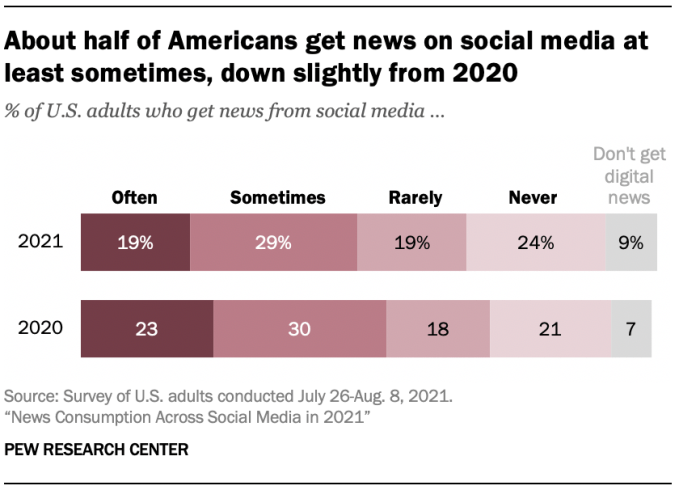
A new report from Pew Research finds that around a third of U.S. adults continue to get their news regularly from Facebook, though the exact percentage has slipped from 36% in 2020 to 31% in 2021. This drop reflects an overall slight decline in the number of Americans who say they get their news from any social media platform — a percentage that also fell by 5 percentage points year-over-year, going from 53% in 2020 to a little under 48%, Pew’s study found.

By definition, “regularly” here means the survey respondents said they get their news either “often” or “sometimes,” as opposed to “rarely,” “never,” or “don’t get digital news.”

The change comes at a time when tech companies have come under heavy scrutiny for allowing misinformation to spread across their platforms, Pew notes. That criticism has ramped up over the course of the pandemic, leading to vaccine hesitancy and refusal, which in turn has led to worsened health outcomes for many Americans who consumed the misleading information.

Despite these issues, the percentage of Americans who regularly get their news from various social media sites hasn’t changed too much over the past year, demonstrating how much a part of people’s daily news habits these sites have become.

Image Credits: Pew Research

In addition to the one-third of U.S. adults who regularly get their news on Facebook, 22% say they regularly get news on YouTube. Twitter and Instagram are regular news sources for 13% and 11% of Americans, respectively.

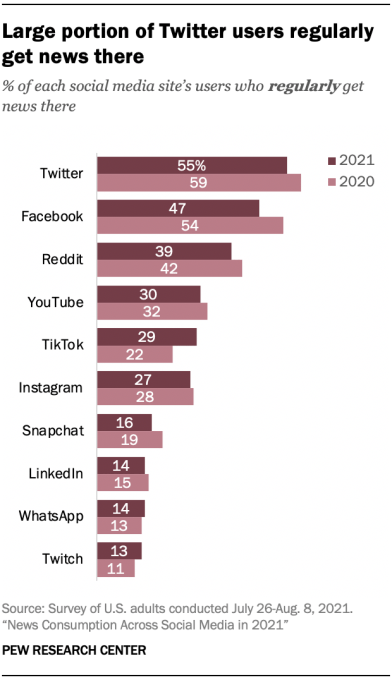
However, many of the sites have seen small declines as a regular source of news among their own users, says Pew. This is a different measurement compared with the much smaller percentage of U.S. adults who use the sites for news, as it speaks to how the sites’ own user bases may perceive them. In a way, it’s a measurement of the shifting news consumption behaviors of the often younger social media user, more specifically.

Today, 55% of Twitter users regularly get news from its platform, compared with 59% last year. Meanwhile, Reddit users’ use of the site for news dropped from 42% to 39% in 2021. YouTube fell from 32% to 30%, and Snapchat fell from 19% to 16%. Instagram is roughly the same, at 28% in 2020 to 27% in 2021.

Only one social media platform grew as a news source during this time: TikTok.

In 2020, 22% of the short-form video platform’s users said they regularly got their news there, compared with an increased 29% in 2021.

Overall, though, most of these sites have very little traction with the wider adult population in the U.S. Fewer than 1 in 10 Americans regularly get their news from Reddit (7%), TikTok (6%), LinkedIn (4%), Snapchat (4%), WhatsApp (3%) or Twitch (1%).

Image Credits: Pew Research

There are demographic differences between who uses which sites, as well.

White adults tend to turn to Facebook and Reddit for news (60% and 54%, respectively). Black and Hispanic adults make up significant proportions of the regular news consumers on Instagram (20% and 33%, respectively.) Younger adults tend to turn to Snapchat and TikTok, while the majority of news consumers on LinkedIn have four-year college degrees.

Of course, Pew’s latest survey, conducted from July 26 to Aug. 8, 2021, is based on self-reported data. That means people’s answers are based on how the users perceive their own usage of these various sites for newsgathering. This can produce different results compared with real-world measurements of how often users visited the sites to read news. Some users may underestimate their usage and others may overestimate it.

People may also not fully understand the ramifications of reading news on social media, where headlines and posts are often molded into inflammatory clickbait in order to entice engagement in the form of reactions and comments. This, in turn, may encourage strong reactions — but not necessarily from those worth listening to. In recent Pew studies, it found that social media news consumers tended to be less knowledgeable about the facts on key news topics, like elections or Covid-19. And social media consumers were more frequently exposed to fringe conspiracies (which is pretty apparent to anyone reading the comments!)

For the current study, the full sample size was 11,178 respondents, and the margin of sampling error was plus or minus 1.4 percentage points.


from TechCrunch https://ift.tt/2ZaCwQZ
https://ift.tt/39jN0zv