Blog

02 Sep 2021

Pixalate tunes into $18.1M for fraud prevention in television, mobile advertising

Pixalate raised $18.1 million in growth capital for its fraud protection, privacy and compliance analytics platform that monitors connected television and mobile advertising.

Western Technology Investment and Javelin Venture Partners led the latest funding round, which brings Pixalate’s total funding to $22.7 million to date. This includes a $4.6 million Series A round raised back in 2014, Jalal Nasir, founder and CEO of Pixalate, told TechCrunch.

The company, with offices in Palo Alto and London, analyzes over 5 million apps across five app stores and more 2 billion IP addresses across 300 million connected television devices to detect and report fraudulent advertising activity for its customers. In fact, there are over 40 types of invalid traffic, Nasir said.

Nasir grew up going to livestock shows with his grandfather and learned how to spot defects in animals, and he has carried that kind of insight to Pixalate, which can detect the difference between real and fake users of content and if fraudulent ads are being stacked or hidden behind real advertising that zaps smartphone batteries or siphons internet usage and even ad revenue.

Digital advertising is big business. Nasir cited Association of National Advertisers research that estimated $200 billion will be spent globally in digital advertising this year. This is up from $10 billion a year prior to 2010. Meanwhile, estimated ad fraud will cost the industry $35 billion, he added.

“Advertisers are paying a premium to be in front of the right audience, based on consumption data,” Nasir said. “Unfortunately, that data may not be authorized by the user or it is being transmitted without their consent.”

While many of Pixalate’s competitors focus on first-party risks, the company is taking a third-party approach, mainly due to people spending so much time on their devices. Some of the insights the company has found include that 16% of Apple’s apps don’t have privacy policies in place, while that number is 22% in Google’s app store. More crime and more government regulations around privacy mean that advertisers are demanding more answers, he said.

The new funding will go toward adding more privacy and data features to its product, doubling the sales and customer teams and expanding its office in London, while also opening a new office in Singapore.

The company grew 1,200% in revenue since 2014 and is gathering over 2 terabytes of data per month. In addition to the five app stores Pixalate is already monitoring, Nasir intends to add some of the China-based stores like Tencent and Baidu.

Noah Doyle, managing director at Javelin Venture Partners, is also monitoring the digital advertising ecosystem and said with networks growing, every linkage point exposes a place in an app where bad actors can come in, which was inaccessible in the past, and advertisers need a way to protect that.

“Jalal and Amin (Bandeali) have insight from where the fraud could take place and created a unique way to solve this large problem,” Doyle added. “We were impressed by their insight and vision to create an analytical approach to capturing every data point in a series of transactions —  more data than other players in the industry — for comprehensive visibility to help advertisers and marketers maintain quality in their advertising.”


02 Sep 2021

Pixalate tunes into $18.1M for fraud prevention in television, mobile advertising

Pixalate raised $18.1 million in growth capital for its fraud protection, privacy and compliance analytics platform that monitors connected television and mobile advertising.

Western Technology Investment and Javelin Venture Partners led the latest funding round, which brings Pixalate’s total funding to $22.7 million to date. This includes a $4.6 million Series A round raised back in 2014, Jalal Nasir, founder and CEO of Pixalate, told TechCrunch.

The company, with offices in Palo Alto and London, analyzes over 5 million apps across five app stores and more 2 billion IP addresses across 300 million connected television devices to detect and report fraudulent advertising activity for its customers. In fact, there are over 40 types of invalid traffic, Nasir said.

Nasir grew up going to livestock shows with his grandfather and learned how to spot defects in animals, and he has carried that kind of insight to Pixalate, which can detect the difference between real and fake users of content and if fraudulent ads are being stacked or hidden behind real advertising that zaps smartphone batteries or siphons internet usage and even ad revenue.

Digital advertising is big business. Nasir cited Association of National Advertisers research that estimated $200 billion will be spent globally in digital advertising this year. This is up from $10 billion a year prior to 2010. Meanwhile, estimated ad fraud will cost the industry $35 billion, he added.

“Advertisers are paying a premium to be in front of the right audience, based on consumption data,” Nasir said. “Unfortunately, that data may not be authorized by the user or it is being transmitted without their consent.”

While many of Pixalate’s competitors focus on first-party risks, the company is taking a third-party approach, mainly due to people spending so much time on their devices. Some of the insights the company has found include that 16% of Apple’s apps don’t have privacy policies in place, while that number is 22% in Google’s app store. More crime and more government regulations around privacy mean that advertisers are demanding more answers, he said.

The new funding will go toward adding more privacy and data features to its product, doubling the sales and customer teams and expanding its office in London, while also opening a new office in Singapore.

The company grew 1,200% in revenue since 2014 and is gathering over 2 terabytes of data per month. In addition to the five app stores Pixalate is already monitoring, Nasir intends to add some of the China-based stores like Tencent and Baidu.

Noah Doyle, managing director at Javelin Venture Partners, is also monitoring the digital advertising ecosystem and said with networks growing, every linkage point exposes a place in an app where bad actors can come in, which was inaccessible in the past, and advertisers need a way to protect that.

“Jalal and Amin (Bandeali) have insight from where the fraud could take place and created a unique way to solve this large problem,” Doyle added. “We were impressed by their insight and vision to create an analytical approach to capturing every data point in a series of transactions —  more data than other players in the industry — for comprehensive visibility to help advertisers and marketers maintain quality in their advertising.”


02 Sep 2021

WhatsApp faces $267M fine for breaching Europe’s GDPR

It’s been a long time coming but Facebook is finally feeling some heat from Europe’s much trumpeted data protection regime: Ireland’s Data Protection Commission (DPC) has just announced a €225 million (~$267M) for WhatsApp.

The Facebook-owned messaging app has been under investigation by the Irish DPC, its lead data supervisor in the European Union, since December 2018 — several months after the first complaints were fired at WhatsApp over how it processes user data under Europe’s General Data Protection Regulation (GDPR), once it begun being applied in May 2018.

Despite receiving a number of specific complaints about WhatsApp, the investigation undertaken by the DPC that’s been decided today was what’s known as an “own volition” enquiry — meaning the regulator selected the parameters of the investigation itself, choosing to fix on an audit of WhatsApp’s ‘transparency’ obligations.

A key principle of the GDPR is that entities which are processing people’s data must be clear, open and honest with those people about how their information will be used.

The DPC’s decision today (which runs to a full 266 pages) concludes that WhatsApp failed to live up to the standard required by the GDPR.

Its enquiry considered whether or not WhatsApp fulfils transparency obligations to both users and non-users of its service (WhatsApp may, for example, upload the phone numbers of non-users if a user agrees to it ingesting their phone book which contains other people’s personal data); as well as looking at the transparency the platform offers over its sharing of data with its parent entity Facebook (a highly controversial issue at the time the privacy U-turn was announced back in 2016, although it predated GDPR being applied).

In sum, the DPC found a range of transparency infringements by WhatsApp — spanning articles 5(1)(a); 12, 13 and 14 of the GDPR.

In addition to issuing a sizeable financial penalty, it has ordered WhatsApp to take a number of actions to improve the level of transparency it offer users and non-users — giving the tech giant a three-month deadline for making all the ordered changes.

In a statement responding to the DPC’s decision, WhatsApp disputed the findings and dubbed the penalty “entirely disproportionate” — as well as confirming it will appeal, writing:

“WhatsApp is committed to providing a secure and private service. We have worked to ensure the information we provide is transparent and comprehensive and will continue to do so. We disagree with the decision today regarding the transparency we provided to people in 2018 and the penalties are entirely disproportionate. We will appeal this decision.” 

It’s worth emphasizing that the scope of the DPC enquiry which has finally been decided today was limited to only looking at WhatsApp’s transparency obligations.

The regulator was explicitly not looking into wider complaints — which have also been raised against Facebook’s data-mining empire for well over three years — about the legal basis WhatsApp claims for processing people’s information in the first place.

So the DPC will continue to face criticism over both the pace and approach of its GDPR enforcement.


Indeed, prior to today, Ireland’s regulator had only issued one decision in a major cross-border cases addressing ‘Big Tech’ — against Twitter when, back in December, it knuckle-tapped the social network over a historical security breach with a fine of $550k.

WhatsApp’s first GDPR penalty is, by contrast, considerably larger — reflecting what EU regulators (plural) evidently consider to be a far more serious infringement of the GDPR.

Transparency is a key principle of the regulation. And while a security breach may indicate sloppy practice, systematic opacity towards people whose data your adtech empire relies upon to turn a fat profit looks rather more intentional; indeed, it’s arguably the whole business model.

And — at least in Europe — such companies are going to find themselves being forced to be up front about what they’re doing with people’s data.

Is the GDPR working?  

The WhatsApp decision will rekindle the debate about whether the GDPR is working effectively where it counts most: Against the most powerful companies in the world, who are also of course Internet companies.

Under the EU’s flagship data protection regulation, decisions on cross border cases require agreement from all affected regulators — across the 27 Member States — so while the GDPR’s “one-stop-shop” mechanism seeks to streamline the regulatory burden for cross-border businesses by funnelling complaints and investigations via a lead regulator (typically where a company has its main legal establishment in the EU), objections can be raised to that lead supervisory authority’s conclusions (and any proposed sanctions), as has happened here, in this WhatsApp case.

Ireland originally proposed a far more low-ball penalty of up to €50M for WhatsApp. However other EU regulators objected to the draft decision on a number of fronts — and the European Data Protection Board (EDPB) ultimately had to step in and take a binding decision (issued this summer) to settle the various disputes.

Through that (admittedly rather painful) joint-working, the DPC was required to increase the size of the fine issued to WhatsApp. In a mirror of what happened with its draft Twitter decision — where the DPC has also suggested an even tinier penalty in the first instance.

While there is a clear time cost in settling disputes between the EU’s smorgasbord of data protection agencies — the DPC submitted its draft WhatsApp decision to the other DPAs for review back in December, so it’s taken well over half a year to hash out all the disputes about WhatsApp’s lossy hashing and so forth — the fact that ‘corrections’ are being made to its decisions and conclusions can land — if not jointly agreed but at least arriving via a consensus being pushed through by the EDPB — is a sign that the process, while slow and creaky, is working.

Even so, Ireland’s data watchdog will continue to face criticism for its outsized role in handling GDPR complaints and investigations — with some accusing the DPC of essentially cherry-picking which issues to examine in detail (by its choice and framing of cases) and which to elide entirely (by those issues it doesn’t open an enquiry into or complaints it simply drops or ignores), with its loudest critics arguing it’s therefore still a major bottleneck on effective enforcement of data protection rights across the EU. And the associated conclusion for that critique is that tech giants like Facebook are still getting a pretty free pass to violate Europe’s privacy rules.

But while it’s true that a $267M penalty is still the equivalent of a parking ticket for Facebook, orders to change how such adtech giants are able to process people’s information have the potential to be a far more significant correction on problematic business models. Again, though, time will be needed to tell.

In a statement on the WhatsApp decision today, noyb — the privacy advocay group founded by long-time European privacy campaigner Max Schrems, said: We welcome the first decision by the Irish regulator. However, the DPC gets about ten thousand complaints per year since 2018 and this is the first major fine. The DPC also proposed an initial €50MK fine and was forced by the other European data protection authorities to move towards €225M, which is still only 0.08% of the turnover of the Facebook Group. The GDPR foresees fines of up to 4% of the turnover. This shows how the DPC is still extremely dysfunctional.”

Schrems also noted that he and noyb still have a number of pending cases before the DPC — including on WhatsApp.

In further remarks, Schrems and noyb said: “WhatsApp will surely appeal the decision. In the Irish court system this means that years will pass before any fine is actually paid. In our cases we often had the feeling that the DPC is more concerned with headlines than with actually doing the hard groundwork. It will be very interesting to see if the DPC will actually defend this decision fully, as it was basically forced to make this decision by its European counterparts. I can imagine that the DPC will simply not put many resources on the case or ‘settle’ with WhatsApp in Ireland. We will monitor this case closely to ensure that the DPC is actually following through with this decision.”


02 Sep 2021

Corelight secures $75M Series D to bolster its network defense offering

Corelight, a San Francisco-based startup that claims to offer the industry’s first open network detection and response (NDR) platform, has raised $75 million in Series D investment led by Energy Impact Partners. 

The round — which also includes a strategic investment from Capital One Ventures, Crowdstrike Falcon Fund and Gaingels — brings Corelight’s total raised to $160 million, following a $50 million Series C in October 2019, a $25 million Series B in September 2018, and a $9.2 million Series A in July 2017.

While it’s raised plenty of capital in the past few years, the startup isn’t planning its exit just yet. Brian Dye, CEO of Corelight, tells TechCrunch that given Corelight’s market opportunity and performance — the startup claims to be the fastest-growing NDR player at scale — it plans to invest in growth and expects to raise additional capital in the future. 

“Public listing timeframes are always hard to forecast, and we view the private markets as attractive in the short term, so we expect to remain private for the next couple years and will look at market conditions then to decide our next step,” Dye said, adding that the Corelight plans to use its latest investment to fuel the acceleration of its global market presence and to develop new data and cloud-based offerings.

“Aside from go-to-market expansion, we are investing to ensure that the insight we provide both continues to lead the industry and can be readily used by customers of all types,” he added. 

Corelight, which competes with the likes of FireEye and STG-owned McAfee, was founded in 2013 when Dr. Vern Paxson, a professor of computer science at the University of California, Berkeley, joined forces with Robin Sommer and Seth Hall to build a network visibility solution on top of an open-source framework called Zeek (formerly Bro). 

Paxson began developing Zeek in 1995 when he was working at Lawrence Berkeley National Laboratory (LBNL). The software is now widely regarded as the gold standard for both network security monitoring and network traffic analysis and has been deployed by thousands of organizations around the world, including the U.S. Department of Energy, various agencies in the U.S. government, and research universities like Indiana University, Ohio State, and Stanford.

02 Sep 2021

Callin, David Sacks’ ‘social podcasting’ app, launches and announces a $12M Series A round

As live audio becomes more and more popular, co-founders David Sacks (former COO of PayPal and CEO of Yammer) and Axel Ericsson sought to combine social audio and podcasting into one seamless app. The resulting app Callin launches today on iOS with an announcement of $12 million in Series A funding co-led by Sequoia, Goldcrest, and Craft Ventures, where Sacks is a founder and partner.

On live audio platforms like Clubhouse or Twitter Spaces, once a room ends, the audio is gone. While Callin has similar live audio functionality, it sets itself apart by allowing users to save their live recording and edit it into an episode of a podcast.

“I’d been meaning to do a podcast for years, and I just had never gotten around to it, because it’s too complicated, and the barriers are too high,” said Sacks, who started his “All In” podcast in lockdown. “We have a guy in the studio who spends six hours doing post-production on every episode of the pod, and we all had to get microphones, hardware… It’s complicated to organize.”

For aspiring podcasters creating their first shows, Callin reduces the barrier to entry while allowing users to retain ownership of the content they create on the app. To start recording, users just open a room, which can be private or public — then they can invite guests to talk with them, or record alone. In a live room, Callin also has a more streamlined queue for audience participation to make it easier for hosts to manage crowds.

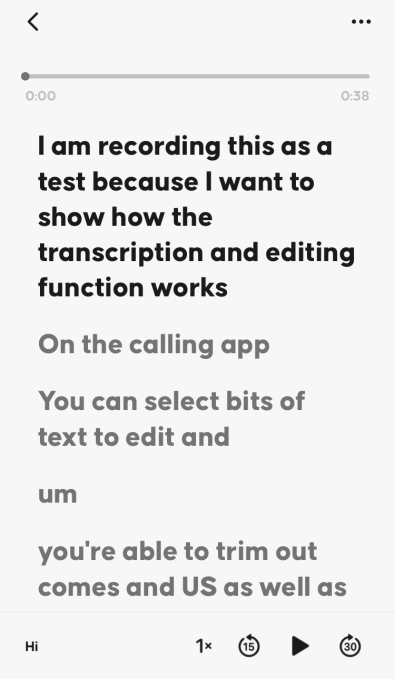
To edit your podcast after recording, the app generates a transcript — it takes about the same amount of time as your recording to transcribe. Then, you can tap a block of text to cut it from the podcast, including isolated filler words, like um and uh. As of now, you can’t cut individual words or phrases within each block of text identified by the AI, but Sacks says that the app will continue building out its editing system. Callin also automates the process of cutting out “dead air” at the beginning or end of a recording. After finishing edits, the host can upload the recording as an episode of a show that they create on the app. Users can also export their audio to share it on other podcasts hosts, and in the future, Sacks said users will be able to syndicate the content via an RSS feed.

“But consuming that content via a podcast app would be different from experiencing it on Callin, because you have the interactive playback to see the room as it was when the conversation occurred,” said Sacks. “So you can see the avatar of who’s talking and you can click it and follow them or browse their profile to see what else they’re interested in, so it’s a different experience than just a flat audio file.”

Image Credits: Callin, screenshot by TechCrunch

Podcasters cannot yet publish their transcripts — which, like most automated transcripts, aren’t 100% accurate — but that functionality, which Callin is working on, could create some much-needed accessibility that’s still lacking on Clubhouse. Like Clubhouse, Callin doesn’t support live captioning yet (Twitter Spaces does). But Sacks said that once it expands to allow hosts to share transcripts, live captioning would “be on the roadmap.”

“There are apps out there that do rooms, there’s apps that let you edit transcripts, and there’s apps that do social discovery or highlights, but nobody’s really put all these pieces together into one experience,” Sacks said. “So we’re trying to be this complete vertical stack for anyone who wants to create an audio show, and so I think you’ll see us keep iterating on every aspect of that experience. We want there to be nothing you can do in a podcasting studio that you can’t do on our app.”

Still, in its current form as it launches into the App Store, Callin lacks tools to edit the quality of an audio recording, add sound effects or music, and edit content in a more precise way. Plus, a podcast recorded on an iPhone won’t sound as good as a professionally produced show, or even a hobbyist’s podcast recorded on a consumer-grade USB mic. But the success of live audio apps has shown that sometimes listeners aren’t looking for quality post-production and sound design, but rather, they just want to hear people talk about a subject that interests them. So, Callin and its investors are betting on the fact that people would want to listen to pre-recorded Clubhouse rooms if they could.

Sacks has used his app to create shows like “Sacks on SaaS,” a show for software company founders, and an interview show called “Red Pills,” which is titled with a phrase that has a very fraught history on the internet. Other user-made content on the app includes shows about the NFL, startups in Berlin, cooking, and more. In its beta, Sacks says that Callin had “thousands” of users who created over 100 shows.

Per its Community Guidelines, Callin “is a place for people to speak, so whenever speech is limited on our platform, there should be a good reason.” Callin will only limit speech restricted by the host of a room, speech restricted by “underlying technology platforms” like Apple and Google, and “dangerous speech not protected by the First Amendment.”

Content moderation has been a challenge on live audio platforms like Clubhouse, which has struggled to refine its content moderation standards after reports of racist and antisemitic speech. Callin’s Community Guidelines indicate that it will host any user-generated content that won’t get the app booted off of Apple and Google stores. Recently, Parler served as a high-profile example of how a social platform’s refusal to moderate content got it removed from app stores, though it has since been reinstated after months of back-and-forth.

With its $12 million Series A round, Callin hopes to support Android and web versions of the app. Eventually, Callin could seek profit through advertisements and show subscriptions, but Sacks says that the company plans to scale first before exploring its monetization options.

“I think this is the best product that I’ve ever worked on,” said Sacks. “I mean, I think it’s better than Yammer. I think it’s better even than PayPal.”

02 Sep 2021

India launches Account Aggregator system to extend financial services to millions

India’s top banks five years ago built the interoperable UPI railroads and enabled over 150 million people in the South Asian market to pay digitally. Scores of firms — including local firms Paytm, PhonePe, CRED and international giants Google and Facebook — in India today support the UPI infrastructure, which is now reporting 3 billion transactions each month.

Banks are now ready for their second act.

On Thursday, eight Indian banks announced that they are rolling out — or about to roll out — a system called Account Aggregator to enable consumers to consolidate all their financial data in one place. (Participants banks are HDFC, Kotak, ICICI, Axis, SBI, IndusInd, IDFC, and Federal Bank. Four of them are rolling out the system Thursday, others say they will roll out the new system soon.)

The objective of Account Aggregator (AA) is to aggregate all financial information of an individual, said M Rajeshwar Rao, Deputy Governor of India’s central bank — Reserve Bank of India — at a virtual event Thursday.

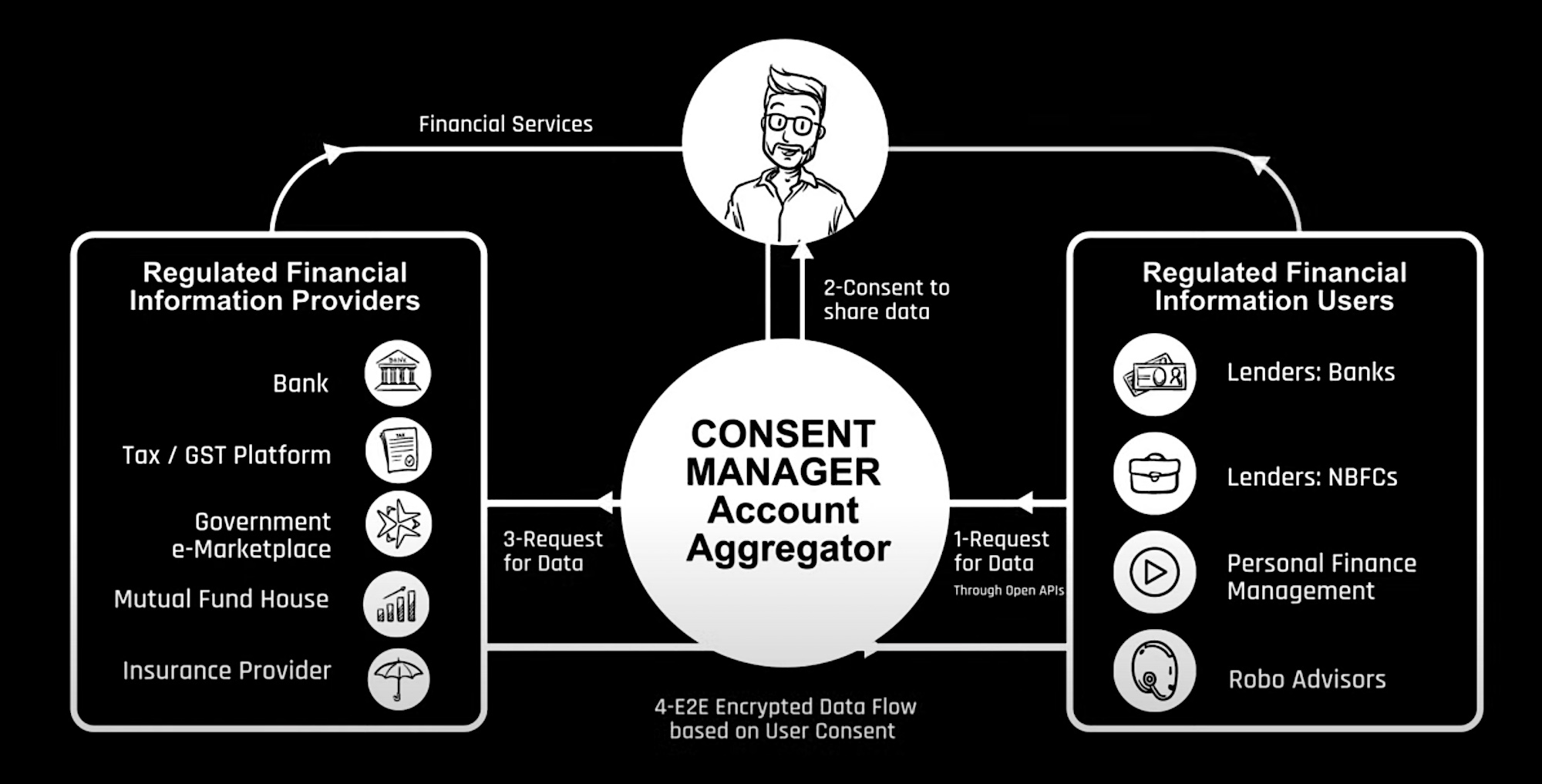
The new system makes it possible for banks, tax authorities, insurers, and other finance firms to aggregate data of customers — who have provided their consent — to get better understanding about their potential customers, make informed decisions and ensure smoother transactions.

Users who provide consent — and it only takes a few taps to do so — will be able to share their financial information from one Account Aggregator participant to another through a centralized API-based repository. Users get to decide for how long they wish their data to be shared with a particular Account Aggregator participant.

“For retail loan underwriting (“eligibility check”), rather than submitting previous 3 years bank statements, I can simply authenticate a data transfer via AA (and revoke the data transfer AFTER the loan is approved or sanctioned). For self-employed or freelance professionals, getting Term Insurance has always been difficult since they cannot prove their income – AA lets you provide an audit trail of past income to underwrite the Term Insurance application,” Rahul Mathur, founder and chief executive of insurance aggregator startup BimaPe, told TechCrunch.

An illustration of how the AA system works.

Account Aggregator is built in part to help consumers and businesses access financial services such as loans. Existing credit bureaus in India have data of only a fraction of the nation’s 1.4 billion population, which makes it very difficult for most in the country to access working capital, explained Infosys chairman Nandan Nilekani, who’s been an adviser to the initiative, at the event Thursday.

“Talks are on to onboard telecom operators as well,” he said, adding that the system has already achieved the sophistication that it could be extended to other industries.

“It’s an architecture that can now be applied to several additional industries,” he said, pointing to healthcare, fitness, testing labs as examples. “We can confidently say that there is no other country in the world that has built a robust infrastructure of this kind and at scale where its people can leverage their data. This approach is now getting global recognition.”

The Account Aggregator system is also positioned to dramatically increase the addressable market for online insurers, lenders, and players in several other industries.

“This is a big step towards a connected financial ecosystem, and will be very significant in Fi’s journey to help working millennials get better with their money. With the successful demonstration of the framework today we are excited to have all our users experience the power and convenience of the AA integration once it’s rolled out to all users,” said Sumit Gwalani, co-founder of Fi.

This is a developing story. More to follow…

02 Sep 2021

India launches Account Aggregator system to extend financial services to millions

India’s top banks five years ago built the interoperable UPI railroads and enabled over 150 million people in the South Asian market to pay digitally. Scores of firms — including local firms Paytm, PhonePe, CRED and international giants Google and Facebook — in India today support the UPI infrastructure, which is now reporting 3 billion transactions each month.

Banks are now ready for their second act.

On Thursday, eight Indian banks announced that they are rolling out — or about to roll out — a system called Account Aggregator to enable consumers to consolidate all their financial data in one place. (Participants banks are HDFC, Kotak, ICICI, Axis, SBI, IndusInd, IDFC, and Federal Bank. Four of them are rolling out the system Thursday, others say they will roll out the new system soon.)

The objective of Account Aggregator (AA) is to aggregate all financial information of an individual, said M Rajeshwar Rao, Deputy Governor of India’s central bank — Reserve Bank of India — at a virtual event Thursday.

The new system makes it possible for banks, tax authorities, insurers, and other finance firms to aggregate data of customers — who have provided their consent — to get better understanding about their potential customers, make informed decisions and ensure smoother transactions.

Users who provide consent — and it only takes a few taps to do so — will be able to share their financial information from one Account Aggregator participant to another through a centralized API-based repository. Users get to decide for how long they wish their data to be shared with a particular Account Aggregator participant.

“For retail loan underwriting (“eligibility check”), rather than submitting previous 3 years bank statements, I can simply authenticate a data transfer via AA (and revoke the data transfer AFTER the loan is approved or sanctioned). For self-employed or freelance professionals, getting Term Insurance has always been difficult since they cannot prove their income – AA lets you provide an audit trail of past income to underwrite the Term Insurance application,” Rahul Mathur, founder and chief executive of insurance aggregator startup BimaPe, told TechCrunch.

An illustration of how the AA system works.

Account Aggregator is built in part to help consumers and businesses access financial services such as loans. Existing credit bureaus in India have data of only a fraction of the nation’s 1.4 billion population, which makes it very difficult for most in the country to access working capital, explained Infosys chairman Nandan Nilekani, who’s been an adviser to the initiative, at the event Thursday.

“Talks are on to onboard telecom operators as well,” he said, adding that the system has already achieved the sophistication that it could be extended to other industries.

“It’s an architecture that can now be applied to several additional industries,” he said, pointing to healthcare, fitness, testing labs as examples. “We can confidently say that there is no other country in the world that has built a robust infrastructure of this kind and at scale where its people can leverage their data. This approach is now getting global recognition.”

The Account Aggregator system is also positioned to dramatically increase the addressable market for online insurers, lenders, and players in several other industries.

“This is a big step towards a connected financial ecosystem, and will be very significant in Fi’s journey to help working millennials get better with their money. With the successful demonstration of the framework today we are excited to have all our users experience the power and convenience of the AA integration once it’s rolled out to all users,” said Sumit Gwalani, co-founder of Fi.

This is a developing story. More to follow…

02 Sep 2021

FAA opens probe into anomaly on Richard Branson’s Virgin Galactic spaceflight

The Federal Aviation Administration is looking into an anomaly on the Virgin Galactic flight that carried Richard Branson to space. In a piece discussing not just that particular flight but the company’s various safety issues throughout the years, The New Yorker explained that Virgin’s spacecraft went off-course during descent, triggering an “entry glide-cone warning.” The spacecraft uses the glide cone method, which mimics water circling down the drain, for landing. Apparently, the pilots for the mission didn’t fly as steeply as they should have, causing the system to raise the alarm.

An FAA spokesperson confirmed to Reuters that the vehicle “deviated from its Air Traffic Control clearance as it returned to Spaceport America” and it’s investigating the incident. The agency gives missions to space a designated airspace they can fly in to prevent collisions with commercial planes and to minimize civilian casualties in the event of an accident. Virgin’s Unity 22 mission flew out of that designated airspace for a minute and forty-one seconds before the pilots were able to correct course.

Nicholas Schmidle, author of The New Yorker piece, said he attended a meeting a few years ago, wherein the same pilots on the Unity 22 flight said a red light entry glide-cone warning should “scare the shit out of you.” Apparently, that means it’s too late, and that the safest course of action is to abort. In a statement it published after the article went out, though, Virgin Galactic said it “disputes the misleading characterizations and conclusions” in the piece and that the people on the flight weren’t in any danger as a result of the flight deviation. The company said:

“When the vehicle encountered high altitude winds which changed the trajectory, the pilots and systems monitored the trajectory to ensure it remained within mission parameters. Our pilots responded appropriately to these changing flight conditions exactly as they were trained and in strict accordance with our established procedures. Although the flights ultimate trajectory deviated from our initial plan, it was a controlled and intentional flight path that allowed Unity 22 to successfully reach space and land safely at our Spaceport in New Mexico. At no time were passengers and crew put in any danger as a result of this change in trajectory.”

It also said that the spacecraft did not fly outside of the lateral confines of the mission’s protected airspace, though it did drop below the altitude of the airspace it was provided. The company added that it’s “working in partnership with the FAA to address the airspace for future flights.”

Editor’s note: This post originally appeared on Engadget.

iv>
02 Sep 2021

SoftBank deepens commitment to LatAm with two new partners focused on early-stage investing

In March 2019, SoftBank Group International made headlines when it announced the SoftBank Innovation Fund, which started out with a $2 billion commitment to invest in tech startups in Latin America.

A lot has changed since then. SoftBank changed the name of the fund to the SoftBank Latin America Fund, or LatAm Fund for short. The Japanese investment conglomerate has dramatically ramped up its investing in the region, and so have a number of other global investors. In fact, venture capitalists poured an estimated $6.2 billion into Latin American startups in the first half of 2021.

As evidence of its continued commitment to the region, SoftBank Group announced today that it has added two new managing partners to its LatAm Fund team: Rodrigo Baer and Marco Camhaji. The two will focus on “identifying and supporting” early-stage companies across the Latin American region, SoftBank told TechCrunch exclusively.

Baer and Camhaji will report to SoftBank Executive President & COO Marcelo Claure, who points out that the firm’s LatAm fund has invested in more than two-thirds of the nearly two dozen unicorns currently operating in the region. He said that SoftBank is today “one of the largest and most active” technology investors in the region.

The move is significant in that the hires represent an expansion of SoftBank LatAm Fund’s mandate and means that the firm is now backing companies at all stages in the region.

By bringing Baer and Camhaji on board, Claure said in a statement, SoftBank will “be better able to identify high-growth companies and support them at every step of their lifecycle.”

SoftBank describes Baer as one of the pioneers of Brazil’s venture capital industry. He has invested in more than 20 companies since 2010. According to Crunchbase, he co-founded Warehouse Investimentos in 2010, where he led deal-sourcing efforts. He joined the investment team of Redpoint eVentures, a LatAm-based early-stage VC fund, in June 2014. He also was previously an engagement manager at McKinsey and worked at Aurora Funds, a healthcare-services focused fund based in the US. He is also active with Endeavor and multiple angel groups. 

Prior to joining SoftBank, Camhaji was a business development principal at Amazon, establishing strategic partnerships with fintechs in Latin America. He also served as the CEO of Adianta, a Brazilian B2B invoice financing company. Previously, Camahji was a founder and partner at Yellow Ventures, making seed investments in technology startups. He was also a partner and CFO of Redpoint eVentures.

In August, Shu Nyatta, a managing partner at SoftBank who co-leads its $5 billion Latin America Fund, pointed out a dynamic that might seem obvious but is rarely articulated: Technology in LatAm is often more about inclusion rather than disruption.

“The vast majority of the population is underserved in almost every category of consumption. Similarly, most businesses are underserved by modern software solutions,” Nyatta told TechCrunch. “There’s so much to build for so many people and businesses. In San Francisco, the venture ecosystem makes life a little better for individuals and businesses who are already living in the future. In LatAm, tech entrepreneurs are building the future for everyone else.

Some recent SoftBank investments in the region include:

  • Kavak, a used car marketplace born in Mexico but now also operating in Brazil and Argentina. “Think of Carvana, but for emerging markets.”
  • Rappi, where “DoorDash-meets-Instacart,” operating across Latin America.
  • QuintoAndar, a Brazilian real estate marketplace.
  • Creditas unlocks the equity trapped in homes and cars and other important assets for Brazilians.
  • Gympass is a marketplace for fitness and wellness, provided through the enterprise to employees.

As global investors continue to flood the region with capital, it’s clear that SoftBank is getting even more aggressive about backing startups in Latin America. Earlier this week, the firm also announced the launch of the SoftBank Latin America Fund II, its second dedicated private investment fund focused on tech companies located in LatAm, with an initial $3 billion commitment.

02 Sep 2021

AxleHire to scale Tortoise and URB-E zero-emissions delivery solutions nationally

Last-mile logistics supplier AxleHire provides same-day and next-day delivery through a network that includes gig economy, couriers and traditional carriers. Over the past year, it has been quietly piloting automated repositioning startup Tortoise’s remote controlled delivery robots in Los Angeles and compact container delivery service URB-E’s e-bike container delivery in New York City. On Thursday, it announced plans to scale the two very different zero-emissions pilot programs nationally over the next 12 months.

AxleHire, which is known for parcel delivery and restaurant meal kit delivery like Blue Apron and HelloFresh, plans to bring over 100 Tortoise robots across the country. During URB-E’s summer deployment with AxleHire in NYC, it deployed 10 vehicles moving 100 containers per week. Now it will deploy 50 URB-E vehicles moving anywhere from 300 to 500 containers per week in NYC, LA and San Francisco, as well as other launch cities. The company, which raised a $20 million round in April, didn’t specify every city it would be entering with these new programs, but Tortoise and URB-E said we can look to the cities AxleHire already operates in: Chicago, Dallas, Houston, Los Angeles, San Diego, San Francisco, New York, Phoenix, Seattle and Portland, Oregon.

AxleHire’s style is to establish delivery hubs in or near dense metro areas, which makes for easier trips and less miles traveled in total. The partnerships with Tortoise and URB-E are a part of AxleHire’s mission to create more sustainable and cheaper last-mile delivery. The company says its partnerships with the two startups have also lowered its emissions by 95%. AxleHire is providing an example of one company trialing two very different greener and tech-focused forms of transporting goods, so it will likely serve as an interesting case study for other last-mile logistics providers.

Image Credits: URB-E

In New York, AxleHire and URB-E have been working together on a microcontainer delivery system between Brooklyn and Manhattan. URB-E’s vehicles are specifically designed to be able to ride in the bike lanes, despite their ability to haul over 800 pounds. AxleHire says its pilot with URB-E resulted in a six times reduction in traffic and a model that is three times cheaper than EV delivery vans, largely based on the avoidance of parking tickets.

Over the past year in Los Angeles, AxleHire stationed Tortoise’s electric, 4-mph remote-piloted carts, which carried up to 120 pounds worth of goods, in its delivery microhubs in cities, allowing the little bots with friendly smiley faces to go back and forth, making about 15 deliveries per day within a three-mile radius. In addition, AxleHire loaded a large truck with multiple packages and a Tortoise robot, which would then drive into a dense residential area. This truck would serve as a mobile delivery hub, doing its own deliveries while the bot goes back and forth delivering parcels and being reloaded all day long.

“It’s basically the hive model, where we’re augmenting the existing van or truck in terms of how many deliveries they could do in a two-hour stretch,” Dmitry Shevelenko, co-founder of Tortoise, told TechCrunch. “There’s communication happening with our subject confirming they’ll be home to receive it. If so, they get notified that the robot’s on the way when it’s about 10 minutes away, and then when it arrives, the customer will come out and get it from the containers in the robot.”

The Tortoise bots, which can ride on sidewalks or bike lanes, have both swappable batteries and can be plugged and charged, according to Shevelenko. On a single charge, they can get around 10 to 15 miles of range.

While Tortoise’s bots will be operated 100% remotely over the next year, remote positioning is not Tortoise’s end goal at all. Autonomy is the goal, and doing partnerships like this, as well as with shared e-scooter operators like Spin, allows Tortoise not only to get into markets that currently don’t have regulation for self-driving vehicles, but also to just get into the market now, rather than spending multiple years mapping it first. The only real infrastructure the bots need is 4G connectivity.

“The beauty is that we can ship the robot to a new location and because we have the benefit of human judgment oversight every inch of the journey,” said Shevelenko. “We don’t need perfect routing or perfect mapping. We’re filling in the maps over time, and that gives us a big data advantage.”

By slowly collecting routing data over the course of the next year, Tortoise will be giving its system more data to learn on and create the most optimal route for the specific use case of low-speed and lightweight delivery vehicles. Shevelenko says the long-term vision of Tortoise is to have its tech on any light electric vehicle, whether it be a delivery robot, a scooter, a cleaning robot, security robot or construction robot. Delivery is a great place to start, given the massive demand in the COVID marketplace.

“The more vehicles we have with Tortoise eyes on them, the more data we’re collecting, which means we’re doing trips with higher autonomy and lower costs,” said Shevelenko.

Aside from allowing for max data collection, remote controlled delivery bots over the next year also give Tortoise the advantage of getting the community used to this new tech.

“We think the right way to enter a community is first to reassure people that this is safe and get them comfortable with it,” said Shevelenko. “Once it’s part of daily life, then slowly over time, we can turn on more autonomy, but there’s no need to rush into that right now. The practical reality is, everybody’s claiming they’re doing autonomy but they aren’t. They always have a fallback like safety drivers or remote monitors. Nobody actually trusts their economy system, and so we’re kind of leaning into that and not trying to do something that is impossible.”