30 Aug 2021

Zoom announces first startups receiving funding from $100M investment fund

For more than year now, Zoom has been on a mission to transform from an application into a platform. To that end it made three announcements last year: Zoom Apps development tools, the Zoom Apps marketplace and a $100 million development fund to invest in some of the more promising startups building tools on top of their platform. Today, at the closing bell, the company announced it has made its first round of investments.

Ross Mayfield, product lead for Zoom Apps and integrations spoke to TechCrunch about the round of investments. “We’re in the process of creating this ecosystem. We felt it important, particularly to focus on the seed stage and A stage of partnering with entrepreneurs to create great things on this platform. And I think what you see in the first batch of more than a dozen investments is representative of something that’s going to be a significant ongoing undertaking,” he explained.

He said while they aren’t announcing exact investment amounts, they are writing checks for between $250,000 and $2.5 million. They are teaming with other investment partners, rather than leading the rounds, but that doesn’t mean they aren’t working with these startups using internal resources for advice and executive backing, beyond the money.

“Every one of these investments has an executive or senior sponsor within the company. So there’s another person inside that knows the lay of the land, can help them advance and spend more personal time with them,” Mayfield said.

The company is also running several Zoom chat channels for the startups receiving investments to learn from one another and the Zoom Apps team. “We have a shared chat channel between the startup and my team. We have a channel called Announcements and a channel called Help, and another one that the startups created called Community,” he said.

Every week they use these channels to hold a developer office hour, business office hour which Mayfield runs, and then there’s a community hour where the startups can gather and talk amongst themselves about whatever they want.

Among the specific categories receiving funding are collaboration and productivity, community and charity, DE&I and PeopleOps, and gaming and entertainment. In the collaboration and productivity category, Warmly is a sales tool that provides background and information about each person participating in the meeting ahead of time, while allowing the meeting organizer to create customized Zoom backgrounds for each event.

Another is Fathom, which alleviates the need to take notes during a meeting, but it’s more than recording and transcription. “It gives you this really simple interface where you can just tag moments. And then, as a result you have this transcript of the video recording, and you can click on those tagged moments as highlights, and then share a clip of the meeting highlights to Salesforce, Slack and other tools,” Mayfield said.

Pledge enables individuals or organizations to request and collect donations inside a Zoom meeting instantly, and Canvas is a hiring and interview tool that helps companies build diverse teams with data that helps them set and meet DEI goals.

These and the other companies represent the first tranche of investments from this fund, and Mayfield says the company intends to continue looking for startups using the Zoom platform to build their startup or integrate with Zoom.

He says that every company starts as a feature, then becomes a product and then aspires to be a line of products. The trick is getting there.  The goal of the investment program and the entire set of Zoom Apps tools is about helping these companies take the first step.

“The art of being an entrepreneur is working with that risk in the absence of resources and pushing at the frontier of what you know.” Zoom is trying to be a role model, a mentor and an investor on that journey.

30 Aug 2021

Prive has raised $1.7 million to build a more configurable e-commerce subscription platform

Prive, a months-old, San Francisco-based startup founded by two former Uber product managers, just raised $1.7 million in pre-seed funding to create what it describes as a far more customizable e-commerce subscriptions platform for D2C brands.

The round was co-led by Patrick Chung and Brandon Farwell at XFund and Ben Ling from Bling Capital, with participation from Defy Partners, Halogen Ventures, and Uber executives.

Founded by Claudia Laurie and Alex Craciun — who both spent two-and-a-half years at Uber and decided, based on their learnings about pricing and incentives, to leave the company earlier this year —  Prive aims to better enable small retailers to compete with behemoths like Amazon.

The broad idea is that by plugging into existing APIs from Shopify and other e-commerce platforms, Prive can form an opinion that it sells to merchants about what customers tend to buy on a recurrent basis. Maybe it sees that people who buy razors also tend to buy toothbrushes on a similar cadence, for example. It passes that information along, then helps the brand create more customized, and flexible, offerings so that their shoppers are presented with items they might, as well as can more easily cancel items

“The market opportunity is huge, and the existing [e-commerce subscription] tools are just scratching the surface,” notes Laurie. Indeed, according to the group eMarketer,  subscription e-commerce sales have grown 41% from the start of the coronavirus pandemic, and it foresees that 3% of US retail e-commerce sales will come from subscriptions this year, totaling $27.67 billion. That’s up from $10 billion in just two years’ time.

Of course, a lot has yet to be built, which is where the pre-seed funding comes in. Right now, Prive is a seven-person team with some serious competition, namely from Recharge, a seven-year-old, Santa Monica, Calif.-based subscription e-commerce company that in May raised $277 million in growth capital at a post-money valuation of $2.1 billion. As of that announcement, Recharge had roughly 330 employees and was fueling the subscription service for what it said was 15,000 merchants and 20 million subscribers worldwide.

Other rivals include nine-year-old, Bold Commerce (it has raised $44 million altogether), and 10-year-old, Chargebee, which has raised around $220 million over the years, according to Crunchbase data.

“E-commerce ‘subscription’ is an incredibly hot buzzword,” acknowledges Craciun, but he also thinks the today’s current product offerings are just scratching the service.

Clearly, investors are willing to gamble that he’s right — and that Prive could be the team to prove it.

“Current tools can create more headaches than they actually solve,” says Craciun. “There is a lot of rigidity in today’s subscriptions that makes it very difficult to identify the right recurring mix of offerings. We’re here to break down that mental model.”

30 Aug 2021

Lessons from COVID: Flexible funding is a must for alternative lenders

Rachael runs a bakery in New York. She set up shop in 2010 with her personal savings and contributions from family and friends, and the business has grown. But Rachael now needs additional financing to open another store. So how does she finance her expansion plans?

Because of stringent requirements, extensive application processes and long turnaround times, small and medium-sized businesses (SMBs) like Rachael’s bakery seldom qualify for traditional bank loans. That’s when alternative lenders — who offer short and easy applications, flexible underwriting and quick turnaround times — come to the rescue.

Alternative lending is any lending that occurs outside of a conventional financial institution. These kinds of lenders offer different types of loans such as lines of credit, microloans and equipment financing, and they use technology to process and underwrite applications quickly. However, given their flexible requirements, they usually charge higher interest rates than traditional lenders.

Securitization is another cost-effective option for raising debt. Lenders can pool the loans they have extended and segregate them into tranches based on credit risk, principal amount and time period.

But how do these lenders raise funds to bridge the financing gap for SMBs?

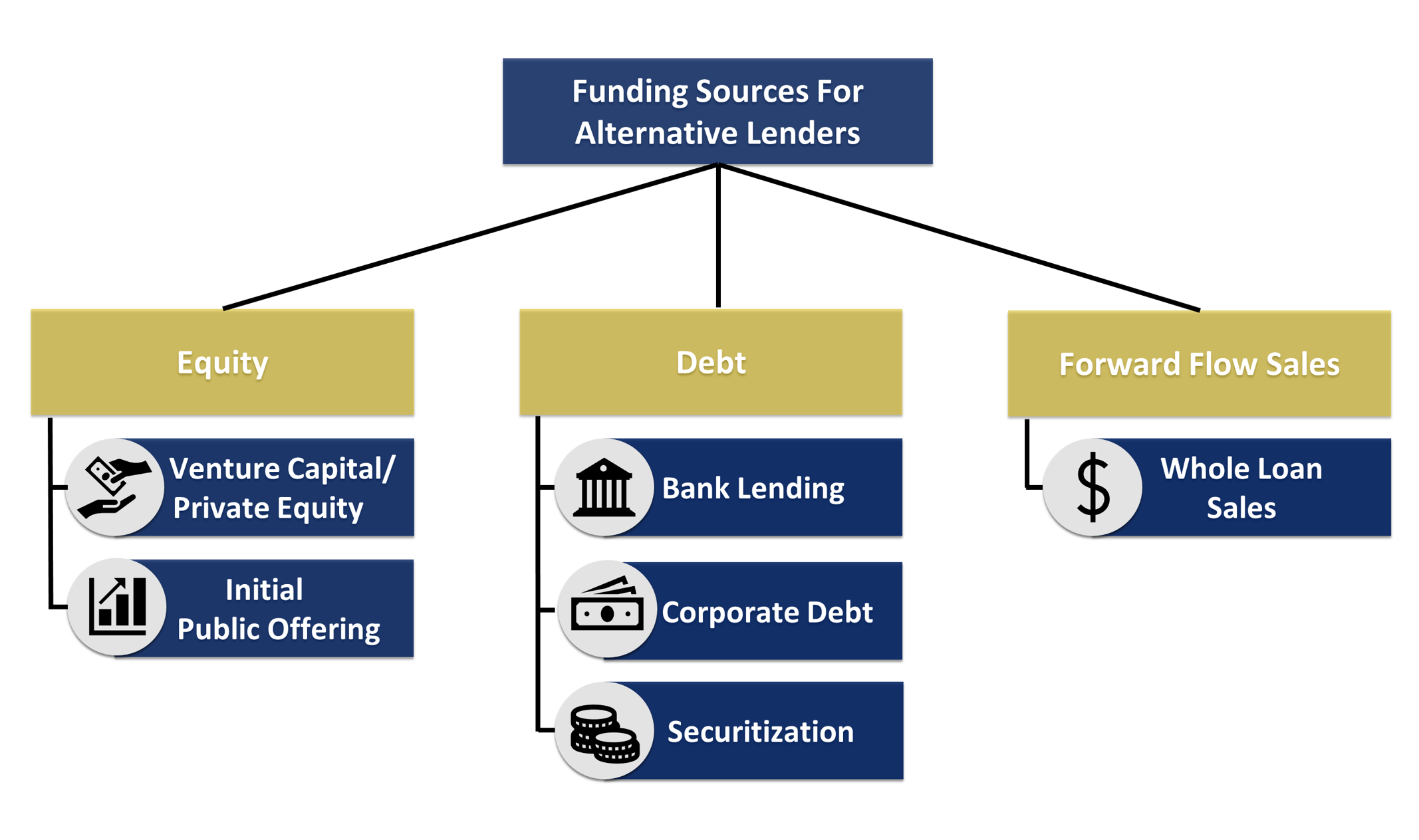
As with all businesses, these firms have two major sources of capital: equity and debt. Alternative lenders typically raise equity funding from venture capital, private equity firms or IPOs, and their debt capital is typically raised from sources such as traditional asset-based bank lending, corporate debt and securitizations.

According to Naren Nayak, SVP and treasurer of Credibly, equity generally constitutes 5% to 25% of capital for alternative lenders, while debt can be between 75% and 95%. “A third source of capital or funding is also available to alternative lenders — whole loan sales — whereby the loans (or merchant cash advance receivables) are sold to institutions on a forward flow basis. This is a “balance-sheet light” funding solution and an efficient way to transfer credit risk for lenders,” he said.

Let’s take a look at each of these options in detail.

Funding sources for alternative lenders.

Image Credits: FischerJordan

Equity capital

Venture capital or private equity funding is one of the major sources of financing for alternative lenders. The alternative lending industry is said to be a “gold mine” for venture capital investments. While it is difficult for such companies to receive credit from traditional banks because of their stringent requirements in the initial stages, once the founders have shown a commitment by investing their own money, VC and PE firms usually step in.

However, VC and PE firms can be expensive sources of capital — their investment dilutes the ownership and control in the company. Plus, obtaining venture capital is a long, involved and competitive process.

Alternative lenders that have achieved good growth rates and scaled their operations have another option: An IPO lets them quickly raise large amounts of money while providing a lucrative exit for early investors.

30 Aug 2021

Telegram tops 1 billion downloads

Popular instant messaging app Telegram has joined the elite club of apps that have been downloaded over 1 billion times globally, according to Sensor Tower.

The Dubai-headquartered app, which was launched in late 2013, surpassed the milestone on Friday, the mobile insight firm told TechCrunch. As is the case with the app’s chief rival, WhatsApp, India is the largest market for Telegram. The world’s second largest internet market represents approximately 22% of its lifetime installs, Sensor Tower said.

“[India is] followed by Russia and Indonesia, which represent about 10% and 8% of [all installs], respectively. The app’s installs accelerated in 2021, reaching about 214.7 million installs in the first half of 2021, up 61% year-over-year from 133 million in H1 2020,” it added.

It’s worth noting that the number of installs doesn’t equate to the app’s active userbase. Telegram had about 500 million monthly active users as of early this year, for instance. But the surge in downloads, which coincides with WhatsApp’s poor handling of relaying its privacy policies to its massive userbase, nonetheless suggests that Telegram has enjoyed some additional attention in recent quarters.

Telegram, which earlier this year raised over $1 billion, is the 15th app worldwide to have been downloaded 1 billion times or more, Sensor Tower told TechCrunch. Other apps on the list include WhatsApp, Messenger, Facebook, Instagram, Snapchat, Spotify, and Netflix, according to Sensor Tower. (Mobile research firms don’t track the installs of most Google apps that come pre-installed on Android devices.)

Telegram didn’t immediately respond to a request for comment.

30 Aug 2021

Luminate aims to make hair loss from chemotherapy a thing of the past

Hair loss resulting from chemotherapy is one of the most recognizable side effects in all of medicine, and for many is an unwanted public announcement of their condition and treatment. Luminate Medical may have a solution in a medical wearable that prevents the chemical cocktail from tainting hair follicles, preventing the worst of the loss and perhaps relegating this highly visible condition to the past.

When Luminate CEO Aaron Hannon and his co-founder Bárbara Oliveira were asking patients and doctors about areas of cancer treatment that they could perhaps innovate in, “we were just astonished at how much hair loss dominated the conversation,” said Hannon. “So from then on out we’ve just been laser focused on making that something that doesn’t exist any more.”

When a patient is undergoing chemotherapy, the cancer-inhibiting drugs course through their entire body — anywhere the blood goes. This has a variety of side effects, like weakness and nausea, and on a longer time scale hair loss occurs as the substances affect the follicles. Luminate’s solution, developed in partnership with the National University of Ireland Galway, is to prevent the blood from reaching those cells in the first place.

Image of a woman wearing the Luminate headset.

Image Credits: Luminate

The device that effects this is a sort of mechanized compression garment for the head. If that sounds a bit sinister, don’t worry — the pressure comes from air bladders and pads pressing against the scalp, not screws or plates; Hannon says that it isn’t uncomfortable and pressure is carefully monitored.

There’s also no risk of damage from lack of blood flow in those cells. “Compression therapy has been really well studied,” he said. “There are years of literature around how long you can apply these therapies without damaging the cells. There’s a certain amount of mechanical engineering involved in making it both comfortable and effective.”

The patient wears the cap during and after the whole chemo session. By restricting blood flow to the skin of the scalp only, it allows the drugs to flow unimpeded to wherever the tumor or cancer site is while saving the hair follicles from damage.

Tests have been done on animals, which saw hair retention of around 80 percent with no adverse effects — and while full human trials are something that will need some time and approval to set up, initial tests of the headset’s bloodflow-blocking effects on healthy patients showed that it works exactly as expected on people as well.

“We’re really excited about the efficacy of this therapy because it works with lots of hair types,” said Hannon. That’s a real consideration, since a tech that only worked with short hair, straight hair, or some other subset of hairstyles would exclude far too many people.

Luminate's app showing how long is left in therapy for the user.

Image Credits: Luminate / Wild Island Pictures

As for competition, although there are some new treatments that cool the scalp instead of compressing it, Hannon noted that the most money is spent by far on wigs. An average of a thousand dollars per patient who opts for a wig means there’s considerable leeway for a device in that neighborhood.

Although hair loss is considered a medical condition by many insurance companies and other methods of reimbursement, and wigs are often covered, it will take time and lots of evidence to get Luminate’s device approved for those processes. But the team is confident that at around $1,500, the device is within the means of many as long as other costs are being picked up by insurance. People do, after all, spend that much and more not just on wigs but on other hair retention products and methods. If there was a checkbox for “don’t lose hair” on the chemo forms with a $1,500 price tag, a whole lot of people would check it without a second thought.

Cofounders Bárbara Oliveira (left) and Aaron Hannon.

Image Credits: Luminate

Ultimately, however, Luminate wants to be able to offer the device also to those who can’t afford the cost out of pocket, so they are progressing towards FDA approval and a U.S. launch, with Europe and others to come.


So far Luminate, just graduating from Y Combinator’s Summer 2021 batch, has been lucky enough to operate on funds provided through grants from the Irish government, which are of course non-dilutive. While more capital will almost certainly be required come time for scaling and international launch, right now the team is focused on getting the device into the hands (and onto the heads) of its first set of patients.

30 Aug 2021

TikTok owner ByteDance buys a top virtual reality hardware startup

TikTok parent company ByteDance seem to be looking to one-up Facebook anywhere it can. After taking over the mantle of most-downloaded social media app in the world with TikTok, ByteDance is coming for Facebook’s moonshot, buying up its own virtual reality headset maker called Pico.

The deal first reported on by Bloomberg last week was confirmed by the company on Monday, though ByteDance didn’t disclose a price tag for the deal. Pico had raised some $62 million in venture funding from Chinese firms including a $37 million Series B in March. Like Oculus, they create both hardware and software for their VR devices. Unlike Oculus, they have a substantial presence in China. Pico may not hold the same name recognition as Oculus or HTC, but the company is a top VR hardware maker, selling to consumer audiences in China and enterprise customers in the Western world.

With Pico finding its home now at ByteDance, two of the world’s largest virtual reality brands now reside inside social media companies. Ironically, many of the company’s North American customers I’ve chatted with over the years seem to have at least partially opted for Pico headsets over Oculus hardware due to general weariness of Facebook’s data and ads-dependent business models which they fear Oculus will eventually become a larger part of.

It’s no secret that the virtual reality market has been slow out of the gate, but Facebook has blazed the trail for the technology dumping billions of dollars into an ecosystem that traditional investors have largely seemed uninterested in, in recent years.

Without knowing broad terms of the deal (I’m asking around), it’s hard to determine whether this is a moment of resurgence for VR or another sign of a contracting market. What seems most likely to me is that ByteDance is indeed interested in building out a consumer VR brand and is aiming to follow in Facebook’s footsteps closely while learning from their missteps and capitalizing on their contributions to the ecosystem. Whether the company solely focuses on the consumer markets in China or loosely pursue enterprise clients stateside as well is a big question ByteDance will have to address.

ockquote>