Blog

18 Mar 2020

Ford temporarily suspends production in North American factories

Ford said Wednesday it will temporarily suspend production at its North American factories through March 30 in response to COVID-19, the disease caused by coronavirus.

“We’re continuing to work closely with union leaders, especially the United Auto Workers, to find ways to help keep our workforce healthy and safe — even as we look at solutions for continuing to provide the vehicles customers really want and need,”  Kumar Galhotra, Ford’s president of North America said in a statement. “In these unprecedented times, we’re exploring unique and creative solutions to support our workforce, customers, dealers, suppliers and communities.”

Ford said it will work with UAW on “restart” plans as well as putting in place additional protocols and procedures for helping prevent the spread of the virus. One of the top priorities is to find ways to maximize social distancing among plant workers – both during work hours and at shift change, when large numbers of people typically gather at entry and exit points and maximizing cleaning times between shift changes, Ford said.

“Today’s action is the prudent thing to do. By taking a shutdown and working through next steps, we protect UAW members, their families and the community,” said Rory Gamble, president of the UAW. “We have time to review best practices when the plants reopen, and we prevent the possible spread of this pandemic. We commend Ford for working with us and taking this bold step.”

Ford also temporarily closed its Michigan Assembly Plant building Wednesday morning after an employee tested positive for the COVID-19. The company said it is thoroughly cleaning and disinfecting the building. The plant, like the others, will halt production through March 30.

Ford’s closures in North America follows a decision to shutter factories in Cologne and Saarlouis in Germany as well as its Craiova facility in Romania. Earlier this week, Ford asked all salaried employees — except those performing business critical roles that can’t be done off site —to work remotely until further notice.

On Sunday, the UAW along with GM, Ford and Fiat Chrysler Automobiles formed a coronavirus task force to work on ways to protect worker and lessen the spread of the disease.

18 Mar 2020

Chinese cloud infrastructure market generated $3.3B in Q42019

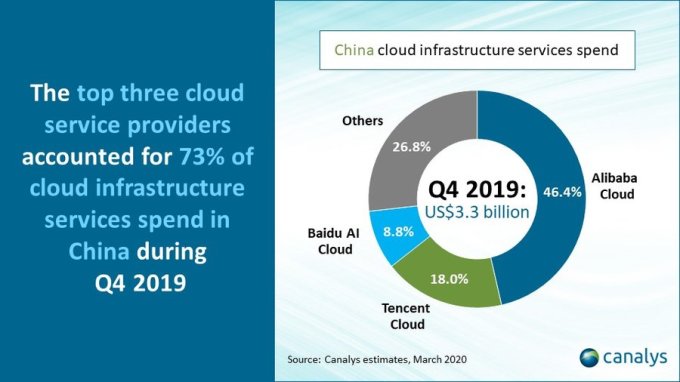
Research firm Canalys reports that the Chinese cloud infrastructure market grew 66.9% to $3.3 billion in the last quarter of 2019, right before the COVID-19 virus hit the country. China is the second largest cloud infrastructure market in the world with 10.8% share.

The quarter puts the Chinese market on a $13.2 billion run rate. Canalys pegged the US market at $14 billion for the same time period with a 47% worldwide market share.

Alibaba led the way in China with over 46% market share. Like its American eCommerce giant counterpart, Amazon, Alibaba has a cloud arm, and it dominates in its country much the same way AWS does in the U.S.

Tencent was in second with 18%, roughly the equivalent of Microsoft Azure’s share in the US, and Baidu AI Cloud came in third with 8.8%, roughly the equivalent of Google’s US market share.

Slide: Canalys

Matthew Ball, an analyst at Canalys says the fourth quarter numbers predate the medical crisis due to the COVID-19 outbreak in China. “In terms of growth drivers for Q4, we have seen the ongoing demand for on-demand compute and storage accelerate throughout 2019, as private and public organizations embark on digital transformation projects and start building platforms and applications to develop new services.”

Ball says gaming was a big cloud customer, as was healthcare, finance, transport and industry. He also pointed to growth in facial recognition technology as part of the smart city sector.

As for next year, Ball says the firm still sees big growth in the market despite the virus impact in Q12020. “In addition to the continuation of digital projects once business returns to normality, we anticipate many businesses new to using cloud services during the crisis will continue use and become paying customers,” he said. The cloud companies have been offering a number of free options to businesses during the crisis.

“The overall outcome of current events around the world will be that companies will assess their business continuity measures and make sure they can continue to operate if events are ever repeated,” he said.

18 Mar 2020

Delta Air Lines will park at least half its fleet and close airport lounges

In a letter to employees, Delta Air Lines CEO Ed Bastian today announced that the company is parking at least half of its fleet as demand for flights during the current COVID-19 pandemic has plummeted both in the U.S. and internationally. In total, Delta is cutting 70 percent of its capacity and 80 percent of its international operations. It is also closing the majority of its Sky Club airport lounges, making it the first major U.S. airline to take this step.

Bastian notes that he expects revenue for March to decline by $2 billion compared to last year, with the expectation that April’s revenue will be even lower.

“We are having constructive discussions with the White House and Congress, and remain optimistic that our industry will receive support to help address this crisis,” Bastian writes. “That said, we have to continue to take all necessary self-help measures. Cash preservation remains our top financial priority right now. Making swift decisions now to reduce the losses and preserve cash will provide us the resources to rebound from the other side of this crisis and protect Delta’s future.”

Delta also notes that it will accelerate the retirement of some of its older aircraft, specifically some of its 767s and MD-88s and 90s. In addition, Bastian says that the company is reducing maintenance spend for anything that is not necessary “to support the safety of our operation.”

Delta executives are taking pay cuts during this period. About 10,000 employees have already volunteered to take leaves from the company. “I know everyone is concerned about the security of your jobs and pay Given the uncertainty about the duration of this crisis, we are not yet at a point to make any decisions,” says Bastian.

Yesterday, United Airlines also announced drastic schedule reductions for both its domestic and international operations. It’s decreasing international flights by 85 percent and 42 percent of domestic flights and to Canada will be scrapped.

18 Mar 2020

Tesla orders factory workers to come to work in spite of shelter in-place directive

Tesla will continue to keep its Fremont, Calif., factory open for production because it has had “conflicting guidance from different levels of government” over whether it could operate during a shelter-in place order in Alameda County, according to an email sent to employees Wednesday by the company’s human resources department.

The human resources department told employees to come to work if their job is to produce, service, deliver or test its electric vehicles, in spite of an order from Alameda County to shelter in place, which requires all non-essential businesses to close, including bars, gyms and dine-in restaurants because of the global spread of COVID-19, a disease caused by the coronavirus.

Tesla and officials with Alameda County could not be reached for comment. TechCrunch will update the article with any responses.

Tesla’s factory and a number of other facilities are located in and around Fremont, which is within Alameda County.

The email was sent after the Alameda County Sheriff declared that the Tesla’s factory is “not an essential business” and the company should follow the shelter in-place directive.

The email sent Wednesday to employees reads:

“We still do not have final word from the city, county, state and federal government on the status of our operations. We have had conflicting guidance from different levels of government.

Until then, we are operating with essential employees only whole all others are working from home and working to incorporate all CDC guidelines into our operations.

There are no changes in your normal assignment and you should continue to report to work if you are in an essential function: production, service, deliveries, testing and supporting groups as discussed with your manager. If you are not assigned to support an essential function, your manager might suggest a temporary relocation to support essential functions, or you may need to be on call.”

If you are not feeling well, please stay at home and use PTO. If your PTO balance is low, you can borrow up to 80 hours (2 weeks) after you exhaust your PTO balance. Please inform your manager and follow the normal procedures for sick time.

Other employees who reached out to Tesla’s HR department with concerns about continuing to come to work received responses that largely followed the email above, with a few more details. In one email shared with TechCrunch, an employee was told that if they could not or were reluctant to come to work they could use PTO or take take unpaid time off, after they exhaust their PTO. The email told the employee that they would be not be penalized for their decision or face disciplinary action for attendance based on health or impossibility to come to work.

One employee, who spoke on condition of anonymity, said that sales people can work from home on a case-by-case base. Employees who deliver Tesla vehicles will still need to come to work and are being told to deliver the vehicles directly to customers’ homes.

Tesla employs more than 10,000 people at its Fremont factory, according to its website. On most days, the factory is packed with workers building its electric vehicles, a portfolio that includes the Model S, Model X, Model 3 and Model Y.

The directive is counter to actions taken by other automakers in the U.S., none of which are located in counties that have called for shelter in-place. Honda said Wednesday it would shut down all 12 of its U.S. plants for six days starting March 23 due to a decline in demand caused by COVID-19.

United Auto Workers has formed a task force with GM, Ford and FCA to help protect workers and lessen the spread of COVID-19. The autoworker’s union urged the automakers to shut down its factories temporarily. The UAW said Wednesday that the automakers have agreed to new measures that will increase adherence to CDC recommendations on social distancing in the workplace.

The three automakers agreed to implement a rotating partial shutdown of facilities, initiate deep cleaning of facility and equipment between shifts, extend periods between shifts, and enact extensive plans to avoid member contact.

“They will be working on shift rotation to minimize risk, the UAW said in an update on its website. “The companies have also agreed to work with us in Washington, D.C., on behalf of our members as we manage the disruption in the industry.”

18 Mar 2020

Trump invokes the Defense Production Act to address the coronavirus pandemic

During a White House press briefing on Wednesday, President Trump opened remarks by confirming that he has invoked the Defense Production Act, a move that many have called for him to take to help fight the coronavirus pandemic since at least earlier this week. The Act, which was originally enacted in 1950 as a measure during the Cold War, authorizes the President to require that businesses agree to contracts or orders in service of national defense, as well as permitting the President broad powers around requisitioning property, settling any labor disputes, setting wage and price controls and more in service of producing resources needed for national defense purposes.

Part of the reason that this Act is being invoked is to address the U.S.-wide shortages in basic necessities for front-line medical staff, including protective masks, gloves and ventilators. As pointed out by a reporter in the press pool for the White House briefing today, hospitals have been sounding the alarm about the lack of adequate numbers of ventilators for weeks, signalling a pending critical shortage. Reports from this week increasingly point out the worsening situation regarding masks, too – with medical staff resorting to risky measures like disposable mask re-use and home-made solutions to make due.

We have targets for masks, you know the masks, the numbers of masks are incredible,” Trump said during Wednesday’s briefing “We’ve ordered millions of them, but we need millions more […] we’ve never had to even think in terms of these numbers, but we need millions of masks, and all of that will be ordered. We need respirators, we need ventilators, and that is a big thing because it’s a complex piece of equipment. So we have a lot of ventilators, but we’re going to be ordering more.”

The administration had previously said it would provide specific numbers on how many ventilators are on-hand, and did so again when questioned today. But the best figure that was available immediately was provided by Vice President Mike Pence, who said that there are “in excess of 10,000 ventilators in the stockpile” in terms of strategic reserve, which doesn’t take into account the number in hospitals and in the industry at large, according to the VP.

Trump was asked directly by press why it took so long to invoke the Defense Act, when it was being called for by experts and other politicians including at the state level.

“When we have thousands of ventilators, it sounds like a lot, but this is a very unforeseen thing,” Trump said, despite the fact that while experts were actually sounding the alarm for quite some time, his tone of urgency is actually only a recent shift in stance in terms of his public remarks. “Nobody ever thought of these numbers, nobody ever saw numbers like this.”

Pressed by a reporter again that in fact, we knew for the past many weeks that we needed many more ventilators, Trump conceded that “well, we knew,” but qualified that “we’ll have to see how it goes” arguing that the numbers reflect worst-case scenarios, and that in practice we could ultimately need fewer than anticipated. However, even earlier this week, a U.S. ventilator maker said that it hadn’t even been asked yet to boost production, despite the fact that it was able to do so as much as five-fold.

Invoking the Defense Production Act could have far-reaching consequences for any American company making hardware or devices, since the powers it grants are so broad in terms of what they allow the President to do in order to prioritize production of anything that could provide some kind of help in combatting the coronavirus outbreak. For now, that production effort is likely focused on ventilators and masks, but it could expand to include the establishment of temporary emergency healthcare facilities, including makeshift hospitals and clinics along with necessary equipment.

Trump is also authorizing mobilization of two army hospital ships the Mercy and the Comfort, in the COVID-19 relief effort, and will deploy the Mercy to NYC, while the Comfort, currently docked in San Diego, will go where needed. Both can launch within a week, he said. The Army Crops of Engineers can now also be tapped to provide support in setting up temporary facilities or taking other additional measures.

18 Mar 2020

Google launches the next Android 11 developer preview

Google today announced the second developer preview of Android 11. Like the first preview, this one, too, is only meant for developers and isn’t available as an over the air update. Instead, developers have to manually download and flash their supported devices, which are currently limited to the Pixel 2, 3, 3a or 4.

Unsurprisingly, this second release doesn’t feature any groundbreaking new features and mostly continues the work done with Preview 1. For the most part, these are new APIs and other developer features. You can expect to hear more about user-facing updates in some of the next releases.

“It’s still an early build, but you can start to see how the OS is enabling new experiences in this release, from seamless 5G connectivity to wrapping your UI around the latest screens, to a smarter keyboard and faster messaging experience,” writes Dave Burke, Google’s VP of Engineering, in today’s announcement.

New features in the second preview include a 5G state API to see if a user is currently on a 5G network, so that developers can then activate experiences that necessitate a 5G network, for example. There is also now better support for foldable devices with a new API that can read data from a hinge angle sensor so that apps can, as the name implies, adapt to the angle of the hinge.  There are also new APIs for screening robocalls and support for variable refresh rates and more. For developers who use neural networks in their apps, Android 11 will include a new “hard swish-op” function that will enable faster and more accurate training for on-device models.

While most of these updates focus on developers, one feature users will likely notice is ‘resume on boot.’ When an Android 11 device reboots after an overnight over-the-air update, it can now immediately access Credential Encrypted storage and start receiving messages right away. In current versions, the phone would mostly lie dormant until you logged in with your credentials.


18 Mar 2020

GM, Ford, FCA to close all factories, AP reports

Detroit’s big three automakers are to shut down all factories due to fears over the coronavirus. This comes by way of the Associated Press citing a person close the matter. GM, Ford, and FCA are expected to the plans later today.

Over the last few days, the United Auto Workers had been pushing the auto makers to shut down its factory over concerns of worker safety. The UAW President Rory Gamble sent a letter calling on the auto makers to shutdown for two-weeks.

Ford and FCA said they intended to suspend operations at several Michigan-based plants. Early today, Honda announced it was pausing all operations at its 12 North American factories including transmission and engine plants in Ohio, Indiana, Alabama, Canada and Mexico.

Along with these factories owned by major automakers, third party suppliers will be affected as their parts will no longer be needed. It’s unclear how many workers will ultimately be affected by these closures.

More as we get it.

18 Mar 2020

Gig workers have created a tool to offer mutual aid during COVID-19 pandemic

Despite cities and states across the nation ordering people to stay at home during the COVID-19 pandemic, gig workers are still out there delivering food to people and giving them rides for essential errands. Some companies have begun offering paid sick leave to workers but there’s more to be done, according to Gig Workers Collective.

Led by two Instacart worker-activists, Vanessa Bain and Sarah Clarke (a pseudonym to protect her identity), Gig Workers Collective has created a mutual aid tool for their fellow gig workers.

“Between the lack of financial security (no sick leave), the number of workers living week to week, and the inability for some workers to take time off due to low income, gig workers are some of the most vulnerable dealing with the COVID-19 outbreak,” the site states.

The map enables workers to connect with each other around resources, help running errands or simply emotional support during these times. It’s a simple tool, but one that could have an outsized impact during the pandemic. Using a Google Form, gig workers can specify if they need help or are able to offer help, and where they are located. Clarke said people outside of the gig economy are also more than welcome to offer assistance.

Gig Workers Collective, which formed just last month, aims to help gig workers effectively organize, file grievances and advocate for themselves.

“We want to be the first responders that, whenever gig workers find out there is a pay cut or some type of issue, they’ll feel comfortable coming to us,” Clarke previously told TechCrunch.

This new tool falls into the Collective’s mission. Whether it’s assisting each other with filing for benefits or running errands, the aim is to support each other and let workers decide how they want to use it.

Gig Workers Collective has also compiled a state-by-state list of resources for workers regarding COVID-19. As the site states, “because no one has stepped in to help yet, we must help each other.”

18 Mar 2020

TikTok brings in outside experts to help it craft moderation and content policies

In October, TikTok tapped corporate law firm K&L Gates to advise the company on its moderation policies and other topics afflicting social media platforms. As a part of those efforts, TikTok said it would form a new committee of experts to advise the business on topics like child safety, hate speech, misinformation, bullying, and other potential problems. Today, TikTok is announcing the technology and safety experts who will be the company’s first committee members.

The committee, known as the TikTok Content Advisory Council, will be chaired by Dawn Nunziato, a professor at George Washington University Law School and co-director of the Global Internet Freedom Project. Nunziato specializes in free speech issues and content regulation — areas where TikTok has fallen short.

“A company willing to open its doors to outside experts to help shape upcoming policy shows organizational maturity and humility,” said Nunziato, of her joining. “I am working with TikTok because they’ve shown that they take content moderation seriously, are open to feedback, and understand the importance of this area both for their community and for the future of healthy public discourse,” she added.

TikTok says it plans to grow the committee to around a dozen experts in time.

According to the company, other committee members include:

Rob Atkinson, Information Technology and Innovation Foundation, brings academic, private sector, and government experience as well as knowledge of technology policy that can advise our approach to innovation

Hany Farid, University of California, Berkeley Electrical Engineering & Computer Sciences and  School of Information, is a renowned expert on digital image and video forensics, computer vision, deep fakes, and robust hashing

Mary Anne Franks, University of Miami Law School, focuses on the intersection of law and technology and will provide valuable insight into industry challenges including discrimination, safety, and online identity

Vicki Harrison, Stanford Psychiatry Center for Youth Mental Health and Wellbeing, is a social worker at the intersection of social media and mental health who understands child safety issues and holistic youth needs

Dawn Nunziato, chair, George Washington University Law School, is an internationally recognized expert in free speech and content regulation

David Ryan Polgar, All Tech Is Human, is a leading voice in tech ethics, digital citizenship, and navigating the complex challenge of aligning societal interests with technological priorities

Dan Schnur, USC Annenberg Center on Communication and UC Berkeley Institute of Governmental Studies, brings valuable experience and insight on political communications and voter information

Nunziato’s view of TikTok — of a company being open and willing to change — is a charitable one, it should be said.

The company is dangerous territory here in the U.S., despite its popularity among Gen Z and millennial users. TikTok today is facing a national security review and a potential ban on all government workers’ phones. In  addition, the Dept. of Defense’s suggested the app should be blocked on phones belonging to U.S. military personnel. Its 2017 acquisition of U.S.-based Musical.ly may even come under review.

Though known for its lighthearted content — like short videos of dances, comedy, and various other creative endeavors — TikTok has also been accused of things like censoring the Hong Kong protests and more, which contributed to U.S. lawmakers’ fears that the Chinese-owned company may have to comply with “state intelligence work.” 

TikTok has also been accused of having censored content from unattractive, poor, or disabled persons as well as videos from users identified as LGBTQ+. The company explained in December these guidelines are no longer used as they were an early and misguided attempt to protect users from online bullying. TikTok had limited the reach of videos where such harassment could occur. But this suppression was done in the dark, unasked for by the “protected” parties — and it wasn’t until exposed by German site NetzPolitik that anyone knew these rules had existed.

In light of the increased scrutiny of its platform and its ties to China, TikTok has been taking a number of steps in an attempt to change its perception. The company released new Community Guidelines and published its first Transparency Report a few months ago. It also hired a global General Counsel and expanded its Trust & Safety hubs in the U.S., Ireland, and Singapore. And it just announced a Transparency Center open to outside experts who want to review its moderation practices.

TikTok’s new Advisory Council will meet with the company’s U.S. leadership to focus on the key topics of importance starting at the end of the month, with an early focus on creating policies around misinformation and election interference.

“All of our actions, including the creation of this Council, help advance our focus on creating an entertaining, genuine experience for our community by staying true to why users uniquely love the TikTok platform. As our company grows, we are focused on reflection and learning as a part of company culture and committed to transparently sharing our progress with our users and stakeholders,” said TikTok’s U.S. General Manager, Vanessa Pappas. “Our hope is that through thought-provoking conversations and candid feedback, we will find productive ways to support platform integrity, counter potential misuse, and protect the interests of all those who use our platform,” she added. 
18 Mar 2020

Sony finally unveils PlayStation 5 details

The PlayStation 5 warranted little more than a mention when it was introduced at CES back in January. Sony was planning a much bigger reveal in a few weeks at GDC in SF, but, well, COVID-19 happened. So here we are with a live-streamed version of the event, offering far and away the deepest dive into the next-gen console.

Lead system architect Mark Cerny kicked off a low key presentation to a small gathering of people — a direct response to on-going social distancing concerns. The event did, indeed go deep, at Cerny discussed how Sony enabled the 5GB/s SSD — the most requested new feature from developers. The system is said to potentially be nearly 100x faster than the PS4’s I/O. 

The company also dumped a number of technical details for the forthcoming system, beginning to bring the PS5 up to speed with the Xbox Series X. Along with the new ultra-high-speed SDD, the system will sport an AMD GPU with ray tracing, and, as is Sony’s wont, 3D audio, for an improved multimedia home entertainment offering.

As with the new Xbox, the system is due out at the end of the year.

Developing…