12 Apr 2018

LG promises to speed up bringing Android updates to its smartphones

LG is making efforts to improve the user experience on its devices after it opened a “Software Upgrade Center” in its native Korea.

The new lab will be focused on “providing customers worldwide with faster, timelier, smartphone operating system and software updates,” the company explained in a brief statement.

The idea is to help get the latest versions of Android out to more users at a faster pace than it does right now.

That’s a genuine problem for Android OEM who are tasked with bringing the latest flavor of Android to devices that already in the market. Issues they have to deal with include different chipsets, Android customization and carriers.

The issue has been pretty problematic for LG. Android Oreo, for example, announced by Google last September only began rolling out to the first handful of LG devices last month.

The Korean firm said that one of the first priorities for this new center is to get Oreo out to Korea-based owners of the LG G6 — last year’s flagship phone — before the end of this month. After that, it will look to expand the rollout to G6 owners in other parts of the world.

Beyond Android updates, the center will also focus on stability update to make sure that the newest features work on devices without compromising performance.

This move is one of the first major strategies from new LG Mobile CEO Hwang Jeong-hwan, who took the top job last year. He came directly from the company’s R&D division, which suggests that he identified the update issue as a fairly urgent one to address.

His bigger challenge is to stop LG’s mobile division bleeding capital. LG Electronics itself is forecasting record Q1 financial results later this month, but its smartphone unit is likely to post yet another loss that drags the parent down.

We’ll find out more when LG’s next flagship is unveiled next month.

12 Apr 2018

LG promises to speed up bringing Android updates to its smartphones

LG is making efforts to improve the user experience on its devices after it opened a “Software Upgrade Center” in its native Korea.

The new lab will be focused on “providing customers worldwide with faster, timelier, smartphone operating system and software updates,” the company explained in a brief statement.

The idea is to help get the latest versions of Android out to more users at a faster pace than it does right now.

That’s a genuine problem for Android OEM who are tasked with bringing the latest flavor of Android to devices that already in the market. Issues they have to deal with include different chipsets, Android customization and carriers.

The issue has been pretty problematic for LG. Android Oreo, for example, announced by Google last September only began rolling out to the first handful of LG devices last month.

The Korean firm said that one of the first priorities for this new center is to get Oreo out to Korea-based owners of the LG G6 — last year’s flagship phone — before the end of this month. After that, it will look to expand the rollout to G6 owners in other parts of the world.

Beyond Android updates, the center will also focus on stability update to make sure that the newest features work on devices without compromising performance.

This move is one of the first major strategies from new LG Mobile CEO Hwang Jeong-hwan, who took the top job last year. He came directly from the company’s R&D division, which suggests that he identified the update issue as a fairly urgent one to address.

His bigger challenge is to stop LG’s mobile division bleeding capital. LG Electronics itself is forecasting record Q1 financial results later this month, but its smartphone unit is likely to post yet another loss that drags the parent down.

We’ll find out more when LG’s next flagship is unveiled next month.

12 Apr 2018

WeWork confirms deal to buy Naked Hub, one of its main competitors in China

WeWork is buying up one of its largest competitors in China after it announced a deal to acquire Naked Hub.

The deal was widely reported by Chinese media yesterday, but WeWork has now confirmed it through a blog post from its CEO Adam Neumann. Terms of the transaction are not disclosed but Bloomberg reported that it is worth around $400 million.

Naked Hub is an offshoot of China-based luxury resort company Naked Group that was started in 2015 by Grant Horsfield and Delphine Yip-Horsfield. The company is primarily anchored in China, with most of its locations in Beijing and Shanghai, but it has expanded into Australia, Hong Kong and Vietnam. All told, it claims to have 10,000 members across its 24 office locations.

Even though a deal to merge with Singapore-based JustCo was called off, Naked Hub had emerged as one of WeWork’s fiercest competitors in China with the ambition to continue that battle in Southeast Asia and other markets, as I wrote last year.

WeWork isn’t commenting at this point about how it plans to integrate the two brands, but its CEO Neumann paid tribute to the Naked Hub business.

“We have found an equal who shares our thinking about the importance of space, community, design, culture, and technology. Together, I believe we will have a profound impact in helping businesses across China grow, scale, and succeed,” he wrote.

“China-born naked Hub and WeWork may come from vastly different backgrounds, but there is more that binds us than separates us. The values we share toward creating a vibrant community for our members by using design, technology, and hospitality are core to how both companies are successful,” said Horsfield, Naked Group’s founder and chairman.

Naked Hub may be a growing threat to WeWork China, but it is far from the only major competitor. Unicorn Ucommune — which changed its name from URwork following a lawsuit from WeWork — is perhaps the largest profile Chinese challenger.

WeWork launched in China in 2016 via Shanghai. Today it said it has 13 locations in Greater China with plans to increase that to more than 40 by the end of this year. That’s a move that it said will quadruple its membership numbers in China from 10,000 to 40,000.

The deal is WeWork’s second acquisition of a competitor in Asia, its first being a deal to buy SpaceMob, a then 1.5-year-old company in Singapore, last year.

The company has been lining its pockets to fuel a big push into Asia.

Last year, the firm span out a WeWork China entity backed by $500 million from investors, while capital also went to WeWork Japan — a unit that investor SoftBank owns half of — and WeWork Pacific, its business focused on Southeast Asia and other parts of the region which also got a $500 million to spend. All of that capital was part of a $4.4 billion investment round in WeWork from SoftBank.

12 Apr 2018

Cluno, the Munich-based ‘car subscription’ service, raises €7M Series A

Cluno, a startup operating out of Munich that offers what it calls a “car subscription” service, has raised €7 million in Series A funding. The round was led by Acton Capital Partners, with participation from previous investor Atlantic Labs.

Founded in 2017 by the same team behind easyautosale, which exited to Autoscout24 in 2015, Cluno lets you subscribe to a car for a fixed and all-inclusive monthly fee as an alternative to car ownership or a more restrictive lease. It’s a similar proposition to Drover, the London startup that raised £5.5 million ‘seed’ funding last month.

“Our vision is to give people smarter access to unrestricted, personalised mobility,” says Cluno co-founder Nico Polleti. “We still see a lot of people who want to have their car in front of their home every day. But in a smarter way than today! Carsharing is not the answer for the mass market. That’s why car subscription or smart ownership solutions will completely change the way people get access to everyday mobility”.

The Cluno service works as follows: You visit the Cluno website and choose the vehicle you want to subscribe to for a minimum period of six months. You then pay a setup fee, and a fixed monthly fee dependent on the model you have chosen, which covers the vehicle, insurance, breakdown cover, tax, and maintenance. The idea is that the only cost you are left with is fuel. You are also free to upgrade or downgrade your car after six months or can pause/cancel the subscription altogether.

“Why do customers have to buy, finance or lease a car for several years?” asks Polleti rhetorically. “People’s lives and needs change and so should their cars. We take care of the whole process… Our customers subscribe and get a car “ready-to-drive” and home delivered”.

To that end, Polleti cites the startup’s main competition as “buying, financing or leasing a car,” and says that typical Cluno customers have usually considered traditional ways of accessing a car. “Then they find us and see the huge advantage of flexibility and an all-inclusive rate. I think, that’s the big difference and main reason to choose a Cluno car,” he says.

Dr. Christoph Braun, Managing Partner at Acton Capital, echoes this sentiment, noting that the notion of mobility is changing, and argues that technologies such as electric vehicles or self-driving cars will no longer be bought or leased in the traditional way.

“In just a few months, Cluno has created an attractive car subscription model that makes these new technologies easily accessible. While traditional leasing offerings are characterised by rigid contracts and lack of transparency, Cluno relies on a flexible model, digital-first customer experience with transparent all-inclusive pricing,” he says.

12 Apr 2018

DroneShield is keeping hostile UAVs away from NASCAR events

If you were hoping to get some sweet drone footage of a NASCAR race in progress, you may find your quadcopter grounded unceremoniously by a mysterious force: DroneShield is bringing its anti-drone tech to NASCAR events at the Texas Motor Speedway.

The company makes a handful of products, all aimed at detecting and safely intercepting drones that are flying where they shouldn’t. That’s a growing problem, of course, and not just at airports or Area 51. A stray drone at a major sporting event could fall and interrupt the game, or strike someone, or at a race it may even cause a major accident.

Most recently it introduced new version of its handheld “DroneGun,” which scrambles the UAV’s signal so that it has no choice but to safely put itself down, as these devices are generally programmed to do. You can’t buy one — technically, they’re illegal — but the police sure can.

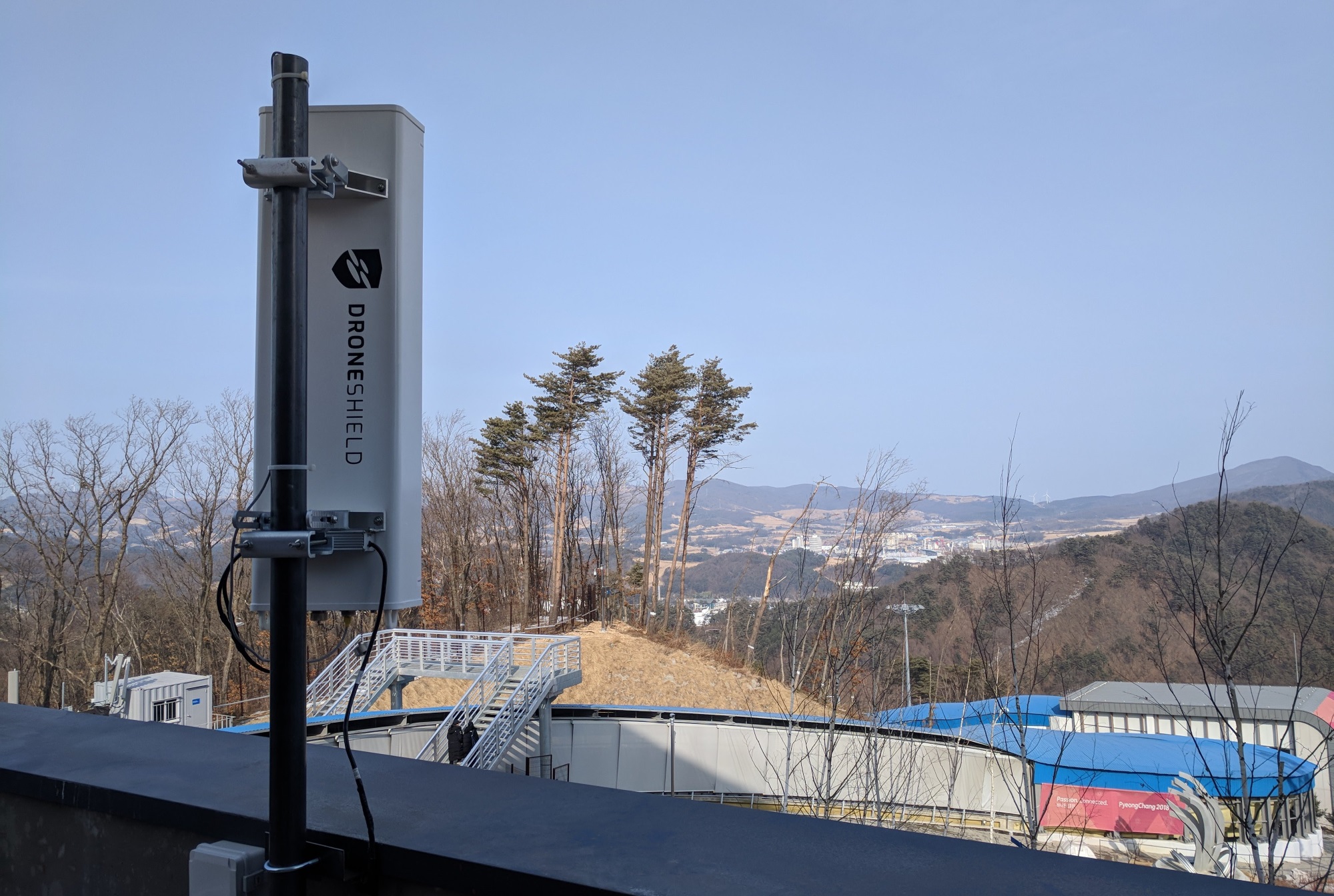
Recently DroneShield’s tech was deployed at the Commonwealth Games in Brisbane and at the Olympics in Pyeongchang, and now the company has announced that it was tapped by a number of Texas authorities for the protection of stock car races.

DroneShield’s systems in place in PyeongChang

“We are proud to be able to assist a high-profile event like this,” said Oleg Vornik, DroneShield’s CEO, in an email announcing the news. “We also believe that this is significant for DroneShield in that this is the first known live operational use of all three of our key products – DroneSentinel, DroneSentry and DroneGun – by U.S. law enforcement.”

It’s a big get for a company that clearly saw an opportunity in the growing drone market (in combating it, really) and executed well on it.

12 Apr 2018

Apple starting to alert users that it will end 32-bit app support on the Mac

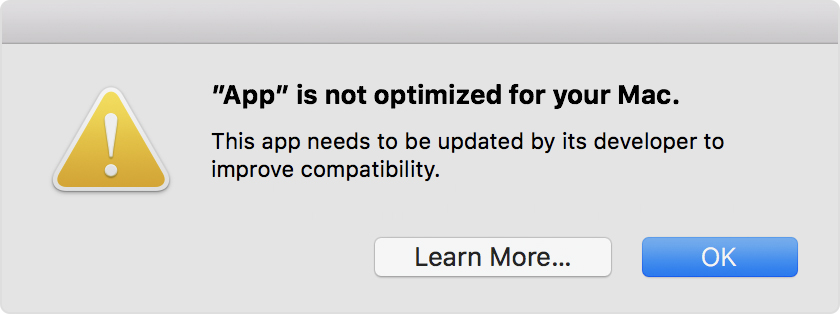
Tomorrow at midnight PT, Apple will begin issuing an alert box when you open a 32-bit app in MacOS 10.13.4. It’s a one-time (per app) alert, designed to help MacOS make the full transition to 64-bit. At some unspecified time in the future, the operating system will end its support for 32-bit technology… meaning those apps that haven’t been updated just won’t work. 

That time, mind you, is not tomorrow, but the company’s hoping that this messaging will help light a fire under users and developers to upgrade before that day comes. Says the company on its help page, “To ensure that the apps you purchase are as advanced as the Mac you run them on, all future Mac software will eventually be required to be 64-bit.”

It’s similar to the transition the company made on the mobile side with iOS 11. Of course, making the shift is a bit messier on the desktop. For one thing, the company’s desktop operating system has been around a lot longer than iOS. For another, while Apple does have a MacOS App Store, plenty of desktop apps are still downloaded from other channels.

As the company notes, the transition’s been a long time coming. The company started making it 10 or so years ago with the Power Mac G5 desktop, so it hasn’t exactly been an overnight ask for developers. Of course, if you’ve got older, non-supported software in your arsenal, the eventual end-of-lifing could put a severe damper on your workflow. For those users, there will no doubt be some shades of the transition from OS 9 to OS X in all of this.

You can skip the alert and just see for yourself by clicking the System Report button. For those apps that haven’t updated yet (I’m looking at you, Audacity), Apple recommends bugging the developers directly.

11 Apr 2018

Who’s a good AI? Dog-based data creates a canine machine learning system

We’ve trained machine learning systems to identify objects, navigate streets, and recognize facial expressions, but as difficult as they may be, they don’t even touch the level of sophistication required to simulate, for example, a dog. Well, this project aims to do just that — in a very limited way, of course. By observing the behavior of A Very Good Girl, this AI learned the rudiments of how to act like a dog.

It’s a collaboration between the University of Washington and the Allen Institute for AI, and the resulting paper will be presented at CVPR in June.

Why do this? Well, although much work has been done to simulate the sub-tasks of perception like identifying an object and picking it up, little has been done in terms of “understanding visual data to the extent that an agent can take actions and perform tasks in the visual world.” In order words, act not as the eye, but as the thing controlling the eye.

And why dogs? Because they’re intelligent agents of sufficient complexity, “yet their goals and motivations are often unknown a priori.” In other words, dogs are clearly smart, but we have no idea what they’re thinking.

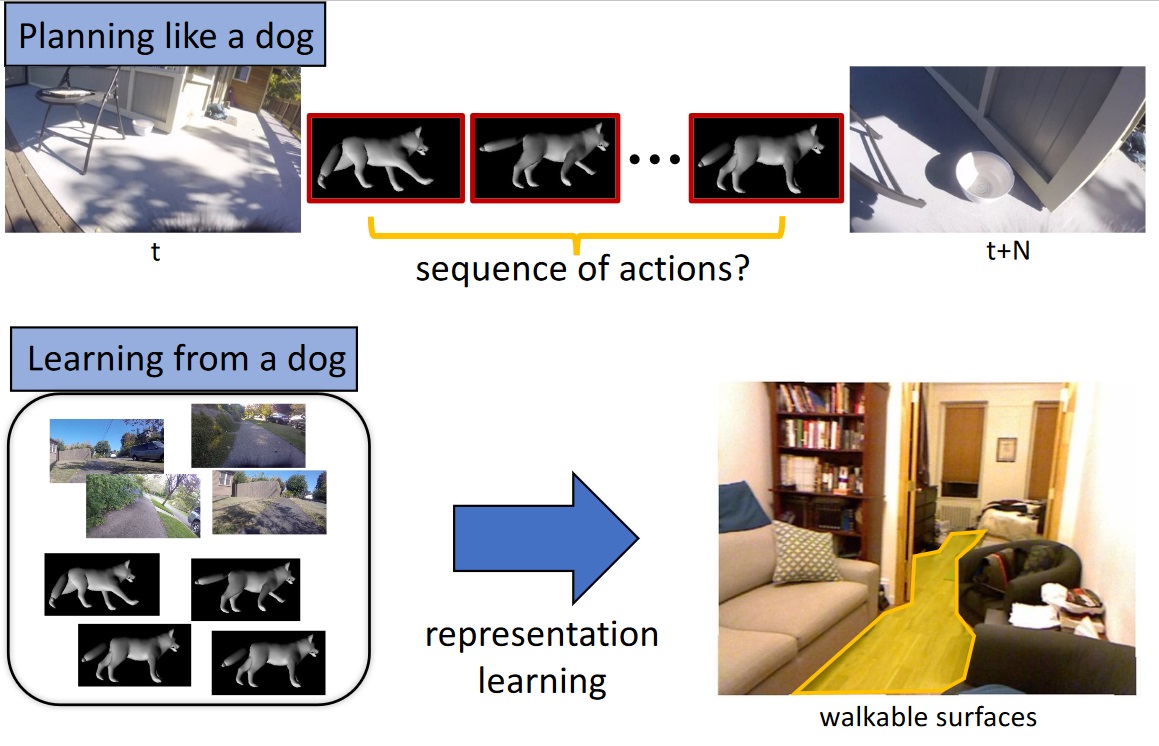
As an initial foray into this line of research, the team wanted to see if by monitoring the dog closely and mapping its movements and actions to the environment it sees, they could create a system that accurately predicted those movements.

In order to do so, they loaded up a malamute named Kelp M. Redmon with a basic suite of sensors. There’s a GoPro camera on Kelp’s head, six inertial measurement units (on the legs, tail, and trunk) to tell where everything is, a microphone, and an Arduino that tied the data together.

They recorded many hours of activities — walking in various environments, fetching things, playing at a dog park, eating — syncing the dog’s movements to what it saw. The result is the Dataset of Ego-Centric Actions in a Dog Environment, or DECADE, which they used to train a new AI agent.

This agent, given certain sensory input — say a view of a room or street, or a ball flying past it — was to predict what a dog would do in that situation. Not to any serious level of detail, of course — but even just figuring out how to move its body and where to is a pretty major task.

“It learns how to move the joints to walk, learns how to avoid obstacles when walking or running,” explained Hessam Bagherinezhad, one of the researchers, in an email. “It learns to run for the squirrels, follow the owner, track the flying dog toys (when playing fetch). These are some of the basic AI tasks in both computer vision and robotics that we’ve been trying to solve by collecting separate data for each task (e.g. motion planning, walkable surface, object detection, object tracking, person recognition).”

That can produce some rather complex data: for example, the dog model must know, just as the dog itself does, where it can walk when it needs to get from here to there. It can’t walk on trees, or cars, or (depending on the house) couches. So the model learns that as well, and this can be deployed separately as a computer vision model for finding out where a pet (or small legged robot) can get to in a given image.

This was just an initial experiment, the researchers say, with success but limited results. Others may consider bringing in more senses (smell is an obvious one) or seeing how a model produced from one dog (or many) generalizes to other dogs. They conclude: “We hope this work paves the way towards better understanding of visual intelligence and of the other intelligent beings that inhabit our world.”

11 Apr 2018

Fantasy sports platforms could have a big future in blockchain

With the number of fantasy sports players in North America heading past 60m, and the industry said to be worth over $7 billion, fantasy sports games are clearly on the rise. On the web, the two biggest players are FanDuel and DraftKings, which between them control 90% of the market. But translating that kind of business into a blockchain world could have even more potential, turning the reward system into a cryptocurrency nirvana.

This is the aim of two blockchain-based startups, No Limit Fantasy Sports and MyDFS. Both have differing models, but both are aiming at the incumbents which are probably unable to grow much further, and especially after their merger was rejected by regulators.

Now, MyDFS plans to take the fight to the next level, with a $2M cash injection from investor Frank Fu, managing director at Chinese technology company Meitu, the chinese phot sharing platform with 456M users. He’ll also join as a board advisor to the company.

Fu says the union of gaming and blockchain is inevitable because “blockchain guarantees safe storage of all in-game digital assets” and “smart contracts exclude third parties from the payment process and make transactions fast and safe” by removing the need for a financial intermediary for transactions.

The view is that potential for payment fraud in fantasy sports means the sector is ripe for blockchain technology, which can record every transaction.

MyDFS CEO Viktor Mangazeev believes tokenization and blockchain will make fantasy sports far more “transparent and user-friendly” and will allow players to invest not just in the games, teams, and players, but also other players, b by earning a share of their winnings. So, in theory, you could hitch your prospects to the best players because of the use of in-game cryptocurrency.

It looks as if blockchain is going to gradually lead to more startups arriving in this arena. Distributed ledger technology could mean a large reduction in transfer times and fees, while affording a more transparent fantasy economy.

Smart contracts could also mean users get their prizes literally as soon as they’ve won games, instead of having to wait for other sites to verify the games. And finally, the use of cryptocurrency (MyDFS uses Ethereum, while No Limit Fantasy Sports uses their own coin called NoLimitCoin) should be able to avoid regulatory issues, at least for now, because the ‘betting’ is not based on fiat currency. That means these sites could reach more global audiences faster.

That said, we will have to wait and see what happens next in terms of regulation and whether these platforms will, in fact, have global appeal after all.

11 Apr 2018

Cruise, GM’s self-driving car unit, brings on Zippy team

Cruise recently brought on seven team members from Zippy.ai, which develops robots for last-mile grocery and package delivery, for an undisclosed amount of money.

The deal did not include any of Zippy’s product or intellectual property. Instead, it seems Cruise was more interested in the skillsets of the co-founders, Gabe Sibley, Alex Flint and Chris Broaddus, and their team.

“Their expertise in machine learning, computer vision, and simulation is among the best in the industry,” Cruise CEO Kyle Vogt wrote in a Medium post. “But perhaps more importantly, their commitment to working on a team — and doing things the right way — strengthens our ability to safely test, validate, and deploy our self-driving technology at scale.”

This announcement comes after Cruise last month parted ways with its CTO, A.G. Gangadhar, who formerly worked at Uber. Though, Zippy’s team joined Cruise back in February.

11 Apr 2018

Twitter replaces its gun emoji with a water gun

Twitter has now followed Apple’s lead in changing its pistol emoji to a harmless, bright green water gun. And in doing so, the company that has struggled to handle the abuse, hate speech and harassment taking place across its platform, has removed one of the means for online abusers to troll their victims.

The change is one of several rolling out now in Twitter’s emoji update, Twemoji 2.6, which impacts Twitter users on the web, mobile web, and on Tweetdeck.

Below: Apple’s water gun

Below: Twitter’s water gun

The decision to replace an emoji of a weapon to a child’s toy was seen as a political statement when Apple in 2016 rolled out its own water gun emoji in iOS 10. The company had also argued against the addition of a rifle emoji, ultimately leading to the Unicode’s decision to remove the gun from its list of new emoji candidates that same year.

With these moves, Apple was effectively telling people that a gun didn’t have a place in the pictorial language people commonly use when messaging on mobile devices.

These sorts of changes matter because of emoji’s ability to influence culture and its function as a globally understood form of communication. That’s why so much attention is given to those emoji updates that go beyond the cosmetic – like updates that offer better representations of human skin tones, show different types of family groupings or relationships, or those give various professions – like a police officer or a scientist – both male and female versions, for example.

In the case of the water pistol, Apple set a certain standard that others in the industry have since followed.

Samsung also later replaced its gun with a water gun, as did WhatsApp. Google, meanwhile, didn’t follow Apple’s lead saying that it believed in cross-platform communication. Many others left their realistic gun emojis alone, too, including Microsoft.

“The main problem with the different appearances of the pistol emoji has been the potential for confusion when one platform displays this as an innocuous toy, and another shows the same emoji as a weapon. This was particularly an issue in 2016 when Apple changed the pistol emoji out of step with every single other vendor at the time,” notes Jeremy Burge, Emojipedia’s founder and Vice Chair on the Unicode Emoji Subcommittee. “Now we’re seeing multiple vendors all changing to a water pistol image all in a similar timeframe with Samsung and Twitter both changing their design this year,” he says.

On Twitter, however, the updated gun emoji very much comes across as a message about where the company stands (or aims to stand) on abuse and violence. A gun – as opposed to a water gun – can be far more frightening when accompanied with a threat of violence in a tweet.

The change also arrives at a time when Twitter is trying – some would say unsuccessfully – to better manage the bad behavior that takes place on its platform. Most recently, it decided to publicize its rules around abuse to see if people would then choose to follow them. It has also updated its guidelines and policies for how it would handle online abusers to mixed results.

In addition, the change feels even more like a political message than the Apple emoji update did given its timing – in the wake of Parkland, the youth-led #NeverAgain movement, the YouTube shooting, and the increased focus on the NRA’s contributions to politicians.

Twitter has confirmed the change in an email with TechCrunch, saying the decision was made for “consistency” with the others who have changed.

However, Emojipedia shows that not all companies have updated to the water gun. Google, Microsoft, Facebook, Messenger, LG, HTC, EmojiOne, emojidex, and Mozilla still offer a realistic pistol, not the green toy.

But Apple and Samsung perhaps hold more weight when it comes to where things are headed.

“I know some users object to what they see as censorship on their emoji keyboard, but I can certainly see why companies today might want to ensure that they aren’t showing a weapon where iPhone and Samsung Galaxy users now have a toy gun,” Burge says. “It’s pretty much the opposite to the issue with Apple being out of step with other vendors in 2016.”


The gun was the most notable change in Twemoji 2.6, but Emojipedia notes that other emoji have been updated as well, including the kitchen knife (which now looks like more of a vegetable slicer than a weapon for stabbing), the Crystal Ball, the Alembic (a glass vessel with water), and the Magnifying Glass, with more minor tweaks to the Coat, Eyes, and emoji faces with horns.

Image credits: Emojipedia; Apple Water Gun: Apple