10 Apr 2018

How to understand the financial levers in your business

How can an electric scooter ride-sharing company like Bird possibly make money?

If you live in a select number of cities in the U.S., it’s hard not to see electric scooters appearing on sidewalks all over the place. Electric scooter ride-sharing services are also remarkably cheap: $1 to start a ride and another $0.15 per minute after that. But electric scooters aren’t cheap, and the logistics of a shared network are off-the-charts complicated.

As someone working in venture capital for hardware startups, the above question is obviously rather prescient.

How does a company like this possibly make money?

Here’s a closer look at the basic unit economics of Bird, the electric scooter ride-sharing company based in Santa Monica, Calif. There’ll be a super simple model and test scenarios that show how critical it is to understand and manipulate the key levers of any startup  —  in fact, it can determine whether a business sinks or swims.

Building a Scooter

Two young people in love, gazing adoringly at a pair of electric kick-scooters. Because that’s totally a normal thing to be doing. 

It looks like Bird is using the Mi Electric Scooter as the base of their platform. The Mi’s recommended retail price is $499, but it’s probably fair to assume that Bird gets a bulk discount and can buy the scooters at around $300 apiece.

On top of the base cost of the scooters, Bird needs modules to turn the scooters into sharing economy units. That doesn’t have to cost a lot of money. A Particle 3G asset tracker in a box, plus some custom code to deal with the scooter’s power management, is all that’s needed, so let’s call that $80 per unit. That takes the total cost per finished scooter to $380; plus, we’ll toss in $20 for final assembly.

My back-of-the-envelope calculation puts Bird’s road-ready scooter at $400 per unit.

Deploying a scooter
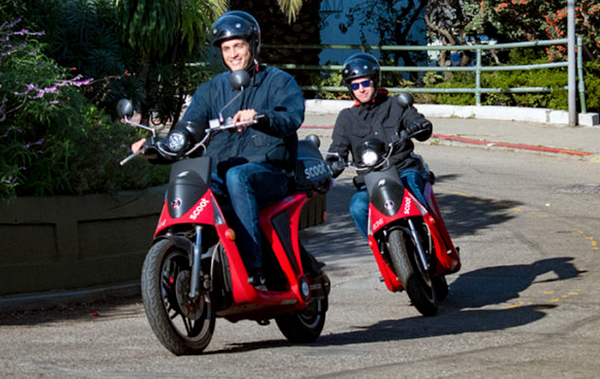
Scooter startup Scoot operates electric scooters that are more like motorcycles than electrified Razer kick-scooters. 

One of the biggest problems electric scooter companies must solve is distributed charging. Scoot solved this problem by building a massive network of charging stations, distributed around San Francisco — a big infrastructure push, but necessary, given the robust profile of the scooters. Unlike Scoot’s wheels, which need to be returned to a charging station for charging, Bird scooters can be easily picked up and taken inside a user’s apartment or office, creating an instant and nearly infinite distributed charging network called “available wall sockets.”

This completely changes the charging game in Bird’s favor, so much so that Bird offers people $5 per charged scooter. This creates an elegant user experience and is a sign that it’s a key lever in their financial model.

A tale of two financial models

A lot of assumptions go into building a financial model. This one came together over a few beers on the weekend and is an example of the kind of “quick and dirty” math all founders should do as they pressure test ideas. You can follow along in this spreadsheet, and if you want to experiment with the numbers, you can duplicate the sheet and plug in your own numbers.

For both models, we’ll assume the following:
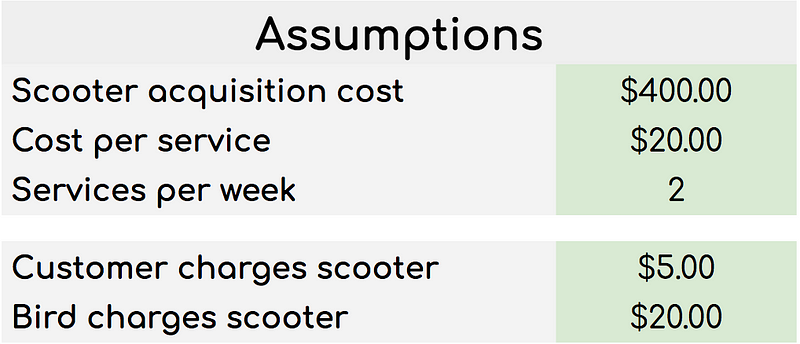
We’ll be playing with the average lifetime of a scooter, the average number of rides customers take per day, and some metrics around charging, to see how that effects gross margin.

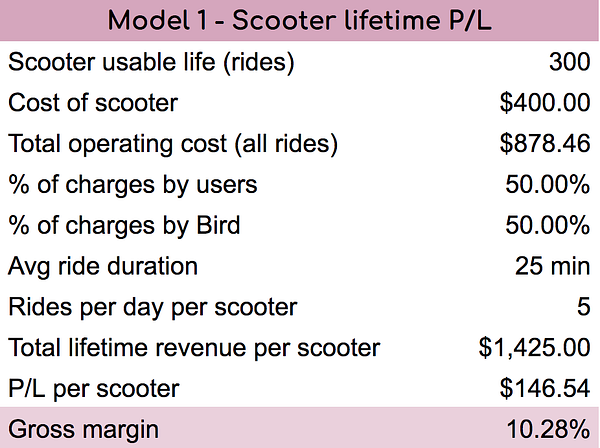
Model 1: Uh-oh, this looks like trouble.

For the first model, let’s look at these dynamics:

  • Average lifetime rides per scooter — 300
  • Average rides per scooter per day — 5
  • Average ride length — 20 minutes
  • Percent of consumer charges: 50%

If those assumptions are right, it takes 220 rides (or 44 days) to reach break-even on the scooter itself.

After 400 rides (when a scooter is written off), the company has generated $147 of profit, at a relatively meagre 10.3% profit margin.

Suffice to say: That doesn’t look like a particularly sustainable business.

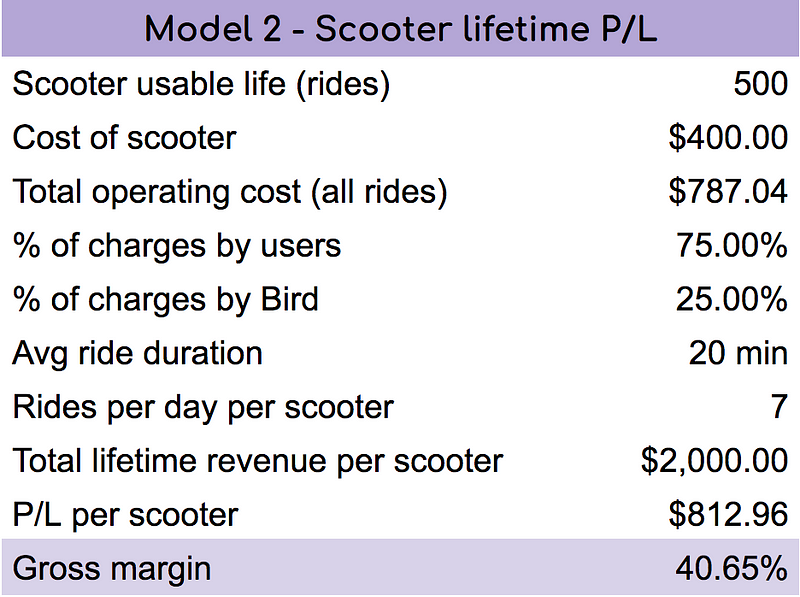
Model 2: A more optimistic outlook

However, you don’t have to change the assumptions much for it to be a much more attractive business.

What if Bird was able to extend the life of a given scooter, decrease the average ride length but increase the average rides per day, and push more of the charging burden to consumers?

Let’s look at these dynamics:

  • Average lifetime rides per scooter — 500
  • Average rides per scooter per day — 7
  • Average ride length — 20 minutes
  • Percent of customer charges — 75%
A very different story. Note here that Bird did not reduce the hard costs of charging a scooter (it’s still $5 for a consumer to charge and $20 for Bird to charge), but they did find a way to encourage customers to charge for them, reducing the overall charging cost.

Changing these four variables means that it only takes 165 rides (24 days) to break even, and the lifetime profit of a scooter is $813 — or a gross margin of 41%.
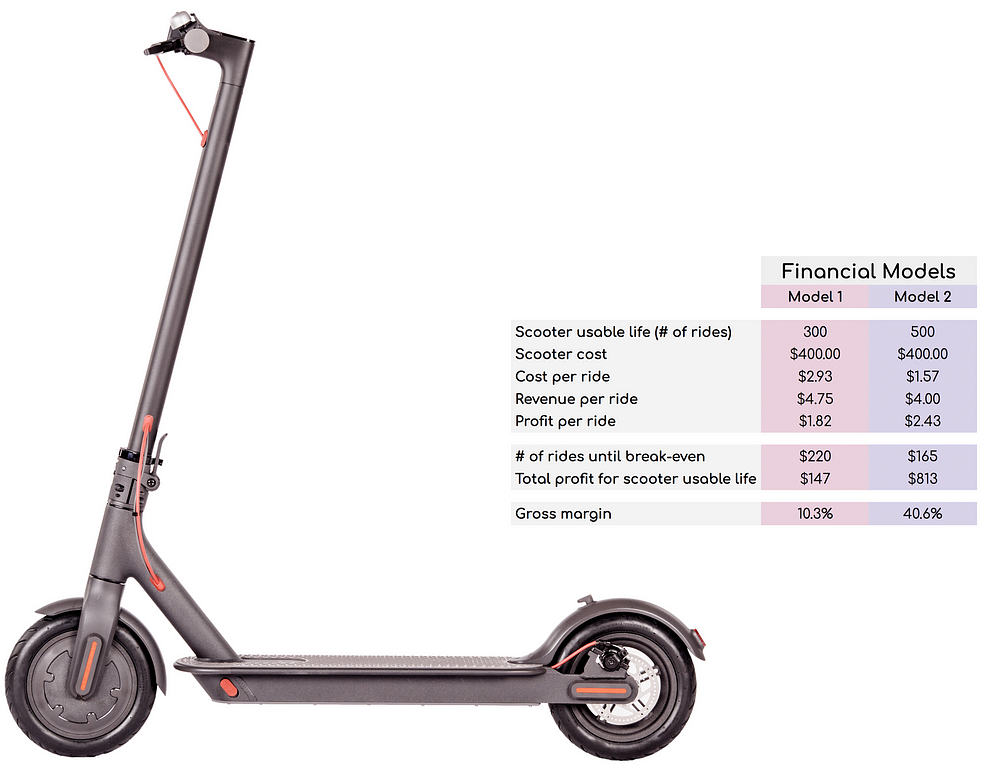
Financial models 1 and 2 side by side, for ease of comparing. 

So, do these unit economics make sense?

Investors certainly seem to think so. In February, Bird raised a $15m Series A, and only a month later, the company raised a $100m Series B. A company like Bird would be struggling to raise money on a 10.3% profit margin (as in Model 1), but if the numbers under the hood are closer to Model 2, it’s easy to understand how Bird starts to look like a rather attractive business.

Isolate variables to find your levers

In the case of Bird, you might be surprised to learn that three levers dramatically affect the finance model: average ride length, cost of charging, and usable life per scooter. Isolate variables and play with the numbers to figure out which ones are key levers.

Taking Model 2 above as a starting point, let’s explore by manipulating one set of variables at the time:

Ride length

Ride length has some impact on gross margin, but not as much as you’d think.

Usable life / Longevity

The durability of the scooters has quite a bit of impact, especially if the scooters fail early.

Cost of charging

The cost to charge a scooter has a huge impact on margins, so perhaps that’s a good place to focus.

Pulling the levers: SuperScooters

Once you know your levers, it’s fun to pull them a bit. If we were to optimize Bird to be as profitable as possible, it might be tempting to try to influence people to ride longer. But how? People’s commutes are probably relatively fixed, and you’re unlikely to be able to get them to change their commuting route. As we saw in an earlier example, though, the cost of charging has a huge impact on the overall business. What if we could find a better way to solve that?

Model 3 — SuperScooters

Say there was a different scooter available on the market— a SuperScooter —  with a swappable battery pack that clocks in at a hefty $1,000 MSRP.

The scooter has a higher up-front cost, but it’s more robust. Instead of a 500-ride lifespan, it has a 1,000-ride lifespan. The replaceable battery pack enables the Bird Service Crew to quickly replace scooter batteries out of charging racks in the back of the vans they’re already driving around town to redistribute scooters.
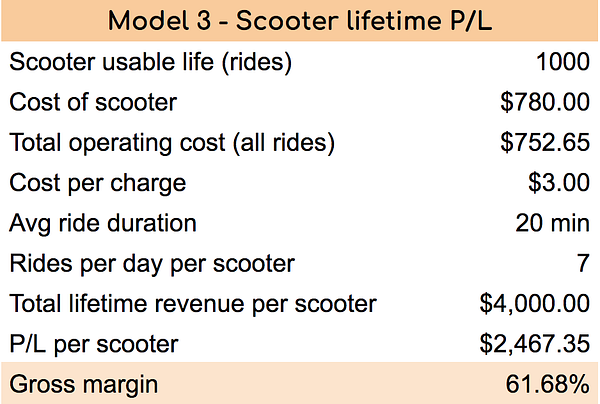
Let’s say that reduces Bird’s “recharging” cost to $3 per scooter per day, even cheaper than the consumer charge in Models 1 and 2, totally eliminating the need for consumers to charge the scooters at all.

In addition, let’s say Bird invents their own asset tracker that they can build for $30 per unit, rather than $80 off the shelf, and their manufacturer agrees to install it at the factory, taking the $20 in-house final assembly cost to zero.

By implementing the changes above, you end up with $2,467 profit per scooter, break-even at 34 days, and a gross margin of 62%. In other words: If such a scooter were available, it’d be a no-brainer: You’d want to replace the entire fleet as quickly as you could.
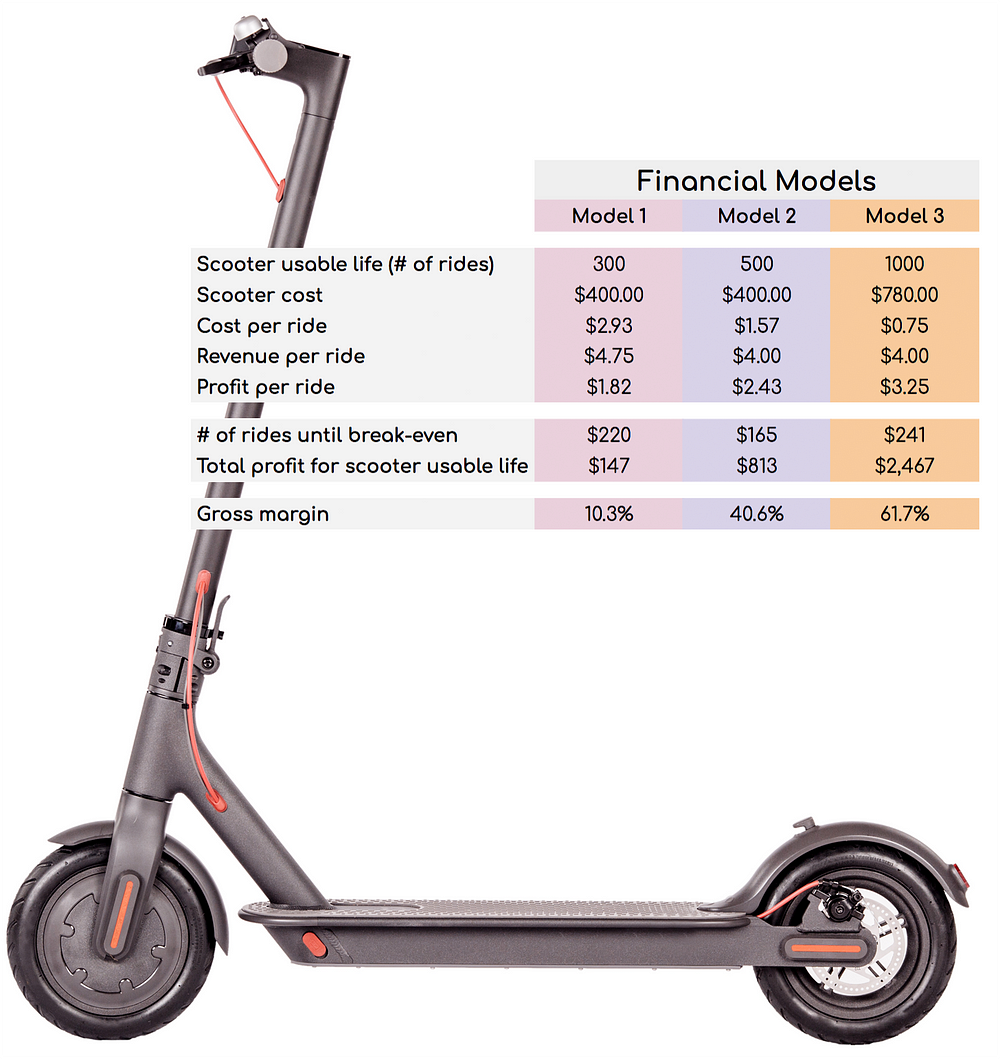
Comparing all three models shows that optimizing for longer scooter usable life and cheaper charging costs (Model 3) would have an extraordinary impact on the gross margin per scooter deployed. 

Build your model. Know your levers.

Obviously, I have grossly simplified the financial model here — if you were to model out the entire business of Bird, you would need to look at customer acquisition costs, customer lifetime value, churn, R&D costs of the elusive SuperScooter, and so on and so forth. Models get complicated quickly, but they also allow you to explore the impacts of changes you might make before you make them, which is invaluable.

Whatever your business, build a business model that includes all of your assumptions — and build the model so you can pressure-test variables and find your levers. Once you’ve identified them, build MVPs to test those assumptions in more detail. It’s really important to experiment early and get some good data on what works (and what doesn’t), before you start ramping up and pouring lots of money into marketing and execution. Some changes can have exponential effects — for better or for worse.

10 Apr 2018

Zuckerberg tells Congress Facebook is not listening to you through your phone

Facebook CEO Mark Zuckerberg officially shot down the conspiracy theory that the social network has some way of keeping tabs on its users by tapping into the mics on people’s smartphones. During Zuckerberg’s testimony before the Senate this afternoon, Senator Gary Peters had asked the CEO if the social network is mining audio from mobile devices – something his constituents have been asking him about, he said.

Zuckerberg denied this sort of audio data collection was taking place.

The fact that so many people believe that Facebook is “listening” to their private conversations is representative of how mistrustful users have grown of the company and its data privacy practices, the Senator noted.

“I think it’s safe to say very simply that Facebook is losing the trust of an awful lot of Americans as a result of this incident,” said Peters, tying his constituents’ questions about mobile data mining to their outrage over the Cambridge Analytica scandal.

Questions about Facebook’s mobile data collection practices aren’t anything new, however.

In fact, Facebook went on record back in 2016 to state – full stop – that it does not use your phone’s microphone to inform ads or News Feed stories.

Despite this, it’s something that keeps coming up, time and again. The Wall St. Journal even ran an explainer video about the conspiracy last month. And yet none of the reporting seems to quash the rumor.

People simply refuse to believe it’s not happening. They’ll tell you of very specific times when something they swear they only uttered aloud quickly appeared in their Facebook News Feed.

Perhaps their inability to believe Facebook on the matter is more of an indication of how precise – and downright creepy – Facebook’s ad targeting capabilities have become over the years.

Peters took the opportunity today to ask Zuckerberg this question straight on today, during Zuckerberg’s testimony.

“Something that I’ve been hearing a lot from folks who have been coming up to me and talking about a kind of experience they’ve had where they’re having a conversation with friends – not on the phone, just talking. And then they see ads popping up fairly quickly on their Facebook,” Peters explained. “So I’ve heard constituents fear that Facebook is mining audio from their mobile devices for the purposes of ad targeting – which I think speaks to the lack of trust that we’re seeing here.”

He then asked Zuckerberg to state if this is something Facebook did.

“Yes or no: does Facebook use audio obtained from mobile devices to enrich personal information about its users?,” Peters asked.

Zuckerberg responded simply: “no.”

The CEO then added that his answer meant “no” in terms of the conspiracy theory that keeps getting passed around, but noted that the social network does allow users to record videos, which have an audio component. That was a bit of an unnecessary clarification, though, given that the question was about surreptitious recording, not something users were explicitly recording media to share.

“Hopefully that will dispel a lot of what I’ve been hearing,” Peters said, after hearing Zuckerberg’s response.

We wouldn’t be too sure.

There have been a number of lengthy explanations of the technical limitations regarding a project of this scale, which have also pointed out how easy it would be to detect this practice, if it were true. But there are still those people out there who believe things to be true because they feel true.

And at the end of the day, the fact that this conspiracy refuses to die says something about how Facebook users view the company: as a stalker that creeps on their privacy, and then can’t be believed when it tells you, “no, trust me, we don’t do that.”

10 Apr 2018

Sen. Kennedy to Mark Zuckerberg: ‘Your user agreement sucks’

As Mark Zuckerberg’s Facebook testimony stretches on, a rough exchange with Senator John Neely Kennedy of Louisiana produced some of the day’s more memorable sound bites.

“Mr. Zuckerberg, I come in peace. I don’t want to vote to have to regulate Facebook, but by God I will,” Sen. Kennedy began his short exchange. “In fact, a lot of that depends on you. I’m a little disappointed in this hearing today, I just don’t feel like we’re connecting.”

From there Kennedy railed against Zuckerberg for how Facebook communicated its user data policies with users of the product.

“Your user agreement sucks,” the Republican senator went on. “The purpose of that user agreement is to cover Facebook’s rear end, it’s not to inform your users about their rights. Now you know that, and I know that. I’m going to suggest to you that you go back home and rewrite it.”

From here on, the exchange with an understandably tired Zuckerberg was a little rough. Kennedy’s knowledge of the Facebook product seemed to be a bit limited and Zuckerberg’s  inability to respond with something not beginning with “Senator, we already…” didn’t help.

The testimony continues…

10 Apr 2018

Cambridge Analytica may have accessed some Facebook users’ messages

The app permissions that led to 87 million Facebook users’ data being harvested and sold to Cambridge Analytica may have also allowed access to those users’ inboxes, the company confirmed today. This wasn’t achieved by any underhanded means, exactly, but people might not have realized that they were granting permission to read and record their private messages as well as more public data like location and interests.

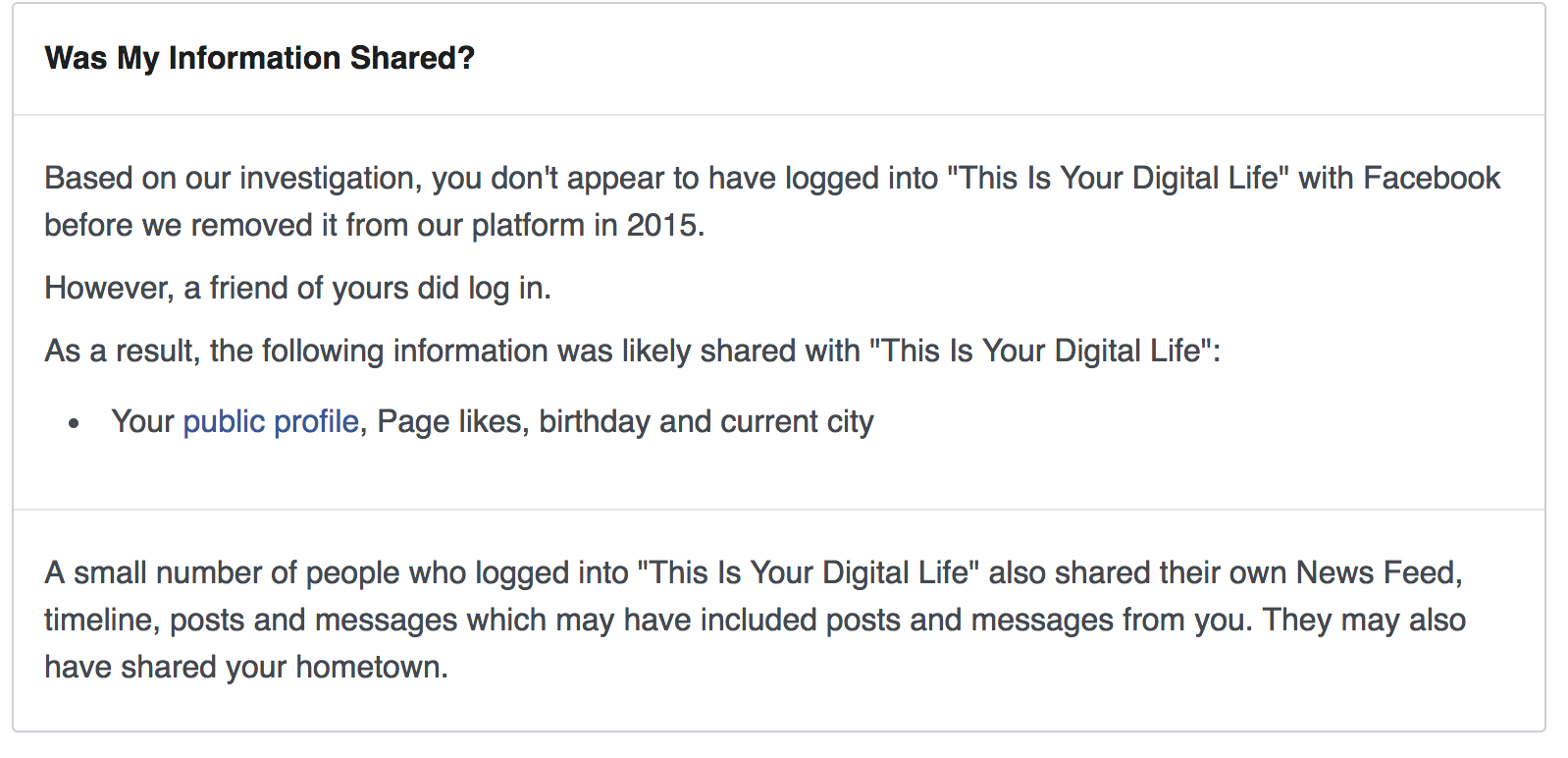
That messages may have been collected by CA was revealed first by Facebook itself as part of its warning issued to the 87 million users in question. “A small number of people who logged into ‘This Is Your Digital Life’ also shared their own News Feed, timeline, posts and messages which may have included posts and messages from you,” reads the warning.

Access to messages had not been previously disclosed. And of course if someone affected had chatted with you, then your messages would also have been collected.

The permission used to do this was called “read_mailbox,” though it would have been put in more everyday terms when a user was agreeing to it. The dialog box would have said something along the lines of, “This app will be able to access your wall posts, friend list, contacts, messages…” in bullet points.

This Is Your Digital Life, the app created by researcher Aleksandr Kogan which served as the harvester for all this data, requested “read_mailbox” privileges for some period and, as Facebook tells Wired, a total of 1,500 people granted that permission.

It’s unclear why the number is so low if hundreds of thousands agreed to the terms, but the app may only have requested messaging access for a brief period — stopping, perhaps, upon finding that people balked at granting it.

Still, even if only 1,500 people had their messages collected directly, the number of people whose messages were indirectly collected could be orders of magnitude higher. After all, look at your inbox, if you have one — there are likely dozens of conversations, perhaps with hundreds of people. So that 1,500 could balloon to 150,000 real fast.

I’ve asked Facebook for clarification on how the 1,500 number was determined and what the number of secondary affected users is.

10 Apr 2018

Apple is making a show based on Isaac Asimov’s ‘Foundation’ books

Okay, Apple, now you’ve got my attention.

Not content with landing an Amazing Stories reboot from Steven Spielberg, multiple series from Reese Witherspoon, a space opera from Ron Moore and much more for its upcoming original TV initiative (which might launch next March), Apple is also developing a series based on Isaac Asimov’s Foundation books.

Deadline reports that the project from Skydance Television is “in development for straight-to-series consideration,” with David S. Goyer and Josh Friedman attached as showrunners. Goyer is best-known for comic book adaptations like Blade, Man of Steel and Batman v. Superman: Dawn of Justice, while Friedman was the creator of Terminator: The Sarah Connor Chronicles.

The Foundation stories depict the fall of a massive galactic empire, and the efforts of a small group of scientists to preserve knowledge and restore civilization. They were first published in Astounding Science Fiction in the 1940s, then collected into three books in the ’50s. (At the 1966 World Science Fiction Convention, the series beat out Lord of the Rings to win the Hugo Award for Best All-Time Series.)

Asimov (a legendary science fiction and science writer, as well as an occasional computer pitchman) returned to the series near the end of his career, and while the later books are not as well-loved by fans, they also won him awards and landed him on The New York Times bestseller list for the first time.

If you want to read thousands more words about why the books mean a lot to me, be my guest. But when it comes to a TV adaptation, two points seem salient: One, the books takes place over hundreds of years, with a constantly rotating cast of characters, and two, they consist almost entirely of conversation, with just a few brief scenes of action.

That may be why previous attempts to adapt Foundation — including an effort at HBO by Goyer’s Dark Knight co-writer Jonathan Nolan  — have failed. If this one pans out, I suspect we’ll see some pretty big changes.

10 Apr 2018

A revamped version of Spotify’s free service is reportedly in the works

Spotify’s got something big up its sleeve, that much we know for sure. The music streaming service has a big event in the works for April 24 in New York — though it hasn’t really offered up anything useful beyond that. A revamped version of the company’s free tier could certainly make sense for the event.

A new report from Bloomberg suggests that such a thing is on the way, as the company looks to make big moves after going public. According to the piece, the new version of the app will make it easier for users to use the ad-supported service on mobile devices. There’s not a lot of information beyond that, however — including how Spotify would continue to differentiate a paid tier in order to keep premium subscribers on-board.

Of course, the free offering is one of the key elements differentiating the service from competition like Apple Music. It hasn’t been the most popular feature among record labels and artists, for obvious reasons, but it’s helped Spotify maintain a healthy lead in the category. Last month, Apple Music announced that it was continuing to grow at a healthy rate, with 38 million subscribers.

That number is dwarfed, however, by Spotify’s 71 million subscribers — and doubly so by its total 159 million users. Clearly the multi-tiered strategy has been a winning one for the Swedish music service, and recommitting to free would demonstrate that the service is still interested in the other 88 million.

We reached out to Spotify, but received a “no comment” on the matter. Same for another recent story suggesting that the company is planning to release a standalone in-car player, which surfaced as users began to receive offers for a new piece of Spotify hardware designed to bring the music service to older model cars.

10 Apr 2018

Mark Zuckerberg: “We do not sell data to advertisers”

While many of us in the tech world are familiar with Facebook’s business model, there is a common misconception among people that Facebook collects information about you and then sells that information to advertisers.

Zuckerberg wants everyone (especially the U.S. Senate) to know that’s not the case, and has laid forth the most simple example to explain it.

During his testimony, the Facebook CEO clarified to Senator John Cornyn that Facebook does not sell data.

There is a very common misconception that we sell data to advertisers, and we do not sell data to advertisers. What we allow is for advertisers to tell us who they want to reach and then we do the placement. So, if an advertiser comes to us and says, ‘Alright, I’m a ski shop and I want to sell skis to women,’ then we might have some sense because people shared skiing related content or said they were interested in that. They shared whether they’re a woman. And then we can show the ads to the right people without that data ever changing hands and going to the advertiser. That’s a very fundamental part of how our model works and something that is often misunderstood.

While, again, this may seem straightforward to many of us, Zuckerberg found himself having to explain more than once that Facebook does not sell data during his Senate testimony.

10 Apr 2018

Theranos reportedly lays off most of its remaining employees as it tries to avoid bankruptcy

The death spiral of blood-testing startup Theranos just became even more real today for the bulk of its remaining employees. The Wall Street Journal reports that the company has laid off the majority of its staff as part of a “last-ditch effort” to save cash and avoid bankruptcy.

The layoffs have taken the staff from 125 to less than two dozen, the report says. Holmes announced the layoffs to staff at an all-hands meeting today in the company’s Newark, Calif. offices.

This spartan crew has been whittled down following round after round of layoffs as customers and regulators have wised up to the lies that the company has been publicly sharing. After once maxing out at nearly 800 employees in late 2016, the company now stands as a skeleton of its former self, though for the company’s leadership this represents an inevitability that is the least of their problems.

Last month, CEO Elizabeth Holmes settled with the SEC over fraud charges, paying a $500k penalty, returning 18.9 million shares that she attained during the period of fraud and relinquishing her voting control of Theranos. Holmes was also barred from serving as an officer or director of a public company for 10 years as part of the settlement.

Holmes and fellow exec Sunny Balwani are both still under criminal investigation by the U.S. attorney’s office in SF, the report says. Balwani is also still being sued by the SEC in federal court in California.

Though the company has been facing a downward spiral for quite some time, the company did manage to somehow secure $100 million in debt financing from Fortress Investment Group this past December, though it reportedly was only able to access that full amount if it met certain product and operational milestones, which it has not done according to the report.

The company was once valued at $9 billion.

10 Apr 2018

The entire Myst series will be re-released for Windows 10

Myst holds a special place in the hearts of many. Released in 1993, it was unlike any video game most had seen at the time — and yet, its DNA lingers in countless games released today. It was also the game that made tens of thousands of kids beg their parents for a CD drive.

With the game’s 25th anniversary just months away, Myst has found itself in a place no one could have predicted in ’93: Kickstarter.

The games original developers, Cyan, have managed to get the rights to all seven games in the Myst universe, and have turned to Kickstarter to re-release it as one big box set. After launching this morning with a target of raising $247,500 dollars, it’s already smashed through its goal and is currently sitting a bit shy of $500k.

The games included in the set:

  • Myst: Masterpiece edition
  • Riven: The sequel to Myst
  • Myst 3: Exile
  • Myst 4: Revelation
  • Myst 5: End of Ages
  • Uru: Complete Chronicles
  • realMyst: Masterpiece (the 3D Myst re-make released in 2000)

$49 gets you digital copies of each game, while $99 gets you DVD copies in a box built to look like a Myst book. Tiers above that include a bunch of real world goodies, from a recreation of Gehn’s in-game pen/inkwell to original, hand drawn concept art.

Oh, and they built a friggin’ Linking book, complete with a 800×480 LCD screen that plays video fly-throughs of the game’s environments when the book is opened. (For the unfamiliar: in the Myst universe, “Linking books” transport those that touch the book to a far off destination.)

They’ve updated the games to work on “modern systems”, but there’s a bit of a good news/bad news situation there. The good news: it’ll work on Windows 10. The bad news: most of the games won’t work on MacOS. That’s a bit of a drag given that the series started its life on the Mac — but Cyan says getting everything running on the Mac would take resources they “just don’t have”. Cyan notes that while they’ll continue to sell the updated games once the Kickstarter is over, the special box set is a Kickstarter-only deal.

As arstechnica points out, much of the Myst series is already available for Windows 10 — only Myst III and IV had never been made updated for compatibility, as the rights were held by a different publisher. But this Kickstarter brings it all together for a whole new generation, with some real-world treats thrown in for the longtime fans.

10 Apr 2018

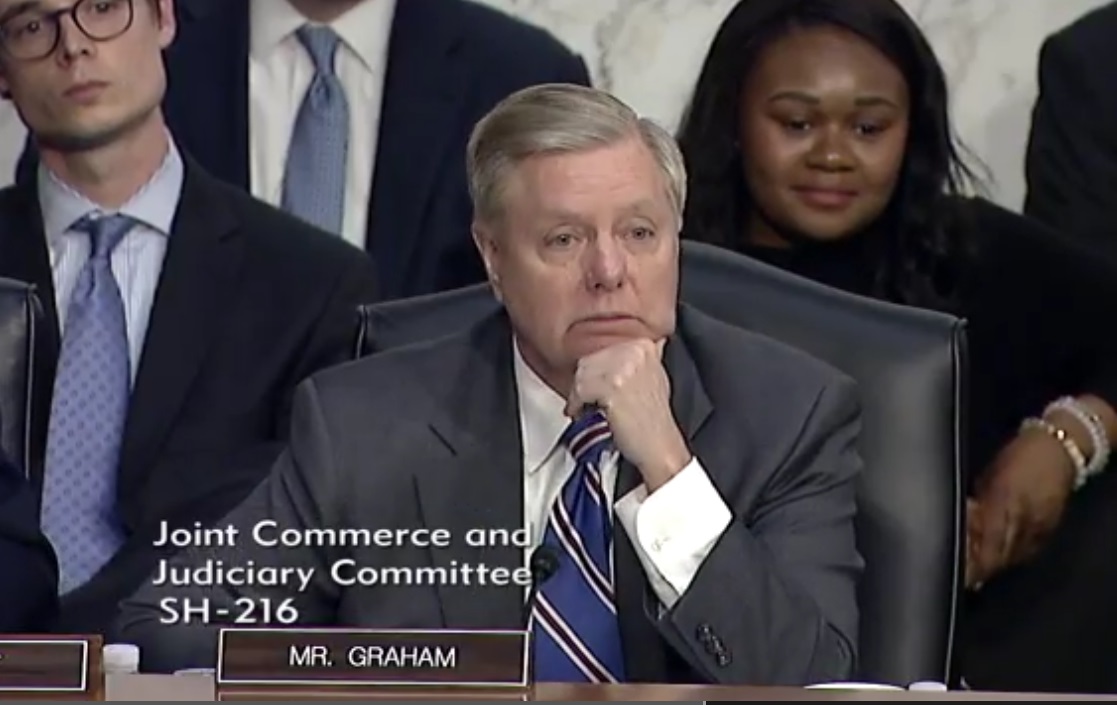
‘You don’t think you have a monopoly?’ Read Sen. Graham’s delightful grilling of Zuckerberg

Today’s testimony by Mark Zuckerberg in front of a Senate joint committee was often boring or redundant with previous statements. But there was an exchange near the two hour mark that was pleasantly refreshing: Senator Lindsey Graham (R-SC) doggedly pursuing a common-sense answer from Zuckerberg on the question of whether it had any real competition.

Graham doesn’t let Zuckerberg employ his spin on the admittedly complex question of what Facebook’s competitors are. Demanding a simpler answer by employing a folksy car-buying metaphor, he makes it clear that at least from one perspective, Facebook is more or less without a real competitor — with the possible exception of Instagram, which it of course opted to buy for a fortune rather than allow it to exist as a credible rival.

The Senator also makes it clear that he doesn’t think Facebook should be allowed to self-regulate — but his invitation to Zuckerberg to collaborate on rules sure sounds like he wants the company to have a say in how it should or should not be bound by law.

I’ve transcribed the exchange below:

Graham: Who’s your biggest competitor?
Zuckerberg: Senator, we have a lot of competitors.
Graham: Who’s your biggest?
Zuckerberg: Mmm… I think the categories of… do you want just one? I’m not sure i can give one. But can I give a bunch?
Graham: Mmhm.
Zuckerberg: So there are three categories I would focus on. One are [sic] the other tech platforms, so Google, Apple, Amazon, Microsoft, we overlap with them in different ways.
Graham: Do they do, do they provide the same service that you provide?
Zuckerberg: Um, in different ways, different parts of it yes.
Graham: Let me put it this way. If I buy a Ford and it doesn’t work well and I don’t like it, I can buy a Chevy. If I’m upset with Facebook, what’s the equivalent product that i can go sign up for?
Zuckerberg: Ah well, the second category that i was going to talk about was…
Graham: I’m not talking about categories. I’m talking about is there real competition you face. Because car companies face a lot of competition. If they make a defective car, it gets out in the world, people stop buying that car, they buy another one. Is there an alternative to Facebook in the private sector?
Zuckerberg: Yes Senator, the average American uses 8 different apps…
Graham: OK.
Zuckerberg: …to communicate with their friends and stay in touch with people, ranging from text to email.
Graham: OK, which is the same service that provide.
Zuckerberg: Well, we provide a number of different services.
Graham: Is twitter the same as what you do?
Zuckerberg: It overlaps with a portion of what we do.
Graham: You don’t think you have a monopoly?
Zuckerberg: (long pause) Ah, it certainly doesn’t feel like that to me! (laughter)
Graham: OK, so it doesn’t. So, Instagram. You bought Instagram. Why did you buy Instagram?
Zuckerberg: Because they were very talented app developers who were making good use of our platform and understood our values.
Graham: It was a good business decision. My point is that one way to regulate a company is through competition, through government regulation. Here’s the question that all of us got to answer. What do we tell our constituents, given what’s happened here, why we should let you self-regulate? What would you tell people in South Carolina, that given all the things we’ve just discovered here, it’s a good idea for us to rely on you to regulate your own business practices?
Zuckerberg: Well Senator, my position is not that there should be no regulation. I think the internet is increasing in…
Graham: Mmkay. You’d embrace regulation?
Zuckerberg: i think the real question as the internet becomes more important in people’s lives, is what is the right regulation, not whether there should be regulation.
Graham: But you as a company welcome regulation?
Zuckerberg: I think if it’s the right regulation then yes.
Graham: Do you think the Europeans have it right?
Zuckerberg: Ah, I think that they get… things right.
Graham: Have you ever submitted… (laughter) That’s true. So would you work with us in terms of what regulations you think are necessary in your industry?
Zuckerberg: Absolutely.
Graham: OK, would you submit to us and propose regulations?
Zuckerberg: Yes and I’ll have my team follow up with you so that way we can have this discussion across the different categories where I think this discussion needs to happen.
Graham: Looking forward to it.

While it’s admittedly not the toughest questioning, it does baldly address the simple idea that Graham and others consider Facebook effectively a monopoly and intend to craft regulations or legislation to remedy what they perceive as a regulatory gap.