10 Apr 2018

Palmer Luckey, political martyr?

In the middle of testimony over Facebook’s privacy scandal, Sen. Ted Cruz of Texas took a moment to grill Mark Zuckerberg over his company’s political loyalties.

In the course of a testy exchange between Sen. Cruz and Zuckerberg, the senator brought up the dismissal of Palmer Luckey, the controversial founder of virtual reality tech development pioneer, Oculus .

It was part of Cruz’s broader questioning about whether or not Facebook is biased in the ways it moderates the posts and accounts of members — and in its staffing policies.

Here’s the exchange:

Cruz: Do you know the political orientation of those 15 to 20,000 people engaged in content review?

Zuckerberg: No senator, we do not generally ask people about their political orientation when they’re joining the company.

Cruz: So, as CEO Have you ever made hiring or firing decisions based on political positions or what candidates they supported?

Zuckerberg: No.

Cruz: Why was Palmer Luckey fired?

Zuckerberg: That is a specific personnel matter that seems like it would be inappropriate to speak to here.

Cruz: You just made a specific representation that you didn’t make decisions based on political views, is that accurate?

Zuckerberg: I can commit that it was not because of a political view.

Luckey left Facebook last March, after reports surfaced that he was a member of a pro-Trump troll farm called Nimble America.

Luckey’s departure follows a lengthy period of absence from public view brought about by a Daily Beast piece revealing his involvement and funding of a pro-Trump troll group called Nimble America. News of his support came during a time when very few figures in Silicon Valley were publicly showing support for candidate Trump, the most notable being Peter Thiel, an early investor in Facebook who started the VC firm Founders Fund, which backed Oculus, as well.

Though Luckey initially denied funding the group, he ultimately took to social media to apologize in the midst of an upheaval that had many developers threatening to leave the platform. His last public statement (on Facebook, of course) was a mixture of regret and defense, reading, in part, “I am deeply sorry that my actions are negatively impacting the perception of Oculus and its partners. The recent news stories about me do not accurately represent my views… my actions were my own and do not represent Oculus. I’m sorry for the impact my actions are having on the community.”

10 Apr 2018

Facebook share price climbs as Zuckerberg gets grilled by the Senate

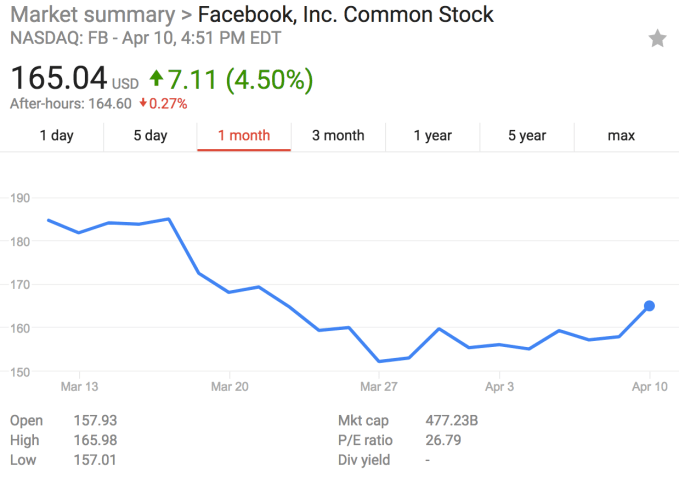
Shareholders seemed to have incredibly low expectations of Facebook CEO Mark Zuckerberg’s ability to handle a Senate testimony, because Facebook stock climbed 4.5 percent Tuesday with the bulk of the gains coming during his televised testimony.

Though the markets closed nearly an hour ago, Zuckerberg is still being peppered by Senators in an hours-long testimony session where the group is aiming to hear more from the company’s CEO and founder about data protection in the wake of the Cambridge Analytica controversy.

While there have been tough questions from several senators, rhetoric regarding government regulation of internet companies like Facebook was not overly pronounced in opening statements, though several Senators did directly address it in their questioning.

While Zuckerberg’s apology tour of the Capitol building seems to have largely been devoted to rehashing the major changes they’ve announced in recent days and weeks, he did reveal that the number of Facebook accounts with ties to Russian Intelligence could be in the “tens of thousands,” an admission that greatly exceeds the several hundred that Facebook had previously disclosed.

Facebook’s gains Tuesday brought the company’s share price to close above $165, a number it has not closed above in nearly three weeks. Facebook is still far below the $185 share price it was above before Cambridge Analytica reports were shared from a number of publications in mid-March.


10 Apr 2018

Zuckerberg urges privacy carve outs to compete with China

Facebook’s founder said last month that the company is open to being regulated. But today he got asked by the US senate what sort of legislative changes he would (and wouldn’t) like to see as a fix for the problems that the Cambridge Analytica data scandal has revealed.

Zuckerberg’s response on this — and on another question about his view on European privacy regulations — showed in the greatest detail yet how he’s hoping data handling and privacy rules evolve in the US, including a direct call for regulatory carve outs to — as he couched it — avoid the US falling behind Chinese competitors.

Laying out “a few principles” that he said he believes would be “useful to discuss and potentially codify into law”, Zuckerberg first advocated for having “a simple and practical set of ways that you explain what you’re doing with data”, revealing an appetite to offload the problem of tricky privacy disclosures via a handy universal standard that can apply to all players.

“It’s hard to say that people fully understand something when it’s only written out in a long legal document,” he added. “This stuff needs to be implemented in a way where people can actually understand it.”

He then talked up the notion of “giving people complete control” over the content they share — claiming this is “the most important principle for Facebook”.

“Every piece of content that you share on Facebook, you own and you have complete control over who sees it and how you share it — and you can remove it at any time,” he said, without mentioning how far from that principle the company has been at earlier times in its history.

“I think that that control is something that’s important — and I think should apply to every service,” he continued, making a not-so-subtle plea for no other platforms to be able to leak data like Facebook’s platform historically has (and thus to close any competitive loopholes that might open up as a result of Facebook tightening the screw on developer access to data now in the face of a major scandal).

His final and most controversial point in response to the legislative changes question was about what he dubbed “enabling innovation”.

“Some of these use cases that are very sensitive, like face recognition for example,” he said carefully. “And I think that there’s a balance that’s extremely important to strike here where you obtain special consent for sensitive features like facial recognition. But don’t — but that we still need to make it so that American companies can innovate in those areas.

“Or else we’re going to fall behind Chinese competitors and others around the world who have different regimes for different, new features like that.”

Zuckerberg did not say which Chinese competitors he was thinking of specifically. But earlier this week ecommerce giant Alibaba announced another major investment in a facial recognition software business, leading a $600M Series C round in Hong Kong-based SenseTime — as one possible rival example.

A little later in the session, Zuckerberg was also directly asked whether European privacy regulations should be applied in the US. And here again he showed more of his hand — once again refusing to confirm if Facebook will implement “the exact same regulation” for North American users, as some consumer groups have been calling for it to.

“Regardless of whether we implement the exact same regulation — I would guess it would be somewhat different because we have somewhat different sensibilities in the US, as do other countries — we’re committed to rolling out the controls and the affirmative consent, and the special controls around sensitive types of technologies like face recognition that are required in GDPR, we’re doing that around the world,” he reiterated.

“So I think it’s certainly worth discussing whether we should have something similar in the US but what I would like to say today is that we’re going to go forward and implement that [the same controls and affirmative consent] regardless of what the regulatory outcome is.”

Given that’s now the third refusal by Facebook to confirm GDPR will apply universally, it looks pretty clear that users in North American will get some degree of second tier privacy vs international users — unless or until US lawmakers forcibly raise standards on the company and the industry as a whole.

That is perhaps to be expected. But it’s still a tricky PR message for Facebook to be having to deliver in the midst of a major data scandal — hence Zuckerberg’s attempt to reframe it as a matter of domestic vs foreign “sensibilities”.

Whether North American Facebook users buy into his repackaging of coach class privacy standards vs the rest of the world as just a little local flavor remains to be seen.

10 Apr 2018

In Senate hearing, Zuckerberg faces blame over violence in Myanmar

While the recent Cambridge Analytica data privacy scandal is the main focus for American lawmakers questioning Facebook’s Mark Zuckerberg today, the company’s record beyond the U.S. raises even more alarms.

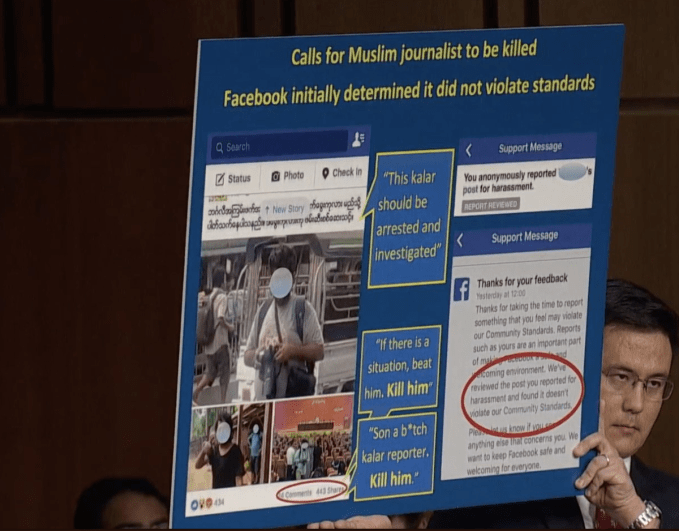
During the hearing, Vermont Senator Patrick Leahy brought up the company’s role in the ongoing ethnic violence in Myanmar, citing one incident where death threats against a Muslim journalist did not violate the platform’s rules. In Myanmar, journalists are regularly arrested and even killed for reporting on the government’s activities.

“Six months ago I asked your general counsel about Facebook’s role as a breeding ground for hate speech against Rohingya refugees,” Leahy said. “Recently, U.N. investigators blamed Facebook for playing a role in inciting the possible genocide in Myanmar, and there has been genocide there.”

Using screenshots mounted on a poster, the Senator cited a specific threat calling for the death of Muslim journalists in the country:

That threat went straight through your detection systems. It spread very quickly and it took attempt after attempt after attempt and the involvement of civil society groups to get you to remove it. Why couldn’t it be removed within 24 hours?

Screenshot from C-Span

Leahy interrupted Zuckerberg when he began to opine about the country’s tragedy. “We all agree it’s terrible,” Leahy said, pressing the Facebook founder for substantive answers.

Zuckerberg cited the language barrier as one of the main obstacles to proper moderation of hate speech and calls for violence.

“Hate speech is very language specific. It’s hard to do it without people who speak the local language and we need to ramp up our effort there dramatically,” Zuckerberg said.

He mentioned the company’s plan to hire “dozens” of Burmese language content reviewers as the first part of a three-pronged approach in Myanmar, also noting a partnership with civil society groups to identify hate figures in the country rather than focusing on removing individual pieces of content.

Third, Zuckerberg stated that Facebook is “standing up a product team to do specific product changes in Myanmar” and other countries with similar situations, though he did not delve into the specifics of those changes.

Leahy’s line of questioning about Facebook’s influence in Myanmar is not speculative. In March, United Nations investigators concluded that disinformation campaigns facilitated by Facebook have played a “determining role” in inciting violence against the country’s Rohingya Muslim minority ethnic group.

As Marzuki Darusman, chairman of the U.N. independent international fact-finding mission on Myanmar, stated those findings:

[Social media] has …substantively contributed to the level of acrimony and dissension and conflict, if you will, within the public. Hate speech is certainly of course a part of that. As far as the Myanmar situation is concerned, social media is Facebook, and Facebook is social media.

On April 5, a group of six NGOs working in the country addressed a critical letter to Zuckerberg, citing “issues that have been rife on Facebook in Myanmar for more than four years now,” criticizing the company for crediting its own systems with catching violent messages when in fact it had been these organizations doing the moderation work. When Zuckerberg responded to that letter just a day before he appeared before Congress, the NGO group dismissed his apology as “grossly insufficient.” It’s unlikely that they’ll be pleased with his lackluster testimony on the issue.

Last October, Facebook told TechCrunch that it works with NGOs and the local community in Myanmar to communicate its policies there, though its efforts seemed fairly toothless. At the time, the focus of that initiative was to “empower people in Myanmar to share positive messages online,” and one component offered local education on fake news. But by October of last year, incitements to violence on Facebook were already being connected to real-world acts against the country’s Rohingya population — a group facing systemic violence that’s widely regarded as a genocide.

For Facebook users in Myanmar, a country in which the platform is synonymous with the internet itself, the stakes couldn’t be higher. With the NGOs Facebook relies on in the Southeast Asian country deeply dissatisfied, it’s clear that words alone will no longer suffice.

10 Apr 2018

Zuckerberg admits it was a mistake not to ban Cambridge Analytica’s ads

Facebook didn’t ban Cambridge Analytica when it found out in 2015 that it had received user data from Dr. Aleksandr Kogan, and Zuckerberg called that a mistake during his testimony before the Senate. Cambridge Analytica has since been banned.

Zuckerberg explained that “I want to correct one thing that I said earlier in response to a question from Senator Leahy. He had asked why we didn’t ban Cambridge Analytica at the time when we learned of them in 2015. And I answered that what my understanding was was that they were not on the platform, were not an app developer or advertiser. When I went back and met with my team afterwards, they let me know that Cambridge Analytica actually did start as an advertiser later in 2015, so we could have in theory banned them back then and made a mistake by not doing so.”

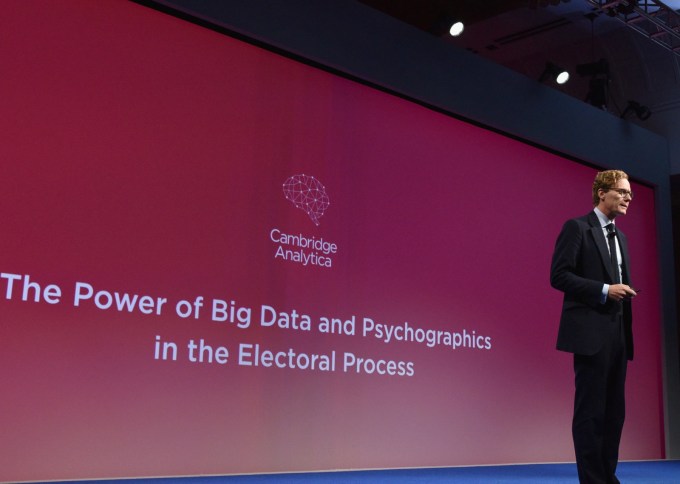
NEW YORK, NY – SEPTEMBER 19: CEO of Cambridge Analytica Alexander Nix speaks at the 2016 Concordia Summit – Day 1 at Grand Hyatt New York on September 19, 2016 in New York City. (Photo by Bryan Bedder/Getty Images for Concordia Summit)

When the Guardian informed Facebook about Kogan sharing user data to Cambridge Analytica, Facebook banned Kogan, and required Cambridge Analytica to formally certify that it had deleted all the improperly attained user data. Cambridge Analytica did so, Zuckerberg confirmed in his prepared testimony for today. But Facebook then stopped short of blocking Cambridge Analytica from buying ads on its platform. The company went on to work with the Trump campaign to help it optimize political messaging and ad targeting.

Had Facebook banned Cambridge Analytica at the time, it wouldn’t have been able to buy ads directly on behalf of political campaigns it worked with. However, the company might still have been able to help these campaigns to optimize their ads, so a 2015 ban wouldn’t have necessarily prevented second-hand use of improperly attained data.

10 Apr 2018

New research shows successful founders are far older than the Valley stereotype

There is a classic stereotype of the Silicon Valley entrepreneur: often a computer science nerd, almost certainly male, ambitious and, most importantly, young — very young. Founders who have been covered extensively by the media, like Bill Gates, Steve Jobs and Mark Zuckerberg, started their companies still glimpsing their teenage years, and that reputation has spread widely across the industry.

Now, a group of economics researchers have conducted a comprehensive investigation of the starting age of founders of high-growth startups — and found that that stereotype just doesn’t match the data.

In a new National Bureau of Economic Research working paper, Pierre Azoulay, Benjamin Jones, J. Daniel Kim and Javier Miranda connected a variety of administrative data sets to investigate the age of founders of new businesses, and particularly the age of founders of high-performance startups. Administrative data sets are the “gold standard” of data, because unlike surveys or other statistical sampling methods, they represent the entire population under consideration.

What they found is that the average age of a startup founder is about 41.9 years of age among all startups that hire at least one employee, and among the top 0.1 percent of highest-growth startups, that average age moves up to 45 years old. Those ages are taken from the time of the founding of the company.

The researchers broke down the population of founders along a number of lines, including geography and industry. They found little difference in their results between subcategories, and, in many cases, the subcategory definition actually increased the average age. For instance, industries like oil and gas can have average founder ages as high as 51.4 years old. The researchers wrote that “The only category where the mean ages appear (modestly) below age 40 is when the firm has VC-backing. The youngest category is VC-backed firms in New York, where the mean founder age was 38.7.”

One interesting dynamic in the data is that older entrepreneurs appear correlated with better startup performance. “For example, the 1,700 founders of the fastest growing new ventures (1 in 1,000) in our universe of U.S. firms had an average age of 45.0 (compared to 43.7 for the top 1% and 42.1 for the top 5%),” the researchers wrote.

Indeed, it’s not just that older entrepreneurs are more successful, but that younger founders are less successful. “Overall, we see that younger founders appear strongly disadvantaged in their tendency to produce the highest-growth companies,” the researchers wrote (italics in original). One reason, they argue, is that older founders tend to have more years of experience in their industries.

With those results out of the way, there is a critical question: If indeed the most successful ventures are run on average by founders in their 40s, why is it that VCs seem to focus so intently on younger founders who seem to be wildly statistically unsuccessful?

The authors speculate that the reason could be that younger founders are “more in need of early-stage external finance” because older founders have the connections, networks and personal wealth to fund their ventures. VCs don’t have access to those deals, so they gravitate to the kinds of deals they can potentially fund.

I think there is a more blunt reason for this dynamic: VCs believe they have “pattern recognition” abilities that they simply don’t have. Instead, they rely on suppositions and stereotypes that don’t match the underlying data on startup success. The same reason why older founders are ignored by the ecosystem is the same reason why women and other minorities struggle in the Valley: It’s really not about what you build, but what you look like while building it. Data like those found in this paper should force all of us to reevaluate what kind of founders with whom we should be partnering.

10 Apr 2018

‘Tens of thousands’ of Facebook accounts may be related to Russian intelligence

Facebook has previously officially noted that 470 accounts associated with Russia’s Internet Research Agency have been banned related to the 2016 election, plus 270 more in Russia just last week. But in today’s testimony Mark Zuckerberg also mentioned a much higher estimate of “tens of thousands,” though the confidence in this number would be also be much lower.

“In the IRA specifically, the ones we’ve pegged back to the IRA, we can identify 470 in the American elections, and the 270 that we went after in Russia last week,” he began in response to Senator Feinstein (D-), who had asked about the numbers of accounts associated with this type of coordinated disinformation campaign.

But then he continued:

“There are many others that our systems catch which are more difficult to attribute specifically to Russian intelligence, but the number would be in the tens of thousands of fake accounts…”

The tens of thousands number must be taken with a grain of salt, since clearly Facebook has not been able to definitively attribute more than the stated 740 or so to the IRA and Russian intel. But it is still significant; this is clearly different from the 30,000-odd accounts banned in relation to France’s election. That was a specific number and also not mentioned in connection with Russia specifically, as this estimate was.

It seems clear that Facebook is being conservative in its enumeration of Russian-linked accounts, and that very well may be the responsible thing to do. But Zuckerberg’s remarks today establish a ceiling in the tens of thousands in addition to the floor of several hundred. That’s worth keeping in mind.

10 Apr 2018

‘Unicorn’ price tags aren’t all they’re cracked up to be

A $1 billion valuation was until recently a significant badge of honor for a technology company, marking it as an unusually successful outlier. Now, though, as membership of the club has swollen to as many as 200 globally (with an aggregate valuation in excess of $600 billion), the “unicorn” epithet given to these billion-dollar companies on account of their rarity has become less apt and attracted considerable skepticism as to whether they can justify their sky-high price tags.

I specialize in economics, corporate finance and credit risk, with a particular focus on venture capitalism. From my vantage point at Stanford, I’ve naturally become especially concerned with the goings-on of Silicon Valley. Along with my co-author Will Gornall, when preparing Squaring Venture Capital Valuations with Reality, I set out to see whether concerns about the potential overvaluation of unicorn companies was justified. What I discovered may shock you.

Overvaluation is endemic

One in 10 unicorns is overvalued by at least 100 percent, and on average a unicorn reports a valuation 50 percent above the fair value we calculated.

The problem is that companies apply an inappropriate valuation model. The standard method of calculating the market value of a publicly listed company is to multiply the number of shares outstanding by the current trading price of a single share. So pre-IPO companies typically use the amount of money raised in their latest funding round and the amount of equity they gave away in the round to arrive at their valuation. The resulting figure might be a useful shorthand for many purposes (not least juicy media headlines), but — as our research found — it can be wildly inaccurate.

Post-money valuations assume that — as would typically be the case post-IPO — all shares are created equal. They aren’t.

In order to attract funding, companies offer investors inducements and securities. They may guarantee a certain return on their investment at the time of IPO — if the company doesn’t reach a certain valuation at that point, it will issue the investor more shares until the difference between the achieved and promised valuation is made up. This can happen several times, with shares issued at each funding round having potentially very different rights. Effectively, common shareholders pay the price, in terms of both their influence and their returns.

The people most affected are employees with stock options.

This situation is not taken into account by standard post-money valuations. When it is — we scoured the relevant documentation for more than 130 unicorns to crunch the numbers — it emerges that common shares are overvalued by 58 percent on average, and for almost half of unicorns “fair valuation” dips below the billion-dollar threshold.

Let’s take a look at some examples.

Payments technology company Square went public in 2015 at a $2.9 billion valuation, less than half the $6 billion headlines following its 2014 Series E round. But Series E investors didn’t lose out. Having been guaranteed $18.56 per share, they were issued additional equity at IPO to make up the difference from the $9 float price. A last private valuation reflecting those special conditions would have been $2.2 billion, making much more sense of the subsequent IPO price.

Elon Musk’s SpaceX, meanwhile, actually saw its fair valuation fall in 2008, while its reported valuation climbed. Investors in that round had been promised twice their money back should the company list, with seniority over all other shareholders.

Is overvaluation a deliberate tactic?

Former SEC chairman Mary Jo White highlighted this issue in March 2016, expressing concern about “whether the prestige associated with reaching a sky-high valuation fast drives companies to try to appear more valuable than they actually are.”

It’s impossible to say for sure whether companies are striking these deals with investors in a deliberate attempt to drive their valuations higher. But it’s not difficult to see how they benefit from those higher valuations. Aside from massaging egos and signaling success and attractiveness to future investors, they create a buzz that helps with marketing and, especially, hiring in a fiercely competitive talent market.

When we circulated an early version of our paper, plenty of companies’ general counsels got in touch, and we invited them to correct any factual errors or other mistakes in our working. We’ve not heard back from them.

Implications of overvaluation

The biggest effect of overvaluation is to drive up the value of shares issued in later funding rounds, as they come with greater control over the direction of the company and the return on the investment. Specifically, we found that 31 percent of unicorns give their most recent investors seniority over all previous backers, 20 percent empower them to block IPOs that don’t return a certain percentage of their investment and 14 percent provide guarantees of returns at IPO — all benefits for which investors will pay a premium.

The people most affected are employees with stock options. Many don’t understand that these options are disconnected from headline-grabbing post-money valuations and that their value falls as investors come on board with preferential deals. This further complicates employees’ decisions about how long to stick around to realize their options — especially considering that the longer they stay, the longer they take a hit on the salary they could earn elsewhere, where part of their compensation wouldn’t be tied up in stock.

The market is undoubtedly overheated, despite nine out of 10 VCs believing unicorn companies are overvalued (as I found in previous research). This is partly a result of non-traditional investors in Silicon Valley, such as Saudi Arabia and China, taking more of an interest in the area as low interest rates globally increase appetites for risk.

At some point, the market will demand either profitability or exits (both of which are becoming less common among unicorns), or valuations will start to fall. It’s hard to predict exactly when, though, as this depends on external macroeconomic trends.

Whether or not we will see a crash on anything like the scale of the bursting of the Dot Com bubble is similarly difficult to say with certainty, depending as it does on which dominoes fall first and how hard investor confidence is hit. But suffice it to say, there will be some major casualties.


10 Apr 2018

Mark Zuckerberg: “There will always be a version of Facebook that is free”

Today during Mark Zuckerberg’s testimony before the Senate, the Facebook CEO reiterated that “there will always be a version of Facebook that is free.”

In the midst of the Cambridge Analytica scandal, in which the user data of up to 87 million people was sold by a third-party developer to Trump Campaign-linked firm Cambridge Analytica, there has been talk of Facebook potentially adding a subscription layer.

The scandal has brought to light the heart of a problem that many have been well aware of: if you’re not buying a product, you are the product.

Last week, when asked if there might be a way for users to opt out of being targeted for ads, Sandberg responded saying they’d have to pay for it.

“We have different forms of opt-out,” Sandberg replied. “We don’t have an opt-out at the highest level. That would be a paid product.”

Our own Josh Constine made an argument that ad-free subscriptions could save Facebook. And while there’s no word on an ad-free subscription, Zuckerberg did at least leave room for it in the future, noting that there will always be a version of Facebook that is free.

“How do you sustain a business model in which users don’t pay for your service?” Senator Orrin Hatch asked Zuckerberg.

“Senator, we run ads.”

10 Apr 2018

Facebook did not inform the FTC about initial Cambridge Analytica leak

In testimony before the Senate Judiciary and Commerce, Science, and Transportation committees, Facebook chief executive Mark Zuckerberg said that his company did not notify the Federal Trade Commission about the initial user data leak that triggered its most recent privacy scandal.

“They considered it a ‘closed case’,”Zuckerberg said in response to a question over whether Facebook’s staff notified anyone at the FTC about the leak of consumer data in 2015 when Facebook claimed it learned about the data leak.

Cambridge Analytica’s access to Facebook user data, which it acquired improperly through a third party quiz app, is at the heart of Facebook’s latest scandal — and Facebook’s failure to notify the FTC of the data leak could have triggered the commission’s recent probe.

In a statement issued at the time about Facebook’s privacy controls, Tom Pahl, acting director of the Federal Trade Commission’s Bureau of Consumer Protection, said:

The FTC is firmly and fully committed to using all of its tools to protect the privacy of consumers. Foremost among these tools is enforcement action against companies that fail to honor their privacy promises, including to comply with Privacy Shield, or that engage in unfair acts that cause substantial injury to consumers in violation of the FTC Act. Companies who have settled previous FTC actions must also comply with FTC order provisions imposing privacy and data security requirements. Accordingly, the FTC takes very seriously recent press reports raising substantial concerns about the privacy practices of Facebook. Today, the FTC is confirming that it has an open non-public investigation into these practices.

The terms of the initial settlement deal that Facebook inked with the SEC in 2011 barred the company from making misrepresentations about the privacy or security of consumers’ personal information; and required the company to get the express consent before changing privacy preferences.

The agreement also included the following commitment from Facebook:

that it “establish and maintain a comprehensive privacy program designed to address privacy risks associated with the development and management of new and existing products and services, and to protect the privacy and confidentiality of consumers’ information; and required, within 180 days, and every two years after that for the next 20 years, to obtain independent, third-party audits certifying that it has a privacy program in place that meets or exceeds the requirements of the FTC order, and to ensure that the privacy of consumers’ information is protected.”