10 Apr 2018

Security shop Carbon Black files to go public

Today Carbon Black filed to go public, publishing its S-1 document with a $100 million IPO figure as a placeholder.

The security-focused firm based in Massachusetts raised more than $190 million during its life as a private company, including a $54.5 million Series F in 2015 and a more modest $14 million Series F extension in 2016.

Today we’ll take a quick peek at the filing, which joins a number of other technology listings in an active IPO cycle. Carbon Black follows notable debuts such as Spotify and Dropbox, along with other, smaller debuts.

Into the numbers!

The big picture

Carbon Black is a big SaaS shop, something it makes plain in the early sections of its S-1 by noting that its revenue mix has increasingly skewed toward subscriptions. Indeed, according to Carbon Black, the firm’s “[r]ecurring revenue represented 77%, 83% and 88% of our total revenue in 2015, 2016 and 2017, respectively.”

That matters for investors as it helps them understand the company’s growth pace and its cash costs. SaaS companies are notorious for being predictable beasts, but also animals that have slipping growth rates in percentage terms and high upfront cash costs to generate their recurring top line.

Carbon Black is a great example of the model. The firm has grown its subscription (et al.) revenue line item greatly in recent years, but with the cost of rising deficits and high sales and marketing costs (as a percent of revenue and gross margin).

To save us both from reading a slower restatement of fact, here are the company’s guts and bolts, as we like to say:

Carbon Black’s revenue growth for calendar 2017 comes to 39.4 percent, down from 64.7 percent the year before.

Notably, the firm’s net loss fell during 2016, only to rise again in 2017. Companies often post rising deficits as they pursue growth. This is doubly true for SaaS companies willing to pay cash today for revenue growth tomorrow. In simpler terms, SaaS companies pay customer acquisition costs upfront but generate the benefits later on. And if a company is bolstering its sales costs during a growth cycle, the red ink can stretch quite far toward the horizon.

But there’s nuance to the firm’s losses, which we need to understand.

Losing money, and losing money

There’s a fun line item in the above called “[a]ccretion of preferred stock to redemption value,” which has risen and fallen over the past few years.1 This allowed Carbon Black to post a net loss decline in 2016, making its growth that year look particularly attractive. However, the return of that accretion cost pushed 2017’s net loss to a period-high.

Backing out that cost, and focusing on the company’s net loss result pre-accretion expenses, the firm’s net loss has instead posted steady growth as the firm has scaled.

Balling that up, from the above chart we can deduce that Carbon Black is growing at a goodly clip from a revenue base over the $100 million mark, with steadily rising operating losses (speaking loosely) and high sales and marketing costs.

What’s missing? A path to profitability, really. And that’s something the firm’s quarterly results don’t help with, as we will now see:

Let’s walk through that data set together. First, check the rightward progression of the firm’s net losses. Its losses go up with near-steady regularity. Next, execute the same exercise, but with the firm’s “Loss from operations” line. It’s a similar story.

So, as the firm grows, we can safely deduce that it’s an increasingly unprofitable affair. Mostly.

Turning to how the firm spends money, Carbon Black’s quarterly spend on sales and marketing, in percentage-of-revenue terms, was 65 percent in its most recent quarter. That was down from 67 in the year-ago quarter and as high as 71 percent in the first quarter of 2016. Since the first quarter of 2016 to the last of 2017, research and development costs have risen a single point; general and administrative costs fell from 22 percent of revenue to 14 percent. Those modest savings have pushed the firm’s percent-of-revenue losses into the low thirties.

Where they have stuck.

For Carbon Black, the question will be whether it can grow into profitability in the medium-term, or if its growth simply feels expensive compared to other companies; in a liquid market, every investment comes with opportunity costs.

At a minimum, and to Carbon Black’s credit, the security world doesn’t seem to be slowing much.

Odds & ends

Returning to the financials, how Carbon Black calculates its revenue retention is interesting, as it is more conservative than what we often find in similar IPO filings. In this case, Carbon Black doesn’t just compare revenue growth among a customer cohort over time from the clients it didn’t lose; instead, it calculates a more inclusive metric that includes customer churn.

But then Carbon Black goes a bit further, adding that it also “exclude[s] the impact of any add-on purchases from these customers during the measurement,” making its retention metric even stricter than we might have guessed. Regardless, we can read the results: “[Carbon Black’s] retention rate was 93% in 2015, 92% in 2016 and 93% in 2017.” That’s steady enough.

In closing, let’s talk bank accounts. How much cash does Carbon Black have on hand? The answer is not that much: $36.1 million. That’s a low-enough figure that we can presume that the firm is going public not because it simply wants to, but because it needs to raise new capital.

That’s no sin, mind, but let’s dismount with cash flow results to see if we are right. The firm’s free cash flow in 2016 came to negative $25.3 million. It fell, however, to just negative $13.8 million in 2017. Enough to run the company out of oxygen in just a few years. However, with, say, another $100 million in the bank, Carbon Black would have more than enough cash to scale — provided it doesn’t start to consume more cash to grow.

More when it prices — assuming this entire exercise isn’t just an attempt to get bought.

  1. Explained on page F-43 of the S-1, this cost is the “increase [in] the carrying values of the Series B, C, D, E, E-1 and F redeemable convertible preferred stock” over time. This accounting charge leads to “decreases to additional paid-in capital and an increase to accumulated deficit,” but has no bearing on operating results.
10 Apr 2018

DFS Lab is helping the developing world bootstrap itself with fintech

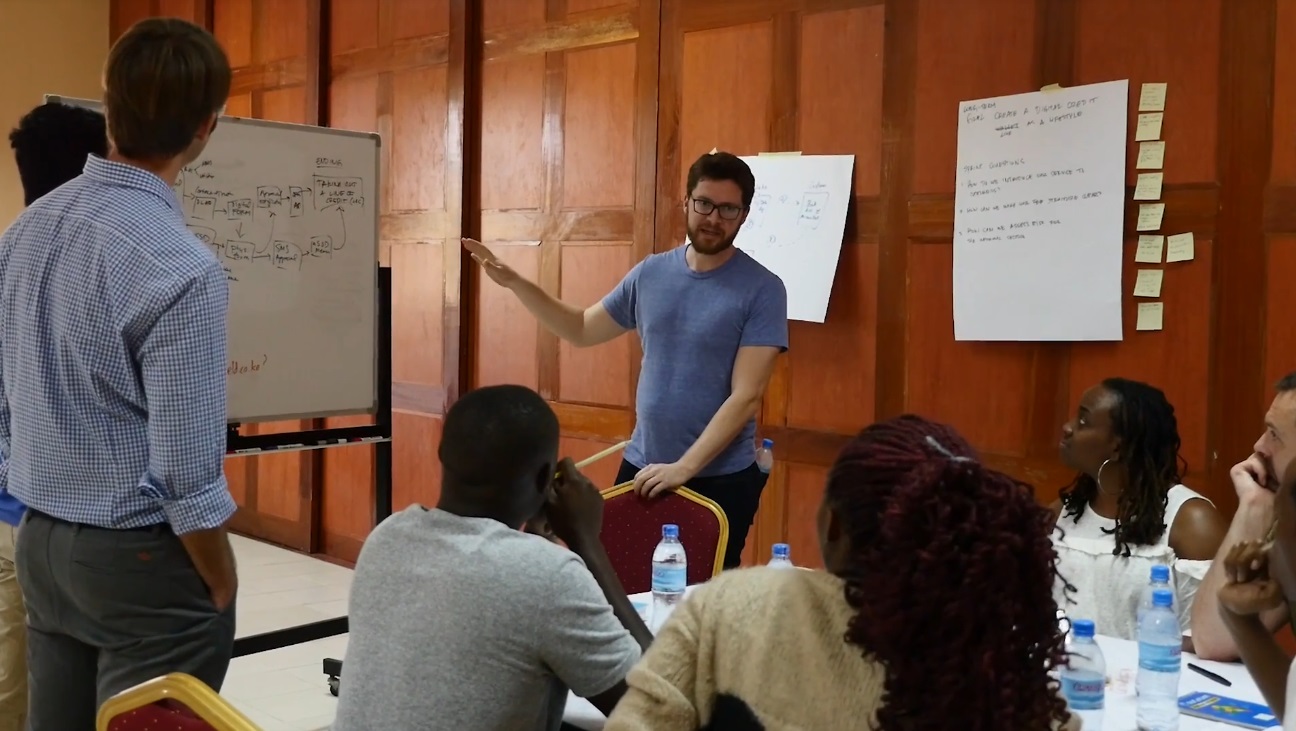
Entrepreneurs have it rough in Africa, India, Pakistan — places where VC cash doesn’t fall from the sky and necessary infrastructure like reliable banking and broadband can be hard to come by. But companies grow and thrive nevertheless in these rugged environments, and DFS Lab is an incubator focused on connecting them with the resources they need to go global.

The company was founded, and funded, on the back of a $4.8 million grant from the Gates Foundation, which of course is deeply concerned with tech-based solutions for well-being all over the world. Its name, Digital Financial Services Lab, indicates its area of focus: fintech. And anyone can tell you that sub-Saharan Africa is one of the most interesting places in the world for that.

This week DFS Lab is announcing a handful of new investments — modest ones on the scale companies are used to in Silicon Valley, but the money is only a small part of the equation. Investment comes at the end of a longer process, the most valuable of which may be the week-long sprint DFS Lab does on the ground, helping solidify ideas into products, or niche products into products at scale.

The relative lack of VCs and angel investors puts early-stage companies at risk and can discourage the most motivated entrepreneur, so the program is aimed at getting them over the hump and connected to a network of peers.

The latest round puts a total of $200,000 into four startups, each touching on a different aspect of a region or vertical’s financial needs. All, however, are largely driven by the massive growth of mobile money in Africa over the last decade and the more recent, ongoing transition to modern smartphones and the app/data landscape familiar to the U.S. and Europe.

  • Nala aims to move p2p payments away from the antiquated but widely used USSD system (more on this later) to a Venmo-like app interface that integrates multiple native mobile currencies like M-Pesa into a single tool.
  • Cherehani connects female entrepreneurs with financial resources; the idea is to provide both much-needed credit and financial literacy at as early an age as possible. (They have a chatbot too, naturally.)
  • Nobuntu is a platform through which South Africans can open and contribute to pension plans via mobile money, simply and with low overhead costs.

The fourth company is choosing to remain in stealth mode for now, but you see the general theme here.

For one reason or another there are major gaps in everyday services that many of us take for granted — the ability to prove one’s identity, for example, is critical but commonly absent. I talked with Paul Damalie, founder of a DFS-funded company called Inclusive that helps address that particular shortcoming.

Basic ID verification can be difficult when you remove many of the things we take for granted. So when, for example, someone wanted to get a loan, a savings account, or some other basic financial service, “Originally you’d have to literally walk into the bank to do it,” Damalie said. Needless to say that isn’t always convenient, and banks as well as users want better options.

“We’ve been collecting existing databases and building a layer of rich access around it,” he continued. “Now we can use facial recognition to check those details. Once you have the ID, you need to check it with the government records” — which Inclusive also does. A range of other data creates a confidence score in the person’s identity, helping avoid identity fraud.

Another opportunity arises not from these gaps but from the unique ways in which the African ecosystem has evolved. USSD, which I mentioned before, is probably unknown to many of our readers — it certainly was to me. But it’s become a standard tool used regularly by millions for important tasks in Africa; if you want to work in that market, you have to deal with USSD one way or another.

The problem is that, as you might guess from Nala trying to deprecate it, USSD is a technology dating back to the ’90s, a text-based interface that’s rudimentary but, much like SMS, universally accepted and intelligible. The importance of cross-platform compatibility in mobile markets as fragmented as these can’t be overstated.

So bridging the gap between USSD and a “traditional” (as we might call it) payment app is a unique opportunity, and one a company called Hover (also in the DFS Lab portfolio) is addressing. Its tech acts as a sort of translation layer between USSD and smartphone app interfaces, allowing for modern app design but also deep back-compatibility. It’s an opportunity specific to this time and this area of the world, but nevertheless one that may end up touching millions.

And from the narrowness of its vision that DFS Lab derives its effectiveness.

“They’re one of the most specialized accelerators in the world,” said Damalie. “It goes beyond just funding — it involves having the right kind of network: access to partners, data, sources across the continent. They had context-relevant fellows, people who had very specific challenges.”

“The grant was useful and let us build a proof of concept, and of course the Gates Foundation gives us credibility. But they were taking bets on us as individuals.”

Although DFS Lab has heretofore been funded by the Gates infusion, that well will run dry soon. Jake Kendall, DFS Lab’s executive director, indicated that the plan is to move towards a more traditional investor fund. They already focus on profitability and the potential for growth to the continental stage or beyond; this isn’t a charity but tactical investment in such a way that social good is a necessary byproduct.

“The best way to have a global impact is to be self-sustaining,” he said.

10 Apr 2018

Uber’s new driver app identifies areas with the best fares

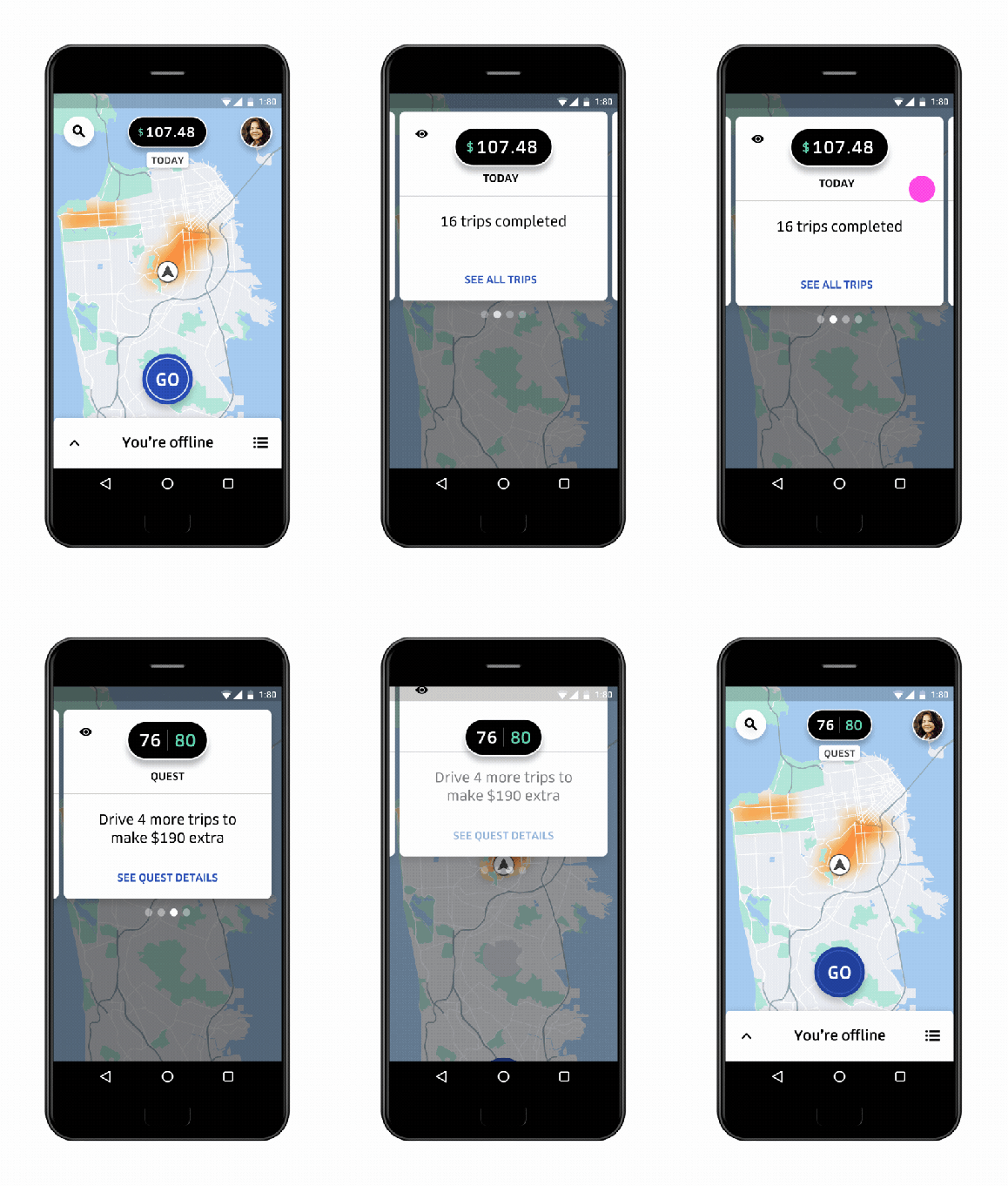
Uber is rolling out a new app for drivers starting today. The hope with the redesign is to make it easier for drivers to access the information they need the most, while ensuring the app is not a distraction while behind the wheel, three Uber driver app product leads told TechCrunch last week. Earnings and incentives, for example, are important to drivers.

“One of the things we wanted to do with the new app is just recognize that this is the most important thing for you and put it front and center,” Uber Driver Experience Group Manager Yuhki Yamashita told me at Uber’s headquarters last week.

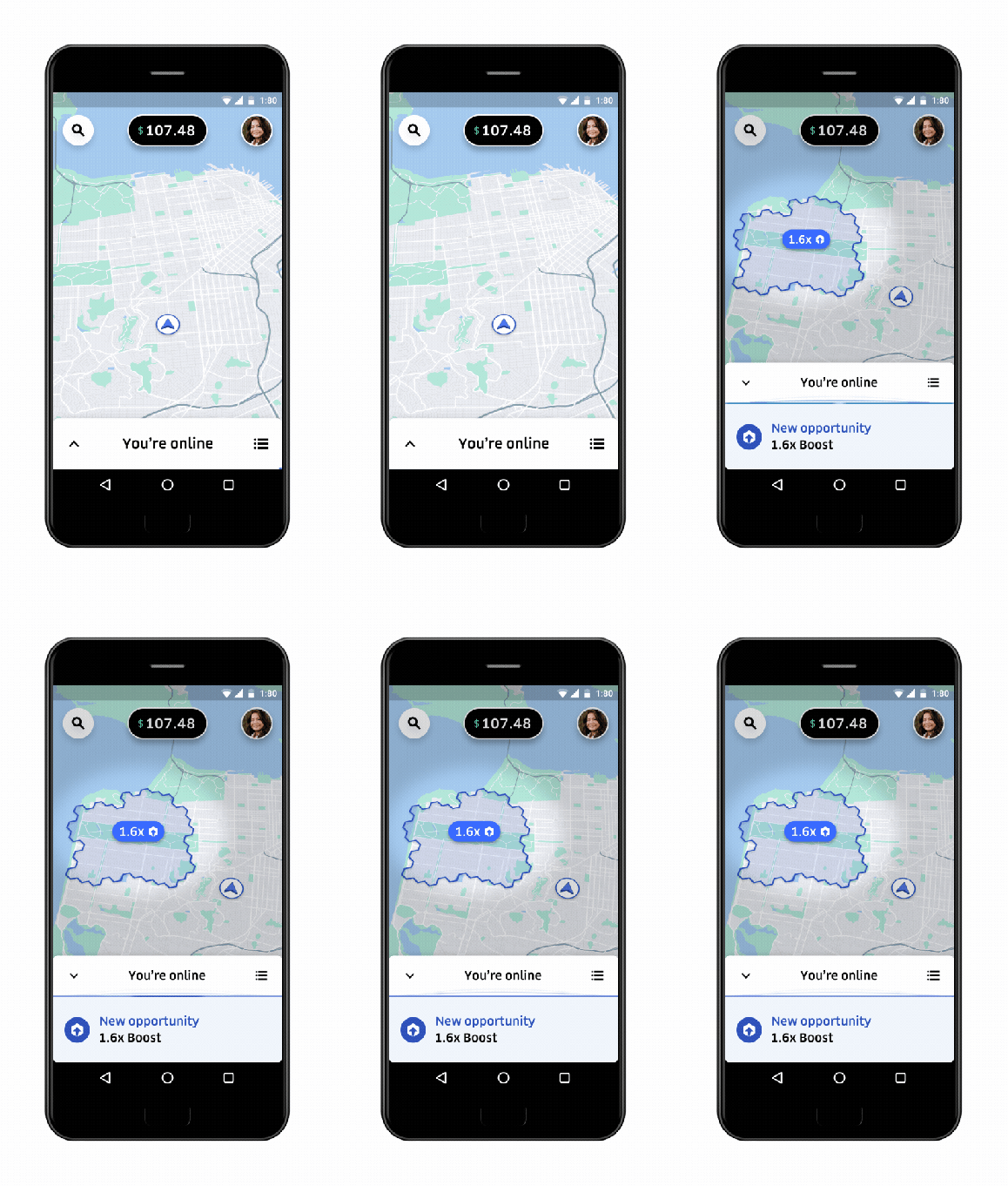
With the new app, Uber makes it easy for drivers to recognize where surge, boost and incentivized areas are located.

“Say you’re in a slow area,” Yamashita said. “We might actually suggest a place to go to instead because it’s much busier. And in this way you get a little bit more information about what’s happening around you. We get to answer questions like well what should you be doing next. And you know it feels like the app understands your current situation.”

Other notable additions are the distance left to travel (before, it was just time to arrival) and one-tap responses to riders. So, if a driver is stuck in traffic, they can quickly tap “stuck in traffic” to notify the rider. Another one is an offline mode feature, which solves the problem of what happens when a driver doesn’t have good internet connectivity.

“What they had to do was drive until you they had internet and then start the trip and then end the trip,” Yamashita said. “And that sometimes means that in certain markets you’re driving until the next town to actually end the trip and it makes it look like the trip was really long.”

Now, Uber will record the drivers GPS and once the driver regains connectivity, Uber will be able to make any appropriate adjustments. This is all part of Uber’s 180 days of change, which aims to make amends for the wrongs the company has done in the past.

“While 180 Days was about correcting missteps of the past, we also needed to think longer term, and the obvious place to start was the Driver app,” Uber CEO Dara Khosrowshahi wrote in a blog post. “It sits at the center of the driver experience, but after a redesign two years ago, it was already showing its age. We knew we couldn’t take the approach we’d taken in the past: redesign the app based on what we thought drivers wanted, launch it, then hope for the best. Instead we needed to listen to what drivers told us they needed, and shape the new app alongside them.”

Uber has been testing the driver app with 470 drivers across seven cities worldwide, incorporating their feedback along the way.

“So what we did during the beta was we actually sent teams of builders teams of people who worked on the app into every one of these seven cities seven cities to spend a real significant amount of time with drivers with better drivers in those cities talking them,” Uber UX Researcher Bjorn Hubert-Wallander told TechCrunch.

During that process, Uber realized that while drivers liked being able to quickly see their earnings, “they felt a little uncomfortable with the idea of it being so visible on the screen, Hubert-Wallander said. They expressed concern about passerbys or riders knowing their business.

“It’s not necessarily even that other people are literally seeing their earnings,” Huber-Wallander said about some drivers in Egypt. “It’s the idea that like that they’re making their earnings and the good fortune visible. This really invites bad luck so it doesn’t feel right to do that.”

In response to that feedback, Uber added a privacy setting so that drives can hide their earnings if they want.

Uber is initially launching the new driver app in Los Angeles and Atlanta, and nine or ten cities in other countries. The hope with the gradual rollout is that Uber will be able to see if the app produces any ripple effects in the marketplace.

For example, with the new app directing drivers to places where there are incentives, there could potentially be a shortage of drivers in other less populated areas, resulting in longer wait times for passengers. As part of Uber’s marketplace test, it will fully launch the driver app in a select number of cities and observe what happens when everyone has it.

“We’ll see if it produces unideal behaviors like that and compare it against sister cities,” Yamashita said. “We’re taking it slow to understand all the sorts of side effects.”

10 Apr 2018

Check out SpotMini, Cassie and more at TC Sessions: Robotics May 11 at UC Berkeley

So far we’ve been telling you about all of the awesome humans we’re going to have at TC Sessions Robotics next month in Berkeley — humans like Boston Dynamics’ Mark Raibert, Playground’s Andy Rubin, Fetch’s Melonee Wise and Pieter Abbeel, Ken Goldberg and Robert Full from U.C. Berkeley.

But what of the robots?

Don’t worry, we’ve got you covered there, too. We’ll be showcasing some of the industry’s most groundbreaking devices at next month’s event. Here’s just some of what you can expect to see May 11 at Zellerbach Hall.

For starters, the folks from Oregon’s Agility Robotics will showing off Cassie. The dynamic bipedal robot captured the internet’s imagination with its ability to mimic human moment on two slender legs. Cassie will be making a rare public debut on our stage, and its handlers will be on-hand to discuss the technology that goes into building this impressive robot.

Speaking of the internet’s imagination, arguably no robotics company has done a better job of capturing it than Boston Dynamics. The company’s latest creation, the electric Spot Mini will be on-stage, along with its creator, Marc Raibert. The quadrupedal robot has been showing off its abilities in a series of online videos in recent months, peeking around corners and opening doors. It even took a walk with Jeff Bezos.

And for good measure, here’s a quick video of Spot Mini and Cassie meeting for the first (but not last) time:

On the human front, we’ll also be joined by U.C. Berkeley Professor of Mechanical Engineering, Homayoon Kazerooni. The exoskeleton pioneer will be at the event to showcase the latest from his startup, SuitX. The company produces low-cost soft robotics exoskeletons designed to help rehabilitate people with mobility issues and aid industrial workers. Kazerooni will be on-hand to put the suits through their paces.

And that’s just the start. More announcements coming soon.

In the meantime, our early-bird ticket sale ends April 13. (Special 90 percent discount for students when you book here!)

10 Apr 2018

Instagram rolls out Focus portrait mode for videos and photos

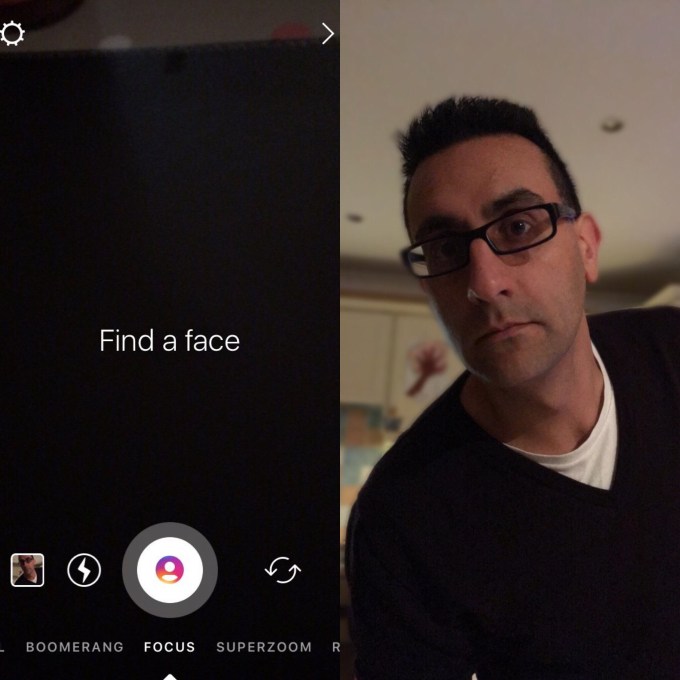
Instagram is one-upping Apple with a portrait mode feature that runs on a wider variety of phones and works with video, not just photos. Last month TechCrunch reported about a Focus feature buried in Instagram’s code which began publicly testing a week later. Now Instagram is rolling out Focus, which blurs the background while keeping someone’s face sharp for a stylized, professional photography look. “Focus mode leverages background segmentation and face detection technology” an Instagram spokesperson told me when asked how it works without the need for dual cameras.

Focus can be found in the Instagram Stories format options alongside Boomerang and Superzoom in both the selfie and rear facing cameras, and it rolls out globally today on iPhone 6S, 6S+, 7, 7+, 8, 8+ and X as well as select Android devices. That’s compared to Apple’s portrait mode that only works on the iPhone 7+, 8+, and X, and Android portrait mode that exists on the Pixel 2 and Pixel 2 XL. Instagram’s launch could also suck attention away from “fake portrait mode” apps like Magic Portrait Mode, FabFocus, LightX and Point Blur that can also add blurry background ‘bokeh effects’ to images.

This comparison provided to TechCrunch by reader Genady Okrain shows how Instagram Focus blurs the background, but can make the edges of the face look a bit hazy too. The iPhone portrait mode that takes advantage of newer models’ dual cameras does a little better job of keeping the whole face in focus, but it’s not available on older iPhones and can’t do video.

Focus gives people another reason to choose Instagram over Snapchat, and could make shooting inside the Instagram app more appealing. After 8 years of sunsets and latte art, it’s the selfies and portraits that still feel fresh on Instagram. Making them look as good as possible could keep Instagram from growing stale as it rockets towards 1 billion users.

Focus appears as an Instagram Stories format alongside Boomerang and Superzoom. Screenshots via Social Pip 

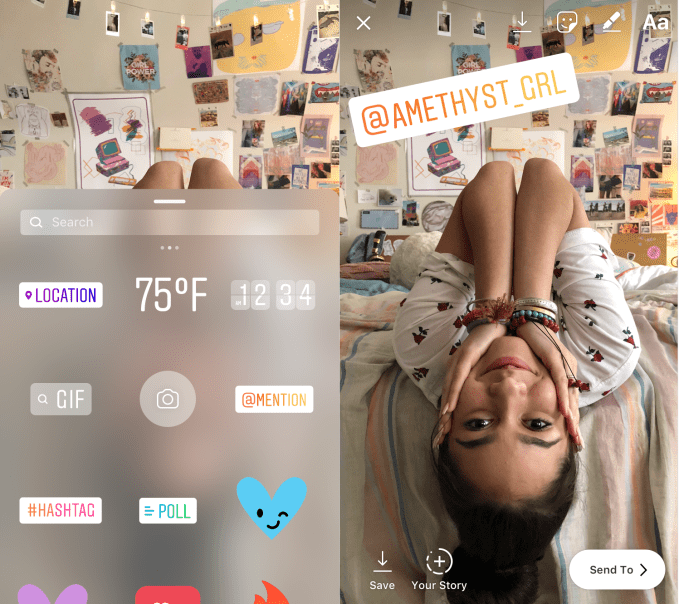
Meanwhile, Instagram is starting to roll out Mentions stickers that make it easy to tag friends in a Story with a stylized graphic instead of just text. Instagram tested these last month, but now they’re becoming available to all iOS users. Just like adding emoji to photos and videos, you can select the Mention sticker, use the typeahead to find a friend’s username, and tag them in a resizable sticker. That lets people tap through to view their profile, and generates a notification to the tagged user.

Instagram has had text mentions since November 2016, soon after it launched Stories, but Snapchat just added them last month. Mentions could make it easier for creators on both the apps to collaborate and cross-promote each other, or encourage fans to spread their name to friends.

 As Facebook endures unending scandals, Instagram has remained relatively unscathed by the backlash. Without links and resharing, its immune to a lot of the fake news and politics that have made Facebook exhausting. Instagram seems to see rapid feature development as the best distraction. Beyond Focus mode, TechCrunch recently reported that Instagram voice and video calling features are hidden inside the app’s code. And it’s just begun testing a Snapchat QR code-style feature called Instagram Nametags that make it easy to follow someone.

10 Apr 2018

b8ta unveils Shopify-like solution for retail stores

b8ta, the store founded by Nest alums to sell trendy gadgets, is entering new territory. Today, the startup is launching “Built by b8ta,” which functions as a retail-as-a-service platform for brands that want a physical presence.

Building off the success of its own retail stores, b8ta is confident it can provide an easy, cost-effective solution to brands wanting to launch physical stores of varying sizes. Since launching its first store in December 2015 in Palo Alto, b8ta has built and deployed an additional 78 stores across the country.

“As our business grew, there started being a class of larger companies in apparel and beauty that wanted to bring products to store but the product experience was misaligned with what they wanted to do,” b8ta CEO Vibhu Norby told TechCrunch. “With apparel, you don’t need a separate display for every shirt. So we started imagining creating a number of different brands for other categories.”

Instead of creating those brands itself, b8ta figured it would be more scalable to open up its store building and infrastructure processes to other entrepreneurs looking to open their own stores. That’s how b8ta landed on selling its software and retail services for a flat, monthly fee. The monthly fee, of course, depends on the square footage required as well as the cost of real estate in whichever market the customer decides to open the retail store.

“For most brands we’re working with, the costs are quite reasonable,” Norby said. “I’ll say that it’s at least 50 percent cheaper than doing it yourself.”

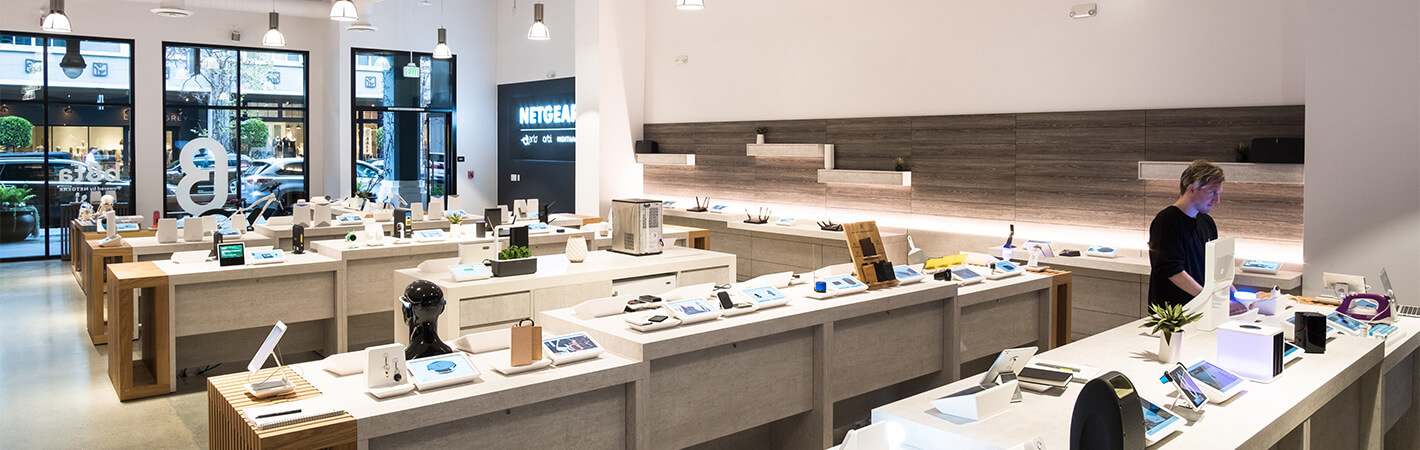
b8ta’s flagship store

b8ta’s software solution includes checkout, inventory, point of sale, inventory management, staff scheduling services and more. Netgear will be the first customer to launch a Built by b8ta store this June in Silicon Valley’s Santana Row. b8ta has plans to deploy additional stores for other brands in that area. In fact, Norby said there are a handful of other brands that b8ta will announce soon. This year, b8ta expects anywhere from ten to 15 companies to launch stores built by b8ta across cosmetics, apparel and furniture.

“This is designed for direct-to-consumer brands who have no store space but believe it’s important or they’ve done one or two stores and are having a hard time scaling that up to ten, twenty or thirty,” Norby said.

Some of these built by b8ta stores will exist within some of b8ta’s existing flagship stores. For brands that need more space, b8ta can build out separate medium to large-sized stores.

b8ta’s concept of small store inside a shopping center

b8ta likens its offering to Shopify, in that it provides physical stores for brands while Shopify provides virtual stores for brands. Instead of requiring brands to deal with store build-outs, infrastructure, real estate people and so forth, b8ta can provide all of that for them. On the real estate side, b8ta already has relationships with national real estate owners, architects, contractors and designers.

“We already have tremendous scale,” Norby said, noting how b8ta has a whole supply chain for fixture manufacturing and modular designs. On the staffing side, Norby said, the “big innovation” b8ta has is opening up many stores in the same shopping center, which is what b8ta plans to do with Santana Row. That enables b8ta to cover operations and management for multiple brands.

“In our system, no individual store needs to hire their own management team,” Norby said. “It’s just one team looking over the whole center.”

10 Apr 2018

CoinTracker raises $1.5M to make tracking crypto investments easy for anyone

It’s April, that means tax returns for people in the U.S. very soon. Given the breakout year that crypto had in 2017 — despite prices cooling down in recent months — and well-intended individuals might be thinking about whether to file taxes based on gains they enjoyed from bitcoin or other cryptocurrencies.

It’s good timing, then, for CoinTracker — a San Francisco-based startup currently tracking $200 million in crypto assets — to pop its head above the parapet and announce that it has raised a $1.5 million seed round.

We wrote about the company earlier this year when it was part of Y Combinator’s winter cohort, and now it has spread its wings with a round led by Initialized Capital — a seed investor in billion-dollar crypto exchange Coinbase — with Y Combinator and a host of angel investors joining in for the ride. Some of those include Protocol Labs CEO Juan Benet and Paul Buchheit, the engineer who created Gmail.

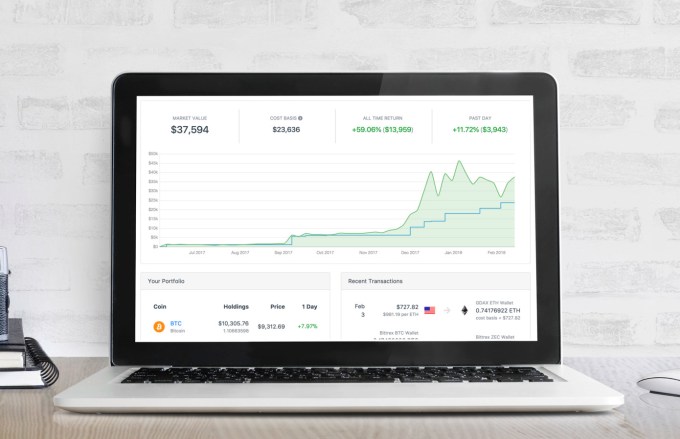
CoinTracker is (as the name suggests) a product that lets you track your crypto portfolio.

Sure, there are a tonne of such services and apps on the market but, having bought and used most of them, there’s none that really fits snuggly. That’s because a lot of the data input is manual. That’s important if you truly want to track the success of your investing, you need to know obvious information like what the price of bitcoin was when you bought. When you factor in crypto-to-crypto trading — e.g. trading bitcoin for ethereum — and the price changes that happen, suddenly your manual attempt to track performance is lacking.

That’s just speaking as a hobbyist. More serious investors are even more underserved, and that is where CoinTracker is aiming to make its mark.

The service tracks your crypto across wallet addresses — using public information, nothing private — while it throws in API keys from the top 14 crypto exchanges. That helps fill in more gaps and give you a fuller read on how your crypto investment has performed. A transfer matching algorithm is in place to help figure out trades on decentralized exchanges, which are more complicated to track.

By pulling that information, CoinTracker is also in a position to help those well-intended individuals I mentioned earlier give the taxman an accurate read on they crypto gains to remain IRS compliant.

Going forward, the plan is to tap into that holistic picture of crypto portfolios to offer more services, CoinTracker co-founder Chandan Lodha told TechCrunch in an interview.

Lodha, formerly a product manager with Google X, started the service alongside co-founder and former TextNow CTO Jon Lerner because both were looking for something to track their crypto investment hobby. When they realized a whole lot more people — both on the more serious and casual end of the spectrum — were too, they made it their main focus.

Lodha said the service aims to set itself apart with a focus on ease of use and simplicity, and he expects that to continue and be reflected in future services that could include trading via exchanges inside the app.

“The key reason we’ve had some success to date is due to focusing on the UX,” Lodha said. “There are tonnes of other tools but one thing that really resonates with our users is that we’ve made it easy to use for mainstream people, not just expert cryptography folks.”

Indeed, gathering and acting on user feedback is a common theme with Lodha, who said the money will go towards adding to CoinTracker’s developer team to work on the “large number” of user requests received. 

Now to price: the basic tracking service is free, but users pay from $49 up to $999 per year for more advanced features centered around optimizing tax filings by computing capital gains reports using FIFO, LIFO or HIFO accounting.

Disclosure: Writer owns a small amount of cryptocurrency.

10 Apr 2018

Vimeo debuts a Mac app for Final Cut Pro users

Vimeo today announced the launch of a new Mac app that will give video creators using Final Cut Pro more control over their file formats and video codecs. The app expands upon the existing integration with Final Cut Pro, which already offered the ability to upload to Vimeo. With the new app, creators can upload multiple files at once, track progress in a status bar, and get instant access to video links, video review pages, and embed codes, among other things.

In addition, Vimeo for macOS users can also add captions in Final Cut Pro, play videos from the app without going to a browser, and adjust the title, description, and privacy settings for their videos, notes a Vimeo blog post about the new software.

The idea is to help save video creators time when working with Final Cut Pro, while also giving them more control over their video workflow.

[gallery ids="1619462,1619463,1619464,1619465"]

More broadly, however, the Mac app is representative of Vimeo’s new strategy to become a tool provider for video creators, rather than a destination site for videos, similar to YouTube.

The company shifted its business last year towards its new focus on helping the creator community get their work done. It ditched its plans for a subscription video-on-demand service, promoted its creator business lead Anjali Sud to CEO, and acquired the live video streaming platform Livestream.

Earlier this year, Vimeo launched new features aimed at simplifying video distribution across social networks, including one tool that allows live video be streamed to Facebook, YouTube, Twitch and Periscope at the same time, and another offering simultaneously uploads to both Facebook and YouTube.

Whether video creators work with live video or pre-recorded video uploads, Vimeo’s big vision is to become the one-stop shop for anything creators need to get their work done – more efficiently and quickly. That, in turn, is meant to drive sign-ups for Vimeo’s paid subscription plans where the more advanced features are available.

Final Cut Pro isn’t the only video editing software Vimeo supports, the company notes – it also has an extension for Adobe Premiere Pro.

Below is the full feature set for Vimeo for macOS, which is a free download on the Mac App Store:

  • Export as ProRes and other advanced codecs from Final Cut Pro
  • Upload directly to your Vimeo account
  • Add captions in Final Cut Pro, and get to settings from the app
  • Adjust the title, description, and privacy settings for your videos
  • Play videos from the app (without going into your browser)
  • Get instant access to video links, video review pages, and embed codes


10 Apr 2018

Sesame Street turns to Kickstarter to fund autism book

Julia is Sesame Street’s first autistic character and her mission is to make neuroatypical kids feel more comfortable and understand that there are kids out there just like them. She’s a sweet little muppet and now she’s getting her own Kickstarter campaign.

The campaign is raising $75,000 to produce content and a free book featuring Julia and her friends. They’ve just hit $10,000 in funding and it’s growing fast. $100 gets you a plush Julia doll and if they reach $150,000 they will print a paper copy of the new Julia book. The project aims to help reduce bullying of autistic children and the Sesame Street team will work with experts to create content and a book around Julia’s adventures.

From the team:

Julia’s television debut was greeted with hundreds of media stories and millions of social media impressions, but the biggest marker of our success was the overwhelming response from the autism community and beyond. Parents say their autistic children have more playdates because of Julia. Teachers report that their students are more inclusive in their play. One mother told us that she used the first Julia storybook to explain to her daughter that she, too, has autism. Her daughter responded, “So I’m amazing too, right?”

This is Sesame Street’s first Kickstarter and it’s really wonderful. This sort of community call-to-action is just what crowdfunding was born to do and it’s great to see the cash going to such a nice cause.

10 Apr 2018

‘Despacito’ and other popular music videos targeted by hackers

It’s been a rough couple of weeks for hacks. Earlier today, music syndication service Vevo was hit with a doozy through its YouTube page, targeting some of its most high-profile artists. The list includes, notably, “Despacito” by Luis Fonsi and Daddy Yankee, which rocketed to the top of the video service’s most viewed list last year.

The name of the songs were replaced by the words “Hacked by Prosox & Kuroi’sh,” with the words “Free Palestine” posted underneath beneath them, according to The BBC. Other impacted videos read like a who’s who of pop stars, including Taylor Swift, Drake and Katy Petty.

A spokesperson for the video service told TechCrunch, “Vevo can confirm that a number of videos in its catalogue were subject to a security breach today, which has now been contained. We are working to reinstate all videos affected and our catalogue to be restored to full working order. We are continuing to investigate the source of the breach.”

At the time of this writing, it appears that most of the videos have already been restored to their proper pop glory, though a number were up for some time after the hack was first discovered. One account taking credit for the hack claimed it was ‘just for fun,’ saying the whole thing was pulled off with a simple script — though the actual process was likely a fair bit more involved.