10 Apr 2018

Join me at the amazing Blue Lacuna space in Chicago

Some folks I met in Chicago are holding an amazing event at a great place on South Canalport Avenue. This former macaroni factory now builds startups and I’ll be helping judge their pitch-off alongside some Chicago luminaries.

You can RSVP here and sign up for a spot to pitch here. We’ll choose eight startups to pitch there are some great prizes available.

Blue Lacuna is at 2150 South Canalport Avenue in Chicago and the event is on April 19 at 6pm. Grab your tickets early for this cool meet and greet.

10 Apr 2018

A brief history of Facebook’s privacy hostility ahead of Zuckerberg’s testimony

The Facebook founder will be questioned by the Senate Judiciary and Senate Commerce Committees later today — in a session entitled “Facebook, Social Media Privacy, and the Use and Abuse of Data.”

Mark Zuckerberg is also due to testify before Congress on Wednesday — to be asked about the company’s use and protection of user data.

As we’ve pointed out already, his written testimony is pretty selective and self-serving in terms of what he does and doesn’t include in his version of events.

Indeed, in the face of the snowballing Cambridge Analytica data misuse scandal, the company’s leadership (see also: Sheryl Sandberg) has been quick to try to spin an idea that it was simply too “idealistic and optimistic” — and that ‘bad actors’ exploited its surfeit of goodwill.

This of course is pure fiction.

Facebook’s long history of privacy hostility should make that plain to any thinking person. As former FTC director David Vladeck wrote earlier this month: “Facebook can’t claim to be clueless about how this happened. The FTC consent decree put Facebook on notice.”

To be clear, that’s the 2011 FTC consent decree — ergo, a major regulatory privacy sanction that Facebook incurred well over six years ago.

Every Facebook privacy screw up since is either carelessness or intention.

Vladeck’s view is that Facebook’s actions were indeed calculated. “All of Facebook’s actions were calculated and deliberate, integral to the company’s business model, and at odds with the company’s claims about privacy and its corporate values,” he argues.

So we thought it would be helpful to compile an alternative timeline ahead of Zuckerberg’s verbal testimony, highlighting some curious details related to the Cambridge Analytica data misuse scandal — such as why Facebook hired (and apparently still employs) the co-director of the company that built the personality quiz app that “improperly shared” so much Facebook data with the controversial company — as well as detailing some of its other major privacy missteps over the years.

There are A LOT of these so forgive us if we’ve missed anything — and feel free to put any additions in the comments.


Facebook: An alternative timeline

February 2004 — Facebook is launched by Harvard College student Mark Zuckerberg

September 2006 — Facebook launches News Feed, broadcasting the personal details of Facebook users — including relationship changes — without their knowledge or consent. Scores of users protest at the sudden privacy intrusion. Facebook goes on to concede: “We really messed this one up… we did a bad job of explaining what the new features were and an even worse job of giving you control of them.”

November 2007 — Facebook launches a program called Beacon, injecting personal information such as users’ online purchases and video rentals on third party sites into the News Feed without their knowledge or consent. There’s another massive outcry — and a class action lawsuit is filed. Facebook eventually pays $9.5M to settle the lawsuit. It finally shutters the controversial program in 2009

May 2008 — a complaint is filed with the Privacy Commissioner of Canada concerning the “unnecessary and non-consensual collection and use of personal information by Facebook”. The following year the company is found to be “in contravention” of the country’s Personal Information Protection and Electronic Documents Act. Facebook is told to make changes to its privacy policy and tools — but the Commissioner is still expressing concerns at the end of 2009

February 2009 — Facebook revises its terms of service to state that users can’t delete their data when they leave the service and there’s another outcry. Backpeddling furiously in a subsequent conference call, Zuckerberg says: “We do not own user data, they own their data. We never intended to give that impression and we feel bad that we did”

November & December 2009 — Facebook again revises its privacy policy and the privacy settings for users and now, in a fell swoop, it makes a range of personal information public by default — available for indexing on the public web. We describe this as a privacy fiasco. Blogging critically about the company’s actions, the EFF also warns: “Major privacy settings are now set to share with everyone by default, in some cases without any user choice”

December 2009 — a complaint (and supplementary complaint) is filed by EPIC with the FTC about Facebook’s privacy settings and privacy policy, with the coalition of privacy groups asserting these are inconsistent with the site’s information sharing practices, and that Facebook is misleading users into believing they can still maintain control over their personal information. The FTC later writes a letter saying the complaint “raises issues of particular interest for us at this time”

April 2010 — four senators call on Facebook to change its policies after it announces a product called Instant Personalization — which automatically hands over some user data to certain third-party sites as soon as a person visits them. The feature has an opt-out but Facebook users are default opted in. “[T]his class of information now includes significant and personal data points that should be kept private unless the user chooses to share them,” the senators warn

May 2010 — following another user backlash against settings changes Facebook makes changes to its privacy controls yet again. “We’re really going to try not to have another backlash,” says Facebook’s VP of product Chris Cox. “If people say they want their stuff to be visible to friends only, it will apply to that stuff going forward”

May 2010 — EPIC complains again to the FTC, requesting an investigation. The watchdog quietly begins an investigation the following year

May 2010 — Facebook along with games developer Zynga is reported to the Norwegian data protection agency. The complaint focuses on app permissions, with the Consumer Council warning about “unreasonable and unbalanced terms and conditions”, and how Facebook users are unwittingly granting permission for personal data and content to be sold on

June 2011 — EPIC files another complaint to the FTC, focused on Facebook’s use of facial recognition technology to automatically tag users in photos uploaded to its platform

August 2011 — lawyer and privacy campaigner Max Schrems files a complaint against Facebook Ireland flagging its app permissions data sinkhole. “Facebook Ireland could not answer me which applications have accessed my personal data and which of my friends have allowed them to do so,” he writes. “Therefore there is practically no way how I could ever find out if a developer of an application has misused data it got from Facebook Ireland in some way”

November 2011 — Facebook settles an eight-count FTC complaint over deceptive privacy practices, agreeing to make changes opt-in going forward and to gain express consent from users to any future changes. It must also submit to privacy audits every two years for the next 20 years; bar access to content on deactivated accounts; and avoid misrepresenting the privacy or security of user data. The settlement with the FTC is finalized the following year. Facebook is not fined

December 2011 — Facebook agrees to make some changes to how it operates internationally following Schrems’ complaint leading to an audit of its operations by the Irish Data Protection Commission

September 2012 — Facebook turns off an automatic facial recognition feature in Europe following another audit by Ireland’s Data Protection Commission. The privacy watchdog also recommends Facebook tightens app permissions on its platform, including to close down developers’ access to friends data

May 2014 — Facebook finally announces at its developer conference that it will be shutting down an API that let developers harvest users’ friends data without their knowledge or consent, initially for new developer users — giving existing developers a year-long window to continue sucking this data

May 2014 — Facebook only now switches off the public default for users’ photos and status updates, setting default visibility to ‘friends’

May 2014 — Cambridge University professor Aleksandr Kogan runs a pilot of a personality test app (called thisisyourdigitallife) on Facebook’s platform with around 10,000 users. His company, GSR, then signs a data-licensing contract with political consultancy Cambridge Analytica, in June 2014, to supply it with psychological profiles linked to US voters. Over the summer of 2014 the app is downloaded by around 270,000 Facebook users and ends up harvesting personal information on as many as 87 million people — the vast majority of whom would have not known or consented to data being passed

February 2015 — a highly critical report by Belgium’s data watchdog examining another updated Facebook privacy policy asserts the company is breaching EU privacy law including by failing to obtain valid consent from users for processing their data

May 2015 — Facebook finally shutters its friends API for existing developers such as Kogan — but he has already been able to use this to suck out and pass on a massive cache of Facebook data to Cambridge Analytica

June 2015 — the Belgian privacy watchdog files a lawsuit against Facebook over the tracking of non-users via social plugins. Months later the court agrees. Facebook says it will appeal

November 2015Facebook hires Joseph Chancellor, the other founding director of GSR, to work as a quantitative social psychologist. Chancellor is still listed as a UX researcher at Facebook Research

December 2015 — the Guardian publishes a story detailing how the Ted Cruz campaign had paid UK academics to gather psychological profiles about the US electorate using “a massive pool of mainly unwitting US Facebook users built with an online survey”. After the story is published Facebook tells the newspaper it is “carefully investigating this situation” regarding the Cruz campaign

February 2016 — the French data watchdog files a formal order against Facebook, including for tracking web browsing habits and collecting sensitive user data such as political views without explicit consent

August 2016 — Facebook-owned WhatsApp announces a major privacy U-turn, saying it will start sharing user data with its parent company — including for marketing and ad targeting purposes. It offers a time-bound opt-out for the data-sharing but pushes a pre-ticked opt-in consent screen to users

November 2016 — facing the ire of regulators in Europe Facebook agrees to suspend some of the data-sharing between WhatsApp and Facebook (this regional ‘pause’ continues to this day). The following year the French data watchdog also puts the company on formal warning that data transfers it is nonetheless carrying out — for ‘business intelligence’ purposes — still lack a legal basis

November 2016 — Zuckerberg describes the idea that fake news on Facebook’s platform could have influenced the outcome of the US election as “a pretty crazy idea” — a comment he later describes as flippant and a mistake

May 2017 –– Facebook is fined $122M in Europe for providing “incorrect or misleading” information to competition regulators who cleared its 2014 acquisition of WhatsApp. It had told them it could not automatically match user accounts between the two platforms, but two years later announced it would indeed be linking accounts

September 2017Facebook is fined $1.4M by Spain’s data watchdog, including for collecting data on users ideology and tracking web browsing habits without obtaining adequate consent. Facebook says it will appeal

October 2017 — Facebook says Russian disinformation distributed via its platform may have reached as many as 126 million Facebook users — upping previous estimates of the reach of ‘fake news’. It also agrees to release the Russian ads to Congress, but refuses to make them public

February 2018 — Belgian courts again rule Facebook’s tracking of non-users is illegal. The company keeps appealing

March 2018the Guardian and New York Times publish fresh revelations, based on interviews with former Cambridge Analytica employee Chris Wylie, suggesting as many as 50M Facebook users might have had their information passed to Cambridge Analytica without their knowledge or consent. Facebook confirms 270,000 people downloaded Kogan’s app. It also finally suspends the account of Cambridge Analytica and its affiliate, SCL, as well as the accounts of Kogan and Wylie

March 21, 2018 — Zuckerberg gives his first response to the revelations about how much Facebook user data was passed to Cambridge Analytica — but omits to explain why the company delayed investigating

March 2018 — the FTC confirms it is (re)investigating Facebook’s privacy practices in light of the Cambridge Analytica scandal and the company’s prior settlement. Facebook also faces a growing number of lawsuits

March 2018 — Facebook outs new privacy controls, as part of its compliance with the EU’s incoming GDPR framework, consolidating settings from 20 screens to just one. However it will not confirm whether all privacy changes will apply for all Facebook users — leading to a coalition of consumer groups to call for a firm commitment from the company to make the new standard its baseline for all services

April 2018 — Facebook also reveals that somewhere between 1BN and 2BN users have had their public Facebook information scraped via a now disabled feature which allowed people to look up users by inputting a phone number or email. The company says it discovered the feature was abused by “malicious actors”, writing: “Given the scale and sophistication of the activity we’ve seen, we believe most people on Facebook could have had their public profile scraped in this way”

April 2018 — the UK’s data watchdog confirms Facebook is one of 30 companies it’s investigating as part of an almost year-long probe into the use of personal data and analytics for political targeting

April 2018 — Facebook announces it has shut down a swathe of Russian troll farm accounts

April 2018 — Zuckerberg agrees to give testimony in front of US politicians — but continues to ignore calls to appear before UK politicians to answer questions about the role of fake news on its platform and the potential use of Facebook data in the UK’s Brexit referendum

April 2018 — the Canadian and British Columbian privacy watchdogs announce they are combining existing investigations into Facebook and a local data firm, AggregateIQ, which has been linked to Cambridge Analytica. The next day Facebook reportedly suspends AggregateIQ‘s account on its platform

April 2018 — Facebook says it has started telling affected users whether their information was improperly shared with Cambridge Analytica


10 Apr 2018

Splunk turns data processing chops to Industrial IoT

Splunk has always been known as a company that can sift through oodles of log or security data and help customers surface the important bits. Today, it announced it was going to try to apply that same skill set to Industrial Internet of Things data.

IIoT is data found in manufacturing settings, typically come from sensors on the factory floor giving engineers and plant managers data about the health and well-being of the machines running in the facility. Up until now, that data hasn’t had a modern place to live. Traditionally, companies pull the data into Excel and try to slice and dice it to find the issues

Splunk wants to change that with Splunk Industrial Asset Intelligence (IAI). The latest product pulls data from a variety of sources where it can be presented to management and engineers with the information they need to see along with critical alerts.

The new product takes advantage of some existing Splunk tools being built on top of Splunk Enterprise, but instead of processing data coming from IT systems, it’s looking at Industrial Control Systems (ICS), sensors, SCADA (supervisory control and data acquisition) systems and applications and pulling all that data together and presenting it to the key constituencies in a dashboard.

It is not a simple matter, however, to set up these dashboards, pull the data from the various data sources, some of which may be modern and some quite old, and figure out what’s important for a particular customer. Splunk says it has turned to systems integrators to help with that part of the implementation.

Splunk understands data, but it also recognizes working in the manufacturing sector is new territory for them, so they are looking to SIs with expertise in manufacturing to help them work with the unique requirements of this group. But it’s still data says Ammar Maraqa. Splunk SVP of Business Operations And Strategy and General Manager of IoT Markets

“If you step back at the end of the day, Splunk is able to ingest and correlate heterogeneous sets of data to provide a view into what’s happening in their environments,” Maraqa said.

With today’s announcement, Splunk Industrial Asset Intelligence exits Beta for a limited release. It should be generally available sometime in the Fall.

10 Apr 2018

Fleetsmith secures $7.7M investment to manage Apple devices

Fleetsmith, a startup that wants to make it easier for companies to manage their Apple devices, announced a $7.7 million Series A round today led by Upfront Ventures.

Seed investors Index Ventures and Harrison Meta also participated in the round. The company has raised a total of $11 million. They also announced that Luke Kanies, founder and former CEO of Puppet has joined their Board of Directors.

Fleetsmith wants to help SMBs provision and manage Apple devices whether that’s computers, phones, iPads or Apple TVs. Trying to provision these devices manually is a time-consuming process, one that larger organizations no longer have to deal with because of other commercial options or in-house solutions, but Fleetsmith puts that same kind of efficient device management within reach of smaller organizations by offering it as a cloud service.

The two co-founders, Zack Blum and Jesse Endahl, who came from Dropbox and Phantom were both in positions where they needed to buy and deploy Apple devices and couldn’t find a good way for a small company to do that on the market.

“How do you manage a fleet of Macs and secure them through the internet? We looked around when we were in a build/buy position and saw a lot to be done. We are democratizing what companies like Google and Facebook have with their own [home-grown] internal Mac management tools,” CEO Blum told Techcrunch.

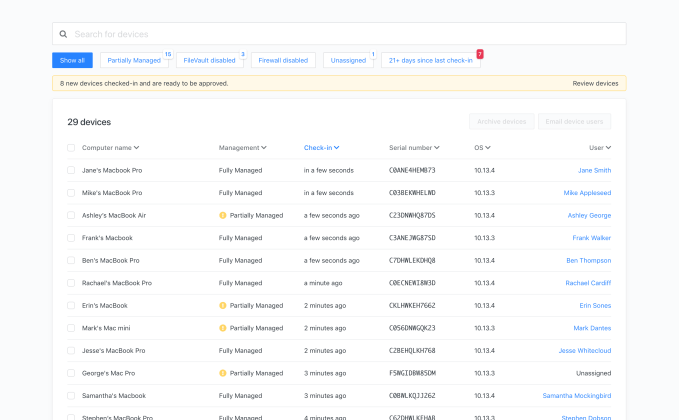
Fleetsmith device admin console. Photo: Fleetsmith

The company takes advantage of the Device Enrollment Program, a business device management service offered by Apple to simplify provisioning of Apple products. As long as the IT administrator is enrolled in DEP, you can use Fleetsmith, Blum explained. An employee can then order a laptop (or any device), and when they connect to to WiFi, it connects to Fleetsmith, which configures the device automatically.

“The really cool thing about how DEP integrates into our feature set is that as soon as the employee connects to WiFi, it take care of deployment. The account is created, software gets installed, the drive gets encrypted. It makes installing and enrolling new people really simple,” he said. Once you’re setup with everything you need installed, the admin can force critical updates, but the system will give you several warnings before installing the update.

“Fleetsmith is automation applied perfectly, handing all of the menial work to the computer so the people do less firefighting and more strategic work. This is especially important in the mid-market because the teams are leaner and every computer counts,” new board member Kanies said in a statement.

The service costs is just $99 per year per device to access the cloud service. They offer a freemium version to manage up to 10 devices at no cost. The company launched in 2016 and currently has 20 employees. Customers include HackerOne, Robinhood and Nuna.

10 Apr 2018

TPH raises a Seed round to ride the vintage clothing wave

A report by US reseller ThredUP estimates that second-hand fashion will soon overtake “fast fashion”, with an expected market worth of $41 billion USD by 2022. According to the site, in 2017 resale equated to six percent of the fashion market, with fast fashion at nine percent. By 2027 however, it’s projected to sit at 11 percent for resale and 10 percent for fast fashion. Why? Because there is a huge glut of clothes in the market, that’s why. You people are just not buying all the clothes that are being made. The trend is starting to affect big retailers. H&M has $4.3 billion worth of unsold clothing.

This is not only an environmental disaster, it’s also a huge turn-off for millenials who are cutting against the waste in the fashion industry and also looking for unique looks that go against the manufactured ‘trends’ in fast fashion.

The biggest sites in this resale space include Vestiaire and Vinted, among others. But mostly they concentrate on person-to-person sales. A new startup hopes to bring small second-hand shops into the space and has now raised a seed round to power its vision.

TPH.co connects local vintage shops with vintage fashion lovers. Vintage shops subscribe to the platform to load op their garments. TPH stands for The Pasta Haters, the idea being that people want to find original pieces, instead of bland ‘pasta fashion’.

It’s now raised $250,000 from London-based Seedcamp, Wave Ventures, STING and The Nordic Web Ventures. TPH says it has been gaining traction not just among fashion-loving customers but among stores as well.

The site is the brainchild of Lisa Gautier, who was previously with Outfittery (Curated shopping for men) and FYNDIQ (Bargain superstore) and was recently joined by cofounder Maki Kobayashi. Gautier says: “At TPH.co we’re reshaping the way you consume fashion, keeping your closet unique and environmentally friendly. The fact that we attracted investors from four different countries perfectly reflects and supports the international ambition and opportunity for TPH.”

Seedcamp’s Carlos Eduardo Espinal, comments, “We were hugely impressed from the moment we met Lisa by the global market potential for TPH, the promising early traction the business has experienced to date, and the social impact of the business.”

Anton Backman from Wave Ventures says: “Cool, trendy and ecological, not to mention global from day one. TPH and Lisa are tapping a huge underserved niche of vintage lovers that is growing year by year.”

10 Apr 2018

Interiors marketplace eporta raises $8M, led by Canvas Ventures

In this day and age of higher expectation in offices, sourcing your furniture from Ikea no longer cuts the proverbial mustard. But the furniture industry is notoriously old fashioned, forcing buyers to leaf through hundreds of paper catalogues, most of which are outdated by the time you get around to ordering. The global design and furniture industry is worth $700 billion, and yet most of its processes for customers are stuck in a previous age. Wouldn’t it be better if someone digitised those manufacturer catalogues, and allowed you to order direct, cutting out the middle-men?

This is what eporta is. This London-based B2B interior marketplace startup, has now raised $8 million in a series A funding round led by US investor Canvas Ventures. It also includes venture capitalists LocalGlobe, Oxford Capital Partners, Talis Capital, Samos Ventures, as well as angel investors Guy Hands, Ed Wray (co-founder, Betfair), Rohan Blacker (founder, sofa.com), Simon Kain (co-founder of Zoopla) and Will Cooper (founder, Achica.com).

Founded in 2015, eporta allows interior designers, architects, property developers, offices and other businesses to find and purchase furniture pieces directly from manufacturers around the world online. The Hilton Hotel Group, Accenture, Ted Baker, and Charlotte Tilbury are included amongst its clients.

Eporta lists over 1,000 sellers in 55 countries and over 10,000 buyers in 85 countries. The idea is that companies that purchase items on eporta can expect to save up to 50% off retail pricing. eporta’s revenue model enables suppliers to pay a low commission to utilise the platform. The service is free for buyers to sign up to, with best pricing guaranteed.

The startup was founded by Manchester-born and Oxford University-educated Aneeqa Khan who previously led strategy at property marketplace Zoopla and oversaw its £919 million IPO in June 2014. Her technical cofounder is Simon Shillaker, a friend from university.

Khan said: “Our manufacturer base is now the largest global database of manufacturers online for trade.” And she says small interior designers can use the service, as well as larger businesses. “If you are someone who has a project — it could be a commercial project or a residential project — if you’re using eporta you’re going to find the best pieces and you’re going to have more selection than you would do anywhere else in the world.”

Recent projects include a large office fit-out for Accenture (where they worked with Studio Jenny Jones interior design practise), the start-up make-up brand Charlotte Tilbury who worked with them to fit out their new space, and Ted Baker’s property development arm on a range of projects.

10 Apr 2018

Where to watch Zuckerberg’s Senate testimony live

Today, Facebook CEO Mark Zuckerberg will begin two of the most publicly scrutinized days of his career.

This afternoon, members of the Senate will hear from Zuckerberg on data use, protection and privacy in the midst of the Cambridge Analytica scandal and Russian election meddling. While Zuckerberg’s prepared statement has already been released to the public, there are plenty of lingering questions to be answered.

We’ll be watching diligently and bringing you all the breaking news and analysis from the hearing. But if you want to watch along yourself, here’s what you need to know:

The hearing begins at 2:15 pm ET.

It’s a joint hearing held by the Senate Judiciary Committee and Senate Committee on Commerce, Science and Transportation.

The hearing will be live streamed right here.

10 Apr 2018

Google Home and Google Home Mini smart speakers go on sale in India

Google’s two smart speaker products — the Google Home and Google Home Mini — and its Pixel 2 and Pixel 2 XL smartphones are now available in India following a launch event in the country.

The devices are priced at Rs 9,999 ($154), and Rs 4,499 ($69), respectively, and Google confirmed that they are available for purchase online via Flipkart and offline through over 750 retailer stores, including Reliance Digital, Croma and Bajaj Electronics.

The Google smart speakers don’t cater to India’s multitude of local languages at this point, but the U.S. company said that they do understand “distinctly” India voices and “will respond to you with uniquely Indian contexts,” such as answering questions about local sport, cooking or TV shows.

For a limited time, Google is incentivizing early customers who will get six months of Google Play Music alongside offers for local streaming services Saavn and Gaana when they buy the Home or Home Mini.

Google Home and Home Mini were first announced at Google I/O in 2016. The company said recently that it has sold “tens of millions” of speakers, with more than seven million sales between October 2017 and January 18.

Still, it’s been a long time coming to India, which has allowed others to get into the market first. Amazon, which is pouring considerable resources into its India-based business to battle Flipkart, brought its rival Echo smart devices to India last October.

10 Apr 2018

Alan raises $28.3 million for its health insurance of the future

French startup Alan closed a $28.3 million Series A round a few months ago. Index Ventures is leading the round, Xavier Niel is participating as well as existing investors CNP Assurances, Partech and Portag3 Ventures LP.

Alan wants to make health insurance as simple as subscribing to a software-as-a-service product. It starts with clear pricing and transparent reimbursement policies. For instance, you can cover a 30-year-old employee for €55 per month.

The price will be exactly the same for all types of companies. The only thing that changes is that you’ll pay a bit less for younger employees and more for older employees. Each employee can choose to cover their significant other for the same price, and their kids for an extra €40 per month.

And then, Alan is following the startup playbook. The overall user experience is much nicer than the interface of a traditional health insurance.

You get a modern dashboard where you can control and view all your health expenses, a mobile app and good customer support. You can also add life insurance from CNP Assurances from the same interface.

This simple promise seems to be working quite well as Alan now covers 7,000 employees across 850 companies. As you can see, the startup has been focusing on small companies as it’s easier to make them switch.

Alan co-founder and CEO Jean-Charles Samuelian also told me that small companies are underserved by big insurance companies. There’s no reason you should pay more because you work for a small company.

With today’s funding round, Alan wants to offer the same product at scale. The company plans to grow from 22 employees right now to 80 employees by December 2018.

“The goal is to reach €100 million in annual recurring revenue as quickly as possible,” Samuelian told me. The startup currently generates between €5 and €6 million in annual recurring revenue.

Eventually, Alan wants to expand beyond France and address other European markets. While the U.S. seems like a big market, it’s already quite crowded. Samuelian thinks there will be a bigger opportunity by building a European company. It’ll take quite a bit of time as regulation is different in each European country.

Recently, Alan has been focused on building a solid infrastructure, optimizing processes and automating tasks. In many ways, Samuelian still thinks about Alan as a tech company. “We want to build the Apple or Google of Europe,” he said.

Alan can beat competitors on price and flexibility by building a tech product that actually works — that’s how you can serve 7,000 people with a lean team.

Disclosure: I share a personal connection with an executive at CNP Assurances.

10 Apr 2018

Stringify relaunches to automate the Comcast smart home

Stringify, an IFTTT-like app that lets consumers control and automate their smart home devices, was quietly snatched up by Comcast last fall to join the company’s larger efforts involving the smart home and the Internet of Things. Today, in its first major update post-acquisition, Stringify is relaunching its app with a new look-and-feel, deeper integrations with Comcast’s services, as well as support for new hardware devices.

Comcast had wanted its own entry point into smart home management that would not only allow the company to compete with popular voice platforms like Amazon Echo, Google Home and Apple’s HomePod, but also help better position its own services – like TV and internet – as essential pieces to the smart home experience.

Stringify is helping with that. You can think of the app as something like IFTTT – the automation service that lets you create automatic routines that are triggered by various events. But in Stringify’s case, there’s a bigger focus on automating the smart home.

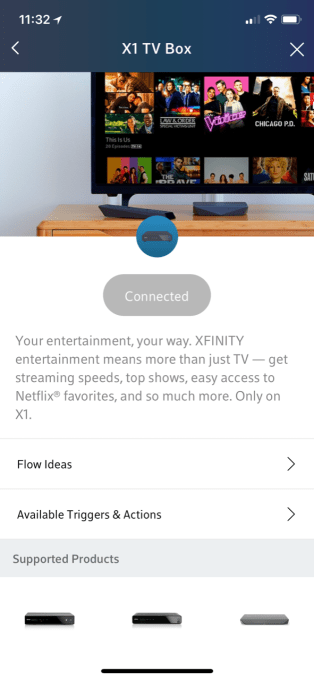
With today’s relaunch of Stringify, the app is now integrated with Comcast’s TV platform, X1, as well as its newer personalized home Wi-Fi offering, xFi.

That means Comcast users can connect their smart home devices – and their notifications – to their TVs, and create their own automated routines that run when certain events trigger them.

For example, you could schedule family movie nights and have the TV channel changed automatically while dimming the lights, Comcast suggests. You could automate pausing the home’s Wi-Fi at dinnertime, or get an alert on your TV when a connected camera detects motion outside. And even without smart home devices, you can do things like get a reminder to close the garage door when it gets windy, or display your commute time at 7 AM, the company also says.

In addition to the Comcast integrations, Stringify also now works with Lutron Caseta dimmers and switches, Serena shades, and Carrier’s line of Cor WiFi thermostats. At the time of the acquisition, Stringify was already working with over 500 products, so this just adds a few more.

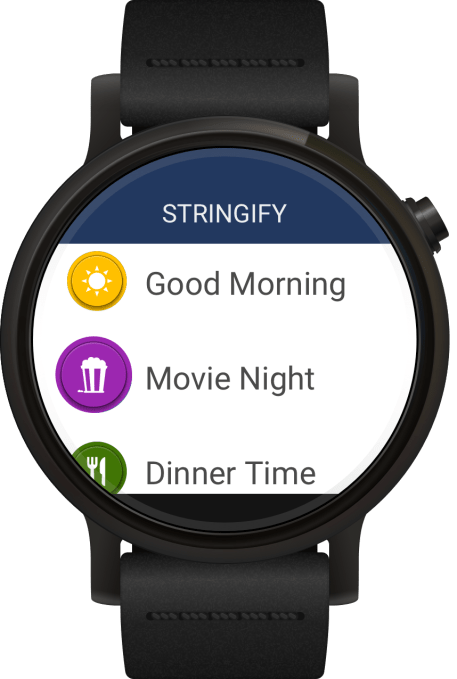
Comcast had announced at CES 2018 that it would soon bring the Stringify technology to its own services, like X1 TV and xFi Wi-Fi. Also launching today is Stringify’s first Android Wear watch app that lets you activate your scenes – like “coming home” or “going to bed” with a tap on your watch screen.

Stringify’s releaunch comes at a time when smart home automation is becoming more advanced. Both Google Home and Amazon Alexa now support “routines” that will kick off a series of actions when you speak a voice command. However, Stringify is not yet integrated with the X1 voice remote for kicking off its own routines (called “flows”) through voice commands. That means it’s not a replacement for voice platforms like Alexa or Google Assistant in terms of managing the smart home.

“What we love about the Stringify app is that it has a tremendous community of smart, devoted users who are on the leading edge of automation technology,” said Sri Solur, Senior Vice President, Xfinity Home and IoT Products, Comcast Cable. “So, the development we do here plays a big role in our broader effort to create powerful new home automation experiences for our Xfinity customers.”

Stringify, which is now sporting a more Xfinity-like interface, is available for download on iOS and Android.