
10 Apr 2018

Tribe combines arcade games with group video chat

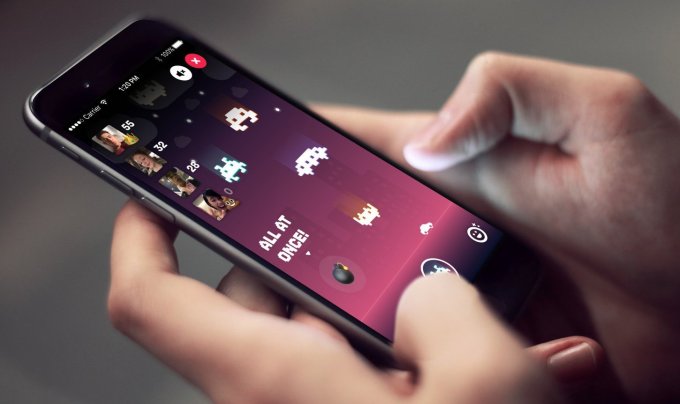
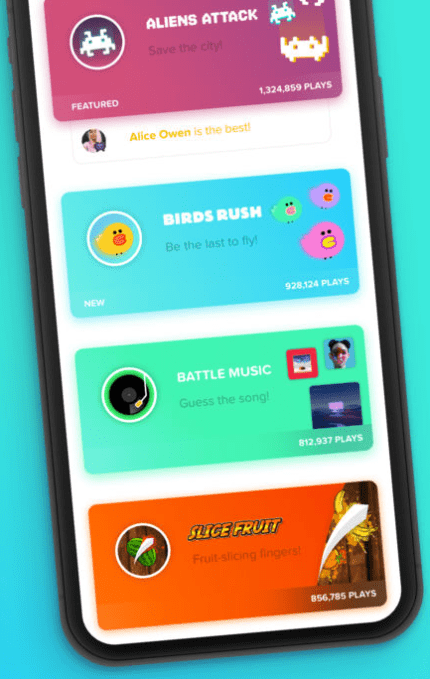
Sick of chatting but want to stay connected? Tribe‘s app lets you play clones of Space Invaders, Flappy Bird, Fruit Ninja, Name That Tune and more while video chatting with up to 7 friends or strangers. Originally a video messaging app, Tribe failed to gain traction in the face of Snapchat and Facebook Messenger. But thanks to a $3 million funding round led by Kleiner Perkins in June, Tribe had the runway to pivot into video chat gaming that could prove popular, even if not in its app.

“As we all know, Messaging is a super crowded area” says Tribe co-founder Cyril Paglino. “If you look closely, very few communication products have been blowing up in the past three years.” Now, he says “we’re building a ‘Social Game Boy.'”
A former breakdancer, Paglino formed his team in France before renting a “hacker house” and moving to San Francisco. They saw traction in late 2016, hitting 500,000 downloads. Tribe’s most innovative feature was speech recognition that could turn a mention of “coffee” into a pre-made calendar request, a celebrity’s name into a link to their social media accounts, locations into maps, and even offer Spotify links to songs playing in the background.

The promise of being the next hit teen app secured Tribe a $500,000 pre-seed from Kima and Ludlow Ventures in 2015, a $2.5 million seed in 2016 led by prestigious fund Sequoia Capital, and then the June 2017 $3 million bridge from KPCB and others. But that $6 million couldn’t change the fact that people didn’t want to sign up for a new chat app when their friends were already established on others.
Luckily, Tribe saw a new trend emerging. Between HQ Trivia’s rise, the Apple App Store adding a Gaming tab, celebrities like Drake streaming their gameplay, and Snapchat acquiring 3D gaming engine PlayCanvas, the Tribe team believed there was demand for a new way to play.

Tribe’s rebuilt iOS and Android apps let you rally a crew of friends or join in with strangers to play one of its old school games. You’ll hear their voices and see their faces in the corner of the screen as everyone in your squad vies for first place. It’s like Houseparty’s group video chat, but with something to do. Facebook Messenger has its own gaming platform, but the games are largely asynchronous. That means you play separately and merely compare scores. That’s a lot less fun than laughing it up together as one of your buddies runs their race car off the road or gets attacked by an alien.

The only problem is that since your friends probably aren’t on Tribe already, the app is vulnerable to cloning by its bigger competitors. Paglino cited technical challenges his team has overcome, its young demographic, and lessons learned from 18 months of iterations as what could keep Tribe from being easily co-opted. But as even public companies like Snapchat have learned, it can be tough to stay ahead of tech giants like Facebook with huge development teams, plenty of cash, and apps that are already popular.
Tribe’s games are legitimately fun, and the video chat makes them feel a lot more like hanging out with friends and less like a waste of time. Even if Tribe isn’t the one to make mobile group video chat gaming ubiquitous, it could see its idea entertain millions…just in someone else’s app.
09 Apr 2018

Department of Energy hosts competition to train cyber defense warriors

From leaked passwords to identity theft, cybersecurity issues are constantly in the news. Few issues though are as important — or as under-reported by the media — as the security of America’s industrial control infrastructure. Oil rigs, power plants, water treatment facilities and other critical infrastructure are increasingly connecting to the internet, but often without the kinds of foolproof security systems in place to ensure bad actors can’t gain access or disrupt service delivery.

This is a growing area of the economy with a wealth of jobs, but few students even realize that industrial and infrastructure cybersecurity is an interesting career path. So, over the past three years, the Department of Energy has hosted a Cyber Defense Competition to encourage university students to engage in the field. The latest incarnation of the completion was held this past weekend and hosted by Argonne, Pacific Northwest, and Oak Ridge national laboratories.

Lewis University won the competition this year in a total field of 25 entrants. That is up from 15 teams last year, and 9 teams in the inaugural competition.

Nate Evans leads the program at Argonne, and explained to me the design of the competition. Teams get a month before the competition to learn how to defend industrial control systems against hackers. Each team is given a small industrial control system that emulates a real-world model.

Then on the day of the competition, those teams compete and run the operations of the model infrastructure as the cyber defense team. A red team cell tries to hack the system, while a green team of regular, nontechnical people do the normal work of using the system, such as answering emails or responding to requests.

Evans explained that they “add in the usability piece as well, so they’re trying not just trying to defend against the red team but keeping usability.“ Six times an hour, a request to the team comes in, such as a new feature desired by the CEO. The idea is to simulate as closely as possible the conditions of a real piece of industrial infrastructure and forcing the team to project manage different priorities.

Teams are allowed to build anything they want to defend their system. “We try to make it as flexible as possible and so they can bring whatever skills they have,” Evans said. We want the teams to “come out and try new things such as a custom operating system that they wrote in the class,” he explained, “or some crazy firewall or setup or design.”

Since each of the three labs hosting the competition is on ES Net, the Energy Sciences Network that connects all labs in the U.S., the competition can be conducted in real-time across all locations, and lasts about eight hours. Lewis University won the national award, while University of Central Florida, Oregon State University, and University of Memphis won first place regional awards.

09 Apr 2018

First look at Instagram Nametags, its clone of Snapchat QR codes

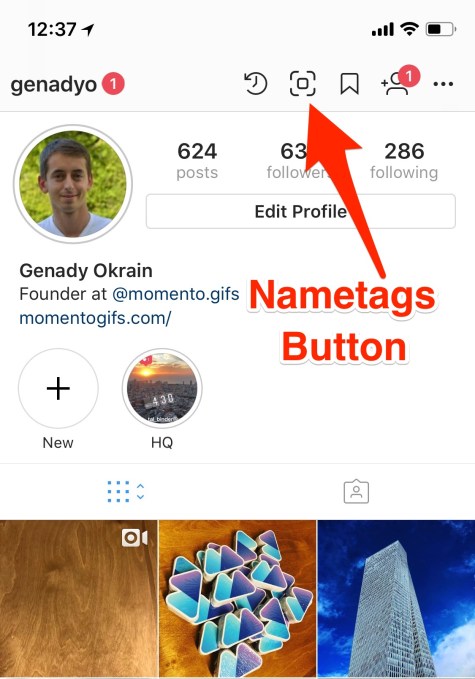
Instagram is preparing to launch a feature called Nametags that lets you create a special image that people can scan with the Instagram Stories camera to follow you. TechCrunch broke the news of Nametags code in Instagram’s Android APK last month. But now thanks to reader Genady Okrain we have screenshots and more details of the Instagram Nametags feature.

Nametags could make it easier for people to visually promote their Instagram account. It could make it simple to follow a friend you just met by having them open their Nametag and then you scanning it. Meanwhile, businesses and social media stars could post their Nametag across other social media handles, print it onto posters or handbills, or even make merchandise out of it.
We’ve asked for comment from Instagram and will update here if we hear back. Instagram’s been spotted doing a flurry of feature development lately. TechCrunch has reported that code for a Instagram Video Calling feature was found in its Android APK. Meanwhile, it’s testing Portrait mode feature called Focus.

Once users have access, they’ll be able to hit a QR scanner button on their profile to bring up the Nametag editor. They can then choose from a purple Instagram color gradient background, a pattern of one emoji they choose, or a selfie they can jazz up with augmented reality face filters that then becomes an emoji pattern. The user’s Instagram username appears in the center. For now, users in the test group can’t share or scan Nametags. But the code we discovered explains that users can scan them to follow people.

Snapchat launched its own Snapcodes that work similarly in January 2015, meaning Instagram took its time copying this feature. But with social media stars and businesses banished to Snapchat’s Discover channel, those accounts might be looking to prioritize promoting their Instagram accounts. If creators find it easier to build an audience on Instagram and get more engagement there, they could give the Facebook-owned app their first-run content. The eventual launch of Nametags could give them one more reason to use Snapchat copycat Instagram Stories instead of the original.

For more on upcoming Instagram features, check out our other stories on Focus and Video Calling

09 Apr 2018

DOJ issues 93-count indictment against Backpage over sex ads

Last week, online classified site Backpage.com was suddenly replaced with a warning noting that it had been seized by the FBI. The move was abrupt, but not exactly a surprise for a site that’s been mired in controversy for years.

The Justice Department had previously acknowledged the move, but it’s shedding more light on the 93-count federal indictment. It’s a laundry list of activities for which you definitely don’t want to get busted by the DOJ, including,

Crimes of conspiracy to facilitate prostitution using a facility in interstate or foreign commerce, facilitating prostitution using a facility in interstate or foreign commerce, conspiracy to commit money laundering, concealment money laundering, international promotional money laundering, and transactional money laundering.

Defendants include Michael Lacey, whose home was the subject of the FBI raid, and fellow co-founder James Larkin, both of whom were also the subject of warrants during a 2016 raid on the site’s Dallas headquarters.

Jeff Sessions didn’t mince words on this one.

“For far too long, Backpage.com existed as the dominant marketplace for illicit commercial sex, a place where sex traffickers frequently advertised children and adults alike,” the attorney general said in a statement tied to the news. “But this illegality stops right now. Last Friday, the Department of Justice seized Backpage, and it can no longer be used by criminals to promote and facilitate human trafficking.”

The 61-page indictment spells out the offending ads in black and white, adding that “By 2008, if not earlier, the Backpage defendants were aware that the overwhelming majority of the website’s ‘adult’ ads involved prostitution. Nevertheless, the Backpage defendants made a financial decision to continue displaying those ads.”

The filing goes on to explain that the site’s owners wouldn’t delete the offending ads altogether, for fear of being put in the “uncompetitive” position of a Craigslist.

The raid, incidentally, came roughly a week after Craigslist pulled its own personals, for fear of repercussion as Fight Online Sex Trafficking Act (FOSTA) passed both the House and Senate. That bill has been criticized by sex workers and internet rights activists for the onus it puts on sites hosting third-party content.

09 Apr 2018

Conserve the Sound is an archive of noises from old tape players, projectors and other dying tech

All of us grew up around tech different from what we have today, and many of us look back on those devices with fondness. But can you recall the exact sound your first Casio keyboard made, or the cadence of a rotary phone’s clicks? Conserve the Sound aims to, well, conserve the sound of gadgets like these so that future generations will know what it sounded like to put a cartridge in the NES.

It’s actually quite an old project at this point, having been funded first in 2013, but its collection has grown to a considerable size. The money came from German art institution Film & Medienstiftung NRW; the site was created (and is maintained) by creative house Chunderksen.

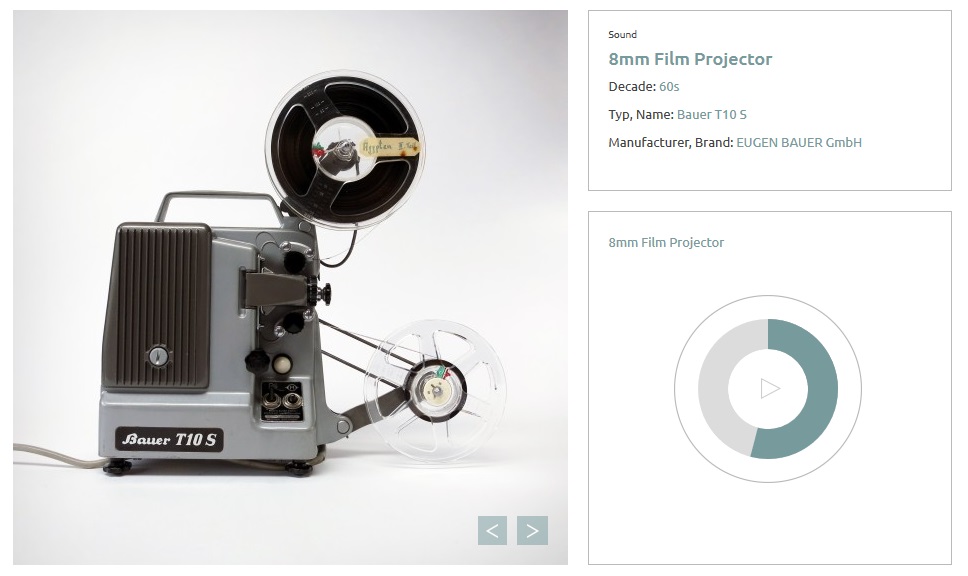
The whole thing is suitably minimal, much like an actual museum: You find objects either by browsing randomly or by finding a corresponding tag, and are presented with some straightforward imagery and a player loaded with the carefully captured sound of the device being operated.

Though the items themselves are banal, listening to these sounds of a bygone age is strangely addictive. They trigger memories or curiosity — was my Nintendo that squeaky? Didn’t my rotary phone click more? What kind was it anyway? I wonder if they have my old boombox… oh! A View-Master!

The collection has grown over the years and continues to grow; it now includes interviews with experts in various subjects on the importance of saving these sounds. You can even submit your own, if you like. “We welcome suggestions in general, sound suggestions, stories, anecdotes and of course collaborations,” write the creators.

I for one would love to revisit all the different modems and sounds I grew up using: 2400, 9600, 14.4, 28.8, all the way up to 56.6. Not exactly pleasant noises, admittedly, but I anticipate they will bring back a flood of memories, Proust-style, of BBSes, hours-long download times and pirated screen savers.

09 Apr 2018

What Zuckerberg’s congressional testimony doesn’t say

There’s a lot of keen analytical hindsight on display in Facebook chief executive Mark Zuckerberg’s written testimony to Congress ahead of his appearance at hearings on Wednesday, but nothing that indicates Facebook is ready to come to terms with the problems rotting the core of the social network.

The bulk of Zuckerberg’s opening statement is an historical analysis of the events of the past two years that have bruised the company’s reputation and share price.

Zuckerberg is defending his company on two fronts as he faces down the members of Congress that could regulate his company out of existence — user privacy and platform integrity.

In the testimony, Zuckerberg highlights the initial steps that Facebook has taken to close down access for third parties and to do more to combat fake accounts and the spread of misinformation.

These steps constitute what are now Zuckerberg’s usual assurances… Facebook is sacrificing its own profits to develop new tools and hire new personnel to combat bad actors that would leverage Facebook’s user information for their own fun and profit. Facebook has taken steps before the U.S. election to root out bad actors and will take even more steps now — since those initial efforts weren’t enough.

Near the close of his written testimony, Zuckerberg writes: “I want to be clear about what our priority is: protecting our community is more important than maximizing our profits.”

What Zuckerberg’s testimony fails to mention, as ever, is whether users themselves will ever be protected from Facebook.

Ultimately Facebook’s scandal is about how much the company knows about its users and how much power those users then have to control how Facebook applies (or shares) its knowledge.

As Wired columnist Zeynep Tufekci pointed out in a column this weekend, that’s been Facebook’s problem since the company’s inception.

By now, it ought to be plain to them, and to everyone, that Facebook’s 2 billion-plus users are surveilled and profiled, that their attention is then sold to advertisers and, it seems, practically anyone else who will pay Facebook—including unsavory dictators like the Philippines’ Rodrigo Duterte. That is Facebook’s business model. That is why the company has an almost half-a-trillion-dollar market capitalization, along with billions in spare cash to buy competitors.

All of the steps that Facebook is taking now to “make sure what happened with Kogan and Cambridge Analytica doesn’t happen again” only achieve one thing — consolidating Facebook’s control over the user data that it can make available to its customers.

The policies just reduce the funnel of information that application developers, advertisers and others can freely access (the emphasis here is on free). For those who want to pay the company for the information — there’s no guarantee that it won’t be used in some way.

As Tufekci writes, Facebook is a surveillance engine — that’s the core of its business and the sale of that surveillance to bidders is the way that it functions to connect its “community.” And protecting that community is a good way to also protect Facebook’s profits.

The problem for Facebook begins with the platform itself — and Zuckerberg’s designs for it. And it won’t be solved with a single congressional hearing.

To pre-empt Congressional questioning and change the conversation, Zuckerberg could have offered solutions for Facebook to proactively address the problems that bedevil it — beyond the adoption of the One scenario that could free Facebook from the advertising chains that ostensibly bind it to being a digital surveillance state is the introduction of a subscription service (as my colleague Josh Constine suggested earlier this year).

For regulators looking at potential legal solutions, the application of GDPR standards across the entire Facebook platform would be a step in the right direction. Zuckerberg has committed to it, but his company has a history of failing to live up to its promises to users. Perhaps Congress will find a way to convince Facebook’s chief to help the company keep its word… and avoid another apology tour.

09 Apr 2018

Congress should demand Zuckerberg move to ‘one share, one vote’

Mark Zuckerberg is an autocrat, and not hypothetically. Through his special voting rights held in Facebook’s Class B shares, he wields absolute command of the company, while owning just a handful of percentage points of the company’s equity.

Like any autocrat, he has taken extraordinary measures to maintain control over his realm. He produced a plan exactly two years ago that would have zeroed out the voting rights for everyday shareholders with a new voteless Class C share, only to pull back at the last minute as a Delaware court case was set to begin. He has received the irrevocable proxies of many Facebook insiders, allowing him to control their votes indefinitely. Plus, any Class B shares that are sold are converted to Class A shares, allowing him to continue to consolidate power as people leave.

And now, borrowing a page straight out of George Orwell’s 1984, he has even tried to retract and disappear his own messages to others on his platform (which has now been retracted itself after it became public).

While Congress is right to focus on Cambridge Analytica, and electoral malfeasance, and political ads, and a whole crop of other controversies surrounding Facebook, it should instead direct its attention to the single solution that would begin to solve all of this: dissolve Facebook’s dual-class share structure and thereby democratize its ownership.

Just as congressmen are elected under the principle of “one man, one vote,” it should demand that Facebook follow the highest standards used by most other publicly listed companies and return to “one share, one vote.”

Zuckerberg himself should certainly agree with this. After all, the original logic of creating a voteless share class was that the company’s financial performance was strong and Zuckerberg needed to be protected to continue it that way. The plan was announced the same quarter that Facebook crushed its financial results, and there was an absolutely implied connection between those results and the controlling stake held by Zuckerberg.

Yet in the two months, from its intraday peak at a share price of $195.32 on February 1, 2018 to today’s price of $160, Facebook has lost more than $100 billion in its market cap. If Congressional inquiries eventually lead to further regulation, it could further erode the value of the stock. It’s easy to argue that a chief executive should be protected when the performance of a company is rocketing up. It’s much harder when everything is crumbling and no one is being held accountable.

Shareholders may have been blinded by Facebook’s dizzying growth over the past few years, but we now know that the edifice of that growth is far more tenuous than we ever knew before. Zuckerberg’s 15-year apology tour can no longer sustain the view that corporate governance should be ignored for the good of the share price.

There’s just one problem though, and it is the problem that confronts any country with a tyrant: shareholders have no power here to affect change. They can’t change the composition of the board, they can’t change the management team. They can’t change anything at all, because one person controls the realm with an iron fist. A proposal back in 2015 to move to “one share, one vote” was struck down at Facebook’s shareholder meeting.

I am not asking for Zuckerberg to be fired, or to resign. I think people should clean up their own messes, and few people have the means to clean up Facebook right now other than him. But I do think there should be consequences, and so far, there have been exactly zero. Zuckerberg has to personally relinquish his control, and no act of mea culpa would better show that he understands the consequences of his actions.

There is a counter-argument, which is that ravenous mobs of private investors would swoop into Facebook and force the company to steal even more data from users to sell to advertisers if Zuckerberg lost control. I am wholly unconvinced though, mostly because Facebook has basically done precisely that over its entire history. Plus, any further deterioration of trust with users would strike at the heart of its financial results.

Zuckerberg says in his prepared statement that, “My top priority has always been our social mission of connecting people, building community and bringing the world closer together.” There are few things he could do to build the community around Facebook’s leadership than sharing the burdens and the responsibilities with a wider, more diverse set of people. Take a page from American history, and abolish the discrimination inherent in the dual-class share vote.

09 Apr 2018

Apple says its global facilities are now powered by 100-percent clean energy

Last week, Apple called out the Environmental Protection Agency’s plan to rollback the Obama-era Clean Power Plan. The company cited both the obvious environmental impact of such a move, along with potential economic fallout.

It turns out Apple’s got quite a bit invested in the latter.  The company announced today that its global facilities are now 100-percent run by renewable energy.

The move is in line with the company’s 2015 plan to push toward 100-percent renewable energy, a list that includes all of Apple’s data centers as of 2014. As of today, the company’s officially adding retail stores, offices and co-located facilities to that list, covering 43 countries, including the US, China, UK and India.

The addition of nine manufacturing partners, meanwhile, brings the total number up to 23 suppliers promising to produce their products entirely with clean energy. How the companies involved actually hit these numbers is, unsurprisingly, somewhat more complex.

“Where feasible, we produce our own renewable energy by building our own renewable energy facilities, including solar arrays, wind farms, biogas fuel cells, and micro-hydro generation systems,” the company writes in its 2017 Environmental Responsibility Report. “Where it’s not feasible to build our own generation, we sign long-term renewable energy purchase contracts, supporting new, local projects that meet our robust renewable energy sourcing principles.”

The push toward renewable energy has included some creative solutions, including 300 solar rooftops in Japan and 800 in Singapore. The company says it’s currently running 25 renewable energy projects globally, with 15 more in the process of being built. That will bump green energy capability from 626 megawatts to 1.4 gigawatts, by its count — and the finally tally doesn’t appear to include carbon offsets, unlike some of the competition. 

It’s easy to see how a rollback of the Clean Power Plan could ultimately have an averse effect on the company’s bottomline.

“We’re committed to leaving the world better than we found it. After years of hard work we’re proud to have reached this significant milestone,” Tim Cook said in a release tied to the news. “We’re going to keep pushing the boundaries of what is possible with the materials in our products, the way we recycle them, our facilities and our work with suppliers to establish new creative and forward-looking sources of renewable energy because we know the future depends on it.”

09 Apr 2018

HQ Trivia finally gets social with ‘Friends on HQ’ update

The popular quiz startup HQ Trivia is beginning to roll out the first of many new social features to its app focused on leveraging competition with friends and family during game time.

HQ Trivia has managed to bring people together in real life to play the game on their phones, but the startup has done surprisingly little when it comes to bringing social interactions to the app itself. Today, HQ is launching a new feature called “Friends on HQ,” which will roll out to U.K. users for today’s game, with a U.S. launch to follow “soon after,” the company says.

The feature lets users search for and connect with friends and family inside the app. Once users connect, they’ll be able to keep track of how everyone is doing and which friends of theirs are playing in any given quiz match. It’s a very easy move for HQ that adds some familial familiarity to the game’s battle royale quiz format.

Building these connections will be important to strengthening its core group of players, which has grown to the millions. HQ Trivia has begun chasing sponsorship deals with companies like Warner Bros. and Nike. As the startup looks to experiment more with monetization, having a user base that is devoted enough to deal with some of these changes will be essential.

This update is far from a one-off and seems to signify a shift for the app. According to a spokesperson, “this update forms the basis of a variety of new features that HQ will be rolling out soon, leveraging friends’ connections.”

09 Apr 2018

PayPal to roll out banking products for the ‘unbanked’ in the weeks ahead

PayPal is expanding into traditional banking through partnership with smaller banks to offer consumers debit cards connected to their PayPal accounts, along with direct deposit for paychecks and other services, according to news the company shared with The Wall St. Journal. The company says its new products are targeted specifically at the unbanked, and will launch in the first half of 2018, following consumer testing.

As PayPal itself is not a bank, it’s been working with other banking partners behind the scenes to offer these new services. For example, a Delaware bank issues the debit cards and a Georgia bank helps with photo deposits of checks.

There are some small fees involved with using PayPal’s banking services, including ATM fees for withdrawals from those not in PayPal’s MoneyPass network, and 1 percent of any check deposited via a photo from a smartphone. However, it won’t charge monthly fees or require minimum balances.

Traditional banking customers may not want to pay for things like check deposits, but the lower fees will appeal to those who usually go to payday lenders, and don’t have regular bank accounts, the company tells us.

“We’re trying to bring more of those people into the digital economy,” Bill Ready, EVP and Chief Operating Officer at PayPal, tells TechCrunch. “For folks who don’t have bank accounts, for folks who don’t have credit and debit cards, we want to give them something so they’re not turning to prepaid cards, check cashiers and payday lenders.”

He says there are billions of people in the world without bank accounts, including some 30 million in the U.S. These people spend nine-and-half percent of their income on interest and fees from alternative financial services, he notes.

PayPal today already offers consumers a debit card (PayPal’s Cash card) for loading accounts with cash at retailers, as one way of serving the underbanked or unbanked user base. There’s also the PayPal prepaid MasterCard linked to PayPal customer accounts and other credit products.

The new banking products won’t be tied to a yet another debit card, but will be offered to existing prepaid card holders – something that wasn’t detailed in the original report.

The banking services have quietly been in testing with select consumers over the past several months, Ready says, and will begin rolling out publicly in the “weeks and months” ahead. They will certainly be live in the first half of 2018, he confirms.

PayPal will determine the best candidates for the new banking products, based on how customers are already using its services.

“For the consumers already in our base that we see using things like loading cash directly onto a PayPal account in retail locations…we’ll reach out directly,” he says. In some “banking deserts,” it may also invest in out-of-home advertising to reach those people without as many options.

The company is not alone in targeting those underserved by mainstream banks.

Amazon was recently cited as having discussions with banks regarding its own possible launch of consumer-facing banking services. Meanwhile, Square’s Cash app has been doling out bank cards to its users, as has its rival, the PayPal-owned Venmo. There are also digital banking services like Simple, Chime, and Varo Money, for example, which take advantage of new technology to address consumer needs, while having accounts backed by traditional banking partners. (Or in the case of Simple, owners – given BBVA’s acquisition of the service years ago.)

However, many of these existing digital banking efforts are targeting younger consumers, including millennials, who prefer to use apps to manage their money, save, and even invest. And if they get a card at all, they opt for debit over credit, studies have found.

But PayPal says it’s not going after millennials with its new products, just the “unbanked” population in general.

“The [banked and unbanked] divide isn’t necessarily along generational lines…those that are unbanked don’t have access to traditional financial services. We’re giving them a pathway to the digital economy,” Ready says.